
Category: General

  • Heartburn is pain in the solar plexus

    Maybe some of us have felt burning and pain in the chest. Sinaumed’s need not panic. This condition is normal and common. However, if it occurs repeatedly to the point that it interferes with daily activities, it must be taken seriously by professionals.

    Launching from the Alodokter.com page, heartburn is pain in the pit of the stomach that occurs in the middle of the chest or just above the stomach. This discomfort is often accompanied by the appearance of a bitter and sour taste in the mouth. These symptoms have the potential to become worse after a large meal or while lying down.

    Please note that hearburn is not related to the heart ( heart ). The cause of hearburn is stomach acid rising into the esophagus. That, which causes a burning feeling in the upper abdomen or lower chest.

    Heartburn occurs when the ring-shaped muscle ( sphincter ) that is part of the valve between the esophagus and stomach cannot tighten or close normally. Which, this muscle ring should be able to contract after food from the esophagus enters the stomach.

    Summarizing from the Alodokter.com page, heartburn triggers include the following.

    • Eat in an amount that exceeds the capacity of the stomach.
    • Eating spicy food.
    • There is pressure on the stomach, usually due to pregnancy, constipation, or obesity.
    • Consuming caffeine, make citrus, alcohol, or chocolate.
    • After eating immediately lie down.
    •  
    • Take certain medications, such as aspirin or ibuprofen.
    • Stress and lack of sleep.

    Symptoms of heartburn vary from person to person. However, the most common signs are a burning sensation in the chest and throat. Launching from the Hallosehat.com page, here are the common symptoms of heartburn.

    • Feeling pain or burning in the chest. This condition usually occurs after eating or at night.
    • Pain in the chest when lying down, bending down, or eating.
    • Bitter or sour taste in the mouth.
    • Often awakens from sleep.
    • Burning feeling in the throat.
    • There is liquid that feels like it will come out of the throat.
    • Very extreme chest pain.
    • Difficulty breathing
    • Difficulty swallowing when eating.
    • Excessive headache.
    • Heartburn occurs several times a week.
    • Nausea and vomiting, even after taking over-the-counter medications.
    • Vomiting blood, or passing blood when urinating.
    • Decreased ability to taste, causing weight loss.

    Pain in the chest that indicates a hearburn and a heart attack is difficult to distinguish. Both have similar markings. The age of the sufferer is also similar, that is, both in adulthood or people with excess body weight.

    To differentiate between a hearburn and a heart attack, Sinaumed’s can look at the areas of the body where the pain is. When the pain is only felt under the ribs and the top of the stomach, it is included in heartburn.

    Other symptoms that often occur are a sour taste in the mouth, wanting to vomit, or a burning feeling in the throat, especially after eating. Meanwhile, symptoms of a heart attack can be felt starting from cold sweats, shortness of breath, dizziness, and chest pain that is pressing and radiating to the shoulders, neck or back.

    Causes of Hearburn

    Under normal conditions, there is a muscle under the esophagus that acts as a barrier for stomach acid to go up into the esophagus. The muscle works by expanding and closing when swallowing food or drink.

    However, when these muscles weaken, stomach acid can rise back up into the esophagus, causing a burning sensation in the chest. This condition can cause heartburn. Launching from the Hallosehat.com page, here are the causes of heartburn.

    1. Food and Drinks

    Food and drink have an influence on the strength of the lower esophageal muscles. Preferably, Sinaumed’s avoid spicy, fatty and sour foods.

    2. Burden or Pressure on the Stomach

    When the stomach and esophageal muscles are stressed, they have the potential to weaken and cause stomach acid to rise. Sinaumed’s need to be careful when doing strenuous exercise, coughing too hard, being overweight, and pregnant. These things can trigger excess burden or pressure on the stomach.

    3. History of Disease

    The state of health of each individual also affects the occurrence of heartburn. Several diseases such as hiatal hernia, diabetes and other autoimmune diseases (scleroderma, CREST syndrome and Raynaud’s phenomenon) are associated with heartburn.

    4. Body Position

    When lying down, the lower esophagus muscles will weaken. Especially after eating. This can trigger stomach acid to flow back into the esophagus more easily.

    5. Lifestyle

    An unhealthy lifestyle has the potential to cause heartburn. Such as smoking, drinking drinks that contain alcohol, often consuming caffeine, and other things that trigger stomach acid to rise to the esophagus.

    6. Certain Drugs

    Several types of drugs have the potential to weaken the performance of the muscles below the esophagus. When Sinaumed’s is undergoing heart, asthma, blood pressure treatment, the risk of experiencing heartburn will be higher.

    Foods and Drinks that Trigger Hearburn

    Every food and drink that enters the body affects the health of the body. Launching from the Hallosehat.com page, here is a list of foods that can trigger heartburn.

    1. Spicy Food

    Spicy foods contain capsaicin which can slow down the digestive process and increase the risk of heartburn. Not only that, spicy food can also injure the esophagus. This can make chest pain worse.

    2. Fatty Foods

    Fat in food can weaken the lower esophageal muscles by stimulating the release of the hormone cholecystokinin (CCK). This has the potential to cause stomach acid to easily rise.

    3. Mint

    The notion that peppermint and spearmint can relieve digestive problems is a misconception. In fact, research has shown that consuming too much mint can injure the esophagus and worsen heartburn.

    4. Food and Beverages Containing Citrus

    In a study involving 400 heartburn sufferers, it was shown that 73% felt heartburn symptoms after drinking orange juice. However, there is no further explanation regarding the link between citrus and can cause heartburn.

    5. Fizzy Drinks

    Drinks or foods that contain soda can increase stomach acid levels and weaken the esophageal muscles.

    6. Chocolate

    Chocolate contains caffeine, serotonin, and theobromine which have the potential to cause the lower esophageal muscles to weaken.

    7. Coffee

    Coffee contains high caffeine. This can trigger an increase in stomach acid and heartburn.

    8. Bombay onions

    The increase in stomach acid is not only caused by food or drinks that contain caffeine or soda. Onions can also increase stomach acid levels. This is due to the presence of fiber contained in onions.

    9. Alcohol

    Alcohol can trigger stomach acid to rise, especially wine and beer. Both types of drinks can increase stomach acid levels and injure the esophagus.

    Hearburn Treatment and Prevention

    When Sinaumed’s visits the doctor to check for heartburn , he will usually be advised to change his diet, certain diets, lifestyle, or be prescribed certain drugs. However, if you are not sure whether your hearburn is acute enough and injures other organs, several tests will usually be carried out.

    Launching from the Hallosehat.com page, here are several types of tests carried out to see if there is damage to other organs.

    1. Gastrointestinal Endoscopy

    Gatrointestinal endoscopy is performed by inserting a small camera through the mouth. The goal is to see the state of the esophageal wall. This test will show the causes and complications of heartburn.

    2. Esophageal manometry

    An esophageal manometry test is performed to determine if the function of the esophagus is normal or not. This test will be done when the endoscope test does not show any complications. However, the patient still complained of pain.

    3. X-ray

    X-ray images are used to see the esophagus and chest clearly.

    4. Ambulatory Acid Probe

    An ambulatory acid probe is performed to detect the time it takes for stomach acid to rise up to the esophagus.

    Handling heartburn can use several types of drugs including the following.

    • Antacids to neutralize stomach acid quickly.
    • H2–receptor antagonists (H2RA) or H2 receptor antagonists can reduce the amount of stomach acid produced and relieve pain.
    • Proton pump inhibitors (PPIs) or proton pump inhibitors such as lansoprazole and omeprazole.

    Sinaumed’s can prevent heartburn through a healthy lifestyle. Here are some tips for maintaining fitness and body health.

    1. Maintain Weight

    Controlling body weight so as not to be obese is one way to prevent heartburn. One of the ways is to run a diet that is safe and according to doctor’s recommendations.

    2. Avoid Overeating

    It’s better to eat small portions and often than to eat large portions once in a while.

    3. Wear clothes that are not too tight

    Shirts and pants that are too tight can put excess pressure on the stomach. This has the potential to cause stomach acid to rise and a burning feeling in the chest.

    4. Sports

    Exercise helps to control weight and maintain overall health.

    5. Avoid Eating Before Bed

    A stomach that is too full before going to bed can cause stomach acid to rise into the esophagus.

    6. Changing the Meal Menu

    Avoid fatty, spicy foods, soft drinks, coffee, chocolate, and so on.

    7. Don’t lie down after eating

    After eating do not lie down. At least wait until 3 hours after eating if you want to lie down. The digestive process will be disrupted if you lie down immediately after eating, let alone eat large portions.

    8. Avoid Smoking and Alcoholic Beverages

    Cigarettes and alcoholic beverages can trigger stomach acid to rise. Therefore, avoiding cigarettes and alcoholic beverages can suppress heartburn and maintain a healthy body.

    Stomach Acid and Heartburn are Different

    When the pit of the stomach hurts, it does not only indicate heartburn. This could indicate stomach acid or gastroesophageal reflux disease  (GERD). GERD itself is a condition that can cause pain in the pit of the stomach,  heartburn,  and various other symptoms in the lower chest and stomach area.

    A person with GERD will experience mild acid reflux, at least twice a week. Meanwhile, they also have the potential to experience severe disturbances, at least once a week. Therefore, medication and/or lifestyle changes are needed to reduce the intensity of stomach acid.

    In general, a person who experiences increased stomach acid is characterized by a sour or bitter taste in the mouth, a burning or burning sensation in the chest and solar plexus. These symptoms will get worse when the patient bends over, after eating, or lying down.

    Launching from the  Alodokter.com page. GERD symptoms do just that. Here are some other symptoms that can accompany GERD.

    • Respiratory problems, such as coughing and shortness of breath. People who have asthma will often relapse when GERD symptoms recur.
    • Hoarseness.
    • Nausea and vomiting.
    • Sore throat.
    • Expulsion of stomach contents involuntarily.
    • Difficulty swallowing or feeling like you have a lump in your throat.
    • Sleep disorders.
    • Bad breath.
    • Tooth decay due to frequent exposure to stomach acid.

    GERD is often confused with a heart attack. This is because both of them cause a burning sensation in the chest and pain in the pit of the stomach. However, the two can still be distinguished.

    A heart attack is characterized by heartburn or chest pain that is so severe that it radiates to the neck, arms or jaw, and appears after physical activity.

    Meanwhile, GERD is characterized by heartburn accompanied by a sour taste in the mouth. It is not exacerbated by physical activity. It also doesn’t spread to the neck or arms, and it gets worse when you lie down.

    Meanwhile, how to deal with stomach acid or GERD, as published on the  Alodokter.com  page as follows.

    • Lose weight, if you are overweight.
    • Do not smoke.
    • Elevates head while sleeping.
    • Do not lie down or sleep for at least 2 to 3 hours after eating.
    • Avoid foods or drinks that trigger acid reflux, spicy and fatty foods, chocolate, mint and coffee.
    • Don’t wear clothes that are too tight.


  • Health Effects of Benzene: Exposure Limits and Routes of Exposure

    Health Effects of Benzene – Benzene is an organic compound with the chemical formula C 6 H 6 . The benzene molecule is composed of six carbon atoms bonded in a ring, with one hydrogen atom attached to each carbon atom. Because benzene contains only carbon and hydrogen atoms, it is classified as a hydrocarbon.

    Benzene is a natural constituent of crude oil and one of the essential petrochemicals. Because the ring has continuous pi bonds between the carbon atoms, benzene is classified as an aromatic hydrocarbon, [n]-anulene ([6]-anulene). Benzene is sometimes abbreviated as PhH. Benzene is a colorless, highly flammable and sweet-smelling liquid. Its presence gives a distinctive aroma at gas stations.

    Its main use is as a precursor to manufacture chemicals with more complex structures, such as ethylbenzene and cumene, which are produced annually by billions of kilograms. Because benzene has a high octane number, gasoline (bbm) contains its aromatic derivatives such as xylene and toluene up to 25%. Benzene itself has been limited to less than 1% in gasoline because it is known to be a human carcinogen. Its non-industrial applications have been limited for the same reasons.

    Benzene is found in trace amounts in petroleum and coal. It is a by-product of incomplete combustion of most materials. For commercial use, until World War II, most of the benzene was obtained as a by-product of coke production for the steel industry.

    However, in the 1950s, when there was increasing demand for benzene, especially from the growing polymer industry, it became necessary to produce benzene from petroleum. Today, most of the benzene comes from the petrochemical industry, with only a small part being produced from coal.

    Use of Benzene

    The main use of benzene is as an intermediate for making other chemicals, most notably ethylbenzene, cumene, cyclohexane, nitrobenzene and alkylbenzenes. More than half of benzene production is processed into ethylbenzene, the precursor to styrene, which is used to make polymers and plastics such as polystyrene and EPS.

    Some 20% of benzene production is used to make cumene, which is required in the production of phenol and acetone for resins and glues. Cyclohexane accounts for about 10% of world benzene production; mainly used in the manufacture of nylon fibers, which are processed into textiles and engineering plastics.

    Small amounts of benzene are used to make several types of rubber, lubricants, dyes, detergents, drugs, explosives, and pesticides. In 2013, the largest benzene consuming country was China, followed by the United States. Benzene production is currently expanding in the Middle East and Africa, while production capacity in Western Europe and North America is stagnant.

    Toluene is currently often used as a substitute for benzene, for example as a fuel additive. The dissolving properties of the two are similar, but toluene is less toxic and has a wider range of liquid phases. Toluene is also processed into benzene.

    Benzene Health Effects

    Benzene is classified as a carcinogen, which increases the risk of cancer and other diseases, and is also a major cause of bone marrow failure. A large body of epidemiological, clinical, and laboratory data links benzene to aplastic anemia, acute leukaemia, bone marrow disorders, and cardiovascular disease. Specific haematological malignancies associated with benzene include acute myeloid leukemia (AML), aplastic anemia, myelodysplastic syndromes (MDS), acute lymphoblastic leukemia (ALL), and chronic myeloid leukemia (CML).

    The American Petroleum Institute (API) stated in 1948 that “it is generally considered that the only absolutely safe concentration of benzene is zero”. There is no safe level of exposure; even a small amount can cause damage. The US Department of Health and Human Services (DHHS) classifies benzene as a human carcinogen.

    Long-term exposure to excessive levels of benzene in the air causes leukemia, a potentially fatal cancer of the blood-forming organs. In particular, acute myeloid leukemia or acute nonlymphocytic leukemia (AML & ANLL) are undoubtedly the result of benzene exposure. The IARC ranks benzene as “known to be carcinogenic to humans” (Group 1).

    Because benzene is ubiquitous in gasoline and ubiquitous used hydrocarbon fuels, human exposure to benzene is a global health problem. Benzene attacks the liver, kidneys, lungs, heart and brain and can cause damage to DNA strands, damage to chromosomes, etc. Benzene causes cancer in animals, including humans. Benzene has been shown to cause cancer in both sexes in several species of laboratory animals exposed by various routes.

    Benzene exposure

    According to the Agency for Toxic Substances and Disease Registry (ATSDR) (2007), benzene is a chemical that is produced anthropogenic and occurs naturally from processes including volcanic eruptions, wild fires, synthesis of chemicals such as phenol, production of synthetic fibers, and manufacture of rubber, lubricants, pesticides, drugs, and dyes.

    The main sources of exposure to benzene are tobacco smoke, car service stations, motor vehicle exhaust and industrial emissions. However, benzene can also be ingested and absorbed through the skin due to contact with contaminated water. Benzene is metabolized by the liver and excreted in the urine.

    Measurement of benzene levels in air and water was carried out by collecting them through activated charcoal tubes, which were then analyzed by gas chromatography. Measurement of benzene in humans can be done through urine, blood and breath tests. However, all of these have limitations because benzene is metabolized rapidly in the human body. Exposure to benzene can progressively cause aplastic anemia, leukemia, and multiple myeloma.

    OSHA regulates benzene levels in the workplace. The maximum permissible amount of benzene in the workspace air for an 8-hour workday, 40-hour week is 1 ppm. Because benzene can cause cancer, NIOSH recommends that all workers wear special breathing equipment when they are likely to be exposed to benzene at levels in excess of the recommended exposure limit (8 hours) of 0.1 ppm.

    Benzene Exposure Limits

    The United States Environmental Protection Agency (US EPA) has determined the maximum contamination level (MCL) for benzene in drinking water to be 0.005 mg/L (5 ppb), as promulgated through the US Primary Drinking Water Regulations.

    This regulation is based on the prevention of benzene leukemogenesis. The maximum contaminant level goal (MCLG), a non-enforceable health goal that will allow an adequate margin of safety for the prevention of adverse effects, is a zero concentration of benzene in drinking water. The EPA requires reporting a minimum of 10 pounds (4.5 kg) of benzene spills or accidental releases into the environment.

    The U.S. Occupational Safety and Health Administration (OSHA) has set a permissible exposure limit of 1 part benzene per million parts air (1 ppm) in the workplace for an 8-hour work day, 40 hours per week. The short-term exposure limit for benzene in air is 5 ppm for 15 minutes.

    These legal limits are based on research showing strong evidence of health risks for workers exposed to benzene. The risk of exposure to 1 ppm for years of service has been estimated as 5 excess leukaemic deaths per 1,000 exposed employees (this estimate has no threshold for the carcinogenic effect of benzene). OSHA has also set an action level of 0.5 ppm to encourage lower workplace exposures.

    The US National Institute for Occupational Safety and Health (NIOSH) revised the Immediately Dangerous to Life and Health (IDLH) concentration for benzene to 500 ppm. The current NIOSH definition of an IDLH condition, as given in the NIOSH Respirator Selection Logic, is one that poses a threat of exposure to an airborne contaminant when that exposure is likely to cause death or immediate or delayed permanent health effects or prevent escape from an environment [NIOSH 2004].

    The purpose of assigning IDLH values ​​is (1) to ensure that workers can escape from a contaminated environment in the event of failure of respiratory protective equipment and (2) to be considered the maximum level above that permitted only for highly reliable respirators providing maximum worker protection. . [NIOSH 2004].

    In September 1995, NIOSH issued a new policy to develop recommended exposure limits ( RELs ) for substances, including carcinogens. Because benzene can cause cancer, NIOSH recommends that all workers use special respirators when they are susceptible to exposure to benzene at levels exceeding the REL (10-hour) 0.1 ppm. The NIOSH short term exposure limit (STEL – 15 minutes) is 1 ppm.

    The American Conference of Governmental Industrial Hygienists (ACGIH) adopted Threshold Values ​​(TLV) for benzene at 0.5 ppm TWA and 2.5 ppm STEL. Regulation of the Minister of Health of the Republic of Indonesia No. 70 of 2016 concerning Standards and Requirements for Industrial Work Environment Health requires a Threshold Value (NAV) for benzene of 0.5 ppm TWA and 2.5 ppm STEL.

    Benzene Toxicology

    1. Exposure Biomarkers

    Several tests can determine exposure to benzene. Benzene can be measured by inhalation, blood or urine, but such tests are usually limited to the first 24 hours after exposure because of the rapid removal of benzene by exhalation or biotransformation. Most people in developed countries have a baseline level of benzene and other aromatic hydrocarbons in their blood.

    In the body, benzene is enzymatically converted to a number of oxidation products including muconic acid, phenylmercapturic acid, phenol, catechol, hydroquinone, and 1,2,4-trihydroxybenzene. Most of these metabolites are of value as biomarkers of human exposure, as they accumulate in the urine in proportion to the duration and degree of exposure.

    In addition, they also persist for several days after exposure has stopped. The ACGIH biological exposure limits for occupational exposure are 500 μg/g creatinine for muconic acid and 25 μg/g creatinine for phenylmercapturic acid in end-of-shift urine specimens.

    2. Biotransformation

    Although not a common substrate for metabolism, benzene can be oxidized by bacteria and eukaryotes. In bacteria, the enzyme dioxygenase can add oxygen to the ring, and the unstable product is immediately reduced (by NADH) to a cyclic diol with two double bonds, destroying its aromaticity. Furthermore, the diol is reduced by NADH to catechol. The catechol is then metabolized to acetyl CoA and succinyl CoA, which are used by organisms primarily in the Krebs cycle for energy production.

    The metabolic pathway for benzene is quite complex and begins in the liver. Several enzymes are involved in it. These include cytochrome P450 2E1 (CYP2E1), quinine oxidoreductase (NQ01 or DT-diaphorase or NAD(P)H dehydrogenase (quinone 1)), GSH, and myeloperoxidase (MPO). CYP2E1 is involved in many steps: the conversion of benzene to oxepine (benzene oxide), phenol to hydroquinone, and hydroquinone to benzenetriol and catechol.

    Hydroquinone, benzenetriol and catechol are converted to polyphenols. In the bone marrow, MPO converts these polyphenols into benzoquinones. These intermediates and metabolites induce genotoxicity through various mechanisms including inhibiting topoisomerase II (which maintains cell structure and organization), generating oxygen free radicals (unstable species) that trigger mutations, increasing oxidative stress, inducing DNA strand breaking, and DNA methylation graying (Fig. that can affect gene expression). NQ01 and GSH alter metabolism from toxicity. NQ01 metabolizes benzoquinones to polyphenols (counteracts MPO effect). GSH is involved in the formation of phenylmercapturic acid.

    Genetic polymorphisms in these enzymes can lead to loss of function or gain of function. For example, mutations in CYP2E1 increase activity and result in an increase in toxic metabolites. NQ01 mutations result in loss of function and can lead to decreased detoxification. Mutations of myeloperoxidase result in loss of function and can lead to decreased formation of toxic metabolites. GSH mutations or deletions result in loss of function and result in decreased detoxification. These genes may be targets of genetic screening for susceptibility to benzene toxicity.

    3. Molecular Toxicology

    The paradigm of toxicological assessment of benzene is shifting towards the domain of molecular toxicology as it enables a better understanding of fundamental biological mechanisms. Glutathione appears to play an important role by protecting against benzene-induced DNA damage and is being identified as a new biomarker for its exposure and effects.

    Benzene causes chromosomal aberrations in peripheral blood leukocytes and bone marrow which explains the high incidence of leukemia and multiple myeloma caused by chronic exposure. These deviations can be monitored using fluorine in situ hybridization (FISH) with DNA quarts to assess the effect of benzene together with haematological tests as markers of hematotoxicity.

    Benzene metabolism involves enzymes encoded by polymorphic genes. Studies have shown that genotype at this locus can influence susceptibility to the toxic effects of benzene exposure. Individuals carrying the NAD(P)H variant: quinone oxidoreductase 1 (NQ01), microsomal epoxide hydrolase (EPHX) and deletion of glutathione S-transferase T1 (GSTT1) showed a greater frequency of single-stranded DNA breaks.

    4. Biological Oxidation and Carcinogenic Activity

    One way to understand the carcinogenic effects of benzene is to examine the products of biological oxidation. Pure benzene, for example, oxidizes in the body to produce an epoxide, benzene oxide, which is not excreted easily and can interact with DNA to produce dangerous mutations.

    Benzene Exposure Routes

    1. Inhalation

    Outdoor air may contain low levels of benzene from auto repair shops, wood smoke, tobacco smoke, gasoline transfers, motor vehicle exhaust, and industrial emissions. Approximately 50% of total exposure to benzene nationally (United States) comes from smoking tobacco or from exposure to tobacco smoke. After smoking 32 cigarettes per day, the smoker will consume about 1.8 milligrams (mg) of benzene. This amount is about 10 times the average daily intake of benzene by non-smokers.

    Most of the inhaled benzene is exhaled in its original form through exhalation. Human studies show that 16.4% to 41.6% of retained benzene is excreted via the lungs within five to seven hours, after exposure to 47 to 110 ppm for two to three hours, and only 0.07% to 0 The remaining .2% of benzene is excreted in its natural form in the urine.

    After exposure to 63 to 405 mg/m 3 of benzene for 1 to 5 hours, 51% to 87% is excreted in the urine as phenol within 23 to 50 hours. In another study, 30% of benzene absorbed through the skin, which is mainly metabolized in the liver, was excreted as phenol in the urine.

    2. Exposure to Soft Drinks

    Under certain conditions and in the presence of other chemicals, benzoic acid (a preservative) and ascorbic acid (Vitamin C) may interact to produce benzene. In March 2006, the Food Standards Agency in the United Kingdom conducted a survey of 150 soft drink brands. It found that four contained benzene at levels above the limits set by the World Health Organization (WHO). The affected group (English: batch ) was withdrawn from circulation. A similar problem was reported by the FDA in the United States.

    3. Contamination of Water Supply

    In 2005, the water supply to the Chinese city of Harbin, with a population of nearly nine million people, was stopped due to exposure to large amounts of benzene. Benzene leaked into the Songhua river, which supplies drinking water to the city, after an explosion at a China National Petroleum Corporation (CNPC) factory in Jilin city on November 13, 2005.

    4. Injection

    The Nazis used injected benzene as one of several methods of assassination.

  • Happy Prayers: When Traveling, The Afterlife, and 10 Manners of Prayer in Islam

    Congratulations Prayer –For Muslims, praying to Allah SWT is something that must be done before carrying out any activity. Starting from eating, sleeping, studying, even going in and out of the bathroom, there are prayers that must be said in order to get the pleasure of Allah SWT. Allah SWT really likes His servant who always prays all the time, because that means his heart still remembers the name of Allah SWT as God Almighty. The meaning of these prayers, besides asking for smoothness by Him, can also be a prayer to avoid any distress. That is why, Rasulullah SAW also often reminds his people to always pray for safety in this world and the hereafter. So, how do you read prayers for congratulations, both before starting a long journey and praying for safety in this world and the hereafter? Come on, see the following review so thatSinaumed’s can practice these prayers and become a true Muslim who adheres to religion.
    How to Pray for a Safe Journey?

    In Islam, it is highly recommended to always pray before starting any activity, including when going on a long or short trip. Even when we are about to leave the house, there is also a special prayer that must be said to Him, so that we will always be under His protection. Just a little trivia , when in the middle of a trip, Sinaumed’s can also recite a prayer in the form of surah Al-Ikhlas. Reporting from jabar.nu , here are some prayers for congratulations when you want to travel both near and far.

    When Leaving the House

    If you want to travel a short distance, surely the time difference between entering the house and leaving the house is only a moment. Even so, Sinaumed’s as a Muslim also still has to recite prayers in and out of the house.

    ( Bismillâhi tawakkaltu ‘alallâhi wa lâ haula wa lâ quwwata illâ billâhil ‘aliyyil ‘adhîm )

    Meaning: “In the name of Allah, I place my trust in Allah. There is no power and strength except with (the help of) Allah.”

    When Entering the House

    After traveling, both long and short distances, when you want to enter the house it is recommended to recite a prayer.

    It means:

    “O Allah, I really ask You for the goodness of entry and exit, by saying Your name we enter, by saying Your name we go out, and only in Allah, our Lord, we put our trust.”

    While on a break from a long journey

    When traveling long distances, for example in the context of going home on Eid, Sinaumed’s and his family will definitely rest first. Usually, this break is done in a rest area or restaurant where you eat with activities in the form of prayer, rest, and eating lunch that has been prepared beforehand. So, while taking a break from this long trip, Sinaumed’s, don’t forget to read a prayer of congratulations

    ( A’udzu bi kalimaatillahit taammaati min syarri maa khalaq)

    Meaning: “I seek refuge in Allah’s perfect sentence from the evil of His creation.”

    When You Arrive at Your Destination

    When you reach your destination after traveling far or near, people usually say Hamdalah. That ‘s okay , because it means they are expressing gratitude for all the blessings that have been given by Allah SWT. But it turns out, there is a safe prayer for Muslims that can be read when you arrive at your destination. Here’s the prayer.

    ​​​​​​Allaahumma innii as aluka lhairohaa wa khaira Profesionalhaa wa khoiro maa fiihaa wa a’uudzubika min syarri haa wa syarri Profesionalhaa wa syarri maa fiihaa.

    Meaning: “O Allah, I ask You for the good of this country and the good of its inhabitants and the good that is in it. I seek refuge in You from the evil of this land and the evil of its people and the evil that is in it.”

    How to Pray Congratulations When Riding a Vehicle?

    In our sophisticated era, to travel to a destination, whether at a short or short distance, it is rare to walk. Most of us, of course, use vehicles, whether by air, land or sea transportation. So, when you want to get on this vehicle, Sinaumed’s also has to recite a prayer of congratulations.

    Generally, when you want to get on a vehicle to travel, you can recite the following prayer.

    (Alhamdulillahilladzī/subhanalladzī sakhkhara lanā hādzā wa mā kunnā lahū muqrinīna, wa innā ila rabbinā lamunqalibūna)

    Meaning: “Praise be to Allah/glorify God who has subjected all this to us. Even though we weren’t able to control it before. Indeed, we will return to our Lord.”

    Air Vehicle

    When we want to travel by means of air transportation, for example an airplane, we still have to pray to Him, OK? This is mandatory, especially for Muslims, so that they are given safety to their destination. Well, reported from orami , here is the prayer.

    Congratulations Prayer When Using the Long Version of the Air Vehicle

    (Allahu Akbar, Allahu Akbar, Allahu Akbar, Subhanalladzi sakhkhoro lana hadza wa maa kunnaa lahu muqrinin, wa innaa ilaa robbinaa lamunqolibuun, allahumma inna nas’aluka fii safarinaa hadzal birro wat taqwa wa minal ‘amal maa tardho, allahumma hawwin ‘alaina safarona hadza wa athwi ‘annaa ba’dahu, allahumma antas shohibu fis safari wal kholifatu fil expert, allahumma inni a’udzubika min wa’tsaais safari wa kaabatil mandzhori wa suuil munqolibi fil maali wal expert)

    Meaning: “God is Great, God is Great, God is Great. Glory be to Allah who has subdued this (plane) for us, whereas before we were not able to control it, and verily to Allah we return.

    O Allah, indeed we ask for goodness and piety in this journey, we ask for deeds that are pleasing to You. O Allah, make this journey easy for us, and make it shorter for us.

    O Allah, You are my companion in traveling and taking care of the family. O Allah, I seek refuge in You from fatigue in traveling, sad sights and a bad return in wealth and family.”

    Prayer of Congratulations When Using a Short Version of an Air Vehicle

    (Allahumma hawwin ‘alainaa safaranaa hadzaa wathwi ‘annaa ba’dahu allahumma anta ash shohibu fissafari wal khalifatu fil-ahl)

    Meaning: “O Allah, make this trip easy for us, and make the distance closer. O Allah, who accompanies you when traveling, and you also protect your family.”

    Land Vehicles

    Land vehicles are the most widely used means of transportation by people around the world to travel, both long and short distances. That’s why, when traveling using land transportation, you still can’t forget the reading of congratulations, OK ?

    Prayer of Congratulations When Using a Long Version of a Land Vehicle

    (“Bismillah

    Alhamdulillah

    (Subhaanal-ladzii sakh-khoro lanaa haadzaa wa maa kunnaa lahuu muqriniin. Wa innaa ilaa robbinaa lamunqolibuun), 

    Alhamdulillah (3x), 

    Allahu Akbar (3x), 

    Subhanaka inni zhalamtu nafsi, faghfirli, fa innahu la yaghfirudz-dzunuba illa anta”)

    Meaning: “In the name of Allah, all praise be to Allah, Glory be to the Lord who has subjected this vehicle to us, even though we were previously unable to control it. And indeed we will return to our Lord (on the Day of Judgment). Praise be to Allah (3x), Allah is the Greatest (3x), Glory to You O Allah, indeed I have wronged myself, so forgive me. Indeed, no one forgives sins except You.” (Reported by Abu Dawud and Tirmidhi).

    Congratulations When Using a Short Version of Land Vehicles

    ( Subhanallazi sakhorolana hadza wa ma kunna lahu muqrinin, wa innaa ilaa robbinaa lamunqolibuun)

    It means:

    “Glory be to Allah who facilitates this (vehicle) for us and we have nothing to associate with Him, and verily we will return to our Lord.”

    Marine Vehicles

    Did Sinaumed’s ever take sea transportation in the form of a ship during a study tour when he was in school? Or even Sinaumed’s want to do the study tour at this time? If so, don’t ever forget to always recite the reading of the prayer of congratulations

    Congratulations When Using the Long Version of the Sea Vehicle

    Reporting from islam.nu , there is a prayer that we can pray as a prayer for congratulations when traveling by sea vehicle. This prayer is actually taken from the prayer recited by Prophet Noah when he boarded his ark during a flash flood.

    (Bismillahi majrêha wa mursâhâ, inna rabbî la ghafûrur rahîm, (Hud ayat 41). Wa mâ qadarullâha haqqa qadrihî, wal ardhu jamî’an qabdhatuhû yaumal qiyâmah, was samâwâtu mathwiyyâtum bi yamînihî, subhânah yurikû wa ta’âlâ ‘an m -Zumar verse 67).

    Meaning: “Noah said, ‘Go up into it all of you by mentioning the name of Allah when sailing and anchoring.’ Truly my Lord is truly Forgiving, Most Merciful,’ (Sura Hud verse 41). They did not magnify God with the glory that they should. Whereas the earth is entirely in His hand on the Day of Judgment and the heavens will be rolled up with His right hand. Glory be to God and Most High is He from what they associate,” (Sura Az-Zumar verse 67).

    Congratulations When Using the Long Version of the Sea Vehicle

    (Bismillahi majreehaa wa mursaahaa inna robbii laghofuurur rohiim)

    It means:

    “In the name of Allah who runs this vehicle sails and anchors. Verily, my Lord is Most Forgiving, Most Merciful.”

    How is the Prayer for the Happy World and the Hereafter?

    Prayer is not only intended so that the activities we do are given smoothness by Him, but also so that we remain safe both in this world and the hereafter. This safety is also not only aimed at ourselves, but also with our families and even property. Reporting from jabar.nu , there are a number of prayers for the survivors of the afterlife that Sinaumed’s can pray anytime and anywhere so that they can still receive safety from Allah SWT.

    Prayers Congratulations and Refuse Bala

    (Allȃhummaftah lanȃ abwȃbal khair, wa abwȃbal baraka, wa abwȃban ni’mah, wa abwȃbar rizqi, wa abwȃbal quwwah, wa abwȃbas shihhah, wa abwȃbas salȃmah, wa abwȃbal ‘ȃfiyah, wa abwȃbal jannah. Allȃhumma ‘ȃfinȃ min kulli balbal’id dunyȃ wa ‘adzȃbil ȃkhirah, washrif ‘annȃ bi haqqil Qur’ȃnil ‘azhȋm wa nabiyyikal karȋm syarrad dunyȃ wa ‘adzȃbal ȃkhirah. Ghafarallȃhu lanȃ wa lahum bi Rahmatika Yȃ arhamar rȃhimȋn. , walhamdulillȃhi rabbil ‘ȃlamȋn) 

    It means:

    “O Allah, open for us the doors of goodness, the doors of blessings, the doors of enjoyment, the doors of sustenance, the doors of strength, the doors of health, the doors of safety, the doors of afiyah, and the doors of heaven. O Allah, save us from all the trials of this world and the torment of the hereafter. Turn us away from the ugliness of the world and the torment of the hereafter with the rights of the great Qur’an and the degree of Your merciful prophet. May Allah forgive us and them. O Most Merciful One. Glory be to your Lord, the Lord of majesty, from all that they attribute. May greetings go to the apostles. Praise be to Allah, Lord of the Worlds” (See Perukunan Melayu, [Jakarta, Alaydrus: undated], pages 55-56).

    Prayers for the World and the Hereafter

    (“Rabbana atina fiddunya hasanah wa fil-akhirati hasanah, waqinaa adzaabannaar.”)

    Meaning: “O our Lord, give us goodness in this world and goodness in the hereafter. And protect us from the torment of hell.”

    Prayers Congratulations on Religion, Fortune, Grace, and Forgiveness from Allah SWT

    (“Allahumma inna nas-aluka salamatan fiddin wa afiyatan fil-jasadi wa ziyadatan fil-ilmi wa barakatan firrizqi, wa repentance qablal-maut, wa Rahmatan indal-maut, wa maghfiratan ba’dal-maut. Hawwin alaina fi sakaratil-maut, wannajata minannari, wal-afwa indal-hisab.”)

    Meaning: “O Allah, we ask You for religious safety, bodily health, increased knowledge, blessings of sustenance, getting repentance before death, receiving grace when dying, receiving forgiveness after death. And lighten the agony of death, and save us from the torment of hell, and get us forgiveness on the day of reckoning.”

    Understanding 10 Adab in Praying to Allah SWT

    Based on Ihya Ulumuddin by Imam Al-Ghazali and Al-Adzkar Al Muntakhabah min Kalami Sayyidil Abrar by Imam An-Nawawi, it is stated that there are 10 adabs in praying, namely.

    1. Pray at the Efficient Time

    The efficacious time means the noble time to pray to Allah SWT, for example on the day of Arafah, in the month of Ramadan, on Friday, at dawn, and the time of the last third of every night. This is also in line with the words of the Prophet Muhammad SAW:

    Allah descends into the heavens of the world every night, when the last third of the night remains. Allah says, ‘Whoever prays to Me, I grant, whoever asks, I will give, and whoever asks for forgiveness I will surely forgive’ .” (HR. Muslim)

    2. Take advantage of the Eligible Circumstances

    Apart from praying at efficacious times as previously explained, we must also take advantage of special circumstances to recite prayers. For example, when the position of prostration, when it rains, before breaking the fast, when iqamah prays, and others. Regarding this, the following hadith has been narrated.

    Abu Hurairah radhiallahu’anhu said, “Surely the gates of heaven open when jihad fi sabillillah is raging, when it rains, and when the iqamah is obligatory. Take advantage to pray at that time.” (Syarhus Sunnah al-Baghawi, 1: 327)

    The Prophet shallallahu ‘alaihi wa sallam said, “ The prayer between the call to prayer and the iqamah is not rejected. ” (Narrated by Abu Daud, Nasa’i, and Tirmidhi)

    The Prophet Muhammad SAW said, ” The closest state between a servant and his Lord is when he prostrate. So pray more .” (HR. Muslim)

    3. Facing Qibla

    When saying a prayer to Allah SWT, including the prayer of congratulations, it must still be done facing the Qibla. Don’t forget to raise your hands and rub them over your face after you finish praying. There is a hadith regarding this etiquette of praying, namely.

    From Jabir radhiallahu ‘anhu, that the Prophet Muhammad SAW when he was at Padang Arafah, he faced the Qibla, and he continued to pray until the sun set . (HR. Muslim)

    From Salman radhiallahu ‘anhu , that the Prophet Muhammad SAW said, ” Indeed your Lord is Shame and Most Giving. He is ashamed of His servants when they raise their hands to Him then his servants return empty-handed (not granted). ” (Narrated by Abu Daud and Tirmidhi and He hasan khan)

    4. Must be in a low voice and not aloud

    When praying, it’s best to do it in a low voice and don’t need to be loud. We must adjust the volume as much as possible so that it is not too loud, but also not too low. This is in accordance with the word of Allah SWT,

    Don’t harden your prayers and don’t underestimate them and find a middle way between the two. ” (QS. Al-Isra: 110)

    5. Avoid Rhyming Sentences

    When praying, it’s better not to need to use rhyming sentences because it’s feared that it will cross the line. The principle of prayer is not to overuse the words. This is in accordance with the word of Allah SWT, which states that:

    Pray to your Lord with humility and a soft voice. Verily, Allah does not like those who exceed the limits. ” (QS. Al-A’raf: 55)

    6. Done in a special way’

    Prayer must be done solemnly, with full submission and fear of Allah SWT. Realizing that we are just ordinary people who are asking something from God Almighty. This is in accordance with the word of Allah SWT,

    Verily they are the ones who always hasten in (doing) good deeds and they pray to Us with hope and anxiety. And they are people who are humble to Us. ” (QS. Al-Anbiya’: 90)

    7. Strengthen your heart and believe that you will be granted

    When reciting prayer readings to Allah SWT, we must be steady in heart and believe that the prayer will be granted by Allah SWT. This is also in line with the words of the Prophet Muhammad, which reads:

    Don’t pray when you say, ‘O Allah, forgive me if You will. O Allah, have mercy on me, if You will’. He should make up his mind, because no one forces Allah .” (Narrated by Bukhari and Muslim)

    8. Continue to Ask Allah SWT

    Praying cannot be done just once or twice, it must be continuous. For example, “O Allah, forgive Your servant, forgive Your servant…, forgive Your servant who is full of sin. forgive ya Allah….” There is a hadith that states the existence of this adab praying, namely.

    Ibn Mas’ud said, Rasulullah SAW when he prayed, he repeated it three times. And when he asked Allah, he repeated three times . (HR. Muslim)

    9. Starting with the Recitation of Dhikr

    The next adab of prayer is that you have to start reading the prayer by reciting the dhikr first. Not only dhikr, but also with praise to Allah SWT and blessings. Likewise when you want to end the prayer.

    The Prophet Muhammad SAW once said, “ You will be granted (prayers) as long as you are not in a hurry. He said, ‘I have prayed, but it hasn’t been answered ‘.” (Narrated by Bukhari and Muslim)

    10. Repentance

    The point is that when facing and asking for prayer to Allah SWT, one must also comply with all the rules of His religion.

    Reference:

    • https://jabar.nu.or.id/
    • https://mediaindonesia.com/
    • https://islam.nu.or.id/

    Also Read!

    • 15 Prayers That Can Be Read After Prayers of Hajat
    • Definition and Examples of Intercessory Prayer
    • Prayers For Parents That Can Be Practiced
    • Procedures for Wudhu and Their Intentions and Prayers
    • 8 Manners of Eating Accompanied by Prayer
    • The number of cycles and the intention of the midnight prayer
    • Prayer for the Rain to Stop
    • Understanding Ain’s Disease and Prayers to Avoid It
    • Grave Pilgrimage Prayers and Procedures


  • Hadith of Husbands Hurting Wives: A Reflection for Husbands

    Hadith of Husbands Hurting Wives: A Reflection for Husbands

    Hadith Husband Hurts Wife – As we all know, men are destined to be the head of the family. But that doesn’t mean they freely control, snap and abuse their wives.

    As long as what the wife does is not a sin, then the husband should forgive. After all, there is no perfect wife in this world.

    It’s not good to only remember the bad things your wife has done. A wife is a child willing to leave her parent’s house and ready to live with her husband.

    So it is unlawful if a husband makes his wife cry without rights and hurts his wife. This has been mentioned in the Al-Quran and Hadith.

    When a husband is unjust to his wife, he has committed a great sin, and his body is no longer prohibited from hellfire.

    Most people may think that women are the poison of the world. But it must be understood that in Islam, women are likened to world jewels.

    Women are extraordinary figures, andwho are so solid and robust in living life. But on the other hand, they can also turn out to be vulnerable and fragile.

    Because, after all, no human is perfect in this world. Don’t just remember the wrong side, but also reflect the goodness of a wife who has cared for you, served food on the table, washed your clothes, and educated your children.

    In the Al-Quran, in Surah Al-Nisa verse 19 to be precise, it explains the law of husbands who hurt their wives; the following is the meaning:

    “O you who believe, it is not lawful for you to marry women by force and do not trouble them because you want to take back a part of what you have given them, except if they do a real abomination, and associate with them appropriately.

    Then if you don’t like them, (then be patient) because maybe you don’t like something, even though Allah made it a lot of good.” (QS Al-Nisa: 19).

    Then, is there a hadith that explains about husbands hurting their wives? Of course, there is. Muslims, of course, already know that Islam is a complete religion. All things have been arranged so that Muslims can live in a directed manner and are blessed by Allah SWT, including household affairs.

    As mentioned above, in Islam, women are considered world jewels. That means women are extraordinary creatures.

    Therefore, as a husband, you must treat your wife well and not hurt your wife either physically or psychologically.

    Hadith Husband Hurts His Wife and Law

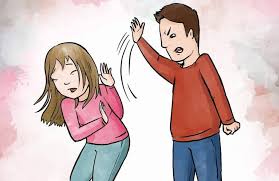
    In this world, many husbands often hurt their wives very quickly and are light on their wives when they do something wrong. Whereas in reality, problems can be solved with a cool head without hurting one of them physically.

    Instead of apologizing and not repeating it, the wife will feel suffering inside and out. What’s more, Islam strictly prohibits husbands who often beat their wives. For more details, here is one of the hadiths that husbands hurt their wives that you need to understand.

    From Jabir bin Abdullah, the Prophet said during the pilgrimage sermon:

    “Fear Allah SWT regarding the affairs of your wives, because you have taken them with a mandate from Allah SWT, and you have made lawful their farji with the words of Allah SWT, so your right over them is so that their wives do not allow people you hate to enter your house .

    If they do it then hit them with a blow that doesn’t hurt, while their right over you is that you give them their livelihood and also their clothes in a good way” (HR. Muslim: 1218)

    From the hadith above,, we can conclude that ,we are never taught to be rude to women in Islam. Because they are also humans who have soft feelings and are very fragile. They will feel tremendous pain if they are hurt even a little.

    Therefore, women should be treated well. When a woman does something wrong, don’t face it with too much anger.

    Husband Law Hurts Wife

    As we understand, the husband is the priest for his family. Allah SWT mandates the husband to be a leader for his wife and children.

    Even though the husband’s position is also the head of the household, that does not mean they can be rude to their wife at will, hurting them with harsh words, especially to the point of committing violence.

    As taught by the Prophet Muhammad SAW that a husband must always do good to his wife and not hurt his wife. Not only that, but Allah SWT also says, which means:

    “And wives have rights that are balanced with their obligations according to the honorable way.” (QS. Al-Baqarah: 228)

    Meanwhile, Ath-Tabari revealed that the verse above has a meaning about the obligation for the husband not only to provide a living but also the obligation to improve his attitude towards his wife and also not to offend his wife.

    This is done because wives have obeyed Allah SWT’s commands and obeyed their husbands well.

    Muawiyah bin Haidah once asked the Prophet SAW,

    “O Messenger of Allah, what are the rights of a wife towards her husband?” The Prophet replied, “You feed your wife when you eat, and you give clothes when you dress. Do not hit his face, do not insult him, and do not shut him up except in the house.” (HR. Abu Dawud)

    From the two arguments above, namely from the hadiths and the Koran, it is clear that the wife’s position in Islam is highly exalted. A wife should not only be burdened with obligations but also get her rights properly.

    Meanwhile, husbands also not only make a living but also have to treat their wives well and always say good things to their wives.

    Because harsh words will hurt the wife. This means the husband has violated his rights which must be fulfilled, as explained above.

    There is a hadith that states that a man who has good morals is a man who is kind to his wife. From Abdullah bin ‘Amr, he Shallallahu’alaihi wa sallam said,

    “The person whose faith is most perfect among the believers is the person who has the best morals among them, and the best of you is the one who has the best morals towards his wives.” (HR. At Tirmidhi and Ibnu Majah)

    Then, what if the wife commits a sin and violates religion?

    Allah says in Surah An-Nisa verse 34,

    “…Women whose nusyuz you worry about, then advise them, and stay away from them in bed, and beat them. If they obey you, don’t look for ways to trouble them. Verily, Allah is Most High and Most Great.”

    In verse above, we can conclude that if a wife does something that violates religion, then as a husband, he should advise his wife in good ways and words.

    If the wife cannot be advised, the husband may silence them and separate beds. If that still doesn’t work, then the husband is allowed to beat his wife, but with the condition that the beating may not cause injury and may not hit her in the face.

    In addition, husbands are not allowed to beat with sticks and other hard hard objects. The punches can be done by using the hands and not hurting. But only for lessons.

    Compared to men, women are the weakest physically and mentally creatures. Therefore, the husband should be kind to his wife because a woman’s heart is easily hurt.

    The husband must treat his wife well unless the wife commits a very heinous act. However, how to reprimand him should not hurt his wife or violence that can hurt her.

    Husband’s Sins Against Wife

    Below are various sins that husbands often commit to their wives because they neglect their obligations to them.

    1. Not Teaching Religion to Wife

    Husbands who are experts at their jobs, provide a living for their wives, and meet the various needs of their wives may have a lot. But how many husbands are willing to teach their wives and children religious knowledge?

    Even though ,this is the obligation of all husbands, it is obligatory to distance themselves and their families from the pain of the punishment of the grave and the fire of hell. Like the hadith below:

    “O you who believe, protect yourselves and your families from the fire of hell whose fuel is people and stones, the guardians are angels who are harsh, harsh and do not disobey God against what He commands them and do what they are commanded,” (QS. At-Tahrim: 6).

    2. Not Jealous of Wife

    Being jealous to an average degree can be a sign of love. So if a couple doesn’t feel jealous of their wife, they must question their love.

    Especially if the wife goes out with other men, but the partner doesn’t feel jealous. That is a big mistake made by the husband.

    “The three groups that Allah will not see on the Day of Resurrection are those who disobey both their parents, women who resemble men and ad-Dayyuts,” (HR An-Nasa’i ‘hasan’ by Sheikh Albani, see ash-Shahihah: 674).

    3. Not giving a wife a living

    Today there are many examples of husbands who do not provide for their wives. This is a big sin for husbands because giving maintenance to the wife is the primary obligation and responsibility of the husband.

    Just imagine if a wife who has sacrificed leaving her parents to live with her husband is not valued or given a living.

    This has also been explained in the hadith of the Prophet, which reads:

    “The Messenger of God said, a person is considered a sinner if he neglects the expenses of the person he is responsible for,” (HR. Abu Dawud no. 1442 CD, Muslim, Ahmad, and Thabrani).

    4. Hate Wife

    The wife is the husband’s life partner. With a wife, a husband will go through a very long life journey. If husbands hate their wives, then they will most likely face failure.

    Because the theme of his life no longer gains trust. So it will damage the relationship itself.

    Rasulullah SAW has also warned husbands not to hate their wives. Especially if his wife is a believer, as the hadith below:

    “Let not a believing husband hate his believing wife. If he does not like one character from him, he will definitely like another character from him,” (HR Muslim).

    5. Light Hand to Wife

    Light-handed here means it’s easy to hit and hurt your wife. If there is a problem or dispute, the husband often chooses to resolve it with violence. This is very hated by Allah SWT.

    “You should feed him if you eat, give him clothes if you dress him, don’t hit him in the face, don’t insult him…” (HR Ibnu Majah authenticated by Shaykh Albani).

    Reflections for Husbands Who Are Rude to Wives

    Until now, some husbands have bad attitudes, such as often yelling at their wives and always showing anger for various reasons, even for trivial matters.

    In addition, because of the problems that husbands may be facing, the wife often becomes the outlet for his anger. Ultimately, the husband says bad words and even acts harshly toward his wife.

    Such a thing is undoubtedly very contrary to what has been conveyed by Rasulullah SAW,

    “The best of you, (that is) the best for his wife and I am the best person among you to my wife. [HR. Tirmidhi].

    Islam is a religion that glorifies a wife as taught by the Prophet Muhammad to his wives. Therefore, Islam does not like the attitude of husbands misbehaving towards their wives.

    The thing that needs to be understood by the husband is that perhaps the services that a wife has performed cannot be assessed in material terms.

    However, the burdens of a wife, such as conceiving, giving birth, raising children, and taking care of her husband and all household matters, cannot be replaced by anything.

    The feelings of a woman who is very gentle and full of affection will feel hurt if she is yelled at and gets rough treatment from her husband. Therefore, all husbands must think again if they want to speak loudly to their wives.

    What might happen if a husband often yells and acts harshly towards his wife is a heart that feels hurt, and can make the wife change her attitude to vengeful, hateful and lose her sincere feelings of love.

    Then change with feelings of hatred towards husbands. Therefore, don’t be rude to your wife if you don’t want to get it all.

    All men who have become husbands should reflect and think again about everything their wives have done.

    Apart from that, the husband should also think about the law of hurting his wife in Islam. As a wise husband, you should treat your wife well, hug and love her and always speak kindly and gently to cool the wife’s heart.

    Those explanations of hadiths that husbands hurt their wives must be understood and contemplated. For whatever reason, no one, especially husbands against wives, should commit violence. Because it causes not only physical injury but also mental.

  • Hadith About Seeking Knowledge To Increase Enthusiasm for Learning

    Hadith about seeking knowledge – Islam was revealed as compassion for the universe ( rahman lil ‘alamin ) and this can only be done by knowledgeable people. That is why Allah SWT and Rasulullah SAW require humans to never stop learning throughout their lives through the Al-Qur’an, Sunnah, and Hadith about studying knowledge.

    The Prophet sallallahu alaihi wasallam was also sent by God to improve human life through science and knowledge. He showed that people who have knowledge and believe in God can form good morals, so that they can love and cherish this universe.

    However, in everyday life, maybe Sinaumed’s often encounters people who use their knowledge for something that is not good. They are a group of humans with bad morals that can harm humans and other living things around them.

    Phenomena like this can arise because of an imbalance between world knowledge and religious knowledge (morals). As expressed by Abu Zakariya An Anbari Rahimahullah:

    Knowledge without etiquette is like fire without wood, and etiquette without knowledge is like a soul without a body

    “Knowledge without adab is like fire without firewood, and adab without knowledge is like a body without a soul” ( Min Washaya Al Ulama liThalabatil Ilmi p. 10 )

    Humans who have extensive knowledge but are not accompanied by religious knowledge at all, tend to commit acts that damage the earth and fellow human beings. That is why, the knowledge of religion, manners and good morals must be taught from childhood.

    Hadith About Seeking Knowledge

    Seeking knowledge is actually a person’s effort to change himself for the better because one of the basic purposes is to show the way of truth so that people are spared from ignorance.

    Islam gives orders to seek knowledge to men and women, there is no difference between the two because seeking knowledge has the value of worship. As the Prophet Muhammad SAW said:

    To rise in the morning and learn a verse from the Book of God is better than worshiping a Sunnah.

    “Truly if you take a step in the morning (or evening) and then learn one verse from the Book of God (Al-Qur’an), then the reward is better than a year’s worship”.

    In another hadith, the Prophet said:

    Whoever goes out to seek knowledge is on the path of God until he returns. (Narrated by Al-Tirmidhi)

    “Whoever goes to seek knowledge, then he belongs to the group of sabilillah (people who uphold the religion of God) until he returns.” HR. Tirmidhi ).

    The two hadiths above show that seeking knowledge has a high position when viewed from the aspect of worship. Because, after all, worship that is not based on knowledge will be in vain. Shaykh Ibn Ruslan also stated:

    . And whoever does without knowledge, his deeds are rejected, not accepted.

    “Anyone who does charity (carries out charity) without being based on knowledge, then all his deeds will be rejected, that is, not accepted.”

    As described in the book Science of Hadith by Munzier Suparta. In this book you will find explanations of various hadiths that can be used as references.

    The Priority of Seeking Knowledge in the Qur’an and As-Sunnah

    So important is knowledge for humans, that Allah SWT and Prophet Muhammad SAW also mentioned several virtues of knowledge in the Qur’an and As-Sunnah, among them:

    Knowledge as a Sign of the Goodness of Allah SWT

    Allah makes it easy for humans to understand and learn science so that humans understand that He has willed good for themselves and guided them to things that are pleasing to Him.

    With knowledge, a person’s life will become more meaningful, his future will be brighter, and he can also achieve pleasures that have never been felt in the world. The Prophet Shallallahu Alaihi Wasallam said:

    Whoever Allah desires good for, He will give him understanding of the religion.

    “Whoever God wants good for a servant, then He will understand about his religion.” Muttafaq Alaihi from Muawiyah bin Abi Sufyan Radhiallahu anhuma )

    On another occasion, the Prophet said:

    Indeed, God Almighty created His creation in darkness, then He cast upon them His light, so whoever strikes him from that light is guided, and whoever misses him goes astray.

    “Truly Allah Azza Wajalla created His creatures in darkness, then Allah gave them from His light, so whoever gets that light, then he gets guidance, and whoever doesn’t get it, then he gets lost.” HR. Ahmad (2/176), Tirmidhi, no:2642, Ibnu Hibban (6169), Al-Hakim in mustadrak (1/84), from the hadith of Abdullah bin Amr bin Ash. Authenticated by Al-Albani in Ash-Shahihah ( 3/1076 ).

    Knowledge as a Savior from the Curse of Allah SWT

    In a hadith narrated from the companion of Abu Hurairah Radhiyallahu Anhu, the Prophet said:

    The world is cursed. Cursed is what is in it except for the remembrance of God and what follows Him, and a scholar or a learner.

    “Indeed the world is cursed, cursed is everything in it, except the remembrance of God and the deeds of obedience, so is a pious or learned person.” HR. Tirmidhi (2322), Ibnu Majah (4112), recommended by Al-Albani in sahih al-jami’, no (1609))

    Knowledge Is the Way to Heaven

    It is mentioned from the hadith of Abu Hurairah Radhiyallahu Anhu in Sahih Muslim, that the Prophet Shallallahu Alaihi Wasallam said:

    And whoever travels a path seeking knowledge, God will facilitate for him a path to Paradise.

    “Whoever follows a path to acquire knowledge, Allah will make easy for him a path to paradise.” (HR. Muslim: 2699)

    This hadith explains that when a human leaves his house to seek knowledge, he will be the reason he enters heaven. With notes, you must learn knowledge with full sincerity.

    That way, it will be easier for you to understand which is good and which is bad; which is halal and which is haram; which is true and which is false; and you will be encouraged to practice the knowledge you have learned. This is what makes a human being a servant who is pleased with Allah SWT because he has followed the guidance of His Messenger and heaven is God’s reward for a servant who is pleased with Him.

    Knowledge Is More Main Than Worship

    Prophet Muhammad Sallallahu Alaihi Wasallam said:

    The virtue of knowledge is dearer to me than the virtue of worship, and the best of your religion is piousness

    “I like the priority of knowledge more than the priority of worship, and the best of your religions is to behave wara’.” HR. Al-Hakim, Al-Bazzar, At-Thayalisi, from Hudzaifah bin Yaman Radhiallahu Anhu. Authenticated by Al-Albani in sahih al-jami’:4214 )

    In another narration, the Prophet said:

    And the superiority of the scholar over the worshiper is like the superiority of the moon on the night of the full moon over all the planets.

    “Indeed, the superiority of a knowledgeable person over worshipers is like the superiority of the moon on a full moon night over all the stars.” HR. Abu Dawud (3641), Ibnu Majah (223), from the hadith of Abu Darda’ Radhiallahu Anhu ).

    The essence of these two hadiths is that knowledge is more important than other acts of worship, such as sunnah fasting, sunnah prayers, and so on. In addition, knowledge is also part of the most noble worship.

    In the book Yuk, Learning Hadith by Dian K. & Aan Wulandari, Sinaumed’s can read 30 stories that contain lessons from other prophetic hadiths.

    The Position of People Who Seek Knowledge

    If compared, the position of knowledgeable people is very far from uneducated people, either in terms of value or degree. As Allah SWT says in QS. Az-Zumar and Al-Mujadalah:

    Say, are those who know and those who do not know equal? ​​Only those with understanding remember. (Al-Zumar: 9)

    “ Say, ‘Are those who know and those who do not know the same?’ Actually only people who have common sense can receive lessons. ” ( QS. Az-Zumar / 39: 9 )

    God raises those among you who have believed and those who have been given knowledge. (Al Mujadalah: 11)

    “ Surely Allah will raise (degrees) those who believe among you and those who are given knowledge by degrees. ” ( QS. Al-Mujãdalah / 58: 11 )

    The two verses above explain the high degree and value of knowledgeable people. Armed with knowledge, humans will be able to get all the goodness and noble positions. Although there is a possibility that one day people’s view of knowledge or the owner of knowledge will “blur” or shift for one reason or another. However, when a very great danger arises, humans will learn again and find out how to overcome it.

    Not only that, the Prophet also explained further about the position of knowledgeable people:

    وعن أِبي أِمامة رِضى اِلله عِنو أِن رِسول اِلله صِلى اِلله عِليو وِسلم قِالَ فَِِِضِْلُِ اِلِْعَِالَِِِ عَِِلَِىِ الِْعَِابِِدِِكَِِِفَِضِْلِِى عِلَِى أَِِدِْنَِاكُِمِْ ثُِ قَِِالَِ رَِِسُِولُِ اِللهِِ إِ نِ اِللهَِ وَِِمَِلَِ كَِِِِتَِوُِ وَِِأَِىِْل اِل سِمَِاوَِاتِِ وَِِالْاَِرِْضَِِ حَِتَِّّ اِلنِّمِْلَِةَِ فِِِِ حِِِجِْرِِىَِا وَِِ حَِِ تِّ اِلُِوِْتِِ لِيُِصَِلِّوِْنَِ عَِِلَِى مُِِعَِلِّمِِى اِلن اسِِ اِلَِْيْ رَِِِ (رواه Al-Tirmidhi)

    ” from Abi Amamah ra. That the Messenger of God Saying the superiority of a person of knowledge over a person who worships is like the superiority of myself over all of you, then the Messenger of Allah, peace and blessings be upon him. Saying “indeed Allah and his angels and all the inhabitants of the heavens and the earth, even the ants in their holes and the fish, truly bless those who teach goodness to people ” ( HR. Turmudzi )

    The reward of the knowledgeable will never end

    Knowledge is so important to humans that the Prophet, may God bless him and grant him peace, called it a reward that will never end even after death:

    When he dies, if he cuts, if he is not one of them, there is no one who is a ritual: no one who is a ritual, or a mother, a mother, a mother, a mother, a mother.

    “When the son of Adam dies, all his deeds are cut off except for three deeds: sadaqah jariyah, useful knowledge and a pious son who prays” ( HR at-Turmudzi) .

    All the hadiths mentioned above clearly explain the primacy of knowledge for humans, both in this world and in the hereafter. Especially knowledge that benefits other humans.

    Requirements That Must Be Fulfilled To Demand Knowledge

    According to Imam Al-Zarnuji, a friend of the Prophet Ali bin Abi Talib said that there are 6 conditions for studying knowledge, namely:

    Intelligent

    The earliest requirement that you must fulfill to study is to have intelligence. Because, as Imam Ghazali said, a smart person knows that he doesn’t know something and that’s why he learns it.

    In this case, intelligent is not the level of one’s intelligence, but rather not crazy. That means you have to be sane and aware. Can distinguish black from white, numbers one and two.

    Greedy (Hirsun)

    Greed is synonymous with bad character, but in studying greed is also necessary. For something positive, greed can also be interpreted as a strong will and enthusiasm.

    In other words, being greedy for knowledge is the same as never giving up even though you have to encounter various difficulties and suffering during the process of learning or seeking knowledge. More than that, throughout his life he also will not stop seeking new knowledge.

    Be patient

    In addition to never giving up when encountering various obstacles, someone who studies knowledge must also be patient through each process. Patience here can also be interpreted as being steadfast in the face of trials or accepting things that don’t suit you.

    Therefore, Sinaumed’s must always surrender to Allah SWT. With a note, you also need to give your best effort to improve the difficult situation you are facing.

    Capital/supply

    Seeking knowledge is an obligation for every Muslim from birth to his last day in the world. Knowledge here is not only obtained from formal education, but also non-formal education.

    Unfortunately, to gain knowledge also requires capital or provisions that are not small. Both in the form of money, energy, time, and thoughts. Hence, some people who are not well off decide to drop out of school for financial reasons.

    However, this is only a small part of it, because the majority of people who are underprivileged will try their best to seek the highest level of knowledge. With all the shortcomings, they are still able to complete education.

    This proves that Allah will surely provide sustenance for everyone who is studying, as promised by Rasulullah SAW. On the other hand, it also shows the power of belief is real.

    Thus, no matter how hard your current condition is, keep trying and have faith in the power and help of Allah SWT, and keep looking for other ways that you can use to study.

    Teacher’s Guide

    Not a few people get lost when studying because they don’t get instructions from a teacher. In this technological era, you can indeed learn many things by yourself because the sources of knowledge are everywhere. However, make sure you have a teacher who can give advice and guidance.

    Long Time

    Because knowledge itself is very, very broad or even has no end, it certainly takes a long time to learn it, as the saying goes “Seek knowledge to the grave”. For example, if you want to become a lecturer, you must first graduate from elementary, middle, high school, and university, which takes approximately 16 years.

    Obligation to Practice Knowledge

    The best knowledge is that which can benefit others. So, apart from being obliged to seek knowledge, you are also obliged to share it with the people around you. Be a guide for those who are studying.

    By doing this you can be an example and role model for them. Who knows, the people you mentor will follow in your footsteps. The Prophet Muhammad SAW gave a threat to his people who did not spread their knowledge in a hadith:

    From the knowledge of the knowledge, it is from the fire (narrated by Abu Hanab, and the ruler of Al-Haram).

    “Whoever knows an information (knowledge) and keeps it (does not practice it), then Allah will bind him with the bonds of hell fire” . ( HR Abu Daud, Tirmidhi, Ibn Majah, Ibn Hibban and judges )

    Knowledgeable people who do not practice knowledge will also have nothing but an image of the knowledge itself and no meaning and essence in it. In essence, knowledge must be spread so that it does not disappear.

    If Sinaumed’s doesn’t believe you, try writing what you’ve learned on a blog or social media. No need to think about how many people will read it, just write down what you get while studying. In this way, it’s easier for you to remember every knowledge you get.

    On the other hand, if you don’t do anything after getting knowledge, gradually it will disappear and leave little picture as proof that you have indeed studied that knowledge.

    Allah swt says in surat al-Baqarah, volume 2, verse 44:

    Take command of the people and forget that your mind, even if a book is written, will you not understand? (Surah Al-Baqarah)

    “Why do you order other people (to do) good, while you forget yourself, even though you read the Bible (Torah)? So you don’t think” ( QS Al-Baqoroh, 2 )

    In this verse, it is very clear that Allah’s command regarding the practice of knowledge is very clear. Knowledgeable people who teach others without doing what they teach are among the losers. Especially if you don’t spread and don’t practice your knowledge.

    As explained by Shaykh DR. Mahmud Ath-Thahhan in his book entitled Mustahalahul Hadith: A Complete & Practical Guide to Learning the Basics of Hadith Science.


  • Growth and Development in Living Things

    Growth and Development in Living Things – Every living thing goes through a process of growth and development. This growth and development as two processes that run parallel and side by side.

    So that the process of growth and development cannot be separated from one another. Check out a more complete explanation of the following Growth and Development, Sinaumed’s.

    Definition of Growth and Development

    Growth in biology refers to physical changes in the form of an increase in size, volume, height, and mass, friends.

    This happens because during the growth period, the cells in a living creature’s body increase in number, as a result the tissues and organs in the living body’s body also change in size.

    Well, body changes in this growth can be measured quantitatively. We can measure our height and weight using a tape measure and body scales. Growth has a very distinctive characteristic, which is irreversible, meaning it cannot return to normal.

    So your current height can’t change anymore to be like when you were little. Growth as a process of increasing size that cannot return to its origin (irreversible), includes an increase in volume and an increase in mass.

    Apart from being caused by an increase in cell size, growth also occurs due to an increase in the number of cells. For example, a newborn baby, for example, is 45 cm in size and weighs + 3 kg.

    After experiencing growth, height can reach more than 150 cm and weight more than 30 kg. Development is a process towards achieving maturity. At the cellular level, development can take the form of the differentiation of newly dividing cells to form the tissues that make up certain organs.

    In plants development is characterized by the emergence of flowers or fruit. While in animals and humans it is characterized by the maturity of the reproductive organs so that they are ready to produce offspring.

    Development also causes psychological development from infancy, childhood, and adulthood. Unlike growth, development cannot be seen with the naked eye or measured and weighed.

    This is because development in biology refers to the process leading to maturity. Because it cannot be measured and weighed, progress can only be measured qualitatively.

    Learn about the growth and development of living things in a fun, varied, creative, and responsible way through the book Thematic 3A Growth & Development of Living Things in the 2013 Revised 2016 Curriculum which acts as a facilitator and motivator.

    The point is this, if you pay attention to a newborn, the baby can only cry. But once the baby enters the age of one to three years, he starts babbling smoothly. This is what is known as development. Growth and Development does not only occur in humans, but also:

    1. Growth and Development in Animals

    Growth and development in animals occur in all parts of the body, in contrast to plants which occur only in certain parts, namely in the meristem area.

    Growth and development in animals begins with the formation of a zygote from the fertilization process and continues until the animal reaches adulthood. Thus growth and development in animals can be divided into two parts, namely the embryonic phase and the postembryonic phase.

    The embryonic phase is the growth and development that starts from the zygote until the formation of an embryo before birth or hatching. While the post-embryonic phase is the growth and development that starts from birth or hatches until the animal is an adult.

    2. Growth and Development of Plants

    Begins from seed germination. The sprout then develops into a perfect little plant. After growing to a certain size and age, the plant will develop to form flowers and fruit or seeds as a breeding tool.

    Growth in plants occurs in the meristematic area (growing point), which is the part that contains meristem tissue. This tissue is located at the tip of the stem, root tip, and cambium.

    The activity of the meristem tissue located at the tips of the stems or roots produces a different growth pattern when compared to the meristem tissue in the cambium. Therefore growth in plants can be divided into two types, namely primary growth and secondary growth.

    Sinaumed’s can learn about the development and growth of both plants and animals through the book SD/MI KL.III Growth & Development of Living Things Theme 1 K/13 Rev.18 BSE.

    Factors Influencing Growth and Development

    The growth and development of living things is influenced by two factors. These two factors are internal factors and external factors. Let’s discuss internal factors first, shall we?

    As the name implies, this internal factor is found in our own bodies. There are two internal factors, namely genes and hormones. Genes have a role in our growth by 60% to 80%. Because everyone’s genes are different, differences appear in the human body.

    For example in Europeans and Asians. Europeans tend to be bigger and taller than Asians because their genes are different.

    While hormones have a role in stimulating the growth of our bodies. When we are in a period of growth, there is something called HGH (Human Growth Hormone) aka human growth hormone. The amount of hormones in our body must be just right, my friends. The problem is that if the amount of our hormones is too little, our growth will be stunted and the result will be our bodies become stunted.

    On the other hand, if there are too many of them, our growth will become exaggerated, aka excessive. As a result our body will experience gigantism, having a size and height above normal.

    Even though most of our growth and development is influenced by genes and hormones, our growth and development can also be influenced by external factors, aka factors that are around us, friends. One of the external factors that affect our growth and development is the food we consume.

    When we were little, our parents always tried to provide nutritious and balanced food so that we could grow and develop optimally.

    In addition to food, environmental conditions also influence the growth and development of living things. For example, in plants, the condition of sunlight in the environment where they grow and develop has a very big role.

    This happens because plants need sunlight to carry out photosynthesis.

    If sunlight in the plant’s environment grows and develops less or does not exist, after a while the photosynthesis process will stop and eventually it can die.

    If you pay attention, your height and size can be different when compared to your classmates. Even though you are almost the same age, in other words, the growth and development time is almost the same.

    Why is that? This is because growth and development are influenced by various factors. Because there are different factors that affect growth and development, the height and size of your classmates may vary. Factors that affect growth and development can be divided into:

    1. Internal Factors

    Internal factors that affect growth and development come from within the living body itself. Included in this category are:

    a. Hormone

    Hormones are substances that control various functions in the body. Even though the levels are small, hormones have a real influence in regulating various processes in the body. There are various types of hormones that affect growth and development in living things:

    1) Hormones in Plants

    Hormones in plants are often called phytohormones or body regulators. Some of them

    • Auxin (functions to stimulate cell elongation, stimulate the formation of flowers, fruit, and activate the cambium to form new cells),
    • Cytokinins (stimulate cell division and accelerate the formation of roots and shoots),
    • Gibberellin (stimulates cell division and enlargement and stimulates seed germination. In certain plants, gibberellins can cause flowers to appear more quickly),
    • Ethylene (plays a role in inhibiting stem elongation, accelerating fruit aging, and causing leaf senescence),
    • Abscisic acid plays a role in the defoliation process.

    2) Hormones in Animals

    Thyroxine (functions to control animal growth. In frogs this hormone stimulates the start of the metamorphosis process), Somatomedin, which affects bone growth, Ekdison and juvenile (functions affect the development of the larval and adult phases, especially in invertebrate animals)

    3) Hormones in Humans

    Learn hormones in the human body through an adventure with Ddotty & Sleepground to understand how they work in the book Latest Science: Ddotty & Sleepground – Hormones, Important Substances in the Human Body.

    Hormones are produced by endocrine glands or blind glands, which are glands that do not have ducts.

    Some growth hormones in humans include the hormone thyroxine (produced by the thyroid or thyroid gland, it will affect growth, development, and carbohydrate metabolism in the body.

    Deficiency of this hormone can cause mixoedema (obesity). Growth hormone produced by the anterior pituitary is also called somatotropin hormone (its role affects a person’s growth rate.

    A child will not grow normally if there is a lack of growth hormone.

    During growth, an excess of this hormone will result in gigantic growth, otherwise a deficiency will cause stunting. If excess hormone occurs after adulthood, it will cause enlargement of certain body parts, such as the nose or ears).

    The hormone testosterone (regulates the development of the reproductive organs and the appearance of secondary sex characteristics in men), the hormone estrogen or progesterone (regulates the development of the reproductive organs and the appearance of secondary sex characteristics in women).

    b. Gen

    Genes are substances or materials that carry traits that are inherited from the parent. Genes affect the characteristics and characteristics of living things, for example body shape, height, skin color, flower color, fur color, fruit taste, and so on.

    Genes also determine the metabolic capacity of living things, thereby influencing their growth and development.

    Animals, plants and humans who have good growth genes will grow and develop rapidly according to their growth and development period.

    Although the role of genes is very important, genetic factors are not the only factors that determine growth and development patterns, but are also influenced by other factors.

    For example, plants that have superior characteristics in terms of growth and development will only grow quickly, bear fruit quickly and bear fruit abundantly if planted in fertile land and the conditions are suitable.

    If it is planted in barren land and the environmental conditions are not suitable, its growth and development will not be good. Likewise, superior livestock will only produce optimally if given good feed and maintained in an appropriate environment.

    In humans themselves, it is believed that genes are the elements that shape self, life, character, and even human destiny, which Sinaumed’s can learn more about through the book Genes by Siddhartha Mukherjee.

    2. External Factors (External)

    External factors that affect the process of growth and development of living things come from environmental factors. Several environmental factors that affect the growth and development of living things are as follows.

    a. Food or Nutrition

    Food is a raw material and source of energy in the body’s metabolic processes. The quality and quantity of food will affect the growth and development of living things.

    The nutrients needed by humans and animals are carbohydrates, proteins, fats, vitamins and minerals. All of these substances are obtained from food. As for plants, the nutrients needed are in the form of water and nutrients dissolved in water.

    Through the process of photosynthesis, water and carbon dioxide (CO2) are converted into food substances with the help of sunlight. Although they do not play a direct role in photosynthesis, nutrients are needed for plants to grow and develop properly.

    Whereas in humans, it is believed that nutrition is important since a person is still in the stages of fetal development until birth which is the golden period of child development. Learn more fully in the book Baby Brain Training Food, a Source of Nutrition for the Golden Age of Baby Brain Development.

    b. Water and Humidity

    Water and humidity are important factors for growth and development. Water is needed by living things. Without water, living things cannot survive.

    Water is where chemical reactions take place in the body. Without water, chemical reactions in cells cannot take place, which can result in death.

    Humidity is the amount of water vapor in the air or soil. Moist soil has a good effect on plant growth.

    Humid conditions a lot of water that can be absorbed by plants and less evaporation. This condition greatly affects cell elongation. Moisture is also important to maintain the stability of cell shape.

    c. Land

    For plants, soil affects their growth and development. Plants will grow and develop optimally if the soil conditions where they live are in accordance with the nutritional needs and nutrients. Soil conditions are determined by other environmental factors, such as temperature, mineral content, and water.

    d. Temperature

    All living things need an appropriate temperature to support their growth and development. This temperature is called the optimum temperature, for example the normal human body temperature is around 37°C.

    At the optimum temperature, all living things can grow and develop properly. Animals and humans have the ability to survive within a certain range of environmental temperatures.

    Plants show a more pronounced effect on temperature. Rice planted at the beginning of the dry season (high average air temperature) is harvested faster than rice planted during the rainy season (low average air temperature).

    A type of rose that grows and flowers well in cool mountains, when planted in hot coastal areas its growth becomes slow and does not produce flowers as beautiful as before.

    This is because all processes in growth and development such as water absorption, photosynthesis, evaporation, and respiration in plants are affected by temperature.

    Photosynthesis can also be interpreted as the process of cooking food in green plants with the help of sunlight. However, the process of photosynthesis that occurs in plants is more complex. Learn this process easily through the Smart Boy Science Comic: Photosynthesis.

    e. Light

    Light affects the growth and development of living things. Plants really need sunlight for photosynthesis. However, the presence of light can actually inhibit plant growth because light can damage the auxin hormone found at the tip of the stem.

    If you store sprouts in a dark place for a few days, they will grow faster (taller) than they should, but appear weak and pale or yellowish due to lack of chlorophyll. Apart from plants, humans also need sunlight to help form vitamin D.

    Study the various plants that are spread throughout the world in the Encyclopedia of World Flora which is below. This book is equipped with interesting explanations and pictures of flora so that Sinaumed’s will be more enthusiastic about learning it.

    4 Fields of Human Growth and Development

    In simple terms, there are four areas of human development and growth. These fields consist of physical, intellectual, emotional, and social. The four mutually influence each other and become important in determining the factors that affect human growth and development.

    1. Physical field

    Physical measuring will automatically present the growth and development of this section. As mentioned above, physical growth would refer to changes in one’s body.

    This can be measured qualitatively by numbers such as height and weight. Physical development usually refers to skills in carrying out complex activities and requires certain skills.

    A person’s physical development is usually related to fine and gross motor skills. This skill would also be related to one’s muscle size and strength. Physical development follows a person’s age. In those with intellectual disabilities, this development can be stunted.

    2. Intellectual

    Human growth and development will also depend on the intellectual factors they have. It is about one’s ability to learn something. Also about how one can organize thoughts and ideas in dealing with life.

    To develop one’s intellectual side, language and communication skills are important. In addition, he must also be able to develop the cognitive side. Cognitive itself is a person’s ability to use and organize thoughts to understand the world around.

    3. Emotional

    Emotional factors also play an important role in human development. This ability is related to one’s feelings towards other people and other things in life.

    A person’s expression in expressing his feelings can be expressed in words. If the individual is still a child, their language skills may still be limited in expressing emotions. When children are emotional, it could be that their control is still immature.

    No wonder we see them crying, hitting, laughing loudly, and even kicking. All expressions will be conveyed depending on the situation experienced whether happy, sad or angry. The more mature, generally a person’s emotional control will be better.

    4. Social

    The social side is also important because it is in the course of one’s life. This ability is important in building relationships with other people in various environments and situations.

    Consciously or not, someone has been in social relationships since they were little. Many consider that this skill is one of the conditions for a person’s success in life.

    In the course of his life, a person will learn this ability in various ways, including:

    • Respect the opinions and feelings of others
    • Share with others
    • Communicate with others Make friends

    Recommended Books & Articles Related to the Growth and Development of Living Things

    Source: from various sources

  • Groundwater: Definition, Benefits, Types, Content of Groundwater and Its Damage

    sinaumedia Literacy – Groundwater is a source of life for every living thing on earth. Without water, the earth will never have life. Today, the need for water has become the main concern in several countries experiencing a water crisis. Get to know some of the types of water on earth including river water, sea water, rain water, and ground water. Groundwater with its very important role for life. Starting from industrial needs, natural balance, to household needs. Check out a more detailed explanation about Groundwater below!

    Definition of Groundwater

    Based on Law Number 7 of 2004 concerning Water Resources which defines groundwater as water contained in the layers of rock below the soil surface.

    According to Asdak in 2002, groundwater is any form of rainwater flow that flows below the soil surface as a result of the earth’s gravitational force, geological layering structures, and potential differences in soil moisture. This subsurface water is then known as groundwater as you can find a complete explanation in the book Groundwater by Iwayanredana.

    Meanwhile, according to experts, the definition of groundwater includes the following:

    • According to Bouwer in 1978, groundwater is a quantity of water below the earth’s surface which can then be collected by wells, tunnels, or drainage systems by pumping. Can also be called a stream that will naturally flow to the ground surface through seepage or a jet.
    • According to Fetter in 1994, groundwater is water that is stored in saturated zones until it moves to various layers and soil rocks on earth until the water comes out as springs, or collects in lakes, ponds, rivers and seas (Fetter, 1994). . The upper limit of the water saturation zone is known as the water table.
    • According to Soemarto, 1989 Groundwater is water that occupies cavities in geological layers. The layer of soil that is located below the soil surface is also known as the saturated zone, with the unsaturated zone that is above the saturated zone up to the ground surface, with its cavities filled with air and water.


    Benefits of Groundwater

    In general, water has various important benefits for life, not only for humans, but also for various living things on Earth such as animals and plants. With the problems of floods and droughts every year in Indonesia, this water problem is very important to address. Find the solution in the book Groundwater Spatial Planning + Cd.

    Because of this, of course, water scarcity will lead to famine, drought, and even species extinction. According to Kodoatie (2012) water that comes from the ground is useful as a source of water for flora, fauna and humans. In addition, water also acts as a major part of the hydrological cycle. Water is then used by humans for daily needs, starting from bathing, drinking, washing, and so on.

    Not only humans, all animals also need water to drink and survive, especially aquatic animals that live in water, such as rivers, lakes and oceans. Plants themselves use ground water which is absorbed through the roots to obtain nutrients to support the process of photosynthesis. The following are the benefits of groundwater that you need to know, which include:

    • Groundwater as part of the hydrologic cycle or water cycle that continues to run over and over again
    • Water also functions as a source of electricity generation, for example, in an underground river in the South Gombong karst area, which utilizes underground water flow for independent electricity.
    • Groundwater fulfills various household needs, such as bathing, cooking, drinking and washing
    • Agricultural irrigation, in farmers’ fields which are located far from water sources such as rivers in general, will then make drilled wells to meet the various water needs of agricultural crops
    • Meet various industrial needs that require water in the production process, for example in textile factories that require water in dyeing, the leather industry to clean leather, and so on
    • Groundwater in the form of underground rivers can be a natural research location regarding hydrological systems, biota, and others.
    • The groundwater in the underground caves can then be further developed into tourism objects


    Elemental Content of Ground Water

    According to Kodatie in 2002, water contained chemical elements according to the groundwater flow system. This groundwater flow system is further divided into three, namely local systems, intermediate systems and regional systems. The chemical elements that dominate the local system include HCO3, Ca, and Mg. Then the intermediate system consists mostly of HCO3, Ca, and Mg. Meanwhile, regional system groundwater contains Na, Cl, and loss of Co2 and O2 elements. Rainwater then seeps below the surface of the soil in the form of infiltration and penetration, it carries various chemical elements.

    This abundant rainwater can also be used to fulfill daily needs. Learn how in the book Harvesting Rainwater: A new source of drinking water.

    The composition of dissolved substances in groundwater itself can then be further grouped into 4 groups (Hadipurwo, 2006) including:

    • The main elements of groundwater (major constituents) which contain 1.0 – 1000 mg/l, which include calcium, sodium, magnesium, sulfate, chloride, silica, and bicarbonate
    • Groundwater secondary elements (secondary constituents) containing 0.01-10 mg/l, which include iron, strountium, potassium, chlorate, nitrate, boron, and fluoride
    • Minor constituents of groundwater which contain 0.0001-0.1 mg/l, which include aluminum, atymon, arsenic, barium, cadmium, chromium, bromine, cobalt, copper, titanium, vanadium, germanium , iodine, phosphate, rubidium, selenium, lead, lithium, molybdium, nickel, manganese, uranium, and zinc
    • Rare groundwater elements (trace constituents) containing less than 0.001 mg/l, which include beryllium, bismuth, cerium, cesium, gallium, gold, indium, lanthanum, niobium, platinum, radium, ruthenium, scandium, silver, thallium, tharium, tin, tungsten, yttrium, zircon


    Ground Water Type

    Surface groundwater is water that is above a layer of soil or rock. Groundwater with characteristics starting from the top and bottom of the layer which has a water content which is limited by an impermeable layer. The layer containing water is then located in a cyclical area of ​​a formation that is in the fold area of ​​groundwater, it can emit if it gets pressure on a strong cyclical area, and if the pressure is not strong enough then water can flow up. Surface ground water itself contains many benefits and is often used by humans in various ways, such as agriculture and irrigation. Groundwater can then be classified into 2 types, namely groundwater based on its location on the ground surface and based on where it comes from.

    • Phreatic groundwater is groundwater on a shallow surface which is not far from the ground surface and is above the impermeable layer, for example in well water.
    • Deep Groundwater or also known as Artesian is groundwater that lies between aquifer layers and impermeable rocks, for example in artesian wells. Artesian water is also called deep groundwater, because it can be found at a depth of 30 -80 meters from the ground surface. This groundwater can also be drunk or consumed directly because it has undergone perfect filtering and is free of germs or bacteria. Usually this type of artesian ground water is often used to overcome drought even during long dry seasons. This is because artesian groundwater contains a variety of groundwater with a stable water discharge, although building an artesian well also requires a lot of money because a large capacity special water pump is needed.

    While groundwater based on its origin is then divided into 3 types, namely Meteorite Groundwater (Vados), New Groundwater (Juvenil), and Konat Water.

    • Meteorite Groundwater (Vados) is groundwater originating from the process of precipitation (rain) clouds mixed with meteorite dust and then condenses.
    • New Groundwater (Juvenil) is groundwater that originates from within the earth due to magma intrusion pressure, for example in geysers or hot springs.
    • Konat water is groundwater trapped in layers of ancient rocks.

    Determinants of Groundwater Quality

    The quality of groundwater is determined by the various physical and chemical properties it contains. Based on physical properties, water quality can be determined from the color, smell, taste, turbidity, viscosity and water temperature. The taste of groundwater is also affected by salt elements dissolved or suspended in the water. The viscosity of water is caused by the particles contained in the water, where the more content there is, the thicker the water will be. In addition, the presence of high water temperatures will make the water then more liquid. The turbidity of the water is also influenced by the content of substances that are not soluble in water. For example, in particles of clay, silt, organic matter and microorganisms. Water temperature is also affected by environmental temperature, such as season or weather conditions that occur during the day and night as well as the location of groundwater.

    • Water hardness is the hardness level of water which is generally caused by the elements Ca and Mg. Groundwater with some dissolved metal content, such as Na, Mg, Ca, and Fe. If the groundwater then contains a high amount of metal components then it will cause hard water.
    • Dissolved Solids is the total solids dissolved in groundwater or all the substances left behind after the water has evaporated at a temperature of 103 degrees to 105 degrees Celsius. Raw water used for household needs and drinking water has a maximum content limit of 1,000 mg/l or is referred to as class I water quality standards. These dissolved substances include other organic substances in small quantities, as well as gases and inorganic salts.
    • Electrical Conductivity as the ability of water to conduct electricity. This conductivity is affected by the elemental salt content in the water. The higher the salt element, the higher the electrical conductivity it will have. The conductivity of water is then affected by the dissolved substances, water temperature and chloride ions.
    • Water acidity is then expressed in pH with a measuring scale between 1-14. Water with good quality is one that has a neutral pH content, namely pH 7, if the water pH is more than 7 then it will be alkaline while if it is less than 7 then it will be acidic.
    • Ion content, both cations and anions contained in water, is measured in units of parts per million (ppm) or mg/l. The ions contained in water include Na, K, Zn, Cl, SO4, H2SF, NH4, NO3, NO2, CO2, CO3, HCO3, Ca, Mg, Al, Fe, Mn, Cu, KMnO4, SiO2, Cr , Cd, Hg, Co, boron, metal ions which are usually rare and toxic, such as Pb, Sn, As.


    Water Source Damage

    Damage to water resources cannot generally be separated from damage to the surroundings, for example population pressure, damage to land and vegetation. These three things are then interrelated and affect the availability of water sources. Of course, this condition also needs to be observed so as not to cause damage to groundwater in the surrounding area. With the existence of problems regarding natural resources, in the utilization for fulfillment of needs there is a law that protects it, and this can be found in Sinaumed’s’ book Law of Water Resources.

    Several factors have caused the problem, including the rapid industrial growth in an area accompanied by the growth of human settlements, which will lead to a tendency for groundwater demand to increase. The use of water itself is quite diverse so of course there will be differences in terms of interests, purposes and ways of obtaining water sources. It requires a change in the attitude of most people who currently tend to be wasteful in using water and neglecting the importance of conservation.

    Groundwater Problems

    Groundwater, especially for household and industrial use in urban and lowland areas, has a tendency to contain organic acids and high levels of iron. This can then result from naturally occurring geological conditions with high Fe deposits, mainly caused by human activities in mountain slope areas. Meanwhile, water with a high organic acid content can be caused by peatlands or mangrove areas which are rich in organic compounds. The characteristics of water containing high organic compound content and high iron content can be seen as follows:

    • Water with high iron content Water will then cause yellow water. When it comes out of the tap the water will appear clear but a few moments after that the water will turn yellow. This is also caused by water coming from a water source before it comes out of the faucet in the form of Fe2+ ions, after coming out of the faucet Fe2+ will be oxidized to Fe3+ which is yellow in color.
    • Permanent yellow water is generally found in mangrove areas and peat soils which are rich in organic compounds. In contrast to the yellow caused by high iron content, this permanent yellow water is yellow when it first comes out of the faucet until after it is left standing it will remain that color.


    Groundwater Basins (CAT)

    The existence of a water crisis caused by environmental damage requires efforts to maintain the existence or availability of groundwater resources, one of which is by having a groundwater use monitoring system that can be visualized in spatial data and its attributes. Learn how to maintain and manage existing resources through the book Management of Water Resources in Regional Autonomy below.

    According to the Law on Water Resources, the groundwater catchment area is called the Groundwater Basin (CAT) which is defined as an area bounded by hydrogeological boundaries, where all hydrogeological events such as the process of stockpiling , flowing and releasing groundwater take place. According to Danaryanto, et al. (2004), CAT in Indonesia is generally divided into two, namely free CAT (unconfined aquifer) and confined aquifer (CAT). These CATs are spread throughout Indonesia with the total amount of potential for each CAT as follows:

    • Free CAT: Potential 1,165,971 million m³/year
    • CAT Depressed: Potential 35,325 million m³/year

    The CAT element is all the water that is below the ground surface, so it seems as if it is the opposite of surface water.

  • Grocery Is: Definition, Types, and Tips

    Grocery is – Various types of business options are all around us, but for those of you who want to focus on doing business while taking care of children and family at home, it seems like a grocery shop business can be the right choice.

    The advantage of opening a stall or grocery store is that you can do business and earn money while at the same time being able to take care of your family at home with flexible time. However, before opening a grocery store business, it is necessary to have a list of goods to be sold, as well as ready capital.

    So, what are the items that can be sold? Are you interested in opening a grocery store business? Before that, let’s look at the following review about what grocery means!

    Definition of Grocery?

    Grocery is included in small-scale markets or minimarkets , which are local grocery stores and shops that are easily accessible in general. Usually, grocery stores like this are located in busy and easy-to-reach areas, such as on the side of the road, at stations, terminals, and other crowded locations. Grocery is also often found in places or housing that is densely populated.

    So simply, a grocery store is a place or shop that provides various kinds of daily necessities. Goods sold generally include all household needs and equipment, such as groceries, bath soap, cleaning tools, rice, kitchen needs, medicines, and so on.

    From the past until now, grocery stalls are still in great demand. This is because the distance is close and easy to reach, a close relationship with the owner, is the main factor for the convenience of buyers in shopping.

    In fact, sometimes, grocery store owners offer various waivers or provide credit, so that many buyers find it helpful and can be in debt for a while. Usually, those who use this system are in minimarkets and supermarkets.

    Grocery stalls are included in the form of Micro, Small and Medium Enterprises or MSMEs, which were formed in order to support the Indonesian economy to reach 99% of all types of business in Indonesia. When Indonesia experienced a monetary crisis, these micro and small businesses became a counterweight to the country’s economy.

    The Origin of the Grocery Store  

    Grocery store has two different meanings, based on KBBI, grocery is a clapper that is sounded by sellers to attract the attention of buyers. The second meaning, grocery is various types of goods for human needs, especially daily needs, such as cutlery, toiletries, to food.

    It is said that these grocers have existed since the 19th century, and have survived until now, with increasingly varied merchandise, such as food, drinks, spices, groceries, soap, and various other products.

    At that time, many sellers who came from China were engaged in this business. Initially, they peddled these consumer goods by going around using a grocery store, and over time they started trading in a place permanently.

    Since then, grocery stores have become the community’s main center for shopping and meeting their daily needs, as well as the effectiveness of locations or places that are usually not far from community housing.

    Until the modern era like now, various businesses have sprung up and there have also been many modern giant retail stores, but this has not dampened the success of this grocery shop. Because there are still many people who prefer to shop for their daily needs at grocery stalls, especially in densely populated rural and urban areas.

    In addition to its goods which are no less complete than those of large supermarkets or modern retail, the main factor in the grocery business surviving is the price which is lower than that of large supermarkets.

    Types of Grocery Stalls 

    Now, grocery stores have developed, and when viewed from the target consumer, these grocery stores are divided into two types, namely wholesale grocery stores and retail grocery stores. Of course, the difference between the two is in the way they are sold. Retail grocery stores sell their goods in retail or individually to buyers, and they generally wholesale them at wholesale grocery stores.

    Generally, the target of potential retail grocery buyers is the community who usually shop for their needs individually. So what’s the difference between a grocery store and a retail store? Let’s look at the following explanation!

    1. Grocery Wholesale

    Wholesale grocery stores are generally larger in shape and require large business capital as well. Why? Because, buyers have to shop in large quantities at once. Well, usually those who shop or wholesale at grocery stores are smaller scale stalls and retail grocery stores.

    Even though you have to shop at wholesale grocery stores in large quantities, it doesn’t affect the wholesale grocery income turnover, because they already have many regular customers. Usually, distributors also provide payment system relief for their loyal customers.

    Wholesale grocery is also a business that has a large profit potential than retail grocery, because grocery grocery sells its goods in large quantities at once, and the level of competition is not too high, because not everyone can pursue the wholesale business, which of course has very large capital.

    1. Retail Grocery

    Next, retail grocery. In contrast to wholesale grocery, retail grocery business does not require such a large amount of capital and the method of selling is retail or in units.

    If you are interested in opening a retail grocery business, then you must have your own marketing strategy to get big profits. You must have the right strategy to find customers and minimize competition. The variety of goods to be sold must be as complete as possible.

    Yes, even though opening a retail grocery business is relatively easy, the level of competition for retail stores is also very tight. So, if your grocery store is busy and has lots of customers, maybe you can double as a semi-agent, or sell retail products wholesale.

    So, those are the types of grocery shop businesses, which are now being found more and more, and can be used as franchises at home. Are you interested in trying it?

    Products that are usually sold in grocery stalls

    pixabay

    If you want to try opening this grocery business, what products can be sold at the grocery store?

    1. ATK equipment

    The first products that are usually sold in grocery stores are stationery or school supplies and office supplies. Yes, of course, students and office workers who need this writing tool. You don’t need to be confused, there are lots of kinds of writing tools, such as pens, pencils, erasers, notebooks, drawing books, envelopes, rulers, and so on.

    2. Drinks

    The next product is drinks. You can sell a variety of packaged drinks, ranging from mineral water, powdered drinks, to other variations of soft drinks so that buyers have many choices. Apart from that, also provide gallons of mineral water, because now there are so many people who need it.

    3. Daily Needs 

    The next item in the grocery store is people’s daily needs. For example, household items such as buckets, brooms, mops, brushes, and other household items.

    4. Snacks or Snacks 

    Next, the grocery store also provides a variety of snacks or light snacks. Grocery stores also usually sell instant noodles and various kitchen spices needed by housewives and the general public.

    In Jakarta, there are many grocery stalls that provide various types of snacks or snacks with a wider variety, ranging from pastries, wet cakes, and various snacks that are liked by children to adults.

    5. Drugs 

    Usually, grocery stores also sell drugs that already have distribution permits, such as headache medicine, cough cold medicine, rheumatic pain medicine, eucalyptus oil, and various other medicines. What’s more, if the pharmacy near the house is far away, many people prefer to buy medicines at this grocery store.

    6. Kitchen Needs

    Then, there are also kitchen needs, namely groceries. Staple food is a basic or main need that is definitely needed by everyone, even every day there must be someone who buys this basic need. Of course, you can provide or sell staples such as rice, cooking oil, corn, beans, spices, sugar, meat, chicken, eggs, and you can even add fruit.

    7. Washing Equipment and Bathing Equipment

    Next is washing equipment and toiletries. Grocery stores usually provide these various necessities, bathing needs ranging from body soap, toothbrushes, toothpaste, shampoo, and others. Likewise washing equipment such as detergents, clothes deodorizers, dishwashing soap, and so on.

    8. Baby Needs

    Then the grocery store also sells various baby needs. This need is also much sought after and needed by people who still have children under five. Baby needs that can be provided include baby bath soap, baby shampoo, telon oil, diapers, baby powder, and so on.

    Tips for Opening a Grocery Store Business 

    In order for the grocery store business to grow rapidly, there are several things that need to be considered, namely:

    1. Strategic Place

    If you want to open a grocery store business, then the first tip is to find a strategic location or place. The location must be easily accessible and in a densely populated residential area.

    2. Make a List of Consumer Needs 

    The second tip in running this business is to have a survey or make a list of consumer needs. This will help you monitor what most people need. The way to do this is to mingle with the community and then listen to their complaints about what goods or necessities are hard to find, then look for items that can be refilled and needs that are always running out.

    3. Cooperation with Suppliers 

    Then, if you want this grocery store to survive well, you have to be able to work with the right suppliers and be able to offer lower prices. With this, of course, it will minimize losses, return capital, and get profits.

    If the seller makes a mistake in wholesale or purchases at an expensive place, it will allow the grocery store to suffer losses.

    5. Hold a Promotion

    The next tip, you can make various promotions. This can be done by creating banners, giving free gifts, or giving discounts on certain items. Of course this will be effective to attract buyers.

    6. Good Service

    As we often hear, the customer is the ” king “, so any business we must provide the best service for customers. This will make consumers more loyal. Even if you only open a grocery store at home, be kind and friendly, even if the customers are your own neighbours.

    7. Set the Layout of Goods

    Finally, you have to arrange the layout of the items in the grocery store. This is of course to make it easier for buyers to shop and choose goods according to their needs in a shelf or place. In addition, the layout of the goods that are right or according to the type, of course, will also look neat so that consumers shop comfortably.

    Sharp Marketing Strategy

    In the business world, whether in the form of selling goods or services, a marketing strategy is indeed needed. As a form of product introduction to all levels of society, so that sales increase.

    In other words, marketing or marketing are the various efforts of business people in selling, introducing their products or services to achieve the desired target.

    Here are some marketing strategy concepts that can be implemented so that the business being occupied is more focused.

    1. Target Market

    In any business, you need to identify the market or target market. So, the clearer the target market, the greater the chances of success. For example, if your business is engaged in retail clothing for teenagers, then the production of clothing must also be adjusted for teenage sizes, and add variations to clothing knick-knacks or clothing models that are trending.

    2. Digital Marketing Strategy 

    The next marketing strategy is to use social media for marketing. Because, in this modern era, everyone must use a gadget.

    For example, doing promotions via Facebook, Instagram, or other applications, this will certainly be more practical and affordable to all levels of society. Usually, online business people often use social media to promote their products and can work with influencers , so as to get a wide range of consumers.

    3. Free Product Promotion

    The next strategy is to hold a free product promotion. This strategy is powerful enough to attract consumer interest, because something free would be a shame to miss. In addition, so that consumers who have never known the product offered can try it first.

    If the business is engaged in services, it can offer a free trial so that customers know and feel the advantages of the services offered. So, the marketing strategy by providing free product promotions to consumers is quite effective to implement.

    4. Target Target

    Next is to pay attention to the target, this also relates to a strategic location. If the place is crowded, the chances of sales will be high.

    For example, if you intend to sell the needs of boarding children, then you can open a shop near campuses, schools, or where there are lots of rented houses.

    5. Prize Promotion For Recommendation 

    The next strategy is to give prizes for recommendations. This method can be done to attract the attention of consumers, because usually someone will trust and be interested if someone recommends it.

    So for example, to get testimonials from consumers, you can give attractive gifts or incentives as a form of appreciation. Incentives or gifts don’t have to be money, but can be in the form of goods or discounts.

    6. Establish Good Relations with Buyers

    Next is to establish good relations with buyers, so that people like the products we sell. If consumers have repeatedly purchased our products, it means that they are loyal consumers and contributors to our income.

    Give credit to consumers if you don’t want to lose or decrease purchases, because loyal customers are a valuable asset, so respond to all input and complaints from consumers, or you can give gifts directly to them.

    Usually, this happens in the food business, because this business relies on consumer loyalty to continue to survive.

    7. Word of Mouth Marketing Strategy 

    The marketing strategy can also be done by word of mouth. This technique is quite effective, because you can immediately explain and communicate directly with consumers.

    If a customer buys a product, then tries it and is satisfied, the customer will automatically notify other consumers. This will potentially attract new consumers, which of course will add new customers as well.

    So, in order for the product to be liked by many people, manufacturers must pay attention to the various things mentioned above. As well as sellers must also maintain product quality and provide the best service for consumers.

    So, that’s a summary of the meaning of grocery to some tips on opening a grocery store business and effective marketing strategies so that your grocery store business can progress and develop.

    Until now, grocery stores are still one of the most promising and profitable businesses. However, now the competition is getting tougher, with the emergence of retail and various big businesses that have a good reputation and reputation.

    In order for your grocery business to continue to grow and survive, you must have tips and various marketing systems that are practical, effective and efficient. You can read the book Marketing Revolution Revised Edition – Sensation

    If you want to find books about grocery stores, or other businesses, then you can get them at sinaumedia.com . To support Sinaumed’s in adding insight, sinaumedia always provides quality and original books so that Sinaumed’s has #MoreWithReading information.

    Author: Veronika Novi 

    Reference:

    • https://www.google.com/search?q=pengertian+warung+kelontong&oq=pengertian+warung+kelontong+&aqs=chrome..69i57j0i22i30l6.23377j0j7&client=ms-android-oppo-rvo2&sourceid=chrome-mobile&ie=UTF-8
    • https://accurate.id/application-kasir/kelontong-ada/
    • https://www.jurnal.id/id/blog/strategi-pemasaran-product-yang-harus-anda-coba/
  • Grave Pilgrimage Prayers, Laws, and Manners Complete with Procedures

    Prayer Pilgrimage to the grave is one of the practices that is almost always done by Muslims, especially when welcoming the holy month of Ramadan and before heading to the victory day of Eid al-Fitr. The moment of visiting the grave itself is in accordance with the advice of Rasulullah SAW as a way for Muslims to always remember death and the hereafter.

    Therefore, as human beings who are still given the opportunity to always worship Allah SWT, of course we should not be too lulled by the pleasures of living in this world for a moment. Rasulullah SAW also said:

    “I used to forbid you from visiting the graves. Now, do a grave pilgrimage, because it will remind you of the afterlife.” (HR. Muslim).

    When carrying out pilgrimage to the graves, of course we are allowed with the condition that we do not cause shirk or associate partners with Allah SWT. The purpose of one’s own grave pilgrimage is usually to pray for those who have died, not to ask for anything or even help.

    As one of the things that can be said to be sacred, Islamic scholars have regulated several procedures for what prayers may be recited when visiting the graves. So, here are a number of prayers that can be read as well as some manners that you need to know when visiting graves.

    A. Prayer Pilgrimage Grave

    1. Greetings

    As a Muslim or Muslimah, we know for ourselves that when entering or leaving the house it is recommended to always say greetings. This also applies to Muslims when they want to make a grave pilgrimage. It’s good, we say hello first before entering the tomb area as a courtesy to the residents of the tomb.

    Greetings that you can use when visiting graves, namely:

    “Assalamu’alaìkum dara qaumìn mu’mìnîn wa atakum ma tu’adun ghadan mu’ajjalun, wa ìnna ìnsya-Allahu bìkum lahìqun”

    It means:

    Assalamualaikum, O place where the believers live. The promise of Allah has come to you which was postponed tomorrow, and we, God willing, will follow you.

    2. Read Istighfar

    After reading or saying greetings, the second thing that is known to be one of the good practices when visiting graves is reading istighfar 7 times. Someone who makes a grave pilgrimage is known as a way to remember death. Therefore, by asking forgiveness from Allah SWT, we become survivors in this world and also in the hereafter.

    “Astaghfirullah Hal Adzim Alladzi La ilaha Illa Huwal Hayyul Qoyyumu Wa atubu Ilaihi”

    It means:

    “I beg forgiveness from Allah the Most Great, in whom there is no god but He, the Most Living, the Most Self-Sufficient, and I repent to Him.”

    3. Read Surah Al-Fatihah

    After reading istighfar, we can read Surah Al-Fatihah to someone who is being visited, be it family or relatives who have died or died.

    “Bismillahir rahmanir Rahim. All praise is due to Allâh, the Lord of the Worlds. Ar Rahmaanirrahim. Maaliki yaumiddiin. Iyyaaka na’budu wa iyyaaka nasta’iin. Ihdinash-shirraatal musthaqiim. Shiraathal ladziina an’amta ‘alaihim ghairil maghduubi ‘alaihim waladh-dhaalliin.”

    It means:

    “In the name of Allah, Most Gracious, Most Merciful. I seek refuge in Allah from the ejected devil. In the name of Allah, the most merciful, the most merciful. Praise be to Allah, Lord of the worlds. The most loving and the most merciful. Who controls the Day of Judgment. Only You we worship. Only to You do we ask for help. Show us the straight path, that is, the path of those whom You have bestowed favors upon them, not the path of those who are angry and not the path of those who have gone astray. I hope you will grant our request.”

    4. Read Surah Al-Ikhlas, Al-Falaq, and An-Nas

    After reading the Al-Fatihah surah to the person being prayed for, the next prayer we need to read is Al Ikhlas, Al Falaq, and An Nas.

    a. Al Ikhlas

    “Qul huwallahu ahad, allahu somad, lam yalid wa lam yụlad, wa lam yakul lahụ kufuwan ahad.”

    It means:

    “Say, ‘He is the One and Only. Allah is the god on whom all things depend. He was childless and not begotten. And no one is equal to Him.”

    b. Al-Falaq

    “Qul auudzu birobbil falaq. Min syarri maa kholaq. Wa min syarri ghoosiqin idzaa waqob. Wa min syarrin naffaatsaati fil ‘uqod. Wa min syarri haasidin idzaa hasad.”

    It means:

    “I seek refuge in God who rules the dawn from the evil of His creatures. From the evils of the night when it’s pitch dark. And from the wickedness of the witches who breathe their breath on knots. And from the evil of those who are jealous when he is jealous.”

    c. An-Nas

    “Qul auudzu birobbinnaas. Malikin unlucky. God damn it. Min syarril waswaasil khonnaas. Alladzii yuwaswisu fii shuduurin unlucky, minal jinnati wan unlucky.”

    Meaning: “I take refuge in the God of mankind, the king of humans. The worship of humans, from the devil’s whispering evil that used to hide. Who whispers evil into the human bosom. From demons and humans.’”

    5. Reading the Seat Verse

    After reciting a few letters, we are then encouraged to read verses of chairs. The chair verse itself is a verse full of privileges. This is because the verse of the chair is one of the verses which contains the oneness of Allah SWT as well as absolute power.

    Here are the verses of the chair that we can read:

    Allāhu lā ilāha illā huw, al-ḥayyul-qayyụm, lā ta`khużuhụ sinatuw wa lā na`ụm, lahụ mā fis-samāwāti wa mā fil-arḍ, man żallażī yasyfa’u ‘ indahū illā bi`iżnih, ya’lamu mā baina aidīhim wa mā khalfahum, wa lā yuḥīṭụna bisyai`im min ‘ilmihī illā bimā syā`, wasi’a chairyyuhus-samāwāti wal-arḍ, wa lā ya`ụduhụ ḥifẓuhumā, wa huwal-‘aliyyul-‘aẓīm.

    Meaning: “Allah, there is no God (who has the right to be worshiped) but He Who is eternally alive and continuously takes care of (His creatures); not sleepy and not sleeping. To Him belongs what is in the heavens and on earth. Nothing can intercede with Allah without His permission? Allah knows what is before them and behind them, and they know nothing from Allah’s knowledge except what He wills. Allah’s chair covers the heavens and the earth. And Allah does not find it hard to care for both of them, and Allah is Most High, Most Great.”

    6. Read Tahlil

    After reading the verse of the chair, when visiting the graves, you need to read a sentence of tahlil or a sentence of monotheism. You can read this sentence up to 33 times, or if done together, you can join the imam who leads the tahlil.

    “Laa Ilaha Illallah.”

    It means:

    “There is no God but Allah.”

    7. Reading the prayer for the body

    Finally, visiting the graves can be closed by reciting the funeral prayer when you are about to make a pilgrimage. The following is a funeral prayer that you need to read when visiting the graves, namely:

    “Allahummaghfìrlahu war hamhu wa ‘aafìhìì wa’fu anhu, wa akrìm nuzuulahu wawassì’ madholahu, waghsìlhu bìl maa’ì watssaljì walbaradì, wa naqqìhì, mìnaddzzunubì wal khathaya kamaa yunaqqas saubul abyadhu mìnad.”

    Wabdìlhu daaran khaìran mìn daarìhì wa zaujan khaìran mìn zaujìhì. Wa adkhìlhul jannata wa aìdzhu mìn adzabìl qabrì wa mìn adzabìnnaarì wafsah lahu fì qabrìhì wa nawwìr lahu fihì.

    It means:

    “O Allah, forgive and have mercy on him. Give him safety and forgive him. Give honor to him, broaden his entry. Bathe him in water, ice and dew. Cleanse him from mistakes as You clean a white garment from dirt.”

    “Replace for him a house that is better than his house, a wife that is better than his wife. Enter him into heaven, give him protection from the punishment of the grave and the punishment of hell. Expand for him in his grave and enlighten him in it.” (HR. Muslim).

    B. Grave Pilgrimage Adab

    In addition to reciting prayers for grave pilgrimages to family and relatives, we as Muslims must also understand the adab or manners that need to be carried out when visiting graves. Therefore, some of the adab in visiting the graves that we need to know, include:

    1. Wear good and polite clothes

    The first etiquette for visiting graves is to wear good and polite clothes. Prayer is basically a way to meet Allah SWT. Therefore, it is better when you want to pray to visit the graves to wear good and polite clothes, and most importantly cover your genitals.

    2. Not sitting on the grave

    The second adab of visiting graves is not sitting on the grave. This adab is actually in accordance with a sunnah Rasulullah SAW which does not allow someone to sit or step on the top of the grave.

    “Do not pray (pray) to the grave, and do not sit on it.” (HR. Muslim).

    3. Don’t talk dirty while in the cemetery

    The third adab of visiting graves is not to speak dirty while in the cemetery area. Of course talking dirty anywhere is not a good thing to do. Even more so at the time of being in a cemetery as a place where people died. The main purpose of someone who is living praying at the grave is of course to pray for the person in the grave so that they will receive forgiveness for their sins while living in the world.

    4. It is not allowed to cry excessively

    The fourth adab of visiting graves is not being allowed to cry excessively while at the grave. Feelings of sadness remembering that someone we love has left us, of course, can cause a feeling of sadness that cannot be stopped. However, we need to realize that all of these things are decrees from Allah SWT.

    Rasulullah SAW also cried when he made a pilgrimage to his mother’s grave. However, Rasulullah SAW did not overdo it in crying, even wailing, wailing, or crying to tear his own clothes. It should not be done in the cemetery.

    5. Not wearing sandals in the cemetery

    The adab of visiting the fifth grave is optional, may or may not be carried out according to the agreement of the local community. Not using footwear in the cemetery has the goal of respecting the grave’s inhabitants. However, this can also be bad because burial ground is known to be unclean. Therefore, wearing sandals in the cemetery is optional.

    Thus the discussion about grave pilgrimage prayers, it’s good for us to always pray for family, relatives, and friends who have left us. In addition, by visiting the graves, we may always be aware of the bad qualities in the world.

  • Grave Pilgrimage Prayers Along with Their Adab and Practices

    Prayers for Pilgrimage of Graves Along with Their Adab and Practices – Grave pilgrimage is a hereditary tradition carried out by living relatives to visit the graves of deceased relatives. Usually the grave pilgrimage is done once a week. Even before the month of Ramadan, people are busy making pilgrimages to the graves of their relatives.

    Generally for people who embrace Islam, they make pilgrimages to pray for and remember relatives who have died, as well as to meditate on the wisdom of death.

    Visiting graves in Islam is a sunnah practice and can be done for those who have deceased relatives, especially their own parents. In visiting graves, Islam teaches that we must respect those who have died. Even grave pilgrimages are also carried out so that Muslims remember death.

    Initially the Prophet SAW. forbade his people to make pilgrimages to graves because the Apostle was worried that there would be people who, instead of praying for relatives who died, asked for help from people who had died. This can be said to be shirk, which is an act that associates partners with Allah SWT.

    This ebook is a guide if you want to make pilgrimages to the Holy Land during the Hajj and Umrah services.

    However, after that the pilgrimage to the graves was allowed to return, and was made a Shari’a for Muslims so that these pilgrims remember that life in this world is not eternal and they must always remember the coming of the Last Day. The matter of prohibition and re-licensing regarding grave visits is in accordance with the words of Rasulullah SAW. from HR. Muslim which reads:

    قَالَ رَسُولُ اللَّهِ صَلَّى اللَّهُ عَلَيْهِ وَسَلَّمَ قَدْ كُنْتُ نَهَيْتُكُمْ عَنْ زِيَارَةِ الْقُبُورِ فَقَدْ أُذِنَ لِمُحَمَّدٍ فِي زِيَارَةِ قَبْرِ أُمِّهِ فَزُورُوهَا فَإِنَّهَا تُذَكِّرُ الْآخِرَةَ

    Meaning: “In fact, before I forbade you to visit the graves, now make a pilgrimage to the graves because it will remind you of the afterlife and will add good to you by visiting it. Whoever wants to make a pilgrimage, do it and don’t say rain (blasphemy).” (HR. Muslim).

    Grave Pilgrimage Prayer

    The purpose of the pilgrimage is to pray for relatives who have died. This prayer is of course specifically for those who have died. The following is a grave pilgrimage prayer.

    A’udzubillahi minasyaithaanir rajim. Bismillahirrahmannirrahim.

    Alhamdullilahi rabbil ‘alamin, hamdan syakiriin, hamdannaa’imiin, hamdan yuwaafiini’amahu wayukaafii mazidah, yaa rabbanaa lakal hamdu kamaa yanbaghi ​​lijalali wajhika wa’adzimi sultanik, allahumma shaalli wasalim ‘ala sayyidina muhammad wa’ala alii sayyidina muhammad.

    Allah humma taqabal wa ausil sawaaaba maa qara, nahu minal qur’anil ‘adzim, wa maa halalna wa maa sabahna wamastaghfarnaa wamaa shalaina ‘atsayyidina muhammad sallallahu’alaihi wasallam, hadiyatan wasilatan, warahmatan najilatan wa barakatan samilatan ilaa hadarati habibina wasafi’ina waqurati a ‘ayuninaa sayyidina wamaulanaa muhammadin sallallahu ‘alaihi wa sallam, wa ila jami’ii ikhwanihi minal anbiyaai walmursaliina wal auliyaai, wassuhadai, wassalihina, wassahabati wattabi’ina wal’ulamail ‘alimina wal mushannafiinal mukhlisiina wa jami’il mujaa-hidiina fi sabilillahi rabbil’ alamin, wal angelil muqarrabinaspecialhan ila sayyidina syih abdul qadir zailanii.

    Summa ilaa jami’i expertl qubur, minal muslimiina wal muslimati, wal mu miniina wal mu minaati, min masaarikil ardhi ila magaaribiha barriha Rompirihaspecialhan ila aabaaina wa ummahaa tiinaa, wa ummahaa tiinaa, wa ajdaadina, wanakhussuspecialhan manijtam’anaa hahunaa bisababihi waliajlihi.

    Allah hummaghfirlahu warhamhu wa’afihi wa’fu anhu wa akrim nujulahu wawasi’ madhalahu, waghsilhu bilmai wassalji wal baradi wanaqihi minal khataaya, kama yunaqqa saubul abyadu minaddannasi wa abdilhu, darran khairan min daarihi wa ahlan khairan min jasahi wa jaujan khairan min jauzihi wa adhilhul jannata wa ‘aidhu min ‘adzabil qabri wa fitnatihi wa min ‘adzabinnar, allohhumaghfir lihayyina wa mayyitina wa sahhidiina wa ghaniina washagiirana wa kaabirana wadakirona wa ansana, allahumma man ahyaitahu minna fa ahyihi ‘alal islami wa man tawafaitahu minna fatawafahu alal iiman allahumma la tuhrimna azrahu wa laa tudillanaa ba’dahu birahmatikayaa arhamaraahimiin, wal hamdu lillahi rabbil ‘aalamiin.

    Meaning: “I seek refuge in Allah from the cursed Satan. In the name of Allah, the Most Gracious, the Most Merciful. Praise be to Allah, the ruler of the universe, as people who are grateful and people who get much pleasure praise Him. With commensurate praise and favors and allows the increase. O our God, praise is only for You, as is worthy of the glory of Your substance and Your majesty and power. O Allah, bestow peace and safety on the Prophet Muhammad and his family.

    O Allah, accept and convey the reward of the Al-Quran that we read, our tahlil, our tasbih, our forgiveness and our salutations to the Prophet Muhammad as a gift that becomes a connection. As a mercy that descends and as a blessing that spreads to our lovers, our helpers and our children, our leaders and leaders, namely the Prophet Muhammad SAW, also to all his friends from among the Prophets and Apostles, saints, martyrs, pious people, friends, tabiin, scholars who practice their knowledge, sincere writers and people who strive in the way of Allah the Lord of the worlds, as well as angels who always worship, especially addressed to Sheikh Abdul Qadir Jailani.

    Then to all the inhabitants of the graves, male and female Muslims, male and female believers, from the eastern and western hemispheres, at sea and on land, especially to our fathers and mothers, grandfathers and our grandmothers, especially the people who brought us together here.

    O Allah, have mercy, have mercy, deliver and deliver him. Exalt his abode and enlarge it. Ennoble his abode, broaden his entry, wash him in clear and cool water. Cleanse him from all mistakes like a white shirt that is clean from dirt, and replace his house with a better home than the one he left behind, and a better family than the one he left behind, and a better husband/wife than the one he left behind anyway. Enter him into heaven and protect him from the torment of the grave and his slander and the torment of hell fire. O Allah, forgive those of us who are still alive and those of us who have died, those of us who are present, those of us who are unseen, those of us who are small, those of us who are adults, those of us who are male or female. O Allah whoever You revived from us, then revive it in a state of faith. O Allah, do not prevent us from being rewarded for doing good deeds to him. and do not mislead us after his legacy by obtaining Your mercy, the Most Merciful. All praise be to Allah, the Lord of the Worlds.”

    Adab in Grave Pilgrimage

    In visiting the graves of relatives or what is called a pilgrimage, of course there are manners that we must do when making a pilgrimage. Pilgrimage is the same as visiting, where guests should have manners, not to make the owner of the house feel disturbed. Moreover, the cemetery is a resting place for humans who have died, we must respect it. Here are the manners in visiting the graves.

    1. Ablution Before Pilgrimage

    Like when you want to worship, you also have to perform ablution before you enter the cemetery where your relatives rest. This is because during the pilgrimage we will read the Koran, and recite prayers for relatives who have died.

    In reading prayers and the Koran, of course, we are required to perform ablution so that our bodies are far from large and small hadas to maintain purity. Chastity is the main thing that we apply before doing things that lead to religion.

    2. Greetings

    Cemeteries are also residences for those who have died. Every cemetery is also certainly guarded by angels. As religious beings, of course we have manners when entering other people’s homes, including cemeteries. To enter the cemetery, of course, we have to say hello to the occupants of the tomb. Greetings for visiting the graves are as follows:

    السَّلisc

    Assalamu’alaìkum dara qaumìn mu’mìnîn wa atakum ma tu’adun ghadan mu’ajjalun, wa ìnna ìnsya-Allahu bìkum lahìqun.

    Meaning: ” Assalamualaikum, O place where the believers live. The promise of Allah has come to you which was postponed tomorrow, and we, God willing, will follow you.”

    3. Facing Qibla

    When we make a pilgrimage to the graves of relatives, of course we pray for them so that they will be accepted by Allah and widen their graves, we also recite short surahs in the Koran, and recite tasbih, tahmid, takbir, and also remembrance. Therefore, it was passed by Rasulullah SAW that when praying we must face the Qibla.

    This Ebook of Prayers and Remembrance of Makbul is here because our bond with Allah can be strengthened through the right prayers that are said with sincerity and full of hope. There is also a complete guide to performing istisqa prayers, occult prayers, and eclipse prayers, as well as examples of speeches in Arabic. Anyone can use this book as a reference material, both for personal use and community activities.

    4. Reading Pilgrimage Prayers

    After making dhikr, reading tasbih, tahmid, and also tahmid, you can read a special pilgrimage prayer for your deceased relatives. This prayer broadly asks God to forgive the sins of the deceased, widen his grave, and enter heaven. The pilgrimage prayer has been included at the beginning of this article.

    5. Reading Short Letters

    After finishing reading the pilgrimage prayer, it is continued by reading short letters in the Al-Quran. The short letters include, Al-Fatihah, An-Naas, Al-Falaq, and Al-Ikhlas.

    The reading of these short letters begins with the letter Al-Fatihah, this is because Al-Fatihah is the opening letter. After reading Al-Fatihah, then read the short letters as mentioned. Then, after reading short letters, Rasulullah SAW. taught that after finishing reading the letter for the deceased, it should be closed with Al-Fatihah again.

    It should be noted that reading short letters when visiting graves will make reading these letters a reward for the deceased to whom the letter is read.

    The hadith reading this short letter has been narrated by Al-Mawarzi from Rahmad bin Hanbal who said that:

    “When you enter the garden of the grave (cemetery) then read Al-Fatihah, Surah Al-Ikhlas and Al-Muawwidzatain (Al-Falaq and An-Naas). Make the reward for the bodies of the graves, because the reward actually reaches them.

    6. Don’t Sit or Step on Graves

    If you have done all the customs and traditions of visiting the graves by reciting prayers for deceased relatives, then we also need to have manners to respect the last house or resting place for deceased relatives.

    The way to respect it is not to occupy or step on the graves around you. Watch your step carefully when visiting the tomb. Do not even step over the grave, because that is also considered impolite. We must always honor and respect the dead.

    This is in accordance with the hadith of Rasulullah SAW which states that:

    “Do not pray (pray) to the grave, and do not sit on it.” (HR. Muslim).

    7. Don’t Say Impolite

    Rude and impolite words should be avoided wherever we are. We must respect the environment around us by speaking kindly. Just like when we go on a pilgrimage, as guests, of course we have to say something polite and avoid saying something that is not polite and rude. This has been explained by Imam Al-Nawawi that, it is not good if in a funeral you say something that is vanity or impolite.

    8. Don’t overdo it

    Excessive behavior is not justified in Islamic teachings. Just like when we make a pilgrimage to a tomb, we shouldn’t overdo it. This is because the cemetery is a place to perform rituals such as praying for the dead, reciting the prayers for the dead, and also glorifying them so that all these activities will be a reward for those who have died.

    Visiting graves should be used to increase your faith because you will also remember death. If you overdo it you will worry if you cause things outside the pilgrimage rules and become sins.

    Practice in Pilgrimage

    In addition to adab, there are also some practices that must be applied when we make a pilgrimage to the graveyard. Here are some practices in pilgrimage.

    1. Planting Flowers, Pebbles, and Plants, and Watering

    Such practice was narrated in a hadi from Ja’far and his father said that, “Indeed the Prophet Muhammad sprinkled water on the grave of his son Ibrahim and, he also put pebbles on it.” (Narrated by Baihaqi).

    This hadith means that the Prophet Muhammad sprinkled water and placed pebbles on the grave of his son, namely Ibrahim. Because of the Apostle’s treatment, his people followed what the Apostle had done. However, some scholars also forbade it, because they thought that only the Prophet could do this.

    2. Remembering Death

    Abu Hurairah said that Rasulullah SAW. once said:

    “Make a pilgrimage to the graves, because in fact it can remind you of the afterlife.” (Narrated by Ibn Majah).

    In this hadith it is explained that pilgrimage has a purpose to remind us of the coming of death and life in the afterlife. With this in mind, of course we can be motivated to prepare good deeds before the day of death and the afterlife arrives.

    This kind of thing is allowed in religion. This world is only temporary, we must prepare good deeds for our provisions on the Day of Resurrection. Because intelligent people are people who remember about death.

    3. Motivation to Increase Good Deeds

    As in the practice of remembering death, the motivation to increase good deeds is also one of the things that can be remembered when we are on a pilgrimage to the cemetery. Rasulullah SAW. has taught us about the good deeds that we must fulfill as provisions for the last day.

    Rasulullah SAW. also teaches about sunnah practices that we can do to add to our good deeds. One of them is pilgrimage. Pilgrimage certainly can provide blessings for both parties. Both pilgrims and those who are visited will both receive rewards from Allah SWT.

    This book contains an explanation of light acts of worship, but the value and reward are enormous. These light practices, God willing, can solve various kinds of problems and our problems.

    Book Recommendations & Related Articles

    Sinaumed’s, such is the explanation regarding the prayers for visiting the graves along with the manners and practices that must be applied when we are on a pilgrimage. Surely you have also visited the graves of relatives, right? If you haven’t memorized the prayers, you can memorize them from this article.

    For those of you who want to learn a lot about other religious education, you can read books from sinaumedia. sinaumedia as #Friends Without Limits has provided various books to accompany you to study. Come on Sinaumed’s, buy the book now!

  • Grafting as a Plant Breeding Technique and How to Do It!

    Grafting – Of the many plant propagation techniques, there is one that has an easy-to-understand process, although you still have to be extra careful. The technique in question is the grafting technique. Sinaumed’s, have you ever heard of the term grafting?

    In short, grafting is done to improve the quality of plants or to reproduce plants, by attaching buds from the initial stem and other stems. Meanwhile, this technique is called artificial vegetative because it is done by humans.

    Many misguided regarding grafting and other breeding techniques. In fact, grafting has its own way and of course the results are different from other techniques. So, what exactly is the meaning of grafting, its purpose, benefits, and conditions?
    Here’s the full review. Let’s see together!

    Making Cuttings. Graft. Connect & Graft+DVD


    Definition of Occulation

    Grafting or shield budding is a technique of vegetative propagation of plants. Generally, this technique is used to improve the quality of the plant itself. This method has been widely practiced and developed by farmers, and to do so requires special skills.

    Shield budding itself is often known as T-budding in English. Performing grafting involves rootstocks (or stems with a well-developed root system). A vertical cut is made to separate the bark from the cambium (the layer of cells between the inner bark and wood), followed by a perpendicular cut just above it, forming a “T”.

    This technique will allow the cut stem to be reduced to a single bud with the tree being sliced. The resulting plants are clones, or plants that are genetically identical by being reproduced from one individual entirely by vegetative means.

    The process of adding scion wood with shoots from the tree that will be developed with rootstock cuttings is a method of propagation called grafting, and is widely used in the world of vineyards.

    Purpose of Grafting

    Actually, what is plant breeding for, especially grafting, done? Here are the main goals of doing plant grafting:

    • Get a new type of plant that is profitable. For example, immunity from disease or other superior and positive properties of ordinary plants.
    • Obtaining the results of combining two traits or types of plants in the parent grafting.

    Benefits of Grafting

    Propagation of grafting itself turns out to have several benefits. The following are the benefits of grafting on plants, Sinaumed’s.

    1. The process of fertilization or reproduction is faster

    The existence of grafting can impact on a faster breeding process. The reason is, this is influenced by the age of the plant and superior parental characteristics, as well as fast growth.

    2. Plant Productivity will Increase

    As a vegetative propagation technique, grafting can increase the productivity of a plant. Because, this process is supported by the parent or seeds with high production. This is what drives the increase in quality and productivity of plants resulting from profitable grafting.

    3. Plants Grow More Uniformly

    Uniform properties will emerge from the results of plants bred by grafting. This is because grafting is a vegetative propagation technique without fusion, so that one parent plant can reproduce itself and its offspring have identical characteristics.

    Application of grafting “T”

    The grafting technique in the “T” shape is widely used to propagate clones of temperate and tropical fruit trees, to temperate ornamental shade trees. For tropical fruit trees, such as oranges, “T” is planted on most of the seedling rootstock.

    Meanwhile, temperate ornamental shade trees such as cultivars of red maple, honey locust, green ash, and Norwegian maple are grown on seedling rootstocks, as they are difficult to root from cuttings or clonal propagation.

    Greenhouse roses are T grafted onto rooted shoot cuttings, either after or before rooting (a practice known as stenting ) in the greenhouse.

    Graduation Terms

    1. Not Plants with New Leaves Growing

    The grafting window in the form of skin has properties, one of which is influenced by the process of forming new leaves. When a plant is growing new leaves, the skin that is slashed for the grafting window will dry faster. For this reason, this new leaf determines the success of the grafting technique.

    2. Free of Pests or Diseases

    Either the plant from the bud or the mother plant, both must be free from disease or pest infections. This needs to be anticipated so that grafting avoids the risk of failure. This is because pests and diseases in plants can interfere with the grafting process.
    Not only that, plants that are attacked by pests or disease will actually later become a source of infection in grafted plants.

    3. Age of the Upper and Lower Stems are the same

    The similar age of scion and rootstock will support the success of the grafting process because it greatly influences the speed of bud formation. This supports the need for age harmony between the two parent plants.

    Plants that are made as rootstocks, should come from seeds so that the roots are stronger, so they are relatively drought resistant. Not only that, the rootstock must also be able to attach properly and support the growth of the scion without causing negative effects. This is why it takes the same stem age.

    4. Both Plants Must Come from the Same Genus

    It is important that the two plants used for grafting come from the same family or genus. Own grafting is rarely applied to plants of different genera because it has a low success rate. This is due to physiological differences between plants that can occur, so it is necessary to avoid grafting using plants of the same genus.

    The Right Timing For Grafting

    The results of successful grafting are signaled or marked by the shoots of the scion material being formed and mature, while the rootstock material is in a state of active growth, so that the bark “slips”. This means that the vascular cambium is actively growing and the bark can be easily peeled off from slightly damaged pieces.

    This moment generally occurs according to the period when the vascular cambium is active (spring, summer). During dormancy, stock plants (winter, early spring, late fall), or drought stress, bark grafting methods such as T-budding are not viable because the bark will tear, not just slip.

    Grafting can be done on certain fruit trees and at the right time. For example, peaches, in June using cold-stored grafting cuttings and rootstocks of field-planted seedlings.

    Plantation Law: Uu Ri No.39 of 2014


    How to do grafting on plants

    After knowing the meaning, purpose, benefits, and application, then, how do you do grafting on plants?

    Individual grafting is the most common technique, in which a “T”-shaped slit is made with a knife to loosen the bark. The buds used are in the axils of the leaves, and they may be so small that they are almost invisible.

    Here’s how to do grafting on plants, which consists of several steps and explanations:

    1. Choose Healthy Buds

    The shoots selected are those that look healthy and fresh. This bud needs to be on a branch to show good growth throughout the season it has passed. Apart from that, what is used is not from the inside of the tree with slender trunks, closely spaced, and small buds.

    The leaf blade is cut from the piece to be attached, leaving the petiole intact.

    2. Cut a Bud and a Piece of Wood

    Cut off the bud and the small piece of wood underneath using an upward slicing motion. These cuts in the wood should be made about one-half to three-fourths of an inch below the bud, as well as going deep enough into the wood.

    This is done so that when the cut is finished about one-half to three-quarters above the bud, the bark and a small piece of top wood can be cut off as well. Perpendicular cuts across the top and upward cuts will separate the pieces from the parent.

    The knife used for this process must be kept very sharp. The goal is to minimize as little damage as possible to the buds to be taken. The reason is, a dull knife will peel and tear the wood, leaving a wound that will not heal properly.

    Shoots must be cut from the buds just before the grafting process. Otherwise, it will dry out. In fact, some people who graft plants even put the freshly cut shoots in their mouths before attaching them to the new mother. However, this practice is not recommended, Sinaumed’s!

    3. Cut from the bottom to the middle of the bud

    Some grafters cut from the bottom to the middle of the bud, then proceed to make a downward cut from the top of the bud as a second cut to completely cut it off. As long as you don’t remove too much wood from the buds, this method will work fine.

    4. Cut the Root Stems Vertically

    This cut must be deep enough to ensure that the bark separates at the cambium.

    5. Perform Grafting

    Furthermore, grafting was carried out. That is, a “T”-shaped cut is made on the parent (a vertical cut complete with a perpendicular cut above it).

    In areas with high rainfall, during the grafting season, or in plant species where the rootstock tends to secrete a lot of juice, the “T” cut is generally made upside down to prevent water or sap from pooling in the graft.

    6. Slip the cut shoots on the rootstock

    Carefully, cut shoots tucked into the rootstock exposing the “pouch”. That is, the sides of the “T” cut are loosened up to create pockets. Extra care must be taken at this stage not to tear the bark folds in the process.

    In this stage, we will find out whether the bark is easy to loosen or not. If not, it means that the plant is not in active growth and the grafting process must be postponed at a later date and should be done when active growth has resumed.

    There is an alternative method of incorporating the plant that does not require “slipping” of the bark, namely the chip budding technique or the bud being cut with bits of the wood beneath. This requires a suitable size cut from the bud to align the cambium and complete proper grafting.

    7. Insert the Cuts Between the Bark Coverings

    Cuts of shoots are carefully tucked between the bark coverings. Cut the top strip of skin on the bud cut to fit over the horizontal cut on the stem, resulting in a strip that fits inside the pitcher.

    8. Bark Cover

    Cover the bark with rubber, tape, or some other suitable covering so that it adheres tightly to the cut shoots. Ultimately, the cap must be of a nature that will be damaged by weathering, or it must be removed within 2 to 3 weeks of successful joining. If the covering material is not damaged, it will bind to the rootstock.

    After successful grafting, the top of the plant and the rootstock can be cut off to allow the shoots to grow.

    Examples of Plants that Can Apply Grafting

    Here are some examples of plants that can apply grafting in their breeding. Let’s see together, Sinaumed’s:

    1. Star fruit
    2. Mango
    3. Avocado
    4. rambutans
    5. Longan
    6. Durian
    7. Guava
    8. Water apple
    9. Orange
    10. Soursop
    11. Pawpaw

    Other Techniques

    Apart from grafting, there are various other plant vegetative propagation techniques, especially those used in Indonesia. Of course, this cannot be separated from the quality that will be produced by prospective seeds that are the same as their parents.

    The most common plant propagation techniques include cuttings, grafts, and grafts. The following is an explanation of the various techniques.

    1. Cuttings Technique

    Cuttings is one of the propagation techniques by planting or growing one part of the plant, such as roots, stems and leaves. Generally, cuttings are chosen by farmers because the materials needed to make them are very small and the results can be obtained in large quantities.

    The results of cutting techniques generally have similarities in terms of age, height, and resistance to disease with their parents. Not only that, we can get perfect plants in a relatively short time, Sinaumed’s.

    Cuttings are divided into root cuttings (banyan trees), stems (kale plant, cassava, and brotowali), and leaves (cocor duck plants).

    Here are the advantages of the cuttings technique:

    1. Continuous propagation
    2. Not affected by time or season constraints
    3. The new individual is the same as the parent
    4. New individuals have the same age as the parent so they bear fruit quickly

    2. Graft Technique

    The propagation technique in the form of grafts is to grow roots before the stems are cut and planted. This technique is used to reduce the failure of plant propagation. Grafting can be an option to get new plants with the same characteristics as the parent, such as immunity to disease, flower beauty, and fruit taste.

    This can happen because the results of the graft are almost 100 percent similar to the parent. If the results are different, it could be due to a gene mutation. This technique can be applied to woody plants, such as mangoes, several types of oranges, various types of guavas, pomegranates, and star fruit. Interested in trying the cuttings technique?

    Benefits of grafting:

    1. The nature of the result is exactly the parent
    2. Propagation time is relatively short, ranging from 1-3 months
    3. Plants can produce fruit in a short time (about 4 years)

    3. Connecting / Grafting Techniques

    The grafting or grafting technique is carried out by combining the rootstock and scion of two similar plants. This will achieve compounding, that is, when the combination will continue to grow to form new plants. Unlike grafting which uses buds, this technique uses the entire shoot of about 7.5-10 centimeters.

    This grafting or grafting technique can be applied to several varieties, such as mango, guava, apple, and others.

    Here are the advantages of grafting :

    1. Accelerates fruiting plants
    2. The plant is strong because the rootstock is resistant to unfavorable soil conditions
    3. The nature of the clone will be eternal which cannot be done with other techniques
    4. Improving the plants that have grown, so that unwanted types change as desired.

    Conclusion

    In addition to knowing grafting as a technique for plant propagation or propagation, we also understand that there are other techniques such as cuttings, grafting, and grafting. It is interesting that there are reproduction techniques that are regulated by humans and can produce new plants with certain beneficial traits. What cool knowledge, Sinaumed’s!

    Anatomical Morphology and Plant Systematics

    To be able to know more things, of course we have to learn a lot, one of which is through book literacy. At sinaumedia, which is the largest bookstore in Indonesia, you can find various types of books related to plants, flowers, fruit, or even other books according to your interests. What’s more, sinaumedia also provides various attractive promos to use!

    Apart from grafting , you can also buy various kinds of books online at sinaumedia.com . To support Sinaumed’s in adding insight, sinaumedia always provides quality and original books so that Sinaumed’s has #MoreWithReading information.

  • Google Inventors You Need To Know Right Now

    Inventor of Google – the Internet is one proof of the advancement of technology that exists at this time. With the internet, it will be easy for us to find various kinds of information, ranging from domestic information and foreign information. The easier it is to get information, the insight we have will increase rapidly. Insight can be said as one of the things that can broaden our point of view in seeing or understanding something. Therefore, at this time, adding insight to yourself is quite important.

    Basically, information obtained from the internet can be anything, from articles, journals, videos, pictures, and so on. What’s more, information can also be obtained from online news In fact, increasingly developing technology makes it easier for us to get information via cell phones or cell phones. In short, existing mobile phones can already use the internet, whether it comes from Wi-Fi or a provider’s card, so they can find information more quickly. So, have you been looking for information to add insight from mobile phones ?

    When looking for domestic or foreign information, we will usually use a search engine that is already used by many people. In this case, the search engine in question is the Google search engine. Google is very easy to use in finding sources of information because we only type in the keywords or keywords we want to search for. Moreover, the Google search engine can be used on a variety of electronic devices, such as cellphones , laptops, computers, and others. Therefore, we don’t need to be surprised when someone says, “just search on Google”.

    As it turns out, Google is not only an information search engine that can function using electronic devices that have the internet, but can also be devices that can make our work easier, such as Google Drive , Google Docs , Google Spreadsheets, to email . All devices that come from Google are very friendly to use and can be used anytime and anywhere. It is possible, if you are a user of a Google device.

    Google itself didn’t just exist out of thin air, but two people created it. Want to know who made Google and a brief history of the emergence of Google? Find the answer in this article, enjoy reading.

    A Brief History of Google

    With Google, it can be said that various sources of knowledge are very easy to access because with Google, we can search for anything, from pictures, videos, news, to events in the world. Therefore, Google can be regarded as one of the media which is quite important for lovers of “cyberspace”. Searching for sources of knowledge through Google is quite easy because you only need to write down what you want to search for in the Google search field. After writing down what you want to search for in the search field, Google can immediately provide the answer.

    The emergence of Google for the first time began with two students studying at Stanford University, California, United States who wanted to develop an information search engine in “cyberspace”. Then, the two students used the Stanford University website , namely Google.stanford.edu. The search engine they had found was then named BackRub. From the results of the search engine development that they have done, they also realize that creating a search engine in the “virtual world” requires a website.

    After realizing the importance of a website to run a search engine, they created a website domain, namely Google.stanford.edu. The domain name eventually changed to Google.com. The search engine that was invented by Lawrence Edward Page and Sergey Brin finally turned into a company on September 15, 1997 and the company name was named Googele Inc.

    According to some historical records, Google was created from a garage in Menlo Park, California, United States. The design of the search engine continued to be developed, until finally Google obtained an official patent that had been assigned by Stanford University. The company Google Inc., which continues to experience growth, eventually built and developed its company in Mountain View, California, United States.

    Basically the term Google itself is a term that comes from the wrong word “gogol”. The word mistake resulted in the name “Google” which is known by many people to this day. “Gogol” is a term in the science of mathematics created by a scientist named Milton Sirota, which leads to the number one, followed by a hundred zeros.

    The reason the name “Gogol” wanted to be used on the search engine that Lawrence Edward Page and Sergey Brin had invented was a reflection of the company he had created. They hope that the search engine company they created will be able to manage various kinds of information in cyberspace. Google obtained a patent right officially in 2001 with Lawrence Edward Page as the inventor.

    In 2004, Lawrence Edward Page and Sergey Brin received an award from the Marconi Foundation for discovering and developing the Google search engine. Not only that, they both also received an award back in 2005. The award was obtained from the American Academy of Arts and Sciences .

    Although Lawrence Edward Page and Sergey Brin had discovered and developed the Google search engine and had built the Google Inc. company, at this time, they were both not at Google anymore. In other words, the company Google Inc. is no longer held by Lawrence Edward Page and Sergey Brin and the leadership of Google Inc. is handed over to Sundar Pichai.

    Thanks to the two inventors of Google, it’s easier for us to find various kinds of information in “cyberspace”. Therefore, we can find and know various kinds of events abroad easily. In short, Google is a search engine in the “virtual world” which is quite popular today.

    Google discoverer

    As previously explained, the inventors of Google were two Stanford University students named Lawrence Edward Page and Sergey Brin. Below will be explained in more detail about the brief biographies of the two founders of Google

    1. Lawrence Edward Page

    Lawrence Edward Page or better known as Larry Page was born on March 26, 1973 in Lansing, Michigan. He has a father named Carl Victor Page and a mother named Gloria. Larry Page is someone who graduated from East Lansing High School. Then, he continued his studies by taking computer engineering at the University of Michigan and he graduated with a Bachelor of Science degree. It didn’t stop there, Larry Page also continued his education to get a Master’s degree at Stanford University.

    Larry Page’s father, Carl Victor Page, was one of the people who played a role in the development of computer science and artificial intelligence. In addition, his father also began teaching staff, lecturer at Michigan State University in 1967. Meanwhile, his mother also became an instructor and gave Computer Programming lessons at Lyman Briggs College of Michigan State University.

    Apparently, the background of his parents made Larry Page have more ability in the field of computer technology. His interest in technology, especially computers, was evident when Larry Page was 6 years old. In fact, thanks to his ability, when he was still in elementary school, Larry Page had successfully completed the task of word processing software .

    His interest in computers made Larry Page continue his undergraduate education at the University of Michigan and majored in Computer Engineering. Then, he also continued his education with a major in Computer Science at Stanford University.

    Larry Page started to have the idea to create a search engine in the “virtual world” when he planned to create a theme accompanied by his PhD at Stanford University. He really wanted to do research on the link structure that exists on the World Wide Web (WWW).

    At that time, in order for the research to be successful, Larry Page was assisted by his friend Sergey Brin. It was from that meeting at Stanford University that they began to develop the Google search engine project using a page ( web ) from Stanford University, then the project they undertook was named BackRub. After doing research, they both got results in the form of a website that has the most number of backlinks when compared to other websites , so that site is the most suitable site in a search engine. Therefore, from the results of this research, they both launched the Google search engine.

    Seeing the results of his research that continues to grow, Larry Page decided to quit his doctoral degree at Stanford University. In other words, Larry Page would prefer to drop out of Stanford University. He did this in order to develop a search engine that had been discovered and developed with Sergey Brin.

    Larry Page married his girlfriend Lucinda Southworth in 2007. The wedding was held on Necker Island, Caribbean. The wife is a researcher with a PhD in Biomedical Informatics at Stanford University. From their marriage, they both had two children. The first child was born in 2009 and the second child was born in 2011.

    2.Sergey Brin

    The inventor and developer of the next Google search engine was Sergey Brin who was born in Moscow, Russia on August 21, 1973. Although he was born in Russia, he and his family migrated to the United States. They migrated when Sergey Brin was 6 years old. His childhood life was mostly spent in Adelphi, Maryland. Sergey Brin’s full name is Sergey Mikhaylovich Brin and his father is Michael Brin. Sergey Brin’s father was a professor of mathematics at the University of Maryland.

    Sergey Brin attended his high school education at the Eleanor Roosevelt school and graduated in 1990. After graduating from high school, he continued his studies at the University of Maryland, College Park. Thanks to his abilities, he managed to complete his studies in just three years, he even received the highest award in the field of computer science and mathematics.

    Sergey Brin continued his studies again with the help of a scholarship from the National Science Foundation and he chose Stanford University as a place to continue his studies. Sergey Brin has the ability to create software that functions to translate documents from Text to HTML. In fact, he also diligently writes articles on data addition and pattern extraction, then he publishes each of these articles in academic journals.

    At first, Sergey Brin started developing the Google search engine, when he met Larry Page at the same university, namely Stanford University. The search engine they created was originally called BackRub which can be run using the web from their campus, Stanford University. The search engine or search engine that they created was growing, so they were looking for a suitable name for the search engine they made.

    After listening to suggestions from their friends, Sergey Brin and Larry Page finally named the search engine they created Googol. However, after registering the search engine his findings, it turned out that Larry Page had given the wrong name, not Googol, but Google. Starting from there, the name of the Google search engine is known by many people until now.

    Sergey Brin married Anne Wojcicki in 2003. Anne Wojcicki is the founder of 23andMe. However, their marriage had to run aground and they decided to separate in 2015. Three years after separating from Anne Wojcicki, Sergey Brin remarried to his girlfriend, Nicole Shanahan. Nicole Shanahan is a businesswoman and lawyer and their marriage is blessed with one daughter.

    Google Products

    Along with the times, the company Google Inc. does not only focus its efforts on search engines, but also develops its company through the products it makes. Here are some Google products that are widely used by many people.

    1. Gmail

    Google’s product in the form of gmail is a Google product in the form of e-mail or electronic mail. Currently, many have used this product because it is very effective and efficient in sending important data. What’s more, this Gmail can be connected to various kinds of electronic devices, such as cellphones , laptops, and computers.

    2. Google Drive

    The next Google product is Google Drive or better known to many people as a software or application for storing various types of files, such as files, images and videos. Usually Google Drive is used by workers to make their work easier. However, some students also use this application, especially to save lecture assignments.

    3. Google Browser

    Who is not familiar with Google Browser, a product from Google that functions to search various kinds of information in the “virtual world”. This Google product is usually included in the electronic devices we use, from cellphones to laptops.

    4. Google Maps

    Getting lost on a long trip? Don’t worry, you can use Google’s product, namely Google Maps. This Google product functions as a guide to an area, so we don’t get lost and can reach our destination. Usually this Google product is used by online motorcycle taxi drivers in finding customer locations.

    5. Google Photos

    Google Photos is a Google product that functions as a medium for storing photos and videos. In fact, this product can also function to edit the photos you have.

    6. Google Docs

    This Google product is practically the same as Microsoft Word, which we often use when typing an article. When using Google Docs products, the tasks we do will be saved automatically, so we don’t have to worry about the files being lost.

    7. Youtube

    Who doesn’t know the Youtube application, from children to adults, they definitely know this application. The YouTube application is a product of Google, so when we open YouTube, we will usually be directly connected to Gmail.

    Those are some Google products that are often used by many people today, are you a user of Google products?

    Source: From various sources

  • Global Warming: Definition, Causes, Impacts and How to Anticipate

    Global Warming – What do you know about global warming? Did you know that scientists are currently anxious to observe weather patterns at the North Pole. In the Siberian region, the temperature of the city of Verkhoyansk, one of the cities in Siberia, was detected at 38 degrees Celsius on Saturday (20/6/2020).

    This temperature became the highest temperature of all time in the history of temperatures throughout the Arctic.
    Verkhoyansk is a city that has the most extreme temperature range on earth, where the lowest point of winter reaches an average of -49 degrees Celsius.

    Meanwhile, when it had the highest temperature the previous summer, it was only perched at 37.2 degrees Celsius. Can you imagine if the area around the poles could be that hot, how are we far from there?

    The condition of the city around the North Pole, which we all know is as cold as our ex’s heart, oops! could heat up like this allegedly as a result of global warming.

    A. Definition of Global Warming

    What is Global Warming? Don’t you know it’s just “Warm Up?” Duh, bad if so! Global warming is a form of ecosystem imbalance on earth due to the process of increasing the average temperature of the atmosphere, sea and land on earth.

    Global warming is a process characterized by rising temperatures of the atmosphere, sea and land. For your information, the global average temperature at the surface of the Earth has jumped 0.74 ± 0.18 °C (1.33 ± 0.32 °F) in the last hundred years. So, fix our earth is getting warmer.

    B. Causes of Global Warming

    1. The Greenhouse Effect

    Carbon dioxide or CO2 produced by activities on this earth, such as breathing and the results of burning fuel, covers the earth. Because the levels are excessive, CO2 is like glass that covers the surface of the earth.

    In addition to carbon dioxide, sulfur dioxide and methane are also the same as CO2 covering the earth. Like the nature of glass, the gases that coat it will reflect infrared from the sun which should be returned to space. Infrared trapped in the earth. What if infrared is everywhere on this earth?

    You see, infrared light has a wavelength between 760 nm to 1000 µm and a frequency of 30 GHz to 40,000 GHz. You know, hot objects due to atomic and molecular vibrations are considered to emit heat waves in the form of infrared rays. Hence, infrared rays are often referred to as heat radiation.

    Actually the greenhouse effect is useful for our earth in terms of giving heat. If there was no greenhouse effect, the earth would be covered in cold. Can you imagine if the earth is cold? With an average temperature of 15 °C (59 °F), Earth is actually 33 °C (59 °F) hotter than it was before.

    If there was no greenhouse effect, the earth’s temperature would only be -18 °C so that ice would cover the entire surface of the Earth. Because of this effect, the earth warms up, but if the levels are excessive, the result is what is called global warming.

    2. Feedback Effect

    Apart from the greenhouse effect, the feedback effect also contributes to global warming. Duh feedback feels like watching football. The feedback here is an example of evaporation of water.

    The heating process besides producing carbon dioxide also produces water vapor. An example of a hydrocarbon burning reaction is as follows: CxHy + O2 → CO2 + H2O

    So, there is H2O, aka water produced. The more warming that occurs due to the greenhouse effect of carbon dioxide, the more abundant water vapor rises into the atmosphere. Water vapor itself turns out to give a greenhouse effect, like CO2 gas.

    The heating that continues to occur continuously increases the amount of water vapor until finally an equilibrium concentration of water vapor is reached. The greenhouse effect of water evaporation is allegedly greater than the greenhouse effect of CO2 gas that produces it. Isn’t it weird that a lot of water feels damp?

    Yes indeed humidity increases, but even though humidity increases because there is a lot of water content, the relative humidity of the air is almost constant and even decreases because the air actually warms up. The feedback duration is slow considering that CO2 in the atmosphere is at home and long lived.

    The second feedback is due to cloud evaporation. When viewed from below, it seems that the clouds are reflecting radiation back to the surface, as a result there will be an increase in the heating effect.

    But it’s different if we peek at it from above. From above the clouds are seen reflecting infrared radiation back into space thereby reducing heat and there is a cooling effect. So remember Ariel Noah’s song “I saw behind the clouds, I saw behind the rain!”

    Wow, this song is perfect for feedback on the effects of cloud and water evaporation. Maybe Ariel made a song after learning about the causes of global warming. Let’s continue the serious conversation, so whether what will be produced by evaporation of clouds is in the form of heating or cooling, it depends on several things such as cloud type and height.

    The next feedback is the disappearance of the ability of ice to reflect light. When global warming occurs, the ice in the polar regions melts. Ironically the longer the disbursement the faster. When the ice melts, the land or water below will be exposed.

    If when covered with ice, it is ice that reflects light, but when land or water is open, then both land and land are only able to reflect less light than ice. The two halves are even more likely to absorb heat from the sun, as a result the warming increases and the ice melts and melts again.

    Feedback is not always negative. There is also a positive. Positive feedback occurs due to the release of CO2 and CH4 or methane gas from the softening of the frozen ground (permafrost).

    This process is another mechanism that also has an effect on heating. In addition, melting ice will also release CH4 which turns out to cause a positive feedback.

    The ability of the oceans to absorb carbon is less than optimal if the temperature rises, why? This is caused by reduced nutrient levels in the mesopelagic zone so that the growth of diatoms is limited compared to phytoplankton which is a low carbon sink.

    3. Variation of the sun

    Let’s get acquainted first with variations of the sun, variations of the sun are changes in the amount of radiant energy released by the sun. Solar variation is influenced by the 11-year solar cycle (red spot cycle) in addition to other fluctuations that are not periodic

    It has been suggested that solar variations caused by feedback from clouds have contributed to the current warming. The cause of global warming due to solar variations with warming due to the greenhouse effect is that in solar variations there is an increase in solar activity.

    This activity is able to increase the temperature of the stratosphere otherwise the greenhouse effect will reduce the temperature of the stratosphere. Since the 1960s, this stratospheric cooling has actually been observed. This event is unlikely to occur if the contributor is solar activity,

    The depletion of the ozone layer also contributes to the cooling. The combination of solar variations with volcanic activity seems to have had a warming effect from pre-industrial times to the 1950s, and a cooling effect since the 1950s.

    It is estimated that the sun may have contributed to a 45-50% increase in global average temperature over the period 1900-2000, and about 25-35% between 1980 and 2000. Scientists conclude that despite this increase in the sensitivity of the climate to solar influence.

    But most of the warming that has occurred in recent decades has been caused by greenhouse gases. Some scientists think the Solar Cycle has only given it a small increase of about 0.07% in the level of brightness it has produced over the last 30 years.

    With this small number it seems that this effect is too small to contribute to global warming. In fact, a study by Lockwood and Fröhlich found that there has been no global warming with solar variations since 1985, in fact there is no relationship at all, either through variations in solar output or variations in cosmic rays.

    As we now know that there are various processes that make global warming happen which can have an impact on the life of living things on earth. This is also presented in the book Global Warming – Business Solutions and Opportunities.

    C. How to Measure Global Warming

    How do we know the size of global warming that we are currently experiencing, is it still normal, is it or is it already worrying? In 1896, scientists actually suspected that burning fossil fuels would change the composition of the atmosphere and could cause global warming.

    In 1957 when researchers working on a global research program namely the International Geophysical Year then took atmospheric samples from the top of Mount Mauna Loa in Hawaii to prove their hypothesis.

    The result turns out that CO2 levels increase in concentration in the atmosphere and cause global warming. Actually, scientists also suspected that the Earth’s climate was getting warmer, but at that time they did not have enough evidence to support their suspicions. They don’t want to be seen as “haluful”

    It takes years to make climate observations. It wasn’t just a day or two.
    It was only in the late 1980s that they managed to record statistical data showing that the earth was warming, but even then they felt it was still inconclusive.

    In areas near urban areas then established weather stations. Location of weather stations in urban areas with the aim of getting a lot of data from heat generated from vehicle and building activities. The data collected turned out to be more accurate.

    These results match their hypothesis so far, the warming of the earth is not just a figment of the imagination. In the late 20th century, it was noted that the ten warmest years over the last hundred years followed 1980, and the three warmest years followed 1990, with 1998 being the hottest.

    In 2001, the Intergovernmental Panel on Climate Change (IPCC) made a conclusion stating that global air temperatures had increased by 0.6 degrees Celsius (1 degree Fahrenheit) since 1861. They agreed that the warming was mainly caused by human activities which contributed to gases greenhouse to the atmosphere.

    The IPCC even predicts that the increase in global average temperature will increase by 1.1 to 6.4 °C (2.0 to 11.5 °F) between 1990 and 2100. If the emission of greenhouse gases continues to increase, experts predict, the concentration of carbon dioxide in the atmosphere could soar.

    Even up to three times as much at the beginning of the 22nd century when compared to the period before the industrial era. What are the consequences? Yes, of course there will be dramatic climate change, it’s sad to make you hysterical! Although indeed this climate change event has occurred throughout Earth’s history several times from the time of the living dinosaurs maybe.

    But this time humans will face this problem at much greater population risk. The number of people on this earth is getting bigger and bigger.

    D. Climate models

    The results show that the addition of greenhouse gases has an effect on a warmer climate. Even though the same assumptions are used for greenhouse gas concentrations in the future, the climate sensitivity will still be within a certain range.

    The climate models that have been formulated are also used to find the causes of the current climate change. The trick is to compare the changes that have been observed with the results predicted by the model for various causes, whether natural or human activities.

    Currently, existing climate models are similar to global temperature changes observed over the last hundred years, but do not simulate all aspects of climate. Indeed, these models do not directly state that the warming that existed between 1910 and 1945 was caused by natural processes or human activities, but the results show that warming since 1975 has been monopolized by the emissions of gases that are present in human daily activities.

    E. Impact of Global Warming

    What are the real effects of global warming? Have you started to feel? What panic? or just normal because it considers normal?

    1. Unstable Climate

    One of the impacts of global warming is that the climate is starting to become unstable. Eits, first check whether you know what climate is? What is the difference between climate and weather? Climate is the average weather situation over a large area over a long period of time. While the weather Weather is the state of the air at a time in a relatively narrow area.

    Factors that affect climate and weather are sunlight, temperature, air pressure, air humidity, wind, clouds and precipitation. Back in the 1980s or 1990s, the climate was so predictable. Usually from October to March, the rainy season will occur but now it often misses, do you realize that?

    In some areas the drought has hit violently because of the drought. The existence of global warming causes the northern part of the northern hemisphere (Northern Hemisphere) to heat up more than other areas on Earth. As a result, the icebergs are now starting to melt so that the land will narrow. Not many more lumps of floating ice.

    Areas that used to experience light snow are now not experiencing it anymore. In the mountains of the subtropics, the areas covered with snow will be less and will melt more quickly. The growing season will be longer in some areas. Temperatures in winter and at night tend to increase.

    Warmer areas will become more humid as more water vaporizes and escapes from the oceans. Rainfall worldwide has increased by 1 percent in the last hundred years. The storms will turn out to be more frequent. In addition, water will quickly escape into steam from the ground. As a result, some areas will become drier than before.

    The wind will blow harder and have a different pattern than before. Hurricane (hurricane) that obtain power from the evaporation of water, will become more intense. Weather patterns are becoming more unpredictable and more extreme.

    2. Rising sea levels

    The melting of ice in the polar regions has caused the volume of seawater to increase, resulting in an increase in sea level. Sea levels worldwide have risen 10 – 25 cm (4 – 10 inches) during the 20th century, and IPCC scientists predict a further increase of 9 – 88 cm (4 – 35 inches) in the 21st century wow!

    What happens if the sea level rises? Of course the area around the beach will be submerged. Like the Netherlands which lost 17.6% of its area because it was sunk by a 100 cm rise in sea level. Erosion of cliffs, beaches and dunes will increase. When the sea level reaches the mouth of the river, flooding due to high tides is unavoidable.

    3. Global temperatures tend to increase

    If we imagine that, with the heat of the earth, a lot of food will be produced, then the image is wrong. Maybe in an area it will be profitable because it experiences a longer rainy season, but areas in other parts of the world, on the contrary, experience a prolonged summer.

    If it snows in the desert areas, desert farms that bring in irrigation water from distant mountains may suffer if the winter snowpack, which thus functions as a natural reservoir, melts before the peak growing months. . Not to mention that food crops and forests can experience more severe insect and disease attacks.

    4. Ecological disturbance

    When the earth’s temperature heats up, we as humans are uncomfortable, as well as other living things. The heating effect interferes with life. Animals will migrate looking for cool places, plants change their direction of growth looking for places that support their growth

    Humans who are gifted with reason might do things to minimize the heat that appears, but other creatures certainly don’t. Animals and plants may end in extinction because they are unable to adapt.

    5. Social and political impact

    Erratic weather conditions cause the emergence of various diseases. For farmers, rainy conditions that don’t stop can frustrate their harvests, while if the heat is prolonged it also makes it difficult for them to start farming because of the difficulty in water supply.

    Heat also causes forests to catch fire easily. Many hotspots have the potential to catch fire. Forests in Indonesia are often burned. The problem of forest fires was complicated and it was difficult to find a solution.

    F. Due to global warming in Indonesia

    How are you doing in Indonesia, to what extent will global warming have an impact on this country? According to the Meteorology and Geophysics Climatology Agency, in 2030 there will be an increase in temperature of 0.5 degrees Celsius. 2030 is only 9 years away guys!

    In addition to rising air temperatures, cases of drought will also increase in the southern part of Sumatra, most of Java, Madura, Bali, West Nusa Tenggara (NTB), and East Nusa Tenggara (NTT) in 2030. Meanwhile, the rainy season will also be heavy to extreme. tends to increase by up to 40 percent compared to today.

    Even though the rain is actually just a drop of water, for those who are sensitive to rain it is a drop of longing. Continuous rain besides causing puddles, which can also cause catastrophic flooding in various areas. You can read a deeper understanding in the book Global Warming; Floods & Logging Tragedy by Hadi S. Alikodra.

    Another thing that is happening due to global warming is decreasing oxygen levels in equatorial regions, including Indonesia. The impact is more severe, compared to the four seasons country. So far, in the ocean there are differences classified based on its depth, the sea makes its own stratification.

    This stratification process makes a lot of oxygen concentrated at the top so as to produce a lot of biomass in the form of fish and algae. As a result, the food chain and marine biota that need oxygen are clearly disrupted. There is an uneven amount of difference.

    This hot temperature also absorbs oxygen on the surface. Well, this change actually disrupts the food chain that has been formed so far. The food chain on which human life is based is the food chain. If the food chain is disrupted, life processes will be disrupted.

    Global warming will also have an impact on rising temperatures so that if this happens, what is feared is the lack of consistency in biomass productivity due to rising temperatures. The condition that is feared is that farmers should be harvesting so they don’t harvest.

    The income that they should have immediately let go of because of crop failure. The strong become weak, then the food chain will be more lame. Various things can also happen during global warming. This was made in animated form by Son Yeong Un in his book entitled Magic Thousand Character Series: Global Warming Threat.

    G. How to Anticipate Global Warming

    Here are some steps that can be taken to participate in minimizing the impact of global warming:

    1. Environmental conservation such as reforestation, planting trees and reforesting critical land.
    2. Using energy sourced from alternative energy (water, solar, wind, bioenergy) to reduce the use of fossil fuel energy (petroleum and coal).
    3. Recycling and energy efficiency.
    4. Educational efforts to the wider community by providing understanding and application to prevent global warming.
  • Gharimin is a person who has a debt and is entitled to receive Zakat

    Gharimin is – Sinaumed’s friends , Zakat is one of the obligatory acts of worship for Muslims because it is the fourth pillar of Islam. The payment of zakat is obligatory for everyone whose wealth has reached the nishab, haul, and other conditions.

    Quoted from the book Everyday Muslim Guide by DR. KH. M. Hamdan Rasyid, MA and Saiful Hadi El-Sutha , Zakat comes from the word zakaa-yazkuu-zakaatan which means holy, growing, good and developing.

    While the concept of zakat according to the term is a collection of funds that must be issued by every Muslim whose wealth has reached the nishab for those who are entitled to receive it. Zakat orders are listed in paragraph 11 of At-Taubah letter.

    But if they repent and establish prayer and pay the zakat, then they are your brothers in religion. We detail the verses for people who know.

    Meaning: ” If they repent, pray and pay zakat, then (they) are your brothers in the same religion. And We explain its verses to those who know them.”

    Payment of zakat fitrah is obligatory for Muslims except for 8 people who are included in mustahiq. Because, there is a verse in the Qur’an that discusses the group of people who are entitled to receive zakat, which is the word of Allah SWT in Surat At Taubah verse 60 which means:

    “Indeed, zakat is only for the poor, the poor, amil zakat, people whose hearts are softened (converts), to (free) slaves, to (free) people who have debts (Gharimin), for people who are fighting in God’s way and for those who are traveling, as an obligation from God. God is All-Knowing, All-Wise.”

    However, not all Muslims who are in debt are called gharimin. There are several criteria for determining gharim based on the purpose of debt. Then what exactly is Gharimin and what are the provisions for Zakat Gharimin? Check out the full explanation below.

    Meaning of Gharimin

    Gharimîn is an Arabic term that means people who have debts. Etymologically, gharimin means a person who owes money. As one of the recipients of zakat, scholars differ in determining who is gharim. Here are some opinions of scholars in interpreting gharimin.

    According to the Hanafi and Maliki schools

    According to Hanafi and Maliki, gharimin is a person who owes money but does not have nisab (property) greater than the debt. Defining gharimin in this sense is relevant to the poor.

    Because according to Hanafi and Maliki, poverty is a condition for all definitions of zakat, except for amil and ibnu sabill. So if he has property that can be returned, he is not included in the ghārim.

    The condition of ghārimān to be able to receive zakat is that they are Muslim, independent, not Bani Hashim and the debt is not for immoral purposes such as drinking, gambling and so on.

    According to the Syafi’i and Hambali Sects

    According to Syafi’i and Hambali, gharimin are Muslims who are in debt. These two sects divide the ghārim into two groups, namely:

    People who owe money for the benefit of their family or loved ones. That is, he borrows other people’s property to calm slander (upheaval and chaos) that occurs between loved ones, whether the slander is between two groups or individuals. The proof is in a hadith narrated by a Muslim from Qabishah bin Mukhariq, which means:

    Regarding Qabishah Bin Mukhariq, he said: “I was carrying a heavy load, so I went to the Messenger of Allah, peace be upon him, to ask what the load was.”

    He said: “Wait O Qabishah come to us in zakat and we will give it to you. He said again: “O Qabishah, his zakat is not halal except for three groups, first, the person who carries the burden, then it is halal for him to ask until he is done, until he stops begging.” (HR Muslim)

    The first group is divided into two groups, namely:

    People who bear the death penalty. Zakat is given to him, rich or poor, to cover debts in order to remove the disorder (fitnah) that exists in the family and among the followers of Islam. In this regard, there are two opinions, namely:

    Zakat is given even if he is rich. Because he owes for the good of the family. This is like a murder debt. This opinion was expressed by imam Syafi’i, zakat is not given by a rich person. But, because the debt is property that he incurred not for murder. That equates to taking ownership of goods when buying and selling.

    This opinion was expressed by the followers of the Imam Shafi’i sect, but it is not mentioned who thought so. A person who owes money for his own good. As long as he is poor and will not be used for immorality.

    Unlike the two previous schools, two. This school understands Lafadh Ghīrim in two groups. First, people owe for their own sake. Condition, they must be poor.

    This first group is the same as the opinion of the two previous schools. Two people who are committed to the good of Muslims, such as enduring a murderous death and reconciling two warring groups.

    There are no strict poverty requirements for this second group which, as explained above, depend on the level of benefits received. This shows that Shafi’i and Hambali understand the meaning of the word ghīrim more broadly. They are included in the concept of gharim people who under certain conditions owe something for themselves and for the benefit of others.

    According to Scholars of Tafsir

    According to al-Tabari

    According to al-Tabari, ghīrimān is a debtor who is unable to pay his debts because he has no assets. The condition is that the debt is not intended for immoral and redundant purposes.

    With reference to the causes of the debt, Tabari cites several traditions that corroborate his opinion. The stories he tells contain the predestined relationships of people who are in debt. These narrations are primarily based on companions. These histories are:

    Many people are in debt due to natural disasters such as house fires and floods. They are in debt to support themselves, not people who are in debt because of extravagance.

    According to al-Qurthubi

    Al-Qurthubi said, the scholars have agreed that what is meant by ghārim is the inability of the debtor to pay off his debt. According to him, the term ghīrim also includes rich people who are in debt. If someone has a debt and has no wealth to pay it, then he is classified as ghārim and fakir.

    He can get zakat from two seniors. This provision is based on the hadith of Rasulullah saw, which means, from Abu Sa’id al-Khudri, he said:

    In the time of the Messenger of Allah, peace be upon him, there was a man who had a misfortune with the fruit he bought, causing him to be deeply in debt, so the Prophet, peace be upon him, said to him:

    “Do charity for him. “People give him alms, but the amount of alms available is not enough to pay off his debts.”

    The Messenger of God, may God bless him and grant him peace, said to the person who gave a loan: “Take what you have, there is nothing left for you except that.” (HR. Muslim)

    The above explanation of ghārim is for those who owe money for personal gain. Furthermore, according to Al-Qurthubi, zakat can also be given to someone who has a debt for the benefit of two people or two conflicting groups.

    He receives zakat according to the burden of debt he carries. Because if he repays the debt from his wealth, then his wealth will run out. In this matter, he followed the opinion of Shafi’i and Ahmad bin Hambal.

    Based on the explanation above, it can be concluded that the meaning of gharimin according to Al-Qurthubi includes two groups, namely:

    People who are in debt for personal gain, even though they are unable to pay debts or rich people who are in debt. People who lack money to reconcile two people or two conflicting groups.

    Based on the explanation above to find out the meaning of the word gharimin, Qurtubi uses the hadiths and opinions of the scholars. Thus, it can be concluded that the reasoning method used is bayani reasoning.

    According to Muhammad Rashid Ridha

    Muhammad Rasyid Ridha divides Gharimin into two parts, namely:

    People who cannot pay their debts because they have no assets. The condition is not guilt for immorality and waste, but guilt for eliminating the conflict between the two groups.

    It was common among the Arabs, that there was a war between them that required that he be killed or someone would come to help; donate by supporting all the above, so the fighting will end.

    It is strongly suspected that this second group is not limited to the poor, but seems permissible for the rich. This means that gharim in surah al-Taubah verse 60 includes rich people who are in debt, with the stipulation that the debt is to eliminate quarrels between two people or two groups.

    Because a person cannot bear the cost of reconciling two conflicting parties if he is not rich.

    Muhammad Rashid Ridha bases his opinion on two hadiths, namely the hadith of the Prophet, may God bless him and grant him peace, narrated by Ahmad bin Hambal from Anas and the hadith by Muslim narrated by Qatīdah bin Mukhīriq as mentioned above.

    Based on the description above, it can be seen that the reasoning method used by Rashid Rida to determine the meaning of ghārimin is the bayānā proposition. He uses hadith to explain the meaning of ghārimin. In addition, he also uses ‘urf of the Arab community to emphasize the meaning of gharimin which is defined

    Menurut Muhammad Ali Al-Sayis

    Muhammad Ali Al-Sayis in establishing the meaning of gharimin by quoting the opinions of Hanafia and Syafi’iyah scholars and the arguments put forward by the two schools of thought. Hanafia and Shafi’iyah scholars differ in opinion, but Muhammad Ali Al-Sayis strengthens an opinion against the two opinions of scholars.

    Conditions of a Person Called Gharimin

    According to Al-Hafidz Ibnu Katsir, he mentions several conditions of people called Gharimin, the following is the argument:

    First , the person who repents from immorality and that causes him to be involved by many debts.

    Lajnah Daimah added that those who are entitled to zakat, including al-Gharim, are those who owe it to meet their family’s needs, including food, clothing, and shelter.

    In one of his fatwas it is stated:

    Like his father, his children, or his wife, or a car that he labors (works on) to spend from his earnings on himself. For example, if someone is obliged to spend on him, and he does not have anything to pay off the debt, he deserves to be given from the zakat money what he can use to pay off his debt.

    “When a person is in debt because he has to build a house to live in, or buy clothes to wear, or to support someone who is his obligation, such as a father, son or spouse. 

    Or he buys a car to use for work so he can support himself and his family even though he has no assets to pay off his debts, then he is entitled to zakat assets to pay off his debts. (Fatwa Lajnah Daimah, 10/9).

    Second , people who bear debts for resolving disputes, so that they spend their wealth. Such people are entitled to zakat.

    The proof is the hadith of Qabishah bin Mukhariq al-Hilaly,

    “I incurred a debt, then I went to the Prophet Shallallahu ‘alaihi wa sallam to ask for help.”

    “Wait, until the zakat is available, let me order it to be given to you.”  Answered Prophet Muhammad Shallallahu ‘alaihi wa sallam.

    Then when the zakat money came, the Prophet, may God bless him and grant him peace, said:

    O Qabisah, the matter is not permissible except for one of three men who carry a burden, and it becomes permissible for him until he reaches it and then he catches it.

    “O Qabishah, begging is not lawful, except for one of the three, (among them):

    The person who is in charge of settling disputes can ask, and when he can pay it, he can’t beg anymore.” (Narrated by Muslim 2451 and Abu Daud 1642)

    Third, people who go bankrupt because of business and have to get into debt.

    Abu Said’s best friend, radhiyallahu ‘anhu, said that during the time of the Prophet sallallaahu ‘alaihi wa sallam, there was a merchant who experienced an accident, his merchandise was damaged. In the end, he was in debt. Then the Prophet (sallallahu ‘alayhi wa sallam) ordered his companions: “ Give him zakat.”

    Many friends gave zakat, but the amount was not enough to cover his debt. So the Prophet Shallallahu ‘alaihi wa sallam asked the person who owed him.

    Take what you find, and you have nothing but that.

    “Take that person’s, and you have no right to take anything else.” (Narrated by Muslim 4064, Abu Daud 3471 and others).

    Gharimin’s position in Fiqh

    Zakat is a way for Muslims and worship to strengthen human relations by helping other people’s difficulties, including those who cannot afford to pay their debts.

    According to fiqh, helping people who are in debt with zakat assets means that they have achieved two main goals, namely:

    • Build friendships with people who have debt.
    • The existence of debt makes the person confused about how to solve it. Therefore, Islam helps him by covering his debts and fulfilling his needs.
    • Establish friendly relations with people who have debts and help them for their benefit.
    • On the other hand, the purpose of zakat gharimin is to eliminate usury from someone who has a debt. So that he does not need to sell his basic needs which will make his life even more difficult.

    In Islam, the position of gharim is important to note. This is because the effect of debt is not only related to personal peace, but also to one’s moral progress and life.

    Nonetheless, Islam has always advocated avoiding debt, for example by doing the following:

    • Train your child or family to live simply and avoid extravagance.
    • Always try not to be in debt.
    • If you are in a debt emergency, then try to really keep your promise to pay it off.
    • Basically, a gharimin is a person who is unable to fulfill his obligation to pay zakat due to debt. Therefore, they are entitled to gharim zakat. However, not all Muslim debt cases can be classified in this category.

    Closing

    Thus a review of the meaning of gharimin and its criteria.

  • Getting to Know Viviparous Animals: Definition, Characteristics, and Examples

    Viviparous Animals – In reality all living things will reproduce which means that living things can have offspring. The purpose of living things in breeding is to multiply offspring, so that their species do not run out or become extinct. Not only do animals reproduce, humans also reproduce by giving birth.

    Definition of Viviparous Animals

    Viviparous animals are one way of reproduction in animals by giving birth. How to reproduce in animals that generally occur in mammals or mammals. As long as the development of the embryo takes place, food is obtained from the mother’s body through the placenta or placenta.

    The process of pregnancy in viviparous animals begins with the fertilization of the male cell against the female egg cell in the mother’s body. After that there is growth until finally the parent gives birth and forms a new individual. The development of viviparous hyacinths is also characterized by the female releasing eggs in her reproductive tract. Then copulation and fertilization occur in the female genital tract.

    General Characteristics of Viviparous Animals

    Viviparous animals have general characteristics that we can usually see from their reproduction by giving birth, namely:

    1. Has mammary glands and nipples
    2. Generally lactating or mammals
    3. Have ears
    4. The body is covered with feathers
    5. Offspring can develop in the mother’s body before being born.

    Examples of Viviparous Animals

    There are some viviparous animals or breeding by giving birth. Here are some types of viviparous animals and their explanations:

    1. Ape

    Many people think that apes and monkeys are the same species. Though these two animals have some differences. Even though they are both primates, the two are different because apes don’t have tails while monkeys have tails.

    Monkeys also have a larger size while monkeys are smaller. Habitat for apes is more often on the ground, while monkeys are more often in trees. Apes are a member of the hominoidea superfamily of the primate order. In the current taxonomic system there are two families of hominids, namely the family Hylobatidae which consists of four genera and twelve species of gibbons, including the outer gibbon and gibbons of the family hominidae.

    In addition there are several animals whose bodies and others are also similar to monkeys, namely:

    a. Orangutan

    The word “orang utan” itself is taken from the Malay language which means ‘people’ or which means human, while ‘utan’ is forest. Orangutans are a type of large ape with long arms and reddish or brown hair.

    Orangutans live in the tropical forests of Indonesia and Malaysia, particularly on the islands of Borneo and Sumatra. Orangutans are found in the tropical rain forest region of Southeast Asia, namely on the islands of Borneo and Sumatra in the parts of Indonesia and Malaysia.

    Orangutans are still included in great ape species such as chimpanzees and gorillas. The great ape group includes the classification of types of mammals that have large brains, eyes that point forward and hands that can grip.

    The second largest type of ape in the world is the orangutan. The types are Bornean orangutans (Pongo pygmaeus), Sumatran orangutans (Pongo Abelii), and Tapanuli orangutans (Pongo tapanuliensis). How to move orangutans by swinging in the trees and making nests from leaves.

    Orangutans can live in various types of forests, ranging from coral forests, hills, lowland forests, watersheds, freshwater swamp forests, peat swamps, dry land above mangrove and nipa palm swamps, to mountain forests.

    b. Gorilla

    Gorillas are the largest type of primates. Gorillas are the second closest species to humans after chimpanzees. There are two species in the gorilla genus, namely the eastern gorilla and the western gorilla.

    Gorilla food consists of vegetables and sometimes gorillas also eat insects. Therefore, gorillas are classified as omnivorous animals. Gorillas come from tropical forests in Africa. Compared to the shape of the human body, gorillas have long arms and legs. Where the arms are longer than the legs.

    A gorilla’s chest is large and most of its body is hairy, except for the fingers, face, armpits, soles of the feet and palms. The head of the gorilla is large, the eyes are small and brownish in color. Gorillas don’t have tails. Each gorilla has a unique nose like humans, unique fingerprints. And the number of adult gorilla teeth is 32. The five senses of gorillas are almost similar to humans. Male gorillas are bigger than female gorillas.

    c. Chimpanzee

    The name chimpanzee is derived from the tshiluba language of the kivili chimpanzee language which is the local name for the animal and translates directly to mockman (English) or it could just be ape . Chimpanzee is the common name for the two living species of ape in the genus Pan. The Congo River forms the natural habitat boundary of these two species.

    Chimpanzees also have several kinds, namely: Pan paniscus or bonobo chimpanzees which are members of the hominidae family, along with gorillas, humans and orangutans. Pan Troglodytes or common chimpanzee.

    Chimpanzees are members of the family hominidae, gorillas, humans and orangutans. Chimpanzees separated from humans in the family rating about 4 – 6 million years ago. The two chimpanzees above are close relatives of humans, all members of the homini tribe. Chimpanzees are known to be the only members of the Panina subtribe. The two Pan species separated about 1 million years ago.

    d. Ancient human

    Early humans are also called ‘Prehistoric people’ or prehistoric humans who are now known as prehistoric humans. Pre-literate humans are a type of ancient human who lived in an era before knowing writing.

    2. Elephant

    Elephants are herbivorous animals that we can find in various habitats, such as savannas, forests, deserts and swamps. They tend to be near water. Female elephants are more likely to live in family groups consisting of just one female and her young or several related females and their young.

    While male elephants leave their family groups when they reach puberty, and will live alone or with other males. Adult males also typically interact with family groups when looking for a mate and enter a stage of increased testosterone and aggression called musth that helps them achieve dominance and reproductive success.

    The calf is the center of attention of the family group and is dependent on its mother for about three years. Elephants can live for 70 years in the wild. Elephants also communicate through touch, sight, smell and sound. The intelligence of elephants has been compared to that of primates and cetaceans. They appear to be self-aware and show empathy for other elephants who are near or have died.


    3. Horses

    Horse is one of the mammals. Horses reproduce by giving birth or viviparous. Before giving birth, the mare will experience a period of pregnancy. This pregnancy occurs due to the fertilization of the female egg by the male cell in the mare’s body.

    The mare produces milk for her foals and will also continue to feed them for several months. And within a short time of about an hour or two after birth, the horse will be able to stand on its own and walk.

    Horses that are going to give birth usually occur at night or early in the morning. After the foal is born, the mare will chew the placenta to prevent the foal from suffocating. The mother horse will lick her child to help blood circulation.

    Foals are born without teeth. As they get older, the horse’s teeth begin to grow. By the age of six to nine months, the horse has all of its baby teeth. When the foal is five to six years old, those baby teeth will be replaced by permanent teeth.

    4. Whale

    Whales are a group of mammals and unlike other fish, whales reproduce by giving birth or viviparous. Mother whales also breastfeed their babies for quite a long time. And when nursing lasts more than a year it appears that the mother whale has a strong bond with her calf.

    Whales breed seasonally and usually breed in warm tropical waters. For female whales can have one child for every one year with a gestation period of nine to eighteen months. The calf that is born can swim immediately after leaving the mother’s body.

    For mating, whales are polygamous mammals and complex matings include long migrations to breeding grounds, vocalizations and sometimes competition between males for females. Mating rituals among whales can be fierce. Male humpback whales can beat each other with fins and heads to win the opportunity to mate with females.

    A female whale mating with one male while being supported from below by another male. There are also species of whales that prefer to sing deep and hoarse vocals to get the attention of the female. Bull whales can sing songs that occur from other sound attacks.

    Whales mate with males by inserting sperm into the female’s vents to fertilize eggs. And after birth, the calves are ready to swim and follow their mother on sea migrations for at least six months.

    5. Giraffe

    Giraffe is a mammal that has a height of 4-6 m. The giraffe’s favorite foods include acacia tree leaves, wild apricots, fruit flowers, buds, seeds and fresh grass. To drink, giraffes only drink water in small portions, giraffes get water from their food.

    If two male giraffes meet, they will start banging their heads and necks. The winner will get a female giraffe. And the female giraffe Alan is pregnant for 15 months. A newborn baby giraffe is 2 meters tall, and has a unique pattern.

    After the baby giraffe is born, the mother will keep and protect the baby giraffe from its friends for 15 days. Young giraffes can join their mother mates after that.

    6. Cat

    In breeding male cats and female cats experience the process of mating first. Then the female cat will be pregnant for 58-67 days or about two months. And the cat will give birth to kittens. Cats can give birth once to six kittens.

    In giving birth, cats have their own characteristics, such as:

    1. Find a quiet and secluded place
    2. The mother cat’s appetite is reduced
    3. Continuous meowing
    4. Release water like pee

    If Sinaumed’s is a cat lover, Sinaumed’s can get to know cats further by reading books available at www.sinaumedia.com .

    7. Lion

    Lions are animals that live in groups. Lion groups usually consist of a male and female, then this group guards its territory. The lifespan of lions is between 10 and 15 years in the wild, but in captivity it is possible to be more than 20 years.

    The female lion is more active in hunting, while the male lion is more relaxed in waiting and asking for rations from the prey of the females. Male lions are also believed to be superior and mighty compared to other lions. However, the lion’s weakness is that it cannot climb trees.

    The male lion’s body grows thick fur around the nape, and it is more advantageous to protect the nape, especially in free fights between big cats which tend to pounce on the nape to immobilize their enemies.

    And when the mating season arrives, once the population takes 20 seconds and lions can mate up to 50 times a day. The gestation period for a lioness is around 98–120 days and a pregnant female will temporarily leave the group. Lions in one birth will give birth to 1-6 tails. Feeding time is 7–10 months.

    For 1 week, baby lions can not see. After 3 weeks I was able to walk. Females who give birth will not return to the group until their young are 6-8 weeks old. Lion cubs can eat meat after 3 months of age. Lion cubs often die because they are killed by males from other groups or are not cared for by lionesses due to the limited availability of food.

    Lion cubs that live up to 1 year are only 40%, up to 2 years is 20%, when they become adult lions the percentage of deaths decreases. Male lions aged 3-4 years have become adult lions, and 3-year-old female lions have become adult lions. Once there was a lion kept until the age of 24 years.

    8. Goat

    Female goats start to mature at the age of 6-8 months. Good age in mating is the age of 10-12 months. And to prevent young female goats from marrying at the age of 5 months, they have been separated from the group of male goats, in cages or in the nursery.

    Meanwhile, male goats start to become sexually mature at the age of 6-8 months, but at the age of 12 they are good enough to mate with females. Males are always in a state of heat, every stimulus that comes through the five senses, for example the smell of a female goat that is not far from him.

    Goats in heat occur every 18-21 days or approximately 19 days and heat lasts for a day and a night up to two days and two nights. The right mating that can produce pregnancy is in mid-estrus.

    If the goat has shown signs of lust in the morning, then mate it in the evening, if it is in heat in the afternoon, then mate it the next day, namely in the morning. Mating with sows after giving birth is carried out when the mother shows the first sign of heat and is repeated every time the animal is in heat for the next time until it becomes pregnant. The duration of pregnancy in female goats is around 150-154 days.

    Goats have signs of being pregnant, namely:

    1. The mother goat is calmer
    2. Better appetite
    3. The body of the goat is fatter
    4. If the goat owner lets him go, the goat chooses to be alone
    5. Lust is not visible anymore
    6. Hair color is more shiny
    7. The right side of the abdomen is getting bigger and hanging
    8. The number of children born is one to four tails but generally give birth to 2 tails
    9. Goats are weaned or released from milk at the age of 3-5 months
    10. The mother is still mated while still breastfeeding the kid goats.

    Those are some examples of viviparous animals and their explanations. If Sinaumed’s is interested in reading books about viviparous animals, their characteristics and examples of other animals. Sinaumed’s can read books available at www.sinaumedia.com . As #FriendsWithoutLimits we strive to give the best!

  • Getting to Know the Various Examples of Paired Dance and Their Explanations

    Examples of Paired Dances – In dance works and their performances, Sinaumed’s will often find dances performed by a dancer or known as a single dancer and some in groups or can be called the embodiment of the meaning of pair dance.

    Simply put, pair dance is dance that is performed not alone and is played by two people in pairs. Even so, group or mass dances danced by many people can also be said to be pair dances.

    The movements between the two dancers in the pair dance must complement each other, interact and fill each other, so that there is a response or agreement in good movement. In Indonesian traditional dance, there are several groups of pair dances, namely sons and daughters, subtle daughters, agile daughters, subtle sons and dashing sons. In order to better understand the pair dance further, here is an example of a pair dance.

    Example of Pair Dance

    1. Twelve Haphazard Dance

    Serampang Dua Belas dance is a traditional dance originating from North Sumatra. This dance is a classical dance from Malay created by Guru Sauti. This dance describes the love story of two human children, which starts from the process of acquaintance to the end of marriage.

    This pair dance has a moral message in the form, if you already have a suitable partner, then you should not procrastinate and go straight to the altar.

    Before being known as the Serampang Dua Belas dance, this dance was previously named Pulau Sari according to the song that accompanies this song, namely Pulau Sari. However, the name Pulau Sari is not suitable, because dances that have the name Pulau usually have a fast tempo or rumba.

    Meanwhile, the name Dua Belas means the dance that has the fastest movement among the songs entitled Serampang. Another reason for changing the name to Serampang Dua Belas is because it refers to the variety of movements used as many as 12 movements.

    The Serampang Dua Belas dance is a classical dance that is quite legendary and influences traditional dances from other regions.

    This dance has been popular since the 1930s and emerged to shift western influences and foster an attitude of nationalism through culture.

    Since its inception, the Serampang Dua Belas dance has been able to unify the nation as well as a medium for entertainment and social interaction. On the other hand, the Serampang Dua Belas dance also sparked controversy because it took the musical rhythm of the Portuguese Branyo.

    This dance is rooted in the Malay Ronggeng dance with three opening songs namely Serampang Laut, Gunung Sayang and Pulau Sari. The song that accompanies the Serampang Dua Belas dance was reworked by OK Adram by taking several elements of dance and music from the archipelago.

    The results of this work later became the Serampang Dua Belas dance and then developed in the Deli Serdang Berdagai Sultanate, Deli Serdang, North Sumatra.

    At that time, this dance could only be performed by male dancers, because there were customary rules that did not allow female dancers to appear in public.

    Then, Sauti’s teacher changed this dance so that it could be accepted by all ethnic groups at all social levels in Indonesia and the Serampang Dua Belas dance was finally in demand by the wider community at that time because it had movements that were not too difficult.

    2. Zapin Dance

    The Zapin dance is the second example of pair dance. This dance is a traditional dance originating from Riau Province and has educational and entertaining properties.

    According to the Big Indonesian Dictionary (KBBI), zapin is a typical Malay dance accompanied by songs originating from Yemen. According to the book Encyclopedia of Archipelago arts and culture by Gendhis Paradisa, the Zapin dance was previously used as a medium for preaching Islam with the lyrics of the Zapin song being sung.

    As a pair dance, the Zapin dance is danced in groups with musical accompaniment consisting of two main musical instruments, namely a small drum called a marwas and a lute.

    The word zapin comes from the Arabic word zafin which means fast foot movement following a series of strokes. For this reason, this dance is considered a form of acculturation of Arab culture and Malay culture in the past.

    According to the official website of the Ministry of Education and Culture (Kemdikbud) the Zapin dance is a pair dance which is performed at various kinds of folk entertainment events.

    At first, the Zapin dance from the Malay tribe was brought from Arabia and Yemen and originated from a special dance at court circles in the Yemeni Sultanate of the Middle East in the past.

    During the transcontinental trading period, namely around the 16th century, Arab brothers brought this dance and introduced it to the people around the Malacca Strait.

    The dance then undergoes a process of acculturation of local culture by inserting Malay tribal values ​​and norms in every movement. After experiencing the acculturation process, every Zapin dance movement contains a philosophical value related to the lifestyle of the Riau Malay community.

    At the beginning of its appearance, the Zapin dance could only be danced by men. Then in the 1960s until now this dance has been danced by women and can even be danced mixed.

    3. Bedhaya Dance

    The Bedhaya Ketawang dance is a sacred dance from the Surakarta Hadiningrat Kasunanan Palace or the Solo Palace. This dance is a dance of greatness that can only be performed at the coronation or at the commemoration of the king’s ascension.

    The name Bedhaya Ketawang comes from the word bedhaya which means a female dancer in the palace and ketawang which means the sky or overcast sky. Meanwhile, the word ketawang symbolizes something that is holy, high and the abode of the gods.

    This pair of traditional dances is full of meaning and has a close relationship with traditional ceremonies, religion, the king’s love affair with Kanjeng Ratu Kidul and the sacred. The story presented in the Bedhaya Ketawang dance is a Javanese folktale originating from the love story of Panembahan Senopati and Kanjeng Ratu Kidul.

    This dance has a composition with a number of dancers of seven to nine female dancers dressed in the same costume as the theme of the story that has been created without dialogue.

    The dancers are symbolized by the position of the scorpion star and are nine in number. The dancers will dress like a Javanese bride with dhodot and sampan with the names of the dancers and their meanings as follows:

    • Batak: Mind and soul
    • Gulu: Body
    • Distended: Sexual organs
    • Apit mburi: Left arm
    • Apir ngarep: Right arm
    • Apit meaning: Left leg
    • Endhel ajeg: Desire or lust
    • Endhel weton: Right leg
    • Dhada: Body

    This dance is not just a traditional dance, because it had become one of the religious activities for the nobility in Java. This is related to the background of the Bedhaya dance, the composition of which is influenced by the old Javanese mindset with its psychological nature and in fact manifested in the nine dancers of the Bedhaya dance. In addition, this dance also has a relationship with the existence of nine shakti forms in Hindu teachings.

    4. Umbrella Dance

    Payung dance or Payuang dance is a traditional dance typical of Minangkabau. This pair dance originates from West Sumatra and was popular in the 1960s. As the name implies, this dance is performed using an umbrella as the main property and is danced by an even number of dancers.

    This traditional dance is a performing dance that has the aim of being a medium of entertainment only. Therefore, the Umbrella dance is usually performed as an opening act at exhibitions, festivals and other important events.

    So far, there is no clear historical record of the Payung dance. However, in its development, the Payung dance is closely related to drama and was often performed during the colonial period.

    Apart from showing an interesting storyline, the drama in the Payung dance is also complemented by jokes in the dance. The Payung Dance is used as a distraction and complement to drama and storytelling in performances.

    When it first appeared, the Payung dance actually did not have standard rules regarding its choreography. However, from 1904 to 1920, Rasyid Manggis did choreography for this dance.

    The struggle of Rasyid Manggis was then continued by Siti Agam who eventually developed the Payung dance into a choreographic art with the theme of youth association.

    The stories in the Payung dance are usually adapted to the lives of city teenagers who go on holiday to the Tanang River in Bukittinggi.

    5. Wireng Dance

    The next example of paired dance is a traditional dance originating from Central Java, or to be precise, from the Surakarta Sunanate or the city of Solo. the Beksan Wireng dance is a pair dance that has a historical background in the Sinom pupuh 15-20 in the Javanese cultural book Serat Centhini.

    This dance comes from the word beksan which means dance and the word wiring which comes from the combination of the words wira or officer and aeng which means superior soldier so, the Beksan Wireng dance can be interpreted as a dance of superior officers and soldiers.

    As explained, that this Wireng dance is in Sinom’s pupuh which tells about the birth of six Wireng dances created in the Jenggala era of Kediri. This dance was created by Lembu Amiluhur or known as the First King of Jenggala with the title Jayanegara.

    Jayanegara created the Beksan Wireng dance to teach his son about dexterity when fighting. Jayanegara’s son then ascended the throne and succeeded his father, he then had the title Prabu Suryawisesa.

    The creation of the Beksan Wireng dance is also closely related to the founding of the Mangkunegaran Duchy after being separated from the Mataram succession.

    6. Karonsih Dance

    Karonsih dance is a pair dance that tells about the love and longing felt by Dewi Sekartaji who was left by her husband, Panji Asmara Bangun.

    The term karonsih comes from the Javanese language, namely kekaron or sacloron tansah asih, which means both of them love each other. It is said that Panji Asmara Bangun had to leave the palace disguised as an ordinary person.

    So that he can know the condition of all the people of the Kingdom of Kediri and the sincerity of love from Dewi Sekartaji. Panji Asmara Bangun’s departure without saying goodbye succeeded in making Dewi Sekartaji confused. He also felt the loss of his soul mate.

    The Karonsih dance is usually performed at traditional Javanese wedding ceremonies. After the traditional ceremony with the extended family, the bride and groom along with their parents and pager ayu will be accompanied by the cucuk lampah dancer to go down the aisle.

    However, there are also those that feature a male dancer as a character from Panji Asmara Bangun to accompany the bride and groom as a cucuk lampah dancer.

    7. Gambyong Dance

    Gambyong dance is a dance originating from Surakarta, Central Java. Usually this dance is staged to welcome guests or as a medium of entertainment. Gambyong dance is a traditional dance that has a variety of choreography, such as the Gambyong Pareanom dance and the Gambyong Pangkur dance.

    Even though it has many variations, the Gambyong dance has the same basic movement, namely the tledhek or tayub movement.

    The Gambyong dance was actually created for a single dancer, but in its development the Gambyong dance is currently being danced by several dancers and even in bulk, by involving several blocking elements on the stage.

    The Gambyong dance is mentioned in the Centhini fiber written during the reign of Pakubuwana IV and Pakubuwana V. In the fiber, it is stated that the Gambyong dance is a tledhek dance.

    Then, KRMT Wreksadiningrat as a dance director during the reign of Pakubuwana IX worked on this folk dance so that it could be performed for aristocrats and aristocrats. So as a result, the Gambyong dance became more refined and popular.

    Nyi Bei Mardusari, an artist and also a concubine from Sri Mangkunegaran, said that at that time, the Gambyong dance had been performed in front of guests in the Mangkunegaran Palace environment.

    A big change then occurred in 1950, Nyi Bei Mintoraras, a dance trainer at the Mangkunegaran Palace during the time of Mangkunegaran VIII, made a standardized version of the Gambyong dance and was known as Gambyong Pareanom.

    The choreography of the first performance of the Gambyong Pareanom dance was at the wedding of Gusti Nurul, the sister of Mangkunegoro VIII, in 1951. Then this dance was liked by the public, until finally another version emerged.

    8. Remo Dance

    Remo dance is one of the arts originating from East Java. This traditional dance is a dance that is used to welcome guests and is performed individually or in large groups.

    The history of the emergence of the Remo dance in East Java is closely related to the development of Ludruk art in that region. In the past, the Remo dance functioned as the opening act at every ludruk event. Therefore, the Remo dance is also often known as the Ludruk dance.

    Remo dance appeared in the 1920s and had a religious nature at the beginning of its development. However, this dance then underwent a shift in function and became a means of entertainment for the community.

    Uniquely, because it is the opening dance for Ludruk, the Remo dance is usually performed at night around 21.00 and lasts for one full night. Traditional dances also use musical accompaniment in the form of a slendro gamelan orchestra with gending and songs in the Madurese language.

    Those are some examples of typical pair dances from the archipelago. For Sinaumed’s who are interested in learning examples of other pair dances or learning more about dance arts, such as Remo dance, Gambyong dance and others, Sinaumed’s can dig up the information by reading books.

    As #FriendsWithoutLimits, sinaumedia.com provides dance art books for Sinaumed’s. To support Sinaumed’s in adding insight, sinaumedia always provides quality and original books so that Sinaumed’s has #MoreWithReading information.

    Don’t hesitate to buy books at sinaumedia because quality is guaranteed!

  • Getting to Know the Supremacy of Law: Definition, Purpose, Characteristics, Principles, and Principles

    Supremacy of Law – In a group of people, especially the state, a law is needed.
    Law has an important role to regulate society so that it can be orderly, safe, comfortable and
    peaceful.

    However, sometimes the role of law is not strong, so it still creates gaps in conflict in people’s lives.
    Therefore, something is needed that can make the legal position stronger, so that it can achieve a
    certain goal such as a more orderly, safe, comfortable and peaceful community life.

    One thing that can strengthen the position of law in people’s lives is the rule of law. Where
    in this case the legal position is considered to be in the highest position or rank in people’s
    lives.

    Perhaps you have often heard and know legal terms. However, only a few people know about the
    term supremacy of law.
    No need to be confused if you don’t fully know about the rule of law.
    Because, in this article, we will explain what the rule of law is in a more complete and
    straightforward manner.

    Definition of Law

    Before we discuss about the rule of law. It would be better if we also discussed what law is.
    Understanding the meaning of law can be the basis or foundation to make it easier to understand
    what the rule of law is.

    Law is a rule in the form of norms and sanctions made with the aim of regulating every human behavior,
    maintaining order, justice and preventing chaos.
    The law also has the duty to be able to
    guarantee that there is legal certainty in people’s lives.
    Therefore, the public has the right
    to a fair defense before the law.

    Law can also be interpreted as a written or unwritten rule or decree or provision to regulate life in a community
    group and can provide sanctions for people who have violated the law.

    Understanding the Supremacy of Law

    In a rule of law there are three basic principles that must be applied. The three basic
    principles are the rule of law (Supremacy of Law), equality before the law (Equality Before The Law), and
    law enforcement in a way that is not against the law (Due Process Of Law).

    As quoted from the official website of the Constitutional Court , it is explained that the rule of
    law means efforts to enforce and place the law at the highest level.
    It is hoped that the
    proper placement of the law in its place will provide protection to all people without any intervention
    or interference from any party, including state administrators.

    Therefore, the rule of law cannot only be marked by the existence of established legal rules, but must also
    be accompanied by the ability to bind the rule of law.
    There is also another definition which
    means that the rule of law is a form of law enforcement that is fair, independent and free.

    Where this principle will be able to give birth to legal certainty which can lead to the birth of a political
    culture that will be aware of and obey the law.

    Definition of Legal Supremacy According to
    Experts

    The existence of the rule of law is not only as a protector of society. However, the existence
    of the rule of law can also be used to maintain the integrity of this nation.
    Previously, we
    studied together about the meaning of the rule of law in general.

    Next, we will study together about the meaning of the rule of law according to experts. There
    are several experts who express opinions related to the notion of the rule of law.
    The
    following is an explanation of some of the opinions of experts related to the notion of the rule of
    law.

    1. Hornby. AS

    Hornby.AS explains that the rule of law is the highest authority. If interpreted more broadly,
    then the law should be in the highest position and have full power in regulating people’s lives.

    2. Soetandyo Wignjosoebroto

    Soetandyo Wignjosoebroto explained that the rule of law is an effort that is used to uphold and place the law in
    the highest position that can cover all levels of society without intervention from any party, including from
    the state administrators themselves.

    3. Abdul manan

    Abdul Manan explained that in terms of the rule of law, it can be interpreted as an effort or strategy used to
    uphold and position the law in the highest position above all else and to make the law a commander or commander
    in chief who can protect and maintain the stability of the life of the nation and state.

    4. Charles Himawan

    Charles Himawan explained that the rule of law is a trick to position the law so that it can function as a
    commander or commander in chief.

    The Purpose of Legal Supremacy

    The existence of the rule of law certainly also has a goal to be achieved. Some of the
    objectives of the existence of the rule of law are as follows.

    1. Preventing the practice of abuse of power by certain groups.
    2. Safeguard the community so that in exercising their rights they do not fall into actions outside the legal
      boundaries.
    3. Guarantee individual independence and place it as the basic principle of a social organization.
    4. Protecting human dignity and status and guaranteeing order and legal certainty for people’s lives.
      In addition, the rule of law can also guarantee a sense of justice in accordance with the fifth
      precept of Pancasila which reads social justice for all Indonesian people.
    5. Maintain and maintain the moral values ​​belonging to the Indonesian nation.
    6. Creating a more democratic society and protecting the interests of society itself. For
      example, such as individual rights in the state and society.
    7. As one method that can make law enforcement officers able to carry out their duties not only to
      protect and develop individual civil and political rights in a free society.
      However, it
      can be used to organize and foster social, economic and population and cultural conditions in order to
      realize people’s aspirations as well as to be able to develop the integrity of human resources.

    Elements of Upholding the Rule of Law

    Basically, the rule of law implies two things, namely to prevent the occurrence of practices of abuse of power
    and to protect the community so that they can exercise their rights accordingly and not fall into actions
    outside the law.

    There are at least four important elements in a rule of law state which can characterize the upholding of
    the rule of law itself.
    Some of these elements are as follows.

    1. There is a banquet that the government in exercising power is always carried out on the basis of law and
      statutory regulations.
    2. There is a guarantee of legal protection of basic rights.
    3. There is a division of state power that is clear, consistent, and fair.
    4. There is legal protection from the judiciary against acts of government.

    The Principle of the Supremacy of Law

    The principle of the supremacy of law is an element of law enforcement that is carried out strictly without
    discrimination and obedience to the law is carried out by the community based on their awareness.
    The implementation of the principle of supremacy of law can be implemented in the following
    steps.

    1. The preparation and determination of legislation and public policies must be carried out in a coordinated
      manner, prioritizing all principles of transparency, accountability and protection of human rights or human
      rights.
    2. Legislation and public policy must have value content that can support the establishment of the rule
      of law.
      This will create legal certainty for the business world as well as the
      public.
    3. In implementing laws and regulations and public policies, all state administrators must be able to
      carry out their respective duties in a more professional and honest manner.
      If this can be
      realized well, it will be able to avoid corruption, collusion and nepotism.
    4. Sanctions for violations of laws and public policies must be carried out in accordance with the provisions
      that have been enforced.
    5. State institutions must be able to ensure the functioning of legal institutions, human resources and
      legal instruments.
      This is done in order to guarantee the realization of a cleaner state
      administration and in accordance with the principles of the law itself.

    The Principle of Upholding the Supremacy of Law

    Upholding the rule of law in a country can work with several principles. Some of these
    principles are such as the rule of law and constitutional principles.
    For more details related
    to the two principles of upholding the rule of law.

    1. Principles of the rule of law

    The principle of the rule of law will teach if communication and social interaction consisting of various
    elements of the community interact and transact to be able to achieve goals and aspirations together.

    The order of life and communication between individuals in a community can refer to the rules of the game
    that have been agreed upon and used as a form of reference and reference by many parties in conducting legal
    relations and actions and not from parties who feel wronged or tyrannized.
    With the basis of
    this concept, there will be no arbitrariness committed by various parties.
    Both law enforcers
    and justice seekers.

    This will be able to give birth to civil society, in which individuals as people or citizens have the same and
    equal position before the law.

    2. Constitutional Principles

    The constitutional principle in a rule of law state will teach that the basis and reference used as a
    guideline in society, nation and state is the constitution.
    So, the rights of citizens and the
    human rights of each citizen can be guaranteed, protected and also protected by the constitution.

    This principle can be realized by requiring law enforcement to be carried out absolutely by paying for
    enforcement measures so that supremacy is not only a symbol.

    Definition of the rule of law

    After knowing what law and the rule of law is. Next we will study together related to the
    notion of a rule of law.

    A rule of law or also known as rechtsstaat or the rule of law is a country where every action is carried
    out based on rules or in accordance with established laws.
    If there are individuals whose
    actions violate the existing rules, then the individual is entitled to punishment because they are
    considered to have violated the law,

    In the 19th century, the term rule of law had begun to develop. According to Plato, a rule of
    law state is a country that has aspirations to be able to pursue truth, decency, beauty and justice.

    Meanwhile, according to Aristotle, the rule of law is a state that stands on a legal basis that can guarantee
    justice for all its citizens.

    Characteristics of the rule of law

    The rule of law also has several characteristics in it. By knowing the characteristics of a
    rule of law country, of course you will also more easily understand what a rule of law is.
    Below are the characteristics of a rule of law state.

    1. Systematic state administration system

    The first characteristic of a rule of law state is the existence of a constitutional system that can
    systematically regulate the state.
    Each institution formed will have its own functions and
    duties which aim to help run the government in the country.
    This is done so that it can comply
    with the rules that have been previously set.

    In Indonesia, it can be seen that there are institutions that have their respective duties, such as the People’s
    Representative Council (DPR), the People’s Consultative Assembly (MPR), the Judicial Commission (KY), the
    Supreme Court (MA), and institutions in other regions.

    2. Law as a Reference in All Fields

    The second characteristic of a rule of law country is that the country makes law a reference or benchmark
    in various fields or commonly known as the rule of law.
    The characteristic of this rule of law
    state is the form of efforts to establish law in the highest place as a means of protection for society
    without any intervention or abuse of law, including from state officials.

    3. There is Protection and
    Recognition of Human Rights or Human Rights

    The third feature of a rule of law state is the protection and recognition of human rights or human rights.
    This characteristic of recognizing and protecting human rights is one of the most important
    characteristics.
    Human rights themselves are the most basic and fundamental rights.
    As for those who violate human rights will be punished strictly.

    4. An impartial
    justice system and equality before the law

    The fourth feature of a rule of law state is the existence of an impartial justice system.
    This judicial system will include judges and prosecutors as well as members of the judicial
    administration determined by applicable law.

    Apart from only the central court, an independent and impartial justice system also applies to regional
    courts.
    Justice must indeed be carried out in accordance with the law that has been determined
    and applied equally.
    This will create no point of one-sidedness between the people and state
    officials.

    5. There is a clear division of powers

    The next feature of a rule of law state is the existence of a clear division of powers. This
    division of power will uphold democratic values.
    Each institution will have its own duties and
    functions where it is hoped that there will be no overlapping.

    If there is a problem or conflict, then the competent authority can apply a more appropriate law.
    As stated by the famous figure John Locke, if power can be divided into three, namely legislative,
    executive and judicial.

    6. The existence of Criminal and Civil Courts

    Next is the existence of criminal and civil justice. Criminal justice is a court that will
    deal with law violations that have involved many people.
    Meanwhile, the civil court will deal
    with law violations involving individuals.

    7. There is Legality in the Meaning
    of a Law Itself

    The last feature of a rule of law state is legality. Legality in law is a fundamental
    principle to be able to maintain legal certainty itself.
    This legality principle will be
    established which will then be used to protect all individual interests.

    Legality will also provide limits on authority for state officials to be held accountable for their actions when
    they violate existing laws.

    That is the explanation of the rule of law and the rule of law. The rule of law is so
    important because it can place the law in the first ranking position which has the aim of being able to
    provide protection to the whole community without any interference from any party including from the state
    administrators themselves.

    If you want to find books about law, then you can find them at sinaumedia.com .
    To support Sinaumed’s in adding insight, sinaumedia always provides quality and original books so
    that Sinaumed’s has #MoreWithReading information.

  • Getting to Know the Structure of a Paper Along with 5 Tips and Tricks for Writing a Paper

    Paper Structure – When you enter university or equivalent, Sinaumed’s will often be faced
    with the task of working on a paper.
    Depending on the course you are studying and the
    supporting lecturer, this assignment could be one of the assignments that you need to do every week.

    The problem is, sometimes there are students who don’t know how to write a paper properly. It
    could be that they haven’t gotten the knowledge to write papers when they were still in high school
    (SMA).

    As a result, the papers they wrote turned out to be messy and not in accordance with the criteria for the
    course and supporting lecturers.
    The contents of the paper are unclear, the structure of the
    paper is not neat, it does not use proper and correct Indonesian spelling, as well as other problems.

    In this article, Sinaumed’s will receive directions regarding how to write a good and correct paper.
    This includes the structure of paper tips and tricks for making paper so that you have no trouble
    doing this assignment and can produce satisfying paper.

    Definition of Paper

    However, before going into the discussion of the process of making a paper, it would be nice for Sinaumed’s to
    first study the meaning of the paper itself.
    This is quite important, because a paper is one of
    a number of writing assignments that Sinaumed’s can find in college.

    Basically, paper is scientific writing that explains a topic based on facts in the field, without
    containing opinions in it.
    Authors are asked to do research and ensure that the data and facts
    in it are genuine and true.

    Even so, the content of the discussion of the paper itself is not that deep. Papers are
    generally only in the form of summaries of other scientific writings which are also often part of
    coursework, namely term papers.
    Often students, especially at the initial level, are confused
    between working on papers and term papers.

    This is because both of them have a processing process that is similar to one another. Because
    they are scientific papers, both require research and proof of accurate data and facts.
    The
    structure of papers and papers is also quite similar, so it can be easily confused if you don’t understand
    in detail.

    Papers and essays are also not scientific writing that Sinaumed’s will find when in college.
    There are also scientific papers called essays, which are often given by lecturers in charge of a
    subject as an assignment for them.
    For those who are unfamiliar with these types of scientific
    work, it is not impossible to distinguish one from another.

    Therefore, we will discuss a little about the differences between papers and essays, with the aim that
    Sinaumed’s can understand the basic differences between the three scientific papers.
    Here’s the
    presentation:

    • Paper: Scientific writing that discusses a particular topic. Writers need research on
      theories, data and facts, so that the contents of scientific writing are accurate.
    • Paper: In the form of scientific writing which is also based on theory, data and facts, but the
      contents are more concise.
      It can be a summary of research such as a paper.
    • Essay: Contains writing on a particular topic, which also requires research in it.
      Authors can add personal opinions, so writing is generally subjective.

    Paper structure

    Every writing, be it fiction, non-fiction, or scientific writing, has its own structure that distinguishes
    them from one another.
    The existence of this writing structure certainly also applies to
    papers, which fall into the category of scientific writing.

    It was said earlier that papers have a similar structure to papers, which makes it difficult for many
    people, especially freshman students, to distinguish between the two scientific papers.
    Even
    so, there are specific things that can be a reference for Sinaumed’s to distinguish between papers and
    papers.

    This time, we will discuss the paper structure one by one. Generally, papers have a structure
    starting from the title, introduction, contents, closing, and ending with a bibliography.
    The
    following is a more detailed explanation of the paper structure:

    1. Title

    This part is probably the most familiar part for Sinaumed’s. Of course, remembering that every
    article needs to have a title so that readers get an idea of ​​the contents of the writing they are reading.
    And in this section, the paper has a lot in common with other scientific writings.

    A good paper title contains the research topic, period, and has a short, concise and clear structure.
    On the title page, generally students are also required to include the institution’s logo, as well
    as student data such as faculties, majors, study programs, classes, and of course, student identification
    numbers (NIM).

    2. Abstract

    This section is actually not a part that is often or required to be found in papers. This is
    because each agency has its own policy in making paper.
    Some of them require an abstract, while
    others do not.

    If Sinaumed’s comes from an agency that asks you to write an abstract in a paper, you can write a short,
    concise and clear summary of your paper.
    Usually, the word count of an abstract is no more than
    300, or about half to one page.

    3. Introduction

    In the introductory chapter, students are asked to explain the reasons why they took the topic as research
    paper material.
    Usually, students are asked to include theories from experts as main ideas and
    as supporting backgrounds.

    The page count of the introductory chapter for papers normally ranges from 2 to 3 pages. Even
    so, there are also agencies that allow students to write the number of pages of the introductory chapter
    more or less than the number of pages in general, according to needs and policies.

    4. Fill

    The contents section can be said to be the most important part of the paper. In this chapter,
    students explain in detail what research results they got for this paper.
    The number of pages
    of the contents chapter should be the largest number of pages for the paper.

    The results of this study are of course also supported by the theories previously written in the
    introductory chapter.
    Make sure that the data, theory, and facts listed in the contents of the
    chapter are true and not fabricated, because this could affect the final result.

    5. Cover

    In the concluding chapter, Sinaumed’s writes the conclusions of the paper’s research. If
    necessary, you can also add suggestions or criticisms regarding the research you are doing.
    The
    length of the cover page is usually around one sheet or a maximum of two sheets.

    The closing chapter is usually a chapter that is quite underestimated and neglected, because writers want
    to quickly finish their paper.
    In fact, this section is also important because it summarizes
    the contents of the discussion as a whole.
    The difference between conclusions and research can
    cause confusion, and bring the paper into question.

    6. Bibliography

    The bibliography is the part that contains references, readings or references that someone uses to write
    scientific papers such as papers.
    Generally, the bibliography itself consists of books or
    journals containing theories that the author quotes and uses to support the research content.

    It’s quite rare for someone to use a website from the internet as a reference, because what they find
    is not necessarily true.
    Even so, sometimes it is also permitted for authors to quote from
    the internet , provided that the website is an official
    website that can be verified.

    Tips and Tricks in Writing Papers

    Writing a paper, if you don’t have experience, especially in scientific writing, can be quite difficult.
    Students are often faced with situations where they are confused about prioritizing something, so
    that their writing system becomes a mess.

    Even someone who has often written does not necessarily have the ability to master writing scientific
    papers.
    This is due to differences in structure and mindset. It takes time for
    someone before they get used to writing scientific papers.

    To make it easier for Sinaumed’s who are not used to writing papers or other scientific writing, there are a number
    of tips and tricks that you can follow so that you can quickly master doing this assignment and be able to write
    papers or other scientific writing properly and correctly.

    1. Don’t Delay. Quickly Collect
    Intentions

    This actually also applies to other college assignments or even assignments in high school.
    The quicker you start, the easier it will be for you to do this task. And this
    certainly applies to working on paper.

    For some negative things if you often delay paperwork. Starting from mistakes in finding data,
    facts, and theories, mistakes in writing words, forgetting to include something, to various other mistakes
    that shouldn’t have happened if you started sooner.

    2. Understand the Topic and Keep It in Your Head

    Each paper must have its own topic and theme. Students are advised to first understand the
    topic and theme of the paper, before they finally start writing it.
    This is done so that the
    contents of the paper discussion do not deviate from the topic or theme that should be.

    Sinaumed’s can do research on the topics or themes that you will write about later. And for sure,
    don’t forget the topic or theme.
    Make sure that the paper you write is in accordance with the
    request of the lecturer in charge of the course.

    3. Install Writing Slowly

    Another benefit that students can get if they write papers faster is that you can work on them slowly.
    With this, you can minimize errors that can occur if someone chooses to write a paper close to the
    submission deadline.

    Not only that, Sinaumed’s can also work on papers in a systematic and tidy manner. Basically, you
    guys have more time to do research.
    You can write and structure, find data better, and double
    check because you still have enough time.

    4. Make sure the data, facts and theories are
    correct

    This is one of the important tips when working on paper. Even in a handful of books, the
    content may not be in accordance with the theory it should be.
    Even though it’s rare, this is
    the reason why students must always ensure the truth of the facts, data, and theories in the paper.

    Especially for those who want to use quotes from the web on the internet, where all kinds of
    information, both true and false, are milling about.
    You have to make sure that the writer
    is someone who can be trusted, and writes on a trusted website too, so that certainty is
    guaranteed.

    5. Don’t Forget to Cross Check Again

    And finally, if Sinaumed’s has finished your paper, don’t be lazy to cross check the assignment.
    Because, it is possible for you to find errors of any kind in this scientific writing that you
    were not aware of before.

    Again this is an advantage for people who decide to start working on paper early. Those who
    work on this assignment close to the submission deadline generally do not have time to
    cross
    check , so their paper is more likely to have errors of any kind.

    Lecture Assignments Other Than
    Papers Often Found by Students

    Of course, apart from papers, students will still be faced with various other assignments as long as they
    carry out this level of education.
    These assignments usually vary from one student to another,
    and cannot be generalized.

    This is because students have study backgrounds that are not necessarily the same as other students.
    Students who have the same study program as their friends do not necessarily get the same
    assignments in one subject, because of differences in supporting lecturers.

    Even so, there are at least 5 types of assignments that Sinaumed’s can find when running lectures.
    Hopefully after knowing these assignments, you will be better able to prepare yourself when you get
    this assignment in one course.

    1. Practicum

    Practicum assignments are indeed synonymous with students who are in majors smelling of Natural Sciences
    (IPA) such as the Department of Biology, the Department of Chemistry, and the Department of Physics.
    Students will be directed to do research in the laboratory to test a component and ensure its
    correctness.

    2. Presentation

    Presentation assignments do not recognize majors, study programs, or courses. Every student at
    some point will be asked to explain a topic in front of the class and in front of the supporting lecturers,
    generally using the PowerPoint (PPT) application.

    3. Field Observations

    Field observation assignments usually involve students working directly in their chosen field.
    Again, almost every student in various majors will get this assignment, so they can understand
    their work later after graduating from university.

    4. Journal Or Book Review

    The task of reviewing journals or books, although it sounds specific to students of the Faculty of Letters,
    in fact can also be found in other faculties such as the Faculty of Medicine, Faculty of Social and
    Political Sciences (FISIP), to the Faculty of Psychology.
    The purpose of this review is to
    deepen students’ knowledge of their field of study.

    5. Project

    Project assignments mean group assignments to make something, be it a product or an idea, so that it can
    also be found in various departments and faculties.
    Project assignments can also be in the form
    of other tasks that have previously been discussed, but are done in groups.

    Enough articles that discuss the topic of paper, starting from the definition of paper, paper structure,
    and also tips and tricks for writing a paper.
    Hopefully, Sinaumed’s will be helped in
    understanding scientific papers more deeply, and won’t find it difficult to do this assignment.

    There are a number of book recommendations regarding paper structure as well as paper writing and course
    assignments that Sinaumed’s can read to add insight.

  • Getting to Know the Solar Eclipse: Definition, Process and Types

    Eclipse is one of the natural phenomena that is quite interesting, because this phenomenon involves celestial bodies in the solar system. The term eclipse itself is a description of the process of the movement of a celestial body into a shadow of another celestial body making it closed.
    The celestial objects that cover each other are the sun and the moon, so they are called solar eclipses and lunar eclipses. However, that does not mean that there are no other celestial bodies that cover each other. However, all that can be seen by our satellites are only solar and lunar eclipses. So it does not rule out the possibility that an eclipse will occur on another planet or in another solar system.

    The composition of our solar system consists of the sun, planets, asteroid belt and Kuiper belt which are neatly lined up with each planet’s natural satellites. The rest are celestial bodies in the form of moons, asteroids, comets and other celestial bodies scattered throughout outer space. The entire series of planets and other celestial bodies permanently move around the sun, while the sun rotates on its axis for 25 days.

    The earth rotates for 24 hours and revolves around the sun for 365 ¼ days or one year. The path of the earth to evolve is also known as orbit. The earth not only revolves around the sun, but is also surrounded by other objects. This celestial body is the moon that revolves around the earth for 27 ½ days.

    Because the moon surrounds the earth which is also rotating, causing the moon to take a long time to return to its initial position. This situation sometimes also causes the moon to be in the same parallel with the earth. This phenomenon is called the Eclipse.


    Definition of a solar eclipse

    A solar eclipse is a situation where the moon is in the middle of the sun and the earth, causing the sun’s rays to reach the earth to be blocked. This occurs when the moon is dead, its cone-shaped shadow covers the earth’s surface and causes the side of the earth that is covered in the moon’s shadow to become dark or eclipse. That is the reason why when an eclipse occurs, the earth becomes dark like at night.

    The moon also has several types of shadows called umbra and penumbra. Umbra is the name for the darkest point that forms a cone with its tip towards the earth. While the penumbra is a faint area that is slightly brighter and the shape is getting farther and wider. Surfaces in the umbra will experience a total solar eclipse. Meanwhile, areas that are at the penumbra point will experience a partial solar eclipse.

    Why can the size of the moon cover the sun even though the size of the sun is much bigger? The reason is because the moon is much closer to the earth than the sun is to the earth. The moon has an average distance of 384,400 km from the earth, while the distance between the sun and the earth is around 149,680,000 km. This factor is the reason the moon can block sunlight because the moon looks the same size as the sun when viewed from the earth.


    Books Related to Solar Eclipses

    Solar Eclipse Magic

    The solar eclipse is a common natural phenomenon, but its charm never goes away. What is the difference between a total solar eclipse, annular solar eclipse and a partial solar eclipse? How did this phenomenon occur? How to record natural phenomena through the camera lens perfectly?

    Did we know that when the total solar eclipse on June 11, 1983 passed through the archipelago, government officials were mistaken in forbidding residents from seeing it directly? As a result, many residents locked themselves in their homes, closing the windows and doors tightly. What are the myths that develop in human culture about eclipses? Find all the answers in this book, which summarizes various Kompas daily articles about eclipses.


    Twin Eclipses (New Cover)

    Lendy, a book editor who works for a publishing company, is shocked when she accidentally finds old manuscripts and bits of letters in her grandmother’s wardrobe. Her own grandmother was dying in the hospital due to her cancer.

    As if entering a world that used to be tightly locked, Lendy is immersed in the story in the script. The deeper he read, the more Lendy was convinced that the story was a true story. The story that his grandmother desperately hid. The story that revolves around her grandmother’s past and becomes the history of her presence in the world. With this story, Lendy retraced his life and relationship with his mother: trying to be honest with himself, have the courage to forgive, and make peace with the past.

    The Process of a Solar Eclipse

    The moon takes 29.5 days to revolve around the earth. So that every 29.5 days the moon returns to its initial position, namely the sun, moon and earth are aligned. However, not always in a straight line. This is because the moon’s orbit is tilted 5 degrees with the earth’s orbit.

    So that when the sun, moon and earth are aligned, the moon will tend to be higher or slightly lower than the line between the sun and earth. This is why not every 29.5 days (1 month) there is a solar eclipse. During a solar eclipse, the moon casts three different kinds of shadows. These shadows are called umbra, penumbra and antumbra.

    The umbra is the central shadow that forms a cone with the tip towards the earth. An image in which the moon’s disk appears larger than the sun’s disk. This disk of the moon will appear larger and cover the entire disk of the sun so that no light will appear on earth. If the umbra shadow reaches the earth then this phenomenon will be called a total solar eclipse.

    The antumbra is a conical extension of the umbra with the tip pointing away from the earth. At this position the disk of the moon appears much smaller than the disk of the sun, so that some of the sun’s light still escapes to earth. The light that escapes will form a circle or ring on the outside of the antumbra. If this antumbra shadow reaches the earth, this condition is called an annular solar eclipse.

    The penumbra is the apparent shadow around the umbra and umbra. This shadow is getting closer to the earth and getting wider. Sunlight will be partially visible at this point. The penumbral shadow that reaches the Earth’s surface is called a partial solar eclipse.

    The tilt of the moon’s orbit will affect whether the moon’s shadow will reach the earth’s surface or not. The moon revolves around the earth in an orbit that is elliptical rather than circular. It’s the same with the earth’s orbit around the sun.

    So that there are certain times that are the closest and farthest distance between the moon and the earth, and the earth with the sun. This variation in distance will determine the shape of the moon and sun disks reaching the earth’s surface or not.

    The closest distance from the moon to Earth is 356,395 kilometers and the farthest distance is 406,767 kilometers. The distance between the moon and the earth is not always the same, so the size of the moon disk that is visible on earth also varies. Meanwhile, the sun has the closest distance to the earth, which is 147,091,312 kilometers and the farthest distance is 152,109,813 kilometers which also makes the diameter of the sun’s disk not always the same.

    When the earth is at a distance far from the sun but very close to the moon, that’s when the umbra will reach the earth’s surface which then forms the path of a solar eclipse. For those who are at that point will witness the phenomenon of a total solar eclipse. However, if the moon’s shadow falls on the earth when the moon is at its furthest distance from the earth, the shadow that reaches the earth’s surface is antumbra.

    The umbral shadow moves from west to east on the earth’s surface, so does the earth which also rotates from west to east as fast as 28 km/minute at the equator. Meanwhile, the speed of the moon is 61 km/minute faster from west to east. The width of the moon’s shadow on the earth’s surface is also determined by the distance from the moon to the earth. The average width of the umbra at the Earth’s surface when it is closest is 267 kilometers.

    Eclipse Duration

    The time it takes for a solar eclipse to occur is determined by several factors. The distance between the moon and the earth is at the closest distance so that the disk of the moon appears larger. Meanwhile, the distance between the sun and the earth is in the farthest position so that the disk of the sun looks smaller.
    The center point of the eclipse occurs near the equator so that the speed of the earth’s rotation is faster than the rotation of the moon. The path of the eclipse’s shadow is perpendicular to the east in the direction of the earth’s rotation. In general, under these conditions a solar eclipse can last at least 7 minutes 40 seconds.

    The phenomenon of this solar eclipse is something interesting because it rarely happens. The solar eclipse that has occurred in recent years, namely on July 22, 2009, saw a total solar eclipse (GMT) which appeared around India, Bangladesh, China and Nepal with a duration of 6 minutes 39 seconds.
    Not long ago there was also a solar eclipse on June 10, 2021 which was visible in Canada, Greenland and Russia. The eclipse is an annular solar eclipse that lasts for 3 minutes. Those in the Greenland region will be able to witness the full Ring of Fire solar eclipse. Sinaumed’s can also find a more complete explanation of this natural phenomenon in the book Bippo and Friends: Solar Eclipse which is told through various illustrations to make it more interesting!

    Types of Solar Eclipses

    We know that the orbit distance of the moon to the earth and the earth to the sun can affect the size of the disks of the sun and moon. Where this will affect which shadow will reach the surface of the earth, whether the umbra or antumbra. This condition will eventually affect the type of solar eclipse that will be seen on earth. Based on this possibility, solar eclipses are divided into 4 types of eclipses.

    1.     Total Solar Eclipse

    As the name implies, a total solar eclipse is a condition in which the sun’s disk is completely covered by the lunar disk so that no sunlight can escape from the lunar disk. This phenomenon occurs because the sun, moon and earth are in a straight line with the distance from the moon to the earth being closer than the distance from the sun to the earth. As if the disk of the moon looks bigger so it can cover the sun.

    1.     Ring Solar Eclipse

    1.     Hybrid Solar Eclipse

    This hybrid solar eclipse is a movement from a total solar eclipse and an annular solar eclipse. This condition is caused by differences in the area of ​​the earth’s surface. in certain areas this eclipse appears as an annular solar eclipse and in certain locations as a total solar eclipse.

    1.     Partial solar eclipse

    When at the peak of the lunar disk eclipse it can only cover half or part of the sun’s disk, this situation is called a partial solar eclipse. Areas that experience a partial solar eclipse are areas that are passed by the penumbra shadow path. On this path, the moon’s shadow is not too dark so that the sun’s rays can still penetrate a little.

    Here are recommendations for novels with interesting stories related to eclipses

    Impact of an annular solar eclipse

    An annular solar eclipse is an event when the moon’s position is right in the middle between the sun and the earth. This type of eclipse appears smaller than the size of the sun it should be. When an annular solar eclipse occurs, there are several effects and impacts.


    1. There are tides and ebbs of sea water waves

    When an annular solar eclipse occurs, it is usually followed by the ebb and flow of seawater conditions.

    However, it cannot be predicted whether an annular solar eclipse will cause seawater to rise or vice versa to recede. This is because the characteristics of beaches around the world are different, thus the tidal and ebb conditions will also be different.


    2. There is a decrease in temperature evenly

    An annular solar eclipse can also cause a temporary decrease in the temperature of the earth’s conditions. Even though an annular solar eclipse does not experience a drastic decrease in temperature like a total solar eclipse, in general, the temperature decrease will occur evenly.


    3. Air humidity increases when the annular solar eclipse ends

    After the annular solar eclipse ends, it will be followed by a higher humidity than usual. In addition, the temperature drop will also cause the wind speed to change.


    4. Obstruction of Light

    Even though an annular solar eclipse occurs during the day, the brightness of the earth will disappear for a while due to the eclipse. As a result, the earth will appear slightly darker. Then, slowly the light can go back in full.

    5. Eye Damage

    Never see a solar eclipse with the naked eye, OK? Use special tools or protective glasses to keep your eyes awake. If you see a solar eclipse directly without protective equipment, eye damage will be one of the effects.


    The Myth of the Solar Eclipse

    As Indonesians, we are used to living with mythological stories that were usually told by grandmothers or parents in ancient times. In Javanese society, there are also several mythological stories about this solar eclipse phenomenon.

    1. Javanese Myth

    In Java it is believed that this solar eclipse is an event where the sun is eaten by Batara Kala because he has a grudge against Batara Surya (the Sun God) and Batara Soma (the Moon God).
    Batara Kala’s anger caused the world to lose its light. Then at that time it was believed that the people had to ring the mortar to produce sound so that Batara Kala spewed out the sun again. This was believed by the people in Java and became a story passed down from generation to generation.


    2. Can Cause Blindness

    Indonesia on June 11, 1983 had experienced a total solar eclipse which at that time was recorded as the longest duration ever in Indonesia. However, the people at that time still believed in this myth plus the government at that time required its citizens to enter their homes and there were no outside activities.

    The government, which had formed the Solar Eclipse Committee at that time, explained the reason that a solar eclipse could cause blindness, so that people had to hide and close all doors, windows, vents to avoid an eclipse.

    However, now people understand the phenomenon of this solar eclipse scientifically and understand the reasons why we cannot see a solar eclipse directly with the naked eye. Sunlight that comes from the sun’s corona when viewed directly is bad for eyesight because it contains UV radiation.

    Sunlight that is seen directly and often can result in burning of the retina of the eye because it receives too much light. This is why workers outside the field such as farmers and fishermen are more susceptible to cataracts because they are exposed to sunlight for a long time.
    During an eclipse, the radiation produced from the sun, even though it is dark, is very high. So that even if you see it for a short time it will damage your eyesight to the point of blindness. However, that doesn’t mean we can’t witness a solar eclipse.

    To see a solar eclipse directly, you can use eclipse glasses that have been specially designed to ward off solar radiation. In addition, it is safer to observe the eclipse in an indirect way, for example by projecting the eclipse on a screen. In this digital era, there are already many TVs or channels that provide live streaming for eclipses.

    3. Sun Eaten by Evil Creatures

    In ancient times, people believed that there were evil creatures that ate the sun during a solar eclipse. Based on the myths circulating in society, in ancient times it was said that there was a shadow of a pair of wolves in the sky. The two wolves chased the sun, caught its light, and then there was an eclipse.

    4. Extreme Weather Changes Occur

    After the eclipse occurs, it is said that poisonous dew and mist will appear from the sky. This myth is widely believed by the people of Japan, Alaska, and America. In fact, a solar eclipse does not cause extreme weather changes.
    After an eclipse occurs, usually the sky will be darker than usual, the temperature drops, and the wind direction changes. In general, there are no changes that harm Earth’s creatures.


    5. Solar eclipses can poison food

    It sounds strange, but in fact many people believe that a solar eclipse can turn food into poison. During the eclipse event, we are not allowed to eat and drink. In fact, the radiation emitted from a solar eclipse cannot change the compounds in food. In addition, the radiation level does not change during an eclipse.


    6. Solar eclipses endanger the womb

    It is said that pregnant women who see a solar eclipse will be in danger. The fetus they contain will be born deformed, blind, and may even die. Meanwhile, the condition of the mother is fine. Of course that’s not true.


    7. The solar eclipse is a sign of death

    Since centuries ago, many have believed that a solar eclipse is a sign of the death of a public figure. In fact, a solar eclipse is a natural event. There is no evidence that solar eclipses are the result of human influence or supernatural influences.


    8. The solar eclipse is a sign of disaster

    The sky that suddenly darkens during a solar eclipse is often seen as a harbinger of disaster. In fact, the disasters that occur after or before a solar eclipse are purely coincidental.


    Know the Solar Eclipse

    Natural phenomena such as solar eclipses are rare and major events that are of interest to many scientists in the world. Natural phenomena are always a new lesson for humans to be able to develop and better understand nature. Solar eclipses that occur several times in thousands of years have sparked new science and theories.

    Some scientists link solar eclipses to Albert Einstein’s theory of relativity which states that objects with a large mass can ‘bend’ light if the object is between the light source and the observer.

    This theory then proved more of what Einstein had predicted. Another scientist, namely Arthur Eddington, proved the correctness of the theory of relativity by observing the difference in the distance of the stars in the constellation Taurus which are behind the sun during an eclipse and when there is no sun.

    Solar eclipses as a natural phenomenon apart from providing breakthroughs for many scientists in their fields are also able to provide a lot of inspiration for writers and have their own enthusiasts. besides that at this time there are also many articles and books that often discuss solar eclipses. There are many interesting written references about eclipses that you can read from these inspirational books


    Articles Related to Solar Eclipse

  • Getting to Know the Process of Metabolism in the Human Body

    Getting to Know the Process of Metabolism of the Human Body – Metabolism is the overall chemical reaction in cells that involves enzymes in living bodies whose purpose is to produce energy. Later, the energy produced will have many uses in daily activities, ranging from controlled body weight, smooth blood circulation, good state of mind, good immune system, and more energy. Check out a more complete explanation of the following metabolism, Sinaumed’s:

    Definition of Metabolism

    Metabolism is all the chemical reactions that aim to maintain life that occur in an organism. There are three main goals of metabolic processes, first converting fuel or food to be used as raw material for building proteins, lipids, nucleic acids and several types of carbohydrates. The second converts food into energy to carry out processes at the cellular level, and the third eliminates metabolic waste.

    Metabolism can also be said to be the occurrence of all the chemical reactions that occur in living organisms, including the movement of substances and digestion within and between different cells. The group of reactions that occur at the cellular level is known as intermediary metabolism or intermediate metabolism.

    There are several metabolic pathways when a chemical reaction, a change occurs in a compound into another compound through several processes facilitated by specific enzymes. Then what is the difference between metabolism and digestion?

    The digestive process is defined as the process carried out by the body when it breaks down and processes food into nutrients, and only occurs in the digestive organs in the human body. While the process of metabolism can occur in various cells in the body which are controlled by special proteins.

    If the digestive process occurs when food enters the body, it is different from the metabolic process that occurs since the fetus is formed in the womb. This is important to study because it is closely related to various other sciences discussed in Metabolism and Bioenergetics.


    Metabolic Stages

    Metabolism is a basic process that occurs in every living thing. Humans, animals and plants experience the same process in order to function normally in everyday life. In the human body, metabolism works through two processes, namely catabolism and anabolism and the processes take place simultaneously. Here’s the explanation:

    • Catabolism is the process of burning calories from food along with processing and breaking down nutrients that are used by the body as energy. Metabolism will change the substances in food and drink that enter the body. For example, amino acids which were previously contained in protein, carbohydrates became glucose, and fats became fatty acids. Furthermore, these substances are absorbed into the blood and distributed to the body’s cells to be used when the body needs a source of energy.
    • Anabolism is the energy burning stage. It is said so, because the existing energy will be used to repair damaged body tissue so that new ones are formed as well as producing various hormones. If you consume more calories from food or drink, your body will automatically store more energy as fat tissue.

    To be able to understand the metabolic processes that occur in the body, knowledge of biochemistry is sufficient knowledge about the structure and function of biomolecules, synthesis of nucleic acids, vitamins and coenzymes, mechanisms of action of enzymes, receptors, and control of metabolism and comparative biochemistry discussed in Biochemistry books. Metabolism & Bioenergytics.


    Things That Affect Body Metabolism

    Everyone is generally different in producing energy through the metabolic rate or the number of calories burned by the body. The following are some of the factors that can affect the metabolic rate:

    1. Body Temperature

    Naturally, metabolism will increase when body temperature decreases (hypothermia) or when the body is cold. This happens so that the body temperature increases and becomes normal, so the organs in the body can also function properly.

    2. Stimulants

    Stimulants such as caffeine contained in beverages and drugs containing stimulants such as methylphenidate or amphetamine can also increase the body’s metabolism.

    3. Hormones

    In the body, there is a thyroid hormone that regulates the body’s metabolism. Therefore, thyroid hormone can decrease or increase the body’s metabolism if it is disturbed. Learn deeply about hormones in the body through the book Women & Hormones.

    4. Pregnancy

    Metabolism in the body of a pregnant woman will increase and is useful for supporting the process of development and growth of organs and tissues in the fetus’s body. This occurs at the age of 15 weeks of pregnancy to the third trimester, usually the metabolic processes begin to increase.

    5. Consumption of Food and Beverages

    If you are lacking in consuming food or drink, it can slow down the body’s metabolic processes. Conversely, the body’s metabolism can increase if you eat or drink too much, especially if the food or drink you consume contains too many calories and nutrients (for example protein) as well as antioxidants such as polyphenols.

    6. Size and Body Composition

    Larger and more muscular bodies are able to burn more energy than smaller bodies, even when not doing anything or resting. This happens because muscle tissue is more active in the process of body metabolism than fat tissue.

    7. Gender

    The female body burns less energy than the male body. This is because men often have more muscle tissue and less body fat than women.

    8. Age

    As we get older, the amount of fat increases but on the contrary, the amount of muscle tends to decrease. This can slow down the burning of calories or metabolic processes to produce energy.

    9. Genetics

    The next factor, which comes from genetics or heredity, can affect the size and growth of muscle tissue. This can affect a person’s metabolism or energy burning in the future.

    10. Activity Level

    Doing lots of physical activities such as sports can make the body burn more energy, especially if you exercise regularly.


    Metabolic Disorders

    Metabolic disorders will cause the body to have too little or too many important substances to stay healthy, this occurs due to failure in the metabolic process. As a result, several diseases can arise if some of these important substances are less or more. The human body must have several types of protein as well as amino acids to use in order to maximize its function.

    If this is not fulfilled, it can cause interference that makes it difficult to move, these disorders occur in various forms. Examples include vitamins or enzymes that inhibit important chemical reactions in the body due to their disappearance, abnormal chemical reactions that can inhibit the body’s metabolic processes, malnutrition, to the emergence of diseases in internal organs related to metabolism (pancreas, liver, endocrine glands, etc.).

    There are many possible abnormalities caused by metabolic disorders, therefore many types of diseases can arise. Many disorders related to metabolic processes have been identified and continue to be discovered. Some types of diseases that can occur are as follows:

    1. Thyroid Disease

    The thyroid gland is a small organ located in the lower part of the neck that is shaped like a butterfly. Its function is to produce the hormone thyroxine which will support metabolic processes to maintain the function of various vital body functions, especially the heart, brain, muscles and skin. Thyroid disease occurs when the work of the thyroid gland is disrupted, it can occur because the thyroid gland becomes underactive (hypothyroid) or overactive (hyperthyroid).

    Symptoms in case of hyperthyroidism can be seen when the heart palpitations, protruding eyes, weight loss, swelling of the neck glands or goiter and an increase in blood pressure. While the symptoms of hypothyroidism are a slow heartbeat, constipation, weight gain and a body that gets tired and weak easily.

    2. Diabetes

    Diabetes occurs because there is a disturbance when the metabolic process takes time to produce the hormone insulin. This results in a lack of insulin hormone in the body resulting in an increase in excessive or abnormal sugar levels. The production of insufficient amounts of the insulin hormone in the pancreas will lead to type 1 diabetes. Type 2 diabetes occurs because the insulin hormone cannot be properly responded to by the body.

    This is known as insulin resistance. As the condition progresses, it can also cause blindness and heart disease, blood vessel problems, kidney problems, and pain caused by nerve damage.

    In reducing the risk of this disease, there are various diets that can be done through a form of diet that Sinaumed’s can find in the book Diabetes (can) Cure Without Medication.


    3. Congenital Metabolic Disorders

    One of the diseases that can occur due to metabolic disorders is an abnormality in the storage of lysosomes. This section is a place that is used to break down waste products that come from metabolism. Metabolic disorders will occur when there is a buildup of toxic substances caused by a lack of lysosomal enzymes.

    4. Galactosemia

    Galactosemia occurs because there is damage to break down galactose, it can cause jaundice, enlarged liver or vomiting. Examples generally occur in newborns after consuming breast milk or formula milk. How do doctors detect galactosemia?

    In newborns, the symptoms of galactosemia are marked by several things, such as vomiting, yellowing of the skin color, and refusal to breastfeed. Other symptoms include fluid buildup and abdominal swelling, enlarged liver, diarrhea, abnormal bleeding, weight loss, and feeling weak.

    Galactosemia can be diagnosed with a galactosemia test. Usually the test is carried out directly from birth, this method is used by developed countries such as the United States. The test is carried out by taking a sample of the baby’s blood, the blood test will detect the level of galactose and also the level of the lactose-breaking enzyme in the baby’s body. In addition, a urine test can also detect whether a baby has galactosemia. Diagnosis of galactosemia is very important to prevent complications for infants who suffer from galactosemia.

    Some complications of galactosemia if this condition is not treated immediately, namely: liver damage or liver failure, serious bacterial infection, sepsis or complications, shock infection, developmental delays, behavioral problems, speech delays, learning difficulties, cataracts, tremors, fine motor disorders, reproductive problems, premature ovarian insufficiency, and others.

    5. Phenylketonuria

    Phenylketonuria is caused by a genetic mutation. When experiencing this condition, the gene disorder will cause the loss or low levels of enzymes needed when digesting amino acids (phenylalanine). As a result, there will be a buildup of phenylalanine in the body and can cause problems when someone with phenylketonuria often eats foods rich in protein, such as nuts, cheese, milk, meat, and others.

    The case that most often occurs when a child has phenylketonuria, is caused by heredity from the parents, either from the mother’s side or from the father’s side. This pattern of inheritance is called autosomal recessive. This can happen unnoticed because there is a possibility that both parents who have the gene disorder never show a significant symptom and only act as carriers. If only one of the parents has a gene disorder, generally the risk of passing it on to children will be lower.

    Even so, the child still has the possibility of becoming a carrier. Many cases occur in children with phenylketonuria with both parents being carriers, but this condition has never been known before. The risk factor for experiencing phenylketonuria is because both parents have a phenylketonuria gene disorder. If both parents pass on the gene disorder, their child may experience phenylketonuria. Being in a certain racial group, one of the races that is rarely encountered is in individuals with African race.

    Children of mothers who have phenylketonuria but do not follow a phenylketonuria diet during pregnancy will be at risk for birth defects, this is due to high levels of phenylalanine in the mother’s bloodstream. Symptoms of Phenylketonuria in newborns with phenylketonuria initially do not show any symptoms. Without monitoring and treatment, symptoms and signs of phenylketonuria may occur in the first few months.

    There are several signs and symptoms of phenylketonuria, these symptoms can be mild or severe, such as:

    • Intellectual disability (formerly known as mental retardation)
    • Slower development process compared to other children his age
    • Behavioral, emotional, and social disorders
    • Mental disorders
    • Neurological disorders, which may include seizures
    • Hyperactive
    • Low bone strength
    • Rashes on the skin
    • Small head size, the most severe form of the disease is classic phenylketonuria.
    • Children and adults with less severe types of phenylketonuria, where the enzymes are still functioning although limited, have a lower risk of developing brain damage.
    • Most children with phenylketonuria require a special diet to avoid intellectual disability or other complications.


    Steps to Increase Body Metabolism

    Metabolism and digestion are two different things. Metabolism is related to processing food and then turning it into energy, while digestion is related to the process of breaking down and digesting food substances so as to provide nutrition for the body.

    Then why do many want a faster metabolism? The reason is that an effective metabolic process can ensure that what is consumed does not turn into fat, but energy. Here are some steps that can be taken to increase the body’s metabolism, Sinaumed’s:

    • Consume lots of protein at meals, the body needs protein to maintain healthy muscles. Consumption of fat-free meat or fish as a daily menu. As much as 35 percent of calories can be burned because of protein.
    • Don’t forget to eat breakfast which will boost your metabolism and keep it high throughout the day. If you don’t have breakfast time, replace it by drinking yogurt or breakfast oatmeal mixed with low-fat milk.
    • Research proves that if you consume fiber, you can burn fat by up to 30 percent. So it is recommended to consume lots of fruits and vegetables, so that the body gets at least 25 grams of fiber in a day.
    • Lifting weights, it turns out lifting heavy weights is also important to maintain and build muscle. The high metabolism of the body is also influenced by the large number of muscles in the body.
    • Drink green tea or oolong tea, as they contain caffeine. Caffeine can increase the body’s metabolism five to eight percent, because it is a nervous system stimulant. According to research conducted in Japan, drinking a cup of green tea can increase the body’s metabolism by up to eight and twelve percent. The researchers believe that the caffeine in tea can speed up the body’s metabolism.
    • Deep sleep. If you have less sleep, it can lower the number of calories you burn, affect the way you process sugar and interfere with appetite-regulating hormones.
    • Drinking coffee. Without realizing it, drinking coffee can help you lose weight while increasing your metabolism.
    • Drink lots of water
    • Do high-intensity exercise.

    sinaumedia as #FriendsWithoutBorders provides a variety of interesting books that contain other health information. Find other interesting things in this book.

    Book & Article Recommendations Related to Human Body Metabolism

  • Getting to Know the Nature Reserve as a Preservation of Flora and Fauna

    Nature reserves – The area of ​​open and natural areas in the world is decreasing. Fields, forests, rice fields and other natural lands have turned into concrete forests, industrial areas, toll roads, houses and so on. As a result, homes for some animals and plants were lost.

    They moved settlements to human villages. It is not uncommon for them to die during the deforestation process. They are also often the target of human hunting for body parts such as fangs, skin, fur, and other parts.

    Therefore, to maintain the survival of animals and plants as well as their ecosystems, a conservation area was created. By building nature reserves, wildlife reserves, national parks, and so on.

    In the following, we will discuss about nature reserves and the things that surround them.


    Definition of Nature Reserve

    According to the Ministry of Forestry of the Republic of Indonesia (2013), a nature reserve is defined as an area described as a forest with regulations related to legal protection because it has a unique ecosystem of plants and animals.

    As for in Law no. 5 of 1990, a nature reserve is a form of nature reserve area because its natural conditions have specific plants, animals and certain ecosystems that need to be protected or preserved so that their development can take place naturally continuously.

    In the Government Regulation of the Republic of Indonesia Number 28 of 2011 concerning the Management of Nature Reserve Areas and Nature Conservation Areas, nature reserves are KSAs which because of their natural conditions have specific/unique plant species and/or plant diversity along with natural phenomena and their ecosystems that require protection and preservation efforts so that its existence and development can take place naturally.

    In the Big Indonesian Dictionary (KBBI), a nature reserve is a regional legal term in which the preservation of the flora and fauna contained therein is protected by law from the danger of extinction; nature reserve.

    A nature reserve can be analogized as a container or place that contains relics of natural resources that are almost extinct, so they need to be protected and preserved.

    From some of the explanations above, it can be concluded that nature reserves are protected forest areas because they have unique animals, plants and ecosystems so that their survival will continue to be sustainable.

    Nature Reserve Criteria

    The criteria for an area to be designated and designated as a nature reserve according to the Government Regulation of the Republic of Indonesia Number 28 of 2011 concerning Management of Nature Reserve Areas and Nature Conservation Areas in Article 6 are as follows.

    1. Having a diversity of plant and/or wild animal species incorporated in an ecosystem type.
    2. Having natural conditions, both plants and/or wild animals that are physically pristine and undisturbed.
    3. There are communities of plants and/or animals and their ecosystems that are rare and/or endangered.
    4. Having certain biota formations and/or constituent units.
    5. Having a sufficient area and a certain shape that can support effective management and ensure the ongoing natural ecological processes.
    6. And/or has potential characteristics and can be an example of an ecosystem whose existence requires conservation efforts.


    Purpose of Establishing a Nature Reserve

    Nature reserves are not established without reason, in general they exist to maintain the sustainability of ecosystems, plants and animals that are on the verge of extinction. Here’s Daric’s goal for nature.

    1. Plant Preservation

    Environmental damage is the background for the establishment of nature reserves so that plants that are almost rare and close to extinction can be preserved. This preservation is important to maintain its survival forever.

    2. Set the Water Circulation Process

    Plants are one of the important actors in the sustainability and maintenance of water on earth. Plants have natural properties, namely binding water in the soil. The water will be processed into oxygen through the process of photosynthesis.

    Photosynthesis is included in the category of evaporation forms in which water evaporates into air. The air will become a cloud that is lowered again to earth. The nature of the roots that bind water is also useful for keeping the soil from sliding.

    3. Maintain Soil Fertility and Test Soil Nutrients

    Fertility of the soil layers, especially nutrients can be seen from the fertility of plants. The more fertile the plant, the higher the nutrient content in it.

    Not only that, the existence of nature reserves can also maintain the fertility of the soil layer. Soil planted with several types of plants will maintain its fertility because the soil will continue to work to support the plants naturally.

    4. Used as a Research Place

    The natural state of the nature reserve is suitable for research. Researchers can conduct research on various things such as nutrient content, animals that exist in it, plants, ecosystems, and other things. So that it can develop a theory or formulate a theory.

    5. Used as a Tourist Place

    The naturalness and beauty of nature reserves can attract people to visit and enjoy them. Both domestic and foreign tourists.

    6. As State Income

    The large number of foreign tourists who come to Indonesia to enjoy nature reserves makes the state treasury more and more. Not only that, the country’s foreign exchange also rose from the difference in tariffs to enter nature reserves which were different from local tourists. Usually foreign tourists are charged a higher rate than local tourists.

    List of Forest Hierarchies in Indonesia

    Indonesia has a fairly large forest. These forests have the following hierarchical levels.

    1. Production Forest Area

    A production forest area is a forest area developed to meet the production of forest products as commodities that meet the needs of the community, particularly for industry, development and exports.

    In Indonesia, most production forests are part of natural forests which are used as forest concessions and artificial forests or plantation forests. For example, tusam forest, teak, mahogany, jabon. bamboo, resin, and so on. As for the characteristics of production forests, namely intensive processing refers to the principles of sustainability, the majority are of age, and the tree species are pure.

    The following are the types of production forest.

    1. Limited Production Forest (HPT) is a forest that can only be exploited by selective logging. Limited Production Forests are forests allocated for low-intensity timber production. These limited production forests are generally located in mountainous areas where steep slopes make logging activities difficult.
    2. Permanent Production Forest (HP) is a forest that can be exploited by selective logging or clear cutting.
    3. Convertible Production Forest (HPK) whose forest area is determined by the slope type, soil and rainfall intensity class factors after each multiplied by the weighing number has a value of 124 or less outside of nature reserve forest and nature conservation forest. Not only that, forest areas are spatially reserved for use for the development of transmigration, agricultural settlements and plantations.

    The characteristics of production forests are as follows.

    • In one area there is only one type of plant or tree, such as teak, rubber, and so on.
    • Intended for consumer needs.
    • The area that is utilized is relatively wide because it is indeed to meet human needs.
    • Usually owned by large private companies or local government.
    • Utilization and use is strictly controlled.

    2. Protected Forest Area

    Protected forest area is a forest area that has the main function of protecting life support systems to regulate water management, control erosion, prevent flooding, prevent sea water intrusion, and maintain soil fertility. Indonesia regulates protected forest areas in the Law of the Republic of Indonesia No. 5 of 1990 concerning the Conservation of Biological Natural Resources and their Ecosystems. The law contains the protection of life support systems in a special chapter, namely Chapter II.

    3. Conservation Forest Area

    According to Law Number 41 of 1999 concerning Forestry, conservation forest is a forest area with certain characteristics which has the main function of preserving the diversity of plants and animals and their ecosystems. Conservation forests have several types of them.

    1. Natural reserve areas (KSA) are state-owned forest areas with certain characteristics. The area is designated as an area for the protection and preservation of the diversity of animals, plants and their ecosystems. In these areas, manipulation by humans is permitted with the aim of maintaining the characteristics of the community and supporting certain species. The nature reserve area is divided into two areas. Here’s an explanation.
      • A nature reserve (CA) is a KSA which, due to its natural conditions, has specific/unique plant species and/or plant diversity along with natural phenomena and their ecosystems that require protection and preservation efforts so that their existence and development can take place naturally.
      • A wildlife reserve is a nature reserve area that has distinctive characteristics in the form of diversity and/or uniqueness of animal species whose habitat can be developed for their survival.
    2. A nature conservation forest area (KPA) is a forest area with certain characteristics that functions to protect life support systems, preserve the diversity of plant and animal species, and make sustainable use of living natural resources and their ecosystems. In Law no. 5 of 1990, a nature conservation area is defined as an area with certain characteristics both on land and water. The nature conservation area is divided into three areas. Here’s the distribution.
      • A national park (TN) is defined as an area intended to preserve nature so that natural ecosystems are maintained or improved (if damaged). Not only preserving nature, national parks also function as places for scientific research, preservation of cultivation, improvement of knowledge, places of recreation and tourism. The national park management system is based on a zoning system for spatial arrangements within the national park area into management zones.
      • Natural tourism parks (TWA) are forest areas designated as natural recreation areas that can be used as tourist attractions or tourism activities. Even though it is allowed for tourism activities, it must adhere to the principles of nature conservation and protection. The establishment of a nature tourism park must go through a Natural Tourism Exploitation Permit (IPPA). For example permits for conservation areas for wildlife reserves, national parks, and large forests. Until now, there have been 118 units of nature tourism parks in Indonesia. this number includes areas in forests, land and sea.
      • Grand forest park (Tahura) is a forest area established to protect nature and preserve biodiversity. The flora and fauna that live in it come from their original habitat or other areas. Therefore, the habitat in Tahura can be formed naturally or formed into an artificial ecosystem. In Indonesia, there are approximately 22 forest park areas. Such as the Raja Lelo Grand Forest Park in Bengkulu with an area of ​​1,122 ha which was stipulated based on the Decree of the Minister of Forestry of the Republic of Indonesia Number: 21/Kpts/VI/1998 on January 7, 1988.

    3. The new park is a forest area designated for hunting tourism. Its function is to accommodate activities related to hunting and facilitate community hobbies. In the new park is not allowed to do activities haphazardly.

    There are a number of rules that must be obeyed. These include permits for weapons, time and season for hunting, types of animals to be hunted, and other regulations. Until now, Indonesia has 12 hunting park locations. One of them is Mount Tambora Selatan Hunting Park, West Nusa Tenggara.

    Nature Reserves in Indonesia

    The following is a list of nature reserves in Indonesia.

    1. Maninjau Nature Reserve in Agam, West Sumatra

    Inside the Maninjau Nature Reserve there is a habitat for Sumatran tigers and sun bears. Not only that, the nature reserve area is also inhabited by several wild animals and rare flowers. The rafflesia arnoldi flower once grew to a diameter of 107 cm. The main attraction of the area is Lake Maninjau with an area of ​​99.5 km2.

    2. Ijen Crater Nature Reserve in Banyuwangi, East Java

    The Ijen Crater Nature Reserve has an area of ​​2,468 ha, of which 92 ha is used as a nature tourism area. Biodiversity in nature reserves is grouped based on altitude above sea level. in areas with an altitude of 700-1,000 meters above sea level are categorized as Mountain Rain Forest with protected forest area coverage.

    As for areas with an altitude of 1,000-2,500 meters above sea level, it is referred to as High Mountain Rain Forest which has the dominant type of vegetation in the form of edelweiss. Areas with an altitude of 2,500-4,000 meters above sea level are called Sub Alpine Rain Forests which are dominated by shrubs and shrubs.

    The animals that live in it consist of panthers, forest cats, Javan langurs, mongooses, and 107 species of birds (including 21 endemic bird species such as the Javan Cekakak and Gunung Cucak).

    3. West Waigeo Nature Reserve in Raja Ampat, West Papua

    Weigo is north of Raja Ampat in the form of an island with an area of ​​301,127 ha. Actually, in the Waigeo Nature Reserve there are two nature reserves separated by Mayalibit Bay, namely West Waigeo with an area of ​​95,200 ha. And East Waigeo with an area of ​​119,500 ha.

    The typical animal in it is Maleo Waigeo. Maleo Waigeo is a maleo bird that is sensitive to sound and hard to find. The number is estimated at only about 980 mature individuals. Therefore, this bird species is included in the endangered status on the International Union for Conservation of Nature (IUCN) red list . To preserve the flora and fauna in the nature reserve area, conservation activities are carried out in the form of area protection.

    4. Anak Krakatau Nature Reserve in the Sunda Strait, Lampung

    When visiting Mount Krakatau, tourists can learn about the awesomeness of the eruption of Mount Krakatau in 1883. This area is also the largest natural laboratory with an area of ​​13 thousand hectares.

    The main attraction of Mount Krakatau is the ascent to the Anak Krakatau with beautiful and exotic ocean views. There are also 206 species of fungi, 61 ferns, 13 types of lichens and 257 types of spermatophytes that grow in this area.

    • Examples of natural resources derived from plants
    • Generative vegetative
    • Dicot Plant characteristics and examples
    • Benefits of solar thermal energy
    • Monocot plants
  • Getting to Know the Lego-Lego Dance: History, Properties, and Their Functions

    Lego-Lego dance is a typical traditional dance from East Nusa Tenggara, more precisely in the Alor area.
    In general, this traditional dance is presented to welcome guests, cultural events and wedding
    ceremonies and so on.

    As a traditional dance art, Lego-Lego Dance has been passed down from generation to generation by ancestors
    from generation to generation.
    Even today, the Lego-Lego Dance is still being preserved and is
    still routinely performed in various events.

    The Lego-Lego dance is usually performed by male and female dancers in a circle by holding hands with each other
    while dancing the Lego-Lego Dance without regard to differences in social or religious status between one dancer
    and another.

    Because of this, the Lego-Lego Dance has earned the nickname as a multi-ethnic dance, where every ethnic
    group, language, clan, religion, gender or social status come together in a performance.
    More
    about the traditional Lego-lego dance that is typical of East Nusa Tenggara (NTT), here is the
    explanation.

    The History of the Lego-Lego Dance

    Alur Regency, NTT is known as Negeri 1000 Moko because of the musical instrument from Alor which is quite
    legendary.
    This musical instrument, not only functions as a musical instrument, Moko is a
    musical instrument made of bronze and is often used as a dowry and pays a number of fines.

    The Moko musical instrument is also used by the people of Alor as an accompaniment to traditional dance,
    namely the Lego-Lego Dance.
    If Sinaumed’s hears the word Lego, maybe Sinaumed’s will immediately
    imagine children’s games.

    Even though it has the same name, the lego in this dance has a different meaning. This Alor
    regional dance from NTT is played en masse by both men and women.

    Therefore, the Lego-Lego Dance performance will be very lively. The special formation that can
    be seen from the Lego-Lego Dance is the position of holding hands and forming a big circle.

    This art from Alor has been passed down from generation to generation, so that until now the people of Alor
    still often perform the Lego-Lego Dance.
    At first, the emergence of the Lego-Lego Dance was
    used as a dance in traditional ceremonies, as a form of gratitude for the local community.

    This form of gratitude is displayed by the community by holding hands and circling the altar.
    The dancers will also sing songs of praise to God in unison when dancing.

    The altar is a special object whose existence is sacred by the people of Alor. With the altar
    in the middle of the Lego-lego dancers, this altar is also a special feature that distinguishes the
    Lego-Lego Dance from traditional dances from other regions.

    Lego-Lego dance is not only played together with the accompaniment of musical instruments, sometimes this
    traditional dance is only accompanied by the singing of the dancers with the addition of clattering sounds from
    the dancer’s anklets.

    The implementation of the Lego-Lego Dance in each region may be different. Depends on the
    traditions of the area.

    Lego-Lego dance is also referred to as a multi-ethnic dance, because it is danced by many people regardless of
    gender, religion, social status, clan and language, all dancers unite and dance in an oral tradition performance
    called Lego-lego.

    When doing this Lego-Lego Dance, the dancers will be guided by one or even two helpers or pantun
    interpreters.
    The support worker in the Lego-Lego Dance is a man who is the elder of the
    community and is considered to have mastered the most songs in the Lego-Lego Dance performance.

    The number of members of the Lego-lego dancers can usually reach tens or even hundreds of people.

    This traditional NTT dance is quite unique, because there is a process of transferring knowledge orally to the
    Alor-Pantar community and not just a dance performance.

    In every Lego-lego poem read or sung by the Juru Pukong, it usually contains a teaching delivered by the
    community and the aim is to respect each other between tribes, clans and maintain harmony between religious
    communities.

    Syar Lego-lego also conveyed about the history of ancestors, tribal history and about migration between
    tribes.
    The Lego-Lego dance originating from Alor Pantar Island also has differences in the
    musical instruments used, between the Alor Pantar people who live in coastal areas and the Alor Pantar
    people who live in mountainous areas.

    The Lego-Lego Dance performed by people living in the coastal areas of Alor Pantar or Nuh Atinang, is generally
    accompanied by musical instruments such as gongs and drums.

    Meanwhile, people who are in the mountainous region of Alor Pantar or Nuh Mate, usually only use musical
    accompaniment that comes from the stomping feet of male dancers and the anklets used by female dancers.

    The Lego-Lego Alor Pantar dance generally has the same characteristics when making movements. The musical
    instruments used are not only bells and whistles, but there are several types such as fong, maal or moko, long
    drum or tubbi and others.

    Lego-Lego Dance props

    As with other traditional dances, the Lego-Lego Dance also requires special properties that are used to
    support the performance of the Lego-Lego Dance.
    Some of the properties used are such as
    accessories, clothing and musical instruments.

    All the properties of the Lego-Lego Dance are not mandatory. Sometimes there are also
    Lego-Lego Dance performances that only use part of the property.
    Here are some commonly used
    Lego-Lego Dance properties.

    1. Gongs

    When performing the Lego-Lego Dance, the dancers will be accompanied by musical instruments such as a gong.
    The gong is in the form of a circle which is sounded by being hit with a special hammer.

    The sizes of the gongs used also vary, some are large so that two people need to lift them, but there are
    also small gongs.
    Even so, there is also the Lego-Lego Dance which is played without the use of
    any musical instruments, only with the rhythm of the dancers’ stomping feet and clattering anklets.

    2. Moko

    Moko is a traditional musical instrument typical of Alor. This one musical instrument is
    almost shaped like a drum and has different sizes.
    In general, Moko is made of copper, brass or
    even bronze.

    Since ancient times, the Moko musical instrument has often been used by the people of Alor as a barter tool, a
    tool to pay fines or even dowry.

    Ownership of the Moko musical instrument for the people of Alor can show the social status of that person.
    Therefore, the Moko musical instrument is also often used as a wedding dowry which is quite
    valuable for the community.

    3. Typical Alor woven fabrics

    Unlike traditional dances typical of Java or other regions which have special costumes, in the Lego-Lego
    Dance, the dancers generally do not need to wear special costumes.
    However, in general, the
    dancers will wear clothes made of woven fabrics typical of Alor.

    This typical Alor woven fabric has a distinctive feature, namely the use of walnut motifs.
    Because Alor Island is also known as Kenari Island. Alor woven cloth craftsmen are
    very numerous in Kupang and other areas of NTT, so it is not difficult to find this typical Alor woven
    fabric.

    4. Custom clothing

    Lego-lego dancers generally only wear traditional clothes when art events are held. For male
    dancers, the traditional clothes worn will be combined with head coverings, so the dancers will look
    neater.

    Meanwhile, female dancers generally let their hair loose when performing the Lego-Lego Dance.
    Of course, traditional clothing from Alor will be combined with various other accessories.

    5. Headband

    The accessories used in the first Lego-Lego Dance performance are accessories worn by male dancers, namely
    headbands.
    However, these headband accessories can also be worn by female dancers.
    Even so, the design of the men’s and women’s headbands is different.

    For female dancers, the headband used is V-shaped and consists of a combination of white, black and red.
    To make the headband look more attractive, it is usually added with other accessories such as
    necklaces, earrings and bracelets.

    Meanwhile, the headband used by male dancers is shaped almost like a crown. To make it look
    more eccentric, in general, a headband will be added with a tie and jewelry worn on the arm.

    For making headbands for men, usually using red cloth, carpet, wax glue and a few strands of bird feathers.
    The combination of these properties will make the Lego-Lego Dance that is displayed even more
    attractive and harmonious.

    6. Anklet

    The final property used in the Lego-Lego Dance is the anklet. The anklet property will be used
    in the Lego-Lego Dance with or without musical accompaniment.

    This anklet has the benefit of producing a jingling sound when the dancer walks or dances. Of
    course, the sound from the anklets will make it easier for the dancers to match each step and make the dance
    more harmonious.
    Given that the Lego-Lego Dance is usually danced in large groups.

    Functions of Lego-Lego Dance

    The staging of the Lego-Lego Dance, of course, will be eagerly awaited by the local community and visitors.
    Because the Lego-Lego Dance has meaning and uniqueness that makes this dance more interesting to
    watch.
    Apart from that, the Lego-Lego Dance does not only function as entertainment.

    There are many functions of the Lego-Lego Dance which make this traditional dance from NTT still
    sustainable today.
    The following is an explanation of the function of the Lego-Lego
    Dance.

    1. As a dance to welcome guests

    Lego-Lego Dance is often performed when there are festivals or even big events. The aim is to
    welcome guests or visitors who attend the event or festival.

    This traditional dance typical of NTT is performed when there is a big event to introduce the culture of
    the Alot people to foreigners visiting from other parts of Indonesia or from abroad.
    In
    addition, the Lego-Lego Dance also shows that the people of Alor, NTT are friendly when welcoming
    guests.

    2. As a form of joy,
    after successfully achieving certain things

    The Lego-Lego dance is also often performed as a form of gratitude after the community has achieved
    success.
    For example, when the community receives smoothness and success when harvesting crops
    that have been cared for for a long time and painstakingly.

    Not only that, the Lego-Lego Dance will also be performed when there are people who are carrying out a
    wedding ceremony.
    Apart from weddings, the Lego-Lego dance was also performed to welcome the
    arrival of war troops.

    The dancers will dance in a circle in unison while singing praises to God. This Lego-Lego
    Dance performance is a form of expression of joy from the people of Alor for all forms of success received
    by the community.
    Therefore, people will also feel the joy by dancing Lego-lego.

    3. Actualization of community togetherness

    The hand-in-hand movement performed by the Lego-lego dancers is a manifestation of the actualization of the
    unity of all Alor people.
    This one movement is also a reflection of the people who have a
    mutual cooperation spirit, in accordance with the meaning of the Lego-Lego Dance.
    So in that
    way, preserving the Lego-Lego Dance is included as one of the efforts in preserving the culture of mutual
    cooperation from the community.

    4. Welcoming at the Sunna Hada Event

    The next function of the Lego-Lego Dance is to welcome the Sunna Hada event. The Sunna Hada
    event is one of the cultures that is still being preserved and carried out by the people of Alor.

    Sunna Hada is a mass circumcision tradition that is held based on a certain period. There are
    also children who may follow Sunna Hada, namely boys with an age range of 4 to 10 years.

    The implementation of Sunna Hada also involves several tribes at once. At the event, the community will also
    dance Lego-lego simultaneously as a welcome from the Sunna Hada event.

    5. Expression of gratitude for the harvest

    The majority of Alor people have their main occupation as farmers. Many Alor residents focus
    on managing their fields by cultivating fields with rice, sweet potatoes, beans, sorghum and corn,

    When the harvest season has arrived, the gratitude of the farmers in Alor will be poured out with praise to God
    Almighty and this praise will be carried out in the Lego-Lego Dance performance.

    In addition to the five functions of the Lego-Lego Dance that make this traditional dance must be preserved,
    there are also several uniqueness of the Lego-Lego Dance that are able to attract the interest of local and
    foreign tourists.

    According to historical records, since time immemorial the people of Alor have often carried out work by
    mutual cooperation.
    After the work is completed, the community will surround the altar and give
    thanks and sing praises to God.

    This custom is then known as the Lego-Lego Dance tradition to this day. Therefore, every local
    community feels happy for something, then the form of their joy will be expressed in the form of
    dance.

    The uniqueness of the Lego-Lego Dance can be seen from the large number of dancers who participate in the dance
    with or without musical accompaniment, even the dancers in this dance do not look at gender, everyone can
    participate in the dance.

    To produce harmonious movements, dancers need to practice and concentrate fully. So, you will
    see a compact dance that describes the function or meaning of this dance, namely togetherness and mutual
    cooperation.

    That is an explanation of the Lego-Lego Dance, which is a traditional dance typical of the Alor region, East Nusa
    Tenggara.

  • Getting to Know the Layers on the Sun and Their Explanations

    Getting to Know the Layers of the Sun and Their Explanations – Lots of people already know what the sun is. The sun is the only source of natural light that can illuminate the Earth. Because the sun also we know a condition of the Earth, namely day. Apart from being the only full source of light that can illuminate the universe, the sun is also the largest and closest star to Earth. The sun is also the center of the solar system and the axis of the planets in the solar system that surround it.

    The sun has the form of a bright gas ball that has a very large size. With the fusion reaction at the core of the sun, it is the reason why the sun can glow. Because of the enormity of the sun’s rays, when we look at it from Earth, we can see that the sun’s surface is smooth and even slippery. The glow on the sun is not solely with light, but also has a very high temperature.

    Therefore solar thermal energy is used in various activities on Earth and supports the occurrence of life on Earth. Even with the sun’s rays or heat, this is the greatest source of energy that can be owned by the Earth. Without sunlight, there would be no life on Earth or even any living things on Earth at all. This is because the sun is a very central position to the Earth and other planets

    Layers of the Sun

    Earth is a planet inhabited by living things that have various layers. The layers of the Earth that we live in are inside and outside the Earth. If it’s inside the Earth, then that layer is called the Earth’s constituent layer. This layer contains soil and rocks. Meanwhile, the layer outside the Earth is called the atmosphere. This layer contains the air layer that surrounds the Earth.

    Not only does the Earth have layers, but other planets also have the same layers, even the sun, as the center of the solar system, also has layers. This layer consists of several types and several levels. There are 4 layers of the sun that must be known together.

    Photosphere Layer

    The first layer of the sun or the outermost layer of the sun is called the photosphere. The photosphere is also known as the light layer. The photosphere is a part of the sun’s surface that forms a very large ball of gas and has a thickness of up to 350 km and the boundaries of the layers are not clearly visible. This photosphere is like a golden disk.

    Of the many layers of the sun, it is this layer of the photosphere that can emit the strongest light, so it is also called the light layer. The strong light that is released in this layer reaches the Earth and is known as sunlight. Apart from light, this layer also emits heat energy along with the sunlight. Because light and heat energy have been distributed to the surroundings, the temperature in this layer will be the lowest compared to the other layers.

    The temperature of this layer of the photosphere touches 5,700 Kelvin. At such temperatures, an object can emit a yellow light, because light or sunlight has a yellowish color. In addition to the light that is dazzling to the eye, in this layer light waves are also produced, such as infrared and ultraviolet rays.


    You can learn about Let’s Adventure To The Sun, Moon And Mars
    by R.Dewi Cupita

    Chromosphere Layer

    Then, the next layer after the photosphere layer is the chromosphere layer. This layer is the layer above the photosphere. This layer is often said to be the layer of the sun’s atmosphere and for this chromosphere layer itself is the lowest part of the sun’s atmosphere. The chromosphere layer itself is thicker than the photosphere layer, which is as far as 16,000 km.

    This chromosphere layer is a layer that contains lots of particles such as electrons, protons, and neutrons. The temperature of this chromosphere layer averages around 6,000 to 20,000 kelvins. The deeper you go, the temperature in this chromosphere layer will be hotter.

    So basically this chromosphere layer is a layer that is difficult to see by the naked eye. However, this chromosphere layer can be seen with the human naked eye during a total solar eclipse. During the process of this total solar eclipse, the chromosphere layer will look like a red ring. This red color is proof that the chromosphere layer emits light that is weaker than the photosphere layer.

    Even though it can be seen with the human eye during a solar eclipse, when you see this layer with the naked eye without any protection at all, it will be very dangerous because the ultraviolet light that is released is very fast, causing damage to the eyes. The light launched by the chromosphere layer is formed from hydrogen gas. In this layer of the chromosphere there is a jump of hot gas outwards which returns to the sun. These hot gas jumps are called prominences. In this layer of the chromosphere we can get a radio wave called “star radio”.

    Corona

    In this third layer that is on the sun is the corona layer. This corona layer is an outermost layer of the sun. The corona layer includes both the photosphere and the chromosphere. The corona layer is also called the outer layer of the sun’s atmosphere. In this corona is also a layer in the form of gas, even though the gas that is present is very little and very thin.

    Because the gas is thin, its shape can change every time and measuring the boundaries of this layer becomes very difficult. The corona layer usually looks like a white crown that covers the sun. Meanwhile, when a total solar eclipse occurs, the layer will appear to have a grayish color. Because it has a shape similar to a crown, this layer is called corona which means “crown”.

    The corona layer is about 1,000,000 kelvin thick. This corona layer becomes the layer of the sun which contains lots of argon, nickel, iron atoms, and also lime. So that you can observe the corona every time by using a tool called a telescope. The telescope used to observe the corona layer is called a coronagraph.

    Core

    For the next layer is the core layer of the sun. The sun’s core is the deepest part of the sun. So that we can know that it is in this section that has the highest temperature among all layers. This layer of the sun has a temperature of 15,000,000 kelvins. Because it has a very high temperature, it is in this layer that fusion reactions occur.

    The fusion reaction that occurs is because in the sun’s core there are many charges, namely electrons (atoms with a negative charge), protons (atoms with a positive charge), and also neutrons (atoms with a neutral nature). Even at the core of the sun, it has a gravitational force that can pull all matter so that it forms a pressure.

    The energy that is created is due to fusion reactions or thermonuclear reactions which are then emitted out by a radiation process. The core part of the sun is around 502,000 km below the sun’s surface. At the core of the sun has a diameter of 386,160 km. The extent of the sun’s core fulfills up to 25% of the total solar radiation as a whole.

    Temperature and Solar Energy Sources

    That the shining sun is not just an ordinary light, but behind this shining light there is a very high temperature. So that the sun produces very high heat. The heat on this high sun and supported by its large size makes this sun’s heat clearly felt by other planets. Even the sun’s heat becomes the greatest natural heat energy for the Earth.

    The temperature in the sun is very high and each layer has a different temperature. The temperature on the sun is measured in Kelvin units. In this part of the sun the deeper it will be the hotter the temperature. The following is a complete breakdown of the temperature of the layers that exist on the sun:

    • The photosphere layer (outermost layer), has an average temperature of 5700 Kelvin
    • The chromosphere layer, has a temperature of around 6,000 to 20,000 Kelvin
    • The corona layer, has a temperature of about 1 million Kelvin

    Those are some details of the temperature that the sun’s layers have. The heat from the sun is very high, so use units of Kelvin to measure it. 1 Kelvin itself, if you change it to Celsius, you get -275.15ᵒ C. The temperature on the sun is much higher than on Earth. So, this solar heat can be used for various activities.

    This source of energy from the sun comes from the fusion reaction that is in the sun’s core. This fusion reaction is a fusion of hydrogen atoms that turn into helium. So that the fusion reaction will produce enormous energy. The sun is composed of several kinds of gases, including helium (22%), hydrogen (76%), oxygen and other gases (2%).

    Sun Size

    The sun is the biggest star in the solar system. A star is a celestial body that can emit its own light. The diameter of the circle on the sun is 1,400,000 km wide, and at this size it is about 109 times larger than the diameter of the Earth.

    With such a large area, the sun itself has the broadest gravitational force as well. So that this sun can become the center of the solar system and can pull the planets around it to form an orbit. Through their respective orbits, the planets revolve around the sun and are called revolution events.


    You can learn about IMC Little Scientist: Catching the Sun
    by Elvina Lim Kusumo

    Benefits of the Sun

    The sun, which is the center of the solar system, becomes a place for the planets to depend. The sun, which continues to radiate its warmth, will create many benefits and functions for the life around it. The sun is the center of the solar system as well as being the only source of light for the Earth. Sunlight itself becomes very important for the Earth and the survival of living things that live. We as living beings, in our daily lives, take advantage of the services of this sunlight.

    The following are the benefits of the benefits of the sun that can be felt in everyday life.

    Help the drying process

    One of the benefits that we can feel directly from the hot sun is to help the drying process. Yes, sunlight is the only thing that is relied upon when carrying out the natural drying process, so it can help with daily work. Some drying that often relies on sunlight are drying clothes, drying rice, salted fish, and other agricultural and marine products. Drying in the sun will give better results than using a machine. In addition, drying with sunlight will also be more frequent, so the process can be completed more quickly.

    Helping the implementation of photosynthesis in plants

    One of the functions that can be enjoyed by living things, especially plants, from the presence of sunlight can help carry out the process of photosynthesis. As we all know that the process of photosynthesis is a feeding activity carried out by plants.

    In addition to the process or activity of eating, photosynthesis can be beneficial for humans because it will produce oxygen which is often needed for humans and animals to breathe. Without the presence of sunlight, this photosynthesis process will not be able to occur, so the presence of sunlight is very important.

    The greatest source of energy

    Sunlight is the largest natural energy source on Earth. With sunlight, humans will be able to carry out various activities and also make various discoveries that can help human activities in their daily lives. This very useful sunlight can be used for electricity generation, namely for PLTS or Solar Power Plants. As we all know, electricity itself is very useful and much needed by humans. Without electricity, humans will not be able to carry out all activities or things smoothly.

    Healthy body

    Sunlight is also useful for nourishing the body. Sunlight in the morning is very rich in vitamin D which is suitable for healthy bones and teeth. So many children are advised to sunbathe their bodies in the morning to benefit from the sun’s rays. Besides that, the sun in the morning is not too hot, so we can use it to sunbathe for quite a long time.

    Regulating the solar system

    Another function of the sun is as the center and regulator of the solar system. This function is the central function of the sun and its relation to other celestial bodies. Because with this sun, these planets have orbits around them and can get goodness from sunlight.

    Those are some of the benefits that can be felt from the presence of the sun, the benefits of its light and heat, as well as the function of the sun itself. Apart from the benefits that have been mentioned, there are many more benefits of the presence of the sun that can be felt.


    You can learn about SD/MI Class II Thematic Theme 6 Water, Earth & Sun Revision
    by Murwani Dewi Wijayanti, Elisa Shapry, M Suranto


    Disturbances in the Sun

    The active symptoms that exist in the sun or the activity of the sun itself often result in disturbances in the sun itself. These disturbances are as follows.

    Lumps in the Photosphere (Granulation)

    The lumps that arise due to the propagation of hot gas from the sun’s core to the surface. Thus, the surface of the sun is not flat but forms clumps.

    Sunspots (Sun Spots)

    These sunspots are areas where a very strong magnetic field appears. These spots are in the form of holes on the sun’s surface where hot gas comes out of the sun’s core, so they can interfere with radio wave telecommunications on earth.

    The Flame of the Sun

    The solar flare is the occurrence of gas scattering from the edge of the sun’s chromosphere. These flames can reach a height of 10,000 km. This flame is often called the prominence or “protuberant”. The flames consist of a mass of protons and electrons from hydrogen atoms that can move at high speeds.

    The mass of these particles can reach the earth’s surface. Before it can enter the earth, the emission of these particles will be restrained by the earth’s magnetic field (Van Allen belt), so the speed of these particles decreases and moves towards the poles, then glowing particles are called aurorae. The scattering of these particles greatly disrupts communication systems on radio waves. Aurora in the southern hemisphere is called Aurora Australis, while in the northern part it is called Aurora Borealis.

    Explosion (Flare)

    Flare itself is an explosion of gas that is above the surface of the sun. Flares can cause interference with radio communication systems, because the gas eruption consists of gas particles that are electrically charged.

    Recommended Books & Articles Related to the Sun

  • Getting to Know the Inventor of Copy Paste and Its History

    Inventor of copy paste – Who doesn’t know about the copy and paste feature on computers, laptops, and other types of gadgets. One of the functions on the computer must be very familiar to most people. Especially for those who frequently use computers and such.

    This useful function for copying and moving text and images on the computer has a history of its own. The inventor of copy paste is Larry Tesler. For Sinaumed’s who often use this function, of course you have to thank the inventor.

    The name Larry Tesler is quite famous and popular because many people call him. Until February 20, 2020, he died at the age of 74.

    The term paste is very close to “pasta”. Where paste is also a kind of function that was used by ancient publishers to edit a reading before it was later published. The trick is to use scissors, then “paste” or attach it to another part of the target. To glue it, they use pasta media. Not only the type of pasta is unique, but also the type of scissors too. The mouth of the scissors used has a length of up to 8.5 inches.

    Since computers have become popular, scissors and pasta have slowly been abandoned. However, it is not as easy as it is today. In the 1960s, a long string of commands had to be typed to copy a piece of writing and then pasted in a certain place. Then in 1974 to 1975 there was a slight change.

    Where an employee at Xerox named Lawrence G. tesler found a way of copy paste that is easier and simpler. Then the right was followed by Apple in 1981 which started copying, ctrl C to cut and ctrl V to paste or paste. This technology becomes more complete with the existence of ctrl Z to cancel or undo. Windows then adopted Apple’s findings.

    Meaning of Copy Paste

    In computers, the term cut means to cut a file, text, or something else. Cut will not be able to duplicate something that has been cut. The cut function will move a file to its destination. While copy means to copy. The copy command is used to duplicate a file, text, folder, and so on. The way this feature works is to duplicate something and then move it to another place. The cut and copy commands will not work without the paste command. The paste feature is used to paste the results of the cut or copy to the destination.

    Background of Larry Tesler the Inventor of Copy Paste

    Larry Tesler is an alumnus of the Computer Science major at Stanford University. He graduated in 1960. Throughout college, Tesler did a lot of programming work. So that when he graduates, work as a consultant is also quite easy to do. Because, he was one of the few people who at that time had programming qualifications in Palo Alto. But unfortunately, in the 1960s there was an economic recession which caused the programming consulting business to fade. This made him leave the business and start working for someone else.

    The first time he worked was at his alma mater as manager of Stanford University’s AI laboratory. Besides that, he also manages learning at the Mid Peninsula Free University. At that time, the world of technology research was still his passion. So that in the 1970s, Tesler left the laboratory with the research institute owned by XEROX.

    Invention of the Copy Paste Function

    In an institution called the Xerox Palo Alto Research Center (PARC), Tesler discovered the Copy and Paste functions. At that time, he collaborated with several people, one of which was Tim Mott, who was in charge of working on the Gypsy text editor project. Within the project, Tesler modeled several methods for copying and moving sections of text. At that time, the functions created by Tesler were directly called copy, paste, and also cut. Tesler’s portfolio on the subject even exists today. Ultimately, Tesler’s performance intrigued Steve Jobs.

    Larry Tesler Joins Apple

    Steve Jobs considered Tesler’s performance at Xerox a gold mine. Therefore, Steve Jobs accepted Tesler to be part of the genius technicians at Xerox. At the Apple company, Tesler has worked for approximately 20 years. The highest position he ever got was Chief Scientist in 1993.

    Several computer products from Apple, such as the Macintosh, Lisa, and Newton, all came from Tesler. Apart from that, Tesler was also a very supportive person that Apple should invest in Advanced RISC Machines or ARM. It is this investment that makes iPhone products stronger. Because, they have become able to build their own strong or powerful chipset ecosystem until now.

    Working As a Computer Scientist in Silicon Valley

    In the early 1960s, Tesler started working in Silicon Valley. There, he worked at the largest IT companies in the United States. At that time, computers could not be used by most people. Tesler spent approximately 17 years as a computer scientist. He also briefly worked at Amazon and Yahoo after leaving the Apple company.

    As previously explained, copy paste was originally made not to take or seize other people’s work. Instead, this function is made to facilitate work. Where this method makes it very easy for the creator to take or cut parts of the text and then move it to another part. So that the creator does not have to bother to retype the information he wants to move.

    The use of copy paste was first recorded in 1973 to 1976 by Larry Tesler and his friend, Tim Nott. The function is used for Gypsy programming. Because of its convenience and efficiency, the copy paste function began to spread widely until it is very well known today. Where the convenience can be felt when we want to copy a long piece of information to be copied to another section where previously we had to retype the information and type it manually.

    Of course this is very tiring right? Not only will it drain time, it will also drain energy and mind. But with the development of technology, copy and paste actually began to be misused. If it was originally used to make work easier, nowadays copy paste is used to carry out various kinds of plagiarism that occur in written works and others. Apart from all that, we should be grateful to Larry Tesler who has created copy and paste to help many people to solve problems more easily and practically.

    Difference between Copy and Paste

    When discussing copy paste, of course we are all familiar with one of the functions on these electronic devices. Especially those who often struggle with computers, laptops, or other media that have a copy paste function. With these two features, it is indeed very easy for us to copy a text or document and writing to another place without the need to change the contents.

    The copy paste feature is currently trending because it provides many benefits and really helps with the activity of typing text and documents. We can imagine if when we type, we don’t have the copy and paste feature. Of course we have to retype all the text and documents that we want to copy to later be moved or duplicated on another page. For Sinaumed’s, who may have often heard the term copy paste but don’t know exactly what the difference between the two is. So the explanation below needs to be read carefully. Actually the difference from copy and paste lies in its usability or function. The uses of copy paste are:

    a. Copy is a command to copy a document or other text from one place to another. Whether it’s within a single page document or between documents. If you copy it using the “copy” command, the original document or text file will remain.
    b. Paste is a command to move or paste a file or document that we have taken by copying.

    We can find this copy paste feature in almost all computer and Android programs. For example, in MS Word, MS Excel, Adobe Photshop, Android, Coreldraw, and many more. For its own function must also be sequential. This is because if we want to use the copy feature, then of course we will need the paste feature.

    So that what we are going to copy can be moved and duplicated on another page by using the paste feature. Without pasting, our goal of copying documents and text will not work. In order to better understand the difference between copy and paste, here are some fairly easy ways to use the copy paste feature on your computer.

    Use of Copy Paste on Computer

    a. Select files to copy:

    – Text: If you are copying text, then click and drag the cursor until the text you want to copy is marked, then release the click.
    – Document: If you want to copy a file, then select the file by pressing and holding down the Ctrl key while the file selection process is in progress.
    – Images: If you are going to copy an image, then you can select several images that you want to copy by clicking on the image.

    b. Then the next way after you have selected the files to copy, the next step is to click on the right side of the file using the trackpad or mouse. If you use the trackpad by using two fingers or by tapping the right side of the trackpad with just one finger. So make sure that the method is in accordance with the settings on the computer.

    c. After that, you can click copy. Then the document or file to be copied will be copied to the clipboard on the computer, as temporary storage

    d. For other alternatives, it’s definitely easy to understand the difference between copy and definitely based on its use, that is, you can press the ctrl+c keys simultaneously. Generally for some applications, you can click “edit” in the menu section, then you can click copy.

    Those are some explanations about the history of the inventor of copy paste and its development to date. So, is Sinaumed’s also among the people who take advantage of this feature on computers and other devices?

  • Getting to Know the History and Philosophical Meaning of the Surakarta Bedhaya Ketawang Dance

    History of Bedhaya Dance – In general, sinaumedia Friends can enjoy a variety of Indonesian
    arts and dances at any time.
    However, Central Java Province has a dance that cannot be
    performed every time.
    The dancers to the audience watching in its implementation are required
    to follow the rules that have been set.
    The dance is Bedhaya Ketawang from Surakarta.

    Bedhaya Ketawang dance is a special dance that is considered sacred as a symbol of the greatness of the
    king.
    This dance is a traditional palace dance which is full of meaning and has a close
    relationship with traditional ceremonies, religion, and the romance of the King of Mataram and Kanjeng Ratu
    Kidul.

    Are you curious about this dance? Please continue to refer to the following reviews to the
    end!

    Beksan Bedhaya Ketawang is a sacred dance or heirloom dance that is only performed during the coronation or
    Lilinandalem Jumenengan ISKS Paku Buwana (commemoration of the king’s ascension). The
    history of the Bedhaya Ketawang dance tells the story of Panembahan Senopati’s hermitage who met and
    made love with Ratu Kencanasari or better known as Kanjeng Ratu Kidul who later became the forerunner of
    the Bedhaya Ketawang dance.

    Quoting an explanation in a book entitled Learning Dance in Indonesia and Abroad written by Arina Restian,
    the name Bedhaya Ketawang itself comes from the word
    bedhaya which means “female dancer in a
    palace or palace”, while
    ketawang means “sky” or “cloudy sky”. (identical with something
    high, nobility, and glory).
    The Bedhaya Ketawang dance is a sacred sacred dance because it
    involves divinity: nothing will happen without the will of God Almighty.

    Ketawang symbolizes something high, holy, and the abode of the gods. The dancers are
    symbolized by the location of the scorpion star, which is seven to nine people wearing matching costumes.
    According to belief, Kanjeng Ratu Kidul will attend and join the dance as the 10th dancer.

    Then, what is the pattern for the Bedhaya Ketawang dance floor? Here’s an explanation.

    History of Bedhaya Dance

    There are several legends that reveal the formation of this dance. Once upon a time, Sultan
    Agung Hanyakrakusuma, who ruled the Mataram Sultanate from 1613–1645 was doing a meditation ritual.
    That said, in silence the king heard the sound of tembangan (humming) from the direction of Tawang
    or the sky.
    Sultan Agung was amazed by the hum.

    As soon as the meditation was finished, Sultan Agung summoned four of his companions, namely Panembahan
    Purbaya, Kyai Panjang Mas, Prince Karang Gayam II, and Tumenggung Alap-Alap.
    Sultan Agung
    expressed his inner testimony to them.
    Sultan Agung himself then created a dance called
    Bedhaya Ketawang because he was inspired by the supernatural experience he had.

    According to another version, it is also said that Panembahan Senapati met and made love with Ratu Kencanasari or
    also known as Kanjeng Ratu Kidul in her hermitage, which later became the forerunner of this dance.

    After the Giyanti Agreement in 1755 Pakubuwana III and Hamengkubuwana I divided the inheritance of the Mataram
    Sultanate, part of which belonged to the Surakarta Sunanate and the other part belonged to the Yogyakarta
    Sultanate.

    In the end, the Bedhaya Ketawang Dance became the property of the Surakarta Hadiningrat Kesunanan Palace.
    Until now, in its development, the Bedhaya Ketawang Dance is still being performed during the
    coronation and the commemoration of the ascension ceremony of Sunan Surakarta (SISKS Pakubuwana).

    About Dance and Philosophical Meaning

    The Bedhaya Ketawang dance is a dance of greatness which is only performed at the coronation and
    commemoration of the king’s ascension in the Surakarta Sunanate.
    This dance is a sacred dance
    that is sacred to the people and the Surakarta Sunanate.

    Historically, this dance originated when Sultan Agung ruled the Mataram sultanate in 1613–1645.
    At one point, Sultan Agung was performing a meditation ritual and he heard humming from the sky,
    Sultan Agung was amazed by the hum.
    Then he summoned his bodyguards and told them what had
    happened.
    It was from this incident that Sultan Agung created a dance called bedhaya
    ketawang . There is also another version which says that in his meditation Panembahan
    Senapati met and made love with Ratu Kencanasari or Kanjeng Ratu Kidul who later became the forerunner
    of this dance.

    However, after the Giyanti agreement in 1755, the Mataram sultanate’s inheritance was divided between
    Pakubuwana III and Hamengkubuwana I. In addition to the territorial division, the agreement also included a
    distribution of cultural heritage.
    The Bedhaya Ketawang dance was finally given to the
    Surakarta Kasunanan and in its development this dance was still performed at the coronation and
    commemoration of the ascension of Sunan Surakarta.

    This Bedhaya Ketawang dance depicts Kanjeng Ratu Kidul’s love affair with the king of Mataram.
    All of that is embodied in the dance moves. The words contained in the song
    accompanying this dance describe Kanjeng Ratu Kidul’s outpouring of heart for the king.
    This
    dance is usually played by nine female dancers.
    According to public belief, every performance
    of the Bedhaya Ketawang Dance is believed to have Kanjeng Ratu Kidul present and dancing as the tenth
    dancer.

    As a sacred dance, there are several conditions that every dancer must have. The main
    requirement is that the dancers must be pure girls and not menstruating.
    If they are
    menstruating, dancers must first ask permission from Kanjeng Ratu Kidul by performing
    a caos
    dhahar on the sanga buwana stage, the Surakarta palace. This is done by fasting for
    several days before the show.
    The purity of the dancers is very important, because it is
    said that during the rehearsal, Kangjeng Ratu Kidul will come over to the dancers if her movements are
    still wrong.

    In the show, the Bedhaya Ketawang Dance is accompanied by the accompaniment of ketawang gedhe gending music
    with pelog tones.
    The instruments used include kethuk, kenong, gong, kendhang ,
    and
    manak . In the Bedhaya Ketawang Dance, it is divided into three rounds
    (scenes).
    In the middle of the dance, the gendhing tone changes to slendro for 2 times.
    After that, the gending tone returns to the pelog tone until the dance ends.

    Apart from being accompanied by gending music, the Bedhaya Ketawang Dance is accompanied by a song (song)
    that describes Kanjeng Ratu Kidul’s outpouring of heart for the king.
    In the first part the
    dance is accompanied by the song Durma, then it is continued by Ratnamulya.
    When the dancers
    return to the palace
    ageng prabasuyasa , musical instruments are added to the xylophone,
    fiddle, gender and flute to add to the harmony of the atmosphere.

    In the show, the clothing worn by dancers in the Bedhaya Ketawang Dance is the clothing worn by Javanese brides,
    namely Dodot Ageng or commonly referred to as Basahan . For the hair, use
    the Bokor Mengkurep Bun, which is a coil that is larger in size than the Yogyakarta style
    bun.

    The jewelery accessories used include centhung, garudha mungkur, comb saajar rapids, cundhuk mentul, and
    arrived dhadha (a flower arrangement worn on the bun , which extends to the right side
    of the chest).

    Bedhaya Ketawang is a dance that functions not only as entertainment, because this dance is only danced for
    something special and in a very official setting.
    The Bedhaya Ketawang dance depicts the love
    affair between Kangjeng Ratu Kidul and the kings of Mataram.
    Everything is manifested in the
    movements of the hands and all parts of the body, the way
    the sondher is held and so on.
    All the words listed in the song that accompanies the dance show a picture of Kanjeng Ratu
    Kidul’s outpouring of love for the king.

    According to public belief, every time the Bedhaya Ketawang Dance is performed, it is believed that Kanjeng
    Ratu Kidul will attend the ceremony and join the dance as the tenth dancer.
    The Bedhaya
    Ketawang dance is performed by nine dancers.
    In Javanese mythology, the nine dancers of Bedhaya
    Ketawang depict the nine cardinal directions ruled by nine gods called
    Nawasanga .

    As a sacred dance, there are several conditions that must be possessed by the dancers. The
    main condition is that the dancer must be a pure girl and not menstruating.
    If they are
    menstruating, dancers are still allowed to dance with the condition that they have to ask permission from
    Kanjeng Ratu Kidul to perform
    caos dhahar at the Sangga Buwana Stage, Keraton Surakarta.

    The next requirement is to be spiritually pure. This is done by fasting for several days
    before the performance.
    The sanctity of the dancers is really paid attention to because it is
    said that Kanjeng Ratu Kidul will come to approach the dancers whose movements are still wrong during the
    rehearsal.

    The nine Bedhaya Ketawang dancers have their own names and functions. Each dancer has its own
    symbol of meaning for its position

    • The first dancer is called Batak which is symbolized as mind and soul.
    • The second dancer is called Endhel Ajeg which is symbolized as the heart’s desire or lust.
    • The third dancer is called Endhel Weton which is symbolized as the right leg
    • The fourth dancer is called Apit Ngarep which is symbolized as the right arm
    • The fifth dancer is called Apit Mburi which is symbolized as the left arm.
    • The sixth dancer is called Apit Meneg which is symbolized as the left leg.
    • The seventh dancer is called Gulu which is symbolized as a body
    • The eighth dancer is called Dhada which is symbolized as a body.
    • The ninth dancer is called Buncit which is symbolized as a sexual organ. The ninth
      dancer here is represented as a constellation of stars which is a symbol of penang or
      sky.

    The clothes worn by the dancers of Bedhaya Ketawang are dodot ageng or also known as basahan, which are
    usually worn by Javanese brides.
    The dancers also use a bokor cupping gelung, which is a larger
    coil, as well as various jewelry accessories consisting of
    centhung, garudha mungkur, saajar rapids
    comb, cundhuk mentul , and arrived dhadha (jasmine flower arrangements worn in a bun that
    extends to the right side of the chest). ).

    The clothing of the Bedhaya Ketawang dancers is very similar to Javanese wedding attire and is dominated by
    green, indicating that Bedhaya Ketawang is a dance that depicts the love story of Kanjeng Ratu Kidul with the
    kings of Mataram.

    Initially, Bedhaya Ketawang was performed for two and a half hours. However, since the time of
    Pakubuwana X, there have been reductions, so that the duration is one and a half hours.
    Gending
    or music used to accompany Bedhaya Ketawang is called
    Gending Ketawang Gedhe which has a
    pelog tone .

    The gamelan instruments used to perform this piece consist of five types, namely kethuk, kenong, kendhang,
    gong , and manak , which dominate the overall rhythm of the piece. Bedhaya
    Ketawang is divided into three scenes (chapters).
    In the middle of the dance, the gending
    note changes to the
    slendro tone twice, then the gending tone returns to the pelog
    barrel until the dance ends.

    In the first part the dance is accompanied by the song Durma, then changes to Retnamulya. When
    accompanying the dancers to enter Dalem Ageng Prabasuyasa, the gamelan instruments being played are added to
    the fiddle, gender, xylophone, and flute.
    This is all done to add harmony to the
    atmosphere.

    Meaning of the Bedhaya Dance Floor Pattern

    As with other dances, the Bedhaya Ketawang dance has its own floor pattern. The floor pattern
    for this dance uses floor patterns for
    monitor mabur wickets, jejer wayang wickets, sequence bean
    wickets, scorpion wickets, war wickets, and three-three wickets . The floor pattern in
    this dance is also known as the
    row raft which describes the five elements in human
    beings, namely light, taste, soul, lust, and behavior.

    As a sacred dance, there are several conditions that must be met by each dancer, namely the nine dancers
    must be a holy girl and not menstruating or menstruating.
    If she is menstruating, the dancer
    must first ask permission from Kanjeng Ratu Kidul by performing
    a dahar caos on the
    Sangga Buwana stage at the Surakarta Palace.
    This is done by fasting for several days
    before the show.
    When the practice begins, Kanjeng Ratu Kidul will come if there are
    dancers whose movements are not quite right.

    Bedhaya Ketawang Dance Choreography

    As explained in the book Kagunan Sekar Padma: Continuity and Development of Traditional Arts in Yogyakarta in the
    Early 20th Century, compiled by Indra Fibiona and Darto Harnoko, the choreography for the Bedhaya
    Ketawang dance is accompanied by sinden and gamelan music.
    Furthermore, the dance was
    composed very carefully based on the direction of the ruler (crown prince) for important events in the
    palace.

    This careful attention to choreography and musical accompaniment shows how important the ritual function of
    the art form is.
    The long and complex choreography, as well as the music of gamelan and sinden
    require the cohesiveness of the playing of artists who need to practice regularly to harmonize with each
    other.
    Initially, such big performances were only held at the Surakarta Palace and Yogyakarta
    Palace.
    However, the show began to be adapted by higher officials in the duchy as time went
    on.

    The oldest and considered the most sacred of the Bedhaya Ketawang dances is the Surakarta Bedhaya Ketawang
    dance.
    This dance later became the dance that inspired all forms of Bedhaya choreography, both
    in Surakarta and Yogyakarta.
    This was because there were marriages between the royal families,
    so the bride and groom brought
    pendherek artists who accompanied them.

    The Story Behind the Bedhaya Ketawang Dance

    Quoted from the same book written by Indra Fibiona and Darto Harnoko, this dance tells the story of Ratu
    Kidul who coincidentally meets the sultan on the beach, the border between the Mataram Kingdom of Yogyakarta
    and the Nyi Roro Kidul Kingdom.
    The Sultan of Mataram and Kanjeng Kidul are attracted to each
    other.

    The Sultan then followed the Queen of the South to her palace which was at the bottom of the sea.
    They lived together for some time, until Sunan Kalijaga’s spirit came to advise the sultan that his
    bride (Queen of the South) was actually not a human, because her eternal beauty was as perfect as a young
    girl’s.

    At that time, Ratu Kidul met the sultan on a full moon night, so that the sultan was so fascinated by the
    beauty of the queen.
    Sunan Kalijaga then made the sultan aware by giving advice to continue
    carrying out the mandate, namely to carry out the task of protecting the people and their kingdom which had
    been neglected because they were enamored with the Queen of the South.

    In the end, Sultan Agung then left Ratu Kidul. However, the queen will always protect Sultan
    Agung and his descendants, whenever the Mataram Kingdom is in danger.

    Source

    • Bedhaya Ketawang Dance “. Indonesia’s Intangible Cultural Heritage .
      Retrieved November 23, 2022.
    • Bedhaya Ketawang Dance “. Center Of Excellence (CoE) Javanese
      Culture . Retrieved November 23, 2022.
    • Bedhaya Ketawang Dance “. Indonesian Tourism .
      Retrieved November 23, 2022.
  • Getting to Know the Hakekok Sect: A Brief History of the Deviant Sect

    Hakekok sect – Recently, the community has been shocked by the existence of a new sect called Hakekok sect in Pandeglang, Banten. This flow is considered very deviant because its followers worship in a completely naked way. This covert activity was then recorded and known by the public until it became popular, especially for the people of Karang Bolong Village, Cigeulis District, Pandeglang Regency, Banten.

    From this incident, the police managed to arrest 16 followers consisting of five women, eight men, and the other three were children. According to the police who secured it, the purpose of the ritual they performed was to purify themselves of sins that had been committed before.

    In this article, we will discuss what the Hakebok school is and its brief history. For more details, let’s see the full explanation below.

    History of the Hakekok School

    The Balakasuta sect is led by someone from Cibungbulang District, Bogor Regency, whose name is Arya. The ritual carried out adopted the teachings of the Hakekok school under the late E alias S. Arya admitted that the teachings he brought had made a commitment with Imam Mahdi and promised to become a wealthy person. However, after waiting for years, the promise never materialized. In the end, they decided to purify themselves by purifying themselves and would later disband.

    Derived From Old Beliefs

    As discussed above, the Hakekok school was adopted by Balakasuta, a belief system that has existed for a long time. A humanist named Ridwan Saidi mentions in his book “Hunted by Mossad and Political Play, Che Guevara Melayu” that Hakekok, a play on reality, is a heretical sect under the guise of Islam. His followers will perform a closed ceremony at night, where men and women must be completely naked, then the lights are turned off.

    There they do not implement the teachings of Islamic law. In fact, they worship Semar. They think that Semar is still alive and likes to visit the village, then disappears after giving them some advice. In his depictions, Semar always visits alone.

    Religious Blasphemy in the Past

    Justus M. Van Der Kroef, a professor in the Department of Sociology, Bridgeport University, Connecticut, United States of America, discusses the Hakekok sect in his article entitled “New Religious Sects in Java. In his writings, Justus revealed that in early 1952, the Office of the Ministry of Religion in West Java announced that there were 29 new religious sects that had appeared in the region since Indonesia’s official independence, namely in 1949.

    Then in the mid-1960s, when the Indonesian government officially declared to be wary of the development of new religious sects, the Attorney General named R. According to Justus, the number of followers of the sect is very difficult to detect. This is because the organizational structure is unstable and many of its followers identify with one of the main religions, for example Islam. Meanwhile, spokespersons for various sects tend to exaggerate the number of their followers.

    Regardless of the number of adherents of these sects, the rapid spread of these sects is a very important phenomenon in society, especially in Java. However, according to Justus, some sects still have a very short lifespan. So that the ideological content contained in it is never sufficiently known. As is the case with the Hakekok cult in Sukabumi, West Java.

    The Hakekok cult is seen to involve a strange ceremony, in which men and women go completely naked inside a mosque. However, its leader, Nawawi, was killed in clashes with the military. Then the sect was disbanded before many followed suit. On the other hand, Alamak Indonesia Volume 1 of 1969 contains a list of mysticism or belief schools, their leaders, and the principles and goals of these schools. One of the streams uploaded is the Hakekok sect led by Armi and also Irsad. The way of worship that they believe in is sufficient with intention alone and there is no need to go on pilgrimage to Makkah. Then, the flow was officially disbanded in 1961.

    Facts About the Hakekok Sect

    The following are some interesting facts about the Hakekok sect which had caused a commotion among Indonesians.

    1. Trust passed down by the family

    According to the police who secured the sect, said that the Hakekok sect was descended from a family that had previously been a follower of the sect. Previously, the Hakekok Balatasutak sect had existed since 2004 and was brought up by S, at which time S had passed away. Then the flow was resumed by one of his family members, namely A until now. Now, this flow has followers from various regions in Java, such as West Java, Jakarta, Banten, and others.

    2. Followers Promise Wealth Until Success

    The followers of the Hakekok sect will be lured with wealth and also success in this world and the hereafter by their leader, namely A. To obtain this, followers are required to carry out all orders, including performing ritual bathing without clothes simultaneously.

    3. Make an Agreement with Imam Mahdi

    To help his followers succeed in this world or the hereafter, A and also the deceased S are said to have entered into an agreement with Imam Mahdi. The agreement they made was then believed by their followers to carry out an unusual ritual. During his life, the previous leader was also known as a spiritual teacher who lived in the Bogor area, West Java. The followers as well as the leaders are known as someone who is closed and does not want to socialize with the general public.

    4. The Padepokan was burnt by a mob in 2009

    One of the religious leaders in Cigeuli District, Mahli Yudi, said that in 2009 the sect had shocked the community and caused anxiety because of the rituals carried out at the hermitage in Seko Village, Pandeglang Regency. The anxiety arising from the presence of this sect prompted the community to take action to burn the Hakekok sect hermitage.

    5. The naked bathing ritual is only done once

    Mahli revealed that the bathing ritual completely naked between male and female followers had only been carried out once. Where the ritual is a symbol to purify oneself from sins and make followers become better people. During his arrest, several items of evidence were found, such as contraceptive devices, and several amulets and other heirlooms believed to be used to complete the bathing ritual.

    6. Followers Will Be Formed

    To prevent the same incident from happening again, Mahli and his party will provide guidance to followers of teachings who have been proven to be heretical. The authorities will also partner with several religious leaders with the aim of facilitating the coaching process.

    7. The Hakekok sect was declared heretical by the MUI

    On the other hand, the MUI or the Indonesian Ulema Council said that the Hakekok Balatasutak sect was classified as a deviant sect. This refers to the absence of a guide similar to the Islamic religion.

    8. The Leader of the Hakekok Sect Admits His Mistakes

    The leader of the Hakekok sect has admitted his mistake and considered that the sect he brought was deviant. This expression was said when A was met by members of the Indonesian Ulema Council. According to A, he is ready to return to the teachings of Islam which are in accordance with the Shari’a and promised not to repeat the same actions.

    Those are some explanations about what the Hakekok sect is and how they can make the surrounding community nervous. Have you ever heard of this genre before?

  • Getting to Know the Flow of Romanticism and Examples of Romanticism’s Works

    The school of Romanticism is one of the schools of fine art which seeks to present a beautiful and fantastic painting. Generally, Romanticism will describe something that is romantic in nature, such as history, tragedy, or natural scenery and presents a fantastic painting. This flow of art was very famous throughout the world in the 18th to 19th centuries and became an important part of the culture of European society and Western society.

    To understand more deeply about the flow of Romanticism, in this article we will discuss it more deeply. Check out the information below.

    Definition of Romanticism

    Romanticism is a movement or school of art that focuses a work on emotion as well as glorious achievements in the past and natural beauty that tends to be dramatic and theatrical. The flow of Romanticism focuses on strong personal emotions as an authentic source of aesthetic experience and awe experienced in the face of a historical or grand experience and the aesthetic beauty of nature.

    The term Roman has the meaning of human greatness, the conquest of foreign nations or colonizers, human achievements, which are displayed dramatically. So that is certainly different from Romance which focuses more on love. Romance is more focused on a human achievement. The word Romanticism was first used in Germany in the 1770s by art critics, namely August and Friedrich who wrote a critical book entitled “Romantische Poesie” or Romantic Poetry.

    According to Isaiah Berlin in his book entitled “The Roots of Romanticism”, explains that Romanticism is a new spirit and anxiety, preoccupation with the ever-changing state of inner consciousness, unlimited and undefined longing for a movement and eternal change.

    The Romanticism school is one of the schools that emphasizes emotional elements in a work by building a dramatic, theatrical image, and a dream-like atmosphere. Romanticism really emphasizes emotion, imagination, and also the idea of ​​returning to the inevitability of history and nature. Not only that, Romanticism has also become a form of resistance to neoclassical art which is bound by norms, always balanced but static. The movement also attempted to reverse social conventions, especially for the position of the aristocrats who existed at that time.


    Why is it called Romanticism?

    The movement or flow of Romanticism comes from the basic word “Roman”. So, Romanticism means romantic things. Romance is a word from classical literature that tells about human greatness, human achievement, and the conquest of colonialists which are displayed dramatically. In the field of Indonesian literature, this school is also known as the romantic school. This is to distinguish it from romantic terms.

    Sometimes, most people call this flow the term Romanticism (from romantic). However, this is incorrect because the two terms have different meanings. Although they are similar, in fact the two words have nothing in common at all. Therefore, the most appropriate term to refer to this flow is the word Romanticism or Romanticism, not Romanticism.

    History of Romanticism

    The term Romanticism comes from the French, namely Roman which means story. It is true, in style Romanticism reflects the influence of French romantic literature. Particularly in describing stories about terrible tragedies, dramatic and gripping events. Romanticism is an artistic, literary, and intellectual movement that originated in Western Europe in the 18th century during the Industrial Revolution. Part of this school was a revolution against the nobility, political and social norms of the Enlightenment period and a reaction against the rationalization of nature in literature and art. The movement emphasizes strong emotions as a source of aesthetic experiences, macabre, and amazement with what one experiences when one encounters sublime nature.

    Romanticism has actually been preceded by several similar streams in the mid-18th century which can be called the era of Pre-Romanticism. In this era there was a new appreciation of romance in the Middle Ages, where Romanticism finally got its name. But among these “Romantic” trends, there are some arts that focus more on stories or stories of knight adventures that focus on individual heroism and on the mysterious and exotic.

    The history of the emergence of Romanticism was influenced by the industrial revolution which began to leave the natural world and was also destructive to the environment. There are lots of artists who reject industrialization practices that are considered to pay little attention to the negative impacts they have on the natural surroundings. Even though it has not been categorized as modern art, the Romanticism school has fought against the classical art movements that were already established before. Romanticism has also begun to explore aesthetic forms that do not only look for the beauty of an object. But Romanticism seeks to explore the sublime noble value of a subject, as a substitute for beauty as well as physical beauty.

    In addition, Romanticism was a movement that continued Neoclassicism, but at the same time reacted and opposed classicism. The pioneer of the Romanticism school, Theodore Gericault, through one of his very famous works, the Medusa Raft. Then later, the Romanticism school remained an art movement that ran away from the reality of life, namely working on an ideal and also mysterious world by using rational academic techniques.

    The presence of the Romanticism school is against the neoclassicism art flow that has existed for decades in France. Followers of Romanticism opposed Neoclassicism for a variety of reasons, including:

    a. Neoclassical is too rational in the work
    b. Neoclassical presents the theme of classical stories as a mirror of aristocratic life
    c. Neoclassical does not show the role of the personal element

    While the flow of Romanticism is just the opposite, namely:

    a. Work through an emotional approach
    b. Presents more themes of mystery world life stories, romance stories, and also exotic themes such as stories from China, Islam, and Africa
    c. More highlighting the role of personal feelings of an artist, for example in terms of dynamic composition and color elements with dramatized dark and light.


    Characteristics of Romanticism

    Romanticism cannot be identified with a single technique, style and attitude, but has a common characteristic. The following are some of the characteristics of the flow of Romanticism, among others:

    a. Imaginative: Although they are still realistic or non-fantasy, the scenes in Romanticism’s works tend to look more theatrical and not everyday scenes. To create a scene like that, it takes high imagination.
    b. Subjective: The creation of works of art is considered as a self-expression of an artist.
    c. Using a fairly high emotional intensity.
    d. The atmosphere and imagery have a dreamlike quality.
    e. Describe strong feelings and not be literal or use symbols and imagery.

    Types of Romanticism

    The following are types of Romanticism that are important to understand:

    a. Romantic Literary Arts

    Romanticism in literary works often uses recurring themes regarding themes of revival or criticism of the past, the cult of “sensibility” with an emphasis on women and children, the isolation of narrators or artists, respect for nature, and supernatural elements. Romantic literature tends to be personal, intense, and expresses more emotion than has been seen in some of the literature that emerges in classical or neoclassical literature.

    Below are some of the authors of the Romanticism wing, namely:

    Edgar Allan Poe
    Nathaniel Hawthorne
    Victor Hugo
    William Wordsworth
    Mary Shelley

    b. Romantic Art

    In the field of fine arts, Romanticism first appeared in a landscape painting in the 1760s. At that time, artists from England began to switch to Gothic-themed landscapes and architecture. Many Romantic artists used religious and supernatural themes as the objects of their paintings, as did the famous painter and writer William Blake.

    Figures of Romanticism and Their Works and Analysis

    The following are some influential figures in the development of Romanticism along with examples of their work and analysis.

    1. Francisco Goya

    Francisco Goya was a Romanticist artist who came from Spain and was considered the most important in the late 18th century. Throughout his career, Goya has perpetuated history through his paintings. Goya is often called the last of the Old Masters and the first of the modern painters. Apart from often painting history, he also often paints portraits with contemporary nuances, which means he has left the tradition of the neoclassical school.

    Example of a Romanticism Painting The Second of May 1808 and Its Analysis

    The painting above is an example of a historical event described by Francisco Goya. By this time, Goya had personally witnessed the French occupation of Spain in 1808. His attempt to overthrow the Spanish empire from Madrid sparked a widespread rebellion. The rebellion took place from 1 to 2 May 1808. Finally, Goya immortalized the tragedy through a painting which he did not witness directly. Goya only learned this information through the speech of other people, then described it with the imagination that was in his mind. This painting is an example of how romantic artists worked with high imagination and depicted it in a dramatic way through a fierce battle scene.

    2. JMW Turner

    Joseph Mallord William Turner is an English artist known for his expressive coloring techniques, imaginative scenery, and dramatic drawings. So it can be easily understood that he is an artist who is a Romanticist. Turner’s most widely known painting is a seascape. JMW Turner is an artist born in Maiden Lane, Covent Garden, London. He comes from a fairly simple lower middle class family. Turner lived in London all his life, retaining his country accent and remaining humble in his popular days.

    Turner himself had studied at the Royal Academy of Arts in 1789. While studying there, he also held a position as a teacher of architectural drawings or drafters. Tuner then opened his own gallery in 1804 and became a professor at the Royal Academy in 1807, then taught until 1828. He loved to travel around Europe from 1802 and came home with many sketches of the landscapes he saw along the way.

    Examples of Fishermen at Sea Romanticism and Its Analysis

    The above painting is the first painting exhibited by Turner at the Royal Academy. The moonlit view was one of the trendsetters for night views in the 18th century. The contrasting moonlight could not be matched by the flickering light of the lanterns. In this painting, Turner seems to want to emphasize that the power possessed by nature cannot be matched by humans.

    The waves that look restless give more tension to the atmosphere in the painting. Not only that, in the background of the painting there is also a silhouette of a rock that was feared by the fishermen at that time, because the rock is very dangerous and often kills people, especially in settings at dark nights.

    3. Caspar David Friedrich

    Caspar David Friedrich was a German romantic landscape painter in the 19th century. Friedrich was one of the most influential German painters of his time. He is also the most important figure in the history of Romanticism. Not only that, Friedrich is also famous for his works of allegorical or universally symbolic landscape paintings, such as fables, animal stories that symbolize human behavior. Friedrich’s paintings generally present a contemplative figure in a landscape facing morning mist, dark night, barren trees and ancient ruins.

    Friedrich’s main interest was contemplation of the natural world. His often symbolic work seeks to convey subjective and emotional responses to nature. Generally, Friedrich’s paintings will place the human presence in a small perspective in the middle of a large scene. According to historian Christopher Murray, this perspective directs the audience’s view of their metaphysical dimension.

    Examples of Wanderer above a Sea of ​​Fog Romanticism and Its Analysis

    Wanderer above a Sea of ​​Fog presents a man holding a staff, standing on the rocks directly overlooking a stretch of rocky and misty hill. The man’s hair was blowing in the wind in front of a sky full of white clouds and indistinguishable from mist. Then the background of the painting is also very foggy and makes the mountain behind it almost invisible.

    Friedrich describes the landscape he painted as a sea of ​​mist. This is an example of the romanticist artist’s style of thinking, who always uses symbolism and imagery in each of his paintings.

    The painting above can produce an interpretation as follows:

    Humans are creatures that are nothing compared to the natural world which is vast and full of mysteries as depicted in the painting of the sea of ​​fog above. However, that doesn’t stop humans from exploring the world with all the ingenuity they have (wearing warm clothes and sticks). Although many obstacles are visible everywhere. When man contemplates the vast sea of ​​fog that is in front of him, he does not know what lies ahead. We cannot predict all of that, humans can only see small clues that are behind the fog.

  • Getting to Know the Duties and Authorities of the KPK, What’s Up?

    Duties and Authorities of the KPK – When Sinaumed’s reads online media news or watches
    news on television, you may have come across a number of figures involved in corruption cases.
    State officials, politicians, even members of the military, or even people within these
    agencies, have been caught in corruption cases, requiring the involvement of the KPK’s duties and
    authorities.

    Unfortunately, corruption is something that is now familiar in Indonesia. Not only big names,
    sometimes the general public is not spared from corruption.
    Actions that seem harmless, such as
    not returning money borrowed from friends, can also be counted as corruption.

    Corruption is a dishonorable act in which a person or group of persons uses money from the agency where
    they work for personal gain.
    Acts of corruption can start from small things like the examples
    described above.
    However, if it is not eradicated, this can grow and graze everywhere over
    time.

    Luckily, Indonesia has an institution that aims to prevent corruption. In this case, the
    agency eradicated corruption in government agencies.
    The name of this institution is the
    Corruption Eradication Commission or commonly shortened to KPK.

    As the name implies, Sinaumed’s can certainly imagine that the duties and powers of the KPK are to investigate
    and eradicate corruption, especially within government agencies.
    The KPK is under the executive
    branch of the government.

    This means that the KPK is directly responsible to the President of Indonesia, who also has the authority
    to inaugurate or dismiss the KPK chairman.
    They move independently in carrying out their
    duties.
    The decisions they make are not influenced by other institutions in the
    government.

    KPK has 5 leaders who all act as advisory boards. Of the 5 people, 1 person was appointed as
    the head of the advisory board, while 4 other people sat as members of the advisory board.
    Since December 2019, Firli Bahuri has held the position of Head of the KPK Advisory Board.

    KPK is a government institution that has a lot of involvement in the history of eradicating corruption in
    Indonesia.
    There are many stories related to corruption cases in Indonesia involving the KPK.
    The book ” KPK Stands for the Nation ” is a book that can add to
    Sinaumed’s’ understanding regarding the importance of the role of the KPK.

    Duties and Authorities of the KPK

    The KPK’s duties and authorities are carried out by taking into account the 6 principles that they use as
    guidelines.
    Without these 6 principles, it can be said that the KPK cannot carry out its
    function as an institution whose role is to eradicate corruption.
    The 6 principles are:

    • The principle of legal certainty
    • The principle of openness
    • Accountability principle
    • The principle of public interest
    • The principle of proportionality
    • The principle of respect for human rights (HAM)

    KPK also has a noble vision for the state of Indonesia. They hope that together with the
    community they will be able to reduce the level of corruption in Indonesia and make this country a more
    developed country.
    The number of missions that they carry out to realize the above vision are
    as follows.

    • Increase efforts to prevent corruption, by improving the administrative management system both in state and
      government institutions that are anti-corruption.
    • Increase efforts to prevent corruption by comprehensively educating Indonesian citizens to reject
      corruption.
    • Eradicating corruption with the most effective methods possible, but still professional, accountable, and
      following the existing legal basis in this country.
    • Improving the good name of the KPK, including integrity, professionalism and accountability when carrying
      out their duties in eradicating corruption.

    In addition, there are the duties and powers of the KPK in eradicating corruption. When
    discussing in more detail, the KPK has 6 main tasks and also a number of authorities to carry out these
    tasks, which are written in Law Number 19 of 2019.

    1. Take Action to Prevent Corruption

    As previously explained, the KPK is tasked with preventing corruption in the country.
    Therefore, they are given the authority to examine the wealth of state officials and receive
    reports if gratuities or bribes occur.

    The KPK can also ask for bilateral and multilateral cooperation to catch corruptors. Not only
    that, the KPK is also obliged to carry out an anti-corruption campaign against Indonesian citizens, in order
    to educate the wider community not to carry out this action.

    The KPK is tasked with planning, executing, and of course implementing this outreach. When
    carrying out their duties, the KPK is required to provide a report regarding work programs to the President,
    DPR and BPK, at least once a year.

    2. Coordinate
    with other agencies to eradicate acts of corruption

    The KPK is given the authority to coordinate with other agencies such as the authorities and state
    institutions in order to eradicate corruption cases.
    And related agencies are also not
    permitted to refuse to cooperate, if the KPK seeks assistance in their investigations.

    When investigating corruption, the KPK can request information and reports from agencies suspected of being
    involved in the case.
    They design systems and coordinate investigations. Even so,
    the KPK must also be willing to listen to opinions and statements from related agencies regarding their
    involvement in corruption.

    3. Monitoring the movement and
    administration of the Indonesian government

    KPK is given the authority to monitor activities and administration in government agencies.
    For this reason, they are obliged to review the management and administrative processes that occur
    in government agencies and other institutions that are still part of the government.

    The KPK is also allowed to provide advice to the government if the activities or administration they carry
    out have the potential to cause corruption.
    If government agencies are not indifferent to the
    KPK’s suggestions, they are obligated to report this to the President, the DPR, or the BPK.

    4. Supervising
    Authorities to Eradicate Corruption

    Similar to the previous task of monitoring government activities, the Corruption Eradication Commission is also
    authorized to supervise, and has the right to monitor and review related administration and administrative
    processes in the competent authorities.

    Here, the KPK also studies, researches, and supervises the activities carried out by the authorities.
    If it finds irregularities in administrative activities or processes that have the potential to
    lead to acts of corruption, the KPK is asked to report this to the President, the DPR, and also the
    BPK.

    5. Investigate, Investigate and Prosecute
    Corruption

    This task is the most important task of the KPK. When discovering acts of corruption that
    involve state agencies or institutions and have the potential to harm the state, the Corruption Eradication
    Committee is given the authority to conduct investigations, investigations, and prosecutions of perpetrators
    suspected of committing acts of corruption.

    Even so, investigations and investigations into corruption suspects were carried out by the police.
    Meanwhile, the KPK monitors these investigations and investigations, and provides advice and input
    to the police so that the investigation and investigation process can run smoothly.

    Sinaumed’s needs to know that suspects in acts of corruption are not allowed to carry out any financial
    transactions and are prohibited from traveling abroad.
    Not only that, suspects are also not
    allowed to ask for help from superiors and the police to be released from suspect status.
    They
    are also required to provide reports and personal wealth data.

    6. Appoint judges and issue criminal verdicts

    KPK is given the authority to take legal action as needed in eradicating corruption. This also
    includes determining judges to conduct trials and court decisions against suspects in corruption cases.
    Of course, the KPK must also be able to account for their decisions in exercising this
    authority.

    Even though it has received a lot of authority to eradicate corruption in Indonesia, the KPK also has
    obligations that must be obeyed when on duty.
    There are 6 KPK obligations listed in Law Number
    19 of 2019, which will be explained as follows:

    • Provide protection for witnesses and reporters who provide reports regarding acts of corruption that have
      occurred in relevant agencies.
    • Inform and supply data related to corruption cases that they handle to people who need the data.
    • Make an annual report which will later be submitted to the President, DPR, and BPK.
    • Uphold the oath of office as a member of the KPK.
    • Carry out responsibilities and apply the 6 principles of the KPK.
    • Develop a code of ethics for the board and members of the KPK.

    All the principles, powers and obligations of the KPK have been neatly arranged and arranged in Law Number 19 of
    2019. If Sinaumed’s is interested in law and has a desire to learn more about the law, you can read the book
    “Amendments to the KPK Law (RI Law No. 19 of 2019) “.

    The Duties and
    Authorities of the KPK in Revealing the Largest Corruption Cases in Indonesia

    When talking about the history of the KPK, Sinaumed’s needs to know that this institution was formed based on the
    Indonesian law regarding the Corruption Eradication Commission, which is contained in Law Number 30 of 2002.
    However, the history of the KPK can be traced back to the late 90s .

    The forerunner of the KPK itself has resonated since the end of 1999 during the leadership of President BJ
    Habibie.
    At that time, Law Number 28 of 1999 was formed, which discussed related to State
    Administrators who were Clean and Free from Corruption, Collusion and Nepotism (KKN), and Law Number 31 of
    1999 which contained the Eradication of Corruption Crimes.

    Towards the end of 2001, Law Number 31 of 1999 was replaced by Law Number 20 of 2001. This Law contained changes
    and strengthening of Law Number 31 of 1999. And with this change, the KPK was officially formed during the
    presidency of Megawati Soekarnoputri.

    And the existence of the KPK was further emphasized in 2019, when the government under President Joko Widodo’s
    leadership issued Law Number 19 of 2019. This Law is the second revision of the previous Law Number 30 of 2002.

    And based on data from a number of sources, from 2004 to 2021, almost 1200 corruption cases have been
    handled by the KPK.
    The sign is that they have succeeded in eradicating at least 70 corruption
    cases in Indonesia each year, both on a small and large scale.

    This number is certainly a number that is not small. The majority of these corruption cases
    are bribery cases.
    There are also not a few other corruption cases such as budget abuse,
    procurement of goods or services, money laundering, and other corruption cases.

    Among the thousands of corruption cases, there were also a number of cases which were relatively large in
    scale and had become the subject of discussion in the national media.
    This time, we will
    discuss the 4 biggest corruption cases in Indonesia that were successfully uncovered by the KPK.

    1. The Meikarta Licensing Bribery Case

    For Sinaumed’s who don’t know, Meikarta is a project carried out by PT Lippo Karawaci, in which they are
    trying to build a planned city in the Cikarang area, Bekasi.
    Meikarta’s planned city itself was
    officially launched in 2017.

    However, the permits for the construction of Meikarta were suspected of being the result of bribes.
    This is because many parties oppose the establishment of Meikarta. These parties
    include members of the DPR, the Indonesian Consumers Foundation (YLKI), and the Governor and Deputy Governor
    of West Java.

    From this case, at least 11 people consisting of several officials, ministry members and PT Lippo Karawaci
    officials, were found guilty in the Meikarta bribery case.
    The KPK is still investigating other
    names potentially involved in this case.

    2. Bribery Case Management at the Supreme
    Court (MA)

    In 2018, Manado High Court Judge Sudiwardono accepted a bribe from Golkar Party (Golkar) politician Aditya
    Nugraha Moha of 110 thousand Singapore dollars or around 1.16 billion rupiah.
    This was done to
    prevent his mother, Marlina Moha Siahaan, from being detained by the judge.

    Previously, Marlina Moha Siahaan was caught in a corruption case. Income Allowance for Village Government
    Apparatuses in the amount of 4.8 billion in 2011. She was only given a 6-year prison sentence in 2015. This
    motivated Aditya Nugraha Moha to bribe judge Sudiwardono.

    For his actions, Aditya Nugraha Moha received a prison sentence of 4 years and was given a fine of 150
    million rupiah.
    While Sudiwardono received a prison sentence of 6 years and was obliged to pay
    a fine of 300 million rupiah.

    3. The Social Assistance Bribery Case of the
    Minister of Social Affairs

    At the end of 2020, the Indonesian government distributed social assistance (bansos) to Indonesian people
    affected by the Covid-19 pandemic.
    However, the social assistance fund program was tarnished
    due to a bribery case.

    The case involved the Minister of Social Affairs, Juliari Peter Batubara. Together with
    Matheus and Adi, who were then appointed as Commitment Making Officers (PPK), as well as Eko and Shelvy as
    personal financial managers, Juliari Peter Batubara received a total of 17 billion rupiah from government
    social assistance funds which are known to reach 5.9 trillion rupiah.

    In the end, Juliari Peter Batubara was sentenced to 12 years in prison. Not only that, he is
    also obliged to pay a fine of 500 million rupiah, and pay a replacement fee of 14.5 billion for the
    additional sentence imposed by the judge.

    4. The East Kotawaringin Regent’s Bribery Case

    This corruption case stems from a construction business permit (IUP) in Kotawaringin Timur district,
    Central Kalimantan.
    It is the regent of East Kotawaringin, Supian Hadi, who is a suspect in a
    bribery case involving 3 different mining companies.

    Supian Hadi is known to have received US$711 thousand, or around 5.8 trillion rupiah. Until
    now, the amount of money Supian Hadi has received is the largest amount of bribes in Indonesia.
    And of course the money that Supian Hadi got was a big loss for the country.

    Currently, the Supian Hadi bribery case is still being handled intensively by the KPK. We
    still don’t know the fate of the suspect.
    However, Supian Hadi has the potential to be
    entangled in Law Number 20 of 2001 related to the Eradication of Corruption Juncto Article 55 Paragraph (1)
    1st of the Criminal Code.

    There are many more corruption cases handled by the KPK. This case reminds us how many of
    these dishonorable acts remain unresolved.
    If Sinaumed’s wants to understand more about how deep
    the ins and outs of corruption are in Indonesia, you can try reading the book ”
    Reform
    Corruption Corruption Eradicated
    “.

    This is regarding the duties and powers of the KPK, hopefully it can help Sinaumed’s to understand the role of
    the KPK in eradicating corruption in Indonesia, as well as preventing Sinaumed’s from all potential acts of
    corruption.
    Sinaumed’s can find other books about KPK and law at
    www.sinaumedia.com . As #FriendsWithoutLimits, sinaumedia will provide
    the best products, so that Sinaumed’s can have #MoreWithReading information.

  • Getting to Know the Definition of BI Checking: Advantages to Functions

    Definition of BI Checking – In this day and age, surely many people need additional funds to be able to fulfill their daily needs, such as buying a house, vehicle, or other needs.

    Therefore, you could say borrowing money from a bank might be a solution that can be considered. Now, to be able to apply for credit to a bank, the BI Checking process must be carried out first.

    Many people don’t know what BI Checking is? How does it work? The following is information about what BI Checking is and how it works. Listen to this explanation until the end, Sinaumed’s.

    Definition of BI Checking

    Previously, there were 3 types of credit including Unsecured Loans (KTA), Home Ownership Loans (KPR), and credit cards. If you make an application, then you will go through the BI Checking process, which means checking historical Individual Debtor (IDI) information, which records the smooth or bad credit payments you make.

    This incoming information is in the debtor/SID information system which has now changed its name to the Financial Information Service System (SLIK) due to a change in supervision from BI to the Financial Services Authority (OJK).

    Information on the credit history of banking or other financial institution customers is called a debtor information service (iDEB). Banks and a financing and financial institution that have access to debtor data, and are obliged to report debtor data to the Debtor Information System (SID).

    BI Checking and Historical IDI which will store all debtor identities, owners, facilities for providing funds or financing received, collateral, guarantor, and collectibility. Many kinds of information from BI Checking can be accessed by members of the Credit Information Bureau every 24 hours per day.

    Get to know a little about OJK SLIK

    As of January 1 2018, debtor status is no longer in the BI Checking system. This is because the function originally owned by BI Checking has now shifted to OJK with the Financial Information Service System or what we call today as SLIK. This system will continue the tasks of Bank Indonesia related to the debtor’s credit status. Similar to BI Checking, SLIK also contains important information about the debtor’s credit history, payment installments, and collateralized assets.

    The difference between BI Checking and OJK SLIK

    When viewed in terms of tasks and functions, there is actually no significant difference between the two. The only difference is the institution that oversees it. Initially, BI Checking which was directly supervised by BI is now being forwarded to the SLIK system which is supervised by OJK.

    With BI Checking or SLIK, an individual or an institution can check the credit quality using a service that is often referred to as the iDEB service or Debtor information. Just like BI Checking, SLIK also has the goal of facilitating banks in conducting screening and minimizing debtor default status.

    Advantages of BI Checking and OJK SLIK

    There are several points of advantage that can be obtained from the BI checking/ SLIK OJK credit status monitoring system, including:

    1. Can be used as a process of analyzing one’s credit capabilities.
    2. Can minimize the risk of one’s default in the future.
    3. Can be used to give reputation value to the debtor.
    4. It can be used by debtors to improve their credit status, which will later be useful in making it easier to obtain loans from a bank or other financial institution.

    Functions of BI Checking

    This BI Checking is very important to do because in order to find out the credit history to find out the collectibility status of the debtor. Whether the debtor can pay off all the credit given or not. In addition, BI Checking can also prevent bad credit from occurring.

    Apparently, there are several functions carried out by BI Checking in the Indonesian banking world, including:

    ● First

    It is very clear from the function of this integrated information system is to collect all data on debtors who have applied for credit to banks or other financial institutions. As a database that is managed directly by official state financial institutions, the confidentiality of information is guaranteed and access to this information has strict regulations.

    ● Second

    As a reference for assessing a bank or financial institution when it has responded to a credit application. Because the debtor’s history can be seen very clearly, financial institutions can assess whether this prospective debtor has the credibility needed when getting a loan.

    ● Third

    As a basis for analyzing credit applications that have been submitted, and analyzing the ability of a debtor to return the debt he has. Starting from discipline, the amount of money borrowed, the ability to pay, and others.

    BI Checking Credit Score

    When applying for credit, debtor customers will be given a score based on collectibility records. Here are the details of the scores:

    ● Score 1

    Current credit, which means that the debtor always performs his obligations in paying installments every month and the interest is paid off without even being in arrears.

    ● Score 2

    It is a DPK credit or can be called a special mention credit, which means that the debtor is counted in arrears on credit installments for 1-90 days.

    ● Score 3

    Non-current credit, which means the debtor is counted as not paying credit installments for 91-120 days.

    ● Score 4

    Doubtful credit, this can happen because the debtor has been counted in arrears on credit installments from 121-180 days.

    ● Score 5

    Bad credit, which means the debtor is in arrears on credit installments for more than 180 days.

    If a prospective debtor has a score of 3, a score of 4, and a score of 5, then he will be blacklisted by BI Checking, and the bank assesses that the prospective debtor has a score that is experiencing problems or is often referred to as a Non-Performing Loan (NPL).

    The NPL indicator is very useful for banks, because it can measure how healthy a bank is. Because the NPL makes the bank’s capital continue to decrease, so it will not get the desired return.

    Then, for a score of 2, the bank considers it something that still needs to be monitored, because debtors may experience NPLs. For debtors who get a score of 1, the bank will immediately process the credit they want. Debtors who get a score of 1 are highly favored by the bank.

    However, the best way to get a good credit status is to pay your obligations on time. However, to improve your bad credit status, you can come directly to Bank Indonesia with a letter of explanation from your bank to arrange BI Checking status if all debts have been paid.

    Tips for Safe BI Checking

    If you have bad credit, then your reputation will not be good in the BI Checking records, including if you want to make a loan through a banking institution it will be difficult.

    In the problem of bad credit, there are also many problems in matters of property ownership. This concern is also growing, especially among millennials.

    How to View BI Checking Status Offline

    The public can also view this information to see their credit history. The following is the procedure for viewing the status of BI Checking offline at the OJK office

    1. Prepare a KTP for Indonesian Citizens (WNI) or passports for Foreign Citizens (WNA). For debtors who already have a business entity, they are required to bring a photocopy of the identity of the business entity and its management.
    2. Come to the OJK office to fill out the SID application form.
    3. If the documents are complete, the OJK officer will print the IDEB results.

    How to View BI Checking Status Online

    Apart from looking offline , you can also see the status of BI Checking online. Here is the procedure:

    1.  Visit the SLIK application page
    2.  Fill in the form and the queue number
    3.  Scan and upload the required documents, such as KTP for Indonesian citizens and passports for foreigners. For business entities, it is mandatory to attach management identity, NPWP, and deed of company establishment.
    4. Wait for the confirmation email from OJK
    5.  The data will be verified, then the applicant will receive a notification from the OJK in the form of an online SLIK queue no later than D-2 from the queue date.
    6.  Then, the customer prints the form, then signs 3 times
    7.  Scan the signed form again to the WhatsApp number listed in the email along with a selfie photo by showing your KTP.
    8.  Next, there will be verification, continue via WhatsApp and make video calls if necessary.
    9. If it passes verification, IDEB SLIK results will be sent via email.

    Documents to Request an IDeb at the OJK Office

    If a debtor comes to OJK with supporting documents and fills out the debtor’s request form. The SLIK service serves three types of debtors to be able to request IDeb data, as follows:

    1. Individual Debtors

    • Photocopy of original identity using KTP for Indonesian Citizens (WNI) and passports for Foreign Citizens (WNA).
    • If authorized, complete the original power of attorney with signatures and identity documents of the recipient of power in the form of KTP for Indonesian citizens and passports for foreigners.

    2. Debtors who have passed away

    Photocopy of original identity by showing documents in the form of identity of parties who have family relations or heirs of the debtor in the form of ID cards for Indonesian citizens and passports for foreigners.

    3. Business Entity Debtors

    1. Legalized photocopy of business entity identity and management identity along with the original identity of the director of the business entity.
    2. TIN of business entity
    3. Deed of establishment of business entity
    4. The final articles of association that make up the composition and management of a business entity.
    5. If authorized, complete the document in points 1-4 with the original power of attorney in the form of a signature and the identity document of the attorney in the form of a KTP.

    How to Read BI Checking Information or SLIK Debtors

    The debtor information form above contains complete information regarding search information, main data of the debtor, owner or manager, summary of facilities, credit or financing, collateral and guarantor.

    Information about this SLIK debtor is confidential personal data and may not be disseminated. Therefore, we can be sure that the information was collected by ourselves. For clearer information, you can view SLIK or BI Checking debtor information on the ojk.go.id website .

    How to Clear Names in BI Checking

    Weaknesses from BI Checking or Historical IDI if the debtor gets a score of 3 because there are installments in arrears that can interfere if you want to apply for credit. However, you don’t need to worry, because BI Checking can make a bad score clean or also called bleaching by doing the following:

    1. Credit installments or debts that are not paid / in arrears must be paid off immediately. Because at any bank you apply for credit, it is certain that you will not get approval because your score or record is still bad.
    2. After paying off the credit or debt installment arrears, look at the existing BI Checking and see if the score has changed. If there have been no changes, then you can submit a complaint to the bank where you applied for credit.
    3. Bring a letter in the form of an explanation or clarification from the bank where you applied for credit, then confirm to the OJK that you have completed your credit obligations. Then wait until the BI Checking is completely clean.

    How to Avoid Bad Credit

    For those who have no experience in managing finances well, sometimes they still cannot manage loan money. Then how to avoid this bad credit so that the BI Checking status remains safe?

    1. Don’t apply for a credit card

    If you have just applied for a mortgage for less than two years, your credit score will still be positive. Even so, don’t try to add to the loan using a credit card.

    This is because having this credit card will trigger the owner to shop for consumer goods. The more the number of installment bills per month, the greater the risk of bad credit that you will experience and your BI Checking status will be at stake.

    2. Pay bills on time with the maximum amount

    One of the customer habits that triggers bad credit and affects the status of BI Checking is being late to pay monthly bills. Not only mortgage installments, but also electricity bills, telephone bills, and others.

    Get used to paying all monthly bills on time with the maximum amount you can afford. Take advantage of the reminder / reminder application on your cellphone.

    3. Avoid the minimum payment on a credit card

    Many people often use a minimum payment or often referred to as a minimum payment to pay credit card bills and that’s actually okay. However, are you ready to pay the price? As a result, yes in the form of BI Checking. There is no guarantee that your debt will not accumulate, so you will have difficulty paying credit card bills.

    4. Make a Target Budget

    Start changing your old habits of spending unlimited money into someone who makes a budget for spending every month in a disciplined manner. Then, track these expenses for every transaction that goes in and out of money in your account.

    Therefore, if you track your monthly expenses, you will be able to keep your BI Checking status safe.

    5. Make payment in cash

    Often you make transactions using a debit card or credit card. A study states that a person tends to spend around 18% more money when using electronic money. So, get used to paying using cash and start thinking twice about using money already stored in your wallet.

    6. Take credit according to your needs and abilities

    Lots of people nowadays are very concerned with a luxurious lifestyle, so spending is more than income, the easiest option to get fast money is through a credit card. Remember, you have to be aware of the limit where your ability to pay. Lower your prestige, lest you score a lot of debt.

    Thus the discussion on BI Checking, starting from the meaning of BI Checking, to the BI Checking credit score. Hopefully all the discussion above can add to your insight.

    If you want to find a book about economics, then you can find it at sinaumedia.com . To support Sinaumed’s in adding insight, sinaumedia always provides quality and original books so that Sinaumed’s has #MoreWithReading information.

    Author: Dennis Tan Kurniawan

  • Getting to Know the Climate of Continental Europe, From Natural Conditions, Population to Flora-Fauna

    For Sinaumed’s who have vacation plans to countries on the European continent. It’s good, to get to know the climate of Continental Europe first. By knowing the climate on the blue continent, you can certainly maximize your time when visiting there.

    Well, this article will discuss the climate of the European Continent and various other interesting things. For more details, let’s see the review below!

    Overview of Continental Europe

    Europe is a continent consisting of the Eurasian peninsula to the west and occupies almost one-fifth of the world’s total land area. Europe itself can be said to be the second smallest continent in the world, with an area of ​​around 10,180,000 square kilometers. The European region is surrounded by many bays, fjords and seas. However, the coastline of this continent is irregular with a length of about 24,000 miles or the equivalent of 38,000 km.

    Astronomically, the European Continent is located between 9º West Longitude (BB) – 60º East Longitude (BT) and 35º North Latitude (N) – 80º North Latitude (N). Meanwhile, when viewed in terms of geographical location, the boundaries of the European Continent, namely the Arctic Ocean in the north, the Asian Continent in the east, the Mediterranean Sea or Mediterranean Sea in the south, and the Atlantic Ocean in the west.

    In addition, there are two large peninsulas that belong to the European Continent, including the European mainland and the Scandinavian region. Three other smaller peninsulas, namely Iberia, Italy and the Balkans are located in the south and directly face the Mediterranean Sea. The Mediterranean Sea is the boundary between the continent of Europe and Africa.

    Regarding regional division, the European continent is divided into four regions, namely Western Europe, Eastern Europe, Southern Europe and Northern Europe. It’s just that the territorial divisions of the adult European continent are starting to fade. This is due to ties or cooperation economically and politically through the European Union agreement, or commonly known as the European Union.

    Based on data quoted from Worldometers, there are 44 countries on the European Continent. A total of 10 countries are in the Eastern European region. Furthermore, there are 10 countries in Northern Europe. In addition, there are 15 countries in Southern Europe and 9 countries in Western Europe.

    European Continental Climate

    The European continent is basically famous for its winter. This is because this continent is outside the tropics so it tends to have subtropical and temperate climates. As a result, countries on the European continent have four seasons, namely spring, summer, autumn and winter. The following are climate characteristics on the European Continent, namely:

    1. Climate of the Western European Continent

    The west coast of Continental Europe has a climate that is influenced by the sea climate of the Atlantic ocean. The warm currents that often flow from the Atlantic Ocean keep the coastal areas in the area from freezing. This means that this area has moderate temperatures throughout the year, a low annual temperature range, and high rainfall. In addition, rainfall in Western Europe is quite abundant and the summer air is relatively cool.

    Some countries in Western Europe that experience an oceanic climate are the United Kingdom (including England, Scotland, Wales and Northern Ireland), Ireland, France, the Netherlands and Belgium.

    2. Central European Continental Climate

    The central part of Continental Europe is a transition between a wet maritime climate and a dry continental climate. In addition, the Central European and Eastern European regions also have an eclectic grouping of climate systems, namely subarctic, humid continental, cold semi-arid, and subarctic climates continuing from Scandinavia to western Russia.

    Further, there is a humid continental climate, covering most of Estonia, Latvia, Lithuania, Belarus, Poland, Austria, Hungary, Switzerland and Moldova, as well as parts of Russia, Ukraine, Romania and Slovenia.

    3. Climate of the Southern European Continent

    The southern part of the European Continent has a warmer climate due to the influence of the Mediterranean sea climate and winds from hot desert areas. This means that this area also has cool, wet winters and relatively dry summers. In addition, the sky conditions throughout the year are also bright. Meanwhile, rainfall in Southern Europe is strongly influenced by maritime air masses or sea climate.

    4. Climate of the North European Continent

    The northern part of the European Continent has a colder climate because it is influenced by the polar climate. As a result, the region has long winters and short summers. This type of climate is usually found in Northern Europe, Eastern Europe, the Alps, and several other highlands.

    Conditions on the Continent of Europe 

    Please note, the natural conditions on the European Continent have their own characteristics. There are 4 categories of landscapes in Continental Europe. Well, here is an explanation of the four natural landscapes on the European Continent, namely:

    1. Old Mountains in the north 

    The continent of Europe has one of the most extensive mountain ranges in the world, those mountains are the old Mountains located in the regions of Norway, the Scottish highlands, and the northwestern highlands of Ireland.

    2. Russian lowlands

    Besides having mountainous areas, the European Continent also has a very famous lowland landscape located in Russia. This lowland area contains old metamorphose rocks. This type of rock used to sink to the bottom of the sea and at one time reappeared.

    3. Great European Lowland 

    After the Russian lowlands, the European continent still has a lowland that is between the old mountains in the north and the young mountains of the Alpine system. Most of this area has an altitude of less than 500 meters above sea level.

    This is what makes two-thirds of the continent of Europe is lowland. This lowland stretches from western Europe to eastern Europe and is surrounded by the Ural Mountains. In addition, this plain is also in the middle of the Caspian Sea Lake, the Caucasus Mountains, the Black Sea, the Alps, and the Eastern Scandinavian region.

    4. Young fold mountains in the South 

    Young fold mountains are the result of activity that occurred during the tertiary period in parts of Southern Europe. This mountain range has the shape of a short arc that stretches from southwest to northeast.

    This folding mountain path on the European Continent is composed of the Alps, Ural Mountains, and the Caucasus mountains. These three mountain ranges became known as part of the Circum Mediterranean Mountains system.

    Population Composition of the European Continent

    The population of the European Continent is basically not evenly distributed. This is because the distribution of the population of the European Continent is influenced by natural conditions and economic progress. The most densely populated Continental Europe tends to be in lowland areas around industrial centers.

    Meanwhile, the low population density of the European Continent is mostly in high mountain areas, namely the Meseta mountains in Spain, the Alps, Alpenia, and so on. This also applies to other mountains that have infertile conditions, such as the limestone areas in Yugoslavia, Midi in France, Arctic Russia, Pripet Swamp, and the saline steppes north of the Caspian Sea.

    According to data taken in 2019, the population of the European continent is around 748,150,542 people. Of all the countries on the European continent, the countries with the most population are in Russia, Germany, England, France and Italy.

    The population of the European Continent has a very diverse composition. Nonetheless, most of the inhabitants of this continent are descended from the Caucasoid nation which is divided into several ethnic groups. According to race and physical characteristics, the European population can be divided into 5 ethnic groups. The following is an explanation of the 5 ethnic groups of the inhabitants of the European Continent, namely:

    1. The Nordics

    The inhabitants of Western Europe to Northern Europe are descended from the Nordics. The Nordics themselves are a people who once inhabited the area now known as Norway, England, Denmark, the Netherlands, Sweden, Belgium and northern Germany. This nation has physical characteristics such as blond hair, blue eyes, narrow face, and long skull.

    2. The Alps 

    Apart from the Nordics, the European Continent is also famous for the Alps. The Alps are a people who mostly live in Central and Southern Europe, from France, Switzerland, Poland, Austria and southern Germany. The Alps have the following physical characteristics, black hair, black eyes, wide skull, not too tall.

    3. The Mediterranean nation

    Furthermore, there are Mediterranean peoples who mostly live in the Southern European region, such as Greeks, Italians, Portuguese and Spaniards. The Mediterranean people themselves have physical characteristics, namely black hair, black eyes, bodies and skulls resembling the Nordic people.

    4. Slavic peoples 

    Next, there are the Slavic peoples who have the same physical characteristics as the Alps. These Slavic peoples settled in Eastern Europe, namely Croatia, Bulgaria, Serbia, Montenegro, Czech, Russia, Ukraine and Slovakia.

    5. The Dinaric Nation

    The last nation on the European continent is the Dinaric people. The Dinars usually live in the territory of Romania. This nation has physical characteristics almost like other nations, it’s just that it has dark hair.

    Apart from the five ethnic groups above, many immigrants from Africa, the Middle East and even Asia have left the European region today. Increasingly here, European society has various ethnic groups.

    Meanwhile, the inhabitants of the European Continent adhere to very diverse religions. However, the religion with the largest number of adherents is Roman Catholicism. Then, there are Protestant Christians and Orthodox Christians. The population of the Jewish religion is also quite a lot in Europe. In addition, adherents of Islam also live in many European countries, especially the Balkans.

    European history

    Based on chronological records, Europe’s important events began in prehistoric times with the emergence of Homo sapiens (early humans). The early inhabitants of the Paleolithic Age were trying to survive. They are grouped into groups to gather plants and hunt wild animals.

    Around 9000 years ago, European societies in the Neolithic Age had already begun to practice cultivating the land, producing crops and raising livestock. During this time too, many people began to use stone tools and people began to live in small groups, or villages.

    As humans continued to travel from east to west across Eurasia (a combination of Asia and Europe), people began to become acquainted with new tools and methods. Starting from here, civilization began to develop along with the discovery of metal axes and arrowheads.

    Furthermore, in the 8th century BC, Greece emerged from the Dark Ages. Classical Greek culture also exerted a strong enough influence on the Roman empire. This then made Greece the basis for various modern Western cultures until now, starting from the development of modern architecture, language, law and religion.

    After the collapse of the Eastern Roman Empire (285-1450) it survived as the Byzantine Empire. Meanwhile, a series of tribes and tribal alliances in Western Europe moved into positions of power in the former Roman Empire.

    In southeastern Europe, the Empire ruled by the Franks arose. The Franks then evolved into the Kingdom of France with parts of it turning into the Holy Roman Empire. This Frankish empire can be said to be the forerunner of Germany.

    Elsewhere, the Anglo-Saxons were crossing the English Channel into southern England. He founded a series of kingdoms that became the Kingdom of England in AD 927. About 100 years later, the Kingdoms of Poland and Hungary would also form.

    Around the end of the 8th century to the mid-13th century, came the heyday of the Vikings in Northern Europe and Scandinavia. With no reason for territorial control, the Scandinavian (Norse) Vikings aggressively explored Europe with the aim of trading. Besides tiu, the Vikings also arrived in Greenland, Iceland, Newfoundland, and Anatolia, aka Turkey.

    Entering the 15th century, many great powers emerged from the European Continent. Starting from England, France, Netherlands, Portugal, and Spain each played a dominant role in global affairs, especially after the start of colonialism.

    The European colonial period, from the 1500s to the 1900s, was the period when European powers were establishing many colonies on the Asian continent, the African continent, and the Americas. In addition, during the 16th and 20th centuries, several European countries controlled North and South America, Africa, Oceania, and large parts of Asia.

    At a time when almost everyone yearned for freedom around the world, the European colonial era was coming to an end. In particular, the British Empire did not become the first global monarch. On the other hand, World War I and II also damaged the European Continent.

    The European situation slowly began to improve after the fall of the Berlin Wall on November 9, 1989. This moment was then followed by the collapse of the Soviet Union in 1991. From here, European cultures and factions were soon integrated, forming the European Council which was the forerunner of the European Union.

    In the present era, Continental Europe is becoming one of the major economic and political power centers. People in Europe are also known as innovative, optimistic, and resilient individuals who change the world.

    Thus the discussion about the climate of the European Continent to its history. Hopefully all the discussion above is useful and can add to your insight. If you want to find books about Europe, then you can get them at sinaumedia.com .

    To support Sinaumed’s in adding insight, sinaumedia always provides quality and original books so that Sinaumed’s has #MoreWithReading information.

    Author: Umm

    Reference:

    • https://www.orami.co.id/magazine/iklim-benua-eropa
    • https://www.tataruang.id/2022/08/01/LAY-astronomical-benua-eropa-beert-pengaruh-dan-limits-region/
  • Getting to Know the Characters Involved in the Battle of Ambarawa

    Figures from the Battle of Ambarawa – Hello, Sinaumed’s friends , did you know?
    The Battle of Ambarawa took place on November 20, 1945 and ended on December 15, 1945. The
    battle took place between the TKR troops and the people of Indonesia against the British
    Allies.

    The incident occurred after the Magelang Incident after the Indian 23rd Division Artillery Brigade landed
    in Semarang on 20 October 1945. They had come to deal with the prisoners of war.
    The Allies
    promised not to disturb the sovereignty of the Republic of Indonesia.
    The Indonesian side
    allowed them to enter the territory of the Republic of Indonesia to solve the problem of Dutch prisoners of
    war in the Magelang and Ambarawa prisons

    After obtaining approval from the Governor of Central Java, Mr. Wongsonegoro carried out his mission with a
    record of not disturbing the sovereignty of the Republic of Indonesia, the Allied troops then advanced to
    Magelang and Ambarawa.

    The arrival of allied British troops, however, was followed by NICA, which then armed the former prisoners.
    On October 26, 1945, an incident occurred in the city of Magelang which turned into a battle
    between the TKR troops and the combined forces of the British and NICA allies.
    The incident
    stopped after President Soekarno and Brigadier General Bethell arrived in Magelang on 2 November
    1945.

    However, the people fought tooth and nail in the Battle of Ambarawa on November 20, 1945. There were a number of
    figures involved in the Battle of Ambarawa who played an important role against the Dutch at that time to
    maintain independence.

    List of Ambarawa Fighting Figures

    Following are some profiles of figures involved in the Battle of Ambarawa who were willing to sacrifice in order
    to defend Indonesia’s independence, which sinaumedia has summarized:

    1. Colonel Soedirman

    Colonel Soedirman, his real name is Raden Soedirman, was born on January 24, 1916 in Purbalingga, Central Java
    province.

    Colonel Soedirman’s parents were Mr. Karsid Kartawiraji, a sugar factory worker from Kalibagor, Banyumas,
    and Mrs. Siyem was a descendant of the Rembang District Head.
    He has an older brother, Muhammad
    Samingan.
    His wife is Alifah and he has 7 children.

    Colonel Soedirman did not live with his parents, he was raised by his uncle Raden Cokrosunaryo, a
    sub-district head in Rembang Purbalingga, so he could lead a more dignified and stable life.
    At
    that time Raden Cokrosunaryo did not have children, so he adopted Colonel Soedirman as his son.
    Together with his uncle, since childhood, the general was highly educated.

    Soedirman in his youth was known as a pious child, diligent in research and diligent in understanding Raden
    Muhammad’s Islam.
    He was later nicknamed Hajj because of his religious knowledge and often
    preached to Muslims so far.

    After his uncle’s death, the General was devastated by the loss of his adoptive parents. He
    also had to go through very bad economic problems, fortunately he was still allowed to study at Wirotomo
    without paying.

    Thanks to his intelligence, he survives and continues to perfect his skills. General Sudirman
    finally started co-founding an Islamic organization when he was still a teenager, Hizbul Wathan from
    Muhammadiyah.
    Because of his dedication at an early age, Colonel Soedirman finally won the
    trust to lead the organization in the Cilacap branch.

    Colonel Soedirman’s leadership spirit was evident from a young age, so that the people were very ashamed
    and respected this general.
    He also continued his education at Kweekschool
    (a special school for teacher candidates) although this was ultimately not resolved due to financial
    problems.
    General Sudirman returned to Cilacap and taught Muhammadiyah elementary school
    teachers there.

    Colonel Soedirman, the first and youngest Indonesian commander and general to participate in the Battle of
    Ambarawa.
    Colonel Sudirman acted as commander of the Ambarawa war and finally won the fierce
    war using the supit urang tactic.

    At that time, the supit urang tactic was only used in very limited circumstances. However,
    Sudirman’s courage, tenacity, and intelligence took advantage of this tactic.

    Simply put, supit urang is a technique of attacking your opponent from both sides so as to make your
    opponent pinned down.
    This attack technique managed to cut off communication between foreign
    militaries, damaging the defense system.
    As a result, the Allies were completely
    surrounded.

    In the battle with the Allies in Ambarawa, Colonel Soedirman bravely led his troops and never gave up.
    The victory thanks to this precise strategy was highly appreciated by the Indonesian military.
    President Soekarno immediately gave him the rank of Commander of the Army.

    2. Lieutenant Colonel Gatot Soebroto

    Gatot Soebroto is one of the Indonesian military fighters in the struggle for independence. He
    was born on October 10, 1907 in Banyumas, Central Java, the first son of Sajid Boedijoewono.

    In leading the soldiers under him, Gatot Subroto always prioritizes the soldiers’ families.
    Likewise with the condition of the people who are within its reach, the most important thing is the
    people’s support for those who are fighting.

    So it was only natural that a figure of the caliber of Gatot Soebroto could threaten Japan while occupying
    Indonesia.
    People loved his attitude in keeping to the truth. It’s no joke, when a
    Japanese soldier behaves arbitrarily towards the people, he immediately intervenes to defend the people.
    The military experience he gained at the KNIL and PETA made him a prominent figure in the
    Indonesian military center.

    History records that his participation as a tactician in the Battle of Ambarawa on October 20, 1945 was a
    tremendous success.
    The combat troops succeeded in expelling the Allies from the famous
    Ambarawa palagan with the ”
    claw us” strategy with Colonel Soedirman (later to become Commander
    in Chief).

    Lieutenant Colonel Gatot Soebroto is one of the important figures in the Battle of Ambarawa.
    The role of Lieutenant Colonel Gatot Soebroto as a participant in the Battle of Ambarawa was as the
    main tactician.
    He accompanied Colonel Soedirman to fight foreign troops. The
    selection of Lieutenant Colonel Gatot Soebroto as part of the Battle of Ambarawa was made after the
    successful formation of the 5th Division in Purwokerto.

    This division was led by Colonel Sudirman. He is also credited with being able to obtain
    weapons from the Japanese army through a negotiation.
    The number of weapons was so great that
    they were sent to BKR in West Java.
    During the Battle of Ambarawa, Lieutenant Colonel Gatot
    Soebroto was appointed Commander of the Ambarawa Front.

    3. Lieutenant Colonel Isdiman

    Lieutenant Colonel Isdiman was born in Pontianak on July 12 1913. He attended Bojonegoro Vocational High
    School.
    Isdiman’s childhood was spent in Cianjur. Ambarawa is a legacy fought for
    by Isdiman and his troop of soldiers.
    He played an important role in the Ambarawa War.
    He was Colonel Soedirman’s confidant to set the operational strategy in Ambarawa. He
    commanded soldiers in the Ambarawa War against the Allies.

    Indonesian troops under Lieutenant Colonel Isdiman tried to liberate two villages that the Allies wanted to
    control.
    However, Lieutenant Colonel Isdiman was seriously injured in an air attack and was
    taken to Magelang, but Lieutenant Colonel Isdiman died on the way to Magelang, but Lieutenant Colonel
    Isdiman died on the way to Magelang.
    M. Sarbini immediately gave chase to them.

    Lieutenant Colonel Isdiman is an officer of the People’s Security Army (TKR) and the commander of the
    Banyumas TKR regiment.
    His skills made him a soldier that General Soedirman relied on.

    Lieutenant Colonel Isdiman’s role in the Battle of Ambarawa was as a tactician or strategist.
    General Soedirman ordered his troops to fight in Ambarawa to withdraw the coalition from the area
    from Indonesia.
    Lieutenant Colonel Isdiman fought bravely, led his troops and determined his
    strategy.
    Even in a difficult or uncertain situation, he is fearless.

    Lieutenant Colonel Isdiman was among those killed in Allied air raids during the Battle of Ambarawa.
    While on duty, his base is attacked by three Allied Mustangs and two Dakotas.
    Lieutenant Colonel Isdiman’s leg was hit by an aircraft machine gun. He died en route
    to a nearby hospital for treatment.

    Lieutenant Colonel Isdiman is remembered as the living soul of the rebels, pumping the fighting blood of
    the young guerrillas.
    Currently, Isdiman’s name is plastered on a street in Purwokerto, namely
    Jalan Overste Isdiman or commonly known as Jalan Ovis.

    4. Colonel GPH Djatikusumo

    GPH Djatikusumo started his military career undergoing military training during the Dutch era, namely as a
    Reserve Officer of the Opleiding Corps (CORO) but on March 3, 1942 Djatikoesoemo was still a CORO cadet,
    assigned to fight against the Japanese Army in Ciater , Subang, West Java until March 8 1942 because on that day
    the Dutch colonial government in the East Indies had begun to surrender unconditionally to the Japanese troops
    at the air base from Kalijati.

    After the Dutch surrendered, Djatikoesoemo also underwent military training called Jawa Boei Kanbu Giyugun
    Resentai, where the education was carried out by the Japanese in Bogor, West Java, with the aim of training
    officers for the Future Defense of the Indonesian National Army (PETA) to serve as volunteer commandos for
    island defense forces Java.
    In facing the threat of Allied invasion after graduating from this
    course, Djatikoesoemo also held the rank of Shodancho (Captain) and was assigned to Daidan (Battalion) I
    PETA Surakarta Army.

    GPH Djatikusumo was a key figure in the Battle of Ambarawa and served as commander of the IV Division.
    The division’s primary task is to track down and encircle foreign troops. During the
    fierce battle in Ambarawa, Colonel GPH Jati Kusumo showed extraordinary leadership.
    Leadership
    is what keeps troops moving in the right direction.
    GPH Djatikusumo held many important
    positions throughout his life.
    For example, the Chairman of BKR Surakarta, the Commander of the
    TRI IV Division, the Chief of Staff of the Army, Ministers and Ambassadors.

    5. Captain Surono Reksodimedjo

    General TNI (Purn) Soerono Reksodimedjo (6 September 1923 – 3 August 2010) served as Army Chief of Staff
    from April 1973 to May 1974 and Deputy Commander of the Armed Forces (Wapanab).
    He also served
    as the Coordinating Minister for People’s Welfare of the Republic of Indonesia and the Coordinating Minister
    for Political and Security Affairs of the Republic of Indonesia during the reign of President
    Suharto.

    At the time of the Palagan Ambarawa incident, he served as a captain under the command of the military unit
    Lieutenant Colonel Gatot Subroto.
    And during his tenure as Governor of the NMA in 1965, Soerono
    helped the Commander of the Kodam VII/Diponegoro at that time, Brigadier General Soerjo Soempeno defeat the
    G30S/PKI action in Central Java, especially within the Diponegoro Regional Military Command itself, after
    announcing the establishment of the Diponegoro Regional Military Command.
    The Central Java
    Regional Revolutionary Council through RRI Semarang station at around 13.00 WIB, with Colonel Inf.
    Intelligence Assistant Sahirman 1 Kodam VII/Diponegoro as President.

    6. Lieutenant Colonel Sarbini Martodihardjo

    General TNI (posthumously) Mas Sarbini Martodihardjo (10 June 1914 – 21 August 1977) was a retired general
    who was born in Indrosari Village, Buluspesantren District, Kebumen, Central Java and had served on the
    battlefield many times in both the army and the army.
    . in the government of the
    Republic of Indonesia.

    During the struggle, especially on October 20 1945, he who at that time held the rank of Lieutenant Colonel led
    troops from the Kedu Center Regiment, the People’s Security Army to attack and cover the siege of Allied troops
    and NICA in Jambu Village, Ambarawa known as the Palagan Ambarawa Incident.

    During Bung Karno’s reign, Major General TNI M. Sarbini served as Minister of Defense in the Dwikora II cabinet
    in 1966, which was later replaced by Lieutenant General Suharto.

    While still alive, Lieutenant General TNI H. Mr. Sarbini was widely known as the Father of Indonesian
    Veterans and his name was immortalized as the name of the Veterans Building or Balai Sarbini which is
    located in the Semanggi area of ​​Central Jakarta.
    To commemorate his services, in Kebumen,
    where he was born, a SMK Jenderal M. Sarbini was also established.

    The course of the Battle of Ambarawa

    On October 20, 1945, Allied troops under Brigadier General Bethell landed in Semarang with the aim of
    clearing prisoners of war and Japanese soldiers in Central Java.
    The appearance of this ally
    was accompanied by NICA.

    The first arrival was greeted by the Governor of Central Java Mr. Wongsonegoro who agreed to provide food and
    other necessities for the smooth implementation of the Allied mission, when in fact the Allies promised not to
    interfere with the sovereignty of the Republic of Indonesia.

    However, when the Allied forces and NICA went to Magelang and Ambarawa to free the prisoners from the Dutch
    troops, instead of arming the prisoners, which angered the Indonesian side.
    Armed incidents
    finally started in the town of Magelang, until the fighting broke out.

    It was precisely in Magelang that the Allied troops began to act as leaders who tried to disarm the
    People’s Security Army and sow chaos.
    TKR or People’s Security Army Regiment I Kedu led by
    Lieutenant Colonel.
    Pak Sarbini also responded to this action by surrounding the Allied troops
    from various directions.

    In the end they were saved from destruction through the direct intervention of President Soekarno who
    calmed the atmosphere.
    The Allied troops then secretly left the city of Magelang and headed for
    Fort Ambarawa.

    After this incident, the Middle Kedu Regiment came under the command of Lieutenant Colonel. M.
    Sarbini is busy with various jobs for them.
    The Allied retreat which had previously been
    organized in the village of Jambu was intercepted by forces from the Young Forces led by Oni Sastrodihardjo,
    also reinforced by troops from Surakarta, Suruh and Ambarawa.

    The Allied Forces again confronted Battalion I Soerjosoemarno at Ngipik. During this retreat,
    the Allied forces tried to seize two villages around Ambarawa.

    Indonesian soldiers under the command of Lieutenant Colonel Sudirman tried to liberate these two villages
    but ended up dying first.
    Since the death of Lt. Cabbage. Isdiman,
    Commander of the Fifth Division in Banyumas, Col.
    Sudirman felt he had lost one of his best
    officers and immediately took to the field to lead the battle.
    the presence of Col.
    Sudirman also breathed new life into the Republic of Indonesia army.

    The coordination organized by the branch command to encircle the enemy was tightened. The
    tactics used include simultaneous surprise attacks in all areas.
    Reinforcements continued to
    arrive from Magelang, Semarang, Yogyakarta, Surakarta, Salatiga, Purwokerto and others.

    Right on November 23, 1945, as the sun began to rise, the tragedy of the shooting of the last surviving
    Allied troops began at the Dutch Kerkhof and the church complex on Jl Street.
    Margo Agoeng.
    The Indonesian army currently consists of Yon. Pastor Adrongi, Yon.
    Soegeng and Yon. Suharto.

    The Allied forces also surrendered the Japanese POWs with reinforcements from their tanks, then infiltrated the
    Indonesian positions from the rear, so that the Indonesians then advanced on Bedono.

    End of Battle

    After another battle on a smaller but continuous scale, four days later on the 15th to be exact, the attack
    was declared over.
    The Indonesian army, with the help of the people, regained control of the
    city of Ambarawa.
    Furthermore, the Allies admitted defeat and withdrew to the city of
    Semarang.

    One of the main keys to this victory is having a strong sense of solidarity. Even when faced
    with allied troops armed with various modern and sophisticated weapons, the freedom fighters were
    fearless.

    Colonel Soedirman was then promoted to Major General before the start of the Battle of Ambarawa. He
    explained the importance of defeating the Allies in Ambarawa in the shortest possible time.
    One
    of the reasons was that the military had big plans to make the city their main power base with the aim of
    controlling the territory of the Central Java province.
    Through popular slogans, the poor,
    corrupted or spoiled simply grow and disappear.

    You can use the Smart Book on Knowing Indonesian Heroes as a reference to learn many
    things about the nation’s heroes.
    This book is presented as an effort to remember their great
    services from various important events in the history of the Indonesian nation.

    In addition, this book is also intended so that the nation’s generation can emulate the noble qualities of
    heroes and their fighting spirit.
    The struggle of the heroes to finally be able to win
    independence is over, now is the time for the younger generation to fight for independence.
    There are many meanings and lessons from the history of this nation and it is fitting for us to
    protect the sovereignty of the beloved Republic of Indonesia.

  • Getting to Know Social Values: Definition, Characteristics, Functions and Examples

    Social Values ​​- Consciously or not, actually in social life there are a number of social values ​​that are embraced by the community itself. This social value will then regulate them in relationships or in the process of social interaction.

    Starting from behavior, speech and so on, it is hoped that it can be more able to create a harmonious side in socializing with these social values. It is because of this that social values ​​become such an important factor and must be understood and practiced by society at large.

    In general, social values ​​are guidelines for group life about what is considered good and what is considered bad. One of the characteristics of social values ​​comes from the interaction process and does not exist because it is innate.

    There are still many things that you can find out more about social values ​​through the explanations provided in this article.

    Definition of Social Values ​​in General

    The first thing we will learn together is about the notion of social value. By understanding the meaning of this social value, at least you already have a general idea about the social value itself.

    Simply put, social values ​​are standards in which there is a set of behavior and function as a guide for human life in society. Next, this standard will automatically be able to regulate all forms of action up to the speech of all people who are in a community group.

    The existence of these social values ​​is expected to help each individual to obtain rights and carry out their obligations in a fair and equitable manner within the community. In addition, the existence of social values ​​can also help a group to achieve common goals.

    For example, social values ​​that have the goal of creating harmony even though there are different ethnicities, religions, races and others. Therefore, later every member of the community group needs to emphasize these social values.

    Next, the public will know better what is included in the good things to do and which are bad things and should not be done. In the end, everyone will be aware of the limits they have and try not to go beyond these limits so that they can be accepted by the community.

    Social value can also be interpreted as a value held by the community about what they think is right and what they think is bad. To be able to determine what is good and bad, appropriate or inappropriate, one must go through a weighing process. This will also be influenced by rules that have existed since ancient times, such as the customs adopted by the community.

    According to the Big Indonesian Dictionary (KBBI), values ​​are characteristics (things) that are important or useful for humanity. While social is related to society. That means, social value is something that is considered good, appropriate, appropriate and can be used as a way of life by a group of individuals.

    Understanding of Social Value from Experts

    After knowing the meaning of social values ​​in general. Next, we will learn together about the meaning of social value according to experts. There are several experts who explain social values. The following are some of the opinions of experts on social values.

    1.Anthony Giddens

    Anthony Giddens explains that social value is a form of idea that is owned by a person or group about what is desired, what is appropriate to implement and what is considered good and bad.

    So, according to Anthony Giddens, social values ​​can help determine what needs to be done and implemented. In addition, social values ​​can determine what things will be bad and not allowed to be done. Then, social values ​​can also help determine the good things that can be done in a sustainable manner.

    2. Horton and Hunt

    Horton and Hunt explain that social value is an idea that can explain an action in society. Where later the action can be said to be important or not important.

    According to Horton and Hunt, social values ​​cover all actions taken by individuals within a group of people. This action will have good and bad judgments which at the same time can determine whether the action is important to take or whether the action is considered not important.

    3. Kimball Young

    Kimball Young explained that social value is an abstract and often unconscious assumption about what is considered important in society. Social value is referred to as an abstract assumption because social value is formed by itself, although there are several conditions that can form a social value intentionally.

    These social values ​​will slowly be applied and passed down from generation to generation. Next, these values ​​will be considered important, but they are still not realized because they are abstract and inherited.

    4. Darji Darmodiharjo

    Dardji Darmodiharjo has an opinion about social value, namely as something that can be useful for human life physically and spiritually. Therefore, social values ​​can encourage individual behavior to be even better.

    5. Hendropuspito

    Hendropuspito explained that social values ​​are all forms of rules that are valued by the community because they have functional utility for the development of people’s lives. That means, social values ​​can be interpreted as the result of a collective agreement that has been recognized and obeyed jointly by a community group.

    The purpose of the agreement results in the existence of social values ​​because in it there are a number of ideas, opinions and so on that will be obeyed and applied together. Later, social values ​​will become the standard of individual behavior in socializing with other individuals in society.


    6. Soerjono Soekanto

    Soerjono Soekanto explained that social value is an abstract concept that exists within humans. This concept can be considered right or wrong.

    7. C. Kluckhohn

    Kluckhohn has an opinion that social value is a measure used to be able to overcome willpower in certain situations. Social value will be a concept that is owned by individuals or groups that can influence forms, methods, goals and actions.

    8. AW Green

    AW Green explained that social value is a form of awareness that can take place accompanied by emotion towards an object.

    9. Alvin L Bertrand

    Alvin L Bertrand has an opinion about social value as awareness and emotion relative to an object of ideas.

    10. Koentjaraningrat

    Koentjaraningrat argues that social value is a concept that exists in human thought, some people will think that this is something noble. The system that exists in social values ​​will be a reference in acting.

    Those are some opinions from some experts about social value.

    Characteristics of Social Values

    Social value also has several characteristics in it. The existence of these characteristics will be able to make social values ​​look different from other things that exist in people’s lives. Some of the characteristics possessed by social values ​​are as follows.

    1. Generated From the Process of Social Interaction

    The first characteristic of social value is derived from or the result of the process of social interaction. When a person is communicating with other people, social values ​​can be formed naturally or deliberately. An example is when someone wants the other person not to discuss a certain matter because this action could hurt him.

    2. Results of the Learning Process

    Social values ​​can be formed from learning outcomes. One can learn to know the boundaries of actions and speech while socializing by hands-on practice. An example is when someone says A because it is considered normal, slowly A’s words may be seen as hurting the other party. From this process can produce a social value.


    3. Diverse

    Social values ​​are embraced and shaped by a community group, therefore it is possible that social values ​​from one group to another will be different. As an example, Javanese and Sundanese people will have different social values.

    4. Inherited

    One of the characteristics possessed by social values ​​is inherited naturally and from generation to generation. Someone who is born and raised in a community group will automatically follow the social values ​​that have been formed from previous generations.

    5. Not Static

    Next, social value has a non-static nature, which means it will continue to grow. An example is an action and a speech. If previously it was considered normal, words and actions may now be considered insulting or hurting the feelings of others.

    6. Binding Individuals or Community Groups

    The next feature is that social norms will have the nature of binding individuals or a group of people and there is an obligation and need to always obey and also apply them. This can be formed naturally and unknowingly even though the social value is not even written down.

    Those are some of the characteristics possessed by social values ​​and you can read in full.

    Social Value Function

    Previously it was explained that social values ​​can help humans to live better in a community group. But actually the existence of social values ​​also has several functions, you know. Some of the functions of these social values ​​are as follows.

    1. As a guideline for human behavior in society

    The function of the first social value is that it can be used as a guide for all individuals in a group of people so that they can behave properly. This is none other than because in the process of social interaction will communicate both orally and with body language or body movements.

    Behavior can also be shown by actions taken when wanting something and when facing something. An example is when you have a fight with your partner at home, whether the action you take is to scream loudly or maybe you will stay quiet and calm while thinking about finding a way out.

    In social life, everyone will prefer to be calm and silent without the need to shout high and even playing a hand is a good action. Social values ​​will regulate things like that with the hope that everyone in society can maintain their own behavior so that it can always be good and acceptable to reason.

    2. Become Every Individual’s Social Control System

    Social value also has a function as a method of social control. That means social norms can become a boundary between what should be done and what will be said. Social values ​​are able to provide boundaries so clearly to be able to show which actions are considered good or considered bad.

    Every individual in a community group has the freedom to do good or bad. But in order to maintain peace and harmony, the action that must be done is a good deed. The existence of social values ​​is able to provide clear boundaries so that everyone can control their personal social behavior.

    3. Acts as a Social Protector

    Social values ​​will automatically be passed on to the next generation from the previous generation for such a long time. This happens not without reason, but because social values ​​can become social protectors.

    Social protection here will display social values ​​that can prevent the occurrence of deviant acts, violations of law and human rights and so on. Of course this will be able to make people’s lives more orderly, harmonious and also peaceful.

    4. Solidarity Tools

    Social values ​​can have a function as a tool or media used to maintain solidarity and cohesiveness in society. This will make each individual prioritize the common interest and work together to achieve common goals.


    5. Fulfilling a Social Role in Society

    Social values ​​in society will be able to fulfill and enhance the role of each individual. This is because each individual is aware of their rights, obligations, responsibilities and so on. So that each of them has a role in social life.

    6. Helps Help Normal Social

    Social values ​​have a function as a medium to be able to build social normal. Therefore there is something called social law for people who violate these social values. For example, being ostracized, being gossiped about, not being invited to socialize and so on.

    Examples of Social Values

    After knowing various kinds of explanations related to social values. Finally we will discuss some examples of social values.

    1. When there was an act of motorbike theft and the culprit was caught by the residents. Communities in the environment will realize that the act of theft is not a good act and must be avoided and cannot be imitated.
    2. Communities in an area have crocodiles so they don’t dry their underwear on the side of the road so that no one sees it. This is done because the act of drying underwear outside the home or on the side of the road is impolite and violates social values. Therefore these actions should not be imitated. Perpetrators who still carry out these actions will usually receive sanctions, reprimands or being reminded by others not to carry out these actions.
    3. There was a student who cheated while the exam was in progress. This act of cheating is one of the bad and despicable actions and must be avoided. Therefore, every student must be able to realize that no one chooses to commit acts of cheating. This is also included in social values ​​because basically there is no written law that explains if the act of cheating is an act that violates social or legal values.

    From each of the explanations above, we become aware of how important social values ​​are for people’s lives. Basically social values ​​can be an individual able to distinguish which actions are good and which actions are bad while at the same time will continue to do good actions in social life.

    Sinaumed’s can read books related to social values ​​and sociology by visiting sinaumedia.com . sinaumedia always provides the best products so you have #MoreWithReading information.

    Author: Hendrik

  • Getting to Know Sangjit and the 10 Obligatory Deliveries for Men and Women in this Tradition

    Sangjit is – Before running a household, couples who are going to marry according to
    custom will generally hold several events including carrying out the application process, offerings, or
    engagements.
    Various ethnic groups in Indonesia have pre-wedding events with unique procedures
    and traditions passed down from generation to generation.
    Of the many customs before marriage
    in Indonesia, one of them is sangjit.

    Sangjit is one of the customs before marriage which is often carried out by the Chinese community.
    Even though times have led to modern times, this sacred tradition cannot be overlooked or
    abandoned.
    In fact, nowadays, this sangjit tradition is becoming simpler and simpler.

    Then, what exactly is sangjit? What are the delivery or offerings or gifts that will be made
    during the sangjit tradition?
    Check out the full review in this article, Sinaumed’s.

    What is Sanggit?

    Sangjit is a traditional procession that is generally carried out after the application process and before
    the wedding takes place in a Chinese culture.
    This sangjit tradition is practically similar to
    the seserahan tradition which is usually carried out by countries in Asia, including Indonesia.
    Usually, Indonesian artists of Chinese descent will perform this sangjit event.

    Therefore, sangjit can be regarded as an official engagement event that begins with the giving of the
    male’s family to the female’s family.
    In this case, the intended offering is like a gift or
    delivery.

    The implementation of this sangjit tradition is generally carried out in closed conditions or only attended
    by large families.
    In addition, it can also be interpreted as a formal meeting between the male
    family and the female family to discuss marriage.
    The existence of this sangjit tradition
    symbolizes sincerity for the groom who is willing to marry the bride and is also willing to take care of the
    prospective woman after marriage.

    This sangjit event is based on the agreement of the two families of the prospective bride and groom.
    However, apart from being based on an agreement between families, this event was also held with
    great seriousness.
    As for what will be discussed at this event, such as determining the place
    for the reception, determining the wedding date, the time of implementation (usually according to the
    beliefs of the Chinese community).

    Sangjit is generally held during the day or around 10.00-13.00 and is held at least one week to six months before
    the wedding day.

    Meaning of Sanggit

    In contrast to offerings in other cultures, the theme of red and gold colors is a characteristic of
    sangjit.
    In general, doing sangjit is a condition that must be passed by the couple
    (prospective bride and groom).

    In fact, it not only shows seriousness, but this event is also believed to be a sacred event because it has
    involved the extended family from both the male and female sides.
    In addition, the sangjit
    event also functions as a meeting between the two families so that they can get each other’s blessings and
    prayers, so as to strengthen ties between families.

    The meaning of sangjit is not limited only as an act of exchanging gifts or handing over between two
    families, but is also seen as an event full of positive meaning and Chinese cultural wisdom.
    The goal is that the next generation will always remember their origins

    Types of Compulsory Delivery from Men and
    Their Meanings

    There are at least 10 types of mandatory delivery that the man needs to prepare for the woman’s family.
    In the past, delivery itself was considered as a means of offering to propose to a woman.
    But now, its meaning has shifted to material gifts in goods or money that serve as provisions or
    capital to marry the woman of choice.
    Here are 10 types of delivery that must be present and
    carried during sangjit along with their meanings.

    1. Delivery Box or Tray

    For Chinese people, red is a symbol of happiness and joy. Therefore, by using a red box, it is
    hoped that all the trays given will give happiness to the bride and groom who will lead a new life.

    Apart from color, also pay attention to the number of boxes or trays used and the number of items in them.
    The number of boxes to be given must be even, such as 8, 12, 16, and 18. Even if the number is
    even, the number 4 must be avoided because according to Chinese belief, this number can bring bad luck. In
    addition, in Mandarin, the number 4 also means having similarity in sound with a word that means
    death.

    2. Angpau Contains Milk Money and Party Money

    Milk money is an amount of money given by the groom’s family to the bride’s family as a reward or a token
    of gratitude to the woman’s parents.
    Apart from milk money, there is also party money or what
    is also known as dowry money.

    This amount of money is free and unlimited, depending on the ability of the groom. This money
    is also a sign of the groom’s material readiness or readiness to bear all the costs of his wedding.
    The denomination must contain elements of the numbers 8 and 9, which mean luck and eternity.

    3. A Set of Clothing for Women

    This gift means that in the future the groom will be able to meet all the clothing needs of the bride.

    4. Makeup Supplies

    The contents of this one sangjit tray are not required to be given to the prospective bride.
    Generally, this tray will contain women’s needs in the form of cosmetic products and toiletries,
    including mirrors.

    The hope is that the bride will be able to take care of herself, so that she always looks beautiful and
    attractive, especially on her wedding day.
    The mirror means that the bride and groom can later
    reflect on themselves, so they don’t demand each other.

    5. Jewelry

    Apart from being a binding symbol, jewelry is also used as dowry which will be handed over at the sangjit
    event.
    The jewelry given is usually made of gold in a complete set, starting from necklaces,
    pendants, rings, earrings, and bracelets with a red jewelry box which symbolizes good luck and happiness in
    marriage.

    6. Even Number of Fresh
    Fruits (8, 10, 12, 16, or 18 pieces)

    Apples and oranges are the two types of fresh fruit most commonly used in the sangjit procession.
    In addition to matching the color red and gold, both have a round shape, sweet taste and are easy
    to find.

    These fruits have symbols of happiness, peace, prosperity, and abundant sustenance. Apart from
    apples and oranges, fruit delivery can also be filled with other fruits.
    All of these must be
    an even number and avoid fruits with thorns, such as durian or rambutan.

    7. Red Candles Tied with Red Ribbons

    Two pairs of red candles with images of a dragon (liong) and a phoenix (hong) which are then tied with a
    red ribbon have a symbol of lighting, safety, protection, and an antidote to negative energy that may appear
    before the wedding day.
    Then, a pair of candles with a hong pattern will then be taken by the
    bride’s family, while a pair of candles with a dragon pattern are returned to the groom’s family so that
    each party can avoid bad luck.

    8. A Pair of Pork Feet or Canned Food

    The habit of eating dishes made from pig’s feet was carried out by the Chinese people in ancient times,
    especially those from Fujian and Taiwan.
    Then, pig’s feet are believed to drive away bad luck
    and contain the meaning of safety.

    So, many of the ancient Chinese traditions still include pieces of pig’s feet in sangjit.
    However, if this is not possible, this delivery can be replaced with pork leg dishes that are
    packed in cans.

    9. Various Kinds of Cakes and Sweets

    Chinese cakes and sweets with a sweet taste and sticky texture must be served on the sangjit tray.
    One of them is a red cupcake. This delivery then contains the meaning of hope for a
    married life that will always be harmonious, multi-layered fortune, and a higher position.

    As with other sangjit rules, the number of sweet cakes should be an even number, such as 8 or multiples
    thereof.
    This is because the number 8 is believed to be the best because it looks like a symbol
    of infinity and implies unlimited luck and fortune.
    Besides cakes, also provide various candies
    or sweets that symbolize the hope of parents so that the lives of their children will bring good luck and
    always be filled with sweet moments in the future.

    10. Two Bottles of Red Wine or Champagne

    A pair of bottles of red wine which is then given by the groom has the meaning of wedding wine.
    This gift will also signify good luck for a woman’s parents. In return, the woman’s
    family prepared two bottles of red syrup in exchange for these two bottles of wine.

    Gifts from the Women’s Party

    After receiving the various gifts given by the man’s family, the woman will also give gifts in return to
    the man’s family.
    The gifts given are not as many as those given by the men.

    Even so, this gift generally means that the woman’s family will maintain a good relationship after the
    wedding.
    Below are some return gifts that will be received by the groom’s family:

    1. Angpau left over from the party money which will then be partially returned, if the woman’s family decides
      that the costs of the wedding are fully borne by the man.
    2. Half of the tray contains the amount of fruit, cakes, sweets, and canned food given at the initial offering.
    3. Items needed by the groom, including complete clothing containing shirts, shirts, trousers, watches,
      perfume, shoes, belts, toiletries, underwear, and handkerchiefs.
    4. A pair of red candles depicting a dragon will be given at the initial offering.
    5. Two bottles of red syrup in return for arak or red wine.
    6. Sweet foods such as candy and chocolate.
    7. Angpau contains money to be distributed to the tray bearers from the groom’s side.

    Surrender Meaning

    All gifts in sangjit are then given stickers, red ribbons, and Mandarin writing Xuang xi , which
    means happiness in married life.
    According to tradition, if the woman’s family takes all
    the items delivered by the man, it means that the woman’s family will hand over the bride completely to
    the man’s family and cut off family ties with the bride after she has a family.

    In other words, by returning half of the gifts, the woman’s family can then still have contact with the
    bride and groom.
    In addition, partial surrender will also give hope that balanced fortune and
    luck will be owned by both parties.

    Related Books

    Wedding Journal : How To Prepare Your Marriage

    Before taking a step and deciding to get married, we should understand about marriage itself, including the
    consequences that will be faced.
    Also, it is necessary for us to prepare ourselves, especially
    mental readiness.
    Do not let, marriage (preferably) once in a lifetime become a decision that
    will be regretted.

    We also need to know whether the couple is ” the one “, whether we are ready, whether the financial
    readiness for the wedding is okay.
    Not infrequently, during the pre-wedding period, when we
    and our partners prepare events that will be remembered for a lifetime, conflicts arise.
    Well, how to react?

    This book will guide couples who are preparing for marriage, from establishing the necessary conditions, to
    organizing and preparing for the wedding.

    Create Your Dream
    Wedding Invitation, Make Creative Wedding Invitations

    This book presents a variety of practical guide steps in order to design wedding invitations or wedding
    invitations using
    photoshop software . Packaged in simple and easy-to-follow language,
    this book can not only be a reference for Photoshop software users who are developing
    themselves to become graphic designers, but can also be a source of inspiration for beginner-level
    Photoshop software users.

    The reviews presented in this book not only raise a trending wedding invitation design theme, but also
    raise several other interesting themes.
    There are designs for wedding invitations with ethnic
    nuances, then also invitations with full floral nuances, to wedding invitations with more free or
    grunge motifs .

    The appearance of several sample templates included in the accompanying CD makes this book even more
    complete as a reference for stepping into a master
    wedding invitation designer .

    When did you get married?

    When did you get married? Are you sure you’re ready to get married? Marriage is
    not as easy as
    updating the status quote , ” Instead of exchanging chocolates,
    it’s better to exchange marriage books,
    you know . Try to
    think carefully about what makes you want to get married quickly.
    If you’re just going
    along, try to reconsider that desire.

    Instead of wanting to get married, it’s better to use your precious time to learn about marriage and get to
    know yourself first.
    If it’s appropriate to get married, there must be a way to experience the
    consent granted process.
    “…for getting married is not only a celebration or wearing a
    beautiful gown.
    It is a lifetime commitment.”

    Anizabella Lesmana (p. 89)

    This book is perfect for those of you who want to know more about things to prepare before marriage.
    This book contains 6 phases, the first phase is about knowing yourself, the second is about
    overcoming fear, the third is about preparing yourself, then the fifth and sixth are about post-reception
    life and maintaining marriage.

    Marital Property

    This book examines the equal rights and position of husband and wife regarding property ownership in
    marriage.
    It is hoped that this book will be able to fulfill legal literature requirements in
    general and enrich material for developers of family law and inheritance as well as marital property law in
    particular.

    The table of contents includes: 1. Marital Property in Indonesian Positive Law. 2. Joint
    Assets in Mixed Marriages.
    3. The principle of justice as the basis for equal rights and
    position of husband and wife in marriage.
    4. Joint Assets as Objects of Material Collateral in
    Credit Agreements.
    5. Moral Aspects as the Basis for Husband and Wife’s Responsibility for
    Compliance with Credit Agreements.
    6. Joint Assets as Objects in the Framework of National
    Property Law.

    Closing

    Sangjit is one of the traditions from the Chinese which is still attached, especially in
    Indonesian Chinese society.
    This tradition is carried out before the wedding takes place where
    both the woman and the man give gifts or offerings.
    Along with the development of the times,
    this sangjit tradition is carried out simply, but still full of meaning.

    If you want to find various kinds of books about marriage, then you can find them at
    sinaumedia.com . To support Sinaumed’s in adding insight, sinaumedia always
    provides quality and original books so that Sinaumed’s has
    #MoreWithReading information .

  • Getting to Know Poetry: Definition, Functions, Types, and Characteristics of Poetry

    Characteristics of Poetry – Sinaumed’s friends, do you know about poetry? Poetry
    is included in the category of literary works.
    The literary work is in the form of old poetry,
    is a type of poetry that is combined according to rules starting from rhyme, bait and syllables.
    Poetry has its own characteristics that make this type of literary work have artistic value.

    Poetry is a type of literary work whose form is chosen and arranged carefully so as to sharpen people’s awareness
    of an experience and evoke specific responses through sound, rhythm and special meaning.

    Humans are able to express various images in the most intimate way, therefore poetry is born with a basic human
    urge to express the reality of life that can give satisfaction.

    That’s a review of poetry, and turning to old poetry. Old poetry is poetry that has existed
    since ancient times or is classical and is usually used in traditional ceremonies.
    In contrast
    to modern poetry which can be written freely without rules, old poetry has various rules that must be
    followed regarding the number of words in 1 line, the number of lines in 1 stanza, the number of syllables,
    and rhymes.
    This old poem from the Middle East was brought into the archipelago along with the
    spread of da’wah, the arrival of Islam to Indonesia.

    We can say that this poem is indeed ancient. However, in Malay literature, it is in accordance
    with the explanation of poetry in general.
    Poetry in its development has undergone contemporary
    changes and renovations so that poetry is designed according to the circumstances and situations that
    occur.

    However, does Sinaumed’s already know more about poetry? Not all beautiful essays that have been
    arranged as well as possible are called poetry.
    Then what exactly is poetry? And
    where did the poem come from?
    This article will clarify the meaning of poetry, its
    characteristics, functions, types and examples of poetry.

    Meaning of Poetry

    Poetry according to language comes from the word sya’ara/sya’ura which means knowing and feeling it.
    Whereas in the Big Indonesian Dictionary (KBBI), it is interpreted as an old poem containing
    stanzas of four lines ending in the same sound.

    Strengthened by the understanding according to experts as follows:

    1. Ali Badri

    According to Ali Badri, poetry is a sentence that is deliberately arranged using rhythm.

    2. Luwis Ma’luf

    Poetry according to Luwis Ma’luf is a sentence that is intentionally given rhythm and rhyme.

    3. Ahmad Hasan Az Zayyat

    Ahmad Hasan Az Zayyat introduced that poetry is a sentence that rhymes and rhymes, which is expressed about a
    beautiful composition and also describes the events that occurred.

    4. Qudamah bin Ja’far

    It is quoted in the book Naqd al-Syi’r that poetry is speech or writing that has rhythm, rhythm and rhyme as well
    as elements of expression of taste and imagination which must be more dominant than prose type writing.

    Poetry Features

    Of course, after knowing the meaning of poetry, every literary work must have characteristics that
    distinguish it from other literary works.
    The characteristics below are also to help Sinaumed’s
    friends not to be mistaken in knowing the category of literary works with old poetry types.

    1. Consists of four lines

    The characteristics of this first poem are that it consists of four lines. However, poetry can
    consist of several stanzas according to the poet’s wishes, but each stanza consists of four lines.

    Poetry by Jalalludin Rumi

    If the lover wants to find (line 1)
    the temple of nothingness, go find it (line 2)
    in
    nothingness in the sky (line 3)
    without limits, you seek him . (line
    4)

    The verse above shows the number of lines in the poem, as many as four lines according to the description.

    2. Each line consists of four to six words

    The characteristics of the second poem are that it consists of four to six words in each line.
    Like the following excerpt of the poem:

    As for/name/poetry/which/was written (5 words)
    Kingdom/District/District/South Kalimantan (5
    words)

    As/material/teaching/knowledge (4 words)
    For/relatives,/friends/all
    (4 words)

    3. Each line consists of eight-twelve
    syllables

    In these three characteristics, it has eight to twelve syllables. Sukh word is the number of
    combinations of one or more consonant letters and one vowel.
    For example, the word dictionary
    consists of one word: ka and mus.
    Here’s an example:

    Ter/bang/nya/ sim/bang/an ber/pe/ri/-pe/ri/ (11 syllables)
    Lin/tas/ di/ kam/pung/ ba/yqn/ jo/ha/ri/ (10
    syllables) words)

    Ter/li/har/lah to/pa/da/ pu/tri/nya/ Nu/ri/ (12
    syllables)

    Mu/ka/nya/ ce/mer/lang/ ma/nis/ ber/se/ ri/ (11 syllables)

    4. All lines are contents

    These four characteristics are not the same as a pantun which has a two-line sarong, the syair only
    consists of the contents of the four lines.
    This is what distinguishes it from rhymes and old
    poetry in general.
    Each line usually has a story or conveys a message, here’s an
    example.

    Our story begins in
    the ancient times of maritime
    times.

    It was originally a country.
    The emergence of the kingdom
    of the king in the temple

    The kingdom was named Negara Dipa.
    The first king was Empu
    Jatmika,

    the only son of Mangkubumi and Sitira,
    from Keling
    Country in the Land of Java

    Mangkubumi, a rich merchant
    , a wise relative of the
    king.

    It is said that he has a beautiful son,
    Empu
    Jatmika.

    5. Has a rhyme ending aaaa

    The characteristics of this fifth poem are that it has a rhyme ending abab, here’s an example.

    It is said that Paksi Simbangan whose name is
    Beautiful and sweet as well as its
    demeanor

    Its eyes are brilliant diamonds
    its beak is resounding
    beyond compare

    6. Contains stories or messages

    With this latter feature, poetry usually contains stories that contain elements of myth, history, religion
    or philosophy, or are simply fiction.
    But poetry can also contain advice or piweling and wise
    advice.

    Types and Examples of Poetry

    After getting to know the characteristics, Sinaumed’s must know the types of poetry and examples, for learning
    materials or knowledge about poetry, of course this is an excellent thing to understand more deeply about the
    poetry.

    1. Romantic Poem

    Romantic poetry is poetry that contains love that is found in solace stories, saga and folklore.
    This poem is used to display a long atmosphere, for example regarding figures of speech, life,
    religion, love, friendship and the like.
    This is an example of a romantic poem.

    Love Potion

    Love is not just a word
    And not just lust
    Love is just a
    feeling

    Write and clean

    And the feeling of
    humility is not excessive
    Which gives
    peace

    even though in confusion

    Love is also a feeling
    Who can see logic
    So if love is
    blind

    And also not logic

    Mala is not love
    But thirst for body
    Who controls
    logic

    And eyes heart chest

    2. Panji Poetry

    Panji poetry is solace. This poem has the theme of the story of the depiction of war, in this
    poem there is an element of love.
    Here is an example of a banner poem.

    Ken Addition

    If you become water,
    Kakang becomes a fish in
    the sand

    If you become the moon
    Kakang becomes the back of a
    merawan

    Aria ningsun golden tempawan
    Don’t scatter, that’s okay
    sir

    Master is like a flower,
    Brother has become a
    beetle.

    Master has given Brother a doubt.
    There is no pity for
    you, brother

    If you become a piece of rampak wood,
    you become a
    peacock.

    No matter how far, you
    can’t even move

    3. Historical Poetry

    Historical poetry is poetry based on historical events in the past. Most of the historical
    poetry contains war.
    Here is an example of historical poetry.

    South Kalimantan witness

    Starting from the word we wrote,
    all thoughts were
    devoted

    to composing a welfare poem,
    stringing events in
    sequence

    As for the name of the poem written by
    the Kingdom of Negaradipa in South
    Kalimantan

    as material for knowledge
    for all of you,
    friends

    Although the historical evidence for South Kalimantan
    is not in the form of objects
    with inscriptions

    , work documents can be proven
    according to
    research by historians

    Former works that can be mentioned,
    such as the Agung Temple, evidence of
    relics.

    Its location in Amuntai has been confirmed,
    its
    restoration has also been carried out

    4. Figurative Poetry

    Figurative poetry is conveying messages in figurative form. This poem is often referred to as
    animal and flower poetry, because its content is satire or an allegory of an event.
    As for an
    example of figurative poetry, below.

    I’m not wanted

    I’m just an ordinary flower.
    Not as beautiful as a
    rose

    . It’s red
    and always adored

    I’m just a fringe flower,
    not as pure as jasmine
    , which
    is white and clean

    and always proud of

    I’m just an ordinary flower,
    even beetles are reluctant with
    me,

    even birds are reluctant with me,
    even bees don’t seem to
    know I exist

    I really don’t have diamonds I
    never held gold
    Diamonds
    never adorned me

    Only this feeling in my heart

    I can’t deny my love,
    I can’t refuse my feelings.
    This
    gift will always be there,

    even if it’s only one side

    You’re a perfect human being.
    No defects, no
    injuries.

    Everything is perfect.
    Never escape my sight for
    you

    This love is not to be expressed.
    There is no strength,
    courage.

    Even the effort really doesn’t feel worth it.
    Because I
    just nod, longing for the moon

    5. Religious poetry

    Religious poetry is very important poetry, this religious poetry has several types, namely, Sufi poetry,
    poetry about Islamic teachings, poetry of advice and historical poetry of the prophet’s story.
    An example of this poem is as follows.

    The soul must be self-aware

    Listen, O true friend
    , a simple poem from the bottom of the
    heart

    . About life in this mortal world.
    About the pebbles that
    must be faced

    Temporary life is just worship
    Not swearing is not
    immoral

    Do not be lulled into temptation of lust
    Until worship is
    missed

    Don’t be negligent about prayer , don’t
    be stingy
    with
    alms.

    God never forgets
    God never turns us away
    Because God is
    always with us

    But we always forget Him

    Where do we go when we are happy,
    choose others to express
    joy,

    where do we go when we are sad
    , remembering God complaining
    about sorrow

    Try to always remember God.
    Pray and surrender.
    Both ups
    and downs within

    O Allah, O our Lord

    Often we ask for forgiveness
    So that the soul is like
    dew

    Don’t be stunned later
    When life leaves the crown

    1. Poetry Book Best Seller List
    2. Understanding Poetry: Types, Examples, and How to Make Poetry
    3. Definition of Gurindam: Characteristics, Types, Functions, and Examples
    4. Definition and Characteristics of Poetry (Old & New)
    5. Definition of Pantun: Purpose, Function, Type, Characteristics, and Examples

    Elements and Functions of Poetry

    The elements in poetry are divided into two, namely intrinsic elements and extrinsic elements:

    1. Intrinsic Elements

    • The theme is the main idea that the poet wants to convey through his poetry to every reader
    • Feeling is what the poet wants from the expression in the form of his characteristics, point of view,
      character and so on
    • The tone is the intonation or emphasis in the contents of the poem which can be ridiculing, advising,
      joking, rejoicing, criticizing, compassionate and so on.
    • Mandate is a message or advice that the poet wants to convey to every reader

    2. Extrinsic elements

    • The background of the poet’s life
    • Poet education
    • Cultural and social background
    • Adat or something customary environment of the local community

    Poetry Function

    1. Working in arts and cultural activities of the community
    2. Poems can be used as songs or songs to accompany certain dances
    3. Poetry can be used as entertainment, for example sung in certain assemblies and wedding customs
    4. The melodiousness of the voice or the softness of the tone of the poetry tries to disturb the feeling and in
      turn leaves a deep impression
    5. Poetry is also used to convey teaching through the story and again
    6. Poetry is also a medium of information for the local environment

    That’s some more extensive information about the definition, characteristics, functions, types and examples
    of poetry.
    We hope that this will inspire you to write old poetry-type literary works in the
    poetry category, and also for Grameads friends who like poetry, you can find a collection of interesting
    poetry books only at
    www.sinaumedia.com . Prey!
    Don’t run out, sinaumedia as #FriendsWithoutLimits will always recommend interesting and
    motivating books for us Sinaumed’s.

  • Getting to Know OCD: Symptoms, Causes, and Treatment

    OCD – Childhood should be filled with sweet and happy memories with parents and friends. But in fact, not all children are lucky and can feel an abundance of love from their parents. Some children actually have to accept and deal with the divorce of their parents at a very young age.

    Don’t think that young children don’t understand anything. In fact, this very bad event can cause deep trauma that he can remember into adulthood. As a result, children can grow up with a high risk of experiencing various kinds of psychological disorders. One of them is obsessive compulsive disorder, also known as OCD. Check out how childhood trauma can trigger OCD here.

    Obsessive–compulsive disorder is the fourth most common mental disorder after phobias, substance abuse disorders and major depressive disorders. Most patients with obsessive-compulsive disorder come to several doctors before they go to a psychiatrist and generally receive 9 years of therapy, only then do they get the correct diagnosis. This shows that doctors other than psychiatrists are important to get the correct diagnosis.

    The prevalence of obsessive–compulsive disorder in the general population is 2 -3%. In one third of obsessive–compulsive patients, the onset of the disorder is around age 20, in men around 19 years and in women around 22 years. The same comparison is found in adult men and women, however, male adolescents are more easily affected than female adolescents.

    Obsessive-compulsive disorder is related to certain areas of the brain. Research on these disorders is expected to be able to find abnormalities earlier as well as observe the development of therapy. Thus the results of a study from the University of Cambridge, England. As reported by the journal Science, brain imaging is useful for diagnosing the disorder. In patients with obsessive-compulsive disorder, it shows that the orbitofrontal cortex in people with obsessive-compulsive disorder does not work properly.

    A total of 14 people with this disorder became respondents. A total of 12 of their relatives also underwent tests. Brain imaging measures activity in the lateral orbitofrontal cortex. The part that should be the center of decision making is not completely activated. Meanwhile, brain activity in people without the disorder appears normal.

    Many studies support the hypothesis that serotonin dysregulation influences the formation of obsessive–compulsive disorder symptoms, but serotonin as a cause of obsessive compulsive disorder is still unclear. Genetics is also thought to have an influence on the occurrence of obsessive-compulsive disorder where significant differences were found between monozygotic and dizygotic twins.

    Definition of OCD

    Obsessive-Compulsive Disorder (OCD) is a type of mental disorder. People with Obsessive-Compulsive Disorder have uncontrollable and recurring thoughts and urges (obsessions), as well as compulsive (compulsive) behaviors. An example of a compulsive behavior is washing your hands 7 times after touching something that might be dirty. These thoughts and actions are beyond the control of the sufferer. Although the sufferer may not want to think or do this, he is powerless to stop it. In other words, OCD can significantly affect the lives of sufferers.

    OCD Risk Factors

    Risk factors for Obsessive-Compulsive Disorder include heredity, brain structure and function (still unclear), and living environment. However, the thing that has the most influence is the living environment that does not support the psychic development of the sufferer as a child, that is, when children are often ridiculed or ridiculed because of their imperfections. This can lead to a mutual feeling of wanting to do the perfect thing.


    Causes of OCD

    OCD is a common disorder that affects adults, adolescents, and children worldwide. Most people are diagnosed by age 19, usually earlier in boys than girls. The exact cause of Obsessive-Compulsive Disorder is not known. However, several of the above factors influence the occurrence of this disorder.

    Other causes and risk factors for OCD, namely:

    In addition to life experience, heredity is also the biggest trigger for OCD psychological disorders. Having a parent or sibling with OCD can put a person at high risk of experiencing the same disorder. OCD is thought to occur because there are certain genes passed down by parents that affect a person’s brain development. However, what types of genes have an effect on causing OCD are still being studied until now.

    Another risk factor that may also influence the emergence of Obsessive-Compulsive Disorder is a person’s personality. People who are neat, conscientious, perfectionists, and have high discipline are at greater risk of experiencing OCD.

    OCD symptoms

    People with OCD have symptoms of obsessions, compulsions, or both. These symptoms can interfere with all aspects of life, such as work, school, and personal relationships. Obsessions are recurring thoughts, urges, or mental images that cause anxiety.

    Meanwhile, compulsions are repetitive behaviors that a person with Obsessive-Compulsive Disorder feels the urge to do in response to obsessive thoughts. Common compulsions include excessive cleaning and/or hand washing, ordering, and organizing things in a special and appropriate way. People with it can also repeatedly check various things, such as checking repeatedly to see if the door is locked or the oven is off.

    Symptoms may come and go, subside over time, or get worse. People with OCD can prevent symptoms from appearing by avoiding situations that could trigger their obsessions, or perhaps using alcohol or drugs to sooth themselves. Although most adults with OCD recognize that what they are doing is unreasonable, some adults and most children may not realize that their behavior is out of the ordinary. Parents or teachers usually recognize the symptoms of OCD in children.

    Here are examples of obsessions that people with OCD can experience:

    • Fear of being dirty, for example anti-touching things that have been touched by other people or refusing to shake hands.
    • Paying close attention to order and symmetrical layout, for example arranging clothes based on color gradations.
    • Excessive feeling of fear, so that the sufferer can repeatedly ensure that the door of the house is locked.
    • The emergence of unwanted thoughts, usually related to aggressive attitudes, sexuality, beliefs, and religion. For example, a sufferer can suddenly swear for no apparent reason.

    The following are some of the symptoms that are common in people with OCD:

    1. Obsessive Thoughts

    Obsessive is a thought disorder that occurs repeatedly and causes anxiety. These obsessive thoughts can appear suddenly when sufferers are thinking or doing something.

    Obsessive symptoms experienced by people with OCD can include:

    • Anxious or afraid of contracting a disease so avoid shaking hands or touching objects.
    • Stress when you see a collection of objects that are not aligned or symmetrical.
    • Fear of doing something that is dangerous to oneself or others, for example doubting whether to turn off the stove or lock the door.
    • Fear of saying something that might offend others.
    • Worried about throwing away items that have been collected

    2. Compulsive Behavior

    Compulsive is a behavior that is done repeatedly to reduce anxiety or fear due to obsessive thoughts. People with OCD will feel relieved shortly after engaging in a compulsive behavior. However, obsessive symptoms can reappear and make people with OCD repeat compulsive behaviors.

    Symptoms of compulsive behavior include:

    • Bathing or washing hands repeatedly until blisters.
    • Arrange objects facing the same direction or by type.
    • Checking repeatedly whether it has turned off the stove or locked the door.
    • Repeat certain words or sentences silently so you don’t say them wrong.
    • Collecting or hoarding items, such as unused letters or newspapers.

    In general, the symptoms of OCD in children and adults are not much different. However, the symptoms of OCD in children are sometimes less obvious. Therefore, parents need to be vigilant if their children show the following symptoms:

    • Often change clothes because they are considered dirty.
    • Puts his things in one part of the house and will be offended if they are moved.
    • Tend to only use one particular toilet when in public.
    • Excessive use of hand soap, body wash, or toilet paper.
    • Avoids socializing with peers and does not enjoy sharing his or her possessions.

    OCD Types

    The following are types of sufferers of Obsessive Compulsive Disorder or OCD, including:

    1. The Checkers

    The checkers type identifies that people with OCD are people who always check or examine something. They are obsessed with always checking what they are doing. For example when he closes the door, he will do the same thing repeatedly to make sure that he has closed the door.

    2. Washers and cleaners

    Washers and cleaners are people with OCD who are obsessed with cleanliness. They have a fear of something dirty and do not want to be contaminated with germs. People with OCD with this type always pay too much attention to cleanliness and feel that their surroundings are always dirty and rarely want to touch other people because they think other people contain lots of germs.

    3. Orderers

    Orderers are people who focus on something to get it in the right place. People with this type of OCD will be very depressed when they see or are around objects that are untidy or don’t match their color. Some examples of people with this type of OCD are that they often feel nauseous or angry when they are eating mixed vegetables, they will indirectly separate carrots from carrots, rice from rice and other side dishes from the same type of side dish.

    4. Obsessionals

    People with obsessional type OCD have obsessive and intrusive thoughts that make them do things that must be precise, appropriate and perfect. For example, a person with this disease may believe in things such as not going to sit in a red chair due to certain myths or having to always wear white because he cannot see himself wearing any other color. Some people who suffer from this type always pay attention to the details of every thing they do, for example, they have to enter the house using their right foot, wash their hair 7 times to make sure their hair is clean.

    5. Hoarders

    Hoarders are people who like to collect things that are not important and worthless.


    OCD diagnosis

    Steps to help diagnose OCD include a physical exam. This may be done to help rule out other problems that could be causing the symptoms and to check for associated complications. Next, laboratory tests are performed including a complete blood count (CBC), thyroid function tests, and screening for alcohol and drugs. Psychological evaluation, including discussing thoughts, feelings, symptoms, and behavior patterns. Diagnostic criteria for OCD are in the Diagnostics and Statistics of Mental Disorders (DSM-5), published by the American Psychiatric Association .


    OCD treatment

    Unfortunately, OCD cannot be cured. However, sufferers can relieve symptoms that interfere with their activities by undergoing several treatments. Treatment for OCD consists of medication, psychotherapy, or a combination of the two. Although most people with OCD get better after getting treatment, some people with OCD continue to experience symptoms.

    Sometimes people with OCD are also found to have other mental disorders, such as anxiety, depression, and body dysmorphic disorder (a disorder in which a person mistakenly believes that part of their body is not normal). It is important to consider these other disorders when making treatment options.

    SRIs and SSRIs are two types of medications used to help reduce OCD symptoms. In addition, some other medications that have also been shown to be effective in treating OCD in both adults and children are tricyclic antidepressant drugs, which are members of the older class of ” tricyclic ” antidepressants, and some of the newer SSRI drugs. If symptoms don’t improve with these types of drugs, research shows some patients may respond well to antipsychotic medications.

    Apart from drugs, psychotherapy is also effective in treating OCD in adults and children. Research shows that certain types of psychotherapy, including cognitive behavioral therapy (CBT) and other related therapies (eg, habit-reversal training) can be as effective as medication for many individuals.

    Research has also shown that a type of CBT called Exposure and Response Prevention (EX/RP) is effective in reducing compulsive behaviors in OCD, even in people who don’t respond well to SRI medications. For many sufferers, EX/RP is an additional treatment option when SRI or SSRI medications are not effective at treating OCD symptoms.

    OCD treatment aims to control the symptoms that appear, so the method used depends on the severity of the symptoms. Treatment methods for OCD sufferers can be in the form of cognitive behavioral therapy, administration of antidepressant drugs, or a combination of the two methods. In some patients, treatment is necessary for life.

    Apart from medication, psychotherapy is also effective for treating OCD in both adults and children. Evidence has shown in some cases that certain types of psychotherapy, including cognitive behavioral therapy (CBT) and other related therapies (eg, habit-reversal training) can be as effective as medication for many individuals. In some cases it has also been shown that a type of CBT called Exposure and Response Prevention (EX/RP) is effective in reducing compulsive behavior in OCD.

    OCD prevention

    There is no sure way to prevent obsessive-compulsive disorder. However, getting treatment as soon as possible can help prevent OCD from worsening and interfering with the person’s daily activities and routine.

    How do OCD children socialize with their surroundings?

    Basically, excessive anxiety makes children always do what is believed to make them calmer. If not stopped immediately, this makes it difficult for him to socialize because he is too worried about the condition of the environment around him. Then, how do OCD children socialize?

    Of course with the assistance of parents. The role and support of parents is an important factor in overcoming OCD disorders in children. Every time your little one wants to do the same thing over and over, mom or dad can help explain to him that what he’s worried about isn’t actually happening. For example, a child is too worried that his hands are still dirty, so he returns to washing them again and again. Well, mom or dad can tell him that his hands are actually clean of germs and dirt after he first washed them.

    When to See a Doctor?

    If you experience this disorder and it impacts your daily activities and causes difficulties, you should immediately contact your doctor to get further treatment.

    Reference:

    • WebMD . Retrieved May 2022. Obsessive Compulsive Disorder (OCD).
    • Mayo Clinic . Retrieved May 2022. Obsessive-compulsive disorder (OCD).
  • Getting to Know Legong Dance as a Typical Balinese Cultural Heritage

    Legong Dance – Bali is one of the spearheads of tourism in Indonesia. This
    island, known as the Island of the Gods, has a lot of tourism potential, from natural tourism to traditional
    and cultural tourism.
    Natural tourism in Bali offers panoramic beauty of very beautiful
    beaches.
    As for its culture, Bali has various types of regional dances such as the Kecak Dance,
    Legong Dance, and others which have not been eroded by the increasingly modern times.

    In this article, we will discuss more about the Legong Dance, which is a traditional dance originating from
    Bali.
    This dance reflects the grace, beauty, and shrewdness of Balinese dancers.
    Usually, this dance will be performed during traditional ceremonies or when welcoming tourist
    guests.

    Get to know Legong Dance

    Legong is a group of classical Balinese dances that have a fairly complex repertoire of movements and are
    tied to the accompaniment percussion structure which is said to be the influence of gambuh.
    The
    word Legong itself comes from the word “leg” which means flexible and flexible dance movements, and “gong”
    which means gamelan.
    So, the word “legong” in this case means dance movements that are bound by
    the gamelan that accompanies it.
    The gamelan used to accompany the Legong Dance is called
    Gamelan Semar Pagulingan.

    Legong dance itself was developed in the palaces in Bali in the second half of the 19th century.
    It is said that the idea for the Legong Dance began with a prince from Sukawati who was still
    seriously ill and dreamed of seeing two graceful dancing girls accompanied by a beautiful gamelan.
    When the prince recovered from his illness, his dream was translated into a dance repertoire with
    complete gamelan.

    In accordance with their origins, the new Legong dancers are two girls who have not menstruated.
    Then danced under the full moon in the palace courtyard. The two dancers are called
    legong, which are always equipped with a fan as a tool.
    In some legong dances, there is an
    additional dancer called a condong, who is not equipped with a fan.
    The structure of the dance
    itself usually consists of papeson, retailer, and pakaad.
    In the times, the Legong Dance lost
    its popularity in the early 20th century due to the widespread form of the Kebyar Dance originating from the
    northern part of Bali.
    Then, a new revitalization effort began in the late 1960s by digging up
    old documents for reconstruction.

    History of Legong Dance

    According to the Babad Dalem Sukawati, this Legong dance was created based on a dream from I Dewa Agung
    Made Karna, namely King Sukawati who reigned from 1775 to 1825 AD. tapa at Jogan Agung Temple, Ketewel
    village, Sukawati area, he dreamed of seeing an angel dancing in heaven.
    They dance using
    headdresses made of gold.

    When he woke up from his meditation, he immediately ordered Bendesa Ketewel to make several masks whose
    faces looked like the ones in his dream when he was meditating at the Jogan Agung Temple.
    Then
    he also ordered them to make a dance similar to the one in his dream.
    In the end, Bendesa
    Ketewel was able to complete nine sacred masks according to the request of I Dewa Agung Made Karna.
    Sang Hyang Legong dance performances can also be performed at Jogan Agung Temple by two female
    dancers.

    Not long after the Sang Hyang Legong dance was created, there was a Nandri dance performance group from
    Blah Batuh led by I Gusti Ngurah Jelantik who performed a performance that was watched by Raja I Dewa Agung
    Manggis, namely Raja Gianyar at that time.
    He is very interested in dances that have a style
    similar to the Sang Hyang Legong dance.
    While ordering two artists from Sukawati to rearrange
    it by using two female dancers as the dancers.
    Since then, the classic Legong Dance, which we
    can see today, began to create.

    Development of Legong Dance

    The development of the Legong Dance is not only confined to the palace, but has also spread to various
    regions and villages.
    In the village itself, this dance is delivered to dance teachers from the
    village, then they are tasked with teaching the dance to the people in their respective villages.
    The villages that have learned this dance include the villages of Saba, Bedulu, Peliatan, Klandis,
    and Sukawati.
    This Legong dance is then taught by teachers to their students which will later
    be shown in the main part of the odalan ceremony.

    In addition, the development of Legong Dance has also penetrated into religious events or animist beliefs.
    This dance cannot be separated from the Hindu Palace culture and also the Hindu Dharma.
    This is caused by these cultures that take part in the process of creating the Legong Dance.

    Legong Dancer

    This Legong dance will be presented by two teenage female dancers who have not experienced menstruation.
    The two dancers are called legong, where they will dance in the palace environment right under the
    sun.
    The distinctive features of this dance can be seen from the dancers who carry fans as
    complementary properties.
    There is also a leaning dancer who acts as an additional dancer whose
    difference can be seen clearly, that is, leaning does not hold a fan during the performance.

    The Meaning of Legong Dance

    The meaning of Legong Dance is related to religious elements and also Balinese culture. As
    previously mentioned, this dance is offered at animist religious events, where it is a form of expression of
    gratitude for the Balinese people aimed at their ancestors for all the blessings they have received.
    This enjoyment is in the form of abundant blessings, be it sustenance, health, and other pleasures
    that are also felt by their offspring.

    However, the meaning of Legong Dance is getting wider along with the times. Not only as an
    expression of gratitude, but also developed into an entertainment dance in a welcoming dance which is useful
    for attracting tourists to visit Bali.
    Sure enough, the tourists visiting Bali really enjoyed
    the cultural-themed performances.

    Legong Dance Movement

    Based on the dance movements, Legong Dance has several elements derived from Gambuh Dance.
    There are three basic movements included in the Panititaling Pagambuhan, namely Agam, Tandang, and
    Tangkep.
    The following is an explanation of the three basic movements of the Legong Dance,
    namely:

    1. Religion

    Agam is the basic movement of dancers who play various characters. In carrying out this
    movement, dancers are required to be able to portray the characters in the dance story being carried.

    2. Away

    Away is a dance movement in the form of walking and other movements. Legong female dancers
    must walk and move according to the gambuh accompaniment.
    These movements include ngelikas,
    ngeleog, nyelendo, nyereseg, away nayog, away nultil, nayuh, and also agem nyamir.

    3. Capture

    Tangkep is a basic movement that comes from a combination of supporting expressions. This one
    element is called facial expressions when the dancer plays the fan while dancing, including:

    a. Eye Movement: Dedeling and Manis carengu
    b. Neck
    Movement: Gulu Wangsul, Scraping Leaves, Ngilen, Ngeliet, and Scratch
    Shoulders

    c. Finger Movements: Nyeliring, Passion, and
    Nredeh

    d. Movement When Holding a Fan: Annoying, Nyekel, and
    Ngaliput

    Property for Legong Dance

    When performing the Legong Dance, useful properties are needed to support the performance.
    Apart from that, props can also help bring the dancers’ performances to life. The
    following are some of the properties used to perform the Legong Dance, including:

    1. Coil

    This coil property has a shape like a headdress. Gelungan itself has several types whose use
    is adjusted to the type of dance to be performed.
    Of the many types of galungan, one of them is
    gelungan legong sambeh bintang which is made from coconut leaves or ron with plendo and puring leaves which
    are used as decoration.
    This type of coil has a shape similar to Uang Kepeng which is colored
    white, green, red and flowers as a complement.

    Apart from that, there are also types of pupundakan coils. Where this type of gelungan has a
    triangular crown on the back and is usually often used when staging the Legong Keraton Dance.
    The third type of bun is the pepusungan bun with a hair fold at the back as its trademark.
    Meanwhile, the hair on the other side, namely the front and sides, will be decorated with
    frangipani flowers.

    2. Hand Fan

    The hand fan property is also included in the property which is characteristic of the Legong Dance.
    Where this hand fan will display a luxurious impression. This fan adopts a bright
    color and is quite shiny.
    In the middle of the fan usually has a long pattern and is sharp at
    the end.

    3. Rocking Flower

    This ornamental property which is typical of its use adjacent to the crown is called Kembang Goyang.
    As the name suggests, Kembang Goyang is made of white flowers that are arranged in such a way that
    they are elongated upwards.
    While at the top end, there is a red flower. This
    Goyang Flower will add to the attractiveness of the Legong Dance because as the name implies, the flowers
    will move following the movements of the dancers’ heads.

    4. Crown Head

    Used on the head as a crown, this one property belongs to the group that must be present when staging.
    As with any crown in general, the crown is gold in color and is combined with hanging ornaments on
    the left and right sides of the property.
    The dangling decoration will also move to follow the
    movements of the dancer’s head.

    5. Badong

    This one property will usually be used on the neck like a necklace. Where this necklace looks
    very luxurious with the effect of using it from the lower neck to the top.
    Usually, badong is
    made using animal skins and is colored gold.

    6. Bracelet

    The bracelets used by the dancers are usually made of silver which weighs around 25 mg. So it
    will not burden the dancers.
    On the bracelet, a Balinese carving was also made as a cultural
    representation and also Balinese characteristics.

    In addition to the properties mentioned above, the dancers also usually use traditional costumes or
    clothing which are definitely typical of Bali.
    Apart from the props attached to the dancers’
    bodies, there are also musical instruments.
    Where the musical instruments used are traditional
    Balinese instruments in the form of Gamelan Semar Pagulingan.

    Legong Dance Floor Pattern

    Legong dance is a type of traditional dance with curved and circular floor patterns. The
    circular pattern of the legong dance floor is generally used when there are 2 dancers.
    However,
    if there are more than two dancers, then the floor pattern for the legong dance used is a half circle and a
    diagonal.

    This dance, originally from the Island of the Gods, is one of the sacred dances for religious ceremonies or
    entertainment and welcoming events.
    Its history, which is related to the dream of a prince from
    the Kingdom of Bali, also contains elements of cultural values ​​that exist on the island of Bali.
    So, it’s only natural that this enchanting dance is always performed and preserved from time to
    time as one of the legacies for the next generation.

    Legong dance accompaniment music

    In staging the Legong Dance, the dancers will be accompanied by original Balinese gamelan music, namely
    gamelan semar pegulungan.
    Various kinds of instruments will complement each other in
    harmonization according to the standard in dance performances, including elements of good and right wirama,
    wiraga, and also wirasa.

    Gamelan Semar Pagulingan

    In the muni-muni chess ejection, this one gamelan is called gamelan samara or in the form of an
    intermediate barungan which produces a melodious sound to entertain the king.
    Because of its
    melodiousness, this gamelan is often played at night when the king wants to rest.
    Semar
    Pagulingan comes from the word semar which means samara, pagulingan which means a bed or bed.
    Nowadays, this traditional music has also become an instrumental offering to accompany dance and
    theatrical drama.
    Balinese people know 2 types of semar pagulingan, namely:

    – Semar Pagulingan with 7 tone pelog tunings
    – Semar Pagulingan with 5 tone pelog tunings

    The two types of semar pagulingan gamelan physically tend to be smaller than the barungan gong kebyar.
    This can be seen from the size of the gangsa and trompong instruments compared to the gong kebyar.
    Instruments or musical instruments in gamelan semar pagulingan include:

    Amount Unit Instrument
    1 fruit trompong with 12 pencons
    2 fruit bladed vine gender 14
    2 fruit gangsa barungan bladed 14
    2 wait gangsa hanger pande
    2 wait gangsa hanger kantil
    2 wait jegong
    2 wait 7 bladed jublag
    2 fruit small drum
    2 fruit kajar
    2 fruit claneng
    1 fruit kempur or small gong
    1 pangkon rick
    1 fruit gentorag
    1 fruit fiddle
    1-2 fruit flute

    The musical instrument that plays a very important role in barungan is the binoculars, which are melodic
    regulators.
    Trumpet can be used to replace the flute in the procession. The
    melodies will be assisted by the fiddle, gender vines, gansa barangan, and also the flute.
    While the rhythm will be filled by the jublag and jegongan as the song’s performers.
    Then, the drum is an instrument to regulate the dynamics of percussion.

    Many of the songs performed by the semar pagulingan instrument come from pegambuhan songs.
    Several villages in Bali are still actively playing gamelan semar pagulingan, namely Sumerta in
    Denpasar, Paket, Teges, and Peliatan in Gianyar.

    Those are some explanations about Balinese Legong Dance. Hopefully the explanation above can
    add to your insight about the culture in Indonesia.

  • Getting to Know Herbivorous Animals: Characteristics and Examples

    Herbivorous Animals – This morning the air is very bright. The forest dwellers greeted this bright morning with joy. Herds of sheep with thick fur resembling blankets have gathered in the meadows together with herds of cows, horses and giraffes, they are ready to eat the green grass that grows in the vast expanses of the meadows.

    Meanwhile, on the other hand, Pak Tani is seen feeding his best friend’s little rabbit. These cute little rabbits eat the carrots given by Mr. Farmer with gusto.

    Well, Sinaumed’s, from the story fragment above, surely you already know the types of animals in the story above. Can anyone answer the types of animals in the story above? Yes, that’s right, if you look at the type of food consumed, the animals above are herbivorous animals. Why is that? To be clearer, consider the following review of herbivorous animals.

    Definition of herbivores

    From the story above, it can be concluded that herbivorous animals are animals that eat plants, both leaves, seeds, or fruits. They survive by relying on the plants that live around them.

    The species of herbivorous animals range from small insects to large mammals. According to the story above, herbivorous animals live in groups with their own kind, such as in meadows, forests, then some are in rice fields, scattered in various parts of the world.

    Herbivorous animals live in groups close to the food sources of these animals, some live with their families, such as elephants and their children. At the level of the food chain, herbivorous animals enter the first level consumer group or primary consumers.

    However, herbivorous animals are also producers for carnivorous animals which occupy positions as second level consumers in the food chain. Because the food material is plants, herbivores do not need sharp fangs to tear their food, but have wide textured molars, which allow them to digest their food easily.

    Herbivores are also divided into types of herbivores that eat certain parts of plants, and herbivores that eat all parts of plants. Fruit-eating herbivores are known as frugivores . There are other herbivorous animals that only eat leaves, known as folivores .

    The next, herbivorous wood-eating animals, known as xylophagus . Apart from animals, parasitic plants are also considered herbivores. Parasites are organisms that depend on other organisms for life. Parasitic plants get nutrition from other plants called hosts, so parasitic plants are also categorized as herbivores.

    Mostly, plant-eating animals are docile, many are even kept by humans, to be bred for consumption as a fulfillment of nutrition from animal protein, such as beef, mutton, and so on. In addition, herbivorous animals are also bred by humans for livestock, which are then taken for their fur, skin and milk as well. Because they are classified as tame animals, it is not uncommon for these herbivorous animals to become prey for carnivorous animals.

    Characteristics of herbivores

    Every living creature must have uniqueness, both physical characteristics, food consumed, living habitat, and so forth. Likewise with herbivorous animals. Herbivorous animals have characteristics that are definitely different from carnivores and omnivores. What are the special characteristics of this herbivorous animal? Let’s continue reading the review.

    1. The main food is in the form of plants, be it leaves, fruit, or wood.
    2. Including viviparous animals, or those that reproduce by giving birth.
    3. Including the group of mammals, or suckling.
    4. Most of its habitat on land.
    5. Including warm-blooded animals, or animals that are able to maintain their body temperature, at certain temperatures stably.
    6. Having molars with a wide texture.
    7. Does not have sharp canine teeth.
    8. The majority of these herbivorous animals have four legs.
    9. Have a backbone or often referred to as vertebrate animals.
    10. Many cultivated and used by humans.
    11. In general, they fall prey to carnivorous animals.


    Herbivore digestive system 

    Herbivores have textured teeth adapted for cutting and chewing their food. The teeth of herbivorous animals do not have sharp canines, but are equipped with incisors which function to cut their food, and molars which function to grind their food.

    Animals have 4 activities when eating, namely prehensile (taking food), mastication (chewing), salivation (secreting saliva), and deglutisi (swallowing food). Herbivorous animals have a large number of stomachs or a long caecum .

    An example is a cow which is a ruminant animal or a ruminant animal. Cows have four stomachs that function to maximize the process of digesting food. These four stomachs are the rumen, reticulum, omasum and abomasum.

    In the first and second stomach or rumen and reticulum is the stomach which functions as a temporary warehouse for food that has been swallowed. In this stomach food will be digested enzymatically by enzymes produced by bacteria or its symbiont microbes.

    After that the food will be vomited back into the mouth and chewed a second time, then passed on to the omasum where there are glands that produce enzymes, these enzymes are then mixed with the bolus. The bolus will be forwarded to the abomasum, which is the actual stomach.

    In other herbivores it is equipped with a long caecum . The caecum is the junction between the small intestine and the large intestine. In other animals, there is a short intestine called the appendix. Caecum in herbivores serves as a site for enzymatic digestion of cellulose. Inside the cecum there are cellulotic microbes that are in symbiosis with herbivorous animals.

    Wow, long yes, the process of digestion. So where do you get the nutrition from? Well, herbivorous animals rely on plants or other autotrophs as a source of nutrition. Stiff plant structure, will be difficult to digest, because animals do not have cellulose enzymes. So, herbivores will carry out symbiotic mutualism, or have a mutually beneficial relationship with non-pathogenic cellulotic microorganisms, ranging from protozoa to bacteria.


    Examples of herbivores

    Surely you are increasingly curious, how and what are the examples of these herbivorous animals? Check out the following explanation.

    Cow

    Cows are the same as goats. Many people raise cattle, especially in Indonesia, because raising cattle has many benefits, namely to produce offspring that can be bred again, the meat can be taken to make steaks, sausages, satay and other preparations because they are tasty and delicious.

    In addition, cows can be taken for their milk because they contain protein which functions to build immunity in the body. Their hides are taken, both for food processing and for raw materials for crafts such as shadow puppets, shoes, bags, and so on.

    Then the manure can be used for plant fertilizer, as well as biogas, as an alternative to fuel for household needs. Wow, that’s a lot of benefits.

    Before the discovery of the field plowing tractor, in ancient times, cows were used by farmers to plow their fields. Apart from that, cows were also used as a means of transportation in ancient times, which connected one village to another.

    The main food of this cow is grass. So, it is certain that this animal is a herbivore animal. Cows are widely spread all over the world. There are Limousin cattle from France, Brahman cattle from the United States, Simental cattle from Australia, and many other types of cattle that we can find in Indonesia.

    Rabbit

    Rabbits are mammals from the Leporidae family . Rabbits reproduce by giving birth, or are called viviparous. The name rabbit comes from the Dutch language, namely konijntje which means rabbit.

    This means that Indonesian people have known rabbits since the colonial era, even though in 1972 on the island of Sumatra a species of Sumatran rabbit (Nesolagus netscheri) was found. Currently rabbits are cultivated as pet rabbits and broiler rabbits.

    But in general, rabbits are divided into two types, namely wild rabbits and domestic rabbits. Wild rabbits are also divided into two, namely hares (Lepus curpaeums) and wild rabbits (Oryctolagus cuniculus).

    Rabbits have a simple digestive system, are herbivorous animals that cannot digest fiber properly, they are called pseudo-ruminant livestock. The main food for rabbits is carrots, other types of vegetables, even fruits.

    In Indonesia, especially the island of Java, many rabbits are raised commercially in the Lembang area, where ornamental rabbits are the prima donna for breeders. There are also many consumers of broiler rabbits in Lembang, especially the culinary type of rabbit satay being the main commodity. So, rabbits that are not included in the decorative rabbit category, are used as culinary processed ingredients.

    Panda

    This animal looks cute and adorable. Panda is part of the bear family which was discovered in central China in 1869. Even though it is classified as an omnivore, its hobby for eating young bamboo makes pandas also fall into the category of herbivorous animals.

    Uniquely, pandas will consume bamboo when they are on a diet, even though these pandas are able to consume quite a lot of bamboo in a day. Pandas need to eat that much, because even though bamboo contains protein, sugar, fat and other nutrients, most of the calories possessed by bamboo are locked in cellulose fiber which is difficult to digest. Pandas are able to chew bamboo with very fast movements. Apart from having sharp teeth, pandas also have a throat specially designed by the creator, so that they can withstand the sharpness of bamboo. Unique right?

    Elephant

    This one mammal is also unique, has a fairly large body, has narrow eyes, wide fan-like ears, and a long nose which is called a proboscis. Elephants are herbivorous animals that live in various habitats, such as grasslands, forests, deserts and swamps.

    The female elephant is an animal that loves the family. Female elephants live in groups with families. Usually a group consists of one female with her young, or several female groups live in contact with their young. In large groups, the oldest individual female elephant, usually called the grandmother elephant, will be the leader of this group.

    Sinaumed’s, it turns out that elephants need 16 hours per day to collect food in the form of plants around them. Elephant food consists of grass, leaves, twigs, roots, a little fruit and flowers.

    Elephants must consume large amounts of food, as elephants only digest about 40% of the food they eat. The texture of the molars that elephants have is quite a lot to chew so much food too. In a day, an adult elephant can consume 140 kilograms to 270 kilograms of food.

    However, sixty percent of the food that enters the body is only left in the body, alias is not digested. Another unique part of the elephant’s body is the trunk. The trunk is an important body part for elephants. The trunk has strong muscles, the trunk functions to help eat, drink, and even help humans who will climb onto their backs. Isn’t that amazing?

    Giraffe

    The giraffe is perhaps the only herbivorous animal that has a long neck compared to other herbivorous animals. The function of this long neck will help the giraffe reach its food which is in a tall tree.

    Even though it is very long, the giraffe’s neck is only composed of seven vertebrae similar to the arrangement of the human neck. In addition to reaching for food that is located far above. The giraffe’s long neck is also used as a weapon to defend itself in the event of an attack from the enemy. What often happens is a fight between male giraffes over a female. Wow, it looks like a human.

    Horse

    This herbivorous animal plays an important role in human life. Horses are useful for helping humans, from being used as a means of transportation, for sports facilities, to war purposes. But recently, horses have also been widely processed into delicious culinary delights, in the form of horse satay and there are also other products in the form of wild horse milk.

    Apart from living for breeding, horses also breed wildly, in Indonesia the population is in the Sumbawa area, NTB. The main food sources for horses are hay and leaves. These two types of horse food are the most important nutrients for horses. Horses are animals that can produce great power to pull transportation equipment, as well as race on the horse racing track.

    Nowadays, providing nutrition for horses must be really considered when keeping horses. The sources of nutrients used are also diverse. This is because some horses have a tendency to be hyperactive, in other words overly excited and overly excited.

    So, the type of food that is appropriate to give is food that releases its energy slowly such as fiber and oil. This type of food contains the safest type of energy and causes minimal disease.

    For horses that are lazy and inactive, it is more suitable to be given feed with a type of food that can release its energy content quickly, such as starch contained in cereals or grains such as oats and barley. However, this feeding must also be adjusted for certain horses, because some foods have the potential to cause various types of diseases.

    Well, Sinaumed’s, that’s a bit of a story about herbivorous animals, starting from the definition, characteristics, and some examples of unique herbivorous animals. Interesting to follow right?

    If you are curious about other literature, sinaumedia Digital as #FriendsWithoutLimits for you, will present interesting information for you to read, especially for those of you who are working on assignments.

    Don’t hesitate, download the application, get various kinds of goodness and benefits, ranging from attractive product choices, as well as discounted parties every time. See you again in other quality writings.

  • Getting to know Gajah Mada, Mahapatih, the originator of the Palapa Oath

    Get to know Mahapatih Gajah Mada – A friend of Sinaumed’s, of course you already know this character. Searching for traces of the history of Majapahit’s glory is incomplete if you don’t talk about Patih Gajah Mada. Gajah Mada is the most influential mahapatih figure in the long journey of the Majapahit Kingdom to its peak of glory.

    He is known as a mighty governor who is loyal to the Majapahit throne to continue to maintain integrity and expand the influence of the kingdom. One of Gajah Mada’s roles during the heyday of Majapahit was to unite the archipelago, as he said in the Palapa Oath.

    His services are still glorified by the people of Indonesia until now. The Indonesian people have considered him a hero, a symbol of patriotism and national unity.

    The story of his life, career and struggles can be obtained from several sources, especially from the Pararaton Book, Kakawin Nagarakretagama ( Nāgarakṛtâgama ), and inscriptions dating from the late 13th century.

    However, Nagarakretagama’s records or the Singhasari Inscription 1351 (Gajah Mada Inscription), two of the main sources for classical historical studies, are not sufficient to explain Gajah Mada in detail and completely.

    Likewise, several chronicles that appeared later, some of which even describe the figure of the Mahapatih as a figure in the air and come from a land that is out of nowhere.

    So, to get to know this figure more clearly, let’s look together at a brief explanation about Gajah Mada, which has been summarized from the following sources. Happy reading.

    The Origins of Gajah Mada

    Illustration of Gajah Mada, this sketch is based on an old drawing by Mohammad Yamin that is out of date.

    No one knows for certain that Gajah Mada was born, except for his own father and mother. This is because there are no written sources that mention it clearly, unequivocally and with certainty. Several chronicles describe the birth of Gajah Mada with explanations that are far above logic.

    However, Mohammad Yamin, a figure from the Indonesian movement, dared to mention the origins of Gajah Mada. This opinion was later expressed by Agus Aris Munandar, a doctor and archeology expert from the University of Indonesia.

    In essence, these two figures said that Gajah Mada was born around the headwaters of the Brantas River and at the foot of Mount Kawi and Mount Arjuna. Agus Aris Munandar said Gajah Mada was born in Pandaan, a small town that was developing on the slopes of Mount Welirang Arjuna.

    Pandaan or Pandakan (now including the Pasuruan Regency, East Java), was once noted as a special place by Pararaton, when Singhasari fell and Majapahit grew.

    Gajah Mada’s father was probably named Gajah Pagon, who accompanied Raden Wijaya when fighting Jayakatwang followers from Kediri. Gajah Pagon could not be an ordinary person, it is even very possible that he was the son of one of Kertanagara’s concubines because in the Pararaton Book, the name Gajah Pagon is specifically mentioned.

    At that time, Raden Wijaya was so worried about Gajah Pagon who was injured and was entrusted to a Head of Pandakan Village. According to Agus, Gajah Pagon probably survived and then married the daughter of the Head of Pandakan Village and eventually had a child, namely Gajah Mada who served Majapahit.

    Gajah Mada may also have the same grandparent as Tribhuwana Tunggadewi. The difference is that Gajah Mada is the grandson of the concubine’s wife, while Tribhuwana Tunggadewi is the grandson of Kertanagara’s official wife. Thus, it is not surprising and understandable that Gajah Mada respects Kertanagara very much.

    Kertanegara is his own grandparent. Only the descendants of Kertanegara will be happy to build a caitya (sacred building) in the form of the Singasari Temple to commemorate the greatness of their ancestor. The concept of the Dwipantra Mandala political idea from Kertanagara may have also inspired and encouraged Gajah Mada to initiate the Palapa Oath.

    The majority of sources state that Gajah Mada was born in 1299 and has another name Jirnnodhara. He was a warlord and mahapatih of the Majapahit Kingdom who was very influential during the leadership of Hayam Wuruk and was famous for his oath, namely the Palapa Oath.


    The meaning of the name Gajah Mada

    According to Hindu mythology, the word “elephant” is believed to be the vehicle (riding animal) of the god Indra, while “mada” in Old Javanese means drunk. The name Gajah Mada is interpreted in two ways, namely as a vehicle for the king or executor of the king’s orders and as a person who seems drunk when facing various obstacles that hinder him.

    Gajah Mada inscription dated 1273 Saka (1351 AD), found in Singasari, Malang, East Java.

    In the Gajah Mada Inscription it is written that Gajah Mada has another nickname, namely Rakryan Mapatih Jirnnodhara which may only be considered as a title. However, it can also be considered as his real name. As for Jirnnodhara itself, it means “builder of something new” or “restorer of something that has been damaged/collapsed”.

    In a literal sense, Gajah Mada is the builder of a sacred building for Kertanegara which did not exist before. However, in a figurative sense, he can be seen as a restorer and successor of Kertanegara’s ideas in the Dwipantara Mandala concept.

    Gajah Mada career

    Gajah Mada began his career in Majapahit by becoming a bekel (troop head) bhayangkara (king’s bodyguard) during the reign of Prabu Jayanegara in 1309–1328. According to Pararaton, when he was the commander of the Bhayangkara special forces, Gajah Mada managed to save Prabu Jayanegara and take him away to Badander Village, and succeeded in quelling Ra Kuti’s rebellion.

    As a reward, Jayanegara made Gajah Mada a governor in Kahuripan in 1319–1321 to accompany Tribhuwana Tunggadewi. However, two years later he was appointed governor to replace Arya Tilam who resigned as governor in Daha/Kediri.

    After Jayanegara died in 1329, Aryo Tadah or Mpu Kewes as the Majapahit governor wanted to resign from his position. He submitted his resignation to the queen mother Gayatri who replaced Jayanegara.

    Mpu Kewes resigned because he was old and sick. He then appointed Gajah Mada who was then a governor in Kediri as his successor. However, Gajah Mada did not immediately agree because he wanted to provide a service first to Majapahit by defeating the rebellion of Keta and Sadeng, who were rebelling at that time.

    After Keta and Sadeng were conquered by Gajah Mada in 1334, he was officially appointed Mahapatih Amangkubhumi (Prime Minister) to replace Mpu Kewes, who had wanted to retire from 1329.

    Gajah Mada is famous for his oath, namely the Palapa Oath. The Palapa Oath was a statement made at the ceremony of his appointment as Mahapatih Amangkubhumi Majapahit in 1334. At that time, Queen Tribhuwana Tunggadewi ruled Majapahit.

    The contents of the Palapa Oath are found in the Middle Javanese text Pararaton which reads:

    ” Even if Huwus loses to the Archipelago, Isun Amukti Palapa, but loses to the Gurun ring, Seran ring, Tanjung Pura, Haru ring, Pahang ring, Dompo, Bali ring, Sunda, Palembang, Tumasik, Samana Isun Amukti Palapa” .

    The meaning of the oath is:

    “ If I have subdued the entire archipelago under the rule of Majapahit, I (will) break my fast. If you defeat Gurun, Seram, Tanjung Pura, Haru, Pahang, Dompo, Bali, Sunda, Palembang, Tumasik, then I will break my fast “.

    When the oath was made, many laughed at and belittled Gajah Mada’s aspiration to unite the archipelago.

    The meaning of the names of the places mentioned in the Palapa Oath are as follows:

    • Desert: Lombok Island;
    • Seram: Kingdom of Seram, West Sumbawa Regency, West Nusa Tenggara;
    • Tanjung Pura: Kingdom of Tanjungpura, Ketapang Regency, West Kalimantan;
    • Haru: Kingdom of Aru, Karo Regency, North Sumatra;
    • Pahang: Pahang, Malaysia;
    • Dompo: Dompo Kingdom, Dompu Regency, West Nusa Tenggara;
    • Bali: Bali Island;
    • Sunda: Kingdom of Sunda;
    • Palembang: Palembang or Sriwijaya;
    • Tumasik: Singapore.

    Although many people doubted the oath he swore, he almost succeeded in conquering the Archipelago. Gajah Mada carried out the policy of unifying the archipelago for 21 years, namely between 1336 and 1357.

    Gajah Mada started his conquest campaign assisted by Admiral Nala by using sea troops to the Swarnnabhumi (Sumatra) area in 1339, Bintan Island, Tumasik (now Singapore), the Malay Peninsula.

    Furthermore, Gajah Mada together with Arya Damar in 1343 conquered Bedahulu (in Bali), Lombok, and a number of countries in Kalimantan, such as Kapuas, Katingan, Sampit, Kotalingga (Tanjunglingga), Kotawaringin, Sambas, Lawai, Kendawangan, Porcupine, Samadang, Tirem , Sedu, Brunei, Kalka, Saludung, Sulu, Pasir, Barito, Sawaku, Tabalung, Tanjungkutei, and Malano.

    During the Majapahit reign led by King Hayam Wuruk (1350–1389), Gajah Mada was the mahapatih who led the Majapahit Kingdom to reach its peak of glory. It was also during the reign of Hayam Wuruk that Gajah Mada’s career peaked.

    He continued to make conquests to the eastern region until 1357, such as Logadah, Gurun, Breadfruit, Taliwung, Cow, Volcano, Seram, Hutankadali, Sasak, Bantayan, Luwu, Buton, Banggai, Kunir, Galiyan, Salayar, Sumba, Muar (Saparua) , Solor, Bima, Wandan (Banda), Ambon, Wanin, Seran, Timor, and Dompo.

    However, Gajah Mada’s glory faded when the Bubat War broke out in 1357. The Bubat War was a war that took place in 1279 Saka or 1357 AD in the 14th century, during the reign of Hayam Wuruk.

    The war occurred due to a dispute between Gajah Mada and Prabu Maharaja Linggabuana from the Sunda Kingdom at Bubat Guesthouse, due to an imbalance between the Majapahit troops and the Sunda Kingdom troops which resulted in the death of almost the entire Sundanese party, including the King of Sunda and Princess Dyah Pitaloka.

    The events of the Bubat War began with King Hayam Wuruk’s intention to marry the daughter of Dyah Pitaloka Citraresmi from the Land of Sunda. That said, Hayam Wuruk’s interest in the princess was due to the circulation of a painting of the princess in Majapahit; painted secretly by an artist of the time.

    The intention of the marriage was to strengthen a long broken brotherhood between Majapahit and Sunda. Raden Wijaya (founder of the Majapahit Kingdom) is a descendant of Dyah Lembu Tal and Rakeyan Jayadarma (king of the Sunda Kingdom).

    The general reason that can be accepted is that Hayam Wuruk did have the intention to marry this woman driven by political reasons, namely to tie an alliance with the Land of Sunda. With the blessing of the Majapahit Royal family, Hayam Wuruk sent a letter of honor to Maharaja Linggabuana to propose to Mayang Sari.

    The wedding ceremony is planned to be held in Majapahit. The Sundanese royal council actually objected, especially Mangkubumi Hyang Bunisora ​​Suradipati. This was because according to the customs prevailing in Indonesia at that time, it was not uncommon for the bride to come to the groom’s side. In addition, there are allegations that this was a diplomatic trap for Majapahit, which at that time was expanding its power, including by controlling the Kingdom of Dompu in Nusa Tenggara.

    Linggabuana decided to still go to Majapahit, because of the sense of brotherhood that already existed from the ancestral lines of the two countries. Linggabuana left with the Sundanese group for Majapahit and was accepted and placed at the Bubat Guesthouse.

    The Sundanese king came to Bubat along with his consort and daughter Dyah Pitaloka, accompanied by soldiers using 200 small boats and the total number was 2,000 ships coming to the Majapahit Kingdom, as told in the Sundanese Song.

    However, according to an interpretation of the Panji Angreni story by historian Agus Aris Munandar (an archaeologist at the University of Indonesia), Gajah Mada was ordered by Krtawarddhana (Hayam Wuruk’s father) to cancel the marriage because he had arranged for him to marry Indudewi, daughter of Rajadewi Maharajasa who was domiciled in Daha (Kediri).

    Agus said that Gajah Mada was only an extension of Hayam Wuruk’s parents, who were worried that the position of empress of Majapahit would fall into the hands of Dyah Pitaloka. Gajah Mada then advised Hayam Wuruk not to continue with the wedding plans. This made the Sunda Kingdom feel humiliated, so they finally chose to fight against Majapahit to protect their honor.

    The general version circulating in society according to the Song of Sundayana, this war occurred due to the ambition of Gajah Mada’s Palapa Oath. With this intention, Gajah Mada made excuses that the arrival of the Sundanese group at Bubat Guesthouse was a form of the surrender of the Sunda Kingdom to Majapahit.

    Gajah Mada urged Hayam Wuruk to accept Dyah Pitaloka not as a bride, but as a sign of submission to the State of Sunda and acknowledgment of Majapahit superiority over the Sundanese in the archipelago.

    Before Hayam Wuruk had yet to give his decision, Gajah Mada had already deployed his troops to Bubat Guesthouse and threatened Linggabuana to admit Majapahit’s superiority.

    In order to maintain his honor as a Sundanese knight, Linggabuana refused the pressure. Finally, there was an unequal war between Gajah Mada and his large army, against Linggabuana with a small army of balamati (royal bodyguards), as well as royal officials and ministers who participated in the visit.

    As a result of this Bubat incident, it is said in the records of the Sundanese Song that Hayam Wuruk’s relationship with Gajah Mada became tenuous. Gajah Mada himself faced opposition, suspicion and criticism from various officials and nobles of Majapahit. This is because they think that Gajah Mada’s actions were very careless and reckless.

    He was considered too bold and presumptuous by not heeding the wishes and feelings of King Hayam Wuruk himself. This unfortunate event marked the decline of Gajah Mada’s career, because Hayam Wuruk then bestowed upon him a fief in Madakaripura (now Probolinggo).

    Although this action appears to be a gift, it can be interpreted as a subtle suggestion that Gajah Mada should start considering retirement. Madakaripura land is located far from the capital city of Majapahit.

    Gajah Mada also died in 1364 and after that died of illness. With the death of Gajah Mada, the greatness of Majapahit was increasingly receding.

    This incident also elicited a number of reactions reflecting the disappointment of the Sundanese people, namely the enactment of a regulation banning estri from outsiders , the contents of which were not allowed to marry outside the Sundanese circle of relatives, or some said one was not allowed to marry Majapahit. This regulation was then interpreted more broadly as a prohibition for Sundanese to marry Javanese.

    Several other reactions of disappointment from the Sundanese people were the absence of roads bearing the names Gajah Mada or Majapahit in the city of Bandung, the capital city of West Java, which is the cultural center of the Sundanese people.

    On March 6 2018, ‎Soekarwo (Governor of East Java), Ahmad Heryawan‎‎ (Governor of West Java), and Sri Sultan ‎‎Hamengkubuwana X (Governor of Yogyakarta) held a Cultural Reconciliation of Sundanese-Javanese Cultural Harmony at Hotel Bumi Surabaya.

    They agreed to end the post-Bubat problem by changing the names of arterial roads in Surabaya, Yogyakarta and Bandung. The first Indonesian telecommunications satellite was named the Palapa Satellite, as a form of respect for Gajah Mada as the telecommunications unifier of the Indonesian people.

    Not only that, the name Gajah Mada is also used as the name of the best university in Yogyakarta, namely Gadjah Mada University.

    So, that’s a brief explanation of the Origins and Career History of Gajah Mada . Appreciating the services of national figures, like Gajah Mada, is not only by remembering and thanking them in their hearts, but also by emulating their attitudes and actions.

    Sinaumed’s can visit sinaumedia’s book collection at www.sinaumedia.com to get references about other heroes, starting from their life background, education, and struggle history.

    The following is a recommendation for sinaumedia books that Sinaumed’s can read to learn about Indonesian history so they can fully interpret it. Happy reading.

    Author: Fandy Aprianto Rohman

    • 6 Very Inspiring Heroes of Independence
    • Biography of Ir. Sukarno, the proclaimer of Indonesian independence
    • Sultan Ageng Tirtayasa Biography: His Life History and Struggle
    • Biography of WR Supratman, the creator of the song Indonesia Raya
    • After the Proclamation, Why Should the Indonesian Nation Defend Independence?
    • History and Meaning of the Proclamation of Independence for Indonesia
  • Getting to Know Export Import: Definition, Purpose, Benefits and Commodities

    Definition of Export and Import – Sinaumed’s must have heard or learned about export and import, right? In a country, export and import activities have an important role and are closely related to economic activities. Then export and import activities become international trade activities carried out between countries.

    In simple terms, an activity of selling goods or services abroad is called export. While the activity of buying a product or goods from abroad is called import. Export and import activities are commonly carried out by Indonesia as a developing country.

    In order for Sinaumed’s to be able to recall the meaning of export and import, this article will fully explain the meaning, purpose, benefits, and commodities of export and import activities in Indonesia. Check out this article to the end, OK?

    Definition of Export and Import

    Definition of Export

    An activity of removing goods from the customs area is called export. What is the customs area? In simple terms, the customs area is an area belonging to the Republic of Indonesia which consists of water, land and air areas within the Exclusive Economic Zone (EEZ).

    The trade system by removing goods from within the country to abroad by fulfilling the applicable provisions can also be referred to as export activities. As one of the economic sectors, export activities play an important role through the expansion of markets in several countries.

    It can be concluded that export is an activity or activity of releasing products and goods from within the country to abroad by following standard regulations and applicable provisions. Export activities are generally carried out by a country that is capable of producing goods in large quantities and this amount has been fulfilled domestically.

    Why so? If the country is able to meet domestic needs, then it can send goods to countries that are unable to produce them. Then in export activities have a term called exporters.

    What is meant by exporter? In general, exporters are activities of legal entities or individuals who carry out export activities. Export activities carried out on a large scale will involve Customs and Excise as a traffic controller for a country.

    Each item to be exported has its own conditions depending on the type of goods. Not all individuals or communities are able to carry out export activities because there are several procedures that must be followed.

    When compared with import activities, export activities are much easier to carry out. Because import activities have many regulations that must be obeyed, especially in terms of taxes. In export activities, there are only a few products that are subject to export taxes, namely exports of rattan, wood, and crude palm oil.

    Export activities are able to create new effective demands that make goods in the domestic market seek innovation to increase productivity. Then export activities can increase economic growth and expand overseas markets for certain goods.

    There are two ways that can be done in export activities, namely ordinary exports and exports without L/C. What is the difference between the two? The difference between the two lies in the use of letters of credit as a means of payment.

    Ordinary export activities will carry out sales abroad with all the applicable conditions. Then the usual export activities are addressed to buyers using L/C. Meanwhile, export activities without L/C can be carried out if the trade department has issued a special permit.

    Export Purpose and Benefits

    1. Controlling Product Prices

    A country that carries out export activities is able to take advantage of over capacity in a product. That way, the country is considered capable of controlling the price of export products that occur in the country.

    Why? Because these domestic products will have cheaper prices when they can be produced easily and in abundance. In order for the country to be able to control prices in the market, it carries out export activities to other countries that need these products more.

    2. Growing Domestic Industry

    An activity or trading activity in the international scope that is carried out to provide stimulation to requests from within the country is called export. Export activities can also be interpreted as trading activities involving international markets.

    A country’s export activities will give birth to other, much larger industries. Increased export demand for a product will have a direct impact on industrial development in a country.

    That way, export activities will produce a more conducive business climate. Then the country will accustom itself to compete with intense competition in international trade.

    3. Increase the State’s Foreign Exchange

    The value of wealth owned by a country in the form of foreign currency is called foreign exchange. For the economic development of a country, export activities or activities will have a positive impact.

    The existence of export activities is useful for opening new market opportunities abroad. This opportunity will grow the expansion of the domestic market, investment and foreign exchange in a country.

    4. Increase employment opportunities

    Export activities will indirectly create new jobs. That way, export activities also help reduce the unemployment rate. In addition, export growth in Indonesia will create jobs that will reduce the poverty rate.

    Indonesian Export Commodities

    Indonesia as a developing country has the five largest export commodities, namely textile products, rubber, palm oil, cocoa, and forest products.

    1. Textile Products

    Indonesian people often import textile products from abroad. However, Indonesian original textile products are no less good than other countries.

    Indonesia has a relatively large number of textile industries and has succeeded in increasing domestic foreign exchange. Therefore, Indonesian original textile products are ranked in the top 5 export commodities.

    2. Rubber

    Don’t be surprised if rubber is used as the main commodity in export activities in Indonesia. Why? Because Indonesia itself is the second largest rubber producing country in the world, you know, Sinaumed’s. Indonesian rubber products are consistently sent to several developed countries, namely China, America and Japan.

    3. Oil Palm

    Palm oil is a product that is often used as raw material for cooking oil, butter, soap, and some beauty products. Most of the palm oil will be exported in the form of palm oil and palm kernel oil. Indonesian palm oil products are sent to several countries, such as Pakistan, India and China.

    4. Cocoa

    Sinaumed’s shouldn’t be surprised if cocoa becomes an export activity commodity in Indonesia. It should be noted that Indonesia itself is the third largest cocoa bean producing country in the world. Exported cocoa beans will later be processed into chocolate or other foods.

    Cocoa beans which are divided into several qualities will later be selected before being exported. Cocoa bean products that have met the Indonesian National Standard or SNI will be sent abroad.

    5. Forest Products

    Indonesia as a tropical country has good and abundant wood industry development prospects. Paper and wood pulp are some of the forest products sent abroad.


    Definition of Import

    What is meant by import activities? An activity or activity of marketing goods products from the customs area or buying a product of goods from another country to meet domestic basic needs is called import. Trade that is carried out by entering goods from abroad into the Indonesian customs area and complying with the provisions of laws and regulations is called an import transaction.

    Activities to enter goods from one country into the customs territory of another country can also be interpreted as import activities. Import activities involving two countries are represented by the interests between the two countries.

    As a simple example, Indonesia, which does not have wheat products, must import wheat products from other countries in order to meet domestic wheat needs.

    The process of assistance by customs is needed when the activity of sending imported goods is carried out on a large scale. In simple terms, the government will apply a tax rate on each product to each importer.

    These tax rates make imported goods products have relatively high prices because there is a tax burden that must be paid by consumers. When compared with local products, imported goods tend to be more expensive.

    Please note, not all products or goods are allowed to enter as imported goods. The Directorate of Customs and Excise has established regulations that allow and prohibit the entry of imported goods. Imported goods that contain elements of pornography, illegal drugs, animals and firearms are prohibited from entering.

    Purpose and Benefits of Import

    Meeting domestic needs is the main objective of import activities. Export and import activities themselves are a form of communication or cooperation in each country.

    In addition to meeting domestic needs, the purpose of carrying out import activities is to increase the balance of payments and reduce the outflow of foreign exchange to other countries. Then import activities are useful for increasing the potential of a country.

    Import activities are useful for obtaining goods and services that cannot be produced by a country due to geographical factors and so on. In addition, import activities are beneficial for obtaining raw materials and modern technology. Indirectly, import activities will support the country’s stability.

    Based on the description above, it can be concluded that there are three points for the purpose of import activities.

    • Meet domestic needs
    • Strengthening the balance of payments position.
    • Reducing the release of foreign exchange abroad.


    Export and Import Commodities                                            

    A product of goods and services that is able to meet the needs of buyers is referred to as a commodity. The type of commodity to be exported to a country certainly has its own advantages. Then Sinaumed’s needs to know three factors that can influence the superiority of a commodity, namely natural factors, technology, and production costs.

    1. Natural Factors

    One of the factors that can influence the superiority of a commodity is the geographical conditions of a country. For example, Indonesia as a country with a tropical climate has geographical conditions that allow rubber trees to thrive.

    2. Technology Factors

    In the process of making a commodity, the use of technology has a major effect on the quality of the product itself. So, it can be concluded that the technological advances used will affect the superiority of a commodity product.

    3. Production Cost Factors

    In addition to natural and technological factors, the superiority of a commodity is also influenced by production costs. The price of an item is influenced by production costs. Lower production costs will make the price of an item cheaper.

    Prohibited goods in Import Export

    In Regulation of the Minister of Trade Number 18 of 2021 concerning Export Prohibited Goods and Import Prohibited Goods, which include:

    1. Goods prohibited from export in the forestry sector
    2. Goods prohibited for export in the agricultural sector
    3. Goods prohibited from exporting subsidized fertilizers
    4. Mining export prohibited goods
    5. Goods prohibited from export of cultural heritage
    6. Goods prohibited from export of metal scrap and scrap.

    Export-import activities are not immediately carried out. We have a few things to look at. As well as goods that are prohibited in export-import activities. Goods that are prohibited from export must meet the following criteria:

    1. Related to the protection of animals, health, fish, plants, human safety and the environment.
    2. Related to national security, national interests, public interests, including social, cultural, and public morals.
    3. Natural plants and wildlife.

    Furthermore, goods that are prohibited from importing are as follows:

    1. It is prohibited to import certain types of sugar
    2. Prohibited import of rice with certain types
    3. Prohibited import of substances that deplete the ozone layer
    4. Prohibited imports in the form of used bags, used sacks and used clothes
    5. Prohibited import of goods based on cooling systems
    6. It is prohibited to import in the form of hazardous and toxic waste or B3 waste. Non-hazardous and toxic waste or non-B3 waste.
    7. Import of hand tools is prohibited
    8. Imports of medical devices containing mercury are prohibited

    If you are interested in import and export and transactions, Sinaumed’s can read and get the book which is available at www.sinaumedia.com .

    Export and Import Procedures

    In exporting an item there are several steps that must be done. Following are the basics in the export procedure, as follows:

    1. Sales contract letter or Sales Contract Process

    For the first, make an agreement letter in the form of a document between the exporter and the importer. The document contains terms of payment, price, quality, quantity, method of transportation or delivery, insurance and so on.

    2. Issuance of Importer Payment Guarantee Letters to Exporters or Letter of Credit (L/C) Opening Process

    Following is the next process after the sale and purchase agreement, namely:

    • The importer asks the foreign exchange bank to open  a letter of credit . Guarantee letter for the money to be paid to the prospective exporter according to the agreement stated in  the sales contract .
    • Foreign exchange banks will open  letters of credit in their network of banks in the exporting country. This bank is called an advising bank .
    • The Advising Bank checks the validity of  the letter of credit from the prospective importer’s foreign exchange bank. After that the Advising Bank sends a Letter of Credit as collateral for the exported goods.

    3. Issuance of Shipping or Delivery Documents or Cargo Shipment Process

    After the exporter receives the letter of credit from the Advising Bank, the prospective exporter will do the following:

    • Prospective exporters order vessels at import-export shipping companies.
    • Then the prospective exporter is required to make a Goods Export Declaration (PEB) at the Customs Office at the port. In addition, prospective exporters must pay export taxes and additional export taxes at  the advising bank or the bank that we use for export and import services according to what is in  the sales contract .
    • Furthermore, the shipping company loads the goods and submits several proof of shipment documents. The evidence is submitted by the exporter to  the advising bank to forward it to the foreign exchange bank where the importer is located.
    • Importers receive shipping documents if they have made payments to foreign exchange banks. Documents are important for importers because they are a condition for picking up goods. To collect goods, the importer must show proof of payment to the shipping agent for the imported goods.

    4. Disbursement of Shipping Documents or Claims on Goods that have been paid by Importers or Shipping Documents Negotiations Process

    Is taking money that has been paid by the importer to the bank. Here’s how:

    • After receiving the documents from the shipment, the exporter prepares other documents required by the letter of credit, such as invoices, packing lists, country of origin certificates, packing lists, and others. After it is complete, it is submitted to the Advising Bank to obtain the appropriate payment in the Letter of Credits.
    • The Advising Bank checks the completeness of documents and the accuracy of shipping documents to issue payment money.
    • Complete shipping documents will be sent to the foreign exchange bank in the importing country to receive payment for the exporter
    • The foreign exchange bank checks the completeness of the documents received. Then the foreign exchange bank pays off the payment to the advising bank in Jakarta.
    • After that, the foreign exchange bank submits the document to the importer which will be used to collect the imported goods.

    Furthermore, if you want to import an item, then the following are the import procedures that you can do:

    1. If you want to send imported goods from abroad to Indonesia, use a ship or plane.
    2. Request complete original import documents from overseas suppliers to be sent immediately to Indonesia.
    3. Make payment of Import Duty and Import Tax according to the type of goods imported.
    4. Payments can be made through banks that have collaborated with the government in paying import taxes.
    5. Notification to Customs and Excise by using the Goods Import Notification (PIB) document, as well as the complementary import documents.
    6. After that Customs will assign a green, yellow, red, or priority line to your import process.
    7. If your import is approved, Customs will issue an SPPB or Approval Letter for the Release of Goods.
    8. If the SPPB is issued, legally the imported goods have been permitted or legally to enter Indonesian territory.
    9. Then transport imported goods from the customs area (TPS or airport) to your place. Transportation of goods usually uses land transportation such as trucks, buses, cars.

    For further knowledge regarding export and import, Sinaumed’s can read and obtain his book which is available at www.sinaumedia.com . As #FriendsWithoutLimits, we always try to provide the best and latest information for you.

    Example of Export and Import Policy

    In international trade there are several policies in the export and import of goods. The following are examples of export and import policies, as follows:

    1. Dumping Politics

    Dumping politics is goods or services abroad and setting prices lower than domestic prices. The purpose of this Dumping Politics is to increase overseas markets and kill competition. This method is often done by companies to get a lot of profit.

    Dumping politics occurs so that domestic purchase prices do not decrease. There are several types of dumping politics, as follows:

    • Sporadic Dumping
      That is dumping done in the short term. The purpose of sporadic dumping is to prevent goods from piling up in the domestic market due to excess production of goods.
    • Persistent Dumping
      That is a practice that is carried out continuously and permanently, due to market differences between importing and exporting countries or also called international price discrimination.
    • Predatory Dumping
      That aims to immobilize its rivals. When competitors fall, the dumping actors will raise the price of their products as desired.

    2. Free trade policy

    It is an agreement between the two countries that does not make any regulations regarding the activity of buying and selling goods. So trade between countries allows the flow of commodities to enter and leave the region without any obstacles.

    3. Tariffs

    Tariffs are taxes imposed on objects or goods that will enter the territory of a country. All goods entering a country or region will be subject to tariffs or taxes according to the value of the goods.

    4. Import Restrictions or Import Quotas

    Import restrictions are made when a country experiences an increase in its production process. Import quota is a direct limit on the amount of goods imported. This method is carried out so that domestic products are not eroded by the presence of foreign products, so that local traders can compete in a healthy manner.

    Besides that, the way to limit the entry of goods is by installing tariff and quota barriers which are useful for improving the balance of a payment.

    5. Export subsidies

    Export subsidies are government policies to encourage exports of goods and reduce sales of goods in the domestic market. Export subsidies are grants of funds from the government to companies in order to increase the amount of goods exported.

    The domestic market uses direct payments, low-interest loans, exporters’ tax wishes, or advertising in other countries with government funding.

    To add insight regarding exports and imports, Sinaumed’s can read and obtain his book which is available at www.sinaumedia.com . As #FriendsWithoutLimits, we always try to provide the best and latest information for you.

    Author: Yufi Cantika Sukma Divine


    1. Getting to Know Export Import: Definition, Purpose, Benefits, and Commodities 
    2. International trade
    3. Negative Impacts of International Trade 
    4. International Trade Theories
    5. Positive Impact of International Trade
    • Type of Sole Proprietorship
    • Type of Group Business
    • Definition of Goods Market
    • Definition of Request and Offer
    • Definition of Money
    • Definition of Inflation
    • Definition of Banks
    • Economic Principles
    • Definition of Scarcity
    • Definition of Macroeconomics
    • Microeconomics
    • Economic Recession
    • Economic growth
    • Economic Globalization
    • People’s Economy
    • Economic agents
    • Economic Problems in Indonesia
    • Economics
    • Types of Economic Systems
    • Types of Business Entities

    Well, Sinaumed’s, that’s an explanation of the meaning of export and import . Hopefully this article is useful for Sinaumed’s who are studying international trade.

  • Getting to Know Customers: Definition, Types, Characteristics, & How to Deal with

    Customer is – Sinaumed’s, if you know the word customer, you will definitely not be separated from business matters. The word customer is a word that comes from English and has a meaning, namely customer. In running a business, of course, it is necessary to have a buyer who will buy the goods or services provided by the producer company.

    Generally, everyone who owns a business knows how to manage and retain their customers. For companies that sell products, to be able to find out customer complaints or satisfaction, usually companies or shops have customer service. In this article, we will discuss more deeply what a customer is.

    Understanding Customers

    The customer has several meanings both in general and according to experts, the general understanding of the customer is an individual or household, a company that buys goods or services produced by producers in economic transactions. Specifically, a consumer is someone who is used to buying goods at a particular store.

    In Indonesian, customer means customer. In the Big Indonesian Dictionary (KBBI), customers are people who buy (use and so on) goods (newspapers and so on) on a regular basis.

    Understanding Customer According to Experts

    Some experts also express the understanding of the customer, among others.

    1. According to Jerald Greenberg

    Individuals or groups who shop for products in the form of goods or services by considering various factors, such as quality, place, price, service, etc. based on their own decisions.

    2. According to Vincent Gaspersz

    It’s all the people who demand that you meet a certain standard of quality and they will have an effect on your performance.

    3. According to Philip Kotler

    Individuals or households that shop for or obtain goods or services for their own consumption.

    If consumers are satisfied with a product or service from a company, then they will be more loyal to that company in the future and can influence the impact of recommendations from one customer to another.

    Customer Types

    Consumers are generally divided into several types, including:

    1. Internal Customers

    This type is a consumer who comes from the inner scope of the company. Usually, they buy a product or service which will later be resold to other people.

    In addition, this type has a share or influence on company performance. Such as marketing employees, operational employees, delivery employees, HRD (human resource management) and others. In order to maximize its performance, internal customers need good collaboration and teamwork, so they can get a large number of end customers.

    2. External Customers

    External types are customers who actively and directly use the products or services of the manufacturing company. This can also be called the end consumer, such as business owners, students, or housewives.

    Usually, they (customers) exist because the company has good performance, quality, or quality of goods or services, so that consumers can directly feel satisfaction with a product or service. By providing the best quality goods or services to customers, commitment from customers will also be higher.

    3. The first customer

    This type of customer is a consumer who acts as an intermediary for selling products. However, these consumers are not the final users of a product or service from a company.

    The first customer difference is that it does not come from the scope of the company, but rather is a general individual or group that distributes products or services from a company. Such as resellers of beauty products, tour booking service bureaus, food raw material agents, and the like.


    Customer characteristics and how to deal with them

    1. Cheap Customers

    This characteristic can be said to be a consumer who prefers products at low and affordable prices, and prefers discounts. Usually, because there are factors such as savings that encourage them in choosing a product or service.

    Consumers like this will ask about certain promotions, bonuses or discounts when shopping. The best way of marketing is to provide promotions as attractive as possible. That way, consumers will be more interested in trying the products you offer.

    2. Difficult Customers

    Then, the characteristics of difficult customers generally often perceive negatively and will compare products or services. This is caused by several factors that can cause this to happen, the most common factor being an unpleasant shopping experience.

    In dealing with consumers like this, the thing that companies can do is be patient with them. Also, don’t start an argument and try to use polite language when communicating. Companies should not focus too much on this type of customer, because it will waste time without making a sale.

    3. Sophisticated Customers

    This type is a consumer who has high knowledge of a product or service before he decides to buy it. When a company handles this type of consumer, you should have good product knowledge.

    This is because they usually have done research and have many references to the product or service that you offer.

    The advantage of this type of customer is that after you have succeeded in impressing them, they will usually become loyal customers and be able to recommend your product to others. So, you must have more detailed product knowledge when dealing with consumers like this.

    4. Affluent Customers

    This type is a consumer who does not pay much attention to product prices. These consumers are the most important factor to consider a business asset in your marketing efforts.

    They are customers who are always loyal to a product. However, they tend to guide the best in terms of both service and quality. So, it is important for companies to pay attention to individuals to attract them in order to encourage repeat purchases.

    5. Grumpy Customers

    This characteristic is a consumer who has a high temperament and irregular emotions. The way to deal with him is to be calm, patient and able to listen to everything he says carefully. You also have to understand what caused the anger and be able to explain this to consumers in the most friendly way.

    6. Silent customer

    This type is a customer who doesn’t talk much and tends to only look at goods or products. The way to deal with consumers like this is that you need to try to get their attention, such as starting the conversation first and trying to get along with them. If you talk to him first, it will make him feel more comfortable and you can ask him what he needs.

    7. Impatient Customers

    As the name suggests, these consumers are customers who always prioritize speed and accuracy of service. Consumers like this are often impatient in asking for a lot of products in a short period of time. If you find consumers like this, then you only need to have great patience and alertness so you don’t disappoint these customers.

    Distribution of Customer Loyalty

    According to Jill Griffin, customer loyalty is divided into 4 parts based on repeat, high and low purchase patterns. Here are 4 types of customer loyalty.

    1. No Loyalty

    There are some consumers who do not develop loyalty or loyalty when buying products. Without product loyalty it has a low association with repeat purchase rates. Basically, this group is included in the company’s target market in general. However, they do not become consumers and use products or services.

    2. Weak Loyalty (Inertia Loyalty)

    This consumer loyalty is low attachment and high repurchase. This is usually caused by consumer buying habits. The reasons consumers buy products or services are usually based on situational factors.

    For example, consumers buy gasoline because the gas station is close to where they work. Consumers will choose the nearest gas station, which is near their place of work, even though there are several gas stations that are far away.

    The company considers the possibility of weak consumer loyalty. This type of customer loyalty leads to positive things. In addition, consumers can experience an increase in high loyalty because of the products and services offered by these companies.

    3. Hidden Loyalty (Latent Loyalty)

    This type of customer loyalty is said to be relatively high, but the rate of repurchase is included in a low number. Consumers will repurchase based on their situation and attitude.

    For example, in a couple of lovers where the woman likes shrimp while the partner, namely the boy, doesn’t like shrimp. Finally, the woman is occasionally invited to go to a place to eat that has shrimp or it could also be that the couple then chooses to find another restaurant that they can enjoy together.

    4. Premium Loyalty

    Premium loyalty is the highest level. Customers will buy products to make purchases continuously. Companies expect consumers to be loyal to use their products continuously.

    Examples of consumers with high loyalty are consumers who are proud to have used a product or service, so they buy the product and even give recommendations to those closest to them. An example we can take is when a woman buys a skincare product and feels comfortable with the skincare product because it can solve her facial skin problems, she will recommend her friends to buy the product.


    Customer Service

    Sinaumed’s, with these many consumer characteristics. It would be better if the company had a place to accommodate all complaints or messages and criticism from consumers. Usually we call it Customer Service.

    In Indonesian, Customer Service can also be referred to as customer service. Understanding Customer Service is a service provided by the company to answer questions and problems from consumers. In carrying out its work, customer service works by establishing interactive communication with consumers.

    Communication can be done in various technical ways, such as face-to-face, telephone, email, chat to social media. Through this interaction, Customer Service will provide answers and understanding or guidance to customers to solve problems regarding problems with product use.

    Customer Service function

    1. Public Relations

    Its main role is as a liaison between the company and its customers or other external parties.

    2. Sales Means

    Not only answering consumer complaints and questions, customer service must also be able to take advantage of the moment to do cross selling .

    3. Maintain Customer Trust

    As a person who interacts directly with customers, customer service must be able to maintain consumer trust and not leave a bad impression.

    4. Collect Customer Data

    The role of this customer service is to enter customer data into the business system. Usually, when placing an order, the customer service will enter information directly into the system.

    Skills that Customer Service Must Have

    1. Set the customer’s Language and tone

    If you get an angry customer, a customer service person should respond calmly and not sound frustrated. If you reply in a calm tone, then it will also rub off on your consumers

    2. Active listening

    When customers are in a state of frustration, what they need is not a solution, so they stop providing solutions but resolutions.

    3. Time management

    As a customer, of course you don’t want to wait long to get answers to the questions you ask, do you? therefore a Customer Service must be able to have time management to solve problems.

    4. Product knowledge

    A customer service person is a person who directly deals with the company’s consumers, therefore it is necessary to know all the product knowledge that the company sells.

    5. Multitasking

    A customer service is expected to handle more than one chat at a time, this is to achieve efficiency. but don’t take too many calls because it will make consumers wait too long.

    The difference between Customer, Consumer and Client

    Maybe according to Sinaumed’s, these three words have the same meaning, namely as a party that buys the services or products offered by the seller. Even though they have the same meaning, the three have differences. Check out the explanation below.

    customers

    As previously explained, a customer is someone who buys or uses goods on a regular basis. that is why the relationship between customer and business cannot be severed and is very close in nature. Customers are also considered as a source of strength for a business, giving rise to the term buyer is king. That means, the relationship between the seller and the customer may last for a while, but the customer still has the right to obtain high-quality products or services according to the price paid.

    consumer

    Consumers are people who are included in the category of end users of a product or service. What’s the difference with the customer? A consumer is not necessarily a customer, but a customer may become a consumer at the same time. Is Sinaumed’s confused? Check out the example below

    You sell special food for pets such as dogs or cats and those who buy these products can’t be the dogs and cats, right? Therefore, the product that you will sell will be purchased by humans who raise dogs or cats.

    After that, the product will be consumed by the dog or cat. So in this case, it can be concluded that pet owners are customers and pets are consumers.

    Client

    Clients are people who use the services of an organization or professional person. Same with consumers and customers, clients are also individuals who use services or products sold by sellers. However, clients are usually more likely to use services than products.

    This is what makes the client synonymous with someone who likes to ask for advice or assistance from a service provider company they trust. This is because a client is someone who uses certain services and in practice he wants to get maximum results.

    These three things are important for you to know, Sinaumed’s, so that you can clearly understand the marketing strategy for the product or service that you will use.


    Well, Sinaumed’s, that’s a complete explanation about the customer, up to the difference between the consumer and the client. Do you understand more about the customer? If Sinaumed’s wants to find out more about customers and books about customers, then you can get them at sinaumedia.com so you have #MoreWithReading information.

  • Getting to Know Cultural Lag: Definition, Examples, and Impact

    Cultural Lag – Many of us as part of modern society definitely want to know the latest world information just to find out information, add insight, or just looking for entertainment. However, in the midst of today’s development, there are some people who actually choose to close themselves off from their surroundings or even the outside world because they choose not to be the center of attention by following the trends that are happening in society.

    The simple impact that is certain to occur from this attitude is that they become less informed about the latest life that is happening in the world or only in the environment around them or become culturally behind. A simple example, when someone chooses not to use a smartphone, their information knowledge about news or world news is less than someone who uses a smartphone.

    Another example, if you have ever watched the film Captain Fantastic (2016) this film can be categorized as a result of being left behind in culture because in the film it tells about a family who lives in the forest and does not want to have anything to do with the outside world (urban) even though they still have broad insights. by learning science through books or music taught by their father in the forest but still the result is that they are unable to adapt to the culture of today’s world except what happens in the forest where they live.

    It can be said that this social phenomenon can occur because they refuse to have a new culture emerge even in the midst of the globalization era, either for reasons of maintaining traditional culture or indeed they simply close themselves off from social life. This phenomenon is now known as Cultural Lag or cultural lag.

    But with this new term, do we know it well? Or are we even experiencing it ourselves because the world’s development is too fast making us not want to know too much about this world’s development that is getting faster?

    So because of that, let’s try to discuss what is Cultural Lag this time ? Definitions, examples, and their impact in our lives. Next, let’s look at the discussion below.

    Definition of Cultural Lag

    Cultural lag in Indonesian is called cultural lag. In the book Citizenship Education: Building Democratic Citizenship, cultural mismatch is another element of a changing culture.

    This cultural lag occurs due to the inactivity of one of the cultural factors. Cultural lag is also known as an imbalance of one cultural factor to accommodate another cultural factor that has changed. Meanwhile, William F. Ogburn explained the theory of cultural shift from a sociological perspective. The theory explained that cultivation and growth would always be different. In theory as a whole, cultural backwardness explains the different levels of cultural progress. Where culture grows fast, while other cultures run slowly.

    Differences in the level of progress are part of cultural mobility. The concept of backwardness has several distinct meanings, such as the period in which a new invention appears and the acceptance of that invention.

    This cultural backwardness is part of a social phenomenon that often occurs in society. Cultural change describes what happens in a social system when it experiences change and its effects are unequal. Often, cultural lag is the result of friction between new discoveries and the existing customs of the surrounding community.

    According to the sociology dictionary, cultural lag is the period between the entry of new technological developments (material culture) into a culture or a society. Cultural lag can be defined as the time it takes for a culture to catch up with technological innovations. Cultural lag can also be called cultural mismatch.

  • Getting to Know Bruner’s Theory as the Latest Learning Model

    Maybe we will agree with the statement that as long as we are alive, then as long as we are still learning.
    Especially for people who are still working as students, university students, prospective teachers,
    or teachers themselves, of course the word learning is increasingly attached to everyday life.
    We have basically done almost all learning theories, but often we are not aware that what we are
    doing actually has a theory.
    Therefore, let’s try to understand the basis and concepts of
    learning from Bruner’s theory.

    Bruner’s theory itself is one of the theories that has had a significant impact on the field of education,
    especially for learning mathematics.
    Then from the existence of this theory, his thinking
    sparked discovery learning learning.
    Then, how did this learning theory succeed in developing
    one of the latest learning models in this century?
    What are its contributions to learning in
    mathematics?
    Everything will be explained in full below.

    Bruner’s biography

    Jerome Seymour Bruner was born on October 1, 1915 in New York City. Bruner was born blind and
    could not see until cataract surgery in infancy.
    He was a graduate of the Psychology study
    program at Duke University in 1937. Next, Bruner also succeeded in obtaining his master’s degree in 1939 and
    also a Ph.D in 1941 at Harvard University.

    During World War II, Bruner served under General Eisenhower in the Psychological Warfare Supreme division
    of the Allied Forces European Expeditionary Force.
    After the war ended, Bruner continued to
    work at Harvard University in 1945. When he was working at Harvard, Brunei began to actively produce various
    kinds of research on how a person thinks.

    At that time, Bruner met with many psychologists at Harvard and many of them adhered to behaviorism which
    views every behavior performed by humans as a response to a stimulus provided by their environment.
    Even so, Bruner does not fully agree with the theory. Until finally he and Leopos
    conducted a series of experiments which resulted in a new theory of perception called New Look.

    The New Look reveals that perception is not something that happens immediately, as has been assumed in the
    old theory.
    Vice versa, perception is a form of information processing and also interpretation
    which involves choices.
    His view was that psychology itself should be concerned with how people
    see and also interpret the world and how they respond to stimuli.

    In 1960, Bruner and George Miller founded the center for cognitive research at Harvard University.
    Both firmly believed that psychology should be concerned with cognitive processes that differ from
    those of humans and the way thoughts are structured in logical syntax.
    This then spawned
    Bruner’s prominent contribution, namely pioneering the school of cognitive psychology which gave impetus so
    that education could pay attention to the importance of developing thinking.

    Bruner’s
    Learning Theory

    Bruner provides more views on human cognitive development, how humans learn, or gain knowledge and
    transform knowledge.
    The basic premise of this theory views humans as processors, thinkers, and
    also creators of information.
    According to him, learning is an active process that allows
    humans to discover new things beyond the information given to them.
    Bruner’s theory discusses
    human learning activities that are not related to age and also the stage of development.

    Bruner’s approach to learning is based on two assumptions, namely the first is that the acquisition of
    knowledge is an interactive process, and the second assumption is that people construct their knowledge by
    connecting incoming information with previously stored and obtained information.
    Bruner
    explained about four educational themes.
    The first theme explains the importance of knowledge
    structure, then the second theme is learning readiness, and the other theme emphasizes the value of
    intuition in the educational process.
    The last theme is about motivation or the desire to learn
    and the various ways available to teachers to stimulate this motivation.

    Discovery Learning

    In his theory entitled “Learning Development Theory”, Bruner explains the learning process that uses mental
    methods, namely individuals who learn to experience what they learn for themselves so that the process can
    be recorded in their minds in their own way.
    Next, this one learning theory is adapted into a
    discovery learning learning model that encourages students to learn independently by finding it for
    themselves.

    In discovery learning, students will learn through active involvement with various concepts and principles
    in solving problems.
    Then the teacher will encourage students to gain experience by doing
    activities that allow students to discover principles for themselves.
    This learning arouses
    students’ curiosity, motivates students to continue working and also interact with the environment around
    them to find answers.

    Bruner’s Learning Stages

    The interaction that occurs between students and the environment will provide opportunities for them to
    make discoveries.
    In connection with this physical experience, according to Bruner, in the
    learning process, children will go through three stages, including:

    1. Enactive Stage

    At this stage, a person will know an aspect of reality without using thoughts or words and consists of
    presenting past events through motor responses.
    In this way, a set of activities will be
    carried out to achieve certain results.
    In other words, at this stage children will be directly
    involved in manipulating or tinkering with an object.
    For example, we want to introduce the
    concept of fractional numbers, so we can use an apple that is divided into two equal parts.

    2. Iconic Stage

    In this stage, presentation activities will be carried out based on internal thoughts, where knowledge is
    presented through a series of pictures or graphics carried out by the child.
    It will also be
    related to mental which is a picture of the objects it manipulates.
    Children will not directly
    manipulate objects as students do in the enactive stage.

    At this iconic stage, namely a stage of learning something knowledge where the knowledge is represented or
    manifested in the form of visual images or visual imagery, images, or diagrams that describe concrete
    activities or concrete conditions that exist in the enactive stage mentioned above in point a.
    Language becomes more important here because it acts as a medium for thinking. Then,
    someone will reach a transitional period and use iconic representations based on the sense of symbolic
    representations based on abstract ways of thinking.

    3. Symbolic Stage

    In this stage, language is a symbolic archetype, where the child will manipulate symbols or symbols of
    certain objects.
    Children are no longer attached to objects as they were at the previous stage.
    At this stage, children are able to use notation without dependence on real objects.
    At the symbolic stage, learning is represented in the form of abstract symbols, namely arbitrary
    symbols that are used based on the agreement of people in the field concerned, be they verbal symbols, for
    example words, letters or sentences, mathematical symbols, or abstract symbols that are other.

    For example, in studying the addition of two whole numbers, learning will occur optimally if students learn
    this from the start using concrete objects, for example combining 3 marbles with 2 marbles and after that
    counting the number of marbles.
    These are the reactive stages.

    Then, learning activities are continued by using pictures or diagrams that represent the 3 marbles and the
    2 marbles combined, then counting the number of marbles altogether, by using the picture or diagram or the
    second stage, which is iconic.
    The students can do the addition by using the visual image of
    the marbles.
    Then in the next stage, namely the symbolic stage, students can add the two
    numbers by using number symbols, namely: 3 + 2 = 5.

    We can accept the steps given by Bruner in simple logical learning. Where the introduction of
    learning starts from the simplest or real things, then reaches the abstract things.
    Maybe we
    can apply this concept in our daily learning process.

    Bruner Mathematics Learning

    Bruner is one of the educational leaders who is engaged in mathematics as the material being tested.
    According to him, learning mathematics will be more successful if the teaching process is directed
    at the concepts and structures made in the subject matter being taught, in addition to the related
    relationships between concepts and structures.
    By getting to know the concepts and structures
    included in the material being discussed, children will later understand the material they have to
    master.

    According to Bruner, there are four principles regarding how to learn and teach mathematics which are
    called postulates or theorems.
    Theorems or theorems related to learning mathematics according
    to Bruner and also Kenvey based on their experiments and experiences include:

    1. The Argument of Compilation

    The argument for the arrangement says that students will always have the ability to master definitions,
    theorems, concepts, and also other mathematical abilities.
    Therefore, the best way for students
    to start learning concepts and principles in mathematics is to construct the concepts and principles they
    are learning themselves.

    2. Notational Proof

    The notational theorem says that the mathematical notation used must be adapted to the child’s level of mental
    development, namely enactive, iconic, and symbolic.

    3. The argument for contrast and
    diversity or variation

    The argument for contrast and also diversity says that a concept must be contrasted with other concepts and
    must be presented with various examples.
    For example, to be able to understand the concept of
    the number 2, students will be given activities to make groups of objects that have 2 members. In addition,
    they will also be given activities to make groups of objects that do not have 2 members. Then, they can also
    choose which group belongs group of 2 objects and which group is not a group of 2 objects.

    4. The Attribution Proposition

    The argument for this association says that one mathematical concept has a close relationship with other
    mathematical concepts, both in terms of content and in terms of the use of formulas.
    For
    example, the formula for the area of ​​a rectangle is a prerequisite material for the invention of the
    formula for the area of ​​a parallelogram derived from the formula for a rectangle.

    Learning Methods in Bruner’s Theory

    Bruner’s theory says that students should learn by participating actively with concepts and principles.
    So that later they will be encouraged to gain experience and conduct experiments that will allow
    them to discover the various principles themselves.
    The knowledge gained by this discovery
    learning method shows several positive impacts, including:

    1. The knowledge will last a long time or can be remembered in other ways.
    2. Discovery learning
    outcomes have a better transfer effect compared to other learning outcomes.
    In other words,
    concepts and principles that are made into one’s cognitive property are easier to apply to new
    conditions.

    3. Overall discovery learning will enhance students’ reasoning
    and ability to think freely.
    Specifically, discovery learning will train students’
    cognitive skills to find and solve problems without help from others.

    Then it was argued, that discovery learning would arouse students’ curiosity, provide motivation to work
    continuously until they found answers.
    Moreover, the approach can teach skills, solve problems
    without help from others, and also require students to analyze and also manipulate information, not just
    receive it.

    The structure of the field of study, especially given by the basic concepts and principles of the field of
    study.
    If a student has mastered the basic structure, it will be easier for them to learn other
    subject matter in the same field of study.
    In addition, they will also find it easier to
    remember new meaningful material, which they can use to see connections that are essential in that field of
    study.
    That way, they can understand things in detail.

    Bruner’s Theory of Instruction in Bruner’s
    Learning Theory

    In Bruner’s theory, pure discovery learning takes time. Therefore, in his book entitled “The
    Relevance of Education (1971), Bruner suggested that the use of discovery learning would only be applied to
    certain limits, namely by directing it to the structure of the field of study.
    In this section,
    it will also be discussed how teaching or instruction is carried out in accordance with the theory put
    forward regarding learning.
    According to Bruner, a theory of instruction should include:

    1. Optimal experience for students to want and be able to learn.
    2. Structuring knowledge for optimal
    understanding.

    3. Details of the order in which the subject matter is presented
    optimally.

    4. The form and also the provision of reinforments.

    The Optimal Experience For Students
    Who Will and Can Learn

    According to Bruner’s Theory, learning and problem solving depend on alternative investigations.
    Therefore, teaching or instruction must expedite and regulate alternative investigations, from the
    student’s point of view.
    This alternative probe requires activation, orientation, and
    maintenance.
    In other words, this alternative investigation requires something to get started.
    Once initiated, the condition must be maintained or maintained. Then guarded so as not
    to lose direction.

    This is an explanation of what Bruner’s theory is and the various stages that must be passed.
    For Sinaumed’s who want to know more deeply about other learning theories, they can read related books
    by visiting sinaumedia.com.
    To support Sinaumed’s in adding insight, sinaumedia always provides
    quality and original books so that Sinaumed’s has #MoreWithReading information.

  • Getting to Know Aves: Anatomy, Breeding, and Examples

    Aves is – Kingdom animalia or animals is so vast that those who study it will never run out of learning topics and can get something new in it. There are so many animal species from various classes in this kingdom that are interesting to study.

    Aves is a class that has its own uniqueness and characteristics compared to a number of other classes. In this article, Sinaumed’s will learn about the Aves class, starting from its definition, anatomical structure, how to reproduce, to a number of examples of Aves species.

    What Are Aves?

    Aves, as previously discussed above, are basically birds. These animals have hard backbones or also known as “vertebrates”, like the other two classes of animals in the animal classification, namely Mammalia and Reptiles.

    Aves also have a number of characteristics that resemble mammals and reptiles. Aves have the same warm blood as Mammals, and reproduce by laying eggs like Reptilia. This way of breeding will be discussed later in another session in the same article.

    Despite having a number of characteristics in common with the two classes of animals, Aves has a quite striking difference, namely the presence of hair all over its body. The presence of these furs is something that neither Mammals, which usually have hair, nor Reptiles, with their scales, lack.

    Another thing that makes them unique is their ability to fly and hover. This is because Aves have a pair of wings on the sides of their bodies, which can be stretched and used to fly. The feathers all over their bodies are also very light, allowing them to float.

    Their ability to fly is one of the reasons why Aves can be found in various parts of the world. They can live in a wide variety of temperatures, climates, and environments. Until now, there have been recorded 10,400 species of Aves that have been discovered and studied.

    Another interesting fact about Aves is that they are the descendants of a number of giant reptiles that once ruled the earth: dinosaurs. A number of Dinosaurs are known to have similar body postures and bone shapes to the Aves in the modern era, making these Dinosaurs considered the ancestors of the Aves.

    The topic of dinosaurs is always interesting to discuss. As one of the prehistoric animals in the past, this animal has many uniqueness that we cannot find in animals at this time. If Sinaumed’s is included in the category of people who like to know about dinosaurs, you can try reading the book “ Wow! 4D Encyclopedia: Dinosaurs” .

    Aves Anatomy

    Each animal class has its own unique anatomical structure and makes them different from other classes. And of course this also applies to Aves, who have an anatomical structure with a focus on making it easier for them to fly.

    The shape of an Aves’ body, from bones, organs, to body hair, is all designed so that they can fly longer. Aves’ body shape also makes them unique in hunting and defending themselves.

    If we talk more specifically about Aves anatomy, we can spend quite a long time. Therefore, this time, Sinaumed’s will study Aves anatomy in outline, and what differentiates it from other classes.

    1. Bone Structure

    Aves bones can be said to be quite sturdy like animal bones in general. However, what distinguishes the Aves bone from other classes is that there are cavities inside the Aves bone. This made their bones much lighter than normal bones, and helped them to fly more easily.

    2. Blood Circulation

    Because they spend a long time in the air, Aves’ blood circulation is fairly fast. Aves heart is actually similar to other classes, which has 4 cavities. The difference is, their heart is able to beat and pump blood as much as 1000 times per minute when flying, or about 16 times per second.

    3. Sensory

    Aves’ sensory systems are so sharp, that many of them are able to feel things much more sensitively than other classes. In comparison, Aves’ sense of sight can be up to 5 times farther than humans, and they can hear sounds that we cannot hear.

    4. Skin

    Aves’ skin is covered with light hair all over their bodies. In a number of parts, one of which is the legs, their bodies have hard skin resembling scales, which serves to protect these parts as well as a weapon for hunting. Aves also have a hard beak that is used to peck at prey or opponents.

    Of course, there are more things that Sinaumed’s can know more about Aves anatomy. You just need to read a lot of Aves books and references if you are interested in this topic. One of the recommended books that you can read about Aves is the book “Aves Invertebrates – Exploring the Animal World”.


    How to breed

    As previously mentioned in the definition of Aves, this class reproduces by laying eggs. And not much different from Reptilia, Aves eggs are covered in a hard shell, so that the children inside can be well protected from predators.

    There is no animal from the Aves class that does not lay eggs. Nonetheless, there are a number of differences that can be found in the way they lay their eggs. Starting from the location where the eggs are placed, the number of eggs released after they give birth, to how long it takes before the children can finally hatch.

    1. Location to Place Eggs

    The location for laying eggs for each Aves is different from one another. One thing that Sinaumed’s probably already knew was that Aves always lay their eggs in the nest. But the nests you know about may be different from the nests in which Aves lay their eggs.

    This difference is partly due to the fact that each Aves has a different habitat. There are some Aves that may nest in trees, if they live in forested or urban areas. However, for those who live in mountainous areas, like it or not they have to nest around the mountain.

    Not only that, anatomical differences are also quite influential. Aves who have the ability to fly can certainly lay their eggs in high places. However, flightless Aves do not have this ability, and inevitably have to nest in the lowlands.

    2. Number of Eggs When Giving Birth

    Again, there are quite striking differences in the number of eggs laid by each Aves species when giving birth. This difference makes it impossible for us to generalize one Aves species with another Aves species when discussing the number of eggs.

    One of the factors that affect the number of eggs when Aves give birth is their body size. Generally, the larger the Aves species, the fewer eggs they will lay. The number of eggs usually ranges from 1 egg to 2 or a maximum of 3 eggs.

    Smaller Ave species are usually able to lay more eggs than larger Ave species. Some species can lay anywhere from 7 to 8 eggs at a time. There are also Aves species that can release 14 eggs when they give birth.

    3. Time Required for Hatching

    Like the number of eggs produced when giving birth, the time it takes before the eggs can hatch is also usually influenced by the body size of the Aves species. It should also be noted that generally, the larger an animal is, the longer it will take them to carry a fetus before their time of delivery.

    Smaller Aves species usually only take about 10 to 14 days for their eggs to hatch. Usually, the growth and development period they go through is also shorter than that of large Aves, ranging from 19 days to 21 days.

    While a number of large Aves species require longer time for their babies to hatch, which is around 20 days to 35 days. The babies that hatch are of course larger than the babies of the small Aves species. This makes their growth and development period longer, which can be up to 2 months to 3.5 months.

    Aves example

    In this session, Sinaumed’s will be given a number of examples of Aves species. As previously explained, there are at least 10,400 species of Aves in this world. Of course, we cannot discuss all of these species in this article.

    Therefore, the Aves species that will be discussed below are representative of similar Aves species. These species have many differences from one another, showing how varied the class Aves is. Check out the following explanation.

    1. Eagle

    Eagles are carnivores that can be found on the continent of North America, such as the United States and Canada. Adult eagles have a body size of up to 2.3 meters if you count the length of the wings, and their body weight can reach 3.3 kilograms.

    The eagle’s main prey is fish, although it is not uncommon for these birds to prey on other small mammals such as rabbits. They are usually found in forest areas or on the edge of lakes, and often nest in nearby trees. The speed of an eagle when flying can reach 100 kilometers per hour.

    2. The Canary

    Canaries are a type of bird that is usually kept as a pet in many households. Canaries were originally native birds from the Micronesian Islands, before being brought by sailors from Spain, and bred as pets.

    Although they are more often kept in cages and kept as pets, canaries are apparently often taken by miners underground when they work. It is known that Canaries have the ability to detect carbon monoxide gas, which is harmful to humans, and is often found in mines.

    3. Bird of Paradise

    Birds of Paradise or also known as “Birds of Heaven” in English, are a type of bird commonly found around Southeast Asia to Australia. Birds of Paradise live in trees in the forest, and usually have nests there.

    Birds of Paradise fall into the omnivore category. They usually eat fruits or insects they find in the forest. Because of their beautiful feathers, Birds of Paradise are often hunted by humans, making their status slowly becoming increasingly rare.

    4. Ostriches

    Ostriches are one of the few types of Aves that do not have the ability to fly. Instead, they are blessed with strong legs for running and defending themselves. Ostriches are often found in desert areas or savanna plains on the African Continent, from Egypt, Somalia to Tanzania.

    Ostrich eggs are known as the largest bird eggs in the world, reaching a weight of 1.5 kilograms and having a diameter of up to 12.5 centimeters. Ostriches are widely distributed to various parts of the world, to be raised and used for their feathers as decorations.

    5. Penguins

    Penguins are another type of Aves that don’t have the ability to fly like Ostriches. Even though they both can’t fly, penguins have quite striking differences compared to ostriches, ranging from habitat, food, to other abilities.

    This type of Aves is commonly found in cold regions such as Antarctica, Greenland Island and Iceland. Penguins do not have the ability to run or walk fast, but are able to swim well, and can reach up to 8 kilometers per hour. This speed allows them to easily hunt fish in the sea and avoid predators.

    6. Flamingoes

    The Flamingo is a unique Aves known for its characteristic pink coat color . These animals are usually scattered around lakes, rivers, and sometimes the coasts of the African continent, the Asian continent and the South American continent. They live in colonies, where there can be up to 50 flamingos.

    Even though it is known to have a pink color all over its body, it seems that the original color of the Flamingo is white. The pink color apparently comes from the food they eat, one of which is crustaceans. The flamingo’s body absorbs nutrients from the shrimp, and changes their pigment.

    7. Chicken

    Chickens are the last type of Aves to be discussed in this article. Sinaumed’s may already know that this species is an animal that is usually used as livestock, and its eggs and meat are used as food throughout the world.

    Due to their status as livestock, chickens can be found in various locations around the world, regardless of climate and environment. Chicken is also one of the animals that can eat anything. What the chicken eats will affect the nutrition and content in the meat and eggs when eaten by humans.

    The Aves species above are enough to represent tens of thousands of other Aves species that exist in the world. And if you are really interested in learning more about the various Aves species, all you need to do is read on. The book “Britannica Educational Series: Birds” is one of the reading materials that can increase your knowledge about Aves.

    Thus ends the article which discusses Aves, starting with its definition, then a brief explanation of the anatomy of Aves, how they reproduce, as well as a number of examples of species from Aves that are scattered in various parts of the world.

    Hopefully this article can add to Sinaumed’s’ knowledge about the Aves class, and can trigger your curiosity about the Animalia kingdom in general, so that you can gain new knowledge.

    Apart from aves or birds, Sinaumed’s can also increase their knowledge on many things by visiting the www.sinaumedia.com site . sinaumedia, always provides books and articles for your reading intake, so that Sinaumed’s can get #MoreWithReading information and knowledge.

    Author: M. Adrianto S.

  • Getting to Know Animal Fiber and Other Types of Fiber

    Understanding Animal Fiber – Animal fiber is a natural fiber that consists mostly of certain proteins.
    Fibers can be natural fibers and synthetic fibers. Synthetic fibers can be made of
    plastic materials.
    Natural fibers can be from plants and animals. Animal fiber is
    a layer of fiber that is usually used by humans for textiles and crafts.

    Animal fibers commonly used in the world of manufacturing and hand spinning are wool fibers from domestic
    sheep and silk.
    And the very popular fibers are alpaca and mohair fibers from Angora goats.
    Unusual fibers such as Angora wool from rabbits and Chiengora for mass production. And
    not all animal fibers have the same properties, even within a species the fibers are also
    inconsistent.

    Merino is a very soft and silky wool, while Cotswold is coarser. But merino and Cotswold are
    breeds of sheep.
    This comparison can be continued at the microscopic level, comparing diameters
    and fiber structures.
    With animal fibres, and natural fibres in general, individual fibers look
    different, whereas all synthetic fibres look the same.
    This provides an easy way to distinguish
    between natural and synthetic fibers under a microscope.

    Most preferred animal fibers come from European countries. The animal fiber that is usually
    used is the fur.
    The fiber is smooth and soft. Comfort, elasticity, flexibility,
    beauty affect the sale value.
    The high selling value of fiber is of course based on the quality
    of the goods.
    Animal fiber can also be a material at a fantastic price, this is due to the high
    quality of animal fiber.
    The higher the quality, the higher the selling price.

    Animal fibers are used for textile materials in the form of thick, smooth and soft jackets.
    People in European countries really need this fiber because the air is cold there. The
    classification of fiber from animals includes staple fiber and filament fiber.

    Fiber Types

    Natural fibers are fibers produced by plants, animals and geological processes. This type of
    fiber can experience weathering.
    Natural fibers can be classified into several types of fibers,
    namely:

    1. Plant fiber

    Plant fiber is a material similar to thread and when it comes from plants, it is referred to as plant
    fiber.
    Plant fiber is also known as natural fiber, because this fiber is obtained from plants.
    Various kinds of natural fiber materials from plants can be used by craftsmen to be produced into a
    craft.

    Natural fibers derived from plants are classified into four, namely fiber from seeds, stems, leaves and
    fruit.
    Plant fibers are usually composed of cellulose, hemicellulose and sometimes also contain
    lignin.
    Here are some examples of natural types of fiber, namely cotton and natural
    fibers.

    a. Hemp Fiber

    Hemp fiber is a plant fiber that originates from the Boehmeria nivea plant. This plant fiber
    has long been used in China as a material for wrapping corpses.
    This sedat is usually used as a
    raw material for making canvas and rope crafts.

    Not only that, this fiber is also very important in Japan, because it is a raw material for making Kimono
    clothes.
    In Indonesia, hemp fiber has been growing since the Dutch Colonial period.
    The following are the characteristics of hemp fiber, namely:

      • It has a very white color and is also clean
      • Does not change color even when exposed to sunlight
      • Has resistance from bacteria and fungi
      • It has a flexible texture and is very comfortable to wear

    b. Abaka fiber

    Abaka fiber is a fiber produced from Musa textilis, which is a plant that is similar to the banana plant
    and originates from the Philippines.
    Abaca fiber is also known as Manila.

    The benefits of abaca plant fiber are quite a lot. Usually the people of the Philippines use
    this fiber as a raw material for handicrafts and for making clothes for nobles or respectable families in
    the Philippines.
    There are several characteristics of abaca fiber, namely:

      • It has a white to ivory color
      • There are also cream to light brown
      • There are also black ones.

    c. Urine fiber

    Urene fiber is a fiber produced from the Urena lobata plant. The benefits of urea fiber as a
    basic ingredient for household needs, such as in the manufacture of sacks.
    This fiber has
    several characteristics, namely:

      • It has a slightly creamy white color and is shiny
      • It has a smooth and soft texture
      • Very supple

    d. Sun fiber

    Sunn fiber is a fiber produced from the Crotalaria Juncea plant and is the most widely produced in India
    and Pakistan.
    The benefits of this fiber as a raw material for making nets, paper, sacks and
    also rigging.
    The following are the characteristics of sunn fibers, namely:

      • The fiber has a very light color and is shiny
      • Sunn fiber is quite resistant from fungi and microorganisms
      • Has a fairly firm texture

    e. Kenaf fiber

    Kenaf fiber is a fiber from the stem of the Hibiscus Cannabinus plant and is most commonly found in India
    and Pakistan.
    The outside of the stem has a rougher texture than the inside.
    Following are the characteristics of kenaf fiber, namely:

      • Has a light brown color
      • Contains high cellulose
      • As a basic material for paper

    2. Wood Fiber

    Wood fiber is fiber that comes from woody plants. Wood fiber has a beautiful texture that is
    different from the others.
    Here are some examples of wood fibers, namely: Teak wood fiber,
    mahogany wood fiber, sonokeling wood fiber, sungkai wood fiber, ironwood fiber, acacia wood fiber, sengon
    wood fiber, pine wood fiber, and also camphor wood fiber.

    3. Animal Fibers

    In general, animal fiber is composed of certain proteins. Examples of animal fibers that can
    be used by humans are sheep wool (wool), leather, fur, and silk. Mineral fibers, generally made from
    asbestos.
    Currently asbestos is the only mineral that occurs naturally in the form of long
    fibers.

    Here are some explanations of the classification of animal fiber, namely:

    a. Staple Fiber

    Staple fiber is a form of animal hair in the form of wool. Examples of animals are sheep,
    alpaca, cashmere, mohair, rabbit and vicuna.
    The most widely used animal fiber is wool which is
    from sheep wool.

    b. Filament

    Filament is a form of fiber in the form of a network. An example of a filament is the fiber
    that comes from the silkworm larvae.
    From caterpillars to cocoons and these cocoons are used as
    threads and then spun into silk cloth.
    Silk cloth itself has a high selling value in the
    market.
    Silk fabrics are embroidered from any country, so apart from having a high selling
    value, they can also be imported to various countries around the world.

    Here are some types of fiber derived from animals, namely:

    a. Wool

    Wool fiber is the hair that grows from the skin of sheep and is a relatively coarse and crimped fiber with
    scales on its surface.
    Wool fibers consist of protein. The appearance of this
    fiber varies, depending on what breed of sheep it is.
    The finer, softer and warmer fibers tend
    to have more scales and are finer.

    Thicker, less warm fibers have less scale and are coarser. Generally, better wool fibers with
    finer scales appear duller than poor quality fibers which have fewer scales.
    The following
    characteristics are found in wool fibers, namely:

      • Hair looks wrinkled Elastic Hygroscopic
      • Easily absorbs moisture
      • Fusifies at a higher temperature than cotton
      • Lower rate of flame spread, heat release and combustion heat
      • Resistant to static electricity

    Wool fiber has many benefits so it is used as the most popular fiber material. Following are
    the benefits of wool fiber as follows:

      • For the manufacture of clothing-jackets, jackets, pants, sweaters, hats and so on
      • Manufacture of blankets, carpets, felt and upholstery
      • Horse rug, Silk Fiber saddle cloth

    b. Silk Fiber

    Silk fiber comes from the saliva of silkworms when they become cocoons. This type of silk
    cloth made from this fiber has high selling power, because it has a luster and smoothness that other fibers
    do not have.
    The strength of the fiber is also good but in the wet state the strength of the
    silk fiber is reduced to 15%.

    Silk fiber has physical characteristics such as smooth, shiny, soft, supple, strong and can adapt to the
    existing air temperature.
    When silk fiber is used as clothing, the silk fiber will feel cold
    and can absorb sweat well.
    However, silk fibers can turn yellow if exposed to too much
    sunlight.
    Silk fiber is also heat and acid resistant but is resistant to moths.

    The following characteristics are possessed by silk fibers, namely:

      • Shiny, fine texture, soft and non-slip
      • Light, strong, but can lose up to 20% of its strength when wet
      • Moderate to poor elasticity. If extended, stay stretched
      • May weaken if exposed to too much sun
      • Can be damaged by insects, especially if left dirty
      • Can be damaged by insects, especially if left dirty

    Silk fiber is used in the manufacture of shirts, ties, blouses, formal gowns, high fashion, women’s
    underwear, pajamas, robes, men’s suits and summer wear.
    In addition, there are many
    applications for furnishing upholstery, wall coverings, and leather wall decoration.

    c. Alpaca Fleece Fiber

    Alpacas are animals that resemble Ilama, but the body of an alpaca is smaller. Alpaca is taken
    for its fur and the fiber is used to make knitwear and sewing items, such as sheep’s wool.
    Alpaca fiber is a natural fiber obtained from alpaca, which is a unique animal that belongs to the
    camel family and also resembles llamas.

    This natural fiber is soft, durable, luxurious and silky. Compared to wool, this fiber is
    warmer, less barbed, and also does not contain lanolin, which makes it hypoallergenic.
    Alpacas
    are naturally water resistant and difficult to catch fire.

    There are two types of alpaca fiber, namely: Huacaya, an alpaca that grows soft spongy fiber, has natural
    wrinkles, making this elastic thread very suitable for knitting.
    Suri has no wrinkles and is
    therefore more suitable for woven items.

    Alpaca can be made into a wide range of products, from very simple and inexpensive clothing made by
    indigenous peoples to sophisticated, industrial and expensive products such as clothing.
    The
    card making, spinning, weaving and finishing processes of alpaca are very similar to the processes used to
    manufacture wool.

    d. Cowhide Fiber

    Cowhide has many benefits, besides being used as a variety of processed foods, cowhide can also be used to
    make crafts.
    The nature of this fiber material is of course very good and durable as well as
    flexible, so it is very suitable as a raw material for making bags, shoes, and so on.

    In the aspect of fashion and animal products, leather is a flexible and durable material made by tanning
    animal skins, generally cowhide.
    Leather has been used as a raw material for clothing, vehicle
    interiors, furniture, book covers, drums, musical instruments and so on.

    Today most of the skin is made from cowhide. Goat, sheep and deer skins were also used to
    produce a material that was softer and valued at a higher price.
    Deer skins can also be used as
    gloves in temperate countries.
    Other animal skins include pig, buffalo, crocodile, dog, snake,
    kangaroo and large poultry such as ostriches.

    Kangaroo skin is strong, flexible, lightweight and anti-abrasion, and is often used as a material for whips
    and jackets for motorcycle users.
    Football boots and boxing gloves. The
    traditional Japanese sword Katana uses stingray skin on the handle.

    e. Crocodile Skin Fiber

    Estuarine crocodile is a type of crocodile whose skin is widely used as fiber for a product that is
    expensive.
    In America, alligator crocodiles are usually used as the utilization of its skin
    which is a raw material.
    Crocodile skin fiber is usually used as raw material for making shoes,
    wallets, bags, and even clothing materials, such as jackets, suits, and other fashions.

    f. Fleece Fiber

    Not all sheep can use their fur, you know Sinaumed’s, Merino sheep are a special type of sheep and of course
    have thick fur that can be used as a natural fiber material.
    Sheep Fleece is usually used to
    make woolen fabrics and several other materials.

    Sheep’s wool fiber has a curly and dense nature which is a technique of gathering the hair by shearing at
    the end of winter.
    The sheep’s wool is then woven into threads and woolen fabrics that we
    usually find on the market.

    g. Bear Hair Fiber

    Bear fur can also be used as material for making clothes and jackets. Even though it is
    difficult to get it, the average population who live in countries with cold climates, wear clothes and
    jackets made from bear fur.

    h. Horse Hair Fiber

    Various types of brushes are usually made from horse hair fibers because they are considered to be better
    for painting.
    In addition to brushes, horse hair fibers can also be used for strings in several
    types of traditional musical instruments due to the unique power of horse hair to produce tones and
    sounds.

    Wow, it turns out that the fibers that we use every day from clothes, cooking tools, musical instruments
    and others are made of various kinds of fibers, ranging from plants, wood to animals.
    If
    Sinaumed’s wants to find out more information about how to care for these animals to produce fibers and how to
    make them into goods, Sinaumed’s can read books available at
    www.sinaumedia.com .
    As #FriendsWithoutLimits we always try to give the best!

  • Get to know who was the founder of Grab and its development

    Founder of Grab – Getting to Know Who Founded Grab and Its Development – ​​Grab is one of the largest
    online transportation companies in existence today, where Grab has been operating in a number of countries
    in Southeast Asia, for example Singapore, Indonesia and other Asian countries.
    Behind Grab’s
    success, of course, there is the extraordinary figure of Grab’s founder.

    Anthony Tan is the name behind the success of an online transportation service called Grab.
    Anthony founded an online transportation service with the aim that people can make things easier
    quickly and easily.
    Currently, Grab itself has a number of services, ranging from Grab Express,
    Grab Car, Grab Bike, Grab Food, Grab Taxi, and other services.

    To find out more about Grab, here is a complete discussion about Grab, starting from the profile of the
    founder of Grab, the history of Grab’s founding, the development of Grab, to the key to success according to
    Grab’s founder, Anthony Tan.
    What are you curious about? Let’s pay attention to
    the full discussion below.

    Grab Founder Profile

    Grab was founded by a man born in Malaysia named Anthony Tan. This Anthony figure comes from
    Chinese descent.
    Father and mother Anthony Tan are successful businessmen in their home
    country, Malaysia.
    Even in 2015, Anthony’s father managed to become one of the richest people
    in Malaysia.

    Anthony Tan is a graduate of a well-known university called Harvard School with a degree he obtained in
    2011 as a master.
    This man of Chinese descent has a desire to build a business in the taxi
    sector.
    Until finally his wish was sparked because of his grandfather’s successful history in
    building a taxi business in Malaysia at that time.

    Then, at the young age of Anthony Tan, who was 30 years old, Anthony managed to build a new business called
    Grab.
    This was proven when at the age of 38, Grab has become a very successful online
    transportation service and is available in almost all countries in Southeast Asia.

    The History of the Founding of Grab

    The history of the establishment of this grab consists of two things, namely the beginning in Malaysia and
    the change of name, which was originally a new service called Myteksi, which changed to Grab.
    Here is the discussion.

    a. The Beginning in Malaysia

    At first, Anthony Tan started the Grab business because he heard concerns from a friend who said that his
    friend found it difficult to find a taxi in Malaysia.
    Hearing this, Anthony Tan felt moved.
    Then he thought of providing taxi services easily and quickly.

    Until finally, a new service was formed with the name Myteksi. This service has two systems in
    the form of a digital ordering and mapping application.
    This system was created to make it
    easier for prospective customers to get a taxi quickly and easily.

    The Myteksi service developed by Anthony Tan existed when he was still in education. This
    service is one of the systems created to meet the needs of college assignments.
    However, seeing
    the enormous potential of the Myteksi system, it made Anthony Tan even more serious about managing the
    application.

    At that time, in 2012 Myteksi company was created by Anthony Tan for the first time. With
    Myteksi’s headquarters located in the country of Singapore.
    His presence in Singapore at that
    time was because Anthony Tan’s main target was taxi services for Malaysia and Singapore.

    b. Changed Name From Myteksi to
    Grab

    Anthony Tan also repeatedly changed the name of his online transportation company, initially named Myteksi,
    changed to Grab Taxi, and finally changed its name to just Grab.
    In 2012, this company began to
    build even more seriously.
    With its headquarters in Singapore, Grab is quickly recognized by
    many people.

    Seeing the fairly rapid development of Grab, the founder of Grab, namely Anthony Tan, also has the desire
    to increase funding from outside.
    Then, a foreign company from Singapore named Vertex Venture
    Holdings provided funding of up to 10 million dollars to develop Grab as Decacorn.

    Following this funding, many capital companies emerged that wanted to participate in it. For
    example, funds of 15 million dollars from GGV Capital from China, then Tiger Global from America, which
    funded 65 million dollars, and a large capital addition of 250 million dollars from Softbank Corp.

    So, that’s the history of the first time the Grab company was founded. Anthony Tan as the
    founder of Grab always innovates in providing better services.

    Grab developments

    Certainly Grab’s current success is inseparable from the long process of development in the field of online
    transportation services.
    Following are the developments of Grab that you need to know about,
    including:

    a. Grab Development Facility

    In 2015, Grab began to actively improve its services. With one of them creating a development
    facility.
    The purpose of this facility is to make Grab more advanced.

    The development and research facilities are made at Grab’s business headquarters in Singapore.
    At a cost of nearly $100 million, Grab finally has its own research facility.

    In its development, Grab brought in a number of experts who have expertise and abilities in the field of
    technology.
    In fact, not only that, Grab also collaborated with a former Facebook engineer
    named Wei Zhu.

    Of course, this is a very significant input and it is hoped that Wei Zhu can make Grab have a reliable
    transportation system.

    b. Acquisition To Company

    Not only making developer facilities, but Grab has also acquired many companies so that it can have new
    innovations.
    One of the things that had a big influence was his acquisition of Uber in
    2018.

    Grab wants to unify Uber’s services with Grab’s own services, the merger has proven to be effective and
    good in improving Grab’s own services.
    However, the impact obtained by Grab is that it is
    obliged to give 27.5% of its shares to Uber owner named Dara Khosrowshahi.

    Even though Grab shares are widely divided, Anthony Tan has always believed that it was necessary to do so.
    Considering that Grab has started to enter a number of countries, of course it requires more
    manpower and new innovation from Uber itself.

    c. Overseas Expansion

    This overseas expansion has begun to be carried out by Grab so that Grab is not out of date.
    For example, opening a development facility in Seattle, United States.

    This step was taken so that Grab can always update the digital world, especially the latest technology from
    Uncle Sam’s country.
    Moreover, with an overseas expansion, Grab can recruit experts directly
    from the United States.

    Of course, this can support Grab’s operations even better. In fact, this can also have a
    positive influence so that the development of Grab in the future will be even better.

    The expansion of Grab for the first time in the United States has raised a number of new speculations, namely
    Grab’s desire to enter America.

    However, this was directly denied by the founder of Grab, namely Anthony Tan. He said that he
    just wanted to always be updated on the latest technology.
    Meanwhile, he is only targeting the
    Asian market at the present time.

    d. Grab Begins to Enter Indonesia

    In recent years, Grab has been very ambitious to provide services in all regions of Asia.
    Indonesia itself is one of the most important goals of this transportation company.
    Grab successfully entered Indonesian territory in mid-2014.

    Even though its arrival brought pros and cons, in reality Grab has now been able to be well received by
    Indonesian citizens.
    Not only that, domestic business actors are currently collaborating a lot
    with Grab.
    With the existence of online transportation called Grab, it is hoped that it can
    make the community’s economic development more rapid.

    e. Grab Services Until Now

    Until now, Grab has become one of the best online transportation services and always innovates by providing
    various new services.
    Examples of services from Grab include Grab Express, Grab Car, Grab Bike,
    Grab Food, Grab Taxi, and other services.

    Grab has reached almost all countries in Southeast Asia, making Grab the first Decacorn company in
    Southeast Asia with a digital basis.
    The development of Grab is inseparable from the best
    service that is always provided by Grab for customers or partners who work with it.

    Anthony Tan as a founder of Grab said that his main focus now is to grow Grab’s reach.
    Particularly in the Asian region, Anthony Tan has no intention of targeting even bigger markets,
    for example the European region.
    Apart from that, currently Grab has become one of the biggest
    companies that almost everyone in Asia knows.

    5 Keys to Success According to Grab
    Founder, Anthony Tan

    There are 5 things that can make Anthony Tan successful and you can emulate them to be able to achieve
    success with your own version.
    According to the founder of Grab, Anthony Tan, the 5 keys to
    success are as follows:

    a. Do Self-Actualization

    As someone who was born into a wealthy family, it does not make Anthony Tan feel safe and only rely on
    family business.
    Even though he is the youngest of 3 (three) siblings, Anthony Tan has never
    had a spoiled attitude.

    He is precisely the only child who can think far ahead. Then, what’s the result?
    When his two older brothers were still in the family business, Anthony Tan was able to set up his
    own company.

    b. Dare to Take All Risks

    Dare to take all risks is not an easy matter. Because you are required to leave something that
    you have in order to do everything that is uncertain.

    However, without any doubts, Anthony Tan decided to get away from the shadow of his family and set up his
    own company.
    Before starting his business, Anthony Tan actually knew what risks and challenges
    he would face later.

    Introducing new technology to drivers was not an easy thing at that time. Because, maybe they
    will refuse to participate because they don’t know how to run the application.

    Even so, all this did not make Anthony Tan feel hopeless and stop walking. He actually has
    great confidence that his business will actually be able to run.

    c. Always Enthusiastic and Persistent

    Without any doubts, Anthony Tan himself visited a number of places that became bases in order to introduce
    the application he made to transportation drivers.
    He goes to malls, gas stations, airports and
    other bases to give drivers an understanding of the importance of technology in the future.

    Not only that, when Anthony Tan first started his business journey, he also experienced what it was like to
    be a call center admin.
    This was deliberately done in order to provide direct understanding of
    the various problems that occur in the field.
    With criticism and suggestions given by drivers
    and customers, Anthony Tan now understands how to improve his business so that it can be even better.

    d. Sensitive and Caring for
    the Surrounding Environment

    In forming a business that can be well received by the wider community is not an easy thing.
    You really need to understand what people need and use every day.

    Well, you won’t find that if you just stay at home and rely on the internet. You must really
    go down into the community to see and know firsthand the problems of the community.

    That is what Anthony Tan does. He sees that there are many problems that occur in the field of public
    transportation.
    For example, when you take a metered taxi you will easily be played by drivers
    by taking a detour.

    Not only that, issues regarding security now often haunt potential customers, especially a woman.
    With Grab, Anthony Tan tries to give awareness to the problems that occur in people’s lives.
    Anthony Tan provides a solution so you can know the taxi meter from start to finish and always feel
    safe when driving.

    e. Learn From Every Mistake

    Anthony Tan admits that his Grab business doesn’t always run smoothly without any hiccups or obstacles.
    Because in 2013, when Grab started to leave Malaysia and was about to enter Manila, the
    Philippines.
    He said that poor management and planning prevented his business from doing well
    there.

    In fact, there was once a misunderstanding that resulted in the salaries of all drivers not being paid for
    1 month.
    However, this incident always reminds Anthony Tan and makes Anthony Tan a lesson to
    this day.
    According to Anthony Tan, things like that are reminders that can build Anthony Tan
    into someone who is not easily satisfied with what he has achieved.

    Thus the discussion about Grab, starting from the profile of the founder of Grab, the history of the
    founding of Grab, the development of Grab, to the key to success according to the founder of Grab, namely
    Anthony Tan.
    Hopefully the above understanding can provide insight into knowledge and you can
    apply it so that it can be useful for you.

  • Get to know who the founder of Gojek is and its development

    Founder of Gojek – Transportation services are one of the things we always use and benefit from in our
    daily lives.
    There are three types of transportation services that are well known by the public
    in general throughout the world, including land transportation, air transportation, and sea transportation.
    Of the three types of transportation, land transportation is the transportation service most often
    used by people for their daily lives.

    As the name implies, ground transportation is a delivery service that operates in the mainland.
    This one transportation service can transport people, objects, or goods from one location to
    another and from one address to another.
    In Indonesia, there are many types of land
    transportation that we can use, including motorcycle taxi services, taxis, public transportation, buses,
    rickshaws, and many more.

    In the 2000s, motorcycle taxi services in Indonesia began to change and develop into an online system.
    In the past, ojek services could only be found in the traditional way. For example, we
    have to go to the motorcycle taxi post first so we can use the service.
    But it’s different from
    today, where we can order motorcycle taxi services from anywhere and anytime.

    This online motorcycle taxi service is very well known among the public with the name Gojek Indonesia.
    Gojek itself has another name, namely PT Aplikasi Karya Anak Bangsa. The main focus of
    the Gojek service is to make it easier for anyone to order a motorcycle taxi online.
    The
    application can also be downloaded for free via your smartphone.

    The first online motorcycle taxi innovation in Indonesia is the work of a nation’s son named Nadiem
    Makarim.
    For his innovation, Nadiem was finally able to help and assist many Indonesian people.
    Then in 2020, Nadiem was appointed Minister of Education of the Republic of Indonesia.

    Even so, the development of the Gojek company continues to run optimally, even progressing from year to
    year.
    Before discussing Gojek’s development from time to time, it would be better if we
    discussed the career journey of the founder of Gojek, Nadiem Makarim.

    Biography of Nadiem Makarim

    By utilizing technological sophistication, Gojek has certainly succeeded in carrying out an industrial
    revolution in the field of ojek transportation.
    Various features have been provided by Gojek,
    ranging from online motorcycle taxis, delivery of goods, online shopping, to ordering food delivery.
    All of these innovations started with Nadiem Makarim. So, to find out more about
    Nadiem Makarim’s profile or biography, here is the full review.

    Nadiem Makarim’s childhood

    Nadiem Anwar Makarim was born in Singapore on July 14, 1984. His father, Nono Anwar Makarim, is a lawyer
    who is quite prominent and also works from Pekalongan.
    Meanwhile, her mother named Atika
    Algadri works in the non-profit sector.
    Where the mother of Nadiem Makarim is the daughter of
    one of the pioneers of Indonesian Independence.
    Then Nadiem Makarim also has two
    sisters.

    For education Nadiem Makarim took, namely he started elementary school in Jakarta, then he graduated from
    high school in Singapore.
    After completing his high school education, in 2002 Nadiem Makarim
    continued his education at Brown University, United States of America majoring in International Relations.
    Then for a year Nadiem decided to take part in an exchange program at the London School of
    Economics.
    In addition, Nadiem also continued his education at Harvard Business School, at
    Harvard University and graduated with a Master of Business Administration or MBA degree.

    Career Journey

    After Nadiem Makarim finished his education, Nadiem is known to have worked at the Mckinsey company and
    also the Company which is a well-known consulting firm located in Jakarta.
    Nadiem worked at the
    company for about three years.
    Apart from that, Nadiem is also known to work as the Co-Founder
    and Managing Editor at Zalora Indonesia.
    After that, Nadiem worked as Kartuku’s Chief
    Innovation Officer.
    Because he had experience from this job, Nadiem then ventured to quit the
    job he was doing.
    Then in 2011, Nadiem founded a company called GO-JEK.

    Stories From GO-JEK Business Ideas

    Initially, Nadiem got the business idea for the Gojek transportation service during a discussion with his
    regular motorcycle taxi drivers.
    Nadiem himself rarely uses his car because of his high
    mobility.
    So that he often or almost every day uses motorcycle taxi drivers to take him to his
    workplace so he can get through Jakarta’s traffic jams.
    At that time, Nadiem was still working
    as Kartuku’s Chief Innovation Officer and Co-Founder and also Managing Editor of Zalora Indonesia.
    From Nadiem’s ​​conversations with the motorcycle taxi drivers he used, he began to discover the
    fact that most motorcycle taxi drivers spend a lot of time just waiting for customers.
    In fact,
    it is very difficult to find customers who want to use their services.
    In fact,

    However, Nadiem Makarim sees that the availability of this type of transportation is not too much compared
    to other types of transportation.
    That way, it’s often quite difficult to find.
    Nadiem Makarim has the desire to provide motorcycle taxi transportation anywhere and anytime when
    needed.
    When viewed from the side of Jakarta’s traffic jams that are getting worse, fast
    transportation services and fast delivery will certainly be needed so that they can help the people of
    Jakarta and its surroundings.
    It was from this problem that Nadiem saw an opportunity to create
    a service that could connect motorcycle taxi drivers and passengers.

    The beginning of GO-JEK

    In 2011, Nadiem Makarim officially founded the Gojek company which later served as one of the CEOs or
    founders of Gojek.
    At the beginning of the founding of the Gojek company, Nadiem only had 20
    ojek drivers.
    While the system provided is still a telephone call center.
    Therefore, for customers who want to use the ojek driver, they must directly contact the call
    center that has been provided.
    At that time, the number of employees he had was still limited,
    the drivers were also few.
    But the belief that Gojek’s founder has in his company is enormous.
    Until finally this has made Gojek able to survive until it develops very rapidly in the next few
    years.

    History of the Establishment of Gojek Indonesia

    Are you one of those people who often use motorcycle taxi services to take them somewhere, for example to
    school or work?
    Transportation services have an important role in our daily lives.
    Without transportation services, it is impossible for us to move easily from one place to another.
    As with the example above, just imagine if you have to walk from home to the office or other
    workplace that is far away.
    How to travel like that would definitely be quite troublesome and
    also tiring.
    On the other hand, not everyone also has a private vehicle or can drive their own
    vehicle.

    Especially in big and dense cities like Jakarta, where the level of congestion is very high due to the
    large number of private vehicles passing by on the highway.
    This congestion factor makes most
    people do not want to have a private vehicle.
    This is because they think that their vehicles
    have contributed to making Jakarta’s traffic jams worse.
    All of the factors mentioned earlier
    make many people finally choose to use online motorcycle taxi transportation or other public transportation.
    Most people consider Gojek’s online motorcycle taxi transportation service as one of the answers
    and solutions that are quite appropriate, easy, fast, and also practical to meet the needs of inter-city
    transportation services.

    The Gojek application was launched to the general public in Indonesia for the first time in 2010, to be
    precise in the DKI Jakarta area.
    As of today, the Gojek Indonesia application has been
    downloaded and used by users more than 50 million times.
    The Gojek application has also been
    operating in the field of online transportation in various cities in Indonesia.
    In fact, Gojek
    has also expanded to countries in the Southeast Asian region, such as Singapore, Vietnam and Thailand.
    In these countries, the Gojek Indonesia application has also successfully competed with
    transportation services that had developed earlier, such as Grab and Uber.

    Kevin Aluwi Founder
    of Gojek who Plays an Active Role in Developing Startup Businesses

    The name Kevin Aluwi is not as popular as Gojek founder Nadiem Makarim. But in reality, this
    man has played a major role in Gojek’s progress.
    Kevin Aluwi was born in Jakarta on September
    1, 1986. He is one of the founders of Gojek besides Nadiem Makarim.
    After Nadiem Makarim said
    goodbye from Gojek, Kevin’s name slowly sounded and was increasingly taken into account when he took on the
    role previously held by Nadiem.
    After Nadiem Makarim was appointed as Minister of Education and
    Culture (Kemendikbud), Kevin began to be given the power to become Co-CEO to replace Nadiem Makarim.

    Kevin is one of the people who has contributed greatly and is also a different color in the
    telecommunications industry, especially for startup businesses.
    From a business that is rich in
    ideas and innovations that can provide solutions to every problem faced by consumers.

    Entered the List of Young Leaders and
    High Influence

    Kevin Aluwi was once included in the “Forbes 30 Under 30 Asia” list. It is a list of young
    people who are considered as promising young leaders, game changers, and talented entrepreneurs.
    These startup businesses generally rely on technology to help grow their business.
    Therefore, there is nothing wrong if some people think that a startup business is one of the
    businesses engaged in technology.
    That’s what makes a new breakthrough in the field of
    technology.
    So that Kevin’s name began to soar like his pioneering business, namely
    Gojek.

    Kevin Aluwi is a graduate of the University of Southern California, Marshall School of Business.
    He is indeed one of the people behind the founding of the Gojek company. Within
    Gojek’s own corporate structure, Kevin was once an analyst at Salem Partners LLC by fully contributing in
    carrying out every strategic role by adopting the Gojek ecosystem data business intelligence.
    To develop a product innovation and growth of Gojek.

    His success in developing a startup business makes him often share knowledge. In July 2021,
    Kevin launched a Young Forward Together Program for 1.00 startups which was jointly carried out with Telkom
    through the Telecommunication and Digital Research Institute (ITDRI).
    This is done in order to
    acquire digital talent as well as explore innovation, especially for areas in eastern Indonesia, such as
    Papua, Kalimantan, Maluku and Sulawesi.

    The program exists as a forum for Indonesian talents to be able to develop their skills and capabilities in the
    digital field and to be able to freely explore and also express their ideas and innovations to provide a
    sustainable solution.

    The Young Forward Together with 1,000 Startup Program is expected to be able to help the government which
    needs around nine million digital talents in the next fifteen years.
    That means, every year, it
    is hoped that there will be 600 digital talents that must be obtained.
    That is a number that is
    quite challenging, because you only expect from formal education.

    Therefore, every year college alumni must be prepared to become digital talents, the number of which may
    still be under one hundred thousand.
    Thus, the country only has a shortage or digital gap which
    is quite large every year.
    So there’s nothing wrong with Kevin having high hopes for new
    startups.
    Especially local startups that can develop technology and innovation like what Gojek
    has done.

    The development of Gojek in the hands of Kevin Aluwi

    Under Kevin’s auspices, Gojek has grown rapidly and processes around 2 billion transactions per year.
    Where in his leadership, the Gojek Company has carried out fundraising or a budget collection
    process that has made several top companies start to look to Gojek.
    For example, Google,
    Tencent, Sequoia, and also Temasek and Astra International as one of their local investors.

    Not only that, in an effort to expand its wings, Gojek has also succeeded in carrying out an expansion as
    evidenced by the launch of services in Singapore, Vietnam and Thailand.
    Gojek himself has
    acknowledged that he is one of the most widely used on-demand applications in Indonesia.
    For
    example, food delivery services and payments have replaced transportation services.
    In Kevin’s
    hands, Gojek has become a company with a valuation of more than 10 billion dollars.

    Apart from cooperating with Global companies, Gojek has also successfully partnered with Tokopedia.
    Where the two decided to merge and create a new name, namely GoTo. GoTo is a fairly
    large technology group in Indonesia that provides a reliable ecosystem for various solutions in living
    everyday life.
    The formation of the GoTo group is a business collaboration and also the largest
    collaboration carried out by internet companies and media services in Asia to date.

    GoTo itself in this case will unite the strengths of the two technology companies by creating solutions
    that are unique and also complement each other globally.
    The trick is to combine e-commerce
    services, transportation, finance, and delivery of food and goods.
    In addition, GoTo has also
    created a digital consumer platform that is quite large in Indonesia and serves most of the household
    consumption needs.
    Going forward, the network of business partners and driver partners within
    the GoTo group will complement each other by presenting a wide selection of goods and services that are
    considered unrivaled.

    This is an explanation of who the founders of Gojek were and how Gojek developed from time to time until it
    finally became one of the largest digital companies in Indonesia.
    How about it, are you one of
    those people who often use Gojek services?

  • Get to know who discovered Proton and the full explanation

    The discovery of the proton occurred in 1815 when the British chemist Willian Prout revealed that all atoms
    are composed of hydrogen atoms or commonly called protyles.
    The channel rays or ions which have
    a positive charge and are formed from gases were discovered by a German physicist, Eugen Goldstein in 1886.
    He observed that the ratio of charge to mass of hydrogen ions was the highest among all gases.
    In addition, Goldstein also observed that hydrogen ions have the smallest size among all ionized
    gases.

    The atomic nucleus was discovered by Ernest Rutherford in 1911 during his research on his famous gold foil.
    He concluded that all particles have a positive charge inside the atom which is concentrated in a
    single nucleus and most of the volume inside the atom is empty.
    Rutherford also discovered that
    the total number of positively charged particles in the nucleus equals the total number of negatively
    charged electrons surrounding it.

    History of Proton Discovery and Proton Discovery

    If the maa of electrons is 0, then a particle will have no mass. However, in reality,
    particles of matter have a mass that can be measured, and these atoms are neutral.
    How is it
    possible if the atom is neutral and has mass, if there are only electrons in the atom?

    The existence of positively charged particles contained in atoms was hinted at by Eugen Goldstein around
    1886. With the discovery of electrons, scientists increasingly believed that in an atom there must be
    positively charged particles that are useful for balancing the negative charge of electrons.
    In
    addition, if the only particles that make up an atom are electrons, then the sum of the masses of electrons
    will be smaller than the mass of an atom.

    In 1886, Goldstein also conducted an experiment using a gas cylinder that had a cathode and had been given
    holes and then carried an electric charge.
    After that, the gas behind the cathode becomes lit.
    This event shows that there is radiation originating from the anode that penetrates into the hole
    in the cathode plate.
    The light is called anode light or positive light. The
    properties of the anode rays are:

    a. Anode rays are particle radiation, so they can rotate a propeller
    b.
    In an electric or magnetic field, it is deflected to the negative pole, so the anode beam is
    included in the positively charged radiation

    c. The particles
    present in the anode beam depend on the type of gas present in the tube

    The results of this experiment proved that during the process of forming electrons towards the anode,
    positive rays would also form going in the opposite direction through the holes in the cathode.
    After trying to put various kinds of gases into the tube, it turns out that it is hydrogen gas that
    can produce the light with the smallest positive charge, either in terms of mass or charge.
    So
    the particle is called a proton.
    The mass of the proton is equal to 1 amu or atomic mass units
    and the charge on the proton is equal to +1.

    The presence of positively charged particles making up the atom was increasingly evident when Ernest
    Rutherford, a person from New Zealand, moved to England in 1906 with his two assistants, named Hans Geiger
    and Ernest Marsden.
    They then conducted a series of experiments to find out the position of the
    particles in the atom.
    Their experiment is known as the scattering of alpha rays on a thin
    sheet of gold.
    They then managed to calculate that the mass of the positively charged particle
    was estimated to be 1,837 times that of the electron.
    Now we call it the proton.
    The term was only recently used starting in 1919.

    Mass of 1 electron = 9.11 × 10⁻²⁸ grams
    Mass of 1 proton = 1.837 × 9.11 × 10–28 grams = 1.673 × 10⁻²⁴
    grams

    From the three observations, it was found that the α particles fired at the thin gold metal plate, most of
    them will be forwarded and some will be deflected.
    There are even some that are reflected.
    It was quite a shock for Rutherford. His discovery led to the collapse of Thomson’s
    atomic theory.
    In his experiments, the reflected α particles were thought to have hit something
    solid in the atom.
    That way, the atom is not homogeneous as described by Thomson.
    In fact, according to Marsden, there is a fact that one in 20,00 α particles will turn at an angle
    of 90 degrees or even more.

    Based on the symptoms described above, several conclusions were obtained including:

    a. Atoms are not solid balls. Because almost all the particles in it are alpha
    (α) passed on.
    That means, most of the atomic volume is empty space.
    b.
    Particles that experience deflection are α particles that have approached the atomic nucleus.
    This is because they both have a positive charge.

    c.
    The reflected particles are α particles that have hit the atomic nucleus.

    Based on the facts obtained from these experiments, Rutherford proposed the atomic capital that he
    discovered and stated that the atom consists of a very small atomic nucleus and has a positive charge and is
    surrounded by negatively charged electrons.
    The number of protons in the nucleus is equal to
    the number of electrons surrounding the nucleus.
    So that the atom has a neutral nature.
    Rutherford also considered that in the atomic nucleus there are neutral particles which function to
    bind positive particles so they do not repel each other.
    From these experiments, Rutherford was
    able to estimate the atomic radius to be approximately 10–8 cm and the core radius to be approximately 10–13
    cm.

    What Are Protons?

    Protons are a type of subatomic particle, where these particles are the minimum particles that make up an
    atom.
    In addition, the proton is also included in the fermion family which is equipped with a
    positive electric charge.
    All matter is generally made of atoms and each turn consists of three
    different types of particles, and is equipped with three types of electric charges, among others:

    1. Electrons with a negative charge
    2. Neutrons with a neutral charge
    3. Protons with a
    positive charge

    Characteristics of Protons

    Protons are composite particles that are stable and much larger than electrons, which is 1,836 times as
    described above.
    Apart from that, the proton is also endowed with a positive elementary charge
    of 1 (1.6 x 10^-19 C).
    On the other hand, the proton itself is composed of three elementary
    particles.
    The half-life of the proton is greater than 1035 years, in which case the proton is
    very susceptible to decay.
    Then, the proton also has other subatomic particles and their own
    spin.
    it is intrinsic and invariable angular momentum and within it is 1/2. This
    property is very useful for nuclear magnetic resonance and is also used for other modern technological
    applications.

    Proton Structure

    Protons and neutrons have their own structure. Within the protons as well as the neutrons, we
    can find elementary particles that are eternal.
    These particles are known as quarks.
    In its core, protons and neutrons are connected through a considerable force, namely in the form of
    interactions whose job is to regulate the behavior of quarks and form individual protons and neutrons.
    Protong is often said to have a quark composition derived from uud. So that the
    quantum number has the following charge:

    q (uud) = ⅔ + ⅔ + (-1/3) = +1

    The mass of the proton above is 938.272 MeV/c2. Meanwhile, the mass of the three quarks is
    only around 12 MeV/c2, which is only about 1 percent of the mass energy of the neutron.
    As with
    protons, most of the mass or energy that comes from neutrons is in the form of strong nuclear force energy
    (gluons). Quark neutrons are then combined with gluons, which are exchange particles for the strong nuclear
    force.

    Proton Stability

    Free protons or protons that are no longer bound to nucleons or electrons are stable particles that have
    not been studied to spontaneously decompose into other particles.
    In addition, these free
    protons are found naturally in a number of situations and conditions.
    For example, free protons
    make up 90 percent of cosmic rays.
    Where the energy or temperature is high enough to separate
    it from electrons that have an affinity.
    Proton decay is also related to the law of
    conservation of baryon numbers.
    The Baryon number is a generalization of the nucleon number
    conserved in reactions and also in non-relativistic nuclear decay.

    The law states that:

    The sum of the numbers in the baryon number originating from all the incoming particles is the same as the sum of
    the numbers in the baryon number originating from all the particles resulting from the reaction.

    atomic nucleus

    Protons are usually found in the atomic nucleus, protons, and neutrons. Where the three are
    often referred to as nucleons.
    On the other hand, electrons orbit around the three particles in
    a dispersing manner.
    Then the atomic nucleus is associated with a fairly strong nuclear force.
    Where in the case of large atoms like Uranium, they can produce other forces, such as
    electromagnetic.
    The nucleons are the highest percentage of the mass of any atom.
    Hence, they can determine the difference between chemical elements and other elements.
    Like for example, the hydrogen atom which has only one proton in its nucleus. While
    helium has two protons as well as one or two neutrons, depending on the specific isotope.

    Atomic Number

    The atomic number of each element can be seen on the periodic table. Where the atomic number Z
    usually indicates how many protons there are in a particular type of atom in its nucleus.
    Each
    chemical element has a different atomic number.
    Although their behavior is equally determined
    by the number of electrons orbiting the nucleus.
    So, for example, chlorine (CI) has 17 protons
    in its nucleus.
    Hence the atomic number also amounts to 17. It never varies, even between
    isotopes of the same atomic version.
    This is because they have different numbers of neutrons in
    their nuclei.

    Proton’s Charge and Mass

    In physics, a proton is a subatomic particle that has a positive charge of 1.6 × 10⁻¹⁹ coulombs and also has a
    mass of 938 MeV (1.6726231 × 10⁻²⁷ kg, or about 1.836 times the mass of an electron. An atom is usually composed
    of a number of protons and also the neutrons in the atomic nucleus, as well as the number of electrons
    surrounding the atomic nucleus.In a neutrally charged atom, the number of protons will be equal to the number of
    electrons.Where the number of protons in the nucleus will usually be in charge of determining the chemical
    properties of an atom. The nucleus of the atom is often referred to as the nucleus, nuclei, and also nucleons.
    Then the reaction that occurs or is related to the atomic nucleus will be referred to as a nuclear reaction.

    physical properties

    Protons usually have less mass than the neutrons that are in the nucleus. Yet they are 1,836
    times more massive than electrons.
    The actual mass of the proton is 1.6726 x 10^-27 kilograms.
    It is one very small mass. The “^ -” symbol will represent a negative exponent.
    The number is the decimal point followed by 26 zeros, so the number becomes 16,726.
    Inside the electric charge, the proton turns into a positive, no longer as a fundamental particle.
    Precisely the proton is actually composed of three tiny particles which are usually called
    quarks.

    Functions in Atom

    The protons in the atomic nucleus are responsible for helping to bind the nucleus together. In
    addition, protons will also attract negatively charged electrons.
    Where the number of protons
    in the atomic nucleus will determine the chemical element.
    This number is known as the atomic
    number or often represented by the capital letter Z.

    Energy for the Stars

    Inside the sun as well as in all other stars, these protons combine with other protons through nuclear
    fusion.
    However, this fusion still requires a high rate of 1 million degrees Celsius.
    This temperature will cause the two lighter particles to melt into a third particle.
    The mass of the particle is less than that of the two initial particles combined.
    Albert Einstein discovered in 1905 that matter and energy can be conserved from one form to
    another.
    This explains how the loss of mass during the fusion process appears, which is the
    energy from the star’s emission.

    Example of Protons

    It should be understood that free protons are real. The nucleus of the hydrogen atom as well
    as the H+ ion are examples of free protons.
    Regardless of the isotope, each hydrogen atom will
    have one proton.
    Then each helium atom will have two protons and each lithium atom will contain
    three protons and so on.

    Thus a complete explanation of the proton inventor, history,
    definition, structure, properties, and more.
    For Sinaumed’s who are interested in studying
    physics or chemistry in more depth, this material also needs to be understood and studied.
    In order to increase knowledge of physics and chemistry. I hope the article is
    easy to understand.

  • Get to know what spoilers are and also the effects of spoilers

    Spoilers are – Ever heard of the word “ spoiler ”? Does Sinaumed’s know what that means? We often hear the word spoiler when a work, whether in the form of a novel, manga, anime, film, TV show, and so on, has not appeared or aired for a long time, but someone else has already told us about the path and story content of thework .

    So, to understand more about spoilers , you can see the full review below, Sinaumed’s.

    Spoiler meaning

    Spoilers are leaking the contents of the story, both orally and through certain platforms that can spoil people’s enjoyment when enjoying the work. The term is often interpreted as an act of leaking the contents of a story which often reduces one’s comfort when enjoying a work.

    In language, the word ‘ spoiler ‘ comes from English which means ‘leak’. This word is usually pinned on those who like to tell the storyline of a work that has just appeared and is much anticipated.

    Meanwhile, according to Wikipedia, in the media and the internet, spoilers are writings or statements about a story, which reveal the storyline. Reading parts of a story can reduce the pleasure of reading that story, because the pleasure of reading a story usually depends on the dramatization or tension that the story creates.

    Usually in the mass media and the internet, disclosures are hidden in a certain way, so that only those who wish to see these disclosures can read them.

    According to the Cambridge Dictionary , spoilers are information that can spoil the fun. Also, spoilers can be defined as information in newspaper articles, blogs, etc. that tells what will happen in a program, thus spoiling the enjoyment of the audience or new readers if you haven’t seen it before.

    Usually, in an article or review that contains spoilers there will be a warning such as “ spoiler warning-if you haven’t watched it, stop reading now! “. The warning was given because spoilers make most people unhappy.

    Therefore, in an article or review that contains spoilers, they often write ” spoiler alert ” or ” spoiler warning ” at the beginning of the article so that readers know that the contents of the article or review will leak the contents of a work, so that readers can prepare themselves and decide whether to keep reading or not.

    The spoiler method is not just telling orally. But it can also be in the form of video recordings to writing. One of the bad effects of receiving leaks from a story is that it can reduce the pleasure of reading that story, because the pleasure of reading a story usually depends on the dramatization or tension caused by the story.

    From the explanation above, it can be concluded that spoilers are leaking the contents of the story to other people. Plus there’s been some research on spoilers and why they make you uncomfortable or don’t want to hear them.

    A study in Live Science found that spoilers or leaking of the main plot may not completely spoil the experience, but they can reduce tension and decrease overall enjoyment.


    Spoiler Types of People

    Understanding spoilers isn’t complete without discussing the types of spoilers. The following are the types of people who are spoilers, including:

    Intentional Spoilers

    Of the many people, the worst spoilers are those who deliberately provide the contents of the course of a film or a story, because they have watched or read the book. Usually, this spoiler is often known as an acute spoiler because it is difficult to remove.

    In fact, they will feel they will benefit if they do spoilers . Apart from the benefits, the acute spoiler also feels that he gets a sense of satisfaction from carrying out these actions even though many people don’t like them.

    Accidentally Became A Spoiler

    It’s not just an acute spoiler , sometimes there are some people who accidentally become spoilers . Usually, they let slip the contents or storyline of a film. This second type of spoiler usually reveals the storyline more often because they are very enthusiastic about the film.

    That enthusiasm then gives recommendations to their friends to read a book or watch a film, even though without realizing they have already told the contents of the book or film. Even so, those who accidentally become spoilers will usually immediately apologize for being so enthusiastic.

    Spoiler for a Job Demands

    After discussing the two types of spoilers, there are also spoilers that are made because of the demands of a job. Although intentionally giving spoilers because of work, when published they will generally be given a label that says “Spoiler Alert” . That way, readers will know if the contents of the content contain spoilers .

    By and large, work related to spoilers is a critic. In this case, critics can be anything, such as book critics, film critics, and so on.

    Reasons For No Spoilers

    In the information age like today, spoilers can be done at any time and through various platforms. The development of social media is often used by irresponsible people to disseminate, for example, snippets of scenes or one page of comics and novels.

    Spoiling is the act of leaking the plot of a show. In fact, the act of spoiling can keep you from enjoying the show because you already know how the story goes. This spoiling action will usually be obtained from someone who has watched the film first and is not from the official film.

    Besides that, spoilers are also prone to occur in articles that discuss a work. So, the writer, reviewer or critic needs to be careful when reviewing a film or novel so as not to give too many spoilers .

    There are several reasons why someone does not take spoiling, including:

    1. Violating Film Copyright

    The first reason why everyone should not do cinema piracy is because it would violate copyright. Please note that any copyright violators will be penalized for violating the rule of law.

    In the rules of film spoiler law there is copyright to protect certain works that have been registered by the creator. The existence of copyright, of course, will protect the work from all forms of violations committed by the perpetrator.

    So, we shouldn’t do spoilers or become spoilers . This needs to be done so that we are not subject to sanctions for violating copyright. That way, other people can enjoy a work in a fun and exciting way.

    The development of social media is very rapid, especially in Indonesia, making spoiler cases widespread. Without realizing it, giving spoilers on social media will reduce the interest of the audience in the wider community. In fact, every cinema story maker will keep as secret as possible about every part of the plot.

    However, the perpetrators arbitrarily violated by distributing film footage, even for a short time, could disturb the comfort of potential viewers. What’s more, if an audience has not watched the film directly, they will definitely not be curious anymore, so that the curiosity that every viewer should have will be reduced because they have seen spoilers. Don’t let your spoilers do it even if it’s only sharing on your own social media.

    Sharing movie spoilers that have been watched makes many parties aware of the puzzle before watching. That way, it will be easier to predict the plot of the cinema story, while other reasons must be known so as not to violate piracy.

    2. The creator of the work is directly harmed

    The reason for not allowing spoilers for the next film can make the creator of the work feel the loss directly. Even the losses received by the creators are far greater than the gains from selling the work.

    Maybe many people already know that every film made will definitely cost a lot of money. The amount of money to pay for the crew on duty, players, and other things causes losses to be created directly. In fact, with the existence of spoilers , it can harm a cinema maker or a work. Apart from that, it can have long-term effects where one of them is not being able to produce films or works anymore.

    So, viewers or readers should be aware that spoilers are actions that can harm many people. Therefore, the Indonesian people should always avoid pirating video films or leaking the contents of a book.

    Disrespecting works is one of the biggest reasons for being prohibited from carrying out an illegal act, namely spreading film spoilers . If you do this, it directly disfigures the work and harms the creator. In fact, it is possible that the creator of the work will be lazy to produce even better works.

    With an explanation of these various reasons, it is highly recommended for all of us to avoid pirating other people’s works in any form, especially cinema.

    Spoiler Impact

    1. Makes Someone Lazy to Watch or Read a Work

    Spoilers often occur in a joke or casual conversation about a work. Often someone, whether intentionally or not, tells the contents of a story that ends up with a spoiler .

    Even though it is often considered a trivial thing, spoilers can have a bad impact on the recipient of the story leak. This can lead to reduced pleasure when reading or watching a work. In fact, it’s not uncommon for someone to cancel their intention to enjoy a work because they’ve already received too many story leaks.

    That way, the creator of the work can suffer a loss because his work becomes unsold in the market. In fact, it may be difficult for creators of works to make good works again.

    2. Spoilers Penalties

    Sinaumed’s, spoilers are a form of piracy. Legally, spoilers can be threatened with imprisonment or fines, you know!

    Based on Law Number 28 of 2014 concerning Copyright Article 113, it is stated that someone who distributes films/works for economic gain is categorized as piracy with a maximum imprisonment of 10 years and/or a maximum fine of IDR 4 billion.

    As is well known spoiler is leaking the contents of the story. Spoilers can also be in the form of video recordings to writing. Several types of spoilers deliberately record and upload film footage to the mass media. Over time, uploading footage of films currently showing in theaters has become a trend in society.

    Of course, this is not justified by the Copyright Law and the ITE Law. For anyone who does this, can be punished with imprisonment of 10 years and/or a fine of IDR 4 billion.

    Copyright infringers can have a negative impact on creators. Losses both economically and morally, so to prevent this from happening and to overcome them, it is necessary to have a governing law. Law enforcement of copyrights is usually carried out by copyright holders in civil law, but there is also a criminal law side.

    Criminal sanctions are generally imposed for serious counterfeiting activities, but are becoming increasingly common in other cases. Criminal sanctions for copyright infringement in Indonesia generally carry a minimum prison sentence of one month and a maximum of seven years, which may or may not be accompanied by a fine of at least one million rupiah and a maximum of five billion rupiah.

    As contained in Law Number 33 of 2009 concerning Films: Article 40 paragraph (1), which reads: “Anyone who intentionally distributes, exports, shows funds or shows films as referred to in Article 33 paragraph 6 is subject to imprisonment for a maximum of 5 years and/or a maximum fine of IDR 50,000,000.00 (fifty million rupiah).” Meanwhile, regarding the administrative sanctions that will be obtained by the film pirate, it is regulated in Article 78 of Law no. 33 of 2009.

    Of course this had to start immediately at a time when all the rules had to be consistently implemented if they were to be upheld. Piracy in the field of film or video recording is increasingly common. One of the reasons is because the original film is a product that cannot be consumed by all parties in every circle because the original film is set at a fairly high price.


    Spoiler Guide

    Compiled from Wired and The Spectrum , there are several things that can be done to become connoisseurs of good works and addressing spoilers , namely:

    1. Don’t be a bully

    This also applies to a narrower scale, such as within your circle of friends. For example, if you know a friend is reading Harry Potter for the first time, don’t tell them what will happen in the second book onwards or reveal which characters will die.

    If you do this, instead of making it look like you have extensive knowledge in your work, it can actually brand you as a nuisance.

    2. Don’t Expect Not to Get Spoilers

    Hoping to stay away from spoilers , especially in today’s information age, this seems a bit excessive, especially for works that have been published for months or years.

    Realize that you are too late to enjoy certain works. Even so, you can avoid spoilers, don’t dig into deeper information regarding the work you are enjoying.

    3. Don’t Read Articles Related to Certain Works

    If you’re enjoying a piece of work and don’t want to be bothered by spoilers , then try to avoid reading articles about that work. Also, don’t peek at the fanbase page of certain works too often.

    4. Waiting

    Try waiting a few weeks before discussing a crucial plot in a movie or TV show with your friends.

    5. Let Others Experience It Alone

    If the ending or plot twist of a success story surprised you, let other people feel the way you have.

    In short, don’t leak important points in the story to friends or people who haven’t, want to, or are currently enjoying the work.

    Being a spoiler is one of the actions that should not be done because it can harm many people. Therefore, we should not take any spoiler action so that creators of works can continue to produce quality works.

    After reading this article to the end, I hope Sinaumed’s can be wiser in using social media and gadgets so he doesn’t become a spoiler .

    Sinaumed’s can get more information by reading books available at sinaumedia.com . As #FriendsWithoutLimits we always try to give the best. To support Sinaumed’s in adding insight, sinaumedia always provides quality and original books so that Sinaumed’s has #MoreWithReading information .