
Blog

  • Edge Computing Concept for Industry

    Edge Computing Concept for Industry

    Following productivity gains in the 1980s and 1990s from techniques such as lean manufacturing, just-in-time manufacturing popularized by Toyota, and Six Sigma, industrial companies have experienced steady declines in efficiency. Today the average annual productivity gain is very poor, 0.5%. With some room left for continued operational improvement, industrial organizations must find new ways to increase production, performance and profits.
    Enter the digital industry transformation.

    Using technological innovations, industrial companies are beginning to push for new levels of performance and productivity. And while cloud computing is a key driver of industrial transformation, Edge Computing is rapidly becoming an important part of the Industrial of Things (IIoT) equation for accelerating digital transformation.

    Edge computing is not a new concept, but several trends have come together to create opportunities to help industrial organizations turn massive amounts of machine-driven data into actionable intelligence closer to the source of the data.

    This blog covers the many facts of Edge Computing, including defining what Edge Computing is, what the components of Edge Computing are, what drives its current feasibility and implications, and its role in distributed computing in coordination with cloud computing. It also provides some examples of Edge Computing as well as Digital’s approach to Edge Computing for industry.

    The existing computing infrastructure is close to the data source.

    In the context of IIoT, ‘edge’ refers to existing computing infrastructure close to data sources, for example, industrial machines (e.g. wind turbines, magnetic resonance (MR) scanners, underwater explosion suppressants), industrial controllers such as SCADA systems, and time series databases. collects data from various equipment and sensors. These Edge Computing devices are usually located far from the centralized computing available in the cloud.

    Wikipedia defines Edge Computing as “pushing the boundaries of compute, data, and service applications from centralized nodes to the logical extremes of the network. This allows analytics and data collection to occur in the data source. This approach requires leveraging resources that may not be constantly connected to the network such as laptops, smartphones, tablets, and sensors. ”

    The role of Edge Computing to date has mostly been used to ingest, store, filter, and send data to cloud systems. We’re at a point in time, however, where Edge Computing systems pack more compute, storage, and analytics power to consume and act upon on-premises data. This Edge Computing capability will be more than valuable to industrial organizations — it will be indispensable.

    The promise of the Industrial Internet includes significant investments in the years to come.

    Industry experts have calculated that tens of billions of connected things will generate huge volumes of data from disparate sources. The promise of the Industrial Internet includes significant investments in the years to come. Industrial IoT unites minds and machines — connecting people to machine data that accelerates the transformation of the digital industry.

    By applying big data, advanced analytics and machine learning to operations, the industry can reduce unplanned downtime, improve asset performance, lower maintenance costs, and unlock the potential for new business models that capture the untapped value of machine data.

  • Understanding Gimmick Marketing

    Understanding Gimmick Marketing

    The ideal gimmick is low cost but still manages to attract the attention of many potential customers. More than that, a good gimmick leaves a strong and positive impression on people’s minds about your company and products, an impression that lingers on them for a long time. A few examples of gimmicks will help you get a feel for what might be happening.

    What is a gimmick?

    A gimmick is something that is intentionally meant to be unexpected and interesting. In the marketing and sales arena, Gimmick goes far beyond the boundaries of typical marketing techniques such as radio advertising or print advertising. Better yet, a very catchy gimmick can get you good, widespread publicity, in the local news or in the print media, all at no cost. For small businesses, successful Gimmick marketing can have the added advantage of being cheaper to launch than conventional marketing tools.

    Of course, after a successful gimmick, they tend to become more common and, therefore, a little less attention-grabbing. Do you remember the first time you saw “balloons with waving hands”, plastic balloons with thin arms waving around a parking lot? At first, they are a very clever and effective way to attract attention – the ideal gimmick. Recently, they have become a fairly common sight. As they proliferate, so do their effects.

    Understanding Gimmick Marketing

    A gimmick  marketing is a trick or novelty designed to attract attention and create interest in a product, service, or company.

    Gimmick and Sales Marketing Examples

    In addition to passionate sky dancers, there are a number of common gimmicks that you may come across nearby, on the news or through online sources.

    The Flash Mob: You may not have seen it in person, but you may have seen it on TV or online: spontaneous-looking music and dancing from “random” people in a crowd. Flash Mob can be interpreted as a group of people who gather at a predetermined time and place to do something like a silly joke that is screaming for 30 seconds and quickly spreads before the police arrive. Using a cell phone, the flash mob can change places if the former has been disturbed. (Wikipedia)

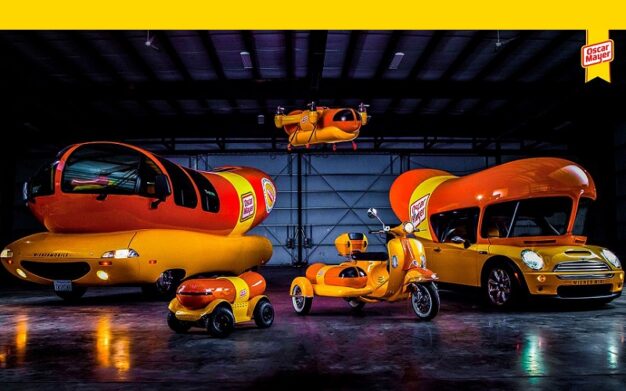
    Tricked-Out Vehicle: Oscar Meyer Wienermobile’s Special Car Design. You may find this something funny and eye-catching, which is a good testament to the power of creative deception (creativity gimmick marketing).

    The Loss-Leader: Selling certain items for much less than the market price in your city is sure to generate buzz. Sure, you’ll incur a loss on the item itself, but many sellers have found the additional influx of customers more than compensated for the loss.

    Making Your Own Gimmick

    Feel free to copy what others have done if you think it would work well for your particular marketing needs. Keep an open mind to things you’ve never tried before. Writing your product’s name in a crowded open space or having a guerrilla salesman somewhere and handing out samples may not work for all businesses, but it may work for yours as well. There are also marketing services that claim to specialize in creating compelling campaigns and gimmicks. See who offers such services in your area.

    Your gimmick will be magnified if it can generate publicity. Be sure to notify your local print and television media of any events you schedule. Use social media tools like Facebook, Twitter, and Instagram to get extra mileage out of your efforts.

  • Understanding Process Management

    Understanding Process Management

    Process management is the most important part of any process development and improvement effort. So process management is a way or action in dividing, allocating programs to be executed so that they are not messy and run well as they should. In its function to develop and increase the degree of efficiency and effectiveness, process management is also one of the most potential work tools in an effort to increase customer satisfaction values.

    In the end, it will also be able to increase profits, business growth and the continuity of the business life cycle of the corporation/company itself. Many work organizations are motivated to manage various activities of their work organization functions by using a process management approach which consists of five main dimensions. The focus of the five dimensions of process management is on the functions of quality, efficiency, response to time, work activities and process costs.

    To get maximum corporate/company business profitability, work organizations must think about reducing process costs, reducing product/process failure rates, and working together to develop and improve product/process quality. Therefore, process management is a strategic work tool that can be utilized for this purpose.

    1. Process mapping
    2. Process diagnosis
    3. Process design
    4. Process implementation
    5. Process maintenance

    Process mapping is one of the most important initial activities in process management whose function is to define processes and capture strategic issues. Process mapping is also part of the control functions of process design and development of initial work activities. When the objectivity and defined process functions have been fulfilled and documented, the diagnostic activity can be carried out.

  • Human Blood Pressure (Normal, High, and Low)

    Human Blood Pressure (Normal, High, and Low)

    Normal adult human blood pressure is 120/80 mmHg. Blood pressure expresses the pressure that the blood experiences when blood is pumped by the heart around the body.
    Blood pressure can change with age, body condition, and activity.

    In general, human blood pressure is classified into three groups.

    1. Normal blood pressure
    2. High blood pressure
    3. Low blood pressure

    Normal human blood pressure

    Normal blood pressure for children and adults has different values.

    Normal blood pressure for adults is around 120/80 mmHg.

    The way to read blood pressure values ​​is to look at the first and second numbers. 120 (the first number) indicates systolic blood pressure. Systolic pressure expresses the pressure when the heart pumps blood around the body.

    80 mmHg (second number) indicates diastolic blood pressure. Diastolic pressure expresses the pressure when the heart muscle relaxes, before pumping blood.

    A person who has a blood pressure value above normal blood pressure is diagnosed with hypertension and if the blood pressure is below normal blood pressure is said to have hypotension.

    Blood pressure table
    Blood pressure table

    High blood pressure (hypertension)

    Hypertension occurs when blood pressure is above normal blood pressure. Blood pressure is above 130/80 mmg.

    Hypertension can lead to diseases such as stroke and heart disease, and fatal diseases of other organs such as kidneys. Besides being able to trigger deadly diseases, hypertension is also difficult to identify.

    Things that can trigger hypertension include: Obesity, likes to consume salty foods, age, rarely exercise, smokers, and heredity.

    Low blood pressure (hypotension)

    Hypotension occurs when blood pressure is below normal blood pressure. Occurs when blood pressure is below 90/60 mmHg.

    Symptoms usually experienced by people with low blood pressure, such as nausea, dizziness, fatigue, thirst, unclear vision, rapid and shallow breathing, lack of concentration, and fainting.

    Blood pressure that is too low can lead to heart and brain damage.

    Things that can cause hypotension include: dehydration, anemia, hormonal imbalances, heart problems, hormonal imbalances, and so on.

    Maintain normal blood pressure

    In order for blood pressure to remain normal, we can do the following things.

    • Get regular exercise
    • Maintain ideal body weight
    • Eat healthy foods
    • Avoid smoking, alcohol, and dangerous drugs.
  • How Geothermal Power Plant Work System

    How Geothermal Power Plant Work System

    What exactly is a Geothermal Power Plant?
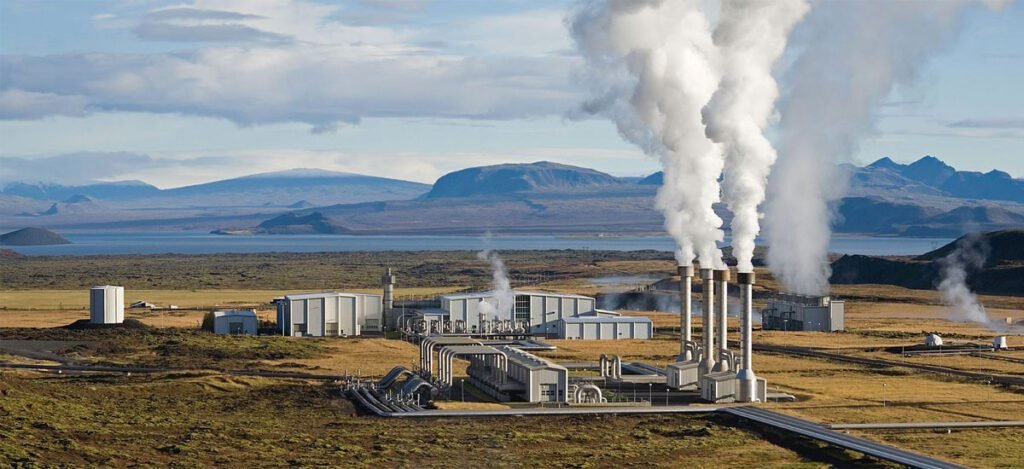
    Geothermal Power Plant is a power plant that uses geothermal energy as its energy source.
    Geothermal energy is one of the natural resources in the form of hot water or steam which is formed through natural heating.
    The word geothermal  comes from the Greek “geo” which means earth and “therme” which means heat. In other words, geothermal energy refers to the energy produced by heat stored in the earth’s core. As a source of energy that comes directly from nature and is renewable in nature, its use does not have a negative impact on the environment and humans.
    Indonesia is very fortunate to be blessed with abundant geothermal resources because of the many volcanoes in Indonesia.

    Things that need attention in choosing technology for using geothermal energy to be converted into electrical energy are:

    1. Temperature; geothermal fluids with a high temperature of> 225 oC have long been used for electricity generation. Medium temperature 150 – 225 oC
    2. Resource reserves of up to 25-30 years
    3. Steam Quality; It is expected that the pH is almost neutral, because if the pH is very low the corrosion rate of the material will be faster.
    4. Well Depth and Chemical Content Usually not very deep (no more than 3 km). The location is relatively easy to reach.
    5. The likelihood of a hydrothermal eruption is relatively low. The production of hot fluid from the bowels of the earth can increase the risk of hydrothermal eruptions.

    Geological Characteristics of Geothermal Areas

    1. Heat Source: Magma which has a temperature of ~ 700 C
    2. Bed Rock: The bedrock layer which is the hard rock of the lower layer
    3. Aquifer (Permeable Zone Layer): is a layer that can be flowed by water. This layer serves as a reservoir
    4. Cap Rock: A layer of hard rock as a cover rock layer.
    5. Water Replishment: as water enhancer.
    6. Surface Manifestation, namely: Symptoms that appear on the earth’s surface (craters, hot springs, geysers, volcanoes, etc.).

    Benefits of Geothermal Energy

    The benefits of geothermal energy obtained from the center of the earth is one of the environmentally friendly alternative energies.
    The way to take advantage of geothermal energy is to drill the part that is the location of geothermal energy to release steam at a certain depth.
    In modern times, geothermal energy is not only used as electricity generation, it turns out that energy from geothermal can also be used as other means such as to help plant growth or other agricultural products that are in the greenhouse during winter. Even this energy can also be used as a space heater and guard the road or sidewalk so that it is not too slippery.
    In the future geothermal energy will be of great help to us in many ways. However, we also have to know that not all regions have locations that have the potential to be used as a source of geothermal energy. With the increasing need for energy in modern times, there are many benefits that we get by taking advantage of geothermal energy.

    How Geothermal Power Plants Work

    How does Geothermal Power Plant work?
    For more details on how the PLTP works, let’s look at the picture and description below.

    1. Steam is supplied from production wells through a steam transmission system which then enters the Steam Receiving Header as a steam collecting medium. The Steam Receiving Header is equipped with a Rupture Disc which functions as the last safety unit. If there is over pressure in the Steam Receiving, the steam will be discharged through the Vent Structure. The Vent Structure functions for warming-up in the pipe line when starting the unit and as a safety valve that will relieve pressure if a sudden trip occurs.

    2. From the Steam Receiving Header, the steam is then flowed to a Separator (Cyclone Type) which functions to separate steam (pure steam) from foreign objects such as heavy particles (Sodium, Potassium, Calcium, Silica, Boron, Ammonia, Fluor etc.).

    3. Then the steam enters the Demister which functions to separate the moisture contained in the steam, so it is hoped that clean steam will enter the turbine.

    4. The steam enters the turbine so that the energy conversion occurs from the heat energy contained in the steam into kinetic energy which is received by the turbine blades. The turbine which is coupled with the generator will cause the generator to rotate when the turbine rotates so that there is a conversion from kinetic energy to mechanical energy.

    5. The rotating generator produces Electricity

    6. Exhaust Steam from the Turbine is condensed in the Condenser with a Jet Spray system (Direct Contact Condensor).

    7. NCG (Non Condensable Gas) which enters the Condenser is sucked by the First Ejector then enters the Intercondensor as a cooling medium and NCG catcher. After from the Intercondensor, NCG is sucked again by the Second Ejector into the Aftercondensor as a cooling medium and then discharged into the atmosphere through the Cooling Tower.

    8. From the condenser, the water from the condensation is flowed by the Main Cooling Water Pump into the Cooling Tower. Furthermore, the cooling water from the cooling tower, dry steam, is recirculated back into the condenser as a cooling medium.

    9. The Primary Cooling System besides being a cooler the Secondary Cooling System also fills the cooling water to the Intercondensor and Aftercondensor.

    10. The overflow from the Cold Basin Cooling Tower will be accommodated for the benefit of the Reinjection Pump.

    11. River Make-Up Pump operates only when filling the Basin Cooling Tower.

    Advantages And Disadvantages of Geothermal Power Plants

    Advantage

    There are actually many advantages to geothermal power. Here are the advantages of geothermal power:
    1. First and foremost, geothermal energy is renewable energy, which means that as long as we don’t pump too much water the energy will continue to exist.
    2. Geothermal energy does not produce pollution, and at the same time, does not contribute to the greenhouse effect.
    3. The location of the power plant for geothermal energy does not require a large area and therefore tends to have little impact on the surrounding environment.
    4. Since geothermal energy is energy that comes from within and from itself, no sources outside of fuel are required to keep the generator running.


    Deficiency

    Although it has many benefits, there are still some disadvantages of geothermal energy. These deficiencies can affect or all three stages of production – pre-production, production and post-production:
    1. Perhaps the biggest drawback of geothermal power is that you don’t build a geothermal power plant anywhere you want. You will need an exact location containing hot rock. After that, not all of these rocks can be drilled because they are too hard. These rocks must also have a depth that allows them to be drilled.
    2. There are also other risks to consider – sometimes a geothermal site may be drilled but has run out of steam. It could be that this happens when the dry season lasts for a long time.
    3. The final loss concerns the potential hazards of geothermal energy. When it is carried out into the soil and which can be mined, this could also mean that there is a possibility that other substances that are not environmentally friendly could also be involved. Harmful gases and minerals can seep from underground and it is very difficult to find ways to safely dispose of these substances into the surrounding environment.
    However, there are certainly advantages and disadvantages caused by exploration. However, with increasingly sophisticated technology, these losses can be anticipated and minimized.
    Why is PLTP now prioritized in Indonesia? Because the profit aspect is greater and Indonesia has abundant geothermal wealth.
  • Benefits of Radioisotopes in Various Fields of Life

    Benefits of Radioisotopes in Various Fields of Life

    Radioisotopes may sound very foreign to us, right? In fact, most people have never seen and also do not know the use of radioisotopes in various fields. Without realizing it, there are many benefits of radioisotopes that we don’t know about, there are various fields that are already feeling their benefits. If so, there is nothing wrong with trying to find out and study the benefits provided by radioisotopes for various fields in the world. Read it until it’s finished, so you can get complete information.

    Definition of Radioisotopes

    Radioactive elements are elements that spontaneously emit radiation. The atomic number of this radioactive element is usually above 83, for example Uranium which has an atomic number of 92. Radioactive elements have an unstable ratio of neutrons and protons, so to stabilize themselves, these elements emit radiation.

    For radioisotopes, the definition is an isotope (when both atoms have the same number of protons) of a radioactive substance, made by the reaction of the nucleus with neutrons. Isotopes of an element, both stable and radioactive, have the same chemical properties. Can become another element, by giving off radiation. So, isotopes that emit radiation can turn elements into radioisotopes.

    To produce radioisotopes, we can shoot stable isotopes with neutrons into a target. This firing can increase the number of neutrons in the target nucleus which will create an instability in the atomic nucleus and make it radioactive.

    When radioisotope elements change from one element to another, it will not cause the type of element to be different. For example, the element O turns into the H element. Radioisotope elements are still the same, but they differ in atomic mass.

    Benefits of Radioisotopes

    The following are some of the radioisotope names and their uses in a wide variety of fields, from health to industry.

    Types of Radioisotopes and Their Benefits

    No. Element Name Benefits / Uses
    1 Iodine (I-131) Helps to look for abnormalities in the thyroid / thyroid gland.

    In the field of hydrology, it can be used to determine the velocity of river flow.

    2 Iodine (I-123) Helps to find out disorders of the kidneys
    3 Carbon (C-14) Look for abnormalities associated with diabetes and anemia.
    4 Chromium (Cr-51) Play a role in the spleen scanning process.
    5 Selenium (Se-75) Play a role in the scanning process of the pancreas.
    6 Technetium (Tc-99) Play a role in the process of scanning lung bones, and heart damage.
    7 Ti-201 Detects heart damage, is used in conjunction with the Tc-99.
    8 Gallium (Ga-67) Play a role in the lymph scanning process.
    9 Xe-133 Play a role in detecting lung health.
    10 Fe-59 Studying the formation of red blood cells.
    11 Sodium (Na-24) Detect narrowing of blood vessels / thrombosis, and detect circulatory disorders.

    Detect underground drainage leaks and investigate river flow velocity

    12 Silicon radioisotope Radioisotope tracer in port or tunnel mud dredging process.
    13 Phosphorus (P-32) Can be used to estimate the amount of fertilizer a plant will need.

    For the health sector, it can be used to detect eye, tumor and liver diseases.

    14 Carbon (C-14) Measuring the age of animal, plant and human fossils (by measuring beta rays).
    15 Uranium (U-238) Estimate the age of the rock.
    16 Uranium (U-235) Controlled chain reaction in the NPP.
    17 Cobalt (Co-60) Play a role in controlling the growth of several types of cancer through the resulting gamma rays.
    18 Isotope 8 O 15 Analyze the photosynthetic process in plants.
    19 Isotope O-18 Atom tracer / tracer from which water molecules are formed.
    20 K-40 K-40 is used in conjunction with stable and Ar-40 to measure the age of rocks, by comparing the concentrations of K-40 and Ar-40 in the rock.


    So, that’s the information along with the benefits of radioisotopes for various fields.

  • How The Diesel Engine Works

    How The Diesel Engine Works

    Diesel engines are combustion engines that use pressure as a trigger for diesel fuel explosion, while gasoline engines run on gasoline.

    Currently we recognize two types of engines for vehicles, namely diesel engines and gasoline engines.

    Diesel engines are combustion engines that use pressure as a trigger for diesel fuel explosion, while gasoline engines run on gasoline.

    However, the use of diesel engines is still sidelined compared to gasoline engines. Even though the diesel engine also has many advantages.

    How the Diesel Engine Works

    In theory, How the diesel engine works are almost the same as a gasoline engine.

    Both are internal combustion engines designed to convert chemical energy from fuels into mechanical energy or motion.

    In short, this mechanical energy will move the piston up and down in the cylinder. The piston is connected to the crankshaft and causes a rotating motion to turn the wheels of the car.

    Diesel engines use a four-stroke combustion cycle like a gasoline engine, where:

    • Intake stroke – The intake valve opens, allowing air to enter and moving the piston down.
    • Compression stroke – The piston moves back up and compresses the air.
    • Combustion stroke   – When the piston reaches the top, fuel is injected at the right moment and ignited, forcing the piston back down.
    • Exhaust stroke – The piston moves back upward, pushing the exhaust resulting from combustion out of the exhaust valve.

    The Advantages of Diesel Machine

    In Indonesia, diesel engines are widely used in heavy transport vehicles such as trucks, and rarely used in private cars.

    Even though the diesel engine has many advantages compared to gasoline-fueled engines. Here are some of the advantages of a diesel engine.

    1. Diesel engines are more efficient than gasoline engines

    diesel engine is

    The thermal efficiency of a diesel engine can reach more than 40%, which is greater than a gasoline engine which is only 20-30%.

    This is why this machine is very popular for use in large vehicles such as trucks.

    2. At high altitudes, diesel engines have better power than gasoline engines.

    diesel engine is

    This is because diesel engines have turbochargers, which pump air into the combustion chamber.

    3. Diesel fuel has a high energy density

    Diesel has a higher energy density than all the fuels used for transportation engines.

    4. The best performance of a diesel engine when it is below 100 km per hour

    diesel engine is

    Peak power is achieved when RPM is low, generally at speeds below 100 km per hour.

  • Getting To Know Max Weber’s Theory Of Social Action

    Getting To Know Max Weber’s Theory Of Social Action

    Young people this time we will discuss one of the popular theories in the scientific realm of sociology, namely the Theory of Social Action. This sociological theory becomes important to be reviewed when the condition of society is experiencing polarization due to the tsunami of information like now.
    Social Action Theory is a theory that concentrates on motives and goals. With this theoretical approach we will be able to examine the behavior of a person or group in taking action. We certainly understand that all actions have different motives and goals and this is where the important starting point is to study this theory.

    In sociology study, Social Action Theory is a theory coined by a modern sociologist, Max Weber. A person who has a big influence on the development of sociological studies. Weber’s influence can be seen through his masterpieces such as Basic Sociological Terms, The Types of Legitimate Domination, The Protestant Ethic and the Spirit of Capitalism, Objectivity in Social Science, Economy and Society, Sociology of Religion, and Methodological Essays.

    Some of Weber’s writings above had a significant impact on the scientific development of sociology. Weber’s thought criticized Marx’s thought which was very materialistic. For example about capitalism, Weber stated that it is not right for western civilization to be built from the ruins of religious values. He considered that religious values ​​were the foundation of the West in winning capitalism. This opinion can be read further in his work entitled The Protestant Ethic and the Spirit of Capitalism.

    Apart from criticizing, Weber also focuses on discussing ideas and values ​​which then become alternatives. Besides that, his writings are also a reference for other scientific treasures such as law, economics and politics.

    Who is Max Weber?

    Born in the city of Erfurt, Germany in a bourgeois family environment in 1864 to a bureaucrat named Max Weber Sr and mother Helene Fallenstein. Little Weber’s real name is Maximilian Karl Emil Weber and has a brother named Alfred. He lived for 56 years, died in Munich in 1920.

    Weber’s interest in academia began when he entered Heidelberg University. Due to the political situation he had to leave Heidelberg in the 3rd semester for military service. In 1884 he returned to Berlin to continue his studies. Besides studying at Berlin Weber also studied at the University of Goettingen. In 1896, Weber was awarded the title of professor of economics at the University of Heidelberg .

    In general, Weber’s thoughts have influenced the discourse of modernity and post-modernity a lot. In addition, his works became a reference for later sociologists such as Pierre Bourdieu and Anthony Gidden.

    Weber’s Theory of Sociology: Theory of Social Action

    Social Action Theory is a theory that examines the motives and behavior of a human. A subjective approach to meaning that allows a person to be able to influence and accept the influence of others. Weber further stated that every individual action directed at another individual or group has a subjective meaning.

    On the other hand, Weber argues that the best way to understand various groups is to appreciate the typical forms of action that characterize them. As a result, we can understand the reasons why these community members act. In general, one of the goals of sociology is to deeply understand the subjective meaning of social actions taken by the individual.

    This theory is useful for understanding the types of behavior and actions of each individual or group. By understanding the behavior of each individual or group, just as we have appreciated and understood their reasons for taking these actions.

    In the context of the motives of the perpetrators Weber divides the theory of social action into four parts, namely traditional action, affective action, action of instrumental rationality and action of value rationality.

    1.Traditional Actions are actions that are determined by habits that have been rooted from generation to generation. This action refers to actions that are based on tradition or actions that have been repeated since ancient times.

    Weber considers traditional actions to be actions that do not go through rational thinking. Because this action is carried out spontaneously without going through thought, planning and consideration. The basis for this action is usually custom, a tradition passed down from generation to generation. This means that this traditional action is carried out repeatedly and is the same as before.

    In the Indonesian context we can see an example of this traditional action from the homecoming phenomenon. That people who have migrated in big cities will carry out their homecoming to their hometowns during Eid. This means that whatever the community does on the basis of existing customs or traditions is a form of traditional action

    2. Affective action is an action that is determined by the conditions and emotional orientations of the actor / actor. This action refers to actions that are based on individual feelings. Just like before, this action is also not done through rational thinking because the emotional impulse is stronger.

    We need to understand that emisional is different from rational. Emotional prioritizes spontaneous reactions to what happens and is experienced, while rational prioritizes thought considerations.

    This affective action can be seen from the phenomenon of crying during a funeral procession. This act of crying was spontaneous and just like that. Happy when you get a gift from your parents or lover. The two actions above include examples of affective action

    3. Actions of Instrumental Rationality are actions aimed at achieving goals that are rationally calculated and pursued by the actor concerned. This action refers to actions that are based on the actor’s rationality in order to achieve certain goals.

    This action is also called an instrumental action aimed because this action is carried out through efforts and efforts to achieve the expected goals. The word rational contains implicit logical and instrumental meanings to achieve goals. This means that this action is carried out through careful planning and prior consideration.

    We can see this phenomenon of rational action from the following examples. Because you want to go to college at 10 o’clock, you choose to ride a motorbike taxi instead of crazy because you don’t want to be late because you wake up late at 9:45. Choosing a motorbike taxi is an example of instrumental rational action because the choice of a motorcycle taxi is based on clear reasons so that you are on time.

    4. Value Rationality Actions are rational actions based on values, which are carried out for reasons and purposes that are related to personally believed values ​​without taking into account the prospects associated with the success or failure of the action. This action refers to actions based on belief in certain values.

    Of course, this action is through thinking rationally and caring out various kinds of values ​​that exist. This means that individuals who act prioritize what is considered good, normal, reasonable or right in society above individual goals. What is considered good can come from ethics, religion, or other forms of value sources.

    We can see this act of value rationality from our choosing to wear trousers over shorts when praying. We choose to shake hands using the right hand rather than the left hand. Both decisions were made because of value considerations. If we don’t do this, we are considered unnatural or even considered insulting, resulting in rejection from the community.

    Finally, understanding social action theory means understanding society interpretatively. This is where sociology can provide a causal explanation of social phenomena and this is one of the intellectual contributions of Max Weber in the scientific realm of sociology.

    By understanding the four parts of the theory of social action above, we can analyze the symbolic meaning of actions taken by individuals. Then we are able to interpret, identify and clarify what types of social actions are carried out by individuals or groups.

    Weber also stated that with the concept of subjective meaning, sociology can understand the orientation, motivation, and causes of actions taken by individuals even though these motives cannot be observed. Hopefully the young people today have the spirit to maintain their intellectuality by reading so that the analysis knife is sharp and organized. Hopefully!


  • Basic Knowledge of Kinetic Energy

    Basic Knowledge of Kinetic Energy

    Energy is something that is very in every activity of our life. Generally, energy is the ability of an object to do work. An object is said to have energy when it is capable of producing a force that can do work. Energy is required in almost all activities, such as pushing tables, playing ball, throwing objects, and other activities. Energy has several types, namely kinetic energy, potential energy, and mechanical energy.
    Kinetic energy is a type of energy due to the movement of an object. The word kinetic comes from the Greek which means to move. Therefore, all energy in motion must have kinetic energy. The kinetic energy is mathematically formulated as follows:

    KE = 1 / 2.mv 2

    Where :

    m = mass

    v = speed

    From this equation, it can be seen that the kinetic energy is influenced by the mass (m) and velocity (v) of an object. The SI unit for energy is the joule (J). The joule is equal to kg.m 2 / s 2 , the other units are calories (cal) which is equivalent to 4.184 J.

    A simple example of kinetic energy is when someone hits a ball with the aim of making the ball fly towards the opponent. Or when you throw stones at a certain speed. Energy can be seen when a rock hits the target it hits.

    Summary 

    • Energy is the capacity of an object to do work or generate heat.
    • Kinetic energy is energy arising from the motion of objects.
    • A joule (J) is the SI unit for energy equal to kg.m 2 / s 2 .
  • Basic Units in the International System of Units (SI)

    Basic Units in the International System of Units (SI)

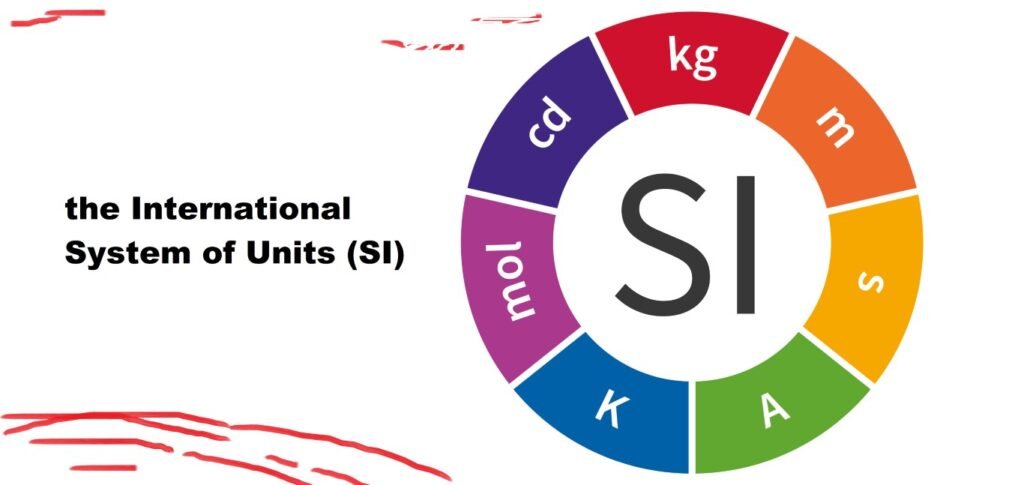
    The International Unit (SI) is a modern form of the metric system and is currently the most commonly used measurement system. This system consists of a coherent measurement system consisting of 7 base units and defines 22 units and many more derivatives.
    Meanwhile, the SI base unit is the seven units of measurement defined by the Systeme International d’Unites , as the basic set to derive all other SI units, namely SI derived units. This basic unit is commonly used in various measurements, such as measuring height, weight, time and many others.

    Here are 7 basic units for the international system (SI) :

    • Long. Dimensions of an object which expresses the distance between ends, with the SI base unit meters (m).
    • Mass. A quantity representing weight, with the SI basis of the kilogram (kg).
    • Time. The entire sequence during which a process, action, or state exists or takes place, has the SI base unit second (s).
    • Temperature. Indicator of the degree of heat of an object, has units of kelvin (K).
    • Electric current. The amount of electric charge caused by the movement of electrons flowing through a point in an electric circuit over time, in the SI base unit amperes (A).
    • Light intensity. The basic physical quantity in measuring the power emitted by a light source in a certain direction per unit angle, has units of candela (cd).
    • Amount of substance. A physical base unit that measures the number of elementary samples which can be atoms, electrons, ions, molecules, or certain particles, with the SI base unit mole (Mol).
    No. Basic Quantity Unit Name Unit Insignia Magnitude Symbol
    1 Long Meter m l
    2 Mass Kilogram Kg m
    3 Time Second s t
    4 Temperature Kelvin K T
    5 Electric current Ampere A I
    6 Light intensity Candela CD j
    7 Amount of substance Mole mole n

    The five of the units of the international system of units are commonly used in chemistry, namely length, mass. Temperature, time and amount of substance.

    Summary

    • The International System of Units (SI) is a modern form of the metric system and is currently the most commonly used measurement system.
    • In international units there are seven basic quantities used, namely length, mass, time, temperature, electric current, light intensity, and amount of substance.
    • Five of the basic SI quantities are commonly used in chemistry.
  • 7 These Are the Causes of Global Warming

    7 These Are the Causes of Global Warming

    Global warming is causing the earth to get worse.

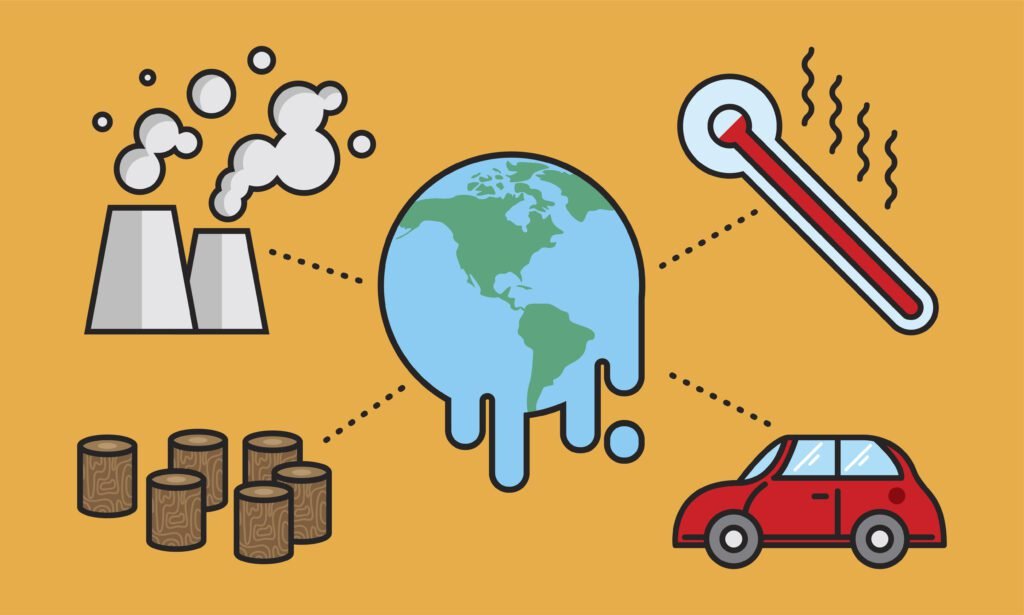
    Global warming causes the earth to experience an increase in average temperature which has an extraordinary impact on life in it.
    Extinction of living things, extreme climate change are also the effects of global warming.

    Here are 7 things that cause global warming:

    Deforestation

    Deforestation

    Forests play an important role in the environment, the more forests the lower the pollution. Massive forest loss caused sudden climate change.

    Trees which are the key to climate regulation, play a role as controlling CO₂ and oxygen. Bush and forest areas act as carbon sinks and regulate the temperature to about 1.5 degrees.

    Currently, the industry uses wood as raw material which is obtained by cutting down forests. Deforestation is the main reason for global warming as the amount of oxygen decreases and CO₂ increases in the atmosphere.

    We know that vegetation is very important, but it is continuously being destroyed and eliminated, the concentration of CO2 is increasing and causing global warming, 1/5 of greenhouse gas pollution is generated from forest degradation and tree cutting.

    The causes of global warming can actually be prevented and checked if the right things are done such as planting more and reforestation

    Rapid Industrialization

    Industry uses chemicals in its manufacture and produces waste that pollutes the environment. These chemicals and industrial wastes enter the environment and mix with water and cause various diseases.

    Some industries use gas and fuel to run factories. During the process, one of the end products is harmful fumes and pollutes the air. The smoke contains large amounts of CO₂ which is the main cause of global warming

    Transportation

    Based on research, findings, and observations, it was gathered that transportation also has a hand to play in the causes of global warming. This can also be seen in the gas output of transportation equipment such as cars, airplanes, trains, and others.

    The World Resources Institute in 2012 proved that 15% of climate pollution comes from transportation.

    Fertilizers and Pesticides

    Fertilizers and pesticides are used to increase production from the agricultural sector. Initially it was clear that the use of fertilizers and pesticides increased production. But on the other hand this results in the release of nitrogen gas which mixes into the air and causes global warming.

    Agriculture also produces methane gas products, especially from livestock such as cattle and sheep. Fertilizers made from nitrogen release nitrogen oxides and have recently become a problem in many countries.

    Household Waste

    This Waste releases methane gas which immediately reacts with oxygen and changes its condition. Why did this happen?

    If not managed properly, waste which generally comes from organic waste which is “anthropogenic waste” will degrade and decompose into methane gas (CH 4 ). CH 4 gas is a greenhouse gas that can cause a greenhouse effect which has the potential to cause global warming.

    Refrigerator and air conditioner

    Refrigerators and air conditioners are used in almost every home and office. These tools use Freon gas or CFC (Cloro Fouro Carbon).

    Freon can deplete the ozone layer when it is put into the air and is one of the causes of global warming. This ozone layer is useful for protecting the earth and living things from exposure to Ultra Violet B (UV-B) radiation and also absorbs high ultraviolet radiation from the sun from reaching the earth.

    Fossil Burning

    Fossil fuels include gas, oil and coal. The main producer of CO₂ is Australia which has been widely recognized for many years compared to others. When fossil fuels are burning, carbon dioxide is released into the atmosphere.

    The cause of this pollution in Australia has been linked to electricity where around 73% of electricity comes from burning coal and about 14% from burning gas. The remaining 13% comes from sources such as wind, sun and water or water. In fact, less pollution is achieved when the amount of gas, coal, several sources of energy. The burning of fossil fuels has for years been recognized as the main cause of global warming.

  • Elon Musk’s productive secrets, and one of them is Take a Bath

    Elon Musk’s productive secrets, and one of them is Take a Bath

    We know Elon Musk as the greatest entrepreneur and technocrat in this era.

    He is revolutionizing space technology with SpaceX, changing the future of world transportation with Tesla and Hyperloop, changing the future of energy with Solar City, and many more.

    All that makes Elon Musk into the ranks of the 100 richest people in the world with a fortune of more than US $ 14 Billion in 2016.

    With his success, Elon Musk is often referred to as “Tony Stark” or “Iron Man” in real life.

    Here are some important tips from Elon Musk to become the great innovator he is today

    1. Be diligent in reading books

    Like other great figures in the world, Elon is also diligent in reading books, to broaden horizons.

    While in elementary school, he spent 10 hours a day reading books, and could even finish two books in one day.

    Through reading habits, Elon can learn BASIC programming in just three days, even though it should have been taught for six months.

    Some of the books that Elon Musk likes are JRR Tolkien’s The Lord of The Rings and Peter Thiel’s Zero to One .

    2. Focus on the important things

    A focus on what matters is a critical component of productivity for Elon Musk, and serves to sharpen his views.

    At both SpaceX and Tesla, Elon Musk has always focused on what’s important in the form of developing quality products, and tends to be reluctant to go on a massive promotion when it’s not needed.

    “At Tesla, we hardly ever spend a dime on advertising. When it comes to spending money, we ask first if this can lead to a better product? If not, then we will not spend the money, ”said Elon .

    3. Diligently take a shower

    It may seem like a joke, but this is actually what Elon Musk does as a component of his productivity.

    For Elon, bathing is a habit that benefits him. He conveyed this in a question and answer session on Reddit social media:

    “What are your daily habits that have a big benefit in your life?”

    Elon Musk also replied, “take a shower”.

    This is supported by research from Radboud University in the Netherlands and various other studies, which say that relaxing conditions such as bathing can trigger the brain to generate new ideas.


  • How to Calculate Working Capital?

    How to Calculate Working Capital?

    Working capital is the company’s ability to pay current liabilities with current assets . Working capital is an important measure of financial health because creditors can measure a company’s ability to pay off its debts within a year.

    Working capital represents the difference between a company’s current assets and current liabilities. The challenge is to determine the right category based on the large number of assets and liabilities on the company’s balance sheet and outline the company’s overall health in meeting its short-term commitments.

    Working Capital Components

    Current Asset

    This is what companies have today – both tangible and intangible – that they can easily turn into cash within a year or a business cycle, whichever is less. The more obvious categories include demand deposits and savings; highly liquid securities such as stocks, bonds, mutual funds and ETFs; money market account; cash and cash equivalents, accounts receivable , inventory and other short-term prepaid expenses. Other examples include current assets from discontinued operations and interest payable. Current assets do not include long-term or illiquid investments such as certain hedge funds, real estate, or collections.

    Current Liabilities

    In the same way, current liabilities include all debts and expenses that the company expects to pay in one year or one business cycle, whichever is less.

    This usually includes all the normal costs of running the business such as rent, utilities, materials and supplies; payment of interest or principal of debt; accounts payable ; accrued obligations; and accrued income tax. Other current liabilities include dividend payable , leases with maturities in one year, and long-term debts that are due.

    How to Calculate Working Capital

    Working capital is calculated using the current ratio, namely current assets divided by current liabilities. A ratio above 1 means current assets exceed liabilities, and generally, the higher the ratio, the better.

    Example of Working Capital: Taruna Arka
    For the fiscal year ended December 31, 2017, PT Taruna Arka has current assets of IDR 36.54 billion. Includes cash and cash equivalents , short-term investments , marketable securities, accounts receivable, inventories, prepaid expenses, and assets held for sale.

    Taruna Arka has current liabilities for the fiscal year ending December 2017 amounting to IDR 27.19 billion. Current liabilities include trade payables, accrued expenses, loans and notes payable, current long-term debt maturities, accrued income taxes, and liabilities held for sale.

    According to the information above, the company’s current ratio is 1.34:

    IDR 36.54 billion ÷ IDR 27.19 billion = 1.34.

    Has Working Capital Changed?

    While working capital funds do not expire, working capital figures do change over time. That’s because the company’s current liabilities and current assets are based on a rolling 12 month period.

    The exact working capital figure can change every day, depending on the nature of the company’s debt. What was once a long-term liability, such as a 10-year loan, becomes a current liability in year nine when the payment deadline is less than one year away. Likewise, what was once a long-term asset, such as real estate or equipment, suddenly becomes an asset as buyers line up.

    Working capital as a current asset cannot be depreciated (depreciated) like a long-term asset. Certain working capital, such as inventory and accounts receivable, can lose value or even be written off occasionally, but how it is recorded does not follow depreciation rules.

    Working capital as current assets can only be charged immediately as a one-time expense to match the income they helped generate in the period.

    Although it cannot lose value due to depreciation over time, working capital can be devalued when some assets have to be marked (Mark-to-Market) to the market.

    It occurs when the asset price is below its original cost, and the others cannot be saved. Two common examples involve inventory and accounts receivable.

    Outdated supplies can be a real problem in operations. When that occurs, the market for inventory has a lower price than the original purchase value recorded in the accounting books. To reflect current market conditions and use the lower cost and market method, companies mark their inventory down, resulting in a loss of working capital value.

    Some receivables may become uncollectible at some point and have to be written off entirely, which is another loss of value in working capital. Because losses in current assets reduce working capital below the desired level, funds or long-term assets may be required to fill the shortfall in current assets, an expensive way to finance additional working capital.

    Means Working Capital

    A healthy business will have sufficient capacity to pay off current liabilities with current assets. A ratio higher than above 1 means the company’s assets can be converted into cash at a faster rate. The higher the ratio, the more likely the company will be able to pay off short-term obligations and debts.

    The higher ratio also means the company can easily fund its day-to-day operations. The more working capital a company has means that it may not need to take on debt to finance its business growth.

    A company with a ratio less than 1 is considered risky by investors and creditors because it indicates that the company may not be able to cover its debts if necessary. A current ratio of less than 1 is known as negative working capital.

    We can see in the graph below that the working capital of Pt. Arka cadets, as indicated by the current ratio, have been increasing steadily over the past few years.

    Working Capital Pt. Arka cadets

    The tighter ratio is the quick ratio, which measures the proportion of short-term liquidity to current liabilities. The difference between this and the current ratio is in the numerator, where the asset side includes cash, securities, and accounts receivable. The Liquid Ratio (Quick Ratio) does not include inventory, which can be more difficult to turn into cash in the short term.

    The value of working capital should be assessed periodically from time to time to ensure that devaluation does not occur, because sustainable operations require sufficient working capital.

  • What is Gross Profit Margin (GPM)?

    What is Gross Profit Margin (GPM)?

    Gross Profit Margin is a metric that analysts use to assess a company’s financial health by calculating the amount of money left over from product sales after reducing the cost of goods sold (COGS) .

    Sometimes gross profit margin is referred to as gross margin ratio, gross profit margin is often expressed as a percentage of sales.

    Key Explanation

    • Gross Proft Margin (GPN) is an analytical metric expressed as a company’s net sales less cost of goods sold (COGS).
    • Gross Proft Margin (GPN) is often shown as gross profit as a percentage of net sales.
    • Gross Proft Margin (GPN) shows the amount of profit made before deducting sales, general and administrative expenses, which is the company’s net profit margin.

    Formula for Gross Profit Margin (GPM)

    GPM = GP / Sales Revenue

    Remarks:

    • GP = Gross Profit
    • GPM = Gross Profit Margin

    How to Calculate Gross Profit Margin (GPM)

    The percentage of a company’s gross profit margin or gross profit margin (MLK) is calculated by dividing gross profit by sales revenue. The figure for the distribution in the form of a presentation is called the gross profit margin.

    Problems example:

    Company A’s gross profit is USD 200,000 and the sales revenue it receives is USD 350,000. So to get the results of the Gross Profit Margin, the calculation is as follows.

    • Gross profit margin = USD 200,000 / USD 350,000.
    • Gross profit margin = 57%.

    What can Gross Profit Margin tell you?

    If a company’s gross profit margin fluctuates wildly, this may signal poor management practices and / or lower product prices.

    On the other hand, such fluctuations can be justified in cases where a company makes massive operational changes to its business model, where cases of temporary volatility should be no cause for alarm.

    For example, if a company decides to automate certain supply chain functions, the initial investment may be high, but the cost of goods eventually decreases due to the lower labor costs resulting from the introduction of automation.

    Product price adjustments can also affect gross margins. If a company sells its products at a premium, all other things being equal, it has a higher gross margin.

    But this can be a tricky balancing act because if the company charges too high, fewer customers buy the product, and the company can suffer losses as a result.

    Examples of Using Gross Profit Margin

    Analysts use gross profit margins to compare a company’s business model with its competitors. For example, let’s assume that Company ABC and Company XYZ both produce electronic products with identical characteristics and similar levels of quality.

    If ABC Company finds a way to manufacture its product at a cost of 1/5, it will provide a higher gross margin due to a reduced cost of goods sold, giving ABC a competitive advantage in the market.

    But then, in an attempt to make up for the loss in gross margins, XYZ fought back by doubling the price of its product, as a method of increasing revenue.

    Unfortunately, this strategy can backfire if customers are deterred by a higher price tag, in which case, XYZ loses gross margins and market share.

  • The Concept of Demand and Supply in Economics

    The Concept of Demand and Supply in Economics

    What is the Law of Supply and Demand?

    The law of supply and demand is a theory that explains the interaction between a seller of a resource and a buyer of that resource. This theory explains the interaction between the existence or availability of a product and the demand for that product on the price of the product.
    Generally, low supply and high demand increase prices and vice versa. Meanwhile, high supply and low demand will reduce prices.

    A brief description

    • The law of demand says that at higher prices, buyers demand less of an economic good.
    • The law of supply says that at a higher price, the seller will supply more of the economy’s good.
    • These two laws interact to determine the actual market price and the volume of goods traded on the market.
    • Several independent factors can influence the shape of market supply and demand, which can affect the prices and quantities we observe in the market.

    Understand the Law of Supply and Demand

    The law of supply and demand is the most basic of economic laws, where it binds almost all economic principles in some way. In practice, supply and demand oppose each other until the market finds a price balance.

    As we know that there are many factors that can affect supply and demand, which causes supply and demand to increase and decrease in several ways. It was studied extensively by Murray N. Rothbard.

    The Law of Demand vs. Supply Law

    The law of demand states that, if all other factors remain the same, the higher the price of a good, the less people will demand that good.

    In other words, the higher the price, the lower the quantity demanded. The number of goods that buyers buy at the higher price is less because when the price of the good rises, so does the opportunity to buy that good.

    As a result, people naturally avoid buying products, forcing them not to consume anything they value more. The graph below shows that the curve is slope downward.

    Like the law of demand, the law of supply shows the quantity to be sold at a certain price. But unlike the law of demand, the supply relationship shows an upward slope. This means that the higher the price, the higher the quantity supplied.

    Producers supply more at a higher price because selling the higher quantity at a higher price increases revenue.

    However, unlike the demand relationship, the supply relationship is a time factor. Time is important to provide because suppliers must — but not always — react quickly to changes in demand or prices. So it is important to try and determine whether the price change caused by demand will be temporary or permanent.

    Say there is an increase in demand for umbrellas and the price of umbrellas suddenly increases in an unexpected rainy season; suppliers can only accommodate demand by using their production equipment more intensively.

    However, if there is climate change, and the population will need an umbrella throughout the year, changes in demand and prices will be expected over the long term; suppliers must change their production equipment and facilities to meet long-term levels of demand.

    Shift vs movement

    In an economy, “movements” and “shifts” in relation to the supply and demand curves represent very different market phenomena.

    Movement refers to changes along a curve. On the demand curve, movement shows the change in price and quantity demanded from one point on the curve to another. These moves imply that the demand relationship remains consistent.

    Hence, a movement along the demand curve occurs when the price of a good changes and the quantity demanded changes according to the initial demand relationship. In other words, a movement occurs when a change in quantity demanded is caused only by a change in price, and vice versa.

    Like movement along the demand curve, movement along the supply curve means that the supply relationship remains consistent.

    Hence, a movement along the supply curve occurs when the price of the good changes and the quantity supplied changes according to the original supply relationship. In other words, a movement occurs when a change in a given quantity is caused only by a change in price, and vice versa.

    Meanwhile, a shift in the demand or supply curve occurs when the quantity of a good demanded or supplied changes even though the price remains the same. For example, if the price for a bottle of energy drink A is IDR 10,000 and the quantity of energy A demanded increases from Q1 to Q2, then there will be a change in the demand for energy drink.

    Shifts in the demand curve imply that the original demand relationship has changed, meaning that quantity demand is affected by factors other than price. A shift in the demand relationship will occur if, for example, energy drink A suddenly becomes the only type of energy available for consumption.

    Conversely, if the price for a bottle of energy drink is IDR 10,000 and the quantity supplied decreases from Q1 to Q2, then there will be a change in the supply of this drink. Like a shift in the demand curve, a shift in the supply curve implies that the original supply curve has changed, meaning that the quantity supplied is affected by a factor other than price.

    A shift in the supply curve would occur if, for example, a natural disaster caused a shortage of hop mass; State drink producers will be forced to supply less of their product at the same price.

    How do supply and demand balance prices?

    Also called the market clearing price, the equilibrium price is the price at which the producer can sell all the units it wants to produce and the buyer can buy all the units it wants to produce.

    At a certain point in time, the supply of goods brought to market is constant. In other words, the supply curve in this case is a vertical line, whereas the demand curve always slopes downward because of the decreasing law of marginal utility.

    Product sellers cannot charge the market more than the market can bear, based on the concept of consumer demand. Over time, however, suppliers may increase or decrease the quantity they supply to the market based on the price they predict will be charged.

    So over time the supply curve slopes upward; the more suppliers expect to charge extra, the more willing they are to produce more and to shower the market with their products.

    With the supply curve sloping up and the demand curve sloping down, it is easy to imagine that at some point the two will intersect. At this point, the market price is sufficient to encourage the supplier to bring to market the same amount of good that the consumer is willing to pay at that price. Supply and demand are in balance, or in balance.

    The right price and quantity occurs based on the position and shape of the supply and demand curves, each of which is influenced by several factors.

    Factors Affecting Supply

    Production capacity, production costs such as labor and raw materials, and the number of competitors directly influence how much of a business supply can be made. Supporting factors such as weather conditions, availability of materials and reliability of the supply chain are also a set of factors that can affect supply.

    Factors Affecting Demand

    The number of substitutes available, changes in prices for complementary products, and consumer preferences can influence demand. For example, if the price of a motorbike for brand A goes down, then the demand for that motorbike can increase because people are more likely to buy it because the price has dropped and want to own it.

  • Conflict Theory According to Lewis A Coser’s Perspective

    Conflict Theory According to Lewis A Coser’s Perspective

    Conflict can also be positive for the fabric of a society or social group. Well, here is the conflict according to Luwis Coser, which states that conflict has a positive function.

    According to Coser’s perspective, conflict theory is a functional social system. According to Coser, conflicts that occur in society do not merely show a negative function. However, conflict can also positively impact the ongoing social order.

    For Coser, conflict is a form of interaction and does not need to be denied. Coser means that conflict does not have to be destructive or dysfunctional for the system concerned because conflict can also have positive consequences.

    Coser shows us that conflict is a dispute about values ​​or demands regarding power, status, and sources of wealth whose supply is insufficient.

    Furthermore, Coser stated that disputes or conflicts could occur between individuals, collectivities, or individuals within the group. We can see the conflict between individuals and individuals; we still remember that when we attended high school, we unconsciously created positive conflicts, namely at the level of competition, in competition events, competing to become class winners, and experiencing positive conflict. We’ve been through.

    In negative conflicts, we can see the final results of the competition where the results are not in line with expectations, such as fights between football supporters/fans, coachmen debate that do not teach us lessons, and examples of negative conflicts that can harm many communities. Therefore, we should avoid these negative conflicts.

    Conflict is an important element of interaction, and it cannot be said that it is always bad, divisive, or destructive. Conflict can contribute greatly to the group’s sustainability and unite/strengthen relationships between its members. Such as facing a common enemy can integrate people, generate solidarity and engagement, and make people forget their internal strife.

    Positive Function of Conflict According to Lewis Coser. Conflict is a way or tool to maintain, unite and reinforce the existing social system. For example, the positive function of conflict is in matters relating to the dynamics of the relationship between the in-group and the out-group. Here are some propositions made by Lewis Coser:

    First, the strength of internal solidarity and inner group integration will increase if the level of hostility or conflict with outside groups increases.

    Second, the increased integrity of groups involved in conflict can help strengthen boundaries between that group and other groups in the environment, especially hostile or potentially hostile groups.

    Third, within the group, there is the possibility of a reduced tolerance for division or divisions and an increased emphasis on consensus and conformity.

    •  Consensus is a phrase to produce or make an agreement that is mutually agreed upon between groups or individuals after debates and research are carried out in the intelligence collective to obtain consensus decision-making.
    •  Conformity is a type of social influence when someone changes their attitudes and behavior to suit existing social norms. (Source: id.wikipedia.org)

    Fourth, deviants in the group are no longer tolerated; if they cannot be persuaded to enter the right path, they may be expelled or put under close surveillance.

    Fifth, on the other hand, if the group is not threatened by conflict with hostile outsiders, the strong pressure on cohesiveness, conformity, and commitment to the group may decrease.

    Internal disagreements may surface and be discussed, and deviants may be more tolerated. Generally, individuals will get greater space to pursue their personal interests.

    According to Coser, the function of external conflict can also be to strengthen internal cohesiveness and increase group morale so that groups can provoke antagonism with outside groups or create enemies with outsiders in order to maintain or increase internal solidarity.

    Tensions that occur in a group due to friction make conflict occur. To be able to solve the conflict problems that occur, Lewis Coser has a way or mechanism to be able to reduce or resolve a conflict.

    The mechanism that Coser mentioned is called a safety valve or other designation a safety valve. Coser admits that conflict can jeopardize unity. Therefore, it is necessary to have a solution called Coser as a safety valve.

    For Coser, this safety valve is an institution (safety valve institution). In society’s broad order of elements, we will find many social interests that may take time to fulfill. There needs to be an institution or institution that becomes the safety valve of these interests so that there will be no conflict in the community.

    Let us look at the legislative institution or body which consists of representatives of the people, such as the Indonesian Parliament in Indonesia. The existence of this institution is as a savior or as a safety valve for high conflicts. This is because each region already has representatives in the realm of delivering the community’s social needs in each region.

    Regarding the implementation in the field, it depends on how the community responds and the representatives give the right of their constituents. Thus, a large conflict does not need to occur because there is already a place to convey aspirations.

    In addition, according to Coser, safety valves also do not have to be on institutions; they can also be safety valves based on actions or habits that can reduce tension because conflicts cannot be channeled.

    For example, a joke inserted in a tense situation can reduce or eliminate the tension at that time, even though the joke itself may still contain critical values.

    Coser’s opinion regarding conflicts is that conflict is functional (good) and/or dysfunctional (bad) for relationships and structures that are not encapsulated in the social system. Coser focuses more on the functional conflict; Coser does not see it as dysfunctional.

    Coser defines social conflict as a struggle for value and recognition of rare status, then powers and sources of conflict are neutralized or perpetuated, and rivals are eliminated.

    Coser’s view of functional conflict states that conflict can change the form of interaction, whereas the expression of feelings of hostility is not the case. Therefore, conflicts that occur in society, either individually with individuals or groups with groups, as well as individuals and groups, are one way of unifying elements of society.

    This is because the conflict that occurs is not always negative but also positive in terms of uniting various social interests in it.


  • 3 Characteristics of Social Facts According to Emile Durkheim

    3 Characteristics of Social Facts According to Emile Durkheim

    According to Durkheim, social facts are all ways of acting, thinking, and feeling outside the individual, coercive and general. Come see the reviews.

    As one of the figures who contributed to the development of Sociology, Emile Durkheim separated Sociology and Social Philosophy and strengthened Sociology as an independent branch of science.

    ” Sociology is a science that studies the Social Fact,” firmly Emile Durkheim.

    Social facts in Emile Durkheim’s perspective. 

    Most of us view social facts as relationships that are all visible and can be grasped by the five senses.

    According to Durkheim, social facts are all ways of acting, thinking, and feeling that are outside the individual, coercive, and general.

    Social facts have three characteristics, namely:

    First, External, which is outside the individual. This means that social facts existed before the individual existed and will remain after the individual did not exist.

    Second, Determined Coercive, namely social facts forcing individuals to always conform to them (social facts).

    Third, General, spread out in the community/society, is jointly owned, not individually.

    According to Durkheim’s view, individual interests and motives are not included in social facts because interests and motives are internal to an individual.

    Let’s try to understand one of the following examples; for example, we want to do a study of consumption using social facts.

    So, we will internalize our thinking that consumption is seen as a social fact, such as clothing patterns, consumption patterns, or ways of eating.

    It is an external, general, and compelling reality. Why can? Try to pay attention to the matter of clothing if you want to dress differently when you want to attend an official event or a wedding ceremony.

    Surely you will follow the fashion etiquette when coming to the event, or in everyday clothes; surely we will wear normal clothes.

    It’s different when you want to look extreme, by wearing a swimsuit you come to a formal event, or your daily activities, you can say it’s a mess, uh, crazy people, uh people are crazy, go to parties wearing swimsuits, in public places how come wearing a swimsuit.

    Or you who want to go to college wearing a swimsuit to campus can die of being bullied and beaten by crazy people straying to campus.

    So therefore, we also have to adjust in terms of our clothes or our patterns in everyday dress because this has become a fashion pattern.

    Externally, it is shown by our unwillingness to dress / clothing patterns that are different from what already exists in society and has been going on for a long time, since you were not born and or until you die later.

    Another example is that you are a married woman, and recently your husband died; you will certainly show your sadness and grief.

    If you are not sad as a woman left behind by your husband, the residents will give you a negative stigma.

    For example, you are reported to have had a new husband, so you don’t have to be sad and grieving.

    Or people will sneer at you that you have a new affair because you don’t show that sadness and grief.

    Now this has been socialized by all people, which is general in nature and external to oneself because it is all the result of the socialization process.

    As for the nature of force, it can be seen from the stigma imposed by society on someone who feels, acts, and behaves that are not following social facts, that is, if they do not look sad and grieving (in the example above)

    Assumptions in Social Facts. 

    What are the assumptions behind social facts? The assumptions include: First, social symptoms are real and affect individual consciousness and behavior.

    Members of society feel social facts and become a guide for individuals in feeling, behaving, and behaving.

    Social fact is something that is shared and shared. Second, because social phenomena are real facts, they can be observed/studied using empiric methods.

    As we explained above, social facts can be understood as a reality that can be felt through the human senses.

    Therefore, human senses can also grasp and feel the presence of social facts, so they can be observed or studied.

    Two forms of Real Social Facts.

    Social facts must be considered as real things. According to Emile Durkheim, as a real thing, it can take two forms, as said by Ritzer, namely:

    • In the form of a material, namely something that can be listened to, captured, and observed, such as architecture and legal norms.
    • In the Non-Material form, something considered real appears in human consciousness, such as compassion, anger, sadness, joy, happiness, and others.

    Well, that’s, guys, some of the characteristics in social facts, according to Emile Durkheim, and two forms of social facts are seen as real: material and non-material.

  • The Principle of Analysis and Conflict Model According to Randall Collins

    The Principle of Analysis and Conflict Model According to Randall Collins

    Conflict is a central process in people’s lives. According to Randall Collins, there are 5 Principles of Analysis and 3 Models of Social Stratification Conflict.
    Examples of Visible Social Phenomena.

    According to Randall Collins, organization is an arena of conflict. Conflict between an organization and another or conflict within the organization itself, namely individuals between individuals.

    Social interactions carried out by individuals are related to their interests, power, wealth, social status, which each individual wants to achieve in social organizations.

    The visible example can be seen from political organizations, where interests and power give each other power of influence to members and followers.

    The existence of a high ego causes conflict within political parties to be inevitable, conflict will always exist in political organizations.

    For example, we can see the conflict over the general chairman, which usually has dualism of leadership in political parties.

    In the end, among individuals who conflict because of an emotional drive or ego, they will leave the party structure.

    And of course, will establish their own political party with other individuals who feel they did not get space in the previous political party.

    That’s a glimpse of what we can see in conflict, because of the maneuvers of each individual.

    Social process.

    Conflict is a central process in people’s lives. The social structure is inseparable from the actors who build it.

    Social structure is the essence of individual interaction patterns in the structure of continually re-creating their social organization.

    Three Models of Social Stratification Conflict According to Randall Collins , namely:

    1. Individuals who live in the world, subjectively constructed where they build themselves.

    2. Some people / individuals have the power to be able to influence or influence the construction of the individual’s subjective world, or to control the subjective experience of the individual.

    3. The existence of several people to try to influence the subjective construction, as well as the tendency of individuals to control different people or to oppose the individual’s subjectivity.

    The Five Principles of Conflict Analysis According to Randall Collins , namely:

    1. Conflict theory should focus on the real world rather than the abstract world.

    2. Stratification conflict theory should examine the arrangement of materials that influence interactions.

    3. In an unbalanced situation, the resource ruling group will likely try to exploit the limited resource pool.

    4. Cultural phenomena (beliefs + ideas) are seen from the point of view of interests, resources and power.

    5. In looking at stratification, conflict theory must conduct empirical research.

  • Michael Faraday

    Michael Faraday

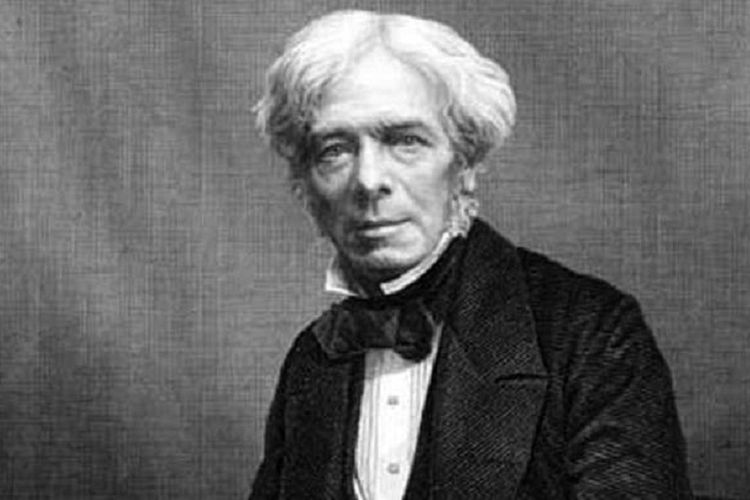
    Michael Faraday (1791-1867), was a physicist and chemist from England. His well-known discoveries are electromagnetic induction and the laws of electrolysis. Faraday’s initial research was in chemistry, under the guidance of Sir Humphry Davy and found two types of carbon chloride and benzene. In his research, Faraday also succeeded in liquefying several types of gases.
    Michael Faraday is an expert in chemistry and physics. He was born on September 22, 1791 and died on August 25, 1867. He is known as a pioneer in researching electricity and magnetism, even many scientists say that he is the greatest researcher of all time. Some of the concepts he derived directly from experiments, such as lines of magnetic force, have become ideas in modern physics.

    Faraday was born in a poor family in Newington, Surrey near London. Young Faraday was a critical child, but he received little education compared to primary school. Even so, it did not make him feel inferior and give up hope to continue learning. When he was 14 years old, he was apprenticed in a bookbinding business. This is where he got interested in physics and chemistry. After hearing the lecture of a famous chemistry lecturer at the time, Humphry Davy, he sent his lecture notes to the lecturer. It turned out that the lecturer was interested and appointed Faraday as his assistant at the famous University Laboratory in London, when he was 21 years old.

    In his first year of work in the laboratory, Faraday discovered two chlorocarbons and succeeded in liquefying chlorine gas and several other gases. Then managed to separate benzene compounds in 1825 where he was appointed chairman of the laboratory.

    In 1807, Davy, who had a great influence on Faraday’s thought, had predicted that the metal sodium and potassium could be precipitated from their compounds by means of an electric current, a process known as electrolysis. Faraday passionately tried hard to prove his professor’s prediction and in 1834 it became a reality, a new law on electricity emerged, known as Faraday’s Law.

    Faraday’s research into electricity and electrolysis was guided by his belief that electricity is one of the other forces of nature such as heat, light, magnetism and chemical tendencies. Although his idea was wrong, this made him enter the electromagnetic world.

    In 1821, Faraday investigated the magnetic field around a conductor that was energized by an electric current which was first discovered by Hans Christian Oersted in 1819. In 1831 Faraday discovered electromagnetic induction and showed the emergence of an induced current in a coil due to an electric current in another coil. . At the same time, Faraday also conducted successful research in the field of electrolysis.

    The thought and one experiment of electromagnetic phenomena that Faraday demonstrated regarding the concept of lines of force were refuted by most of the European mathematical physicists, they assumed that electric charges attracted and repelled each other by distance and made the lines of force insignificant. However, a well-known physicist at the time, James Clerk Maxwell accepted Faraday’s thoughts and converted them to mathematical equations and became the cornerstone of the birth of modern field theory.

    Another result of Faraday’s creativity (1845) was about the intensity of a magnetic field that could rotate a polarized light field and is now known as the Faraday effect. This phenomenon has been used to determine molecular structures and provide information about the magnetic fields of galaxies.

    Faraday describes much of his research on electricity and electromagnets in three volumes entitled Experimental Researches in Electricity (1839, 1844, and 1855). His research notes are dated in Experimental Researches in Chemistry and Physics (1858). In 1855, Faraday stopped researching because of health problems but he continued his work as a lecturer until 1861. On August 25, 1867, Faraday the inventor died leaving all his work, but all his services, both products and thoughts, will always be remembered by the world and make him the true inventor.

    Michael Faraday’s work 

    1. 27 Oct 1813 With Humphrey Davy investigating his theory of volcanic activity.
    2. 1821 Describes the dynamo principle.
    3. 1821 Invented the first electric motor.
    4. 1821 Examining the magnetic field around conductors.
    5. 1823 Melts chlorine gas.
    6. 1831 Discovering electromagnetic induction.
    7. 1831 Research on moving magnets causes electric currents.
    8. 1831 Finding lines of magnetic force.
    9. 1831 Invented the electric dynamo.
    10. 1831 Inventing electric transformers.
    11. 1831 Making laws about induction.
    12. 1832 Explaining the laws of electrolysis and taking the term “ion” for the particles believed to be responsible for carrying current.
    13. 1833 Developed his laws in the field of electrolysis.
    14. 1845 Investigating the rotation of light polarized by magnetic fields.
    15. 1845 Discovered that the propagation of light in matter can be affected by external magnetic fields.
    16. 1850 Corrects his failed research to find a relationship between gravity and electromagnetic fields.

    25 August 1867 Michael Faraday died in England as a chemist and physicist who contributed to the advancement of science

  • Lord William Thomson Kelvin

    Lord William Thomson Kelvin

    Lord William Thomson Kelvin  is a physicist, mathematician, inventor (owns 70 patents), professor, author, and president of the Royal Society. He was born in Belfast, Ireland, on June 26, 1824. He received the Lordship title from Queen Victoria.

    Lord William Thomson Kelvin

    Because of the intelligence of Lord William Thomson Kelvin , at the age of 10 he entered university. At 15 years of age,  William Thomson Kelvin won a gold medal for his essay entitled “An Essay on the Shape of the Earth”. At 17, he earned a BA from Cambridge University and was appointed professor at the age of 22 at the University of Glasgow.

    Karya Lord William Thomson Kelvin

    In 1841, when he was 17 years old, William studied at Cambridge University. He graduated in 1845 and obtained a BA (Bachelor Degree) with satisfactory scores. That same year, he studied the work of George Green (which applies mathematics to electricity and magnetism) and the work of the physicist and chemist, Michael Faraday (the use of magnets in creating electricity and how electric currents give off magnetic fields).

    In 1846, at the age of 22, Thomson became a professor of physics (formerly known as natural philosophy) at the University of Glasgow. He held this post for 53 years, despite numerous offers to teach elsewhere. When Thomson became professor of physics, physics covered a wide range of topics and there were almost no ties connecting the topics. However, in the works of Fourier, Faraday, and Green, he begins to see a unity. He himself was able to determine mathematically the relationship between fluid motion and electric flow. This idea he got from the work of Fourier, when he was 16 years old.

    In 1848,  William Thomson Kelvin proposed his absolute temperature scale. Zero degrees on the Kelvin scale (his last name) is absolute zero, because the temperature is the lowest one can expect, where the object no longer radiates the slightest bit of heat. He became wealthy and famous after inventing the Kelvin galvanometer and siphon recorder that could pick up weak electrical signals and succeeded in installing telegraph cables at the bottom of the Atlantic Ocean connecting the Americas and the European Continents by Lord William Thomson Kelvin .

  • Europe Wants To Build Solar Power Plants In Space

    Europe Wants To Build Solar Power Plants In Space

    power plant solar power is already being built on Earth. But the European Space Agency ( ESA ) will make it in space . What is the goal?

    ESA said that the development of solar power plants in outer space is a response to climate change on Earth which continues to be a big challenge.

    Increasing global temperatures to erratic weather patterns have forced humans to change the way they produce and consume energy.

    Renewable energy technology can be the answer, but it has problems in energy absorption that is not constant, as reported by IFL Science .

    On Earth, new energy can be obtained when the wind blows and the sun is shining, while humans need electricity all the time.

    The most likely way to work around this is to produce solar energy from a place that is always reached by light, namely in outer space.

    This option has many advantages. Space-based solar power plants can orbit facing the Sun in 24 hours.

    The Earth’s atmosphere also absorbs and reflects some of the Sun’s light, so solar cells above the atmosphere will receive more sunlight and produce more energy.

    But one of the main challenges that must be overcome is how to assemble, launch and implement such large structures.

    A solar power plant should probably have an area of ​​10 square kilometers or the equivalent of 1,400 football fields. Designers should use lightweight materials, given that the biggest cost lies in launching into space on a rocket.

    One proposed solution is to develop thousands of smaller satellites that will be bundled together and configured to form one large solar generator.

    Earlier in 2017, scientists at the California Institute of Technology outlined a design for a modular power plant, which consists of thousands of tiles of ultralight solar cells. The team of experts also demonstrated a prototype tile weighing only 280 grams per square meter.

    Reporting from IFL Science on Saturday (12/12/2020), another big challenge is getting the power sent back to Earth.

    Scientists plan to convert electricity from solar cells into energy waves and use electromagnetic fields to transfer it to antennas on Earth’s surface.

    The antenna will convert the waves back into electricity. Previously, a team of scientists led by the Japan Aerospace Exploration Agency had developed designs and demonstrated an orbiter system that could do this.

    While much work remains to be done in this area, scientists hope solar power generation in outer space will soon become a reality in the coming decades.

    Scientists in China have designed a system called Omega which is targeted to be operational by 2050. The system is expected to be able to supply 2GW of power to Earth’s grid.

    In comparison, to get that much power with solar panels on Earth would require more than six million solar panels.

    That’s the plan of a European space bandan who wants to build a solar power plant in outer space.

  • What is a News Text?

    What is a News Text?

    For some people, reading the news may be like eating or drinking, which is not only a necessity but also a necessity. What for? Yes, especially if you don’t get information, as is the meaning of the news text that we know.

    The information contained in the news text itself can be in the form of events that are currently happening or those that have already happened. And this is usually conveyed either orally as we often hear and see on television, or in writing as we usually read in print media.

    When referring to Wikipedia, news itself can be interpreted as new information or information about something that is happening, presented in print, broadcast, on the Internet, or by word of mouth to a third person or crowd.

    News reports are the duty of the journalist’s profession, when the news is reported by the journalist, the report becomes the latest facts / ideas which are deliberately selected by the news editor / media to be broadcast on the assumption that the news chosen can attract a large audience because it contains news elements.

    What are the elements referred to? There are at least six, namely what, who, where, when, why and how.

    Understanding news according to experts

    Mickhel V. Charniey stated that “news is the fastest report of an event or incident which is factual, important, and interesting for some readers, and concerns their interests”. Meanwhile, according to Willard C. Bleyer, news is defined as something recent (new) which is chosen by journalists to be published in newspapers so that it attracts readers’ interest.

    Not much different, Wiliam S. Maulsby argues that news is a true and impartial narrative of facts that have significant meaning and have just happened, which can attract the attention of the readers of the newspaper containing them.

  • How to define the main idea in a paragraph?

    How to define the main idea in a paragraph?

    The main idea or main idea is a topic that will be discussed in a paragraph. A good paragraph has a main idea and a few explanatory sentences. The main idea serves as the topic of discussion, while the explanatory sentence serves to explain the topic. A paragraph must have a main idea and explanatory sentences that are correlated or related. Then, how do you determine the main idea of ​​a paragraph?

    Types of paragraphs based on the location of the main idea are divided into three, namely deductive, inductive, and mixed paragraphs. A deductive paragraph is a paragraph where the main idea is at the beginning, while a paragraph whose main idea is at the end is called an inductive paragraph. Then what about mixed paragraphs? Yes, a mixed paragraph is a paragraph that has at least two main ideas, namely at the beginning and end.

    How to Determine the Main Idea

    Determining the main idea of ​​a paragraph is not too difficult. Accuracy is one of the things that you must have to be able to find a main idea easily. To make it easier for you to determine the main idea of ​​a paragraph, there are several ways you can do it, such as

    1. Separate the Main Sentence from the Special Sentence

    The main sentence will usually be followed or preceded by a special sentence. To be able to recognize a special sentence, you can pay attention to one of its characteristics, which is a sentence that contains examples, evidence, or special details, so that if you see a sentence with these characteristics, it is a special sentence. After that separate the two, then you will get a main idea in the form of the main sentence.

    2. Read Carefully

    Maybe this is the simplest way, you only need time and a little concentration to do it. In this way, you can determine which one can be called the main idea or which includes an explanatory sentence.

    3. Concluding a paragraph

    The main idea can determine a conclusion from the paragraph. Therefore, by reading a paragraph and then concluding it, you will get a main idea.

    Those are three ways to determine the main idea easily that you can put into practice, now let’s look at some examples in determining the main idea of ​​a paragraph.

    Examples of Finding Key Ideas in Paragraphs

    Heavy rain for four consecutive hours caused the river to overflow at several points. This causes flooding and can hinder daily activities. This overflowing water caused the streets in the village to inundate, thus narrowing the space for the residents to move. Even the protocol roads were flooded and further hampered traffic in Jakarta. This situation is expected to take place within the next 24 hours. If there is no effective handling from the DKI Jakarta provincial government.

    Based on the sentence above, we can recognize the characteristics of a special sentence. The special sentence here serves to explain the meaning of the main sentence in the form of a further description of the problem alluded to in the main sentence, namely the flood that hinders activity. The second to the fourth sentence is a special sentence that will support the main idea in the main sentence.

    We can also draw a conclusion from the example of the paragraph above, that the floods that occurred caused obstruction of residents’ activities, this conclusion fits the first sentence of the paragraph above, so the first sentence is the main idea of ​​this paragraph.

    If there is a question how to determine the main idea, the answer is these three things. By utilizing these methods, you can answer various questions easily.

    Do you have any questions about this? Please write your question in the comments column and don’t forget to share with others about this knowledge!

  • From Mudharabah to Ijarah, Get to Know the Principles of Islamic Banking

    From Mudharabah to Ijarah, Get to Know the Principles of Islamic Banking

    Islamic banks are banks that carry out their activities based on Islamic law (Islamic principles). This bank is also called an interest-free bank. Why not, in raising funds this bank does not provide interest in return and in loans are not subject to interest.

    In carrying out its activities, this bank is based on Islamic religious principles which prohibit levies and loans with interest or what is called usury. This system also prohibits investing in businesses that are categorized as haram. For example, businesses related to the production of haram food or drinks, non-Islamic media businesses and so on.

    So, what are the principles of the Islamic banking? In the following we will describe them one by one, from the so-called principles of mudaraba, murabahah, to ijarah.

    1. Mudaraba

    The first principle of Islamic banking is mudaraba. This is an agreement between the provider of capital and the customer. Each profit earned will be shared according to a certain ratio agreed upon. The risk of loss is fully borne by the bank, as long as there is no evidence of customer fraud or actions that are not in accordance with the trust of the bank.

    2. The Murabaha Principle

    Murabahah is the distribution of funds in the form of buying and selling. Banks buy goods needed by service users, then sell them back to service users at prices that are increased according to the profit determined by the bank. Service users can pay the goods in installments.

    3. The principle of Musharakah

    Musharakah is financing based on the principle of equity participation. Banks and customers become business partners. Each of them contributes capital and agrees on the ratio of profit in advance for a certain time.

    4. The Wadiah Principle

    Wadiah is a fund deposit service (savings) where the depositor can take the funds at any time.

    5. Ijarah Principles

    Ijarah principle, namely the financing of capital goods based on the principle of pure lease without choice, or with the option of transferring ownership of the goods leased from the bank by another party (ijarah wa iqtina).

    As for some examples of Islamic banks that we can currently find are BRI syariah, Mandiri syariah, BNI syariah and others.

  • Get to know tissue culture techniques

    Get to know tissue culture techniques

    In their efforts to acquire new individuals or reproduce, plants, like other living things, also carry out the process of reproduction. There are several reproductive technologies that can be applied to plants, including plant tissue culture techniques. What is this?

    Plant tissue culture is a method that aims to multiply plants by taking a part of the plant, such as a cell or a group of cells, tissues, or organs. This tissue culture technique utilizes the principle of vegetative propagation of plants.

    In practice, the previously extracted plant parts are grown in sterile conditions on a medium containing nutrients and growth regulators or hormones. Parts of the plant will be able to multiply and develop into plants that have complete organs, namely roots, stems, and leaves.

    In tissue culture techniques, several components are needed such as explants and culture media that contain the nutrients that plants need for their growth. Eksplan is a plant tissue that contains young tissue or tissue that is meristematic only a few millimeters in size which will later be cultured on culture media.

    Examples of tissue commonly used as explants are stem tips, leaf tips, and root tips. Culture media is a place where plant cells grow in the form of agar in a sterile tube and contain the nutrients that plants need. Some examples of plants that have been used as objects for culture are mango, sugar cane, banana and orchid.

    There are several advantages of developing plant tissue cultures, including:

    • In a short time you can produce the required plant seeds in large quantities.
    • The nature of the plants produced is in accordance with the characteristics of the parent plant being cultured.
    • Can be bred without waiting for the plant to mature.
    • No large area is needed to grow plant seeds.
    • Plants produced by tissue culture produce faster.
  • Definition of Cultural Change

    Definition of Cultural Change

    Along with advances in science and technology have a significant impact on human life. One of them, with the internet which has a very big influence on changes in the world of education. With the many advantages of the internet, both in terms of time efficiency, complete information, and flexibility, books are no longer the only source of knowledge. These are all examples of cultural changes in the world of education today. Then, what exactly is the meaning of cultural change?

    In general, cultural change is a change in a system involving ideas in people’s lives. Cultural change can also be said to be the occurrence of conditions of incompatibility between existing cultural elements and ultimately creating conditions that are incompatible for life.

    Cultural change actually refers to a change in the social order process in society. Where, this cultural change can take place very quickly or slowly and generally cannot be realized by the people in a country.

    There are several basic elements of culture known as seven universal elements, among others:

    Living equipment systems and technology

    This includes cooking utensils, clothes, weapons, cleaning tools, means of transportation and others. For example, in the days of our ancestors, we used to cook food by baking, but in modern times we can bake in the oven, or fry in a pan.

    Language

    In ancient times, language was only conveyed by word of mouth. However, nowadays language can be conveyed through writing such as newspapers, media, scientific journals, and many more.

    Knowledge system

    This is the logic or basis of society’s thinking that continues to evolve over time.

    Social system

    As time goes by, science is getting more advanced. In the past, humans could only trace what was visible to the eye but now humans can examine even the very smallest such as atoms and particles.

    Economic systems and livelihoods

    In the past, most of the livelihoods were controlled by men in terms of agriculture, industry, and offices, while women were usually at home taking care of the household. Unlike the case today, women can also seek other livelihoods and help the family economy.

    Religious system

    If in the past humans only believed in the existence of spirits, no longer. Today, humans often use reason and logic.

    Art

    This includes fine arts, dance and sound arts. In the past, Javanese people thought that a dark house was a beautiful house. However, today many Javanese have homes with light or pastel shades.

  • What Are the Components of Genetic Engineering?

    What Are the Components of Genetic Engineering?

    Genetic engineering is a branch of science that deals with direct modification or alteration of the genetic makeup of a living organism to express unnatural but desirable traits. In genetic modification usually uses DNA and certain gene transformations to create new gene variations. What are some of the components of this genetic engineering?

    The basic principle of genetic engineering technology is to manipulate or change the nucleic acid composition of DNA or insert new genes into the DNA structure of the recipient organism. There are several main components used in genetic engineering techniques, including enzymes, cloning vectors, and competent host cells.

    Enzyme

    In genetic engineering, 2 types of enzymes are used, namely restriction endonuclease and ligase enzymes. Restriction endonucleases function to break DNA phosphate sugar bonds and cut specific nucleotides in DNA.

    Hence, the restriction enzymes are known as “molecular scissors”. Meanwhile, DNA ligase is an enzyme that functions to connect DNA fragments by forming diester bonds between two nucleotides.

    Cloning Vector

    The cloning vector is a component that carries genes to be inserted into the host cell. A cloning ventor must have an origin of replication (ORI) that marks the start of DNA replication, a selectable marker that helps identify the cell to be converted from the original cell, and a restriction site or cloning area. is a typical DNA sequence that the restriction enzyme will recognize.

    A cloning vector has more than one restriction site. Some of the restriction sites for some endonuclease enzymes in the vector are called polylinkers. There are several known types of cloning vectors, namely plasmids, bacteriophages, cosmids, vectors, YAC, animal viruses and plant viruses.

    • Plasmids, are cloning vectors that are most often used in the cloning process for bacteria. Plasmids are extrachromosomal DNA that is usually circular in shape, and these plasmids are found in bacterial cells. Bacteria have the ability to divide quickly, so plasmids are often used as vectors for carrying genes to produce a particular product in a fast time.
    • Bacteriophage, is a virus that infects bacteria by inserting their DNA into the host bacteria. Viral DNA can be manipulated by inserting a foreign gene and then inserting it into the bacteria. The bacteriophages developed for cloning vectors are lambda and M13 bacteriophages.
    • Cosmide, is a combination of several parts of the plasmid vector and the lambda bacterium COS site. The cosmide allows the target DNA to enter the lambda’s head. The advantage of using cosmides is their high level of transformation efficiency and can carry 45kb of foreign DNA.
    • The YAC vector is a vector developed to clone very large segments of DNA.
    • Animal virus, animal virus DNA can be manipulated to insert foreign DNA into cultivated animal cells. For example, Simian virus 40 (SV 40), Adenovirus and Papilloma virus.
    • Plant viruses, these viruses can be manipulated to insert foreign DNA into plant cells. For example, Tobacco Mosaic Virus (TMV) and Cauliflower Mosaic Virus (CaMV).

    Competent Host Cell

    The competent host cell functions to reproduce recombinant DNA mocellules that are genetically engineered. Some of the host cells that can be used are bacteria, yeast, plant and animal cells. The type of bacteria most often used is E-coli because it is easy to grow and control, can accept a variety of vectors, and divide rapidly.

    In addition, competent cells are cells that are capable and ready to accept foreign DNA. Where, these cells are usually made using a CCMB80 buffer containing a divalent cation salt, namely CaCl2. This salt functions to change the charge on the cell membrane so that the bacterial cell is not selective against foreign molecules, including plasmid vectors. Furthermore, when the heat shock method is used with a temperature of approximately 420C, the foreign DNA can enter the host cell.

  • What is a carbon footprint and what does it do?

    What is a carbon footprint and what does it do?

    Carbon footprint is a measure of the impact of human activities expressed in terms of the amount of greenhouse gas (carbon dioxide) emissions.
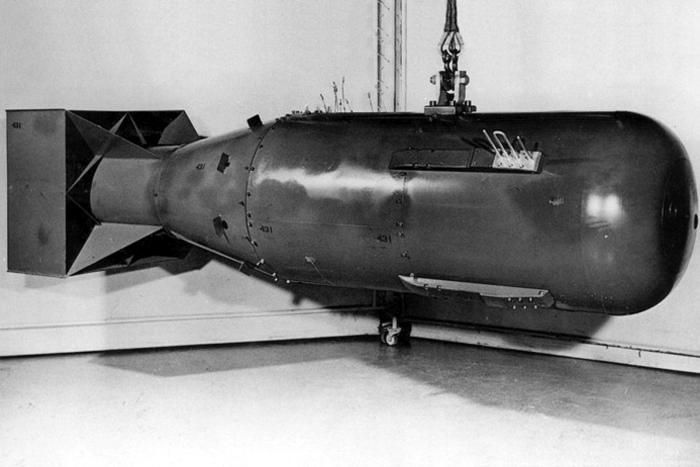
    Every human activity always has an impact on the environment . One of these impacts is the contribution of greenhouse gas (carbon dicoside) emissions.

    These impacts can occur directly (such as burning garbage) or indirectly (such as using electricity from the Steam Power Plant).

    This emitted greenhouse gas then causes the heat entering the earth to become trapped in the earth’s atmosphere, causing global warming.

    The amount of greenhouse gas emissions resulting from human activity is what is called  carbon footprint 

    Carbon Footprint Function

    This carbon footprint is important to know so that we can find out how much impact each of our activities will have.

    Thus, we can try to reduce the impact of the carbon footprint that we produce every day. And also trying to offset the impact on the carbon footprint that we have created.

    Types of carbon footprint (Carboon Footprint)

    This carbon footprint is divided into two types, namely

    1. primary carbon footprint ( primary carbon footprint )
    2. Secondary carbon footprint ( secondary carbon footprint ).

    The primary carbon footprint is the carbon footprint generated from the direct combustion process of fossil fuels, for example, the use of motorized vehicles.

    Meanwhile, the secondary carbon footprint is a carbon footprint resulting from the cycle process of the products used, from manufacture to decomposition.

    An example of this secondary carbon footprint is products that are consumed daily (usually in the form of food), so that the more products consumed, the greater the carbon footprint.

    How to calculate your carbon footprint

    How do we know how big the carbon footprint of our activities is? There are actually a lot of carbon footprint counters on the internet.

    In general, there are many things that can be included in calculating your carbon footprint . For example, for calculating the carbon footprint of individual or household activities, the activities calculated can include food consumption, travel activities, and household electricity consumption.

    Consumption of these foods includes whether the products consumed have high carbon footprint levels or not.

    Foods that contain a high carbon footprint are usually meat, while foods that contain a low carbon footprint are usually vegetables.

    The following is the carbon content of several types of food, as quoted from the Environmental Working Group (EWG).

    The carbon footprint of travel activities can include the type of vehicle used, whether private vehicles (cars or motorbikes) or public transportation (buses, trains, or planes).

    If using a private vehicle, the carbon footprint calculation will also include the type of fuel used.

    Quoted from the Energy Information Administration (EIA) in the United States, this is the large amount of greenhouse gas emissions from various fuels

    • avtur is 2.20 kg CO2 / liter
    • biodiesel is 2.50 kg CO2 / liter
    • diesel fuel is 2.68 kg CO2 / liter
    • gasoline is 2.35 kg CO2 / liter

    So to find out how big our carbon footprint is from travel activities, we can calculate it from how much fuel is used.

    Meanwhile, for household consumption, in general, the carbon footprint is calculated from the number of kWh of electricity used in one year.

    The carbon footprint for household electricity consumption then depends on the type of power plant used, whether using coal, diesel fuel , nuclear, or using renewable energy (for example solar, wind, geothermal, or hydropower).

  • The Theoretical Physicists Behind the Development of the Atomic Bomb

    The Theoretical Physicists Behind the Development of the Atomic Bomb

    Talking about the early development of the atomic bomb in the 1940’s, there are two names of great physicists who are worth mentioning:

    • J. Robert Oppenheimer
    • Werner Heisenberg

    Oppenheimer became a central figure in the development of the atomic bomb in America, while Heisenberg in Germany — where the two countries were at odds with each other.

    Interestingly, both Oppenheimer and Heinsenberg were theoretical physicists by nature and had never “worked on a real project”.

    J. Robert Oppenheimer

    J. Robert Oppenheimer

    Oppenheimer works in two important areas of modern physics at the same time:

    • In quantum mechanics, he coined the Born-Oppenheimer Approximation for the wave function of particles
    • While in general relativity, he pioneered the modern theory of neutron stars and black holes

    Werner Heisenberg

    Heinseberg is clearly no less great than Oppenheimer.

    He won the Nobel Prize in physics for his contributions in establishing the foundation and foundation of quantum mechanics.

    One of his most famous discoveries was the Heisenberg Uncertainty Principle, which broke the understanding of classical physics in seeing subatomic particles.

    The Atomic Bomb Project

    Both Oppenheimer and Heisenberg are both “forced” out of their comfort zone.

    They broke out of the habit of scribbling paper and thinking theoretically about physics, becoming the leaders of the most ambitious project aimed at ending the Second World War.

    Yes, even though they are opposite, their goals are the same. The difference is only whether America or Germany succeeded in making the atomic bomb and ending the war.

    However, the most important lesson is not that.

    In my opinion, an important lesson from Oppenheimer and Heisenberg is that learning something theoretically does not mean limiting oneself to just a paper or paper scribbles.

    Both Oppenheimer and Heisenberg shared distant visions. It’s not just looking at physics in the mortal world, but also about applying it to the real world.

    Hiroshima Nagasaki Bombing

    End of the Atomic Bomb Race

    In the end, Heisnberg did lose the race to develop the atomic bomb.

    His laboratory exploded during a chain reaction experiment in breaking up uranium nuclei. But he still came back and continued that research.

    Until finally he and his team of scientists were caught by the United States soldiers on the Alsos mission, so he could not continue the development of the atomic bomb.

    Meanwhile, at the same time Oppenheimer was getting very fast progress both in getting a chain reaction, as well as the production of uranium and plutonium as the main “fuel” of the atomic bomb.

    On July 16, 1945, the first attempt to detonate the atomic bomb of the Manhattan Project, led by Oppenheimer, was successful.

    And following that success, after three weeks, the atomic bomb was ready to be brought by US troops to be detonated in Hiroshima and Nagasaki in Japan.

  • 6 Engineers Who Revolutionized the World’s Electrical System

    6 Engineers Who Revolutionized the World’s Electrical System

    All the technology that you use today, will not function without electricity . The study and development of electricity was long before the first industrial revolution began.

    Here are 6 engineers who are pioneers in the world electrical system revolution.

    1. Michael Faraday

    Michael Faraday

    In 1831, Faraday discovered the phenomenon of electromagnetic induction. The results of his experiments are now the basis of modern electronic technology.

    2. Alessandro Volta

    In 1800, Volta published the electronic device “voltaic pile” which became the forerunner of battery technology

    3. Georg Ohm

    Ohm showed that the electric current flowing in a conductor is proportional to the voltage and inversely proportional to the resistance.

    His name is immortalized as the unit for electrical resistance.

    4. Andre-Marie Ampere

    Andre-Marie Ampere

    Ampere conducted a theoretical and practical study of electric currents. Because of his services, his name is immortalized as a unit of electric current.

    5. Gustav Kirchoff

    German physicist who studied the characteristics of electric currents in conductors.

    His famous contribution is Kirchhoff’s Law, where the amount of current entering the branch is equal to the amount of current flowing out.

    6. Nikola Tesla 

    Tesla was the engineer who made the AC power system widely used today.

    Contributions include AC electric motors, electricity distribution, and many others.

    Thus the discussion about the six engineers who revolutionized the world’s electrical system. Hopefully useful and inspire us all.

  • Marcian Ted Hoff, Founder of the Microprocessor

    Marcian Ted Hoff, Founder of the Microprocessor

    Marcian Ted Hoff is the father of the inventor of the microprocessor. Thanks to his findings, he changed the world of technology to become increasingly rapidly developing.

    The microprocessor is one of the most influential inventors in technological developments.

    Without a microprocessor, there might not be computers, cell phones, or the internet.

    Luckily Marcian Ted Hoff invented the microprocessor.

    Marcian T. Hoff was born in Rochester-New York, in 1937.

    He studied electrical engineering and earned a Ph.D from Stanford University.

    Hoff then joined Intel Corporation to develop a series of integreted circuits for electronic calculators.

    Hoff then had the idea of ​​creating a universal processor on a single microchip, on special circuits.

    From these results, the microprocessor was born.

    Until now the microprocessor continues to be further developed to process data faster and to use a wider range.

  • Water Pollution: Types, Impacts on the Environment and Solutions

    Water Pollution: Types, Impacts on the Environment and Solutions

    Water pollution is a condition in which a decrease in water quality is caused by harmful substances such as chemicals or microorganisms.

    In some cases of severe water pollution, this condition can cause water to be toxic and dangerous to humans and the environment.

    This pollution can occur in water areas such as rivers, lakes, seas, aquifers, or other water areas.

    Buffer water is polluted due to the main characteristic of water which is easy to dissolve materials. It also makes harmful chemicals dissolve in the water and cause pollution.

    Water can be said to be polluted by looking at indicators such as:

    • Physical parameters,
      parameters related to the observed physical conditions of the waters, including color a, smell, temperature, taste, and turbidity
    • Chemical parameters,
      parameters relating to the chemical conditions contained in these waters. These parameters include the pH, organic substances, and the amount of heavy metals in water.
    • Bacteriological Parameters ,
      These parameters can include the number of coliform, puristic, and pathogenic bacteria in water.

    Types of Water Pollution

    Water pollution  can be classified into 4 types of pollution. Here are the types:

    1. Contamination of microorganisms

    Microorganism contamination is caused by microorganisms in water areas.

    Microorganisms such as phytoplankton or zooplankton can cause pollution if there are too many of them to reduce water quality.

    Pollution can be marked by the color of cloudy water, due to lack of oxygen content in it.

    2. Inorganic contamination of plant nutrients

    The cause of inorganic pollution of plant nutrients is closely related to the use of inorganic fertilizers and pesticides on plants.

    Chemicals such as phosphate, or nitrogen can contaminate and contaminate waters. This of course will endanger the survival of living things around these waters, including humans.

    3. Contamination by inorganic chemicals

    Similar to inorganic pollution of plant nutrients, this pollution is also caused by the use of inorganic chemicals used by humans.

    This pollution is usually caused by the use of high levels of salts, acids and toxic metals such as lead, cadmium, mercury.

    4. Contamination by organic chemicals

    This pollution is caused by organic chemicals that are often used by humans daily, such as plastics, oils, cleaning fluids, detergents and so on.

    In the use of a small scale, maybe the impact of using these materials will not be felt directly, but over time the effect can cause damage to the ecosystem around the stream.

    One of them is the death of animals or plants due to damage to water quality.

    Its Impact on Life

    Pollution in water areas can cause many problems in human life. This is due to water pollution.

    • Water pollution can trigger landslides, erosion and flooding.
    • Disruption of environmental balance
    • The occurrence of damage to aquatic ecosystems, which has an impact on the death of water biota
    • The emergence of disease in dirty water areas
    • Reduced supply of clean water sources

    How to prevent pollution

    We can prevent water pollution by doing the following things

    1. Do not throw household products such as cleaners, beauty products, medicines, car fluids, paints, and lawn care products in drains.
    2. Avoid and reduce the use of pesticides on plants
    3. Reduce consumption of plastics and single-use materials, use materials that are more environmentally friendly

    That is the discussion of the article on pollution in the waters, let’s continue to take care and love our environment. Hopefully useful.

  • Understanding the Meaning of Economic Bubbles

    Understanding the Meaning of Economic Bubbles

    There is a phenomenon in economic studies called economic bubbles or bubble economy . This phenomenon occurs in many countries and has a long history. In this article we will study the general definition of a bubble economy or economic bubbles and some of the events in which the phenomenon of economic bubbles occurs.

    According to its basic concept, economic bubbles or bubble economy refers to a situation where the price of a product or asset in a certain market segment experiences an unusual or unnatural increase in value/price, and occurs in a relatively fast time.

    There are many examples of economic bubble phenomena that occur and involve different economic sectors, including the housing sector or better known as housing bubbles and the stock market or stock bubbles .

    In its development, there have been many studies that examine more comprehensively the concept of the bubble economy , including the question of what is meant by an unreasonable price increase and how to categorize time as relatively fast. However, we will not discuss this in this paper.

    The following are some examples of events that illustrate the phenomenon of economic bubbles .

    One of the classic examples of the bubble economy phenomenon occurred in the 1637’an era known as The Tulip Mania .

    Since the late 1590s, tulips have become one of the commodities imported from Turkey to the Netherlands. Later, this flower became phenomenal in the Netherlands and became one of the trendsetters , especially as a decoration on clothing. Because of the high charm of tulips in the eyes of the public, the demand for these flowers soared rapidly with increasing public demand, until its peak in the early 1637’s.

    The high demand, which is not matched by the availability of tulips, has made the price of tulips soar to the equivalent of 40 times the average salary of Dutch workers per year. Unfortunately this did not last long, especially when market participants holding tulips started selling the flowers to the market and other market participants followed suit, causing the price of tulips to plummet within a month. It is said that after the incident, the price of tulips was not more expensive than the price of a red seed.

    Economic bubbles in the 1997-1998 Asian economic crisis.

    Not a few studies have stated that the 1997-1998 Asian economic crisis was caused, among other things, by the bursting of the economic bubble, considering that in the late 1980s and mid-1990s, interest rates in developing countries in the Asian region tended to be high, far above interest rates. interest offered by developed countries.

    The high interest rate is seen as an attraction by investors, resulting in a very large capital inflow to developing countries, including South Korea, the Philippines, Indonesia, Thailand, and Malaysia. As a result, the economic growth of these countries increased rapidly to be in the range of 8% to 12%.

    Even so, the high growth was solely due to the large inflows of capital, not supported by investment in the real sector and productive assets owned by these countries. In other words, the economic fundamentals of these countries can be said to be porous.

    As a result, when the Central Bank of the United States began to raise the benchmark interest rate ( Fed rate ) after being able to recover from the domestic economic recession, the flow of funds that previously existed in Asia began to move rapidly towards the US market which was considered more stable.

    In addition, the higher the interest rate ( Fed rate ), the stronger the US$ exchange rate against other countries’ currencies. These two factors led to massive capital flight from Asia. In the end, this caused a panic rush in the banking sector, when many people collectively withdrew the cash they had stored in commercial banks, resulting in the collapse of Asian currencies.

    The case of the economic bubble that hit internet-based companies ( .com companies ) in the mid-1990s to early 2000s.

    Another example of the occurrence of economic bubbles in the modern world is the period from the mid-1990s to the early 2000s. At that time technological developments entered a new phase, where there was a boom in internet-based technology companies. This period is also known as the era of The New Economy , which was marked by the emergence of internet – based companies or better known as . com companies .

    When these companies began to go public , the value of their shares skyrocketed many times over, offset by high expectations of market participants and the general public for the success of the new economic era. At that time, all issues related to the internet and online became the main topic of every conversation with optimistic tones.

    Unfortunately, all of these things are not followed by prudent company management , solid financial foundations, and optimal analysis of operating profit/loss calculations; in other words, the focus of attention is the marketing factor alone.

    Until when the United States Central Bank ( the Federal Reserve ) again raised its benchmark interest rate in the 1999-2000 range, these companies began to lose financial strength. This was exacerbated by the number of start-up companies that posted large losses in their financial statements.

    In the end, all public expectations did not materialize, and the economic bubble burst. Records say there is more than US$ 8 trillion evaporated in the market. Even big companies like Amazon.com, Cisco System, Priceline.com, to Yahoo! experienced a decline in stock prices by more than 90% (Jimenez, Alvaro, Understanding Economic Bubbles , 2011).

    Furthermore, there are several theories that try to explain the characteristics of the economic bubble, one of which is the research conducted by Thompson and Hickson.

    The study conducted by the two mentioned two types of bubbles , namely short -term informational monopoly bubbles . This type of economic bubble is usually characterized by the absence of an increase in the supply of products/assets. These bubble characteristics are also known as mini bubbles .

    These bubbles tend to occur through market manipulation mechanisms by market participants who have information about certain assets/products. With financial strength, certain market participants began to speculate on the asset. This attracted the attention of other market participants and began to hunt for similar assets, resulting in a drastic increase in the value/price of the asset in the market.

    This condition is usually unpredictable from the start and it is not known how long it will last. Therefore, this phenomenon is not accompanied by an increase in supply to offset demand .

    Furthermore, the bubble will burst when the perpetrator performs a massive asset disposal, thereby dropping the price/value of the asset.

    As we know, there are at least two behaviors ( economic behavior ) that we can find in market participants, namely those who make decisions with a long-term horizon and prioritize the fundamental factors of an asset, and market participants who focus more on short-term profits, by making purchases. asset at a low price and release it again when the price is high (market participants of this type are known as speculators).

    In this case, the phenomenon of The Tulip Mania can be categorized as short-term informational monopoly bubbles .

    Meanwhile , the next bubble is a long-term government involved bubble , which tends to last longer and is characterized by an increase in product/asset inventory.

    Bubbles like this usually occur as a consequence of taking or changing economic policies (monetary and/or fiscal) and other policies by the relevant authorities.

    However, different from the first type of bubble , here policy makers have calculated and calculated the impact of implementing the policy, both positively and negatively, thus including anticipatory steps as compensation for these impacts.

    The case of .com companies is an example of long-term government induced bubbles . This is evidenced by the growing number of .com -based companies even today, but with capitalization that is not accelerating as fast as in this case (Thompson, E., and Charles R. Hickson, Predicting bubbles, Global Business and Economic Review , Vol 8, 2006).

    In closing, the phenomenon of economic bubbles ( economic bubbles or bubble economy ) has occurred since several centuries ago until now. These bubbles can occur due to purely speculative factors, but can also be caused by the emergence of consequences for economic policies taken by policy-making authorities. **

  • Understanding Economic Growth: Characteristics, Factors and Measurement Methods

    Understanding Economic Growth: Characteristics, Factors and Measurement Methods

    The economic growth of a country is closely related to the welfare of its people which also becomes a benchmark for whether a country is in a good economic condition or not.

    Simon Kuznets himself stated that economic growth is a condition in which a country is able to increase its production based on technological progress which is accompanied by an adjustment of its ideology. The following is a more complete explanation of the Theory of Economic Growth, Starting from the understanding, characteristics, factors to the measurement steps:

    Understanding Economic Growth

    Economic growth is an increase in the value and amount of production of goods and services calculated by a country in a certain period of time based on several indicators, such as the increase in national income, per capita income, the number of workers that is greater than the number of unemployed, and the reduction in poverty levels.

    Economic growth can also be interpreted as a process of continuous change towards better conditions in the economic conditions of a country. The economy of a country itself can be said to be growing if the economic activities of its people have a direct impact on the increase in the production of goods and services.

    By knowing the level of economic growth, the government can then make plans regarding state revenues and future development. Meanwhile, for business sector players, the level of economic growth can be used as a basis for making product development plans and resources.

    Economic Growth Theory

    In its development until now there are various theories of economic growth. This theory itself appears a lot to explain the growth cycle as well as the factors that directly influence an increase in the national economy by experts. Among the many theories that have emerged, here are some of them:

    1. Neoclassical Theory

    Neoclassical theory or also known as the Solow-Swan model of economic growth because it was originally introduced by Adam Smith, then put back by Robert Solow and TW Swan. This theory states that there are three main factors that influence economic growth including capital, labor, and technological developments.

    This theory also believes that an increase in the number of workers can increase per capita income. However, without developing modern technology, this increase will not have a positive impact on national economic growth.

    2. Classical Theory

    Classical theory has developed since the 18th century. Its originator is a prominent figure named Adam Smith who stated that the economy of the population in a country will reach its highest point when using a liberal system consisting of two main elements, namely population growth and output.

    This concept was later refuted by David Ricardo who stated that population growth did not have a positive influence on national economic growth, on the contrary, it would only increase the productive workforce, thus resulting in a decrease in worker wages.

    Classical economic theory was born as the first milestone in economic thought which is used as a scientific discipline. This theory arises because of the weaknesses and shortcomings of previous economic theories.

    3. Historical Theory

    This theory was developed by a number of economists including Karl Bucher, Werner Sombart, and Frederich List with different views, but both are centered on the economic activities of society.

    According to Karl, the relationship between producers and consumers affects national economic growth, this relationship itself occurs in cities, communities, closed household levels, to the world.

    Meanwhile, Werner Sombart classifies the role of society in economic growth, from the closed economic stage, the industrial growth stage, to the capitalist stage.


    Factors Affecting Economic Growth

    Economic growth is a process of changing the economic conditions of a country on an ongoing basis towards a better state within a certain period of time. Find out what factors really play an important role in influencing economic growth:

    1. Natural Resources (SDA)

    Natural Resources or something that comes from nature includes soil fertility, location and composition, natural wealth, minerals, climate, water resources, to marine resources. For economic growth, the availability of abundant natural resources is very good in supporting development.

    Natural resources themselves are further divided into three types including Biological Natural Resources (resources that come from living things both from animals and plants. Examples of biological natural resources include chickens, cows, vegetables, rice, corn, cotton, wood, tea, coffee, to fish, non-biological natural resources (resources that do not come from living things.

    Examples are water, sunlight, air, soil, mining materials, petroleum, and natural gas), natural resources that can be or are recovered (Examples of these resources include animals, plants, trees, and fish, Natural resources that cannot be recovered) renewable resources (resources that are limited because they are formed by natural processes over a long period of time (petroleum, coal, and natural gas), lastly, eternal natural resources that will never run out (examples of these resources include water, air, sunlight, etc.) sun, wind, waves, tides, and geothermal).

    2. Human Resources (HR)

    Human Resources play a very important role in economic growth. Human resources or also abbreviated as HR are productive individuals who act as drivers of an organization, both within companies and institutions.

    It acts as the main element of the organization compared to other elements such as technology and capital, because it is humans who will then control these other factors. Human Resources itself is not solely calculated based on the number but rather on its efficiency. In encouraging Human Resources to work efficiently, there are several things that can be done:

    • Motivation of Human Resources (HR)  – Change and development will not occur without the awareness of each party. Therefore, motivating Human Resources (HR) is one of the things that must be done.
    • Adjust the Work to the Abilities and Interests of Human Resources (HR)  – Human Resources (HR) performance will be less productive if they accept assignments that are not in accordance with their abilities and interests. Therefore, they must be smart in choosing and determining their position according to their abilities and interests in something.
    • Training Programs  – Providing training programs to Human Resources (HR) will also help improve their skills. The training program must be well structured and must be right on target and in accordance with valid data. Guidance on valid data will then produce optimal output.
    • Periodic Evaluation of Human Resources (HR)  Performance – In controlling the performance of Human Resources (HR) within the specified period, it is necessary to have an evaluation so that they are introspective and try to improve and improve their work to maintain their position.

    Human Resource Economics can also be defined as the science of economics which is applied to analyze the formation and utilization of human resources related to economic development.

    3. Capital Accumulation

    The accumulation of capital as a supply of reproducible factors of production. Capital accumulation is the process of adding to the stock of human-made physical capital in the form of equipment, machinery and buildings. If the capital stock increases within a certain time, it is also called capital accumulation or capital formation.

    The relationship between Capital Accumulation and economic growth itself can measure aggregate capital accumulation from the gross capital formation (gross investment) minus depreciation, both of which are within the scope of the Gross Domestic Product (GDP) component.

    In the Harod-Domar model of economic growth, an increase in the saving rate allows more investment, which then leads to a higher rate of economic growth in the medium and short term.

    4. Managerial Personnel and Production Organization

    Production organization as an important part in the process of economic growth which is then closely related to the use of production factors in various economic activities. Production organization is also carried out and regulated by managerial personnel in various daily activities.

    5. Technology

    Technological change is considered as one of the most important factors in the process of economic growth, because technological change and progress is closely related to changes in production methods. It will eliminate the boundaries of time and space which then gives rise to new industries that take advantage of technological developments.

    This is what then results in economic movement, if initially the exchange of goods was done physically, now this exchange is also happening through the media of technology. Economic movements that occur later will indirectly affect economic growth.

    At the macroeconomic level, technological developments play a role in contributing to economic growth and encouraging economic development in a better direction. The development of information technology will also indirectly strengthen the competitiveness of a country in developing its economy.

    The companies in it can then increase national income which can later be used to support the welfare of its residents. Therefore, technological changes will increase the productivity of Human Resources (HR), capital, and other production factors.

    6. Political Factors and Government Administration

    Weak political and administrative structures are a major obstacle to a country’s economic development. Politics that are in an unstable condition and a corrupt government will certainly hamper economic progress.

    In addition, the social aspects of people’s lives such as behavior, attitudes, work motivation, community views, or community institutions, legal order and the composition and incorrect implementation of laws and regulations are also factors that hinder economic progress. So it does not support the implementation of economic growth. Therefore the law should be implemented in a consistent and orderly manner.


    How to Measure Economic Growth

    The economic growth of a country can be measured by comparing the Gross National Product (GNP) and Gross Domestic Product (GDP), in the current year with the previous year. These two benchmarks help in calculating the total output of a country’s economy.

    Meanwhile, according to Todaro and Smith (2004) there are three main factors or components that affect economic growth, namely capital accumulation, population growth (growth in population), and technological progress (technological progress).

    Meanwhile, how to measure the economic growth of a country can be used the following formula:

    Gt = ((PBDt – PBDt-1) / PBDt-1)) x100%.

    Information :

    Gt    = Economic Growth Rate

    PBDt       = PDB value period t

    GDPt-1 = GDP value of the previous period

    In addition, in encouraging economic growth, there are several factors that influence it. Among them, are human resources, natural resources, science and technology, culture and capital resources.


  • Definition of Functional Integration and Examples

    Definition of Functional Integration and Examples

    Functional integration is a form of social integration. Therefore, functional integration is always related to the differences that exist in society, especially differences related to certain functions in a society or social institution. This social integration is structured in a structured manner, so that each individual has a role to maintain and maintain safe, peaceful, and peaceful social relations. Thus, functional integration is always focused on the needs of the community in order to run safely, fairly and stably.

    So, functional integration is integration that occurs because of the functions in society that must be carried out properly and correctly. However, social integration can be realized if we as a society are able to prioritize these functions, so that it can produce integration in society. A simple example of functional integration is the existence of community groups who work as fishermen, businessmen, farmers, and others, all of whom will carry out their respective functions, so that the needs of each community can be properly met.

    Examples of Functional Integration

    To make it easier to understand functional integration, you need to look at the examples below. So, what are you waiting for, immediately see examples of functional integration.


    1. Integrated Betawi and Sundanese in order to meet food and industrial needs

    The first example of functional integration can be seen in the people of Jakarta with their Betawi ethnicity and the people of West Java with the Sundanese. The two tribes carry out functional integration to meet the supply and availability of food in their respective regions. In addition, the industry in West Java can develop because of the support that comes from Jakarta.

    In this case, the intended functions are commodities and food availability and industrial development. If food commodities cannot be fulfilled, the prices of food ingredients can soar, so that people will find it difficult to get decent food. Meanwhile, in terms of industry, the industry will not develop without the help of the nearby regions. The development of an industry can open up new jobs.

    These two different tribes prove that with differences they can work together instead of bringing each other down. With the cooperation of the two tribes, the needs of the community, be it food or work, can be met.

    2. Regions of West Java and Aceh that are integrated with each other so that the need for tea and coffee can be met

    After the first example is the difference between two tribes, now the second example is the difference between two regions, namely the Aceh region and the West Java region. The two regions carry out functional integration with the aim of meeting the needs of tea and coffee. Tea and coffee are drinks that are already known by the people of Indonesia, from teenagers to adults. Therefore, the supply of tea and coffee in an area must be balanced so as not to experience a shortage.

    The Aceh region is very well known for the quality of coffee beans that have a distinctive aroma and taste. In fact, coffee beans from Aceh have been exported to several countries. Meanwhile, the West Java region is very well known for the quality of its tea. The quality of tea in West Java is unquestionable, especially if you drink the tea directly at the tea plantations, the taste will be more delicious. The taste of coffee and tea is indeed unique and liked by many people, so stock must always be there.

    Therefore, the Aceh region needs quality tea from West Java so that the availability of tea in Aceh does not run out. Likewise, the West Java region requires coffee with a distinctive aroma and taste so that it takes coffee from the Aceh region. The two complementary regions will make tea and coffee in each region not run out.

    3. The Bugis and Javanese Tribes Integrate with each other to meet the needs of agriculture and marine products

    The next example that shows the existence of functional integration is the good relationship between the Bugis and the Javanese. The two tribes cooperate with each other in terms of meeting agricultural and marine needs. In terms of food, agriculture and marine affairs must complement each other so that each individual is able to eat a balanced diet. By eating a balanced diet, a child will experience maximum growth and development.

    The Bugis are very well known for their marine catches because the Bugis tribe’s residence is close to the sea. Meanwhile, the Javanese are also known for their quality agricultural products. Therefore, the Bugis and the Javanese are working together to meet the needs of the local community. The Bugis will take agricultural products from the Javanese and the Javanese will take marine products from the Bugis.

    With this cooperation, the Bugis people can feel the taste of agricultural products that come from Javanese farmers. In this case, agricultural products that enter, such as vegetables, beans, rice, and others. While the incoming marine products, such as salmon, lobster, tuna, and others.

    When the availability is met, it is a sign that the community’s needs in fulfilling balanced nutrition must be met. So, do not underestimate the importance of putting aside capital and prioritizing the needs of the community.

    4. Functional Integration in the Field of Global Competition

    As an era develops, global competition becomes more stringent. Not only global competition is getting tougher, technology is also changing to become faster and more sophisticated. Every country must be quick to adapt to the times, because if we don’t adapt immediately, our country will be left behind by other countries.

    To adapt to the times, functional integration can be done. With functional integration, global competition can be overcome immediately. For example, in terms of promoting a product, it can be done through social media where the whole world will know the products sold in the world market. The more people know about domestic products, the greater the opportunity to export goods, so that the state treasury can increase.

    In this case, the social media in question, such as Twitter, YouTube, Instagram, and others. In fact, this social media can be played through the smart phones we have, so we play social media anytime and anywhere.

    With the presence of social media, it can present a  startup  in the digital world. Social integration between social media and digital developments can build  start-ups  that are able to compete with older companies. The birth  of this startup  will open up job opportunities for the community.

    5. Functional Integration in Business Cases Through Application of the Principles of Usefulness

    Functional integration can not only be done to meet the needs of an area or community. Functional integration in the business world can be implemented through the introduction of products based on their uses. By doing this, consumers will know the functions and advantages of the product so that the product being marketed is selling well.

    For example, the isotonic drink product,  Pocari Sweat  , wants to introduce its products to consumers by providing as much information as possible about the advantages and uses of this isotonic drink when compared to other isotonic drinks. The more often you spread the advantages of a product to consumers, the greater the chance if the product is selling well in the market.

    To inform about the uses and advantages of a product can be through social media. This is because the information disseminated through social media will be easily known by many people. Information spread through social media will make it easier for a product company to communicate with consumers.

    This communication is very important to do because it can build a company. The more advanced the company, the more its products will be known by many consumers.

    Functional Integration Benefits

    Functional integration has several benefits that can be felt directly by the community. Below will be explained some of the benefits of functional integration.

    1. Bringing forth New Collaborations

    As previously discussed, functional integration is a collaboration to meet the needs of the community based on the differences that exist in society. Cooperation is very important to do because it can strengthen brotherhood ties, facilitate communication, and prevent conflicts between community groups and community groups or regions between regions.

    The existence of this cooperation not only creates peace, but also has a positive impact on society or a region, especially in the economic field. An area or community will benefit if the goods derived from the cooperation can be sold or sold in the market.

    In fact, on a wider scale, the birth of this new cooperation will increase the state’s income through an exported product. Exported products indicate that these products are already known by the world community. Social media has become a liaison or media to introduce these products to the world community. The increase in state income makes the country have foreign exchange reserves that can be used to develop the country.

    2. The Needs of a Region and Society Are Fulfilled

    Every need of the community in an area cannot be fulfilled just like that. In other words, there will definitely be some needs that cannot be fulfilled in an area, so that the people of that area cannot feel those needs. For example, Aceh is well known for its coffee quality and West Java is known for its quality tea. To meet the need for coffee, West Java ordered coffee from Aceh and to meet the need for tea, Aceh ordered it from West Java.

    The needs that can be met in an area make the people of the area able to feel a product that comes from another area. Not only that, products from other regions will always tell their own story for the local community. So, every local community with other regional communities must be able to understand each other.

    The fulfillment of a community need in an area makes people’s lives safer, more peaceful, and peaceful, so that unity and integrity can be realized.

    3. Giving Caring Attitudes and Behaviors Towards Others

    Functional integration is related to cooperation that can have a good economic impact. However, it turns out that functional integration has benefits not related to economics. The benefit is to provide the attitude and behavior of the community so that they continue to care for others. This caring attitude and behavior makes people always want to help others who are in trouble.

    There will be many people who will be helped by this caring attitude and behavior. The thing that needs to be underlined in caring for or helping others is that there is no need to differentiate between ethnicity, race, culture, country, and religion when caring for or helping others. If we discriminate between tribes, races, cultures, countries, and religions before helping others, it can trigger offence between people, so it is possible that a conflict will occur.

    Caring for each other can be done, starting from our closest environment, such as neighbors, friends, or relatives. If we are used to helping others, we will instill a desire to help others.

    4. Improving the Nature of Nationalism

    All the benefits of functional integration can be felt by fellow citizens. Not only that, with functional integration, we will get used to increasing the nature of nationalism. The nature of nationalism is important for every member of society because the nature of nationalism can build the life of the nation and state.

    The nature of this nationalism can be in the fields of economy (doing cooperation), education (educating and teaching people who have not been able to go to school), social (providing assistance in the form of food or money), and many more.

    5. Opening Jobs

    The existence of a new collaboration carried out by a community group with different backgrounds can produce a company. Every company that is built definitely needs employees to run its production. It takes employees that will open up new jobs.

    The more jobs available to the community, the greater the welfare of the community. This community welfare will reduce social inequalities that exist in the community.

    Conclusion 

    Functional integration is a form of social integration, so that functional integration can be said as a thing in the form of cooperation carried out based on differences, be it differences in the roles of society, ethnicity, region, and so on. With functional integration, fellow people can live safely, peacefully, and peacefully. Therefore, to maintain unity we must work together so that we can complement each other.

  • Kakeibo, Japanese Tricks to Manage Finances

    Kakeibo, Japanese Tricks to Manage Finances

    Kakeibo is a Japanese concept art of financial management that teaches us how to save more by reducing the amount of spending each month.

    Why learn from Japan’s Kakeibo?

    Hundreds of years ago, Japan was famous for its agricultural production in the traditional way. Japan has changed now, even famous for its very advanced technological developments.

    Japan is the country with the highest cost of living in the world. This phenomenon occurs because the level of competition between residents is hard. That is why Japanese residents are required to manage finances as perfectly as possible. This is where Kakeibo comes into play

    Instead of buying new trending clothes every month, they are better off squandering the extra cash and collecting it to buy more than just clothes.

    Understanding Kakeibo: Origins, Recording Plans, Targeting Savings, and Character Discipline

    Kakeibo is basically a concept of managing finances where we are required to record all our income, our expenses in detail. Kakeibo does not use applications or technology in its financial records, but instead writes with a notebook.

    The main goal of this financial record is to achieve the target of how much money is saved at the end of the month. The average person who implements the Kakeibo financial system is able to accommodate up to 35% more money

    Fumiko Chiba, a Japanese writer who wrote the book “Kakeibo: The Japanese Art of Budgeting Saving Money. Fumiko stated that the challenge in Kakeibo is to manage hard, be more disciplined to reduce the amount of non-essential expenses, then focus on habits and decisions.

    Kakeibo became famous in 1904. It was a Japanese journalist, Hani Motoko, who had popularized Fumiko Chiba’s book Kakeibo and attracted the attention of many people.

    Chiba also said that Kakeibo was made to make things easier for women. Especially housewives. Kakeibo gives freedom to women, meaning that women can be trusted to make wise decisions in managing finances even in the traditional way.

    The basic understanding of Kakeibo is to get rid of the thought of how to buy the things you want to buy. Replace these thoughts with more attention to other things that are more important.


    4 Basic Questions In Kakeibo

    Before starting to apply Kakeibo, there are 4 questions that must be answered first. Everything must be answered in order, not randomly or swapped

    1. How much money do you have? / How much do we earn each month?
    2. How much would you save? / How much target money do you want to save?
    3. How much do you spend? / How much do you spend each month?
    4. How can you make things better? / How do you make things better?

    Starting from the first question to the last is the order of the process of managing Kakeibo’s finances. The last question is the stage where you have to do an evaluation at the end of every month, if something goes wrong.

    For example, your initial target is that you can save 200 usd per month, but after calculating you only get 150 usd. Then you should start evaluating your financial records .

    Maybe you still spend too much money to hangout  with friends or other reasons. So in the next month, you try not to do the same thing in order to reach the savings target.


    4 Kakeibo Budget Allocation Posts

    1. Survival / Basic Necessities

    Which includes basic needs: Food, clothing, transportation, internet quota, vitamins & medicines, masks, toiletries, debt.

    1. Optional / Secondary Need

    Which includes secondary needs: Eat at a restaurant, snacks, buy clothes that are trending , home decor knick-knacks, new gadgets , hobby supplies, and vacations.

    1. Culture / Educational needs and add insight

    Which includes educational needs: Books, courses, visits to museums, magazines/newspapers.

    1. Extra / Additional production

    Which includes additional expenses: Wedding or birthday gifts, vehicle service, doctor fees, assistance to the needy (Alms)


    Recording Income, Expenditures, and Savings Targets Every Month

    Applying Kakeibo requires two notebooks, namely a large notebook and a small notebook.

    A large notebook is useful for recording all income, expenses and savings in detail.

    While a small notebook is useful to carry wherever you go so that when you are shopping, you immediately record your expenses right away so you don’t forget and are accurate.

    Large notebooks should reflect the following:

    1. Monthly Income Plan

    You can make notes in the form of bullets or tables. You must keep a record of your income.

    Starting from basic salary, bonus salary, debt repayment, sales, and so on, everything is recorded at once along with the date on which you received the income.

    1. Set aside savings

    Savings records are divided into two, namely monthly savings and daily savings. Monthly savings are recorded in the form of targets. Create a record table containing date, description, monthly and daily.

    For example, a monthly savings target of 500 thousand, after that we make it in another column of this month’s calendar from the 1st – 31st. Every time we save money in a day, then cross out the stairs on that day.

    The purpose of this daily savings is so that our savings will increase. Prepare an envelope to enter daily savings. While monthly savings are taken at the end of the month, which is the rest of our money.

    1. Pay debt

    Expenditures to pay debts must be set aside from the beginning of the month, so they are not mixed with other expense records.

    1. Allocate 4 Expenditure Budget Items

    Record all expense categories in separate tables. For example, in the table of Basic Needs (survival), sub-categories are also included. For example, eating, how much food was spent on that day and continued to be recorded until the end of the month.

    Other categories of needs are also recorded in their respective tables. That’s what a little notebook is for. Then in the big notebook, there is one big table that summarizes all the total records of each need.

    1. Prepare 5 Envelopes

    The envelopes are divided into savings target envelopes, basic needs envelopes, secondary needs envelopes, educational needs , and additional needs. Each envelope contains approximately how much money is needed to meet these needs.


    End of Month Evaluation and Consistency

    One of the most difficult to implement is the application of a disciplined and consistent character. Kakeibo requires us to be disciplined in managing our finances. Demanded to be wiser in spending money.

    All records of both income, expenditure and savings are intended so that we know accurately the amount of our money. Usually people will not realize that they have bought a lot of clothes, then after that the money just seems to disappear for some reason.

    With records, we know where the money has gone, so when buying expensive things that are not needed, feelings of regret grow.

    The evaluation process at the end of the month is a warning to ourselves that we need to improve ourselves. The process of forming this character will definitely not be easy, and it will take a long time for us to keep ourselves consistent and disciplined.

    But believe me everything will feel worth it. In the end the savings will be useful for us in the future.

    Thus the article about the hormone of happiness from  Tumbooh.com , please share it with your friends if this article is useful. thanks.

  • Signs You’re Burnout and Need Healing from Work

    Signs You’re Burnout and Need Healing from Work

    Fatigue after work is common for everyone. However, fatigue that is experienced continuously and has a negative impact on job performance can be dangerous. This fatigue is called burnout .

    Some people take burnout lightly . And if it happens continuously, a person’s mental health can be disrupted. Doing daily activities is not optimal.

    One way to overcome burnout is by healing . What is healing ? What activities can be done while healing ?

    This article will review the signs of burnout and how to heal to get rid of burnout. Check out the review below!

    Definition of Burnout and Healing

    Burnout

    Burnout is a feeling of being physically, emotionally, and mentally overwhelmed by the situation at hand. Burnout can be caused by fatigue from work or study that is forced continuously.

    Healing

    Healing is an English term that refers to healing. Healing can mean physical healing and/or mental/emotional healing. Healing does not mean the answer to all mental problems. Healing can be done as a way other than therapy in psychology and mindfulness .

    Signs Someone is Burnout and Needs Healing from Work

    1. Easily Emotional and Offended

    You may not be aware of this sign. However, when people around you start telling you that you get angry easily for no reason, it’s a sign that you need to stop for a moment to think about it.

    2. Decreased Self-Confidence (Insecure)

    When you burnout , chances are you are not performing well at work. Criticism from colleagues and superiors will often come. When you are tired and get bad comments, your self-confidence can decrease.

    Even when you look good, burnout can cause cynical thoughts to arise about your own work. You will feel dissatisfied with the results of your work and self-performance.

    3. Easily Tired and Difficult to Concentrate

    Are you tired and frustrated because you keep feeling tired? That’s a sign you’re burnout . You feel the work is endless even though before you feel enjoy living it.

    Because you feel tired, you choose to divert your mind to other less productive activities. Easily distracted, lose focus, and engage in non-essential activities are also signs of burnout . This usually happens not just once, but has become a pattern that you often do, consciously or unconsciously.

    4. Feeling like you don’t want to do anything

    During burnout , you will feel very tired, even just doing simple activities such as taking a shower or cleaning the room. Just wanting to get out of bed was very hard.

    You feel like you don’t have any energy. This is due to the accumulated fatigue without rest so your body sends a signal that it wants to rest more. Don’t think yourself lazy, okay… Just listen to your body and take a break. If you can only do light activities or want to take a complete break from work, go for it!

    5. Decreased Appetite and Enthusiasm

    When you feel excessively tired, your mind can ignore hunger signals. That’s why when you’re overwhelmed, you just panic and can’t feel what your body really needs.

    The spirit that you usually have is also instantly lost. Burnout can cancel all planned activities because of the lack of enthusiasm to do something.

    6. Lost Work Motivation

    Motivation to work can be lost when you burnout. It’s because you’ve been doing repetitive work that at one point, you feel really bored.

    Try to do work with a different method than what you usually do. Set the layout and decoration of the desk. Making small changes can help you feel new so you can get out of the boredom phase.

    7. Often Sick

    Because you are tired and skip meals, your body will physically weaken. Excessive stress will also make the immune system decline which can eventually make you sick.

    Not just once but in a certain time you will get sick several times. This could be a sign that you need to rest and use your time off for healing .

    Healing Activity Ideas

    Healing is one way to deal with burnout. No need to waste money on healing , here are simple healing ideas that you can do yourself.

    1. Practice Deep Breathing

    Sometimes when we are anxious, breathing occurs quickly and quickly. Resetting your breathing can help relieve anxiety . How to do deep breathing is:

    • Sit or stand position with your chest slightly puffed out
    • Inhale deeply through the nose. Set the count according to your strength. Do it slowly.
    • Hold your breath for a count of five
    • Exhale slowly through the nose
    • Repeat until you feel calm

    2. Enjoying Nature

    There are many options that you can visit while taking a break from work. You can visit the beach, mountains, or even just take a walk in the rice fields near your house.

    Enjoying nature can make you feel grateful for the beauty of nature that you may have ignored because you are too busy working. Enjoying the blue sea and the sound of the waves or gazing at the green trees can also provide a calming effect.

    3. Write a Gratitude Journal

    When you take time off and rest, try to reflect on your feelings in a journal. Try to use positive words about your current job.

    If you are confused about where to start, try using less negative words first. The use of words in an emotional journal is important in shaping your mindset and interpretation of the work you are doing.

    Just mention what you are grateful for from your current job. What makes you happy at work? What was the initial motivation when you took the job? Writing gratitude has been shown to calm the soul and reduce anxiety.

    4. Soak in warm water

    Taking a warm bath after a long day can relieve stress. Warm water can release stiffness and tension in the muscles. A tired mind can be refreshed with the aroma of aromatherapy fragrances.

    Just have hot water and aromatherapy candles on the side of the tub. You can also prepare your favorite face mask to wear while bathing. Play soothing music for deeper relaxation. Also prepare hot chocolate drinks for warmth from the body.

    Besides being cheap, you don’t need to go out of the house to do this healing .

    5. Communicate with Boss

    There is no better healing than rearranging your work. Maybe all this time your workload is too heavy and you just realized it.

    Try talking to your boss about your current condition. Offer options by asking for some adjustments if possible. You can also ask your boss to modify your work routine or ask to be transferred to another division. If you feel uncomfortable, think about the option of applying for a job in a new place.

    Ask your boss for their opinion on these options. If your boss is a professional, he will respect the situation and find the best solution for you.

    Well, that’s a sign that you need healing and sinaumedia version of how to heal . What is your favorite activity while healing? Submit your answer in the comments column, yes!

  • High-Income Skills That Students Can Learn On Their Own

    High-Income Skills That Students Can Learn On Their Own

    Everyone wants to have a high income. To achieve a high income, you need to hone the skills needed.

    No need to wait to pass. As a student, you can actually learn high-paying skills during college .

    In addition to still having free time to learn new skills , you can find additional income by applying the skills you have learned on a self-taught.

    Skills That Students Can Learn Self-taught Even If They Are Busy in College

    If you are a student who wants to increase your income, you can prepare yourself by learning new skills . You can practice your new skills through online courses spread on YouTube or other online courses .

    The following are high-income skills that are suitable for increasing student income .

    1. Sewing/ Fashion Design

    Sewing isn’t exactly a high-paying skill. However, sewing skills can be an additional point for those of you who are pursuing fashion design.

    Fashion design is the skill of making patterns and designs of clothes. You can learn it through online courses spread on Coursera, Udemy, and YouTube.

    The skills you will hone are creativity , drawing, recognizing clothing materials, clothing proportions, and mixing and matching colors and motifs.

    Reporting from Indeed , the average salary of a fashion designer in Indonesia reaches 5 million per month. Meanwhile, if you have sewing skills, you can start your own clothing business. Isn’t it fun?

    2. Coding Skills

    Coding is a highly sought after skill. As a coder/programmer, you are required to at least speak English, read source code , and debug .

    Complex computer languages ​​are not necessarily difficult to learn. You can get many learning resources, from YouTube, the web, free courses, even paid ones.

    With coding, you can apply the skills to create applications, software, build websites , and so on. You’ll fit in if you like technology and things about computers.

    The average salary for programmers is no joke. For junior programmer positions only, you can get 1000 USD .

    3. Digital/ Social Media Marketing

    Do you like watching FYP Tik Tok? Like to monitor Twitter trends ? or see a new trend on Instagram? If so, it means that you are suitable for the position of Social Media Marketing.

    The job market is currently wide open for those of you who have digital marketing skills . This skill requires expertise in using social media advertising. You are also required to be able to do digital market research and understand social media algorithms.

    By studying digital / social media marketing , you can earn from 700 thousand to 14 million or an average of 5 million per month.

    4. Creating Social Media Content

    The skill of creating social media content is now also being loved by young people. Many of them become content creators for their own Instagram accounts or corporate social media accounts.

    Many internship and freelance opportunities are opened by companies for you to create interesting content to increase sales.

    To be able to earn high income from creating social media content, you need to hone your company branding skills , always update with social media trends, social media language, and visual messages.

    Because it requires a lot of expertise, content creators and social media influencers have high salaries of around 5-6 million rupiah.

    5. Writing

    As a student, you are used to making writing assignments. Writing is a skill that can apply in any industry.

    You can practice writing skills with various writing formats. You can start practicing from writing short articles, writing fiction, science articles, and news. You can also apply writing skills to become a UX writer,  copywriter , film script writer, or online media article .

    Try posting your writing on a personal blog or web or send it to famous media. If it has been published, try to collect the results of your writing to be used as a portfolio. You can use the writing portfolio to work freelance , apply for an internship, or even work regularly at a media company.

    The average writer’s salary ranges from 500 usd up, depending on the industry in which they are involved. While the UX Writer could be higher, which is around 2000 usd.

    6. SEO Skills

    SEO or Search Engine Optimization basically requires the expertise to create content that can appear easily from search engines. SEO techniques require skills to create or write SEO content, read analytics, keyword research, and optimize site and web page addresses.

    This skill is very much needed in today’s digital marketing era. SEO skills can help increase web rankings in the SERP so that the visibility of the web, service, or product being sold can reach the audience directly on the first page of search results.

    You can learn SEO from various websites, books, YouTube tutorials, and paid courses scattered on the internet. By honing your SEO skills , you can have the opportunity to earn high income as an SEO Specialist or Content Writer , which is around 1000 usd.

    7. Graphic Design/ Art/ Illustration

    Graphic design and illustration skills are skills that you can learn independently without going through graphic design courses. These skills are needed in many companies in various industries.

    Graphic designers are often asked to create logos, packaging designs, advertisements, and visual works across a variety of media. Not only expertise in using design software such as Photoshop, Adobe Illustrator or Corel Draw, you need to hone this skill with knowledge of layout or layout of design elements, color combinations, and drawing skills.

    If you have your own style of illustration or design, you can sell your work by opening a pre-order. You can market yourself through a portfolio via Instagram uploads or other portfolio websites.

    Graphic designers have a salary range of 1000 usd. If you are freelance and already have a mature portfolio, you can set prices above 5 million per project, you know!

    Well, those were 7 high-income skills that you can learn during college .

    Even if you don’t take a major that matches your skills , you can hone it through online courses .

    Moreover, yes, a skill with a high salary? Try writing your answer in the comments column! Don’t forget to share with your friends so they can learn together!

  • Reach Your Target using the SMART Method

    Reach Your Target using the SMART Method

    The SMART goals method is one method for making goal setting . The word SMART comes from the words Specific , Measurable , Achievable , Relevant , and Time-bound

    The use of the SMART method will make the target look more clear and specific. In addition, the use of this method will also make it easier for someone to know the progress. 

    For this reason, many businesses also use the SMART method.

    Metode SMART Goals

    So how do you make SMART targets? Check out the following explanation, come on!

    metode smart

    1. Specific

    The first stage is specific. When you set a goal, be specific about it. 

    Avoid writing targets that are general and ambiguous. Make the target in detail and describe it clearly. 

    In making a specific target you can formulate it using 5W.

    • Who : Who is involved in this target?
    • What : What target to achieve?
    • Where : Where do you want to achieve this target?
    • When : When will this target be achieved?
    • Why : Why should achieve this target? 

    2. Measurable 

    A target must be measurable . This means whether the target you want to achieve has progress from time to time. 

    To find out this progress, you can ask yourself questions like what are the indicators of success and how do you know if you have achieved the target. 

    Measuring this progress is not only useful for knowing progress. This step can also be a reminder whether you are still on the right path to achieving your target or not. 

    In addition, you can also use this stage as a guide to determine the next step. 

    3. Achievable

    There are some people who have big dreams . However, there are also some people who are afraid to dream too high. 

    A good target is an achievable target . This means that you can achieve that target. Not too easy but not too difficult either. 

    An achievable target will make someone feel challenged to achieve it. However, there is still a possibility to achieve it. 

    Then how do you determine achievable targets . Try asking yourself. Do I have the ability to achieve this target? If not, what am I missing?

    4. Relevant

    SMART targets are relevant targets. 

    Sometimes when we have a target, we will try hard to achieve that target. Unfortunately, we become oblivious to our other targets. 

    As a result, chaos ensues. The target you are fighting for turns out to be irrelevant and actually destroys other targets. 

    Therefore, there are tips so that the targets you make are relevant to other targets you want to achieve. Ask yourself.

    • Is this the right time to reach that target?
    • Could this goal be useful?
    • Am I right to reach the target?
    • Are these targets in line with other targets that you want to achieve?

    5. Time-bound

    A SMART goal must also be time-bound . This means that there is a certain duration to reach a target. 

    You need to determine when you will start the target and when the target must be completed. With this time limit , there will be urgency to complete the target. 

    In other words, this time limit can be self-motivation in order to achieve a target. 

    Closing

    So, those are the 5 SMART goals methods from Sinaumedia . You can use the method above when you want to determine the target you want to achieve. These SMART goals not only make targets clearer but also make targets more structured. 

  • Impact of Bullying Actions on Victims, Perpetrators, and Witnesses

    Impact of Bullying Actions on Victims, Perpetrators, and Witnesses

    Who would have thought that bullying does not only have a negative impact on the mental health of victims of bullying , but also has an impact on the perpetrators and witnesses.

    Everyone will be found guilty. Everyone will go to court to give a statement if bullying cases go to law.

    the following is the impact of bullying on victims, perpetrators, and witnesses.

    Victim

    A teenager who is often bullied at school will be a closed person, low self-esteem, and tend to avoid other people. They will feel that they are worthless, and do not want to be friends with him.

    Of course, such thinking is a very wrong prejudice. That way they think school is a place of discomfort and even hate school.

    Instead of having a passion for learning at school, school becomes a place where we stop learning and academic achievement will decline.

    Those victims will find it hard to trust anyone . Pain in the heart will cause depression and trauma which if it gets worse it must be handled by professionals.

    Of course this will be a serious problem because the pain that is unbearable makes the victim grow a sense of revenge, hurt himself, and commit suicide.

    Perpetrator

    At first it could be just joking with friends, but a teenager may not understand the extent to which we joke without even realizing that we have crossed the line.

    Bullies are those who find it difficult to control their emotions. When there is a problem they tend to vent their anger on other people , the victims of this bullying .

    If someone has been defeated by anger, conscience has been defeated by emotion, then what arises is only a hard and merciless personality.

    A rude personality like this will lead someone into a fight without mercy.

    Because they feel they are used to juvenile delinquency, the environment will continue to lead to alcohol and drug abuse.

    Academic achievement will also decline, to seek other emotional outlets such as trying early sex or out of wedlock.

    Witness

    A witness who is also a human being of course also has a conscience that can feel the emotional conditions of the people around him.

    This means that they actually feel guilty when watching bullying , but are also unable to do anything or are confused about what to do.

    Over time , feelings of guilt and regret will arise in their hearts, especially if the bullying case has gotten worse.

    Witnesses of bullying are also likely to experience health problems, such as depression and excessive anxiety .

    Emotional problems when they cannot be controlled will likely end up in the decision to seek an outlet.

    The outlet that can be done when conditions are unstable is juvenile delinquency such as alcohol and drug abuse.

    Closing

    It’s not just one party, or you alone, but everyone in the bullying circle is wrong for not being able to stop bullying .

    One thing is certain and we need to always remember, that God is just, and those who commit crimes against fellow human beings will certainly receive learning .

    Everyone deserves to accept the same behavior, we can be friends with everyone. Bullying is merely an outlet for anger when someone is tired.

    Doing bullying does not make you a strong person, it actually indicates that you are a coward and weak person because you are unable to stand on your own without demeaning others.

    Thus the article about the hormone of happiness from  Sinaumedia.com , please share it with your friends if this article is useful. thank you.


  • 5 Recommended Movies That Describe Loneliness Accurately

    5 Recommended Movies That Describe Loneliness Accurately

    As social beings, humans need to interact and build relationships with other people. Building social relations is one way for humans to survive. Lack of social relationships and interactions makes a person feel lonely .
    What exactly is loneliness? What are the signs?

    In this article, you will be invited to identify the definition of loneliness, the symptoms of loneliness, and movies that accurately describe loneliness. Listen to the end, yes!

    Loneliness and its Signs

    Loneliness according to Healthline is a negative feeling experienced when the need for contact and social relationships is not met. There are two types of loneliness, namely social loneliness and emotional loneliness .

    Social loneliness is related to unfulfilled access to social networks, for example loneliness in the absence of close relatives or friends.

    While emotional loneliness is related to a lack of closeness and intimacy in an exclusive relationship. This type of loneliness is often experienced by singles.

    Loneliness is also common among people who are older, live alone, or use social media.

    Physical and mental signs of loneliness according to Healthline include:

    • Lack of energy and enthusiasm
    • It’s hard to focus
    • Insomnia and sleep disorders
    • decreased appetite
    • Having doubts and losing hope
    • Easily hurt
    • Impulsive shopping or engaging in other impulsive habits (example: always drinking alcohol to get rid of negative feelings)
    • Desire for physical warmth (hot drink, warm bath, or blanket)

    Recommended Movies about Loneliness

    Sometimes seeing someone who is lonely is very difficult from the outside. To find out you can watch the following films to find out how someone is experiencing loneliness and what they really need.

    Here ‘s a list of movie recommendations that accurately depict loneliness .

    1. On The Beach At Night Alone (2017)


    Title : On the Beach at Night Alone (2017)

    Director: Hong Sang-soo

    Writer: Hong Sang-soo

    Cast: Kim Min-hee, Young-hwa Seo, Jae-yeong Jeong

    Duration: 1 hour 41 minutes

    Genre : Drama

    IMDb Score : 6.8/10

    This indie film by director Hong Sang-soo talks about a young actress (played by Kim Min-hee as Young-hee) who has an affair with a married director. This film describes how the feeling of losing the actress after the director left.

    The film is set in two countries, the city of Hamburg, Germany and the province of Gangwon-do, South Korea. Both settings are depicted in winter, so the melancholy atmosphere adds to Young-hee’s sadness.

    This movie can be pretty boring if you like movies with lots of dialogue and fast pace. However, to describe the feeling of loneliness, this film manages to show several scenes of drinking alcohol, traveling alone, and daydreaming. This film is increasingly sure to raise the issue of loneliness by ending the scene of the actress who enjoys sleeping on the beach alone.

    2. Can You Ever Forgive Me? (2018)

    Title: Can You Ever Forgive Me? (2018)

    Director: Marielle Heller

    Authors: Nicole Holofcener, Jeff Whitty

    Cast: Melissa McCarthy, Richard E. Grant, Dolly Wells

    Duration: 1 hour 46 minutes

    Genre : Biography, Comedy, Crime, Drama

    IMDb Score : 7.1/10

    Can You Ever Forgive Me? (2018) tells the story of a writer named Lee Israel. Usually Melissa McCarthy gets witty roles but in this film, she plays a lonely and desperate writer.

    Failure and a fading career make Lee along with his cat and the help of his best friend, Jack Hock (played by Richard E. Grant) forge letters from famous people. He then sold the fake letters to collectors at high prices. However, his efforts aroused suspicion. He was eventually investigated by the FBI and received a sentence.

    This film very accurately depicts two lonely friends. Lee and Hock need each other for drinking buds. They accept each other because no one wants to accept both. Several scenes also depict the emptiness of Israel. For example , the scene sitting alone in the room or when Lee is drinking at the bar without friends.

    3. Christine (2016)

    Title : Christine (2016)

    Director: Antonio Campos

    Author: Craig Shilowich

    Cast: Rebecca Hall, Michael C. Hall, Maria Dizzia, Tracy Letts, J. Smith-Cameron

    Duration: 1 hour 59 minutes

    Genre : Biography, Drama

    IMDb Score : 6.9/10

    Christine (2016) set in 1974 tells the story of a local television reporter, Christine Chubbuck (Rebecca Hall), who committed suicide while on air .

    The relentless suffering, from her self-diagnosis of being unable to conceive, unrequited love, the betrayal of a friend, and her stagnant career made her snap the trigger of a gun to her head.

    This film shows the complexity of Christine’s emotions during the ups and downs of life. This film is very accurate in depicting depression and loneliness that is neglected. Prepare your mentality before watching this film, OK!

    4. Shame (2011)

    Title : Shame (2011)

    Director: Steven McQueen

    Writers: Steven McQueen, Abi Morgan

    Cast: Michael Fassbender, Carey Mulligan, James Badge Dale

    Duration: 1 hour 41 minutes

    Genre : Drama

    IMDb Score : 7.2/10

    Shame (2011) tells the story of Brandon Sullivan (played by Michael Fassbender) who has an addiction to sex and pornography.

    What makes this film apt to describe loneliness is how addiction is Brandon’s way of eliminating the emptiness of his day as a company employee. He also often changes partners and is never serious about his love relationship.

    Director Steve McQueen’s frustration is expressed time and time again as Brandon tries to get rid of his pornography collection and head to the club to remedy his failed relationship with his ex and sister, Sissy Sullivan (played by Carey Mulligan).

    Fassbender’s great acting earned him the title of Best Actor at the Venice Film Festival. This film is rated for adults only so it is worth watching for those of you who are old enough and interested in addiction and loneliness issues.

    5. Her (2013)

    Title : Her (2013)

    Director: Spike Jonze

    Author : Spike Jonze

    Cast: Joaquin Phoenix, Amy Adams, Scarlett Johansson

    Duration: 2 hours 6 minutes

    Genre : Drama, Romance, Sci-Fi

    IMDb Score : 8.0/10

    In a world full of technology, all human interaction is minimal. Loneliness often becomes Theodore (played by Joaquin Phoenix).

    This film tells the story of Theodore, a writer who orders an assistant program on his computer. The loneliness he experienced made him feel “full” again when he began to fall in love with the voice of the digital assistant program (voiced by Scarlett Johansson).

    In addition to the unusual story idea, Theodore’s story has actually been experienced by many people today. This is what makes this film relevant to watch.

    That’s the recommendation for a movie about loneliness according to sinaumedia. Have you watched any of them? Which do you think hit the most? Submit your answer in the comments column, yes!

  • The Concept of Deflation and Its Impact on the Economy

    The Concept of Deflation and Its Impact on the Economy

    In the previous material, we have studied the definition of inflation, its triggering factors, and economic policies to overcome it. In this article, we will study the situation opposite to inflation, namely negative inflation or deflation and its impact on the economy.

    1. DEFINITION OF DEFLATION.

    In principle, deflation is a general decline in output prices . This situation is actually a common thing in the economy.

    It should be noted that when the price decline lasts only for a moment, it cannot be said to be deflation.

    Likewise, when price declines only occur in certain sectors even though they last for some time, as long as they do not have an impact on the aggregate economy, it cannot be said to be deflation.

    Therefore,a deflative situation has the potential to harm the economy if a general decline in prices occurs over a period of time (some literature mentions at least 1-2 quarters), and is reflected through a decline in the consumer price index (CPI) or GDP deflator .

    The decline in prices could be caused by several factors , including:

    1. productivity increase .
    2. application of modern technology .
    3. policy changes , for example through regulatory deregulation.
    4. decrease in the price of input goods .
    5. excess capacity ( excess supply ).
    6. weak demand .

    If the deflation that occurs is caused by points 1 to 4, what usually happens is mild deflation ( benign deflation ) which does not pose a threat to the economy , because falling prices tend to be followed by an increase in economic growth.

    The simple explanation:

    • when modern technology is applied to increase productivity, it will result in cost and time efficiency . This efficiency will cut production costs and operating costs , thereby lowering the selling price of output that must be borne by consumers.
    • in turn, this situation will trigger an increase in consumption (an increase in the quantity of output sales), as well as encourage an increase in economic growth . This also applies if there is a deregulation policy that encourages productivity growth.

    It is different if the price decline lasts for a long time and causes the CPI and GDP deflator to become negative , then this situation has the potential to harm the economy (a deflative situation like this is known as a malign deflation ).

    The explanation is simple:

    • when prices have decreased for some period of time, consumers and investors will hold liquidity (choose to hold money), in the hope that prices will continue to decline in the future.
    • on the other hand, when supply exceeds demand for a long time, this results in a decrease in profit, an increase in input costs, and an increase in unemployment .

    One case of deflation was the economic crisis in the United States in the 1930s (the Great Depression ), where output prices fell by about 25%, real GDP fell by 30%, and the unemployment rate rose sharply to 25% (Brooks, Douglas H. ., and Pilipinas F. Quising. Danger of Deflation , Asian Development Bank, ERD Policy Brief No. 12, December 2002).

    2. ECONOMIC VIEWS ON DEFLATION.

    In this section we will summarize some of the economists’ views on deflation.

    2.1. The view of the monetarists.

    The monetarist’s point of view is the money supply – side cause . The occurrence of deflation can be described by the following equation:

    The view of the monetarists.

    description:

    • M is the money supply ( money supply ).
    • V is the velocity of money circulation .
    • P is the price of output, which also indicates the size of the GDP deflator.
    • Y is the quantity of output, which also shows the size of real GDP.
    • (Remember! In the previous lesson we learned that the GDP deflator = Nominal GDP / Real GDP. This means P x Y = Nominal GDP).

    The explanation is as follows:

    • If real GDP is held constant in the short term (recall material Three Model Approaches in the Study of Macroeconomics), a decrease in M ​​or V through tight monetary policy, will result in a decrease in the GDP deflator or inflation rate .
    • when the decline in the inflation rate continues to below zero , then deflation occurs .
    • For the record: tight monetary policy ( contractionary monetary policy ) is the central bank’s policy by reducing the money supply (M), or increasing the benchmark interest rate (i).

    The monetarists suggest the implementation of expansionary monetary policy ( expansionary monetary policy ) , for example by increasing the money supply through the purchase of financial assets (bonds). This policy is also known as quantitative easing .

    2.2. Irving Fisher’s Perspective (Fisher’s Effect).

    The deflative situation can also be explained by the Fisher effect, where:

    Irving Fisher's Perspective

    description:

    • i is the nominal interest rate ( nominal interest rate ).
    • r is the real interest rate ( real interest rate ).
    • nē is the expected inflation ( expected inflation ).

    The explanation is:

    • when consumers and investors still view the continued decline in prices in the future, this will result in a decrease in expected inflation as well as a lower nominal interest rate .
    • at that time, consumers and investors tend to choose to hold liquidity rather than spending on consumption or investment. This is what triggers deflation.

    2.3. The Keynesian View.

    The Keynesians view that deflation occurs because of a decrease in aggregate demand ( demand-side cause ) (note: remember the equation Y C + I + G + NX, this equation will often be found in subsequent materials; and given the large number of materials related to aggregate demand , then the review will be presented in a separate article).

    According to Keynesians, deflation is associated with an increase in unemployment, a decrease in profits and income , and the emergence of debt defaults .

    One of the important focuses of the Keynesian perspective is the theory of the liquidity trap ., where the addition of liquidity by the central bank is not able to raise interest rates and income , and encourage economic growth .

    In modern macroeconomic concepts, the liquidity trap is a situation where the nominal interest rate is zero . So if the interest rate is zero , then consumers and investors prefer to hold cash rather than invest (for example in bonds) with a 0% profit rate .

    This at the same time argues against the view of monetarists, stating that monetary policy is not effective in overcoming deflation .

    To answer this question, Keynesians suggest implementing a fiscal-stimulus policy (Eurobank Research. Is Deflation a Risk for Greece? , Economy & Markets, Vol IX, Issue 3, April 2014).

    This is an understanding of deflation and its impact on the economy. **

  • Book Review : The Subtle Art of Not Giving a F*ck – Mark Manson

    Book Review : The Subtle Art of Not Giving a F*ck – Mark Manson

    The Subtle Art of Not Giving a F*ck , a book by acclaimed New York Time selling author Mark Manson.

    Mark Manson managed to make many people change perspectives in life. Most people think of following the stereotypes that exist in society, but Mark Manson makes us ignore the stereotypes.

    Any doubts and questions about the little things in life, the book The Subtle Art of Not Giving a F*ck by Mark Manson, manages to answer them.

    The book The Subtle Art of Not Giving a F*ck has become the most purchased book in bookstores. It has been sitting in the window for the best selling book category for a long time in 2020.

    There’s a lot to be gained from the book The Subtle Art of Not Giving a F*ck by Mark Manson . The following are thoughts that we can learn from the book The Subtle Art of Not Giving a F*ck.


    An Art To Be Stupid It Means To Be Ignorant

    Thoughts of indifference sound harsh and evil, turn into a thought that increases the mental strength in us to face life.

    Don’t care is a word that Mark Manson sticks to, so that his readers no longer feel guilty for thinking so stupid or not caring. Not caring at all does not mean indifferent behavior.

    Indifference and indifferent are very different.

    In the first chapter of The Subtle Art of Not Giving a F*ck, we will explain in detail why we have to act like we don’t care at all.

    Being indifferent doesn’t mean being indifferent, not caring means being comfortable being different , as Mark Manson wrote.

    It’s not that simple, Mark Manson explains on his “don’t be special ” page. Definition of indifferent? explained in the book The Subtle Art of Not Giving a F*ck, indifference means those who are weak and timid, those who are classified as “couch potatoes”.

    Mark Manson thinks couch potatoes sometimes act like they don’t care, but they don’t really care because they’re immature. They don’t like being criticized.


    Don’t Try Too Hard

    If only we cared what other people say? Dare to follow our heart. Happy and active with our routine. It doesn’t matter if you win or lose.

    Mark Manson explained, that’s not the real value . We have to accept that the world isn’t always on our side, but it doesn’t matter.

    You’ll find the ironic fact in The Subtle Art of Not Giving a F*ck that we don’t really have to try.

    Directing thoughts on positive things: about what is better and what is superior will only remind ourselves again and again about our failures, our shortcomings, what we should have done but failed to achieve.

    Like this, if we realize that we are happy, there is no need, right, every morning to say in front of the mirror that we are happy. “Stay happy, stay healthy.” or “You are beautiful.”

    Mark Manson reminds us to be “All right, just believe in yourself today.”.


    Values ​​of Life / Principles and Values ​​of Life

    The book The Subtle Art of Not Giving a F*ck also covers the story of the world famous heavy metal guitarist, Dave Munstaine .

    Dave Munstaine had been kicked out of his band , then determined to become a musician who was far greater than the band . He devoted himself to heavy metal music and formed his own band, Megadeth .

    Dave Munstaine is considered the legendary and most influential, most brilliant heavy metal musician in the history of heavy metal music . Dave Munstaine has released more than 25 million albums, and toured around the world.

    Unfortunately the band that first kicked Dave Munstaine was Metallica , who sold 180 million copies of the album worldwide.

    Even with such success, Dave Munstaine still considers himself a failure, because he measured the value of life by beating Metallica, while his fans around the world measure Mustaine in different ways.

    Mark Manson berkata, “Do what you love, love what you do. Don’t think about awards, winning or losing. Just do it!”

    Ultimately, Mark Manson divides life values ​​into two categories:

    • Bad Values ​​/ Bad life values

    The bad values ​​of life, namely enjoyment, material success, always feeling right, and staying positive.

    Although being positive is a good attitude, for Mark Manson, negative emotions are a component of emotional health that must be present. Denying the negative side is the same as perpetuating the problem, not solving it.

    Bad life values ​​can be identified from superstitious, socially destructive, and uncontrollable beliefs . Usually comes from external factors

    • Good Values ​​/ Good Life Values

    Mark Manson mentions the values ​​of the good life , namely honesty, innovation, defending oneself, defending others, self-respect, curiosity, charity, humility, and creativity.

    The values ​​of a good life are based on facts or facts that have happened. The values ​​of a good life are also socially constructive, can be controlled, and usually come from internal factors.


    Don’t Be Special

    Because the truth is we’ve never been special.

    Mark Manson means it this way, when we feel that we are lucky. that we can do everything easily. We will begin to increase our self-confidence on a delusional level .

    Because in reality, we are not that special. We will become narcissistic, consider others below us. Mark Manson said that failure is really useful for creating a strong and successful person.

    There’s no such thing as a personal problem . When you have a problem, there is a chance that millions of other people have the same problem. Either then, now, or tomorrow. It could be a stranger, a friend, or a relative.

    You’re not the only victim. Again, as simple as that you are not special.

    Most of us can be categorized as “mediocre” in almost any area. Even if we are special in one area, the chances are that we are average or below average in other areas.

    Such is the nature of life. To be extraordinary in a field. There is no other way, other than to take the journey of dedicating our energy and time to achieve it.


    Thoughts to Be a Successful Person

    No worries.. we are all destined to be successful people . In the book The Subtle Art of Not Giving a F*ck, there is a funny question, that if everyone is successful, what does it mean to hold the title of being successful?

    The nickname of successful people is even considered the new standard of failure. Many people are afraid to accept their successful selves, because they believe that if they accept them, they will never achieve anything again.

    It never changes for the better, and their life will no longer have any meaning and this can be a dangerous thought.

    In fact, successful people, managed to become professionals in their field not because they think that they are special or belong to the category of successful people.

    On the other hand, successful people have an obsession with improving themselves again and again and never feel special.


    Closing

    The book The Subtle Art of Not Giving a F*ck doesn’t just slap us on the unrevealed realities.

    Nobody is perfect. Even human memory is an absolute inaccuracy.

    For Mark Manson, no one’s speech is 100% correct, there must be errors or system errors when we speak. So never feel that you are the most correct.

    Mark Manson’s The Subtle Art of Not Giving a F*ck uncovers the true secrets of the human mind. We just need to ignore everything. There is no need to overdo it, because in fact, we will still be fine with our stance as it is.

    Thus the article from  sinaumedia.com, please share it with your friends if this article is useful. thanks.

  • difference between zyrtec and claritin

    difference between zyrtec and claritin

    Difference Between Zyrtec and Claritin: Which is Better for Allergies?

    Overview:

    Allergies can affect anyone, and they can make you miserable. With so many over-the-counter allergy medications available, it can be challenging to know which one is right for you. Two of the most popular allergy medications on the market today are Zyrtec and Claritin. While both are widely available and effective, they work in different ways, and knowing their differences can help you choose which one to use.

    Active Ingredients:

    The primary active ingredient in Zyrtec is cetirizine hydrochloride, and Claritin contains loratadine. Both of these ingredients belong to the same class of drugs known as antihistamines, which reduce or eliminate the symptoms caused by allergies.

    Effectiveness:

    Both Zyrtec and Claritin are highly effective in treating allergy symptoms. However, they work differently. Zyrtec is a more potent medication and can provide longer-lasting relief from allergy symptoms, such as sneezing, runny nose, itchy skin, and watery eyes. Claritin, on the other hand, works more quickly and is more effective in treating mild symptoms.

    Side Effects:

    The most common side effects of Zyrtec and Claritin are similar and may include drowsiness, headache, dry mouth, and nausea. However, Zyrtec can cause drowsiness more often than Claritin. Therefore, if you need to drive or operate heavy machinery, it’s essential to take Claritin rather than Zyrtec.

    Usage:

    Both Zyrtec and Claritin are available without a prescription, and they come in tablet, syrup, and chewable forms. They are suitable for adults and children over two years old, but the dosage can vary based on age and weight. Always read the label or consult a doctor for the appropriate dosage.

    Conclusion:

    Choosing between Zyrtec and Claritin depends on your specific allergy symptoms, the severity of your allergy, and your lifestyle. If you have severe allergies and need long-lasting relief, Zyrtec might be the better option. However, if you have mild symptoms or need to stay alert, Claritin is a safer bet. Always consult a healthcare professional before starting any allergy medication.

    Table difference between zyrtec and claritin

    Criteria Zyrtec Claritin
    Brand name Zyrtec Claritin
    Active ingredient Cetirizine Loratadine
    Uses Treats symptoms of allergies, such as sneezing, runny nose, itchy/watery eyes and itching of the nose or throat Treats symptoms of allergies, such as sneezing, runny nose, itchy/watery eyes and itching of the nose or throat
    Onset of action Within 1 hour Within 1-3 hours
    Duration of action 24 hours 24 hours
    Age restrictions Not recommended for children under 6 years old Not recommended for children under 6 years old
    Side effects Fatigue, dry mouth, headache, dizziness, nausea Fatigue, dry mouth, headache, dizziness, nausea
  • Concepts of Utilitarianism, Liberalism, Libertarianism, and Socialism in Economic Policy Determination

    Concepts of Utilitarianism, Liberalism, Libertarianism, and Socialism in Economic Policy Determination

    Concepts of Utilitarianism, Liberalism, Libertarianism, and Socialism in Economic Policy Determination.

    Determination of economic policy is a classic problem that has always been a debate. The question of what policies the government should implement regarding equitable distribution of social welfare often raises pros and cons. In this paper, we will study the basic concepts that become the reference in determining policy, namely utilitarianism ( utilitarianism ), liberalism ( libertarianism ), libertarianism ( libertarianism ), and socialism ( socialism ).

    Previously, it should be noted that these concepts are multidisciplinary in nature, from the perspectives of politics, ethics, law, economics, and sociology. However, this article will only review from the point of view of economics.

    UTILITARIANISM TREE OF THOUGHT.

    The concept of utilitarianism developed in the mid-17th century until the 18th century. The main thinkers of this concept include Jeremy Bentham (1748-1832) and John Stuart Mill (1806-1873).

    The view of utilitarianism departs from two factors that influence human behavior, namely pain/suffering ( pain ) and satisfaction/happiness ( pleasure ).  These factors determine individual actions, related to whether or not the actions taken, as well as the causes of the actions themselves. It is also said that  every individual always wants happiness and avoids suffering  (Bentham, Jeremy.  An Introduction to the Principles of Morals and Legislation , Batoche Books, Kitchener, 2000).

    Thus, a  socially just policy is a policy that is able to produce  the greatest pleasure  or  total utility  for the community.  It can simply be shown in Figure 1. below.

    description:

    • The initial utility of each individual in society is represented by the line A – B.
    • The blue curve depicts the possible limit of increasing the total utility of society through government policies.
    • The shaded area (in green) is the government’s effort to increase the total utility of the community.

    Furthermore,  Mill asserts that the main purpose of a policy is to maximize utility (happiness) for the majority of society.

    Why the majority of people? Because each individual has a different goal of happiness, happiness for the many (society) becomes more important than happiness for the few (individuals).

    In determining policy, the basis used is the law of diminishing marginal utility , which states that individual satisfaction will decrease as consumption increases for a good (Mill, John Stuart.  Utilitarianism , Batoche Books, Kitchener, 2001) .

    simple example:

    • Individual A has an  income  of IDR 100,000 which can be spent on 10 servings of meatballs. According to the concept of  diminishing marginal utility , the more he consumes meatballs, the less satisfaction he gets.
    • individuals B, C, and D have an income of IDR 30,000, IDR 20,000, and IDR 15,000. With this income, each of them is only able to consume 3 portions of meatballs (for B), 2 portions (for C), and 1 portion (for D).
    • because the goal of utilitarian thought is to provide total satisfaction, then through an economic policy (eg the application of a proportional tax rate), some of the  marginal utility of  individual A will be reduced; while in individuals B, C, and D, will be added, so as to achieve the maximum total utility.

    However,  the concept of utilitarianism cannot be separated from criticism . Some of them are:

    1. The view of utilitarianism  ignores individual rights , simply because individual happiness differs from one another.
    2. The concept that solely aims to maximize happiness,  negates the ‘human’ side of the individual.
    3. Policies that satisfy the majority of people in the short term  do not necessarily provide maximum benefits in the long term.

    LIBERALISM PERSPECTIVE.

    In contrast to the view of utilitarianism which focuses on achieving the total utility of society,  liberalism sees it from an individual point of view .

    In one of his works,  John Locke (1632-1704) stated  that there are at least  three things that form the basis for achieving a liberal society , namely  tolerance and freedom in embracing beliefs, government policies at a certain level, and the recognition of individual rights as basic human rights  (Locke). , John.  A Letter Concerning Toleration , Liberty Fund, 2010).

    Locke asserts that  policy is made  not to produce the truth of an opinion, but  to ensure the security and safety of society and every individual in it.

    In addition, the view of liberalism also states that  the government must be able to regulate and manage public goods , and  ensure that each individual has the freedom to achieve their own happiness.

    In this case,  public goods  are a means of achieving public welfare, social stability, and economic efficiency. Some of the instruments in it include: national security tools (army), health and education facilities, civil security institutions, and infrastructure.

    The management of  public goods  is also what distinguishes the liberalism system from the  laissez-faire system  (classical view), which sees no need for the government’s role at all in the allocation of production factors and market intervention.

    As for one of  the characteristics of liberalism in the economy is a free competitive market , where the factors of production such as labor and capital are determined entirely by the market. In other words,  the free market mechanism is believed to be able to create effective resource allocation and produce efficient production  (Freeman, Samuel.  Liberalism , Oxford Research Encyclopedia of Politics, Online Publication, April 2017).

    Meanwhile, Rawl (1921-2002) argues that community institutions, legal order, and public policy stand on equality. The problem he raises is how to determine ‘equality’ objectively.

    Furthermore,  Rawls mentions that the formation of a community structure begins with cooperation, discussion, and bargaining between individuals, which ends with a mutual agreement; This is where public policy is created.

    Therefore,  public policy must prioritize increasing the degree of individuals who are most vulnerable or in the lowest position in society , or also called the  maximin criterion  (Rawls, John.  A Theory of Justice , 1971).

    VIEW OF LIBERTARIANISM.

    Libertarians argue that  the government must make policy through the application of the law against crime, as well as enforce the agreement voluntarily.  On the other hand,  the government does not need to intervene in terms of income redistribution.

    In one of his studies,  Friedman (1912-2006) states that people who receive minimum intervention from the government will tend to be more efficient and equal .

    In addition,  the market mechanism must work as freely as possible , because it is the key to economic efficiency; so that when a transaction occurs between two parties voluntarily, it will only be realized when each party benefits (Friedman, Milton.  Capitalism and Freedom , 1962).

    While  Nozick (1938-2002) asserts that the main focus of a policy is on the process of economic activity , not on the  outcome ; so that when there is an injustice in the income distribution phase, that is where government policy is applied to overcome the problem.

    On the other hand, when every process of economic activity has been running fairly, the government does not need to think about fairness in   economic outcomes .

    So it can be concluded that  libertarians view equality in opportunity as a more important factor than income equality.  Therefore, the government must ensure that the policies taken allow each individual to have equal opportunities in economic activity (Nozick, Robert.  Anarchy, State, and Utopia , 1974).

    SOCIALIST VIEW.

    If the perspective of liberalism and libertarianism lies in the position of the individual in economic activity, then  in the perspective of socialism, society is in control.  In socialism  there is no recognition of individual property rights related to economic capital  such as land, buildings, and means of transportation. In other words, true freedom is under the complete control of society.

    Marx (1818-1883) and Engels (1820-1895) argued that the workers ( labor force ) were in a vulnerable position to be exploited by capitalists , mainly related to economic productivity. The capitalists will also try to keep the wages of workers as low as possible.

    Therefore,  government intervention in economic activity is an absolute must  to achieve equality for every economic actor.

    While responding to the criticism that too much government intervention has a negative impact on the economy, socialists assert that in principle each party can make a collective agreement in determining the value of justice for each party (Marx, Karl, and Friedrich Engels.  The Communist Manifesto , NY: SoHo, 2013).

    Thus the perspectives of utilitarianism, liberalism, libertarianism, and socialism are related to the determination of economic policy. **

  • difference between zygote and foetus

    difference between zygote and foetus

    Understanding the Biological Difference between Zygote and Foetus

    If you are interested in the human reproductive system, you have probably heard of the terms zygote and foetus. While both are related to the process of human conception and pregnancy, they are two different stages in the development of an individual. In this article, we will help you understand the biological difference between zygote and foetus.

    Zygote

    The zygote is the first stage of development after fertilization. When the sperm cell from the father fertilizes the egg cell from the mother, they fuse together, creating a single cell called the zygote. The zygote contains all the genetic material from both the mother and father, and this marks the beginning of a new individual’s life.

    The zygote undergoes a series of cell divisions, which eventually form a cluster of cells known as the blastocyst. The blastocyst consists of two parts; the inner cell mass (ICM) and the outer layer of cells, also known as the trophoblast. The ICM is responsible for forming the embryo and the foetus, while the trophoblast is essential in the formation of the placenta.

    Foetus

    The foetus stage comes later in the process of human development. It starts around the ninth or tenth week of pregnancy, and it marks the beginning of a fully-formed human being. Before this stage, the cells are still dividing and differentiating, working to form the various parts of the body.

    During the foetal stage, the different body systems, such as the respiratory, digestive, and nervous systems, continue to develop and mature. The foetus also grows rapidly in size, with recognizable human features such as eyes, ears, and limbs becoming evident.

    Conclusion

    In summary, the zygote is the single cell that forms after fertilization, while the foetus is the stage where the embryo has developed into a fully-formed human being. Understanding the difference between these two stages is crucial in understanding the biological process of human conception and pregnancy. As such, it is essential to keep yourself informed and educated on the subject to make more informed decisions in terms of reproductive health.

    Table difference between zygote and foetus

    Feature Zygote Foetus
    Definition The initial developmental stage after fusion of a sperm and an egg The later developmental stage after the zygote has implanted in the uterine wall
    Size Smaller than 0.1mm Approximately 30 cm in length by the end of the 9th month
    Number of cells Only one cell Trillions of cells
    Organ development No organs have formed yet All major organs have formed
    Duration From fertilization to implantation (about one week) From implantation to birth (about 9 months)
    Viability outside the womb Not viable May be viable (with medical assistance) after 24 weeks
  • difference between zygote and embryo

    difference between zygote and embryo

    Understanding the Difference between Zygote and Embryo

    The journey of human life starts with a fertilized egg that eventually develops into a full-blown human being. However, many people often confuse the terms “zygote” and “embryo.” While they both refer to stages in human development, there are significant differences between them. In this article, we’ll explore these differences and what they mean for the developing fetus.

    What is a Zygote?

    A zygote is formed when a sperm cell fertilizes an egg cell during conception. It is a single-cell entity that contains all the genetic material required to form a human being. After fertilization, the zygote undergoes a process called cleavage, where it divides into multiple cells. The cells produced are identical and have the same genetic material as the original zygote. Over time, they continue to divide and differentiate into specific tissues and organs, forming the embryo.

    What is an Embryo?

    An embryo is the stage that follows the zygote. It starts from the first development of distinct features and lasts until the end of the eighth week of gestation. During this period, the embryo undergoes significant transformation, including the development of the head and growing of the limbs. At this stage, the neural tube and the heart begin to form, and the fetus’s organs start to differentiate.

    During the embryonic period, the fetus is especially vulnerable to external influences that can negatively impact its development. These factors include exposure to toxins, infections, and poor nutrition. Therefore, mothers are encouraged to take extra care during pregnancy to mitigate potential negative impacts.

    The Key Differences between a Zygote and an Embryo

    The primary difference between a zygote and an embryo is their developmental stage. After conception, the zygote divides into multiple identical cells, while the embryo is a multicellular organism with distinct features and the start of organ formation.

    Additionally, an embryo is more susceptible to external factors that can negatively impact its development than a zygote. Therefore, it is crucial for expectant mothers to take measures such as seeking the right prenatal care to ensure their fetus’ optimal development.

    Conclusion

    In conclusion, while zygotes and embryos both play a vital role in the development of a fetus, they represent different stages of growth. Understanding the differences between these two stages is crucial for expectant mothers and those seeking to understand the process of human development. By doing so, they can make informed decisions to protect and optimize the health and growth of developing fetuses.

    Table difference between zygote and embryo

    Criteria Zygote Embryo
    Definition The first stage of development after fertilization The stage of development from the zygote to about 8 weeks of gestation
    Size Single cell Several hundred cells
    Movement Does not move Moves through the fallopian tubes and attaches to the uterine lining
    Developmental features Fertilization, cell division, formation of blastocyst Formation of major organ systems, differentiation of cells, limb buds start to form
    Growth rate Rapid cell division Slower growth compared to the zygote stage
    Duration A few days About 8 weeks of gestation
    Viability Not viable outside of the uterus Can sometimes survive outside of the uterus with medical intervention after 24 weeks of gestation
  • difference between zoo and wildlife sanctuary

    difference between zoo and wildlife sanctuary

    Difference Between Zoo and Wildlife Sanctuary

    Wild animals have always fascinated humans, and many of us want to see them up close. Zoos and wildlife sanctuaries are two places where people can interact with animals. However, there is a significant difference between the two. In this article, we will explain the main differences between zoos and wildlife sanctuaries and how they care for animals.

    Zoo

    A zoo is a place where people can see animals from different parts of the world that are kept in enclosures for public display. The primary objective of a zoo is to entertain visitors, educate them about different animal species, and promote conservation efforts. Zoos usually breed animals in captivity to maintain a sustainable population and often sell surplus animals to other zoos.

    Zoos provide a safe and controlled environment for animals that are not suited for release into the wild. However, zoos are often criticized for keeping animals in confined spaces, causing stress and behavioral issues, and not providing enough space for animals to move around freely. Some also argue that zoos do not focus enough on conservation and animal welfare.

    Wildlife Sanctuary

    A wildlife sanctuary is a place where animals are protected from hunting, habitat destruction, and other human activities. The aim of a wildlife sanctuary is to provide a natural and safe environment for animals to live, breed, and thrive. It is a place where animals can live their lives as they would in the wild, without being subject to human intervention.

    Wildlife sanctuaries do not allow visitors to enter the enclosures or interact with animals. The focus of wildlife sanctuaries is on the conservation and rehabilitation of animals. Animals that are orphaned, injured, or rescued from illegal wildlife trade are rehabilitated in sanctuaries before being released back into the wild.

    The main objective of a wildlife sanctuary is to protect endangered species and maintain biodiversity, without compromising the welfare of animals. It is a vital approach to conservation efforts and has gained popularity in recent years.

    Conclusion

    In conclusion, zoos and wildlife sanctuaries might seem similar in many ways, but the fundamental difference between them is the purpose they serve. Zoos focus on entertainment, education, and the conservation of animals, but at the cost of an animal’s freedom. Wildlife sanctuaries, on the other hand, focus on the welfare and conservation of animals without compromising their natural habitat and behavior.

    Both zoos and wildlife sanctuaries have their pros and cons, but the decision to visit and support one over the other depends on an individual’s priorities and values. However, it is essential for us to remember that animals are not ours to use for entertainment or any other purpose, and our efforts should always be toward their protection and conservation.

    Table difference between zoo and wildlife sanctuary

    Sure, here’s a sample HTML table that compares the difference between a zoo and a wildlife sanctuary:

    “`

    Zoo Wildlife Sanctuary
    Definition A facility where animals are exhibited for public viewing and entertainment A place where animals are protected and/or rehabilitated in their natural habitat
    Purpose Entertainment, education, and conservation Conservation and preservation of wildlife
    Visitors Mainly tourists and families Researchers, scientists, and wildlife enthusiasts
    Animal Management Animals are kept in enclosures and fed by zookeepers Animals are allowed to roam in natural habitats and are not fed
    Species Exhibits a wide range of animals, including exotic species Mainly local species found in the area of the sanctuary
    Focus Focus is on providing entertainment and education to the public Focus is on the protection, conservation, and rehabilitation of animals

    “`

    Feel free to edit or modify the table to suit your needs.