Author: Johannes Surya

  • Data Collection Techniques in Research Design

    Data Collection Techniques in Research Design

    Data Collection Techniques in Research Design – Have you ever collected data by means of interviews? This activity is the most important activity in a research. When the plan has been carefully prepared but the data collection and analysis activities are not carried out properly, the objectives that have been set are not achieved properly.

    In other words, data collection and analysis activities are the implementation stage in the process of conducting research. The collection and analysis of research data is based on a method or procedure so that the desired data can be collected completely from the field. The following is an explanation of data collection techniques and research data processing. Check these out!


    Definition of Data Collection Techniques

    Data collection techniques are methods used to collect information or facts in the field

    Data collection was carried out to obtain the information needed in order to achieve the research objectives. Before conducting research, a researcher usually has a guess based on the theory he uses, this assumption is called a hypothesis. To prove the hypothesis empirically, a researcher needs to collect data to be investigated in more depth.

    The data collection process is determined by the variables in the hypothesis. Data collection is carried out on a predetermined sample. Data is something that has no meaning for the recipient and still requires processing.

    Data can have various forms, ranging from images, sounds, letters, numbers, language, symbols, and even circumstances that can assist research results later.

    All of these things can be called as data as long as we can use it as material to see the environment, object, event, or a concept. Data can be divided into several categories.

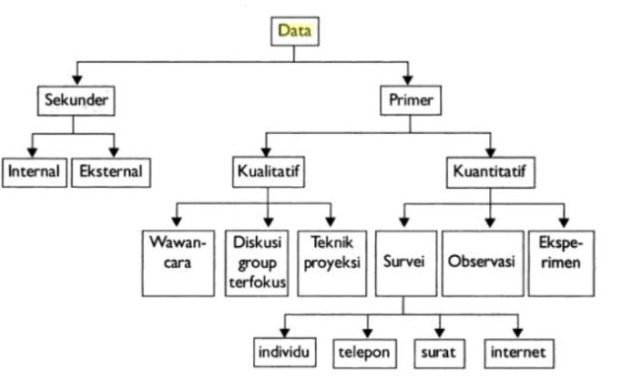
    Types of Data According to How to Obtain It

    The types of data can be categorized as follows according to how they are obtained, including:

    1. Primary data , namely data collected and processed by the researcher himself directly from the subject or object of research.
    2. Secondary data , namely data obtained not directly from the object or research subject.


    Types of Data by Source

    The types of data can also be categorized according to the way they are sourced, including:

    1. Internal data , namely data that describes the state or activities in an organization
    2. External data , namely data that describes a situation or activity outside an organization.


    Types of Data by Their Nature

    The types of data can also be categorized according to their nature, including:

    1. Quantitative data , namely data in the form of exact numbers, which can be measured ( measurable ) or can be calculated using numeric variables or numbers
    2. Qualitative data , namely data that is not in the form of numbers or data from verbal word explanations so that it cannot be analyzed in the form of numbers or numbers.

    Examples of quantitative data:

    • Data on the total number of students each year in a school
    • Data on the total sales of goods in a supermarket every day
    • Visitor data of a website
    • Tourist visit data for a province

    Examples of qualitative data:

    • Description of an area under study
    • Biographies of resource persons used as research references
    • The history of the establishment of a company under study

    Types of Data by Time of Collection

    The types of data can also be categorized according to the time of collection, including:

    1. Cross section / incidental , ie data collected only at a certain time
    2. Periodic data / time series , namely data collected from time to time to describe a development or trend of circumstances / events / activities.


    The Importance of Data Collection in Research Design

    Data collection is the recording of events or things or information as well as the characteristics of some or all elements of the population that will support and support research.

    Data is the plural form of datum. Data is information about something, it can be something that is known or in the form of an assumption. This data can also be in the form of facts depicted through numbers, symbols, and codes.


    List of Questions in the Data Collection Process

    The questionnaire is an important standard data collection tool in the form of a series of questions about a number of indicators from a number of variables that are ordered in such a way as to facilitate the interview. There are several things that must be considered before making a list of questions, namely as follows:

    • There is clarity of concepts and variables used
    • Standardization (each respondent will be asked the same question)
    • Objectivity (questions must be as neutral as possible)
    • Unit Relevance (there is accuracy in the selection of units or elements of data sources with research problems)


    Question Type

    Judging from the type of questions posed in the list of questions can be divided into several types of questions, namely:

    1. Questions about facts ( e.g. questions about Age, occupation, etc.)
    2. Questions about Opinion, for example, what is someone’s opinion about the existence of electricity entering the village?
    3. Questions about information or knowledge, for example, “Since when did electricity enter this village?”
    4. Questions about perception (this question is a question that seeks to measure how respondents judge something in relation to other things or other people).


    Data Based on the Source of Retrieval

    The list of questions cannot be separated from research, especially in the data collection process. Based on the source of data collection is divided into:

    1. Primary Data or

      data obtained or collected directly in the field by the person conducting the research or the person concerned who needs it.

      Primary data is also known as original data.

    2. Secondary Data i.e.

      data obtained or collected by people conducting research from existing sources.

      This data is usually obtained from the library or from previous research reports. This secondary data is also known as available data.


    Question Forms

    While seen from the form, the questions can be divided into three forms, namely:

    1. Closed questions are questions that are equipped with a number of alternative answers. Respondents just choose one of the alternative answers. Respondents just have to choose one of the alternatives that have been provided according to their choice.
    2. Open-ended questions are types of questions that are not accompanied by alternative answers. So the respondent is free to express the answer according to the will of the respondent.
    3. A half-open question , which is a question in which a number of alternative answers are available, it is also possible for the respondent to present an answer according to his will.

    Based on its nature, data can also be divided into two, namely qualitative data and quantitative data. Qualitative data is data that is not in the form of numbers, while quantitative data is data in the form of numbers.

    Data Based on Level of Measurement

    Based on the level of measurement, the data is divided into four, namely:

    • Nominal Data is Data that comes from grouping events based on certain categories, the difference only showing qualitative differences
    • Interval data is data that comes from objects or categories that are sorted by a certain effect, where the distance between each object is the same. In this data, not against absolute zero
    • Ordinal data is data that comes from objects or categories arranged according to size, from the lowest level to the highest level or vice versa with distances that do not have to be the same.
    • Ratio data is data that collects all the characteristics of nominal data, ordinal data, and interval data. Figures in this data, indicate the actual size of the object being measured.


    Data Collection Techniques in Social Research

    Social research is conducted to solve problems using the theory and knowledge that has been learned. Research is also a requirement for students before completing their studies.

    Through social research, we are required to apply the material we have learned to the real world and recognize the patterns that occur in society.

    When conducting research, we also need to identify the data collection techniques that need to be carried out. Data collection techniques are the methods used by researchers in obtaining data in the field. In social research, there are several techniques that are commonly used, namely:

    1. questionnaire,
    2. literature review,
    3. interview, and
    4. observation.

    Questionnaire

    Questionnaires or questionnaires are data collection techniques by asking questions to be answered by respondents, usually in writing.

    Questionnaires are used when researchers want to know the perceptions or habits of a population based on respondents. Questionnaires that are distributed must be tested beforehand to find out if the questions entered can be used as a valid and reliable measuring tool.

    In general, questionnaires are used in quantitative research analysis using SPSS or the Statistical Package for the Social Sciences which is quite complicated.

    Questionnaires can be in the form of printed or online questionnaires. Literature Study The most commonly used data collection technique is literature study. Literature study collects relevant data from books, scientific articles, news, and other credible sources related to the research topic.

    Advantages of the Questionnaire method

    • In this technique the respondent fills in by themselves so that no interview is needed.
    • In terms of cost, this technique requires a relatively low cost.
    • In terms of time, this technique saves time, meaning that it can be sent to various different places at the same time, so that the return can be received in a not too long time.
    • With this technique, respondents can more freely fill out the questionnaire, without feeling embarrassed because no one is interviewing.
    • There was no influence from the interviewer who gave the questionnaire or questionnaire.

    Weaknesses of the Questionnaire include:

    • Less flexible
    • Low rate of return of the questionnaire
    • Unable to observe the respondent’s reaction when answering the question
    • The atmosphere of the environment when the respondent filled out the questionnaire was not controllable. It is possible that the questionnaire was filled out by someone else not the respondent
    • It is difficult to control respondents to answer in accordance with the order of questions in the questionnaire
    • Unable to use complex questionnaire formats.

    Literature review

    Literature studies can strengthen the background for doing research and allow us to study previous research, so that we can produce newer research. Interviews Interviews were conducted by means of question and answer with respondents or informants to obtain information needed for research. Literature Studies can be done through:

    • Editing – Editing is the process of re-examining the data that has been collected to find out whether the data is good enough and can be immediately prepared for the next process. The purpose of editing, basically, is to eliminate errors contained in the recording in the field and is to correct it. Things that need to be edited on the incoming data include whether or not the incoming data can be read, the completeness of the filling and whether or not the sampling instructions are fulfilled as well as compatibility, whether the contents of the answers can be understood.
    • Coding – is the provision of codes for each data that belongs to the same category. Code is a signal made in the form of numbers or letters that provide clues or identity on an information or data to be analyzed. Why do we use code? the answer is to simplify the research data. For example, with a number symbol, it is possible for researchers to make comparisons between respondents’ answers easily.
    • Processing data using simple statistics – usually using several techniques such as frequency distribution (frequency distribution), central tendency, and dispersion measures such as standard deviation and variance

    Interview

    Interviews are used to explore information or subjective perceptions of informants related to the topic to be studied. Previous researchers must prepare interview questions in advance. Similar to questionnaires, interview questions need to be tested for their abilities so that researchers can obtain the data needed. The advantages of interview techniques include that they can be used on respondents who cannot read and write.

    If there is a question that is not understood, the interviewer can immediately explain. The interviewer can immediately check the correctness of the respondent’s answer by asking comparison questions or by looking at the respondent’s face or movements. Disadvantages of interview techniques are interviews require a very large cost in terms of travel and daily money for data collectors, interviews can only reach a small number of respondents, the presence of the interviewer may annoy the respondents. Types of interviews can be divided into:

    Structured interview

    The structured interview technique is an interview conducted based on a questionnaire. The questionnaire is used by the interviewer and communicates the questions as stated in the questionnaire, so that the respondent understands the intent of the question asked by the interviewer and can answer it well.

    Unstructured interview

    The unstructured interview technique is an interview conducted based on a guideline or note that only contains points or points of thought about the things that will be asked during the interview. These guidelines are called interview guidelines. In this technique, the interviewer has the freedom to formulate and ask questions or points listed in the interview guide to the respondent.

    Type of unstructured interview

    This type of unstructured interview is divided into three, namely:

    1. Interviews focus is interview is meant to clarify an issue with the research hypotheses were formulated in advance
    2. A clinical interview is an interview that is basically the same as a focused interview in terms of its implementation. The difference only lies in the theme or topic. This interview is used to obtain information about the biographies of the people who are the unit of analysis of the research problem in question. This interview is usually used in the medical field.
    3. Free interviews are interviews that have absolutely no structure. Most depend on the development of Q&A between the interviewer and the respondent during the interview

    Observation

    Observation is a data collection technique that is carried out through direct observation.

    Researchers make observations on the spot on the object of research to be observed using the five senses. Researchers are positioned as observers or outsiders. In collecting data using observation, researchers can use notes or recordings.

    Observation can be participatory

    participatory, namely when the researcher joins in and carries out activities with the object of his observation.

    Advantages of the observation technique

    The advantages of observational techniques include:

    1. The data obtained is more actual in the sense that the data is obtained from the respondent at the time it occurs,
    2. The validity of the measuring instrument can be known directly.

    Weaknesses of observation technique

    The disadvantages of this technique are:

    1. In obtaining the expected data, the observer must wait and observe until the expected behavior appears.
    2. Some behaviors, such as criminal or personal behavior, are difficult or impossible, and may even be harmful to the observer.

    Types of Observation Techniques Based on Observer Involvement

    In addition to being structured or unstructured, observation or observation techniques are also distinguished based on the involvement of observers in the target environment of observation, including:

    • Engaged Observation – In this observation the observer takes on the role of a member of the target community.
    • Observation is not involved – In this observation, the interaction between the observer and the respondent as the object of observation does not occur at all. The observer only plays a role in observing the target of his observation, from outside the environment he is observing.

    The difference between the two itself lies in the observation involved is aimed at special interests or human values ​​and interactions between humans such as the view from the perspective of the people who are in or part of the situation and special setting, besides the location or place here and now from the setting and situation. daily life as the basis for research and methods.

    A form of theory and theory formulation that emphasizes the interpretation and understanding of human existence, A logical research process that is open-closed, flexible, provides opportunities and requires constant redefinition of what is the problem, based on facts collected in a different setting. concrete aspects of human existence.


  • What is an oxygen concentrator and how does it work?

    What is an oxygen concentrator and how does it work?

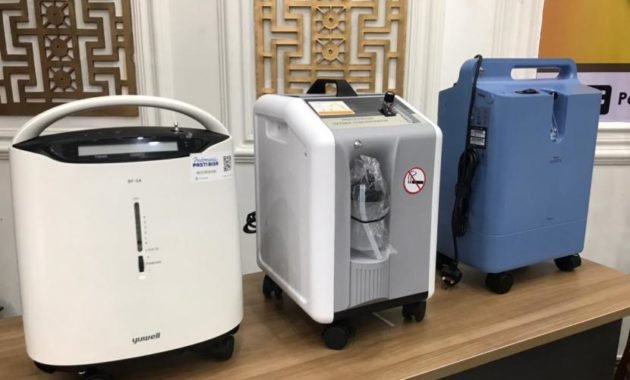
    An oxygen concentrator is a type of medical device used to deliver oxygen to a person with respiratory problems. A person whose blood level is lower than normal will often need this machine to replace that oxygen. In general, it is not recommended that you use an oxygen concentrator without a doctor’s prescription. A doctor should prescribe it after the patient has completed a thorough medical evaluation. Doctors will also usually show patients how to use these concentrators effectively while traveling and at home.

    The Oxygen Concentrator filters the surrounding air, compresses it to the required density and then delivers purified medical grade oxygen into a pulse-dose delivery system or continuous-flow system to the patient. Equipped with special filters and filters that help remove Nitrogen from the air to ensure delivery of fully purified oxygen to the patient. The device is also equipped with an electronic user interface so that you can adjust the oxygen concentration level and oxygen rate setting and then the patient inhales oxygen through a nasal cannula or a special mask.

    You normally measure the Oxygen Concentrator output in LPM (liters per minute). Your doctor will determine the level of oxygen you need, which can vary at rest, during sleep, and when you exercise.

    What are the Uses and Reasons for Choosing an Oxygen Concentrator?

    What are the Uses and Reasons for Choosing an Oxygen Concentrator

    There are many reasons to choose an Oxygen Concentrator and doctors can recommend oxygen therapy to their patients for a variety of medical conditions. Normally, your lungs absorb air oxygen, transferring it to your bloodstream. If you recently had blood tests or pulse oximetry to assess your oxygen saturation level, and you find you have low blood oxygen levels, your doctor may recommend short- or long-term oxygen therapy.

    You may be wondering what oxygen concentrators are used for? Acute conditions usually require short-term oxygen therapy. This condition usually lasts a short time. They may have sudden symptoms versus a chronic condition where things happen gradually. However, some respiratory or chronic conditions require long-term oxygen supplementation.


    Acute Conditions Requiring Oxygen Concentrator

    Some examples of acute conditions where you may need an Oxygen Concentrator for short-term oxygen therapy are:

    1. Asthma / Shortness of Breath

    This condition is where your airways become inflamed and start producing a lot of mucus, which makes it harder to breathe. While there are a number of medications that can treat and control asthma, oxygen concentrators can pump high levels of oxygen into a patient’s bloodstream while they are having or have had an asthma attack.

    2. Pneumonia / Inflammation of the Lungs

    Pneumonia is an infection in which you develop inflammation of one or both of the air sacs of your lungs and in most cases, fill them with fluid. Many pneumonia patients have been prescribed oxygen therapy and have seen good clinical outcomes.

    3. Bronchopulmonary dysplasia (BPD)

    Newborns with RDS also have a higher risk of developing BPD. This is a severe lung condition that requires long-term breathing assistance.


    Chronic Diseases Requiring Oxygen Therapy

    Some chronic conditions that require long-term use of Oxygen Concentrators are:

    1. Chronic Obstructive Pulmonary Disease (COPD)

    Chronic Obstructive Pulmonary Disease COPD affects about 16 million people, but oxygen concentrators can be an effective treatment. When you have COPD, you have chronic lung damage that makes it difficult for your lungs to absorb enough oxygen. As a result, you may have difficulty breathing, and oxygen therapy via a concentrator can help.

    2. Cystic fibrosis

    You inherit this life-threatening condition. It causes damage to the digestive system and lungs. This is a rare condition that affects the body’s cells that are responsible for producing mucus, sweat, and digestive juices. The fluid is altered which produces a sticky, thicker solution that clogs the ducts, tubes, and passages of the infected person.

    3. Sleep Apnea

    Sleep apnea is a sleep disorder that can be serious and cause an individual’s breathing to stop sporadically and start during their sleep. Usually, treatment for this condition is continuous positive airway pressure (CPAP), weight loss and physical exercise, although some people with sleep apnea may need oxygen therapy.

    How Does an Oxygen Concentrator Work?

    The oxygen concentrator uses an intelligent method to remove nitrogen from the air and produces up to 96 percent pure oxygen. For reference, room air contains 80 percent nitrogen and 20 percent oxygen. The oxygen concentrator will change the surrounding air using one or two filters to take air from outside and then process it from the machine which will make pure oxygen ready to be inhaled by the patient.

    Think of an oxygen concentrator as a window air conditioner, so it needs air to enter, change it and give it a different form. Oxygen Concentrators take air and purify it for use by individuals who need medical oxygen due to low levels of oxygen in their blood.

    1. Compressing air while the cooling mechanism prevents the concentrator from getting hot
    2. Inhaling air from the surroundings
    3. Using electronic interfaces to adjust delivery settings
    4. Removing nitrogen from the air through filters and filters
    5. Delivering pure oxygen through a mask or nasal cannula tube

    Advantages of Oxygen Concentrator

    1. No need to refill oxygen
    2. Small size (portable) and easy to carry
    3. Safe because it doesn’t have a tank and doesn’t leak
    4. Easy to operate
    5. Lighter weight than oxygen cylinders

    Disadvantage of Oxygen Concentrator

    1. Relatively more expensive
    2. The engine may be a little louder
    3. Cannot be used if the power goes out or the battery runs out

    The oxygen concentrator machine is very suitable for home use, patients who need a continuous oxygen supply while sleeping or resting will need an oxygen concentrator according to the supplemental oxygen prescribed by the doctor. The oxygen concentrator can also be turned on for 24 hours, but you can rest the machine for about an hour. It is always recommended to have an oxygen cylinder ready as a daily backup in case the power goes out at any time. If the mains voltage is less stable, use an electric stabilizer. Keep the appliance away from cigarettes or flammable objects.

  • Tourniquet – Blood Flow Blocking Device

    Tourniquet – Blood Flow Blocking Device

    Tourniquet is a tool that functions in suppression and is used to control venous and arterial circulation in the surgical area for a certain period of time. Tourniquet serves to stop bleeding in open wounds, with the aim that the patient does not bleed out.

    A tourniquet is a first aid tool whose role is very important. The tourniquet function helps stop blood flow in open wounds. This tool that is often encountered when measuring blood pressure should only be used in emergency conditions.

    How to install and use Tourniquet

    – Cover the place where the
    tourniquet will be placed with gauze so that the skin doesn’t blister – Place the tourniquet between the wound and the heart, by tying the knot over the wound
    – tighten the bandage with a rotating stick until the bleeding stops
    – Every 10-15 minutes the tourniquet must be loosened by rotating stick in opposite direction
    – Wait – 1 minute. If within one minute the blood is no longer flowing, leave the tourniquet in a loose state.
    – If bleeding occurs again, immediately tighten the tourniquet again.

    When is the right time to use it?

    There are at least two conditions that allow the use of a tourniquet:

    • If the bleeding does not stop after pressing and lifting simultaneously
    • If it is impossible to keep the wound area under pressure

    The method of pressing and lifting the injured area should be done simultaneously whenever possible. For example, raising the hand so that it is higher than the heart while pressing with a finger or cloth.

    If the blood continues to come out after doing this, then you might consider using a tourniquet.

    In addition, if a patient has more than one open wound, a tourniquet can also be a lifesaver. Mainly, in the time span while waiting for the ambulance to arrive. Of course it will be tiring if the rescuer has to press several injured areas at once for quite a long time.

    Controversy over the use of a tourniquet

    Historically, the use of a tourniquet was first documented on the battlefield in 1674. However, there is controversy that accompanies the use of this tool.

    Complications due to the use of tourniquets are closely related to severe tissue damage. An example is the experience of war soldiers whose limbs had to be amputated. There is an assumption that this occurs because of the use of a tourniquet, but it could be due to infection.

    This tool was popularly used on the battlefield because the risk of severe bleeding from open wounds was quite high. The soldiers needed a solution to stop the bleeding as soon as possible and stay awake, even continue the war.

    Despite its popularity, the use of this tourniquet has earned a negative reputation in the emergency relief field.Meanwhile, in the context of everyday life, the use of a tourniquet is considered the last resort.

     Logically, people who are not soldiers of war are still more free to apply other measures such as pressing or raising the injured area.However, the views surrounding the tourniquet controversy have changed. Now, heavy bleeding or hemorrhage is a very serious issue. When this happens, it must be stopped immediately.

    Every second is at stake. Otherwise, the patient may die.

  • 11 Types of Music Genres In The World

    11 Types of Music Genres In The World

    At this time, music has become a symbol of the human mood, again confusing those who listen to sad music, while again happy listening to music that suits his heart’s content.

    Music is a complicated part of everyday life to separate from the human being. When you wake up, sometimes in the bathroom, when working, when your boyfriend decides, even your cell phone ringtones use music. Music is a part of us.

    Well, there are many music genres that we must know, which can be seen from each genre’s characteristics.

    Definition of Music

    Before understanding music genres and the various genres of music that exist today, let’s first discuss the meaning of music. Music contains rhythm, song, and harmony obtained through the arrangement of tones or sounds in such a way.

    “Music”  originally came from the Greek word “music.” Musik comes from the phrase muse-muse, which means the nine Greek gods under the god Apollo, the protector of art and science.

    The art of music is considered something that produces a work of art, which in this case is a sound that is a song-shaped composition, an outpouring of the creator’s thoughts and feelings by combining the music’s main elements. There is rhythm, harmony, melody, and form or arrangement of songs. , expression, and feeling as a whole.

    Music is an exciting thing to learn and even hear daily. Listening to music makes life more colorful. Well, know it or not, you guys, there is a classification based on the characteristics inherent in the music, usually called the genre of music. In this article, we will discuss the understanding of music genres in more depth and understand what music genres exist today.

    Understanding Music Genres

    After understanding music, then we will understand the genre of music and any genre of music that exists. You must be very curious about what the genres of music are.

    Before that, we must first understand the meaning of the genre of music. A music genre is defined as a classification of music based on their similarity to each other. This classification can also be adjusted to different criteria, such as geographical similarity.

    Musical techniques, contexts, styles, and musical themes can serve as a definitive reference in a musical genre. The genre of music cannot be clearly defined because when the genre is characterized by a person, then that person defines it without looking at aspects from the other side. In fact, sometimes, in a song, there are two genres in it, but it is only defined as one genre only.

    Types of Music Genres

    After understanding the meaning of the genre of music, we will further understand the various genres of music and the history of the genre was born, namely:

    1. Jazz Music Genre

    Modern Jazz Quartet - Concert in Jazz (full album) HQ - YouTube

    The jazz music genre is considered a type of music that emerged due to the incorporation of other music genres, namely blues, ragtime, and European music, including band music.

    Given the understanding of music genres earlier, if there are basically several genres of music in a song, that is eventually made into a genre. There are several sub-genres in the jazz music genre; those subgenres include Dixieland, bebop, cool jazz, swing, hard bop, free jazz, fusion jazz, cafjazz, and smooth jazz.

    Musical instruments commonly used in this genre of music are trombone, trumpet, piano, saxophone, and guitar. Sometimes not everyone can enjoy this genre of jazz music. In the use of tones, the tones of this genre are very unique and have a distinctive feature in the musical game.

    2. Blues Music Genre

    Nights In White Satin (Days Of Future Passed Live) - YouTube

    The genre of blues music genre originated in the United States, both vocal and instrumental music. It emerged from praise and spiritual music, which initially appeared from the community of formerly enslaved Africans in the United States.

    This is evidenced by the use of song lyrics and the use of blue notes and the application in the pattern of call and response (in this case, there are two sentences sung by two people in succession, and in the second sentence, considered as “answer” to “question” in the first sentence).

    3. Country Music Genre

    George Strait - God And Country Music (Live From The 54th ACM Awards) -  YouTube

    The country music genre is a genre of mixed elements of American music, which is a combination of the Appalachian Mountains and the southern United States. The music has a cheerful tone and a relaxed and light disposition.

    This country music originally came from North American folk songs, gospel music, and kelt music, and it has evolved since the 1920s. Around the 1940s, the term country music began to be used, replacing the term hillbilly music, which, in a sense, seemed degrading.

    Then in the 1970s, the term became popular. There are other terms for this genre of music, namely country and western, but they are rarely used, except in Ireland and the United Kingdom. Famous artists who use this country genre is Taylor Swift, for example, with the title song Red.

    4. Techno Music Genre or EDM

    HARDWELL LIVE @ ULTRA MUSIC FESTIVAL MIAMI 2023 - YouTube

    This one music genre is a genre of music whose music streams usually use futuristic themes. Nightclubs usually use these genres of music, and usually, the music is played by a DJ (disc jockey).

    Using digital musical instruments such as DJ Maker, which is always used to me remix existing music into music that has a futuristic theme. Due to the use of digital musical instruments, this genre of music cannot be played by traditional musical instruments, such as guitars, Zalando, or drums. The music group that uses this genre of music is Daft Punk.

    5. Reggae Music Genre

    The Wailers Live @ Reggae Rotterdam Festival 2019 - YouTube

    Reggae music became a genre of music that was first developed in Jamaica around the end of the 60s. Usually, this naming is used more widely to name all types of music that exist in Jamaica.

    This reggae music is based on an accent on syncopation or off-beat to characterize a rhythmic style of music; this is called skank. See, this reggae music usually takes longer. Here are the Reggae musicians: Jimmy Cliff and Bob Marley.

    6. R&B Music Genre

    Live Retro Soul Music & Old School R&B: D-Soul Davis - YouTube

    In the genre of R&B music, it became popular because it merged with several other music genres, such as jazz, blues, and gospel. It was introduced initially by musicians of African-American descent.

    Well, R&B music is an abbreviation of Rhythm and Blues. The artist who uses the R&B music genre is Justin Timberlake. Well, the song with R&B music that writers often hear today is At My Worst by Pink Sweats.

    7. Rap ​​Music Genre

    THE MOST LIT LIVE SHOWS & CONCERTS COMPILATION (Ft. Travis Scott, Lil Uzi  Vert, XXXTentacion...) - YouTube

    Rap music has become one of the elements of hip-hop music. If you usually listen to this genre, usually the vocal technique used is to speak fast. Singers of this genre are known as rappers.

    Rap is usually accompanied by music by a band or DJ. The rapper is also included in the regular singers who sing solo; the rappers are Xzibit and Jay-z. In addition, there are rappers who are members of a band, for example, Linkin Park.

    8. Death Metal Music Genre

    DEATHSTARS - Metal (OFFICIAL MUSIC VIDEO) - YouTube

    Death metal music, this genre is a subgenre of heavy metal music that initially evolved from thrash metal in the early 1980s. The typical style of this genre of music is in the lyrics, which are generally themed on death or violence. The band that uses this genre of death metal music is The Berzerker.

    The following is a list of bands and musicians in the metal genre:

    • Metalica
    • Avenged Sevenfold
    • Rash
    • Slayer
    • Diamond Head

    9. Dangdut Music Genre

    Didi Kempot, campursari legend and Indonesia's 'Godfather of the Broken  Heart,' dies at 53 | Coconuts

    When you hear the term “dangdut,” you must be very familiar with this genre of music. Dangdut is one of the most popular music genres in Indonesia. The hallmark of this music is the playing of drums or tabla instruments.

    If you listen to this one genre of music, you must be familiar with Bollywood music because, basically, dangdut music is influenced by Classical Indian music and Bollywood.

    In addition, if viewed from the original elements of the musical style, dangdut is a combination of Malay, Hindustani, and Arabic parts. Considering that dangdut music is a blend of aspects of Arabic music as well, this is seen from the crookedness and harmonization of the tone.

    The beginning of presence of dangdut music began in the 1960s; this accompanied the popularity of Bollywood films in the 1950s. In fact, it is also rooted in the existence of Malay music in the 1940s.

    Well, in 1968, Rhoma Irama was one of the pioneers of dangdut music in Indonesia. Beginning in the 1970s, dangdut music became widely popular in Indonesia. Even in the 1970s to 1980s, this genre of music became a genre of prima donna music that is loved by people in Indonesia.

    The term dangdut is actually an onomatopoeia, which comes from a drum or tabla that is usually filled with the sounds of dang and nut. And in further development, it is called dangdut. The artist who uses this genre of music is Rhoma Irama, who has the nickname of the King of Dangdut, and Elvy Sukaesih, who is nicknamed the Queen of Dangdut in Indonesia.

    10. Pop Music Genre

    A K-Pop Concert Movie Is Coming to YouTube – Rolling Stone

    Well, the following genre of music is the genre of pop music. Pop music tones and lyrics are made to be simple and related to everyday life. Therefore, the theme of this genre is easier to digest and, straightforward to sing, even easy to memorize the lyrics. This genre has become a universal genre of music because it can be accepted by people well.

    This genre of music is also called a popular music genre and originated in more modern forms that existed in the United Kingdom and the United States since the mid-1950s. The limitation of this genre is to refer to music that has tremendous appeal, given that the term music genre is a popular music genre.

    11. Ballad Music Genre

    John Mayer - Last Train Home (Ballad Version - Official Video) - YouTube

    There is a genre of ballad music, which is a type of music that harmonizes the song slowly, and usually, the themes used are themes about love.

    Use poetic lyrics and use slow music. Specifically in the grouping of genres, ballads have unique characteristics, namely the presence of poetry and melancholy songs. This genre comes as a slow form of popular love songs.

    Ballad music itself, the term is taken from the English language, namely “ballad,” which has the meaning of music in the form of narrative. It began popular in the Middle Ages to the 19th century, then spread throughout Europe and then America, Australia, and North Africa. A song that is perfect for those who are in love or heartbroken!

    12. Classical Music Genres

    Classical Concerts - Live Classical Music | HalidonMusic - YouTube

    This genre of music is defined as a type of music that is intellectual and beautiful and can be enjoyed by almost any age. It initially originated in Europe during the years 1750 to 1825. Usually, in this classical music, there is a division based on a specific period.

    More precisely, there is a division into three eras. Namely, there is Medieval and Renaissance, there is Classical and Romantic Baroque, and there is Modern and Contemporary. From this division, there are several musicians from the genre of classical music that are famous to date, among them, namely:

    • Mozart
    • Johann Pachelbel
    • Chopin
    • Beethoven
    • and others.

    Of the four musicians mentioned by the author above, the most famous and popular is Johann Pachelbel. Maybe his name is entirely foreign to our ears, but his work entitled  “Canon in D”  may be some who are familiar with his song.

    This classical music is an inspiration for the music and musicians that are emerging today. Classical music is a piece of soothing music; the serenity brought in this genre brings many benefits to human beings.

    Even according to research, classical music has many benefits, one of which is to minimize hypertension and calm emotions.

    Some examples of classical music genres are Symphony 40, Piano Sonata No. 16, which is a work of Mozart, and Moonlight Sonata by Beethoven. Mozart, one of the classical music musicians who has a big name and is recognized around the world, has a life story behind his success.

    The next musician, Beethoven, was the next famous classical musician; in his life had difficulties and problems with his hearing, but that did not prevent his work from being successful. Beethoven’s book by Edmund Morris tells the life journey of this world’s classical musician.

    Well, that’s some music genre that exists in the world, along with examples of singers and songs. Each of these genres has its own patterns and characteristics, even the history of the formation of different music genres.

    However, these music genres have one purpose, which is to entertain the listener. So, after understanding each of the existing music genres, which is your favorite music genre?

  • History of Communication Technology Development

    History of Communication Technology Development

    You certainly know that today’s communication technology plays a very important role in human life. Why is that? As we know, communication technology has become an intermediary medium that humans use to be able to carry out various interactions and express themselves. Humanity has also felt that the world is developing very rapidly and we have been able to adapt to these developments.

    Every day there is always a progress and development that occurs in this world. These developments succeeded in producing a new innovation that is certainly very useful for mankind in the world. You must have realized that we ourselves use various technological developments and innovations discovered by even countless scientists, as well as developments in communication technology.

    The development of communication technology is a cycle that will continue to develop over time. The development of communication technology certainly brings changes in aspects of daily communication. You must know very well right, we will be very difficult if we live without communication and technology. We cannot possibly do things in daily life without the communication that is made by human beings.

    Well, this time we will invite You to look at the history of the development of communication technology from time to time in the world. Eits, before we will introduce the meaning of communication technology first so that You is not confused.

    Understanding Communication Technology

    Before understanding what communication technology is, it helps if we first understand what communication is.

    Communication is a term that has a meaning where the process of exchanging information, words, or signs is carried out by two or more people. The process or the communication process can be done by means of nonverbal or verbal. In the communication process, two or more people who communicate have the potential to give or receive information.

    A person can understand the meaning of another person through the communication process carried out by that person. If a communication process runs smoothly and effectively, it does not rule out the possibility of closeness and a sense of togetherness. Having good communication skills is an important thing that must be owned by every human being. Why is that? As we have explained, that communication plays the most important role in this life.

    After knowing the meaning of communication, it’s time for you to tell about the meaning of communication technology.

    In general, communication technology is a thing that refers to all goods or tools that can be used to support the communication process (sending, conveying, receiving, processing, editing, processing and manipulating information).

    History of Communication Technology

    After knowing about the meaning of communication and communication technology, now is the time for you to present a brief history of the development of communication technology that has occurred from one period to another.

    1. Communication Technology in the form of Cave Paintings

    Cave Paintings

    Cave painting is claimed to be the oldest communication method in the world. The method of cave painting functioned as a sign of early humans in marking their area. Not only to mark the territory, cave paintings are also a medium to record various important events that occurred at that time.
    These cave paintings can usually be found on the walls or ceiling of the cave.

    Cave paintings also have other functions, namely as a religious function as well as a symbolic function. The symbolic function in cave paintings is symbolic to communicate. These symbols usually have various forms with different meanings. The goal is of course only to convey a certain message.

    2. Communication Technology Through Symbols

    It is known that there are stone carvings called petroglyphs that were discovered and introduced around 10,000 years BC. These stone carvings functioned as a medium for recording stories by early humans.

    Lately, we often hear the fact that graphic symbols function as a medium to describe a certain concept or idea. It is known that the Chinese state created the characters used to communicate. Over time, the letters of the pn alphabet were created and communication technology developed with the help of the creation of the letters of the alphabet.

    3. Communication Technology Using Smoke Signs

    Smoke Signs

    Smoke signs are often known as signals that are used to send messages or information. The use of smoke sign communication technology is quite popular and the most widely used in China. An example of its use is when a guard releases the signal into the air. Smoke will be interpreted as a message that goes to the Great Wall in China. There is also a Greek historian who uses this signal to replace the letters of the alphabet.

    4. Communication Technology Using Pigeons

    Pigeons are very popular because they know the direction in which they are flying, the direction to their home even after they have had a long and long journey.

    People who use pigeons as their messengers will usually put a small letter around the dove’s neck in the hope that it will reach the recipient. Pigeons have an important role in the development of this communication technology.

    5. Postal System Communication Technology

    After the development of the times, people are increasingly aware to stop using pigeons as messengers and switch to using courier services. This postal system makes someone who wants to send a message must send it to someone else and it will be sent to the recipient via the postal service. In this postal system, it requires the use of a mailbox.

    Postal System

    6. Communication Technology Using Newspapers

    Newspaper or formerly known as newspaper is a communication technology that is still used today. Newspapers or newspapers contain the delivery of a written news as well as various events that are taking place at that time. There are two types of newspapers, namely national newspapers and international newspapers.

    The type of newspaper published is very dependent on what news is contained in it. Newspapers themselves are known to take people’s attention and slowly change the method of conveying information from time to time.

    7. Communication Technology Using Radio

    The emergence of print media communication technology in the form of newspapers was followed by the emergence of radio. Radio itself is a communication technology that can produce sound and provide news and entertainment for the community.

    Scientists began to study and test wireless signals to be able to generate radio. Even today, radio is still there and placed as a feature in today’s cell phones.

    8. Communication Technology Using Telegraph

    The telegraph became the first electrical communication tool that could send text messages. The telegraph was created to make it easier for people to send messages in text form to help spread information across the country.

    9. Communication Technology Using Telephone

    Communication Technology Using Telephone

    The telephone became an invention that played an important role at that time. Telephones are highly reliable for a variety of situations both at home and in the office. This communication tool provides access for users to transmit voice and will be converted into a signal. The signal will then be routed using a cable and delivered to the receiver.

    10. Communication Technology Using Television

    Television is the umpteenth communication technology that is still used today. Television itself is a source of entertainment for people who cover the world at large. Television is a form of communication technology that is indirect for the audience.

    Initially television has a black and white display. After the development of the times, then television can be watched to be more colorful and equipped with various unique features in it.

    11. Communication Technology Using Computer

    The computer was created in 1930 by an American engineer named Vannevar Bush. 16 years later, scientists from the University of Pennsylvania, United States, created a digital computer called the ENIAC. This tool is controlled by tubes without air or vacuum.

    Over time, ENIAC was judged to have no memory (memory capacity). Because of that, around the 1950s, a mathematician developed a thought to store all programs on a computer in a memory bank. The mathematician was named John von Neumann.

    About 20 years later, in 1970, computers began to operate using more efficient transistors. Furthermore, computers continue to be developed to become the most perfect communication technology and can do various jobs that greatly help the work of mankind in the world. In its development, computers are also equipped with various reliable specs and network access to increase their usefulness.

    12. Internet

    Internet

    The world of internet has brought people closer and closer. Especially after the website. Where Berners Lee’s team invented the WWW or the World Wide Web in 1990. Then satellites supported the internet. With the internet, we can search for anything and anywhere in the world. Then, wireless connections started appearing in 1991. Since then, people have started to get addicted to the internet. Especially now, all activities no matter how small, starting from daily life, business, and education are not far from using the internet.

    13. Email or Email

    Email or email is one of the most formal communication media and is usually only used in the office or campus. John Vittal in 1975 developed a software or software to support letters. Since the invention of e-mail, many mailing platforms have fallen out of use. Because, email seems more effective for recording and also cost-effective.

    14. Text Message

    The next communication technology is the existence of text messages. Where various network providers are used to transmit texts. The first person to send a text message was Neil Papworth, an engineer. He sent the text message in 1992. Since then until now, text messages have become part of social life in long-distance communication. People from any corner of the world can chat via text messages. With the advent of the sophisticated internet, text messaging applications began to appear. These apps can help in connecting people. Where they can share messages via the internet.

    15. Social media

    Social media

    These days, almost everyone shares their entire life story on social media. Social media platforms can help people share photos, videos and anything on the internet. This is the newest communication medium in the digital world. Currently, there are many social media platforms that have sprung up, starting from Instagram, Facebook, Twitter, and others. The presence of a smart phone or smartphone also adds to the convenience of people in using social media. Social media applications can be installed on our smartphones.

    Then social media users can freely share their stories or life events to the public domain. Nowadays, many people are obsessed with social media platforms. In fact, many of them share things that are actually unethical to upload on social media. This is done for the sake of popularity only. Therefore, social media has revolutionized the way people communicate.

    On social media, we can see what other people are doing through their respective social media profiles. So, nowadays it is too easy to contact our friends who live far away. Communication has also become much easier and more effective. Distance is no longer a problem to communicate.

    We can talk to anyone in all corners of the world, even people we have never met. Communication technology that has become better is very helpful for us in gaining social skills. From verbal speech to text messages. Everyone can communicate about their daily life.

    The Role of Communication Technology

    Technological developments have changed human life and affected almost all major sectors of society. Starting from transportation, business, and also communication. Advances in communication technology and science have had a huge impact on the way we communicate. It also leaves us with no choice but to go through the developments of this era.

    Over the years, the means of communication have begun to evolve from simple text messages to audio calls. Then it developed again with the emergence of chat platforms that offer advanced features that make communication more efficient. The impact of communication technology has had an impact on both individuals and businesses.

    The dominance of communication technology has forced business people to start investing heavily in providing communication services. Good for employees or clients. This can be proven in the marketing strategy that occurs in service providers and customers.

    In addition, social media platforms have also caused drastic changes in the way we communicate. Through social media platforms such as Facebook, Instagram, Twitter, Tiktok, and others, users can communicate through comments, likes, and even user profiles. The platform is able to break down barriers related to differences in religion, ethnicity, race, and others.

    Communication Technology Function

    To facilitate all human activities, communication technology has several functions. The first is to make work easier in the business world and also in the economy. With this, communication technology which is developing rapidly has become a supporting pillar in transportation technology in the industrial sector.

    Second, the function of communication technology can also be to assist and facilitate in sending or receiving data from one device to another. Both from close range and from a distance. Then the third is being able to play a role in regulating a system so that it can be managed properly. With good system management, it will affect system performance for the better.

    In addition to the functions mentioned above, there are other functions where communication technology is able to bring values ​​from social, economic and political structures in general. Then the last function of communication technology is to be able to increase the senses of every human being in hearing and seeing.

  • What is Capitalism? Definition and Characteristics

    What is Capitalism? Definition and Characteristics

    Ideology is an idea, thought, or principle that is owned by an individual or group of people. This time, we will briefly discuss one of the ideologies which was also coined as an economic system, namely capitalism.
    Capitalism upholds individual ownership of the means of production and distribution used to gain competitive advantage of the characteristics of capitalism. In the mid-20th century, capitalism was growing, supported by advances in technology and information.

    What is Capitalism ?

    The theory as well as the economic system of capitalism is estimated to have first appeared in the late 18th and early 19th centuries. Capitalism was present when the economic system at that time was still under the mercantilism economic system, namely an economic system in which there was a lot of government intervention, especially in matters of restrictions on economic activities aimed at increasing export activities and limiting import activities.

    Here are some very important meanings in capitalism as follows:

    • Capitalism is an understanding that was first coined by figures including Adam Smith and David Ricardo.
    • The origin of the word Capitalism is “capital” which generally means “profit” or capital, while the suffix -ism is a term that describes a way of life that has become a principle or habit.
    • Therefore, capitalism can be interpreted as an ideology that emphasizes capital in a commercial ownership or in an economic activity. Capitalism is an ideology that supports personal interests.

    Characteristics of Capitalism

    The economic system of capitalism can indeed provide large profits for the owners of capital or the means of production, but in reality capitalism opens the gap to social inequality that is getting bigger. Sometimes profits are only obtained by the elite who are better able to compete and survive, while the lower middle class still experience difficulties in meeting the capital needs to carry out the production process. So that the capitalist economic system can be said to be not fully in favor of the welfare of the general public. According to one source, in general capitalism has three characteristics, namely:

    • Right to private property,
    • The right to raise capital and obtain maximum profit with minimum capital,
    • The right to compete in any way between the owners of capital.

    Meanwhile, in particular, Capitalism is characterized by the following:

    • Recognition of individual property rights over factors of production including natural resources.
    • There is freedom to own private means of production. This causes a lot of production tools and capital such as factories, machines, raw materials which are owned by private parties individually or in groups in the form of companies.
    • Every individual is free to try in any way and compete with each other for maximum personal gain, one example is establishing his own company. In the economic system of capitalism, humans are seen as creatures who always seek profit for themselves or homo-economicus. One of the principles of capitalism is to get maximum results with minimum capital. These characteristics can be a gap for the negative impact of capitalism, because for the sake of pursuing profit, someone can justify all means, including even bad ways.
    • The production process is the full responsibility of private entrepreneurs and they are free to determine what will be produced, how many goods will be produced including the price that will be charged on the production. But in a capitalist economic system, prices are more often determined by market supply and demand.
    • There is a free competitive market, which is where supply and demand play a major role in the market mechanism, for example in determining prices. This is related to the “Invisible Hands” theory proposed by Adam Smith. That supply and demand as a market mechanism seems to be an “invisible hand” that can manage economic problems, such as inflation and unemployment without realizing it.
    • Does not recognize government interference in the country’s economy. In a capitalist state, the government only acts as a ‘night watchman’, that is, it can only regulate the economic process but cannot limit the ownership and economic activities of the owners of capital.
    • The capitalist system encourages the formation of an individualist attitude based on the nature of materialism.
    • The number of individuals who are hedonistic. This is because the owners of capital will take all the attractive ways through various depictions of products or services through advertisements or other mass media that aims to attract market interest, and this is often successful. Consumers are continuously ‘fed’ with various attractive advertisements with various product advantages that will make consumers decide to buy it without thinking.

    Capitalist Economic System

    Whereas what is meant by a capitalist economic system is a system that gives economic actors the freedom to do everything possible with the resources or factors of production that they have individually, so that they can compete optimally with these resources or factors. other production. This economic system frees everyone to have resources, work, try and compete with each other to meet the needs of life, without interference from the government. So there is a lot of competition between business entities.

    According to Adam Smith, the main elements that must exist in a capitalist economic system are:

    1. Private Property Rights Both Individuals and Groups.

    Capitalism liberates and gives everyone the right to own the factors of production including resources in a legal way. In addition, the owners of capital are allowed to compete in any way to achieve large profits at small costs.

    2. Invisible Hand as Regulator of Economic Activities.

    The invisible hand is a theory coined by Adam Smith, who says that there are “hidden forces” that regulate the course of the economy through the mechanism of supply and demand. These forces are also a motivation for the owners of capital.

    3. Economic Individualism

    Namely, the limitation of government power on economic activities so that individuals can carry out economic activities independently without any government intervention.

    4. Free Competitive Market

    Capitalism can also give birth to individuals who only pursue profit without paying attention to the quality and benefits of something that is produced because it is only made based on market demand. In addition, capitalism can also give rise to monopolies on the means of production or capital. The mechanism of demand and supply that occurs causes the formation of a free competitive market.

    In conclusion, capitalism is an ideology as well as an economic system that prioritizes individual freedom to own the factors or means of production, forms a free competitive market through the mechanism of supply and demand, and does not recognize government interference in economic activities. A brief explanation of the meaning and characteristics of capitalism. Hope it is useful.

  • The “Sausage”: Its Discovery and Development

    The “Sausage”: Its Discovery and Development

    Hello friends, this time we want to share insights about processed food from livestock called sausage. We will discuss starting from the definition, history of sausages, the process of making sausages, types of sausages, and the technology used to make sausages. keep reading.

    In the past, people faced many problems in the processing and handling of animals. First, the size of animal is large. Animal must be cut into small pieces so that it is easy to use. Cutting tools that are commonly used such as animal bones, horns, and teeth. Second, animals have a short shelf life so that are prone to spoilage. As we know, meat is one of the perishable foodstuffs. Third, the body parts of the animal are not fully utilized. The ancients needed great effort to hunt, but not all parts of the body of the game were used so that they were wasted.

    In fact, people have known that smoking and drying can extend the shelf life of food. They also have known that salt can improve the quality and preserve meat. Many of these references are obtained from an inscription in the form of clay found in the Mesopotamian era of the 16th century BC. In addition, people are starting to realize that the intestines, stomachs, and skins of animals can be used, but they still have nott figured out how to use them.

    1. Definition of Sausage

    The word Sausage comes from the Latin “Salsus” which means salted or preserved. Sausage has been an important food product for the last twenty centuries. The first recognizable mention of this meat diet is found in a Greek play called “The Orya” or “The Sausage” written around 500 BC, after that the word for sausage appeared in many Greek writings. Sausage was originally invented to preserve blood, offal, and small pieces of meat that were inserted into the intestines of animals.

    Sausage
    Sausage

    2. Sausage: Its Discovery

    Sausage was first discovered in an area called Mesopotamia. This area was roughly the territory of modern-day Iraq, Kuwait, and some of Saudi Arabia. The dominant tribe in this region is the Sumerians. These people were instrumental in the invention of the sausage around the 3100 BC century.

    Sausage is then more widely known in other areas, for example in Turkey around 1000 BC and in China around 580 BC based on historical records. The development of sausages occurred due to the introduction of new spices that allowed sausages to be more varied in taste and advances in technology such as drying/preserving.

    Previously, countries with hot climates were very limited with the utilization and processing of their meat. They do not have many choices of what products they can make and where they can market their processed meat products. Furthermore, the development of the taste and type of sausage is greatly influenced by the spices available in each region of the world.

    3. Sausage: How Its Made

    The sausage-making process includes several stages, namely:

    1. Preparation of ingredients and spices. Seasonings and ingredients include: chicken eggs, tapioca flour, salt, garlic, flavourings, (nitrite/nitrate), emulsifier. The best products will be produced if the best ingredients are used too
    2. Grinding Process. This process aims to reduce the size of the meat so that it is easily mixed with other ingredients
    3. Mixing meat and spices. This process aims to mix the spices and minced meat evenly
    4. Emulsification process. In this process a piece of ice is added to reduce the effect of heat so that the meat protein is not damaged. The occurrence of a stable emulsion is largely determined by the functional properties of meat protein as an emulsifier. In addition to meat, other sources of emulsifier are eggs and emulsifiers in the form of protein concentrates
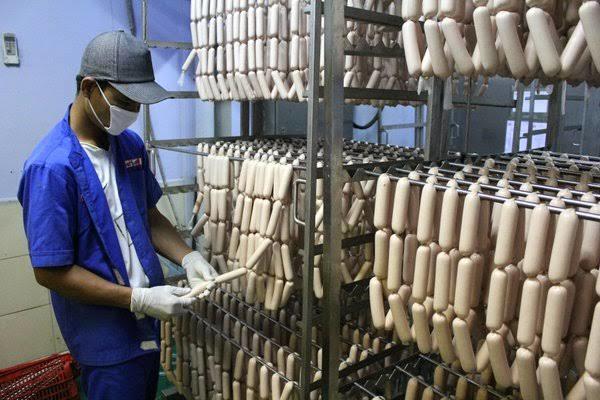
    5. Filling the dough into the casing. Sausage dough is inserted into the casing and then tied according to the desired sausage size. Fastening can be done manually or by machine
    6. Cooking (boiling or smoking). This process aims to cook, preserve, improve taste and aroma
    7. Removal of the casing. Not all sausages are removed from the shell/skin. Peeled sausages need to be repackaged. Some types of sausages use an edible casing, meaning that you can eat the contents as well as the casing
    8. Packaging: Sausage that has been peeled is put in plastic packaging

    Sausage

    4. Types of Sausages

    Sausages are made from minced/ finely ground meat that is seasoned and stuffed into gut casings, then dried, can be fermented, smoked, or produced using a combination of these techniques. Sausages can be made using very finely ground beef or meat cut into small pieces. Some sausages need to be cooked further before consumption, but there are also those that have been preserved or smoked so they are safe for direct consumption.

    Based on the method of manufacture, sausages are categorized into several types as follows:

    1. Fresh sausage : The most popular type in some countries, for example in the UK. This sausage is usually marketed in the form of uncooked (fresh/uncooked) in frozen or unfrozen conditions, the contents of which are coarsely ground meat and fat. Example: British fresh sausage (not widely marketed in Indonesia)
    2. Cooked sausage : The sausage is cooked after the process of filling the sausage dough into the casing. The meat and fat are finely ground, but not to form an emulsion. This type of sausage has a longer shelf life than fresh sausage. Popular example: Sozis
    3. Emulsion sausage: The meat and fat are finely ground to form an emulsion (oil in water emulsion). Meat protein acts as an emulsifier because it can “unite” fat and water (protein has a hydrophobic arm that can bind to fat and a hydrophilic arm that binds to water). Meat proteins that act as emulsifiers are myofibril proteins, namely myosin and actin. Emulsion-type sausages are also usually cooked sausages, some are also smoked. Example: Bologna, frankfurter, bratwurst
    4. Fermented sausage: In its manufacture involves the formation of lactic acid through the fermentation process. Lactic acid is produced by lactic acid bacteria. Has a fairly long shelf life (1-2 years) without freezing; This is the combined effect of low water content and acidic conditions. Grouped into dry (dry) and semi-dry (half-dry). Example: Dry: salami, pepperoni, genoa Semi-dry: summer-sausage, Lebanese bologna

    Based on the type of meat used, sausages can also be divided into beef sausage, chicken sausage, pork sausage and so on.

    type of sausage

    5. Development of Sausage Making Technology

    Long ago, people cooked sausages with the idea of ​​a sausage production site, close to slaughterhouses and markets so that meat raw materials could be obtained easily and the final product could be marketed more quickly.

    However, with the freezing technology, sausages have a longer shelf life and of course can be marketed more widely.

    To reduce production costs as well, the sausage industry is making innovations, for example, replacing meat raw materials with cheaper ones and adding flavour as a substitute. For example, beef-flavoured chicken sausage.

    Sausage casings also did not escape development. In the past, sausage casings came from natural ingredients (made from the digestive tract of animals; cows, goats, sheep, pigs). The advantage of natural casings is that they are edible, but have non-uniform shapes and sizes, often tear easily.

    So the industry is looking for other alternatives such as artificial casings. Artificial casings can be made from cellulose (non-edible), collagen (edible & non-edible), plastic (non-edible). With the development of sausage-making technology, the more variety of sausages on the market.

    References:


  • Complete 20+ Branch of Chemistry and Explanations

    Complete 20+ Branch of Chemistry and Explanations

    In this article we will discuss various branch of chemistry. The branch of chemistry is divided into several branches including Analytical Chemistry, Physical Chemistry, Organic Chemistry, Thermochemistry, Geochemistry and others. You can learn various branches of chemistry in the following review. 
    In addition to the branch of physics and biology, chemistry is also a part of the natural sciences.

    Chemistry is the study of the composition, structure, changes and properties of a substance.

    Chemistry Branch

    Currently, there are many that include chemistry, so they are grouped into several branches of chemistry. The following are some of the branches of chemistry that exist, namely:

    1. Analytical Chemistry

    Analitycal Chemistry

    Analytical chemistry is a branch of chemistry that studies the analysis of chemicals.

    Examples include how to separate or identify the types of constituent substances and their amounts, grouping of substances and the formation of new substances.

    Analytical chemistry is divided into two parts, namely qualitative analysis and quantitative analysis.

    2. Physical Chemistry

    Physical chemistry is a branch of chemistry that studies the relationship between the concepts of chemistry and physics.

    Examples such as the occurrence of chemical reactions, the separation between two compounds, changes in chemical compounds, energy calculations and determination of the properties of a substance.

    In addition, in physical chemistry, you will find many mathematical equations and calculations related to energy.

    3. Organic Chemistry

    Organic chemistry is a branch of chemistry that studies chemicals such as the synthesis or properties of organic compounds.

    The nature of these organic compounds consists of hydrocarbon compounds and their derivatives.

    Organic chemistry also has a role in the synthesis of compounds and research on other carbon atoms.

    4. Inorganic Chemistry

    Inorganic chemistry is a branch of chemistry as opposed to organic chemistry, which studies the synthesis and properties of inorganic compounds, such as salts, minerals and metals.

    Inorganic chemistry also studies the separation of inorganic compounds, mineral processing and crystal formation.

    In its use, inorganic chemicals are often used for the glass, textile, plastic and paint industries.

    5. Environmental Chemistry

    atmospheric

    Environmental chemistry is a branch of chemistry that studies the chemistry and biochemistry that occurs in nature or everything that happens in the environment.

    Chemistry is also a science that includes atmospheric, aquatic and soil chemistry so that chemistry is often associated with environmental pollution and how to overcome it.

    In addition, environmental chemistry is highly dependent on other branches of chemistry, such as analytical chemistry.

    6. Core Chemistry

    Nuclear chemistry or often referred to as radiochemistry is a branch of chemistry that studies radioactive substances, the structure of the atomic nucleus and its influence on nuclear stability and reactions in the decay process of radionuclides and nuclear transmutation.

    7. Biochemistry

    Biochemistry is a branch of chemistry related to the branch of biology.

    In biochemistry, you will learn about the chemical processes that occur in the body of living things and the analysis of the compounds involved.

    In addition, biochemistry is related to genetic research, the chemical components of cells, as well as research on reactions in the bodies of living things.

    8. Food Chemistry

    Food chemistry is a branch of chemistry that studies chemical processes and interactions with biological components and improves the quality of food.

    For example, a food product that undergoes changes due to the emergence of various food processing methods so how to improve or prevent changes.

    9. Pharmaceutical Chemistry

    Pharmaceutical

    Pharmaceutical chemistry is a branch of chemistry that studies the development of materials containing drugs based on quantitative and qualitative analysis of chemical compounds, both organic and inorganic.

    10. Complex Chemistry

    In chemistry, a complex or coordination compound refers to a molecule or entity formed by the joining of a ligand and a metal ion. Previously, a complex meant the reversible association of molecules, atoms, or ions through weak chemical bonds. This understanding has now changed. Some metal complexes are formed irreversibly and many of them have fairly strong bonds.

    11. Geochemistry

    Geochemistry is the science that uses chemical principles and technologies to analyze and explain the mechanisms behind geological systems such as the Earth’s crust and the oceans above it. The scope of geochemistry extends beyond the geo (earth), covers all rock movement systems in the solar system and has an important contribution in understanding the processes behind mantle convection, planet formation, to the origin of rocks such as granite and basalt.

    12. Stereochemistry

    Stereochemistry, a branch of chemistry, involves the study of the relative spatial arrangement of the atoms that make up the structure of molecules and their manipulation. An important branch of stereochemistry is the study of chiral molecules

    13. Electrochemistry

    Electrochemistry is a branch of physical chemistry that studies the electrical aspects of chemical reactions. Elements used in electrochemical reactions are characterized by the number of electrons they have. In general, electrochemical cells are divided into two groups, namely galvanic cells and electrolytic cells.

    14. Material Chemistry

    Materials chemistry is a branch of chemistry that studies organic, inorganic materials, and the structure of a chemical substance. There is a fundamental difference between matter which is known in chemistry and the term material which is used in materials chemistry. Chemistry studies the properties of matter, both intensive and extensive. However, in material chemistry, the properties of matter are studied so that they can be used for certain functions. For example, certain properties of metalloid elements (silicon, germanium, and arsenic) that can be used as semiconductor materials.

    15. Thermochemistry

    Thermochemistry is a branch of chemistry that studies the energy that accompanies physical changes or chemical reactions. The main objective of thermochemistry is the establishment of criteria for determining the probability or spontaneity of the required transformation. In this way, thermochemistry is used to estimate the energy changes that occur in chemical reactions, phase changes, and solution formation. Most of the features in thermochemistry develop from the application of the first law of thermodynamics, the law of ‘conservation’ of energy, to the functions of internal energy, enthalpy, entropy, and Gibbs free energy.

    16. Polymer Chemistry

    Polymer chemistry or macromolecular chemistry is a branch of chemistry that focuses on the chemical synthesis and chemical properties of polymers and macromolecules. According to IUPAC recommendations, macromolecules refer to individual molecular chains and are the domain of chemistry. Polymers describe the properties of polymeric materials and are a subfield of polymer physics as a subfield of physics.

    17. Theoretical Chemistry

    Theoretical chemistry is a branch of chemistry that deals with physics that studies and predicts chemical phenomena. Although not entirely precise, theoretical chemistry is often confused with quantum chemistry.

    18. Mathematical Chemistry

    Mathematical chemistry or mathematical chemistry is a branch of theoretical chemistry that uses mathematical functions to study chemical phenomena. Mathematical chemistry does not have to be related to quantum chemistry although most of the theories used relate to quantum mechanics or quantum chemistry, for example: group theory to explain the phenomenon of symmetry in molecules.

    19. Quantum Chemistry

    Quantum chemistry is a branch of theoretical chemistry, which applies quantum mechanics (and more recently quantum field theory) to dealing with problems in chemistry. The explanation of the behavior of electrons in atoms and molecules in terms of reactivity is one of the applications of quantum chemistry. 

    20. Computational Chemistry

    Computational chemistry is a branch of chemistry that uses the results of theoretical chemistry which are translated into computer programs through computer simulations to calculate the properties of molecules and their changes as well as to simulate large systems (macromolecules such as proteins or systems of many molecules such as gases, liquids, solids). , and liquid crystals), and apply the program to real chemical systems.

    Benefits of studying chemistry

    The benefit of studying chemistry is a better understanding of the environment and the processes that take place within it.  From the description above, it has been explained that matter can change physically or chemically. By studying chemistry, we can change natural materials into more useful products to meet the needs of human life , and we can understand the needs of human life, and we can understand various natural phenomena that we encounter in our daily lives , for example:
    • Digestion and burning of food substances in the body. Food comes from plants. Growing plants are assimilated by chemical processes. Our bodies need carbohydrates, proteins, fats, vitamins, all of which are chemical processes that can produce carbon dioxide gas, water and energy .
    • In this life, we need soap, toothpaste, textiles, cosmetics, plastics, medicines, fertilizers, pesticides, fuels, paints, cooking spices, household utensils, even various types of processed foods, all of which are the result of application of chemistry. Almost all the materials we need, more or less, either directly or indirectly experience chemical touch. Try to pay attention.

    Given the importance of the benefits of chemistry in life, it is not surprising that then chemistry continues to be developed. Various studies on anything continue to be done. Inventions continue to be born, it is all aimed at the lives of many people. In contrast to chemistry which tends not to be liked much, the benefits of chemistry are actually in demand and needed by humans themselves.

    Everyone has their own view of chemistry and the benefits of chemistry for life. Some have a negative view, some accept its presence. Those with negative views are people who do not understand how important chemistry is in life, lack of knowledge can be the main cause.

  • Complete 20+ Branch of Physics and Explanations

    Complete 20+ Branch of Physics and Explanations

    In this article, we will discuss the branch of physics. There are various branches of physics, such as Mechanics, Fluid Mechanics, Thermodynamics, Electronics, Geometric Optics, Quantum Physics, Geophysics, and others. Check out the full review below. 
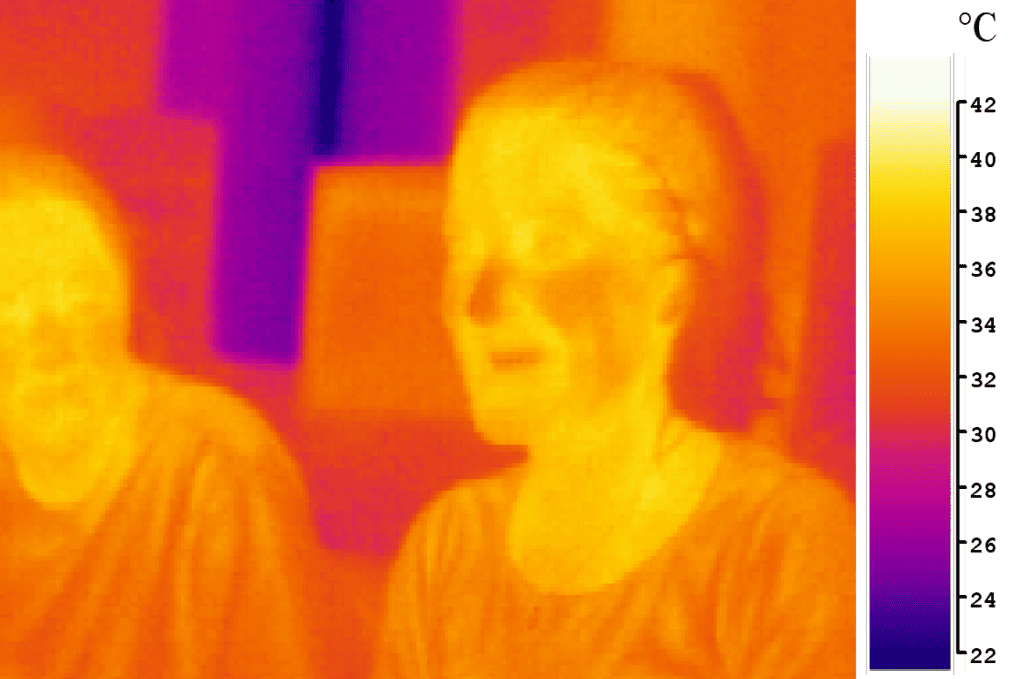
    Physics is a natural science which is divided into several branches. Each of these branches of physics has a different focus of study. The division of physics simultaneously proves that physics is a comprehensive science. This aligns with the fact that many facets of the universe can be studied separately.

    Branch of Physics

    All branches of physics have played many roles in human life. The following are the important branches of physics:

    1. Mechanics

    Mechanics

    Mechanics is a branch of physics that studies motion and changes in the shape of objects caused by forces. Mechanics is a branch of science in the early or oldest period of all branches of physics. Rows of physicists who laid the foundations of mechanics include Archimedes, Galileo Galilei, and Isaac Newton.

    Mechanics is a branch of physics that is widely applied in everyday life. The most crucial problem in mechanics is how things move and what causes them. This problem was solved by Newton in his Laws of motion. The branch of physics mechanics is further divided into two, namely kinematics and dynamics.

    • Kinematics is a part of mechanics that studies the motion of matter without regard to the cause of the object’s action.
    • Dynamics is a branch of mechanics that studies the relationship between the motion of an object and the cause of action, namely force.

    2. Fluid Mechanics

    The next branch in physics is fluid mechanics. Fluid mechanics comes from the words mechanics and fluid. Mechanics is the study of motion, while fluid is a substance that, when a force is applied to it, will change shape continuously because it cannot withstand the pressure, no matter how small the force acts.

    So, mechanics study motion in fluids (liquids, gases, and plasmas) and the forces acting on them. Fluid mechanics is a science that has long been applied in everyday life. Since time immemorial, without us realizing it, many human activities have been related to fluid mechanics.

    Famous fluid mechanics laws include Archimedes’ Law, Pascal’s Law, and Bernoulli’s Law. The physics branch of fluid mechanics is further divided into fluid kinematics and fluid dynamics.

    • Fluid kinematics is a branch of fluid mechanics that studies the behavior of fluids at rest or not in motion.
    • Fluid dynamics is the branch of fluid mechanics that studies fluids in motion or flow.

    3. Thermodynamics

    Physics also has a branch called thermodynamics. In simple terms, thermodynamics is the study of energy transformations, changes in state, and the equilibrium of a group of particles that make up gases, liquids, and solids, especially those related to thermal or heat properties.

    Thermodynamics is often defined as the study of energy changes from one form to another, significantly changing from heat to other forms of energy. The physicist who is known as the father of thermodynamics is Sadi Carnot.

    4. Electronics

    Electronics is a branch of physics that studies the emitting behavior and effects of electrons and the control of charged particles in vacuum, gases, and semiconductor materials.

    In other words, electronics is a branch of science that deals with how to flow and control electrons and their behavior and effects when in a medium such as a vacuum, gas, semiconductor material, or a pie.

    Electronics is further divided into several branches, including:

    • Digital electronics are electronic systems with digital strategies or discrete signals.
    • Analog electronics are electronic systems that have a continuous signal.
    • Microelectronics is an electronic device that uses the concept of integration (integrated circuit-IC).
    • Integrated circuits (ICs) are Active Electronics components consisting of a combination of hundreds, thousands, and even millions of transistors.
    • Optoelectronics is an electronic component that uses the properties of light or the interaction of light with matter.

    5. Geometric Optics

    Geometric optics is a branch of physics that studies light’s reflecting and refracting properties. A well-known law in this branch of physics is Snell’s law. The basics in geometric optics are as follows:

    • The path of light in a homogeneous medium is straight
    • The rays do not affect one another
    • The trajectory of the rays can be reversed
    • The trajectory of light obeys Snell’s laws of reflection and refraction

    6. Physical Optics

    Physical optics is a branch of physics that studies the properties of interference, diffraction, and polarization of light. In another sense, physical optics is the study of the physical properties of light as a wave. Light is polychromatic, consisting of many colors called the color spectrum.

    7. Quantum Physics

    Quantum Physics

    Quantum physics is a branch of physics that studies the physical properties of matter on an atomic or sub-atomic scale. The essence of quantum physics is uncertainty; predictions in quantum theory are more likely than confident. Quantum physics is a branch of physics that will invite us to see the world of physics from a different perspective. A point of view that considers matter not only as matter but also as waves.

    8. Medical Physics

    Medical physics is a branch of physical science that uses the principles, methods, and philosophies of physics in practice and research to prevent, diagnose, and treat disease. Medical physics is needed to reduce the risk of devices that use radiation by implementing and developing quality assurance methods in terms of the safety and feasibility of medical radiation equipment.

    9. Biophysics

    Biophysics is a branch of physics that studies physical phenomena in living things. Biophysics is a combination of biology and physics. In biophysics, biological processes are studied using physical methods. The method is applied to biological organisms and systems to gain insight into how they work

    10. Geophysics

    Geophysics is a branch of physics that studies the earth, including the atmosphere surrounding it, such as volcanic eruptions, earthquakes, landslides, weather changes, etc.

    Geophysics is the knowledge of the physical properties of the earth, and its application includes methods: seismic, gravitational, magnetic, electrical, and radioactive.

    Geophysics is a combination of physics and geography.

    11. Environmental Physics

    Environmental physics is a branch of physics that studies everything about the earth and air and those related to the environment. Environmental physics is divided into several components: soil physics (surface and deep), water physics, air physics, ocean physics, earthquake physics, cloud physics, atmospheric physics, and weather physics.

    12. Astrophysics

    Astronomy is a branch of physics that studies space and everything in it. In other words, Astrophysics is the study of celestial bodies such as the moon, planets, and stars, including the sun. Astrophysics is a combination of physics and astronomy.

    13. Economic Physics

    Economic physics is a branch of physics that studies economics using physical methods. Financial physics is a combination of physics and economics. The physics framework is used to solve problems that exist in economics.

    14. Radiation Physics

    Radiation Physics is the science of physics that studies any process by which energy moves through a medium or space and is eventually absorbed by another object.

    15. Atmospheric Physics

    Atmospheric physics is a branch of physics to study the atmosphere. Atmospheric physicists attempt to model Earth’s atmosphere and the atmospheres of other planets using fluid flow equations, chemical models, radiation budgets, and energy transfer processes in the atmosphere (and how these bind to other systems, such as the oceans).

    16. Meteorology

    Meteorology, or weather science, is a branch of atmospheric science that includes atmospheric chemistry and atmospheric physics, with the main focus being on the science of weather forecasting.

    17. Computational Physics

    Computational physics is the study of numerical implementation of algorithms to solve problems in areas of physics where quantitative theory already exists. In history, computational physics was the first application of modern computer science in science and is now a subsection of computational science.

    18. Physics of solids

    Solid matter physics is the study of the physical properties and behavior of substances in the solid phase

    19. Physics of condensed matter

    Condensed matter physics deals with the exploration and manipulation of phenomena and physical properties of solid and liquid matter based on the principles of quantum mechanics and statistical physics.

    20. Nuclear Physics

    Nuclear physics is the study of atomic nuclei and the changes in atomic nuclei. Particle physics is the branch of physics that studies the fundamental particles that makeup matter and radiation and their interactions. Particle physics is also called high-energy physics.

    Relationship of Physics with Other Sciences

    Physics is a very fundamental science among all the Natural Sciences. For example, in Chemistry, the arrangement of molecules and practical ways of changing specific molecules into others using the method of applying the laws of Physics. Biology must also rely heavily on physics and chemistry to explain the processes in living things.

    The purpose of studying Physics is to know the essential parts of objects, understand the interactions between objects, and explain natural phenomena that occur. Although physics is divided into several fields, the laws of physics apply universally. A review of a phenomenon from a particular area of physics will obtain the same results when viewed from another area of physics.

    In addition, the basic concepts of physics support not only the development of physics itself but also the development of other sciences and technology. Physics supports both pure and applied research. Geologists, in their study, use gravimetric, acoustic, electrical, and mechanical methods. Modern hospital equipment applies physics principles, and astronomers require spectrograph optics and radio engineering.

    Benefits of Studying Physics

    It is something that we often hear about the statement of some people, or maybe most people think physics is complex. They believe physics is a science full of formulas and high-level mathematical calculations. This results in not everyone being able to study physics well. Even physics is often considered the scourge of learning. This situation is almost the same as the assumption in mathematics.

    But despite all the assumptions above, there is something more essential for us to consider. That is about the advantages of studying physics and the disadvantages if we do not want to study physics. Whether we realize it or not, essentially every human being needs knowledge. It keeps up with technological developments to live this life in harmony, where the development of technology is certainly an implication of the physical sciences that experts in their fields have studied.

    Studying physics has many benefits. From the beginning of studying physics, physics has been proven to help humans carry out daily life activities. There are several benefits of studying physics, including:

    • Physics plays a significant role in technological discoveries.
    • Through physics can reveal the secrets of nature.
    • Physics is at the forefront of technological developments.
    • Physics is a basic science that has a role in developing other sciences.
    • Physics trains us to think logically and systematically.
  • What is Infrared Light?

    What is Infrared Light?

    summary

    • Infrared is a type of energy radiation that is invisible to the human eye, but we can feel its heat.
    • Infrared has many applications in everyday life, from smartphones for facial recognition, data transfer, remote control, to astronomical telescopes.

    Have you ever tried to point the tv remote when you press it towards the camera?

    If you see with your eyes, when you press the button, the small light on the end of the TV remote doesn’t seem to shine.

    However, with the camera, you can see that the small light is white.

    Why is the light visible only to the camera and not to our eyes?

    What light is that?

    Infrared Light

    Infrared radiation or infrared light is a type of energy radiation that is invisible to the human eye, but we can feel its heat.

    Infrared light has a longer wavelength than visible light.

    Everything in the universe emits some level of infrared radiation, but the most obvious sources are the sun and fire.

    Infrared radiation is a type of electromagnetic radiation as well as visible light.

    It is produced when an atom absorbs and releases energy in the form of photons.

    William Herschel, British astronomer, was the first to recognize the existence of infrared waves in 1800.

    He conducted an experiment to measure the temperature difference between the various colors of visible light.

    Placing the thermometer along the path of the rainbow light due to the dispersion of the crystals.

    He observed the temperature rise from blue to red light, he found a strange hot temperature near after the red light.

    Infrared Ray
    Infrared Light is hot

    Infrared is located in the frequencies above the microwaves and below the red waves.

    Infrared light waves are longer than visible light waves .

    Infrared frequencies range from 3 gigahertz to 400 terahertz.

    And the wavelength ranges from 1000 micrometers to 760 nanometers.

    Similar to visible light, which ranges from light purple to red.

    infrared-waves-definition-uses

    Infrared also has its own range.

    Infrared radiation is one of 3 ways of heat transfer, in addition to convexid and conduction mechanisms.

    All objects with a temperature above 5 K or -268°C emit infrared radiation.

    The sun emits almost half of its energy in the form of infrared radiation. Like most other stars.

    One of the most useful uses of infrared is for sensing and detection.

    All objects on Earth emit infrared radiation.

    Which can be detected by electronic sensors, such as in infrared cameras and night vision goggles.

    What are infrared rays used for?

    Infrared (IR) light is used by electrical heaters, cookers for cooking food, short-range communications like remote controls, optical fibres, security systems and thermal imaging cameras which detect people in the dark.

    1. Face Recognition On Our Smartphone

    The latest security technology in smartphones like the iPhone X.

    By using facial recognition or face recognition that takes the owner’s face with an infrared camera.

    10,000 points of infrared light are projected on our faces then captured by infrared cameras and processed to produce a model of our face.

    2. Remote Control

    TV and AC remote controls use infrared light as a medium of communication with their electronic equipment.

    The receiving sensor converts the infrared light signal into an electrical signal which instructs the microprocessor on command.

    3. Data Transfer

    infrared data transfer

    Those of you who have owned a Nokia mobile phone with Java OS must have recognized it.

    Infrared rays were popularly used as a data transfer technology between mobile phones.

    But gradually lost to other technologies such as Bluetooth and WiFi direct because of the low transfer speed and its use is a bit complicated.

    4. Optical fiber

    The fiber optic cables that run our modern internet systems use infrared light to transmit data.

    Infrared rays are used because they are compatible with fiber materials, are not easily dispersed and lose energy.

    5. Satellite

    Imaging on satellite devices mostly uses infrared scanners, mainly on weather satellites.

    Infrared cameras or scanners on satellites can be used to determine the height and water vapor content of clouds.

    Infrared channel image on Himawari . weather satellite
    Infrared channel image on Himawari . weather satellite

    Infrared images of the ocean can be analyzed to determine the movement of ocean currents which is useful for the shipping industry.

    6. Incandescent lamps

    Incandescent lamps convert only about 10% of electrical energy into visible light, while the other 90% of energy is converted into infrared radiation.

    7. Thermal Camera

    Most digital cameras have filters that block infrared.

    This filter can be removed and allows sensitivity in the infrared range.

    The same two photos. The photo on the left was taken with a camera that has an infrared filter and the image on the right was taken with a regular camera.
    The same two photos. The photo on the left was taken with a camera that has an infrared filter and the image on the right was taken with a regular camera.

    8. Astronomical Telescope

    The imaging system on the infrared CCD is able to capture detailed observations of infrared sources in space.

    The advantage of infrared radiation is that it can be used to detect or see objects that are too cold to emit visible light.

    This technique is able to find previously unknown objects, such as comets, asteroids, dwarf planets and interstellar clouds.

    Infrared is useful for observing cold molecules in gases and determining the chemical composition of dust particles in space.

    This observation uses a CCD detector which is sensitive to infrared photons.

    Another advantage of infrared radiation is that the longer the wavelength, the less light is scattered by the atmosphere.

    Visible light, which can be absorbed and reflected by gas and dust, infrared, which has a longer wavelength, is more difficult to interfere with the medium through which it passes.

    Because of this property, infrared can be used to observe objects where the light is blocked by gases and dust.

    Expanse of the Milky Way Galaxy in Infrared light
    Expanse of the Milky Way Galaxy in Infrared light

    Like celestial bodies, newly formed stars are confined within the nebula or center of the Milky Way galaxy.

  • The Importance of the Phi for the World

    The Importance of the Phi for the World

    First of all, why Phi? The mathematical symbol for Phi “π” is a Greek letter, derived from the first letter of the Greek words “περιφέρεια”, meaning periphery, and “περίμετρος”, meaning perimeter. The earliest known use of symbols was by the Welsh mathematician William Outright in 1647, but was only popularized in 1748 by Leonhard Euler in his Introduction to Infinite Analysis.

    Mathematically, Phi is used to calculate the volume of a sphere or the circumference or area of ​​a circle. So why all the fascination and curiosity towards Phi? First, we must trace the history of Phi and then we will discuss the discovery of the decimal place of Phi. We will see that Phi is an irrational number, a transcendent number, and possibly a normal number.

    We will then end with some of the mysteries surrounding Phi. Even if you don’t like math, algebra, trigonometry, Gauss, Thales, Pythagoras and these kinds of theorems, I guarantee that you’ll find the odds somewhere in this article!

    To become a real expert on Phi in math class and know everything there is to know about math, all you have to do is read!

    What is Phi? And what is the history?

    If today, the most powerful computers are capable of determining up to 13 trillion decimal places of Phi, you can imagine that this is not always the case.

    If today, the most powerful computers are capable of determining up to 13 trillion decimal places of Phi, you can imagine that this is not always the case.

    In the level of studying mathematics, it is not foreign to discuss Phi. We use it a lot but do you know what Phi is and what is its history?

    Phi is the ratio of the circumference of a circle to its diameter. Phi is denoted by the lowercase Greek letter which is spelled as phi which comes from the first letter of the Greek word perimetros or the so-called circumference. The value of pi is the length of the circumference of a circle whose diameter is 1 unit. Based on the previous definition, the phi formula is derived from the definition of as the ratio of the circumference of a circle to its diameter d;

    π = k / d

    From this comparison, we finally get the formula for the circumference of a circle as k=πd. Approach for the value of phi itself, we can use =3.14 or =22/7 . The number is only an estimate used for approximation of the value of itself, but there is no exact number that shows the exact value.

    History of the value of Phi

    • Since antiquity, scholars and mathematicians have been fascinated by Phi and have tried long and hard to get values ​​that are as representative as possible.
    • 1680 BC: The oldest known value of Phi is the work of the Babylonians. They tried to compare the perimeter of a circle with that of a hexagon. The approximate value of Phi at that time was 3 + 1/8 = 3.125
    • 1650 BC: The Rhind Mathematical Papyrus discovered in 1855 teaches us that the Egyptians also studied Phi and tried to find its closest approximation. The Egyptian scribe Ahmès observed that the area of ​​a square of 8 units on one side could be reformed to almost produce a circle with a diameter of 9. Mathematically, this would mean (16/9) 2 or about 3.16.
    • 700 BC: The Indian text Shatapatha Brahmin also gives an estimate of Phi equal to 25/8 (3,125). Indian mathematicians from the Vedic period again estimated Phi to be 3.1416 using astronomical calculations.
    • Archimedes (-287 / -212) is widely considered to be the first person to calculate an accurate estimate of Phi in his essay on ‘Measurement of Circles’. Archimedes, using a very clever method, figured out how to estimate the perimeter for a polygon with twice as many sides. Using a polygon with 96 sides, Archimedes arrived at the following approximation: 220/71 < Pi < 22/7

    Archimedes’ method was used for 2000 years after his death. Not bad, right?

    The circumference of the circle (blue) is between the circumference of the green hexagon and the purple hexagon according to Archimedes' method. (Source: math.psu.edu)
    The circumference of the circle (blue) is between the circumference of the green hexagon and the purple hexagon according to Archimedes’ method. (Source: math.psu.edu)

    Phi Value Relationship with Radians and Degrees

    In measuring angles, we will recognize radians and degrees which are units of measure for angles. The value of phi in degrees is 180 degrees or for a full circle it is 2π.

    Radian is the radius or radius. As we know, the circumference of a full circle is 2π radians or the equivalent of 360 degrees. For this reason, v radian represents a circle as far as 180̊ so that 1 radian is equal to 180/π or 1 radian is equal to 57,290 degrees.

    Phi Value: The Process Towards Decimal Numbers

    After proving his method, many mathematicians will use Archimedes’ method to determine the more digits of Phi.

    3.14 is not an exact number to show the exact value of pi. Source: Pixabay
    3.14 is not an exact number to show the exact value of pi. Source: Pixabay
    • 5 decimal places: Liu Hui used a method to give an estimate of Phi to the nearest one hundred thousand (3rd Century).
    • 6 decimal places: approximation determined to the nearest millionth (3.141592) by mathematician Tsu Chung Chih (5th century).
    • 14 decimal places: still working from the discoveries of Archimedes, the Persian astronomer Jemshid al Kashi presents us with the first 14 decimal places of Phi (15th century).

    Western countries did not start the race to estimate the value of Phi until several centuries later, although in the early 17th century Leonardo da Pisa Fibonacci proposed an interesting estimate of the value of Phi.

    • From 20 to 32 decimal places: Based on Archimedes’ theory, German mathematician Ludolph Van Ceulen fixed the first 20 decimal places of Pi in 1596 using a polygon with 480 billion (60 * 233) sides, then the first 32 in 1615. He was pleased to know that the number Phi is called with the “Van Ceulen number”. A little confession!

    The real turning point in the calculation of Phi was the discovery of analysis and differential calculus. Many mathematicians such as John Wallis, Leibniz, James Stirling and Newton understood that Phi could not only be understood geometrically, but could be in the form of a series.

    • From 71 to 100 decimal places: thus Abraham Sharp got the correct 71 decimal places of Phi in 1699, the 100 decimal bar was then crossed in 1706 by John Machin with the help of the arctan function. From an interest in pure mathematics, Phi has become a challenge for all mathematicians, a clear sign of pride.
    • Several thousand billion decimal places: today, the most advanced computers are able to provide several thousand billion digits after the decimal point, humans no longer feel burdened …

    Humans have found another way to have fun with math and Phi: say as many decimal places as you can! There is even a group of individuals who can make a list from the first 1000 decimal places of Phi (1000-club).

    Notable achievements include Daniel Tammet who in 2004 quoted 22,514 Phi decimal places in just 5 hours. The record is currently held by a Japanese native who can read 100,000 decimal places of Phi.

    100,000 decimal places of Phi.

    If you want to get started, it only takes sixteen and a half hours…! If you’re feeling bored or need a break from your usual lessons, why not see how far you and your math teacher can help you? If the value of Phi is uncertain, and therefore mysterious, do you know one of the greatest mysteries in mathematics?

    Features- Phi Features

    Let’s get back to the point of these two little letters, which will still reveal a lot of surprises! Not a very rational thing, right? Phi is an irrational number, which means it cannot be written as a fraction of two whole numbers (like a rational number). B

    In fact, the decimal places are neither periodic nor finite. In other words, the decimal Phi is unpredictable and no model can predict it. The first Mathematicians discovered the principles of infinity and abstract infinity, they even saw Phi as an insult to God’s omniscience! A number of transcendents! Phi is a transcendental number, which means it cannot be a solution to polynomial equations with integral coefficients.

    However, the formula that ties Phi to other mathematical constants such as the Golden Ratio, which corresponds exactly to the method of constructing the Fibonacci sequence.

    Is Phi a normal number? The fact that researchers still don’t know whether Phi is a normal number (a number with a finite order of decimal places) has had a profound effect on our continued interest in Phi. In nearly four millennia, this figure still hasn’t revealed all its secrets!

    Phi is everywhere! Oh yes! Phi is all around you! Phi’s omnipresence, outside of geometry classes, is of real interest to many researchers and mathematicians alike.

    Phi is effectively a certain continuous fraction limit, nested radicalism. Research carried out on transcendental and irrational numbers, mostly related to Phi, provided the answer to the square of a circle.

    It is actually impossible to construct a square with the same area as a given circle. In statistics and probability, the Phi number also appears, as in Buffon’s needle problem.

    Interesting Facts about Phi

    More interestingly, Phi is everywhere beyond the bounds of simple mathematics. Phi exists wherever the circle is, for example in a light bulb, sun, eye and DNA! Phi is even present in the equations of Heisenberg’s famous uncertainty principle, which seeks to evade our understanding of the universe. Pi-ramid from Cheops

    What is the relationship of pi with the Egyptian pyramids? Source: Pixabay
    What is the relationship of pi with the Egyptian pyramids? Source: Pixabay

    What is the connection between Phi and the Egyptian pyramids? Pi also appears in mythical constructs, which have no clear connection to the circle. This is particularly the case with the famous Cheops pyramid case. A number of works show that Phi is the ratio between the perimeter of the base and twice the height of the pyramid.

    This mathematical ratio for Cheops is almost the same as Phi (I’ll let you calculate the perimeter!). Was this intentional by the architects or just a coincidence? Math and literature! Finally, for those who categorically separate mathematics from literature, Phi reconciles the two subjects.

    Poetry allows us to learn the first few decimal places of Phi (127 in the full poem), so why not amaze your friends! The idea is that the number of letters in each word corresponds to the decimal point Phi.

    This short stanza has thirteen digits : Look, I have a very helpful rhyme 3 1 4 1 5 9 My weak brain ability, 2 6 5 Which sometimes refuses to do its job. 3 5 9 9 Why not study the whole poem!

    In conclusion: Why obsessed with Phi?

    • Because it’s historic! Phi has always been interesting because it has deceived mathematicians throughout history. All the greatest mathematicians have been fascinated by this symbol. This attraction is universal and has been around for almost 4000 years.
    • More secrets to discover! It is a fact that Phi has not revealed all its secrets, it is a symbol that holds many mysteries, a symbol that transcends mathematics and is a very beautiful, if not the most beautiful embodiment.
    • Live Math! Often viewed as a bleak science where imagination has no place, Phi restored mathematical prowess and dispelled this theory.
    • Phi is really special! His extraordinary qualities and his presence in science as well as in everyday life give Phi a special place.

    You have won against Phi! Be sure to pay tribute to one of the greatest mathematical discoveries on the next “Phi day”, every March 14th.

  • Ohm Law Formula in Electrical Circuits

    Ohm Law Formula in Electrical Circuits

    on this occasion we will share information about Ohm law formula for you so that your insight becomes wider. Here is the discussion, please read to the end

    This article will discuss the Ohm law formula, of course complete with understanding to example questions and discussion.

    Who here wants to be a reliable electronics engineer? If that is your goal, it means that you really have to understand the basic science , namely Ohm law. At school, you also learn this law , guys . Precisely in Physics subjects. But don’t worry, the Ohm law formula can be said to be easy, because it’s still basic. The important thing is that you understand the basics first, then deepen them to advanced levels, and become a reliable electronics engineer. Beuhh .. It’s really cool anyway. So that you understand about Ohm law, see the explanation below, come on !

    What is Ohm Law

    OHM LAW FORMULA

    Yep , so you don’t get confused when discussing the formula later, you must first understand the meaning of Ohm law itself. So, what is Ohm law , sis? Ohm law is a science in physics that states the relationship between electric current, voltage, and resistance in an electrical circuit.

    Ohm law was first introduced by a German physicist named Georg Simon Ohm in 1827 through his work entitled ” The Galvanic Circuit Investigated Mathematically” . This is how Ohm law reads:

    The amount of electric current (I) flowing through a conductor will be directly proportional to the voltage/potential difference (V) applied to it and inversely proportional to the resistance R

    As already I mentioned earlier, if the law of ohm is the basis of a variety of science related electronic same electrical circuit. Such as TV sets, refrigerators, washing machines, and much more. So, yes it is true that Ohm law is the basis of all electrical circuits. That’s why you have to understand this material, guys .

    Ohm Law Formula

    OHM LAW FORMULA

    Well , after you understand the meaning and benefits of Ohm law, now you also understand the formula. Based on the sound of Ohm law in the previous point, the formula for Ohm law can be written as follows:

    V = IR

    Information:

    • V : voltage (Volt)
    • I : current strength (Amperes)
    • R : resistance (Ω or Ohm)

    The formula above can also be used to find the electric current and resistance. Stay behind and forth just formula, in accordance with the following pyramid, guys .

    If you want to find the electric voltage, you use the formula V = IR. If it turns out that you need to find the electric current, then use the formula I = V/R. Well , if what you are looking for is electrical resistance, then use the formula R = V/I. The point is you need to remember the pyramid, yes, guys . It would be easier to remember, wouldn’t it?

    Sample Questions and Discussion

    Okay, let’s just go straight to the example questions and discussion. Eitsss.. but before that, you need to prepare the writing utensil first! So, you can simply scribble deh so that more understand more about Ohm law.

    Problems example:

    In an electrical circuit, there is a power supply with a voltage of 20 Volts. The resistance in the circuit is 20 Ohms. Determine the current flowing in the circuit!

    Discussion

    Given: V = 20 Volts; R = 20 Ohms.

    Asked: I

    Answer:

    I = V/R = 20/20 = 1.

    So, the current flowing in the circuit is 1 Ampere.

    also read : Basic Units in the International System of Units (SI)

    That’s the explanation of Ohm law formula. From the above, what wrote the new really you know, guys ? So far we ‘ve learned about the Ohm law. we also learn the formulas. It turns out easy for me right measure and understand the formula. I hope the above explanation is useful for you. Eager to learn!

  • Longitudinal Research: Definition and Examples

    Longitudinal Research: Definition and Examples

    Longitudinal research is a research design that has unique characteristics. Longitudinal research is carried out in a relatively long time. The costs incurred are also often not small because it involves monitoring developments or changes that occur in the research sample.

    This post will attempt to provide an initial explanation of what longitudinal research is. This research design is often used in social research, such as sociology, psychology, public policy, and public health. The main characteristic of longitudinal research is that it uses data over a certain length of time.

    Definition of longitudinal research

    Longitudinal research is research that uses data over a long period of time . How long the length of time in question is very relative. However, the emphasis of longitudinal research is actually on the extension or extension of the survey conducted. The renewal is periodic.

    Thus, longitudinal research can also be understood as an extension of periodic survey research. At least, the survey was conducted twice with a predetermined time span from the beginning. This research data collection technique usually uses a questionnaire or structured interview. The researcher determines the time span between when the data is first taken from the sample, when the sample is taken again, until the third time and so on depending on how long the time span is.

    A more detailed explanation of longitudinal research usually leads to the classification of this research design into two types: panel studies and cohort studies. To understand the two types of designs, it’s a good idea to move on to the examples section below:

    Example of longitudinal research

    Understanding longitudinal research is actually quite easy. The research design is not much different from other studies such as surveys. For example, we will conduct research on the changing characteristics of youth violence in a city where brawls often occur.

    To conduct a longitudinal research, we first conduct a survey with a questionnaire and/or interview the youth selected as the sample. The identities of the participants or young people are recorded carefully and stored neatly in the archives. The first survey was conducted with variables that had been carefully arranged.

    As mentioned earlier, this research uses a clear timeframe. For example, every five years we go to the same young people to see changes or developments in their characteristics. There is no stipulation on the number of times participants are returned to be surveyed, but usually they are re-surveyed at least twice.

    The results of the second, third and so on surveys will show what changes have occurred to these young people who may not be classified as young people in the third survey and so on. With this research design, it is possible to know the changes in the characteristics of violence as the focus of the research.

    Difference between panel and cohort study

    We return to the difference between a panel study and a cohort study.

    Panel studies generally use data at the national level. The data collected can be in several different cases, such as organizations, households, schools, and so on.

    For example, a study on household economic development in Indonesia. Researchers of course not only survey the household income of the participants but also the number of family members, the existing public facilities where they live, monthly expenses, and so on. Within a certain period of time, the surveyed households were visited again to see their progress.

    While cohort studies have characteristics in individual surveys with the same characteristics. Often they are of the same generation or born in the same year or have had the same experience in the same time frame, such as getting married, getting a job, being fired, and so on.

    For example, we want to know the mental development of children born in 2000. First we want to examine how mentally they are when exposed to gadgets and the internet , then we also want to know their lives as teenagers, and so on.

    At this point, we hope that we have an initial picture of what longitudinal research is. The keywords that I can give here as material to remember are follow up . Longitudinal research has the characteristics of follow-up, which is to follow up research participants who have been previously surveyed or interviewed periodically at least once. The follow-up period was determined from the start of the study.

  • Examples of Research Methods

    Examples of Research Methods

    Examples of research methods that are often used in social research include descriptive, survey, experimental, interview, observation, ethnographic, case studies, and longitudinal methods. This post attempts to briefly explain examples of these research methods so that readers have complete consideration in choosing what research method is most appropriate for their research.

    First, I need to say that social research can be understood as an investigative process to find out the social world . Through social research we can describe the social world systematically and scientifically. The most common method in social research is the descriptive method. But lately many demands have been made on social scientists to not only describe the social world, but more than that, namely to explore in depth the social world around them.

    How to choose the right research method?

    There are many factors to consider, such as sources and data types. In social research, it has become a general rule to distinguish sources and types of data into four parts, namely qualitative data, quantitative data, primary data and secondary data.

    • Qualitative data is data in the form of narration in the form of writing, images, audio or visuals.
    • Quantitative data is data in the form of numbers in the form of statistics.
    • Primary data is data obtained directly by researchers.
    • Secondary data is data provided by third parties, such as the government, media, or other organizations outside the researchers and research participants.

    The four sources and types of data will determine which examples of research methods are relevant to be used by researchers later. For example, the researcher will calculate the relationship between household income and subjective happiness levels in a country. The data needed is quantitative data. So the survey research method becomes relevant to use. If the researcher wants to write about the meaning and philosophy of cockfighting in a village, ethnographic research methods can be considered.

    It should be borne in mind that research methods are not separated by rigid boundaries . In fact, the boundaries between methods are often so blurry that they overlap. Research design cannot be determined by only one method.

    Examples of research methods

    Descriptive method

    The descriptive research method was chosen based on the researcher’s need to narrate social behavior that specifically occurs in a particular social context. The descriptive method is also called the narrative method. The data obtained is in the form of an in-depth narrative that explains in detail the object of research under study.

    Research that uses descriptive methods seeks to describe, identify why, what and how social phenomena can occur . Examples of descriptive research methods usually adopt the observation method because often descriptions of social phenomena are obtained through observation. However, it is not limited to observation, case study and survey methods can also be used to produce descriptive data.

    Survey method

    As mentioned earlier, the survey method is identical to quantitative research . Research that adopts the survey method has a questionnaire or questionnaire as the main research instrument. The questions asked in the questionnaire are generally structured and closed. Respondents were limited to filling in answers according to orders that had been designed before the researchers went out into the field.

    Research using survey methods generally covers relatively simple topics. For example, the type of visitors to historical attractions on weekends. Surveys can be carried out by allowing respondents to fill out their own questionnaires or by conducting structured interviews with researchers.

    Experimental method

    The experimental method was chosen to measure the possible consequences that arise from certain variables. Social researchers can apply experimental methods to see the causal relationship between two or more variables . Examples of experimental research methods, for example, research on the use of minority religious symbols in public spaces in a religiously homogeneous society. Researchers can conduct social experiments to see how people react when they see minority religious symbols in public spaces.

    Experimental research generally begins with a hypothesis. Experiments were conducted to test whether the hypothesis was rejected or accepted. In general there are two types of experimental methods; experiments in the laboratory and in the field. Experiments in the laboratory are carried out with computers or teaching aids. Experiments in the field are carried out in social spaces or the ‘real world’.

    also read : ELEMENTS OF SCIENTIFIC RESEARCH THAT MUST BE UNDERSTOOD

    Interview method

    Interview is a method of collecting data by asking orally . There are three types of interview methods in the social sciences:

    • A structured interview is an interview with a structured or closed question model. Typically used in survey methods.
    • Unstructured interviews are interviews with an open-ended question model. Informants were given the freedom to narrate orally in answering questions. Typically used in quantitative research.
    • Semi-structured interviews are interviews that use a question model from a combination of both. The research questions were structured in a structured manner, but at the end the informants were given the freedom to tell a more open story.

    Observation method

    Observations in general are observations with the five senses of social phenomena that are outside the researcher ‘s self . In social research, the observations made usually involve the active role of the researcher. The active role of researchers in making more relevant observations is called participatory observation.

    • Participatory observation can be done openly (overt) or closed (covert). Open means that the identity of the researcher and the research being carried out are known to the group or community being researched. Closed means that the community being studied does not know that it is being observed for research.

    Ethnographic method

    The ethnographic method is an in-depth study of the way of life of a group of people studied in as natural a social setting as possible . Ethnographic research involves cultural integration between the researcher and the subject being studied. Typically, ethnographic research takes a very long time because it requires the absorption of the culture of the community being studied into the researcher.

    Ethnographic research usually uses participatory observation methods. To obtain richer data, in-depth interviews and document checks are often conducted. In daily life, the researcher records in detail the research findings into a diary which can later be used as a primary data source.

    Case study

    An example of a case study research method is applied to research that focuses on one case and the investigation is carried out in depth . Research that adopts the case study method tends to intersect with ethnography. The methods used can also be the same as ethnography, such as: in-depth interviews, document examination and participatory observation. Ethnography is actually also an in-depth case study.

    Longitudinal Study

    An example of a longitudinal research method is applied to a study designed for a relatively long period of time . Longitudinal research subjects are the same individual or group, studied over a certain period of time. Thus what is seen is the development of individuals or groups during a certain period. For example, we want to look at the characteristics of violence in youth. In 2010 we conducted a survey or interview on a group of youth. Five years later we went to them again to be surveyed or interviewed again.

  • Tropical pitcher plant – Nepenthes

    Tropical pitcher plant – Nepenthes

    Tropical pitcher plant belong to The genus Nepenthes  which belongs to the monotypic family , consists of 130 species and does not include natural or artificial hybrids. This genus is a carnivorous plant in the tropics of the Old World , now including Indonesia , southern China , Indochina , Malaysia , Philippines , western Madagascar , Seychelles , New Caledonia , India. , Sri Lanka , and Australia . The habitat with the most species is on the islands of Borneo and Sumatra .
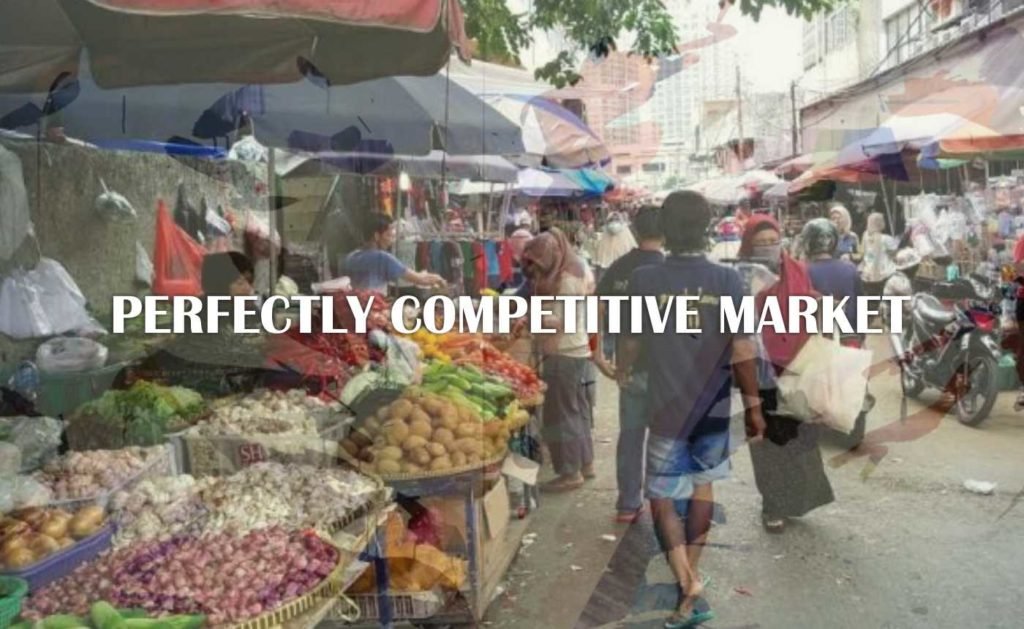
    Scientific classification
    Kingdom:
    Plantae
    Division:
    Magnoliophyta
    Class:
    Magnoliopsida
    Order:
    Caryophyllales
    Family:
    Nepenthaceae
    Dumort. (1829)
    Genus:
    Nepenthes
    L. (1753)


    Nepenthes distribution
    Nepenthes distribution. source : wikipedia

    Physical characteristics

    This Tropical pitcher plant can reach a height of 15-20 m by climbing other plants, although there are some species that do not climb. At the tips of the leaves there are tendrils that can be modified to form pockets, which are traps used to eat their prey (eg insects , pacets , frogs ) that enter inside. [1] These bags are used to meet nutritional needs that are not available in growing habitats. [2]

    Nepenthes ampullaria climbing stem
    Nepenthes ampullaria climbing stem

    In general, Nepenthes has three types of pouches, namely upper pouch, lower pouch, and rosette pouch. The upper bag is a pouch from an adult plant, usually funnel-shaped or cylindrical, has no wings, does not have an attractive color, the tendrils are facing backwards and can be wrapped around the branches of other plants, the upper bag more often catches flying animals such as mosquitoes or flies, pouches this species is rare or not found in some species, for example N. ampullaria. The lower pouch is a pouch produced on the part of a young plant which is usually lying on the ground, has two wings that serve as a tool for soil insects such as ants to climb up the mouth of the bag and finally plunges into the enzymatic liquid inside, while the rosette pouch has a similar shape. the same as the lower pouch, but the rosette pouch grows on the rosette-shaped leaf, examples of species that have this type of pouch are N. ampullaria and N. gracilis . Some plants sometimes secrete a central pouch that is shaped like a mixture of a lower bag and an upper bag.

    Taxonomy 

    About 160 species of Nepenthes are officially recognized at this time, which is a rapidly increasing number, with several new species being defined each year. [3]

    Habitat

    This Tropical pitcher plant has a very wide distribution from the coast to the highlands, because of this Nepenthes is divided into two types, namely the highland type and the lowland type, although most species grow in the highlands. The species recorded growing at the highest altitude was N. lamii at an altitude of 3,520 m. [1] [4]

    Most species grow in places with high humidity and moderate to high levels of light. Some species such as N. ampullaria grow in shady places with not too much light, while N. mirabilis grows in open areas with abundant light. The soil in which nepenthes grows is usually poor in nutrients and acidic. Some species grow in places that are highly toxic to other plants such as N. rajah which grows on soils containing heavy metals and N. albomarginata which grows on sandy beaches in zones exposed to sea water, some species grow epiphytes such as N. inermis which grows without touching the ground. [1]

    This plant grows in marginal soils poor in nutrients, especially nitrogen (such as peat soil, heath, lime soil, swamp). [5]

    Symbiosis with bats

    Woolly bats (genus Kerivoula ) are known to have symbiosis with pitcher plants. The bat sleeps in it while protecting itself from insects that will slip into the pitcher bag. In addition, bat droppings are also nutritious for semar bags. [6]

    References 

    1. Barthlott, W., Porembski, S., Seine, R., and Theisen, I. 2007.The Curious World of Carnivorous Plants. Portland, Oregon: Timber Press.
    2. Muhammad Mansur. Potensi Serapan CO2 Pada Beberapa Jenis Kantong Semar Dataran Rendah. Berita Biologi. Volume 16 No. 1, April 2017
    3. Clarke, CM & CC Lee 2004. Pitcher Plants of Sarawak . Natural History Publications (Borneo), Kota Kinabalu.
    4. Jebb, M.; Cheek, M. (1997). ” A skeletal revision of Nepenthes (Nepenthaceae) “. Blumea . 42 : 1–106.
    5. Muhammad Mansur. Potensi Serapan CO2 Pada Beberapa Jenis Kantong Semar Dataran Rendah. Berita Biologi. Volume 16 No. 1, April 2017
    6. Fuchs, Hannah (2013). Legowo, Vidi, ed. “The Unique Symbiosis of the Bornean Bat” . DW.DE (in English) . Retrieved 22 September 2013 .
  • Advantages, Disadvantages of Perfectly Competitive Markets

    Advantages, Disadvantages of Perfectly Competitive Markets

    In general, a perfectly competitive market is a market structure in which a large number of buyers and sellers are present. And all of them are involved in buying and selling homogeneous products at a single price prevailing in the market.

    In other words, perfectly competitive market is also referred to as pure competition, there is no direct competition between market participants. and all sell identical products for a single and equal price.

    Advantages of Perfect Competition

    You can see an explanation of the characteristics of a perfectly competitive market in this article. In addition, here are the advantages of a perfectly competitive market:

    a. Due to perfect knowledge among market participants, there is no misinformation and product knowledge is shared equally among all market participants.

    b. There are no barriers to entering a perfectly competitive market, so existing firms cannot gain the power to monopolize the market.

    c. There is no need to spend money on advertising, because the products sold are homogeneous, there is perfect knowledge of information, and companies can sell everything they can produce.

    d. There are two possibilities, namely the benefits to consumers and economic welfare.

    e. The formulation P (Price) = MC (Cost Margin) and MC = ATC (Average total cost) will occur. This means that production efficiency is well pushed and producers will improve the quality of the products they sell.

    Disadvantages of Perfect Competition

    In addition to the advantages of a perfectly competitive market, there are some disadvantages as well, namely:

    a. Because the goods sold are homogeneous, consumers feel limited in buying other products outside the homogeneous goods.

    b. It is very difficult to market a product whose brands are not that big or are not on a homogeneous product list.

    c. Limiting producers in innovating for product development because they are too satisfied and comfortable to produce homogeneous goods.

    How Realistic is the Manifestation of Perfectly Competitive Markets in the Real Business World?

    Realistically, there are very few markets or industries in the world that are perfectly competitive. For example, how can a company create a homogeneous product given that even the smallest companies engaged in manufacturing or services try to differentiate their products from other companies.

    The assumption that producers and consumers act rationally in a perfectly competitive market has been questioned by behavioral economists. A number of studies have shown that decision making by market participants is often irrational.

    Decision making can be biased and subjective when consumers and producers are faced with complex situations. This can be an interesting lesson .

    While a perfectly competitive market may be labeled unrealistic by some economists, this model still holds true in two respects; First, many primary commodity markets such as coffee and tea represent some of the characteristics of a perfectly competitive market.

    Such as the number of individual producers that exist, and their inability to influence market prices. Second, for other markets in manufacturing and services, the perfectly competitive market model is a useful benchmark against which economists and regulators can evaluate the level of competition in real markets. Also read our article The Concept of Demand and Supply in Economics.

    Conclusion

    Following is a brief review of the advantages, disadvantages, and criticisms of a perfectly competitive market. Whatever the market conditions, every market participant wants to benefit from their business.

    To achieve this, one of the steps that must be taken by each company or business person is to create a good accounting system for the company’s internal smoothness, comprehensive recording and reporting of each business transaction.

  • SWOT Analysis: Benefits, Factors and Examples

    SWOT Analysis: Benefits, Factors and Examples

    Strengths, Weaknesses, Opportunities, Threats is an acronym for SWOT. SWOT Analysis is a strategic planning techniques that are useful for evaluating the strength and weakness , opportunities and threats in a project. Here will also be discussed about examples of SWOT Analysis for companies.
    But of course, both analysis for an ongoing project or one that is in new planning.

    SWOT analysis was first introduced by Albert S Humphrey in the 1960s in leading a research project at the Stanford Research Institute using data from Fortune 500 companies.

    The benefits of SWOT analysis are as follows

    The SWOT analysis method is the right tool to find problems from 4 (four) different sides, where the applications are:

    • How strength are able to take advantage of an opportunity that exist.
    • How to overcome the weaknesses that prevent profits.
    • How the strengths able to deal with threats that exist.
    • How to overcome weaknesses that are able to make threats become real or create a new threat.

    With the interconnectedness of these 4 factors, making this analysis makes it easy to realize the vision and mission of a company.

    SWOT Analysis

    SWOT Analysis Example

    The following is a simple example of conducting a SWOT analysis to evaluate a company’s strengths, weaknesses, opportunities, and threats.

    Strength 

    Strengths are the strengths of your business, such as quality, location, or other elements that make you superior to your competitors. List as many strengths as you can so you can see what sets your business apart from similar businesses that are similar to yours.

    1. We can respond quickly to every customer request without having to go through a long bureaucracy.
    2. We have low overhead costs, so we can offer our customers the best possible price.
    3. We pay close attention to every customer’s requests and needs.
    4. We are very flexible in handling each case and customer request.
    5. We have a good reputation in our market.

    Weakness 

    Weakness is the weakness of your business when compared to competitors. Estimate all the shortcomings you have so that when you want to do a promotion, you can find out which points have a “safe” location so that they don’t mention the weaknesses of your business.

    1. Our staff still has low ability in certain areas.
    2. Our company has limited capital.
    3. Cash flow is sometimes not smooth.
    4. The location of the office is in a less strategic place.

    Opportunity

    Opportunity is an opportunity that you can achieve after analyzing your position through the two internal factors above. Opportunities can also be determined by calculating the budget that you will spend on certain promotions or advertisements.

    1. The sector we are working in is on the rise.
    2. The government is very supportive of local companies like us.
    3. There is no intense competition in the sector we are engaged in.
    4. Only with low capital we can start a business well.

    Threat

    Simply put, external factors are things you cannot manage as a business owner. High risk requires business owners to analyze threats in order to prepare loss prevention strategies. Threat factors that must be considered are natural disasters, technological developments, competitor activities, and changes in government regulations.

    1. The rapid development of technology in this area is beyond our capabilities and may cause us to be late in adopting it.
    2. Changes to competitors’ strategies could threaten our position in this area.
    3. Lack of banking interest in financing funding for the industry we are currently working on.

    Factors Affecting SWOT Analysis

    There are 2 main factors that will influence the four basic components of a SWOT analysis.

    SWOT-Analysis

    External and internal factors that will affect the analysis of Strength, Weakness, Opportunities, Threats are:

    Internal Factors (Strength dan Weakness)

    Internal factors or factors that come from within consist of two points, namely strengths and weaknesses.

    Both will perform better in a study when strengths outweigh weaknesses.

    Thus the maximum internal strength will obviously give much better research results.

    As for the part of the internal factors themselves, including the resources owned, financial or financial, internal strengths or weaknesses of the organization, as well as previous organizational experiences (both successful and failed).

    External Factors ( Opportunities and Threats )

    This is a factor from outside the entity, where this factor is not directly involved in what is being researched and consists of 2 points, namely threats and opportunities.

    The existence of these opportunities and threats will of course provide data that must be included in research journals so as to produce strategies to deal with them.

    Several points are included in external factors, including trends, culture, socio-politics, ideology, and the economy , sources of capital, government regulations, technological developments, events that occur, and the environment.

    SWOT Analysis Combination Strategy

    In the analysis, you can focus on a combination of the two SWOT points to determine the strategic steps of your business . These focus combinations include:

    1. Focus on  strengths-opportunities (SO)  to obtain offensive alternatives by using internal strengths to take advantage of external opportunities.
    2. Focus on  Weaknesses  (WT)  to obtain defensive alternatives by exploiting internal weaknesses to reduce external threats.
    3. Focus on  Strength-threats  (ST)  by using internal strengths to reduce external threats.
    4. Focus on  Weaknesses  (WO)  by shoring up internal weaknesses to take advantage of external opportunities.

    As a method in general, this SWOT analysis can only help analyze the situation being faced by a company or an organization.

    This means that in principle this method is not a definite answer that is able to provide a solution to every problem at hand.

    But at least it will break down the existing problem by breaking it down into small parts that will look simpler.

    In addition to making a SWOT analysis, companies must also start to make a proper financial analysis.

    For advance guide, please read this article from corporatefinanceinstitute.com

  • Understanding Accounting and Its Importance in Business

    Understanding Accounting and Its Importance in Business

    For some people, the science of accounting is related to the calculation system, but the fact is that accounting is a process that is not simple. What is accounting? What is the definition and understanding of accounting according to some experts? Sinaumedia will review it here.

    This knowledge is quite widely used in daily applications, especially related to business activities.

    By using this knowledge, entrepreneurs can monitor whether the business they are running is running well or not.

    Well, by reading this article, you will have a better understanding of the following topics and be able to answer questions such as:

    • an information system that provides reports to interested parties regarding the economic activities and condition of the company. What is the definition of this sentence?
    • Accounting is the process of identifying, measuring and reporting economic information to enable clear and unambiguous judgments and decisions for those who use the information.

    The definition or definition of accounting is as follows

    Broadly speaking, the notion or definition of accounting is a process that begins with recording, classifying, processing, presenting data, and recording transactions related to finance.

    Thus, the information can be used by someone who is an expert in the field and can be used as material for making a decision.

    A practitioner who is an expert in this field is called an accountant.

    The definition of accounting has also been referred to as the language of business to measure the results of economic activities in organizations and convey information to various parties, including management, investors, creditors, and regulators.

    Various theories themselves have been put forward regarding the notion of accounting.

    Various theories develop along with the increasing number of people who want to learn it, considering the science of accounting systems provides various conveniences in carrying out activities.

    Although accounting software is very helpful, but as an entrepreneur, accounting knowledge is very important to understand.

    The definition of accounting according to experts is as follows

    Various definitions and understanding of accounting represent different things. This difference occurs because the experts who put forward explore different fields of science.

    Here are some definitions of accounting according to some experts:

    • Warren

    What is accounting? In general, accounting or accounting is an information system that produces reports to interested parties regarding the economic activities and conditions of the company.

    • Paul Grady

    What is accounting? According to Paul Grady, accounting is a body of knowledge and organizational functions that are systematic, authentic and original in recording, classifying, processing, summarizing, analyzing, interpreting all transactions and financial events and characteristics that occur in the operations of accounting entities with the aim of providing information that This means that management is needed as a report and accountability for the trust it receives.

    • Zophar Lumbantoruan

    Accounting is a tool used as a business language where the information conveyed can only be understood if the accounting mechanism is understood.

    Stating that accounting is a service activity whose function is to provide quantitative information which is then used for economic decision making.

    The Process in Accounting Is As Follows

    As it has been mentioned above that accounting is a process related to finance whatever happens in a business or organization.

    The process consists of recording, summarizing, analyzing, and reporting data.

    If you want to know more, here is an explanation of the four processes:

    1. Take notes

    The first and most important process in the accounting process is the recording of transactions that occur within the company.

    This process is often referred to as bookkeeping, which is recognizing transactions and entering them into records.

    Bookkeeping is concerned with recording only.

    In accounting, bookkeeping is usually done for the sake of detailed recording and becomes a report to present data as a final financial report.

    2. Summarizing

    Generally, raw data is the result of recording transactions and is considered not very important.

    This raw data has no influence in the decision -making process.

    However, this is where the role of the accountant is to use the raw data, divide it into categories, and translate it.

    So, the usual process is to record transactions, then summarize them.

    3. Report

    Every business that happens in the company is the responsibility of management.

    Every business owner should know the various operations or activities that take place in the company and how the company uses the money.

    In this case, the owner of the company will receive a financial report for the company which is usually sent monthly.

    Meanwhile, there is also an annual report that will summarize all the performance within the company.

    sample accounting report
    sample accounting report

    4. Analyze

    Finally, analyzing is an important final process in accounting.

    After recording and summarizing, of course you have to draw conclusions.

    This is where the important role of management to examine the positive and negative points.

    In analyzing all of this, accounting introduces the concept of comparison.

    Where you can compare sales, profit and loss , equity, and more to determine and analyze work and make decisions.

    Of the many understandings of accounting science, all of them have almost the same goal where each goal is to provide accurate reports relating to company financial problems.

    The definition of accounting will help you in presenting a detailed report on the company’s expenses and income so that you can find out the profits and losses.

    In addition, the use of accounting knowledge will also help companies to identify employees who commit fraud.

    Can you now answer the question what is accounting?

    Again, accounting is the process of recording and processing data on every transaction that occurs in a business.


  • Integrated Circuit (IC) : Definition, History, Functions, Types and Examples

    Integrated Circuit (IC) : Definition, History, Functions, Types and Examples

    Do you know what IC is? In general, IC is an important component that we often find in an electronic circuit.

    This time, we will discuss in more detail what IC is. Starting from understanding, history, types, functions, and also examples.
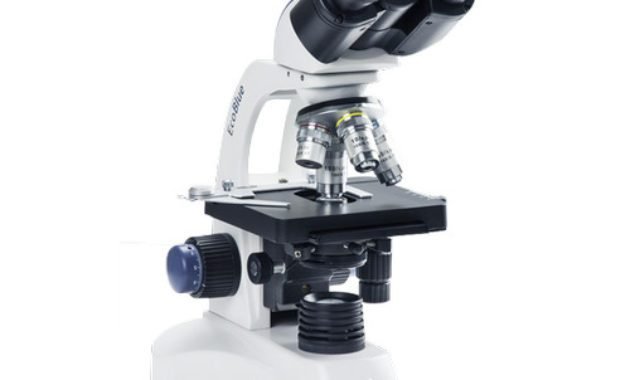
    So, don’t miss the complete information below, okay?

    What is IC / Integrated Circuit ?

    What is IC

    IC stands for Integrated CircuitBriefly, the definition of IC is an active electronic component . Which in it consists of a collection of thousands or even millions of resistors, transistors, diodes and capacitors.

    All of these elements are assembled into one electronic component and then integrated in a small package that we know as an IC.

    In terms of language, this IC is usually referred to as an Integrated Circuit. To make it, you need semiconductor materials in the form of silicon.

    IC serves as a logic gate whose job is to control a circuit. When using IC, the electronic device will have a small or portable form. This is why the appearance can be more concise, practical and more modern.

    history of Integrated Circuit

    IC history

    IC invented by whom?

    IC history was first introduced in 1958. This technology was introduced by a worker from Texas named Jack Killby.

    After being introduced for the first time, six months later IC was re-developed with a more sophisticated format than before.

    Robert Noycer is a person who succeeded in making IC fabrication. Which IC is made with a system connected to a silicon chip.

    With this discovery, IC is known as a popular technology and continues to grow rapidly from time to time.

    This IC is very influential on the appearance of today’s electronic equipment. Just imagine, how big the old electronics were because they still used vacuum tubes as their basic components.

    Now with the IC, almost all electronic equipment today has a thinner and more practical form.

    But not so when IC technology was invented. Some electronic devices have had significant changes.

    As we can see now, electronic equipment such as mobile phones, laptops or televisions have a slimmer and lighter form.

    In addition, IC technology is also proven to be able to make electricity consumption much lower.

    Therefore, nowadays almost every electronic component uses IC technology as its main internal part.

    What is the functions of IC?

    What are the functions of ICs?

    As we discussed above, IC is the main component used for electronic circuits .

    The IC functions for electronic devices are divided into 3 parts, namely:

    1. Linear IC
    2. Digital IC
    3. Mixed IC

    The following is an explanation of the IC functions of the 3 parts above, namely:

    1. Linear IC

    Linear IC

    Linear IC is also known as Integrated Circuit Analog. This linear IC can only operate on a continuous waveform signal.

    Here are some functions of the linear IC that you need to know.

    • Power amplifier (power amplifier).
    • Micro signal amplifier (microwave amplifier)
    • voltage regulator (voltage regulator)
    • RF and IF amplifier (RF And IF amplifier)
    • Multiplier
    • Voltage comparator
    • Radio frequency reception (radio receiver)
    • Operational amplifier
    • Signal booster and so on.

    2. Digital IC

    Digital IC

    igital IC is a type of IC that is popular for its use in the latest electronic equipment. For example, ICs are embedded in calculators, smartphones and laptops.

    These digital ICs generally have input and output voltages. Where each voltage has two levels, namely high and low. As for binary code, generally use the symbols of the numbers 1 and 0.

    The tasks and functions of digital ICs are as follows.

    • As a logic gate.
    • flip-flop
    • Timer
    • Counter
    • multiplexer
    • Memory
    • Calculator
    • Microprocessor and so on.

    3. Mixed IC

    Mixed IC is a type of IC that consists of a combination of analog IC types and digital ICs. The main function of the Mixed IC is to convert from analog signals to digital signals and vice versa.

    As technology develops, mixed ICs are also used for digital signal integration and RF functions.


     the Types of IC

     the Types of IC

    Having previously known about the various functions of IC, then next we will discuss about the types of IC. Let’s look at the explanation of the following IC classification.

    1. Transistor Transistor Logic (TTL)

    Transistor transistor logic (TTL) is a type of digital IC that is quite widely used in electronic circuits. Because the TTL IC has a relatively low voltage source. That is only about 4.75 volts to 5.25 volts.

    TTL ICs are built using transistors as the main element. The function of the transistor in this case is as a logical variation, so it is often referred to as Transistor Logic.

    In TTL ICs, several transistors are combined into one. So that it forms two states, namely on / off or functioning as a switch .

    TTL ICs also have multiple logic gates. Where each gate has a different function. These include AND, NAND, OR, NOR, and XOR. In addition, this component also has several other logical functions.

    For example, such as econder, multiplexer, decoder, and also memory.

    2. IC-CMOS

    2. IC-CMOS

    IC-CMOS stands for complementary with MOSFET. Which, the CMOS IC consists of a combination of MOSFETs. IC-CMOS uses a square wave.

    Where the waves used are generally in two conditions. Namely points 1 and 0 which function as a switch.

    The function of the IC-CMOS is as a logic gate. Where when using it, the electronic circuit can function automatically.

    IC-CMOS can usually function optimally when given an electric current of 12 volts. In this type of IC, there are several functions of logic gates.

    Among them are AND, NAND, OR, NOR, and XOR functions. Then there are also other logic functions such as multiplexer, decoder, econder and memory.

    3. Linear IC

    Linear ICs are not included in the category of digital ICs. This is why linear ICs and digital ICs work differently. If the digital IC usually uses a contact signal, then this linear IC uses a sinusoidal wave.

    The sinusoidal wave contained in the linear IC functions as an amplifier or amplifier. So, the IC does not have a function as a logic gate. Because its main function is specifically designed as a voltage amplifier.

    Linear ICs in general also have a proportional circuit. So, it is balanced in order to produce an output that is proportional to the input value. An example of the application of a linear IC is that it is used as an operational amplifier.


    Advantages and Disadvantages of IC

    IC is an electronic element that has many advantages and benefits. However, in addition to having advantages, these electronic components of course also have disadvantages.

    What are the advantages of using IC and what are the disadvantages? Check out the full review below!

    1. Advantages of IC

    Here are some of the advantages of IC in electronic circuits are:

    • IC has a much larger size.
    • Has a light weight.
    • Can be produced simultaneously or in large quantities so that the selling price can be cheaper.
    • Soldering and interconnecting ICs with very few IC internal components.
    • The use of electrical power can be smaller and of course efficient.
    • Easier to replace and repair if there is damage.
    • Suitable for operating systems with low signal.
    • Can perform complex functions and work systems.

    2. Lack of IC

    In addition to having many advantages, IC also has several disadvantages. Among the disadvantages of IC are :

    • The IC can only be operated on low-voltage systems.
    • IC cannot trigger or generate high power.
    • ICs need to be handled with care as they are very sensitive to Electrostatic Discharge.
    • IC is not resistant to high temperatures. This is why a fan or heatsink is needed to lower the temperature around the IC.
    • Tolerance to voltage is very small and limited.

    Conclusion :

    In short, IC is an electronic component that contains thousands of transistors, diodes and capacitors. Technically the IC functions as a logic gate to control an electronic circuit.

    With the IC technology, electronic devices have a significant improvement. Among them are slimmer, portable and also compact. In addition, the IC also saves electrical energy. So that its use is very popular until now.

    Well, how? Do you understand what IC is? See you on the next material about electricity.

  • All parts of the microscope and their functions

    All parts of the microscope and their functions

    The microscope is an important part in the laboratory, but do you already know all the parts of the microscope and their functions? Actually this tool is quite familiar to know and use. It has even started at an early age, aka students. But not necessarily already know all the parts. Though every part of the microscope has an equally important role. Curious what the parts and functions are? Check out the full explanation with GeneCraft Labs below.
    Types of Microscopes

    Before entering into an explanation of the parts of a microscope and their functions, you should first get acquainted with the types. In total there are two types of microscopes, namely light and electron microscopes.

    Light microscopes are further divided into two, namely dissection microscopes which are useful for observing the surface of objects, and monocular and binocular microscopes for observing the inside of cells.

    A monocular microscope has only one eyepiece. In contrast, a binocular microscope has two eyepieces that can be used by both eyes at once.

    For the electron microscope itself, the way it works is by using an energy source from electrons to enlarge the image of the research object.

    All parts of the microscope and their functions

    Microscope Components and its function

    Now it’s time to get into the discussion of the microscope parts and their functions. The microscope itself consists of two parts. There are optical and mechanical parts.

    Optical Parts

    For the optics, there are four components in it. Consist of:

    1. Ocular Lens

    The eyepiece, which is located directly above the microscope, is the first source of vision for the user. Its function is to form a real image of the objective lens. The number of ocular lenses in a monocular microscope is only one, so it can be used by one eye. However, for the ocular lens in a binocular microscope, there are two so that the user can have both eyes at once.

    2. Objective Lens

    The objective lens is located close to the object. The function of this lens is to enlarge the image of the observed object from 10 times to 100 times.

    3. Spotlight

    The reflector is a regulating mirror that is useful for reflecting light into the diaphragm.

    4. Condenser

    The condenser is useful for collecting the light reflected by the regulating mirror. The light is focused on the object.

    mechanical part

    For the mechanical part, it consists of seven components, namely:

    1. Microscope Tube

    The microscope tube is useful for adjusting the focus. Then another function is the link between the objective lens and the eyepiece.

    2. Revolver

    The revolver functions as a lever to support the objective lens in order to make it easier to adjust the observation value of the microscope.

    3. Object Clamp

    The object clamp is useful for holding the object glass so that it is easy to move during the observation process.

    4. Diaphragm

    Diaphragm is a component that is located in the preparation table. Its job is to determine how much light enters and is focused on the object of observation.

    5. Object Table

    As the name implies, the object table is useful as a container for placing observation objects. Usually there is an object clamp as well so that it can hold the object so it doesn’t move easily during the observation process.

    6. Microscope Arm and Leg

    The arm of the microscope is a handle when you want to move the microscope. On the other hand, the foot of the microscope is useful for placing this laboratory instrument on a plane that is not flat.

    7. Joint Inclination

    The inclination joint is useful for adjusting the degree of tilt of the microscope. This component is certainly needed to make it easier to observe.

    So that’s the information about the microscope parts and their functions. Hopefully the information can be useful for you.

  • How Induction Stoves Work

    How Induction Stoves Work

    How Induction Stoves Work, Superior and Safe Electric Stoves. Induction cookers heat cooking utensils placed on them directly by magnetic induction. Cooking utensils do not get hot because the surface of the stove is hot like on a gas stove. But the heat is directly flowed into the cooking utensil which makes the food in it cooked. So, the surface of the stove is not hot, it is safe to touch.
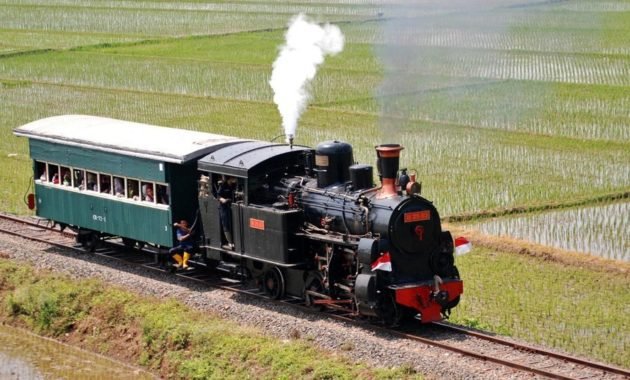
    Induction Stove Components and Their Functions

    There are several main components in an electric stove. These components also have their respective roles. Are as follows :

    1. thermostat

    The function of this component is to regulate the temperature of the electric stove. With this component can be determined how high the desired heat temperature when cooking.

    2. Control Knob

    This component is useful for disconnecting the electric stove from the power source. The form of a button can be a touch screen or a regular button.

    3. Timer

    The advantage of electric stoves is the presence of a digital timer. From this component, you can set a warning for the length of time required to warm up.

    4. Halogen Coil/Lamp

    A coil is a kind of wire that is able to convert electric current into heat. The mechanism of action uses the principle of electromagnetic induction. While the halogen lamp uses the principle of heat radiation.

    5. Fuse

    Induction hobs use a series of fuses to protect the heating element. This fuse will blow if too much electricity flows through it. Its main function is to prevent spikes from reaching the heating element.

    How Induction Cookers Work

    The working principle of the induction cooker can be explained as follows

    1. When the stove is connected to a regular power source with a frequency of 50 Hz. Using the converter and controlling element, the mains frequency of 50 Hz is converted into a high frequency of up to 25 kHz (the frequency can be adjusted via the controlling element).
    2. This high-frequency electricity is supplied to the induction coil, then current flows through the coil. Keep in mind here that the current flowing into the induction coil is alternating current with high frequency.
    3. This alternating current generates magnetic field lines. This magnetic field always changes according to changes in the current, namely ac.
    4. This magnetic field cuts the cooking place (container) made of metal (conductor). What happens when metal is cut by a magnetic field that changes all the time?
    5. In metal, there will be an induced emf (voltage) ( Faraday’s law ).
    6. Because the metal for cooking is a single unit, it is electrically the same as being short- circuited. What happens when the voltage is short-circuited? There will be a current which in this case is rotating in direction. Because of its direction, this current is then called an eddy current or eddy current .
    7. The eddy current that flows in the metal and the metal still contains a resistance even though it is small, so heat arises and this heat is used for cooking.

    The heat generated by the stove depends on the electrical energy converted to heat. The power of the stove will be determined by the frequency of the electricity supplied to the induction coil. The higher the frequency, the higher the power of the stove and the higher the temperature (heat) of the stove.

    How it Works Induction stoves do not produce fire, there is no risk of exploding if the gas cylinder is not installed properly like on a gas stove. The surface of the induction cooker is also not heated, so it is safe to touch.

    The Kanahome induction stove is equipped with a sensor to stop the heating process if the temperature on the surface of the stove is too hot or if no cooking utensils are placed on the stove, there is also a timer feature so that the stove will turn itself off within the set time.

    The heat generated by induction stoves is more efficient than gas stoves. The flat shape makes the heat received by the cookware more evenly and 90% accepted by the cookware. While the gas stove produces uneven fire, sometimes the fire is large in certain parts so that the heat is only on a certain side, the heat received by the cooking utensils is only 65-70%. Therefore, cooking with an induction cooker is also faster and more efficient. In addition, the bottom of your pan will not turn black from being exposed to excessive heat.

  • HOW DOES A STEAM ENGINE WORK?

    HOW DOES A STEAM ENGINE WORK?

    In this article, you will learn what the components of a steam engine are and how they work. Steam engine is a technology that converts heat energy into motion energy. The steam engine has a way of working using physical concepts that apply the laws of thermodynamics.
    Inventor of the Steam Engine

    We know James Watt as the inventor of the steam engine in the mid-18th century. In that year, the invention of the steam engine became one of the most revolutionary inventions in history because it revolutionized the industrial world. The invention of the steam engine was the beginning of the industrial revolution.

    But in fact, James Watt was not the first inventor. James Watt made repairs to the previous steam engine on the condenser and shaft parts.

    So who invented the steam engine? So the answer to the inventor of the steam engine is Thomas Newcomen. The steam engine invented by Thomas Newcomen in 1712 had the purpose of pumping water in the mining world. While James Watt made repairs in 1776.

    After improvements by James Watt, the steam engine operated more efficiently and moved more smoothly in its energy conversion process. Through its improvements, the steam engine can be applied in industry more efficiently.

    James Watt worked with Matthew Boulton to design steam engines for industries in Europe.

    Not only for industry, the use of steam engines is increasingly developing as a means of supporting land transportation. Steam engines began to replace animal power during the industrial revolution, one of which was the steam locomotive. Animal power began to be replaced by steam engines in 1830 when there was a race between horses and steam engines.

    In the early 19th century, the steam engine underwent continuous improvement until it became more efficient with a smaller size.

    Steam Engine Components

    The working principle of a steam engine can occur because the components are interconnected into a system. The components of a steam engine consist of frames, pistons, cylinders, bearings, valves, etc.

    Steam Engine Components

    1) Frame

    Steam engine has a frame or frame that has a function as a container to connect the components in it. A steam engine frame is made of metal casting material because it is more resistant to thermal expansion.

    2) Cylinder

    Component Cylinder or cylinder on a steam engine is a part or component in the form of a room that has a function to accommodate steam and piston movement. Some engineers refer to the cylinder on a steam engine as the crankcase.

    3) Steam Chest

    Steam Chest on a steam engine is a part or component of a steam engine that is integrated with the cylinder. This Steam Chest generally has a cube or spherical shape depending on the valve used.

    4) Main Bearings

    Bearing is a component or part of a steam engine that has a function to maintain the rotating axis of a shaft. Because friction or flexion often occurs, the inner bearing surface needs to be coated with lubricant.

    5) Piston 

    piston in the steam engine has a similar way of working like the piston in a car engine or motorcycle engine in general. The piston in the steam engine has a function to continue the steam compression force into rotation.

    6) Piston Rings or Piston Rings

    A piston has rings to keep steam from penetrating between the pistons and cylinders.

    7) Piston Rod or Piston Rod The piston

    rod in a steam engine has a function to transmit the compressive force on the piston head to a rotary crank.

    8) Stuffing Box

    The Stuffing Box on the steam engine has a function as a seal to prevent the steam in the system from escaping into the atmosphere. If a leak occurs, the energy in the steam engine system will not be maximized.

    9) Crosshead

    Crosshead on a steam engine has a function so that the movement of the piston is not sideways and out of line.

    10) Connecting Rod or Piston

    Rod Connecting Rod on a steam engine has a function to connect the piston to the crankshaft.

    11) Valve / Valve

    As previously explained that the valve is a part of the cylinder and steam chest. The valve on the steam engine has a function as a gate for the entry and exit of steam in the system.

    12) Valve Rod and Eccentric Rod

    Eccentric Rod The machine has a slab-like shape that has the function of converting rotary motion into linear motion. Why do we need linear motion in steam engines? The answer is to open and close the valve.

    13) Flywheel

    Free Will or we call it the gear on a steam engine is a mechanism to dampen the rotation suddenly. So that the torque on the steam engine becomes more stable.

    How Does Steam Engine Work?

    Steam engines are included in the category of heat engines, namely equipment used to convert thermal energy from fuel into mechanical energy through the combustion process. There are two types of heat engines, namely Internal Combustion Engines (ICE) and External Combustion Engines (ECE). In ICE-type heat engines, the process of burning fuel to produce mechanical power is carried out within the equipment itself; while in ECE, this equipment only converts thermal energy into mechanical energy while the combustion process is carried out outside the equipment.

    Examples of ICE-type heat engines are gasoline and diesel engines, which are very popular as prime movers for both automotive and industrial use. In gasoline and diesel motors, the process of burning fuel (gasoline/diesel) is carried out in the motor cylinder itself and the change in thermal energy resulting from combustion into mechanical energy is also carried out in the aircraft itself through the back and forth movement of the piston into rotational movement of the crank shaft.

    Examples of ECE-type heat engines are steam engines and steam turbines. In this equipment, the steam engine only converts the potential energy of the steam into mechanical energy in the form of to and fro movement of the piston and then converted into rotational motion of the crank shaft; while the steam turbine converts the potential energy of the steam into mechanical energy which is directly the rotational motion of the turbine axle. The fuel combustion process is carried out outside the steam engine and steam turbine, namely in the boiler (boiler). In the boiler (boiler) the thermal energy from the combustion of fuel is used to heat water so that it turns into steam with high temperature and pressure, then the steam with high temperature and pressure is flowed to a steam engine or steam turbine to be converted into mechanical power.

    The workings of the steam engine are as follows: See the picture below,

    HOW DOES A STEAM ENGINE WORK

    Inside the steam engine cylinder there is a piston which has a piston rod connected to a cross head which is outside the cylinder. The cross head is connected by a connecting rod to the crank shaft (not shown in the picture), so that when the piston moves to and fro, the crank shaft can rotate.
    The slide valve which has a valve rod is driven by the crank shaft through an eccentric, so that the slide valve can move to and fro while opening and closing the two steam holes connected to the cylinder. The valve box where the slide valve is located has two channels, the intake channel is connected to the boiler to deliver high pressure steam (red color), and the exhaust channel is connected to the chimney to remove used steam (blue color).

    When the piston reaches the leftmost position, the slide valve will open the steam hole of the left cylinder so that steam from the boiler can enter the cylinder on the left side of the piston and push the piston to the right, while the right steam hole is connected to the exhaust channel so that the used steam can be drained. discharged through the chimney. Before the end of the piston stroke, the steam hole is closed by the slide valve so that the steam supply stops but the piston continues to move to the right due to the expansion of the steam.

    When the piston reaches the far right position, the slide valve will open the steam hole of the right cylinder so that steam from the boiler can enter the cylinder on the right side of the piston and push the piston to the left, meanwhile the left steam hole is connected to the exhaust channel so that used steam can be wasted. through the chimney. Before the end of the piston stroke, the steam hole is closed by the slide valve so that the steam supply stops but the piston continues to move to the right due to the expansion of the steam.

    Because the cross head with the crankshaft is connected by a connecting rod, the back and forth movement of the piston will be converted into rotational motion of the crankshaft. Thus as long as there is a supply of steam from the boiler, the steam engine will turn into mechanical power with the rotational movement of the crank shaft.

    HOW DOES A STEAM ENGINE WORK

    Steam locomotives usually have 2 steam engines mounted on the right and left of the locomotive, the rotational motion produced by the two steam engines is directly used to turn the locomotive wheels so that they are able to pull the entire train series (see picture below).

    HOW DOES A STEAM ENGINE WORK

  • The Function of Charcoal in Water Purification

    The Function of Charcoal in Water Purification

    We often hear the question of what is the function of charcoal in water purification. So is it true that charcoal can actually purify water? Let’s see the  following Sinaumedia review  !
    What is Charcoal?

    Charcoal itself is   a black residue which contains impure carbon compounds. Charcoal can be obtained by removing the water content and volatile compounds/components  from  plants and animal bones through the combustion process.

    The form of charcoal is almost like coal consisting of 85% to 98% carbon, the rest is in the form of ash and  other chemical compounds  . There are several basic ingredients for making charcoal such as wood, bones, coconut shells, rice husks and so on.

    The Function of Charcoal in Water Purification

    If you have studied science, you must have done water purification techniques using sand, gravel and stones, right? Can the water you filter be perfectly clear? Of course you can’t! Then why is that? The reason is because the material you use does not contain activated carbon compounds.

    As we know, charcoal contains activated carbon which is able to bind impurities through the absorption or  absorption process . That is, when there is a substance or material that passes through the activated carbon and interacts, the material contained in it will also be absorbed. Therefore, charcoal with activated carbon is able to purify polluted water and at the same time eliminate odors and tastes in the water.

    The use of charcoal in the water purification process is an example of the adsorption properties of colloids, namely the ability to absorb colloidal dispersed particles in water. Dirty water will usually have a lot of colloids that need to be separated using adsorbents such as charcoal, activated carbon and zeolites.

    The way this separation works is by binding the dirt that has accumulated in the water so that the water can be clean and fit for consumption. In addition, activated carbon can also bind to the remnants  of the cleaning agents  used, such as  fluorine  and  chlorine .

    Conclusion

    Purification of dirty water to be clean can indeed use charcoal or activated carbon. You can use charcoal from coconut shells, wood, bones, rice husks and so on.

    The real use in our daily life is in the process of refilling gallons of water. The gallon water refill machine has a purification section with the help of activated charcoal to produce water that is safe for consumption.

    Waste Management

  • Understanding Aquades and its functions

    Understanding Aquades and its functions

     This distilled water is something that is commonly found, many people have used this water. Especially in the laboratory. So what is aquadest?, aquadest or some also call it aquadest water is a type of water where this water is produced through a distillation process.

    Then what is the function of aquadest? The distillation process here is a process where the goal is to produce water with very good quality, which later on so that the results of the water can be equalized with mineral water. What kind of mineral water is meant?, namely water in which has a lot of good content.

    Examples such as salt, sulfur, and in the form of gases dissolved in water. Aquatic water is a type of water whose content is able to be equal to mineral water. However, this water can only be obtained by one distillation process. Did not achieve two or more processes.

    Although this water can only be obtained with one distillation process, but still the content contained can exceed the content contained in mineral water. So, mineral water is far superior to distilled water. This does not reduce the use of distilled water.

    A. Definition of Aquades

    Aquadest water is water from the distillation process or can also be called distilled water, which is a process of boiling water which will produce water vapor. This process aims to remove the minerals present in the water. From this boiling process the steam will then be re-solidified in a different container.

    So, after distillation, only H2O is contained in the water, in the absence of other elements. Even though it contains only H2O, this water can still be consumed. Here are some explanations of the advantages and disadvantages of the distillation process:

    The advantages of aquadest water

    Aquadified water certainly has many advantages in its use. Here are the various advantages of aquadest:

    1. From several research studies, that this water can be consumed to help prevent  arthritis . Why is that?, This is because distilled water is believed to be able to get rid of mineral deposits contained in human joints.
    2. Distilled water is also believed to be free from various  microscopic toxins . Examples  are bacteriaviruses , and various  other microorganisms  found in a faucet or tub and can be harmful to the health of the body.
    3. Distilled water is also free from various other chemical mixtures. Such as  chlorinefluoride , and other mixed materials that are likely to be found in ordinary bottled water, or bathtubs in general.
    4. Distilled water is even believed to be an alternative for preventing gallstones. This water will remove the minerals contained in the cells of the human body. So that the risk of gallstone disease can be avoided.
    5. Distilled water also does not have the various ingredients found in tap or bottled water in general. Why is that?, because this water has gone through the distillation process first.

    Lack of Aquatic Water

    Not only does it have various advantages, in fact distilled water also has several disadvantages. Following are the disadvantages of aquadest:

    1. Consuming distilled water in the long term and in excessive amounts can result in poor health. This is because distilled water is able to absorb  very large amounts of carbon dioxide  .
    2. If you continue to consume distilled water, then this results in a rapid loss of electrolytes in the body of the person who consumes it. This is clearly dangerous, isn’t it?
    3. If the body has experienced a deficiency of various electrolytes that are very important, for example, such as  chloridemineralssodium , and others. This can cause irregular heart pressure, this cell also results in blood pressure fluctuations.

    B. Aquatic Functions and Its Various Uses

    Generally, some people consume aquadest as an alternative to absorb various toxic substances in the body, then dispose of them. Even so, there are also those who use this water in various other areas of life that are far more important.

    Because actually consuming distilled water is not always profitable. Another use of this water can be in the  laboratory space . Namely as a mixture of chemical solution substances  . Here are some explanations regarding the use of aquadest water:

    1. Aquatic Function in the Laboratory

    The function of distilled water in the laboratory is as a mixture of chemical substances, when conducting research. In addition, distilled water is also used to clean  laboratory equipment  before or after use. After this, use distilled water as an alternative to assist in research.

    2. Function of Aquades in Steel Processing

    Besides being used in the laboratory, aquadest can also be used in steel processing. What kind of processing is meant?, that is, it is utilized in the process of cutting steel and cooling the engine. It is known to be very effective in inhibiting the presence of scale and moss.

    3. Aquatic Function in Chemistry

    chemical lab

    In the field of chemistry, aquadest can clearly be utilized. As already explained, distilled water is used as a mixture or solvent for chemicals, or certain solutions. This water can be used when researching a concentration or compound.

    4. Aquades Function As Battery Water

    It turns out that this very popular distilled water is also popularly used as a substitute for battery water. Do you know how important  it is to use battery water  in motorized vehicles? The answer must be very important. So this shows that distilled water can be another alternative as a substitute for battery water.

    Those are some explanations about the use of aquadest water in everyday life. Is distilled water considered important and useful?, judging from the explanation above and the many benefits that can be obtained from aquadest, then distilled water is considered very important and beneficial.

  • Mutualism Symbiosis Examples and Explanations

    Mutualism Symbiosis Examples and Explanations

    There are 3 kinds of symbiosis in general which is a relationship between living things, including symbiotic mutualism, commensalism and parasitism. In this article, we will specifically share the understanding and examples of mutualism symbiosis in ecosystems.

    Understanding symbiosis mutualism is an interaction between two living things that benefit both parties. This means that in this symbiosis, the two living things involved benefit each other without anyone being harmed.

    The first is the service-resource interaction which includes pollination, cleaning and seed dispersal. While the second is service-service interaction where both interactions contribute. This type is also quite rare and rarely found.

    There is also a symbiotic mutualism which is an obligation. This means that the organisms involved need each other to survive. Examples of mutualism symbiosis can be seen all around us, both in animals, insects, birds, plants, bacteria, fungi and even humans.

    Examples of Symbiosis Mutualism

    Below will be explained 20+ examples of symbiotic mutualism in various terrestrial and marine ecosystems along with the interaction process and a complete explanation.

    Flowers with butterflies

    The interaction between flowers and butterflies is one of the best known examples of symbiotic mutualism. Butterflies suck honey and nectar in flower petals to make food. This process also helps pollinate flowers.

    The profit will be obtained by the butterfly which gets its food in the form of honey and nectar. While flowers also benefit because the pollination process is assisted by butterflies.

    Flowers with bees

    Just like the interaction of flowers and butterflies, another example of symbiotic mutualism is the relationship between flowers and bees. Bees also suck honey and nectar from flower petals which help pollinate the flower.

    Benefits will be obtained by bees who get food in the form of honey and nectar. While flowers also benefit because the pollination process is assisted by bees.

    Flowers with beetles

    One more example of symbiotic mutualism in the form of flower pollination, namely the interaction of flowers with beetles. This example is the same as the relationship between flowers and bees or flowers and butterflies. Beetles will get nectar and help the process of pollination of flowers.

    The benefits will be obtained by the beetles that get food in the form of honey and nectar. While flowers also benefit because the pollination process is assisted by beetles.

    Flies with rafflesia flowers

    Flies and Rafflesia flowers are examples of mutualism symbiosis between animals and plants. The Rafflesia flower is known as a flower with an unpleasant odor and is nicknamed the corpse flower. This is used by flies to perch on the Rafflesia flower in search of food.

    Profits will be obtained by flies that get food for free. Meanwhile, the Rafflesia flower also benefits because it is assisted by the pollination process by flies.

    Zebra with wildebeest

    In the African savanna, many herd animals live including zebras and wildebeests. The two species are known to be very familiar with each other. The two herds also often migrate together. In eating, the two also often divide where the zebra eats long grass and the wildebeest eats short grass.

    In relation to predators, the two are also mutually beneficial to each other. Wildebeest have more sensitive instincts, while zebras have sharper eyesight. If there is a predator, the two will warn each other.

    Starling with buffalo

    The relationship between starlings and buffalo is also another example of mutualism symbiosis. Starlings usually perch on the back of buffalo to look for fleas on their skin. Buffaloes will also feel helped by the starlings that eat the ticks on their skin.

    The advantage will be obtained by the starlings who get food in the form of lice. Meanwhile, buffalo also benefit because the itching caused by fleas is reduced.

    Storks with hippos

    The interaction of the stork and the hippopotamus is also an example of a symbiotic mutualism. The stork will eat the fleas and parasites on the hippo’s back. The hippopotamus certainly benefits from the habits of the crane.

    Profits will be obtained by the cranes who get food. While the hippopotamus also benefits because his body becomes clean and free of fleas.

    Crocodiles with plovers

    The next example of symbiotic mutualism is the interaction of crocodiles and plover birds. Plover birds have a habit of eating dirt or food debris in the mouth and teeth of crocodiles. Crocodiles of course also benefit from this habit.

    Profits will be obtained by plover birds who get food for free. While crocodiles also benefit from being free from oral diseases because their feces are cleaned.

    oxpecker with zebra

    The zebra-oxpecker interaction is also almost identical to the starling and buffalo interaction. The oxpecker usually eats fleas and other insects on the zebra’s body. In addition, the oxpecker will be a signal for the zebra if there is a predator coming.

    Profits will be obtained by oxpecker birds who get food in the form of lice. Meanwhile, zebras also benefit because they feel less itching and are signaled when predators such as tigers or lions are coming.

    Tropical pitcher plant with woolly bats

    The relationship between pitcher plants and woolly bats is an example of a mutually beneficial interaction. Wool bats usually live in comfortable places around pitcher plants which also provide benefits for pitcher plants.

    The advantage will be obtained by woolly bats who will get a comfortable place to live. Meanwhile, semar bags also benefit from obtaining fertilizer derived from bat droppings which are rich in nitrogen.

    Spider crab with algae plant

    The spider crab is a species of crab from Japan that lives in the ocean with the characteristics of having long legs. This species lives in the green areas of marine plants. Usually the algae plants will stay on the spider crab’s back.

    Profits will be obtained by algae plants that get a place to live. While spider crabs also benefit from the presence of algae plants, spider crabs can camouflage with their surroundings so that they are not detected by predators.

    Ant with woodpecker

    Woodpeckers like to make holes in trees to make their nests. While ants are common in trees. Both are mutually beneficial to each other. Ants guard woodpecker eggs in trees, while woodpeckers provide protection for ants.

    The advantage will be obtained by the woodpecker where the eggs are protected by ants. While ants also benefit from getting protection from woodpeckers.

    Aphids with ants

    Aphids are parasites that suck leaf sap. After that the ants will approach to press the back of the tick so that the liquid sap that has been processed in the body of the tick will come out and be eaten by the ants. Ants also help aphids to find food by bringing ticks to trees that are larger and contain a lot of sap.

    The advantage will be obtained by the ants who get food from the liquid sap from the tick. Meanwhile, aphids also benefit from being helped to find food by ants.

    Plants with hornbills

    The interaction of hornbills and plants is also an example of a symbiotic mutualism. Hornbill ants often live in trees. The hornbill ants often get food in the form of pests that grow on the leaves of the trees they live in, usually mango or sugar apple trees.

    The advantage will be obtained by the hornbill ants who get food and make nests in trees. Meanwhile the occupied plants also benefit because the existing pests have been eradicated.

    Beans with rhizobium bacteria

    Legumes and rhizobium bacteria have mutually beneficial interactions. Legumes need nitrogen-containing soil for growth. The presence of rhizobium bacteria in the soil helps legumes to obtain nitrogen.

    Benefits will be obtained by legume plants that obtain nitrogen from rhizobium bacteria. While rhizobium bacteria also benefit from getting food from the roots of legumes.

    Termites with flagellate bacteria

    Termites and flagellates interact and benefit from each other. In the body of termites there are flagellate bacteria that will help digest food when termites eat wood. Flagellates secrete cellulose enzymes which function to make hard wood soft.

    The benefits will be obtained by termites which are helped by the process of digesting their food. While flagellates also benefit because they can live in the intestines of termites.

    Farmers with owls

    Humans who work as farmers also have a symbiotic mutualism interaction with owls. Owls will usually prey on mice that are on farmland. This of course also benefits farmers considering that rats are pests.

    The advantage will be obtained by owls who get their prey in the form of mice. Meanwhile, farmers also benefit because rats, which are pests, are reduced.

    Mushrooms with algae plants

    The next example of symbiotic mutualism is the relationship between fungi and algae plants. The fungus will make the surrounding environment moist so that algae plants can grow and can carry out the process of photosynthesis. Later the fungus also gets a share of the results of photosynthesis.

    The benefits will be obtained by algae plants that can carry out the process of photosynthesis. While fungi also benefit because they get food from photosynthesis.

    Humans with plants

    This is an example of a symbiotic mutualism that we should know and feel every day. Humans and plants need each other. Humans emit carbon dioxide which helps the process of plant photosynthesis. While the oxygen produced by plants will be inhaled by humans.

    The benefits will be obtained by plants that obtain carbon dioxide from humans. While humans also benefit in the form of oxygen produced by the photosynthesis process of plants.

    Humans with small intestine bacteria

    Humans also have a mutualistic symbiotic relationship with small intestinal bacteria. Small intestinal bacteria known as Escherichia ecoli are useful for reducing the growth of bad bacteria and speeding up the process of decay in the large intestine.

    Benefits will be obtained by humans where the growth of bad bacteria is reduced and the decay process is accelerated. While the small intestine bacteria also benefit because they can get food debris from the large intestine.

    This is a reference for examples of mutualism symbiosis that exist in terrestrial and marine ecosystems and involve various living things such as humans, plants, animals, fungi, fleas and bacteria. This is an example of an example of mutualism symbiosis this time.

  • Discussion of the Photosynthesis Process in Plants [+Image]

    Discussion of the Photosynthesis Process in Plants [+Image]

    Since we were in elementary school, of course, we are all familiar with the term photosynthesis. Photosynthesis is the process of making food substances carried out by plants that takes place on the role of the sun. If the sun shines very brightly, then the process of photosynthesis can run perfectly. Because without the sun, photosynthesis could never happen.

    Photosynthesis role in the Carbon Cycle
    Photosynthesis role in the Carbon Cycle

    Definition of Photosynthesis

    Photosynthesis comes from two words, photo which means light and synthesis which means the process of making or processing using nutrients. On earth, there are only a few creatures that can carry out photosynthesis. Among them: plants, algae, and several types of bacteria.

    It can be said that photosynthesis is very important for life on this earth. This is because almost all living things are very dependent on the energy produced from the photosynthesis process in plants , especially in terms of obtaining food sources (glucose).

    see phorosynthesis definition from wikipedia.

    Photosynthesis Function

    After knowing the meaning of photosynthesis, we continue with the function of photosynthesis. There are many functions obtained from photosynthesis. And here are some of the functions obtained from photosynthesis.

    Producing Glucose

    Photosynthesis is carried out by plants to produce glucose. Glucose is also the main raw material that can be used as the manufacture of other food substances, such as fats and proteins in plants. These substances are also a source of food for animals and humans. Therefore, the ability of plants to convert light energy into chemical substances has always been the most important thing in the food chain system.

    Convert Carbon Dioxide to Oxygen

    Photosynthesis also functions to clean the air. Carbon dioxide that cause of global warming  can be reduced due to the photosynthesis process carried out by plants. Because carbon dioxide is the raw material used for photosynthesis. The more photosynthesis occurs, the more carbon dioxide content is reduced in the air.

    Produce Coal

    Photosynthesis carried out by plants also causes plant remains that lived in the past and buried in the ground to turn into coal which is still one of the sources of energy for life on this earth. This is of course very important because coal has so many functions and benefits. Therefore, it is appropriate for us to always maintain and preserve the plants that exist in our environment.


    Main Ingredients Used In Photosynthesis Process

    • Carbon dioxide (CO2)
    • Water
    • Chlorophyll
    • Sunlight

    Photosynthesis Process

    Photosynthetic Process
    Photosynthesis Process

    The process of photosynthesis also has stages, and the following steps are carried out by plants during the photosynthesis process.

    • Photosynthesis begins with carbon dioxide taken from the mouth of the leaf at night. After carbon dioxide is taken, plants will then take water from the soil by using the roots carried by the transportation system in plants. The transport system that carries water is called xylem and
    • If sunlight is available, then plant chlorophyll will directly absorb sunlight as the main energy in making glucose
    • Furthermore, glucose will be directly processed into protein, fat, and other substances. The process of photosynthesis is also very complex.

    2 Stages in Photosynthesis

    In general, the process of photosynthesis that occurs in chloroplasts requires sunlight to be able to make glucose. But there is also a process of photosynthesis that does not require sunlight at all. As a result there are 2 types of reactions caused by the process of photosynthesis. The following are the two reactions.

    The two stages of photosynthesis
    The two stages of photosynthesis : Photosynthesis takes place in two stages: light-dependent reactions and the Calvin cycle (light-independent reactions). Light-dependent reactions, which take place in the thylakoid membrane, use light energy to make ATP and NADPH. The Calvin cycle, which takes place in the stroma, uses energy derived from these compounds to make GA3P from CO2. source : lumenlearning.com

    1. Light dependent Reaction / Photolysis

    The light reaction is a photosynthetic reaction that requires the help of sunlight. In general, this reaction takes place in an open space exposed to direct sunlight. The light reactions also take place in the thylakoid membrane in the chloroplast space. In this reaction, chlorophyll will serve as an absorber of sunlight which is used to convert water molecules into oxygen and hydrogen. The light reaction is also known as photolysis.

    2. Dark Reaction / The Calvin Cycle

    If the light reactions desperately need help from sunlight, then the dark reactions don’t need it at all. But the dark reaction can never happen if the plant does not carry out the light reaction first. If the light reactions take place in the thylakoid membrane, the dark reactions take place in the stroma and chloroplasts.

    The processes that occur in the dark reactions are also very complex, just like those that occur in the light reactions. The purpose of this dark reaction is to convert carbon dioxide into glucose. Therefore, the light reaction is closely related to the dark reaction. Because the dark reaction itself can never occur if the plant does not carry out the light reaction first.


    Factors Affecting the Success of Photosynthesis

    There are several factors that can affect the success of the photosynthesis process. The success or failure of the photosynthesis process is very dependent on the elements that are the basic ingredients in the photosynthesis process. Not only that, the condition is also one of the factors that can influence. And here are some factors that affect the success of the photosynthesis process.

    • Internal Factors

    Internal factors are factors that come from plants that will carry out photosynthesis. Because basically there are many types of plants that live in various conditions. Therefore the photosynthetic reactions that occur will also be very different.

    In addition, heredity is also one of the things that greatly affects the process of photosynthesis. For example, such as albino plant species that absolutely cannot produce chlorophyll. So that the type of albino plant can not carry out the process of photosynthesis. There are also several other influencing factors. Among them: leaf age, completeness of plant organs, number of leaves, and carbohydrate translocation.

    red colored plant
    • External Factors

    In addition to the internal factors described above, there are also external factors that also greatly affect the success of the photosynthesis process carried out by plants. And here are some external factors that affect the success of the photosynthesis process.

    • Water Availability

    Water is one of the main ingredients needed in the process of photosynthesis. The availability of water in the soil greatly affects the results that will be obtained from the photosynthesis process. The more water content in the soil, the greater the results that will be obtained from the photosynthesis process. Vice versa, if the water content in the soil is very little, the smaller the results that will be obtained from the photosynthesis process. The process of photosynthesis can also potentially fail.

    • temperature

    Photosynthesis is highly dependent on the performance of enzymes. Enzymes themselves can work optimally at a temperature of 23-30 degrees Celsius. If the available temperature reaches minus 5 degrees Celsius or even exceeds 50 degrees Celsius, the photosynthesis process carried out by plants will not produce maximum results.

    • Content of Carbon Dioxide (CO2)

    In order for plants to carry out photosynthesis, plants really need carbon dioxide. Plants must absorb at least 0.03 percent of the existing amount of carbon dioxide. But that’s just the bare minimum. The more carbon dioxide content absorbed by plants, the better the results obtained by plants from the photosynthesis process itself.

    • Oxygen Content (O2)

    Not only carbon dioxide, plants also need oxygen to be able to carry out photosynthesis. Because oxygen is the energy used by plants during photosynthesis. If the oxygen content around is very low, the results will not be perfect. This is because very little oxygen content can inhibit the respiratory system in plants.

    That’s a brief discussion of the meaning of photosynthesis and a little discussion of the processes that occur during photosynthesis. Hopefully the above explanation can add insight to all of us.

    In addition, we all must try as much as possible to be able to maintain and preserve plants so that plants can carry out photosynthesis perfectly. Because if there were no plants, all of us who live on this earth would never be able to live. Because plants play an important role in life on the entire surface of the earth. May be useful!

  • 11 Most Wanted Computer Skills 2022

    11 Most Wanted Computer Skills 2022

    Today technology has changed the face of the business world. The business world is increasingly dependent on the latest technological capabilities. So many companies are competing to recruit many skilled workers and have qualified computer skills.
    Given the growing trend of the market, if you are looking to land a profitable job, this article might be for you. Here, we’ll dig deeper to find out what computer skills are the best to invest in and what resources are needed.

    Here are the six most in-demand computer skills

    1. Spreadsheets and Databases

    Data processing capabilities such as Spreadsheets and Database management skills are top of the list. It is the most sought after job skill in the market.

    To be hired, we must be proficient in processing spreadsheets. Starting from storing data, organizing it, applying complex mathematical formulas, and complex macros. So complete expertise is absolutely needed here.

    In other words, you need to have expertise in working with:

    • Microsoft Excel
    • Microsoft Access
    • Statistics
    • Data analysis
    • Adobe Campaign
    • Quickbooks
    • XML Database management system
    • Professional Film Maker
    • MATLAB
    • FORTRAN
    • RDBMS (Relational Database Management System)
    • SAS

    2. Social Media, Email, and Blogging

    Although many people are active on social media, not everyone knows how to use social media professionally. In this case, having the skills to write attractive and professional emails, write blogs, and manage and organize activities on social media are the main keys to getting into a well-known company.

    Some of the skills related to social media, email, and blogging are:

    • Content Management System (CMS)
    • Google Analytics
    • Cascading Style Sheets (CSS)
    • Marketing Email
    • Webpage Design
    • WordPress
    • digital media
    • Search Engine Optimization (SEO)
    • Management Software Campaign

    3. Graphic Design and Word Processing

    desain grafis

    Currently, the market requires the presentation of information in a form that is easy to read and understand. So, the ability to be able to present information and content so that it is easy for people to read and understand is needed. Therefore, the abilities or skills that must be developed are abilities related to the following:

    • Adobe Photoshop
    • Adobe InDesign
    • Adobe Illustrator
    • AutoCAD
    • Corel Draw
    • Microsoft Visual Studio
    • Maya
    • Microsoft Word
    • Microsoft Publisher
    • Digital Camera Operation

    4. Software or Hardware Design and Development

    Software and Hardware Development , in simpler language, means designing, implementing, and testing the software or hardware of a computer. It is the most lucrative and promising computer skill. This includes software designers or developers, software analysts , software programmers , hardware configurations , etc.

    In order to be able to develop and test software and hardware properly, we need to carefully read what the user needs or users, and make applications according to what they want. We need to understand various web and mobile application coding languages ​​to be able to get orders from users or users, some of which are:

    • HTML
    • C/C++
    • Java
    • Python
    • XML
    • UI/UX
    • LINUX
    • CISC and RISC architecture Arsitektur
    • Hardware Design Built In Processor
    • RAM Management
    • PCB Layout
    • SQL

    also read: Benefits of Virtual Private Network (VPN)?

    5. IT Expert

    The ability to see a problem and solve it in real-time, is sought after by many companies. Especially related to the management of operations, maintenance and security of the company’s IT infrastructure.

    So, if you are familiar with understanding the basic anatomy of computers and machines and know the tricks to make work operations efficient, it is very suitable to enter the IT department. The problem solving skills in IT that must be mastered are:

    • Backup Management
    • Diagnostic
    • End User Support
    • Client-Server Management
    • Installation and configuration
    • Problem tracking system (ITS)
    • Administration system
    • Technology support

    6. Enterprise Systems and Operations Expert

    Many companies own internal software , such as PeopleSoft to manage their data and operations.

    So try to be able to integrate the capabilities we have with the software that has been running in the company for a long time, so as to be able to make system performance and company operations even more efficient.

    Conclusion

    After knowing the 6 most sought-after types of computer skills on the market, the first decision that needs to be made is to focus on mastering one skill first. All of the above skills are equally good and promise to make our career progress. So, choose one according to your talents, skills and interests. If you interested in android gaming, maybe you need to read this article  best emulator for 4gb ram pc.

  • Get to know the types of surgery that exist in the medical field

    Get to know the types of surgery that exist in the medical field

    For some people, they may have had surgery, both for themselves and those closest to them. Hearing the word type of surgical operation, many of us think that the person who undergoes it must be exposed to a dangerous disease, even though it is not necessarily a very serious disease. There are people who undergo minor surgery so that there is no risk to him. This time sinaumedia will review further types of surgery.

    Definition of surgical operation and its types 

    While surgery itself is a method of treatment carried out by medical personnel / doctors to treat a disease by opening / closing certain body parts according to applicable procedures. Not all diseases can be cured by surgery, so doctors must know very well the symptoms, treatment and appropriate treatment for patients.

    Medical personnel or doctors who perform surgery should also not be careless because it can be bad if something fatal happens. Must have had good experience. There are many kinds / types of this surgical operation, judging from its purpose, level of risk, and technique.

    Types of operations based on their objectives are divided into:

    • Diagnose

    Diagnosing disease is an obligation for a doctor in his work. The operation that is commonly performed for this is a biopsy operation which aims to determine the presence of cancer or tumors in the patient’s body.

    • Prevent

    This action aims to prevent the spread of the disease in the patient’s body. For example, surgery to remove intestinal polyps is done to prevent cancer.

    • Remove

    Surgery that aims to remove a number of tissues in the body because it has spread in several body tissues. For example, surgical removal of the uterus, and breast removal.

    • Restore

    The purpose of this operation is to restore the function of certain body organs to normal again. Like breast reconstruction surgery.

    • palliative

    This type of surgery is only to reduce the pain felt by the patient, usually this action is done in patients with end-stage chronic disease.


    Surgical operations based on the level of risk are divided into 2, namely:

    • Minor surgery (minor)

    This type of surgery is a surgical procedure that does not require a long time in the recovery process because there is no need to perform surgery in a dangerous area and usually this type of anesthesia uses local anesthesia. For example, surgery on external tissues when an accident occurs in the hands/feet, extraction of nails, ganglion surgery on the hands.

    • Major surgery (severe)

    Major surgery is an operation that is carried out with greater risk because it has to open wider body tissues so that the recovery time for the patient is usually relatively longer. Examples of major operations such as organ transplant surgery, brain tumor surgery, heart surgery and so on.

    Based on the technique of surgery is divided into:

    • Open surgery

    This surgical operation is better known as conventional surgery, where medical procedures are performed by making incisions in the body using a special knife. For example, heart surgery, where the doctor must cut the patient’s chest and open it so that the heart organs are clearly visible.

    • Laparoscopy

    A type of laparoscopic surgery where the doctor only makes a small incision on the body and then inserts a tool such as a tube into the incision hole to find out the problems that occur in the patient’s body

    Based on the timing of the surgery, surgery is divided into 3, namely:

    • Elective

    Surgical procedures are performed to treat diseases that do not endanger the patient’s life and are only performed at the request of the patient.

    • Emergency

    Surgery performed to save a patient’s life or a patient’s body part due to an accident or injury which caused trauma.

    • Semi elective

    Surgery is performed to prevent the effects of an illness or injury, but does not have to be done immediately, this surgery can be postponed for a while.


    Thus the explanation for the types and definitions of surgical operations, this knowledge is to make the general public understand the importance of surgery on body parts to be carried out for some patients. So, we should not equate that all operations are dangerous.

  • Types of Oxygen Masks

    Types of Oxygen Masks

    An oxygen mask is a medical device that provides a method for transferring respiratory oxygen gas from a storage tank to the lungs. Oxygen masks can cover the nose and mouth  (oral nasal mask ) or the entire face ( full-face mask ). Giving oxygen to the patient by using a mask filled with oxygen with a position covering the patient’s nose and mouth.
    Oxygen masks are generally transparent and have straps so they can be tied tightly around the client’s face. There are various forms of face masks. The difference between a rebreathing and a non-rebreathing mask lies in the presence of a valve that prevents exhaled air from being re-inhaled.

    Types of Oxygen masks:

    • The simple face mask delivers oxygen with an oxygen concentration of 40-60% with a flow rate of 5-8 liters/minute.

    Simple_face_mask

    • Rebreathing masks deliver oxygen with an oxygen concentration of 60-80% at a flow rate of 8-12 liters/minute. Has a pocket that continues to expand both during inspiration and expiration. During inspiration, oxygen enters from the mask through the hole between the mask and the reservoir bag, plus oxygen from the chamber enters the expiration hole in the bag. The inspired air is partially mixed with the exhaled air so that the CO2 concentration is higher than that of a simple face mask.

    • The non-rebreathing mask delivers oxygen with oxygen concentrations up to 80-100% at a flow rate of 10-12 liters/minute. In principle, inspired air does not mix with exhaled air because it has 2 valves, 1 valve opens during inspiration and closes during expiration, and 1 valve whose function is to prevent room air from entering during inspiration and will open during expiration.

    How to use :

    • Explain the procedure to the patient (if conscious)
    • Set a comfortable position on the client (semi-fowler)
    • Connect the oxygen tube to a simple facemask with a humidiflier.
    • Adjust the simple facemask so that it covers the patient’s nose and mouth mulut
    • Wrap the rubber mask around the patient’s head so it doesn’t come off
    • Deliver oxygen as needed.


  • THE 3 TYPES OF RESEARCH

    THE 3 TYPES OF RESEARCH

    Hello Statisticians, this time Sinaumedia will review about recognizing 3 types of research that you need to know. For those of you who are going through a thesis or research, I hope this article can be an inspiration.
    Although there is often a blur within the boundaries, research in general can be classified into 3 types. The first is exploratory research, explanatory research or confirmatory research , and descriptive research.

    WHAT IS SCOPING OR EXPLORATORY RESEARCH?

    An exploratory research is a type of research that is open, still searching, and does not necessarily have a hypothesis. Researchers’ knowledge about the symptoms to be studied is still very little.

    Scoping research is thus often carried out as the first step for more in-depth research, be it explanatory research or descriptive research. Through this exploratory research, research problems can be formulated more clearly and in more detail, and hypotheses can be developed.

    In general, the definition of exploratory research is an activity in conducting an in-depth analysis of something new, which has never existed before.

    Here are some examples of studies with exploratory research designs:

    • A study of the role of social networking sites as an effective marketing communication channel
    • Investigation of how to improve the quality of customer service in the hospitality sector in Bangkok
    • Assessment of the role of corporate social responsibility on consumer behavior in the Garment industry in Vietnam

    DEFINITION OF EXPLANATORY RESEARCH ( EXPLANATORY OR CONFIRMATORY RESEARCH )

    Explanatory research is a type of research that highlights the relationship between research variables and tests hypotheses that have been formulated previously. Therefore, this has also eaten research hypothesis testing or testing research . Although the description also contains a description, as a relational research the focus lies in explaining the relationship between variables.

    Explanatory Research allows researchers to provide deep insight into a particular subject, which breeds more subjects and provides more opportunities for researchers to learn new things and question new things.

    An in-depth study of a subject creates cycles and, critical thinking/study of a subject creates more questions and those questions lead to more ways for the researcher to learn more things related to that subject.

    Explanatory research is a type of research that is a pillar of other types of researchers. Before starting the research for the next research, we should always do explanatory research first, because without it the research would not be complete and would not be as efficient.

    Explanatory research works to give your survey and research design a better focus and significantly limits unwanted bias information.

    THEN, WHAT ABOUT DESCRIPTIVE RESEARCH? WHAT DOES IT MEAN?

    Descriptive research usually has two objectives. The first is to determine the development of certain physical facilities or the frequency of occurrence of certain aspects of social phenomena. For example, the number of two-wheeled vehicles, four-wheeled vehicles, family planning acceptors, the number of films being screened, and so on.

    The results are listed in the frequency table table. the second is to describe in detail certain social phenomena. For example, social interaction, kinship system, and others. Such research is usually carried out without a rigorously formulated hypothesis. Sometimes using a hypothesis but not for statistical testing

    In essence, descriptive research is used to describe various aspects of phenomena. In its popular format, descriptive research is used to describe the characteristics and/or behavior of a sample population.

    An important characteristic of descriptive research relates to the fact that although descriptive research can use a number of variables, only one variable is needed to conduct descriptive research. The three main objectives of descriptive studies can be described as describing, explaining and validating research findings.

    this type of descriptive research is closely related to observational research, but is not limited to the method of collecting observational data. Case studies and surveys can also be defined as popular data collection methods used with descriptive studies.

  • ELEMENTS OF SCIENTIFIC RESEARCH THAT MUST BE UNDERSTOOD

    ELEMENTS OF SCIENTIFIC RESEARCH THAT MUST BE UNDERSTOOD

    Hello statisticians. Are you working on a script or want to take a script? Now this time sinaumedia will discuss the elements of scientific research. Keep on reading.
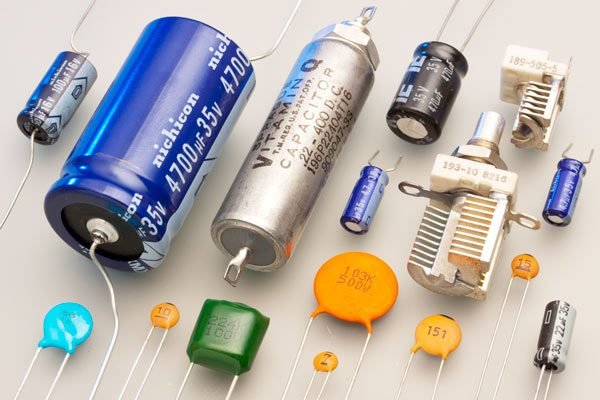
    To be able to conduct research well, researchers need to have knowledge of various elements of research . The elements that form the basis of this scientific research are: concepts, prepositions, theories, variables, hypotheses and operational definitions .

    Scientific research is a systematic process of proving the relationship. Therefore, the relationship between the elements of scientific research can also be presented systematically below.

    the relationship between the elements of research
    the relationship between the elements of research

    The schematic above shows the theoretical process of the empirical process of a research; formulation of concepts, positions and theoretical arrangements in a scientific research. Formulation of operational definitions, data collection, formulation and testing of statistical hypotheses is an empirical process.

    It should be remembered that the research process is an ongoing process and begins with the researcher’s deep interest in the relationship to be studied.

    With the interest and ideas, the research process increases in theoretical understanding (which requires an understanding of concepts, theoretical propositions), hypothesis formulation (including an understanding of hypothetical variables, operational definitions and statistical hypotheses), and hypothesis testing.

    ELEMENTS OF SCIENTIFIC RESEARCH

    Below, the statistical consultant’s efforts will describe the elements of this research one by one with examples of their actual use.

    1. CONCEPT

    The concept of research is the most important element of research and is the definition used by researchers to abstractly describe a social phenomenon or natural phenomenon.

    For example, to describe the reproductive capacity of poultry known as the concept of fertility and hatchability. Another example to illustrate population movement is known as the concept of migration and mobility.

    Some of the concepts commonly used in population research and social research include the value of children, contraceptive behavior, labor force, unemployment and so on.

    2. PREPOSITION

    Prepositions are statements about the nature of reality that can be tested for truth. A hypothesis is a proposition formulated for empirical testing. Theorems or laws are also prepositions that have a wider range or scope and have received a lot of empirical support.

    3. THEORY

    Theory is the main means of expressing the systematic relationship between social and natural phenomena to be studied. A theory is a logical sequence of one or more prepositions.

    Is scientific information obtained to increase the abstraction of meanings and relationships in prepositions. Theory is scientific information obtained by increasing the abstraction of meanings and relationships in prepositions. More complex theories are usually logical combinations of several prepositions.

    4. VARIABLE

    Another element commonly known as the element of research is the variable. Variable is a concept that has a variety of values.

    So, the concept of the body is not a variable why and does not contain the meaning of the existence of varying values. Weight or height are variables because they have different values.

    Sex is a variable because it can have a value that is male or female. Age, education, marital status, number of children, home ownership status, money supply are all variables.

    Concepts that do not contain multiple value meanings can usually be turned into variables by focusing on certain aspects of the concept.

    An example is eggs. The concept of eggs can be used as a variable, for example by assessing aspects of egg weight, egg length and width, egg color and so on.

    5. HYPOTHESIS

    As previously discussed, the research objective is to examine the systematic relationship between the variables. This relationship is usually presented in the form of a hypothesis which is an important research element.

    A hypothesis is a tentative conclusion or preposition about the relationship between two or more variables. The hypothesis is always presented in the form of a statement that links explicitly or implicitly a variable with one or more other variables.

    A good hypothesis must meet 2 criteria. First the hypothesis must describe the relationship between the variables. Both hypotheses should provide clues on how to test the relationship. This means that the variables listed must be measurable and the direction of the relationship between these variables must be clear.

    Example of a hypothesis in animal husbandry research: the fertility rate of native chicken eggs is influenced by the quality of feed and the age of the mother.


    6. OPERATIONAL DEFINITION

    One element of research that really helps communication between researchers is the operational definition. The operational definition is an indication of how a variable is measured. By reading the operational definition of a study, a researcher will know the measurement of a variable, can know the good or bad of the measurement.

    In the operational definition section, it is usually explained how the research method is carried out. such as the number of samples, how to measure variables, the research process, experimental design, how to analyze statistical data, and so on.

    Well, that’s the article about the elements of research from sinaumedia , I hope this article is useful and enlightening. see you again in the next article. stay tuned.

  • Definition of Capacitor and How it works?

    Definition of Capacitor and How it works?

    Understanding Capacitors, Types, Formulas, Kinds, Types, Functions and Examples: are electronic components that have the ability to store electrons for a certain time or electronic components used to store electric charges.

    Definition of Capacitor

    A capacitor or capacitor by Michael Faraday (1791-1867) is essentially a device that can store energy/electrical charge in an electric field, by accumulating an internal imbalance of electric charge or an electrical component capable of storing an electric charge formed by a surface. (disk or chip) connected which are separated by an insulator.

    Michael Faraday
    Michael Faraday

    When a capacitor is connected to a voltage source, the disk or plate is filled with electrons. When electrons separate from one plate to another, the electron charge will exist between the two plates. This charge is caused by a positive charge on the plate that loses electrons and a negative charge on the plate that gains electrons.

    Capacitors are electronic components that have the ability to store electrons for a certain time or electronic components that are used to store electric charges consisting of two conductors and are separated by an insulating material (dielectric material) each conductor is called a chip.

    Like resistors, capacitors are one of the passive components that are widely used in making electronic circuits. Capacitors differ from accumulators in that they store electric charge, especially when there is no chemical change in the capacitor material. Another definition of a capacitor is an electronic component that can store and release an electric charge. Capacitors or often called capacitors are electrical components that are made in such a way that they are able to store an electric charge.

    The principle of a capacitor in general is the same as a resistor which is also included in the passive component group, namely the type of component that works without the need for bias current. Capacitors consist of two conductors (metal plates) separated by an insulating material (insulator). This insulating insulator is often referred to as a dielectric material.

    The dielectric substance used to block the two transmitters of the component can be used to distinguish the type of capacitor. Some definitions of capacitors that use dielectric materials include paper, mica, liquid plastic and others.

    If both ends of the metal plate are given an electric voltage, then positive charges will collect on one of the metal legs (electrodes) and at the same time negative charges will accumulate on the other metal end. Positive charges cannot flow towards the negative end of the pole and conversely negative charges cannot go to the positive end of the pole, because they are separated by a non-conductive dielectric material.

    This electric charge is “stored” as long as there is no conduction at the ends of the legs. The ability to store electric charge in a capacitor is called capacitance or capacity. Capacitance is defined as the ability of a capacitor to accommodate electron charges. Coulombs in the 18th century calculated that 1 coulomb = 6.25 x 10¹⁸ electrons.

    Then Michael Faraday postulated that a capacitor will have a capacitance of 1 farad if with a voltage of 1 volt it can carry a charge of 1 coulomb of electrons. With the formula it can be written: Q = CV Where: Q = electron charge in C (coulombs) C = capacitance value in F (farads) V = voltage in V (volts) In the practice of making capacitors,

    The capacitance is calculated by knowing the area of ​​the metal plate (A), the distance (t) between the two metal plates (dielectric thickness) and the dielectric constant (k) of the material. The formula can be written as follows: C = (8.85 x 10⁻¹²) (k A/t) The following is a table of examples of the constant (k) of some simplified dielectric materials Vacuum air k = 1 Aluminum oxide k = 8 Ceramics k = 100 – 1000 Glass k = 8 Polyethylene k = 3

    As the ability of a capacitor to accommodate the charge of electrons. Coulombs in the 18th century calculated that 1 coulomb = 6.25 x 10¹⁸ electrons. Then Michael Faraday postulated that a capacitor will have a capacitance of 1 farad if with a voltage of 1 volt it can carry a charge of 1 coulomb of electrons.

    With the formula it can be written:

    Q = CV

    With assumption :

    Q = electron charge C (Coulomb)

    C = capacitance value in F (Farad)

    V = high voltage in V (Volts)

    In the practice of making capacitors, the capacitance is calculated by knowing the area of ​​the metal plate (A), the distance (t) between the two metal plates (dielectric thickness) and the dielectric constant (k) of the material. With the formula can be written as follows:

    C = (8.85 x 10^-12) (k A/t)


    How capacitors work

    The way a capacitor works in a circuit is to flow electrons into the capacitor. When the capacitor is filled with electrons, the voltage will change. Furthermore, electrons will exit a capacitor and flow into the circuit that needs it. That way, the capacitor will generate a reactive circuit.

    But we do not deny, even though a capacitor component has a different shape and size, the function of a capacitor is still very much needed in an electronic component or even an electronic circuit.

    As for the two plates or plates in a capacitor separated by an insulator, basically no electrons can cross the gap between the two plates. When the battery is not connected, the two pieces will be neutral (uncharged). When the battery is connected, the point where the wire at the negative end of the pole is connected will repel electrons,

    while the point where the positive pole is connected attracts electrons. The electrons will be scattered throughout the capacitor plates. Momentarily, electrons flow into the right-hand plate and electrons flow out of the left-hand plate; in this condition current flows through the capacitor even though there are no electrons flowing through the gap between the two plates.

    After the outside of the chip is charged, it will gradually reject the new charge from the battery. Therefore the current in the plates will decrease in magnitude with time until both plates are at the voltage that the battery has. The plate on the right will have an excess of electrons which is measured with a charge of -Q and on the plate on the left it is charged with +Q .


    How is a capacitor made?

    • If two or more plates are facing each other and are limited by insulation, then the plate is electrified, a capacitor will be formed (the insulation that limits the two plates is called a dielectric).

    • The dielectric materials used are different, so the naming of capacitors is based on the dielectric material. The area of ​​the plate opposite the dielectric material and the distance between the two plates affect the capacitance value.

    • In a circuit that does not occur stray capacitors. Such a property is called parasitic capacitance.The cause is the presence of adjacent components in adjacent electrical conductor lines and adjacent coils of wire. The picture above shows that there are two plates that are bounded by air. The distance between the two plates is expressed as d and the input voltage.

    Capacitance

    The capacity of a capacitor is the ratio of the amount of electric charge to the voltage across the capacitor. C = Q / V If calculated by the formula C = 0.0885 D/d. Then the capacity in units of pico farads D = the area of ​​the plates facing each other and influencing each other in cm2. d = distance between plates in cm. If the voltage between the plates is 1 volt and the magnitude of the electric charge on the plates is 1 coulomb, then the ability to store electricity is called 1 farad. In reality capacitors are made with units below 1 farad. Most electrolytic capacitors are manufactured from 1 microfarad to several millifarads.


    Capacitor Formula

    The Capacitor Formula consists of several formulas that are used to calculate the amount of electric charge both generated by the capacitor and the incoming electric charge. The following are some formulas about capacitors with parallel circuits, series circuits and series and parallel capacitor circuits whose units of calculation are farads (F). The following are the formulas that are stored in the pieces of an electrically charged capacitor as follows:

    Here is an Example of the Capacitor Formula Rumus

    Explanation:

    Q = Charge in Coulombs
    C = Capacity in Farads
    V = Voltage in Volts
    (1 Coulomb = 6.3*1018 electrons)

    The capacitor can function as a battery because the voltage remains in the capacitor even though it is not connected, the length of the remaining voltage depends on the capacity of the capacitor itself. Examples of other formulas in a capacitor circuit:

    • Formula for Capacitors with Parallel Circuit 

    C Total = C1 + C2 + C3

    In the Capacitor Formula above it can be concluded that, in the parallel capacitor circuit there is no division for voltage or electric charge at all, all voltages will have the same amount at every point in the parallel capacitor circuit the reason is because at the same point the parallel capacitor is connected , so it has no significant changes.

    • Formula for Capacitors with Series Circuit

    1/C Total = 1/C1 + 1/C2 + 1/C3

    In the formula for a capacitor with a series circuit above, it can be concluded that, at each measurement of this series capacitor, there is a voltage distribution from the voltage source to each point, which in the end when combined by adding up the voltages from each point it will look the same as the sum of the voltages. from the voltage source.

    • Series and Parallel Capacitor Formulas

    C Total = (C1 + C2) // C3
    1/CA = 1/C1 + 1/C2 (tie)

    In the Capacitor Formula with series and parallel circuits above, it can be concluded that this type of circuit can be calculated by combining several equations that can be seen from the two capacitor formulas, namely series and parallel. So we can find out the total number of combinations between these 2 types of capacitors.


    Capacitor Circuit

    Capacitor circuit is divided into two, namely series circuit and parallel circuit. The calculation method is almost the same as for series and parallel circuits on resistors. The following is the equation of the capacitor circuit.

    Series circuit

    The series circuit on a capacitor is a capacitor circuit by connecting the NOT similar poles between the capacitors, as shown in the following figure:

    The replacement capacity in a series circuit is:

    tot = 1 C 1 + 1 C 2 + 1 C 3
    tot = Q 1 = Q 2 = Q 3
    tot = V 1+ V 2+ V 3

    The series arrangement of capacitors is that the capacitors are arranged in one unbranched connecting line. If a capacitor is arranged in series, the total replacement capacitor can be determined from all the capacitors in the series circuit. In this series arrangement the following rules apply:

    • The charge on each capacitor is equal to the sum of the charges on the replacement capacitor.
    s = Q 1 = Q 2 = Q 3 = Q 4 
    • The potential difference (V) across the ends of the replacement capacitor is equal to the potential difference across each capacitor
    Vs = V1 + V2 + V3 + V4
    • The capacity of the replacement capacitor can be found by the formula
    Cs = 1/C 1 + 1/C 2 + 1/C 3 + 1/C 4
    • For n capacitors with the same capacity, you can use the quick formula
    Cs = C/n

    What needs to be remembered because the replacement capacity of the series arrangement of several capacitors is always smaller than their respective capacity, so capacitors arranged in series can be used to reduce the capacity of a capacitor.

    Parallel Circuit

    Parallel circuit is a series of capacitors by connecting the SAME poles between the capacitors, as shown in the following figure:

    The replacement capacity in a parallel circuit is:

    tot = C 1+ C 2+ C 3
    tot = Q 1+ Q 2+ Q 3
    tot = V 1 = V 2 = V 3

    • The charge on the replacement capacitors is equal to the sum of the individual capacitors (same as the voltage in a series circuit)
    Qp= Q1 + Q2 + Q3 + Q4 + dst…
    • The potential difference of each capacitor is equal to the potential difference of the original source (same as the charge in a series circuit)
    Вп = В 1 + В 2 + В 3 + В 4
    • The capacitance of the replacement capacitor in a parallel circuit is equal to the sum of the total capacitances of the capacitors in the circuit.
    Cp = C1 + C2 + C3 + C4

    Because the replacement capacity of all parallel circuits is always greater than that of each capacitor in the circuit, so parallel arrangement can be used to increase the capacity of the capacitor.

    Combined Series and Parallel

    This arrangement is a combination of series and parallel arrangement. The formula that applies is the same as the formula that applies to the two previous types of circuits. Here, my friend must be shrewd in identifying from a series of combinations which are series and which are parallel. The following is a simple example of a combined circuit

    Capacitor Energy

    An electric charge creates an electric potential and work is required to move it. To charge a capacitor requires electrical work, and this electrical work is stored in the capacitor as energy. The loading starts from zero to Q coulomb. The energy equation for the capacitor can be written as:

    W = 12 CV 2 = 12 QV = 12 Q 2 C

    information :

    W = energy of the capacitor

    Q = Electric Charge ( C )

    V = Electric potential


    Capacitor Type

    According to the type, capacitors can be divided into 2 types, namely:

    Fixed capacitor

    Fixed capacitor is a capacitor whose capacitance value cannot be changed and the value has been set by the manufacturer. The shape and size of the capacitor still vary and differ from one another depending on the material of manufacture.

    Fixed capacitors are also divided into 2, namely:

    • Polar capacitor

    1) Electrolytic capacitor

    This capacitor is a type of polar capacitor or has 2 poles on the legs. The long leg is the positive pole and the short leg or the leg that has a special sign is the negative leg. The installation of electrolytic capacitors in electronic circuits should not be reversed, especially for DC current circuits but for AC current it is not a problem.

    This capacitor should not be exposed to excessive heat during the soldering process because the electrolyte contained in the capacitor can boil and cause the capacitor to be damaged. The following is a picture of an electrolytic capacitor. These capacitors are available with a large enough capacity, the smallest having a capacity of 0.1 microFarrad and the largest commonly available on the market is 47000 microFarrad. But the author has encountered this capacitor in the size of 1 Farrad at a price that is enough to make the bag dry. The working voltage of this capacitor is very diverse but is usually written on the capacitor body. Its working voltage ranges from 6.7 V to 200 Volts.

    2) Tantalum capacitor

    In accordance with technological developments in the field of electronics, electronic component manufacturers are always creating new inventions in the form of capacitor components that have high reliability. In general, these capacitors are made with a small physical shape and are red or green in color. Because they have high reliability, tantalum capacitors are quite expensive.

    • Non-polar capacitor

    1) Ceramic capacitor

    Named ceramic capacitors, because these capacitors are made of ceramic dielectric material. Ceramic capacitors come in various shapes and sizes. This capacitor is stable enough that it is often used in electronic circuits. The capacitance value of this capacitor is usually written in color code, but there are also those that are written directly on the body using numbers.

    2) Polyester capacitor

    The role of plastic is not limited to making bags or household appliances, but also plays a role in the manufacture of electronic components, namely capacitors. Plastic capacitors are very popular in their use and in the field of electronics known as polyester capacitors. In general, these capacitors are made with a small and flat shape. This capacitor does not have a polarity so the installation will not be difficult. The inclusion of the capacitance is usually in color code.

    3) Mica capacitor

    Mica capacitors are components that were born since the first generation and are still widely used today because of their high reliability in addition to having stable properties and low tolerance. As the name implies, this capacitor is made of mica. The use of this type of capacitor is in circuits associated with high frequencies. The capacitance of this capacitor is 50 to 10,000 F

    4) Film capacitor

    Film capacitors, the dielectric is made of film. The amount of capacitance is listed with a color coded in the form of a bracelet and the reading method is almost the same as reading the resistor color code.

    5) Paper capacitor

    It is called a paper capacitor because the dielectric material is made of paper. This type of capacitor has been born since the first generation where at that time still using a vacuum tube. This type of capacitor is now rare and almost not used anymore. In the installation of this capacitor will not be a problem because it is not equipped with polarity. The capacitance of this type of capacitor is 100 pF to 6800 pF.

    Capacitor is not fixed (Variable)

    A variable capacitor is a capacitor whose capacitance value can be adjusted as needed. The types of variable capacitors are;

    • Variable capacitor (Varco)

    Variable capacitors are a type of capacitor that are larger than fixed capacitors. In accordance with its physical form, the variable capacitor has a large capacitance. Capacitors of this type were made in the first generation. Variable capacitors are widely used in large circuits. The capacity of this type of capacitor usually ranges from 1 F to 500 F.

    • Trimer Capacitor

    The trimer capacitor is a variable capacitor that has been developed from the previous variable capacitor which has a small size, so because it has a small size this capacitor is very suitable to be installed in today’s modern circuits.

    Trimmer capacitors are equipped with presets, which are tools used to adjust the amount of capacitance. The adjustment can be done using a screwdriver. This type of variable capacitor uses a dielectric material, namely mica or plastic. The capacitance of this type of capacitor is 5 to 30 F

    • Active capacitor or CDS

    Technological developments in the field of electronics are currently growing rapidly so that now many components are appearing that are getting smaller but have better functions than before.

    Likewise with capacitor components, currently active types of capacitors have been developed, meaning that these capacitor components will actively flow charge when exposed to light, either sunlight or other light sources. These components are widely used as sensors in garden lighting circuits or alarm circuits or functions as an automatic switch.


    Capacitor Function

    Capacitor function is needed in an electronic component. Capacitors are electronic components that function to store electric charge, besides that capacitors can also be used as frequency filters. The capacity to store the ability of a capacitor in an electric charge is called Farad (F) while the symbol for a capacitor is C (capacitor).

    The function of the capacitor itself is divided into 2 groups, namely capacitors that have a fixed capacity and capacitors that have a capacity that can be changed or in other words variable capacitors. The basic nature of a capacitor is that it can store an electric charge, and for DC current the capacitor functions as an insulator / retainer of electric current, while for AC current the capacitor functions as a conductor / passes electric current.

    In its application the capacitor is used as a filter, DC voltage leveler which is used to change the AC voltage to DC, AC wave generator or oscillator and so on, and can also function as impedance (resistance whose value depends on the given frequency), to save power. electricity in fluorescent lamps.

    The function of a capacitor  in an electronic circuit is as a coupling, a filter in a power supply circuit, a phase shifter, a frequency generator in an oscillator circuit and is also used to prevent sparks in a switch.

    • To temporarily store current and voltage
    • As a filter or filter in an electronic circuit such as a power supply or adapter
    • To eliminate the bounce (sparks) when installed on the switch
    • As a coupling between one electronic network and another electronic network
    • To save electricity when installed in fluorescent lamps
    • As an insulator or electric current barrier for DC or direct current
    • As a conductor or conduct electric current for AC or alternating current
    • To even out the DC voltage waveform in the AC to DC voltage converter circuit (adapter)
    • As an oscillator or AC wave generator (alternating) and so on

    Examples Types of Capacitors

    Tantalum Capacitor

    Tantalum Capacitor Is a type of electrolytic capacitor whose electrodes are made of tantalum material . This component has a polarity, how to distinguish it by looking for the + sign on the body of the capacitor, this sign indicates that the pin underneath has a positive polarity. It is expected to be careful in the installation of components because they should not be upside down. The temperature and frequency characteristics are better than electrolytic capacitors made of aluminum.

    Ceramic Capacitor

    The capacitor uses titanium acid barium for its dielectric. Because it is not constructed like a coil, this component can be used in high frequency circuits. The frequency response characteristics need to be taken into account, especially if the capacitor operates at high frequencies.

    For frequency response calculations, the unit of quality factor Q ( quality factor ) is also known which is nothing but 1/DF. Usually used to pass high frequency signals to ground . This capacitor is not good for analog circuits, because it can change the shape of the signal. This type has no polarity and is only available with very small capacitor values.

    Electrolytic Capacitor

    The electrolytic capacitor group consists of capacitors whose dielectric material is a metal-oxide layer. The electrode of this capacitor is made of aluminum which uses a thin oxidation membrane. Generally, capacitors belonging to this group are polar capacitors with + and – signs on their bodies. From these characteristics, the user must be careful in its installation in the circuit, do not turn it upside down. If the polarity is reversed it will be damaged and even “explode”.

    To get a large surface, this Aluminum plate material is usually rolled radially. So that way can be obtained capacitors with large capacitance. Usually this type of capacitor is used in power supply circuits , low pass filters , and timer circuits.

    This capacitor cannot be used in high frequency circuits. Usually the working voltage of the capacitor is calculated by multiplying the power supply voltage by 2. For example, the capacitor will be supplied with a power supply of 5 volts, meaning the selected capacitor must have a minimum working voltage of 2 x 5 = 10 volts.

    Multilayer Ceramic Capacitor

    The material for this capacitor is the same as the type of ceramic capacitor, the difference is in the number of layers that make up the dielectric. In this type the dielectric is arranged in many layers or usually called a layer with a thickness of 10 to 20 m and the electrode plate is made of pure metal.

    Besides being small in size and having better temperature characteristics than ceramic capacitors, this type is usually good for applications or passing high frequencies to ground.

    Polyester Film Capacitor

    The dielectric in this capacitor is made of polyester film . Has better temperature characteristics than all the above types of capacitors. Can be used for high frequency. Usually this type is used for circuits that use high frequencies, and analog circuits. These capacitors are usually called mylars and have a tolerance of ±5% to ±10%.

    Polypropylene Capacitor

    The capacitor in addition has a higher tolerance value than the polyester film capacitor . In general, the capacitance value of this component will not change if it is designed in a system if the frequency through it is less than or equal to 100kHz.

    The picture above shows a polypropylene capacitor with a tolerance of ±1%. This type of capacitor is still under development to get a large but small and light capacitance, for example for electric car applications.

    Mica Capacitor

    This type uses mica as its dielectric material. Mica capacitors have a high level of stability, because of their low temperature coefficient. Because the frequency characteristics are very good, usually these capacitors are used for resonant circuits, filters for high frequencies and circuits that use high voltages, for example: radio transmitters that use transistor tubes. Mica capacitors do not have a high capacitance value, and the price is also relatively high.

    Polystyrene Film Capacitor

    The dielectric of this capacitor is polystyrene film . This type can not be used for applications that use high frequencies, because the construction is the same as an electrolytic capacitor, which is like a coil. These capacitors are good for timer and filter applications that use frequencies of several hundred kHz.

    This component has 2 colors for the electrodes, namely: red and gray. For the red one, the electrode is made of copper, while the gray one is made of aluminum foil.

    Electric Double Capacitor (Super Capacitor)

    This type of capacitor has the same dielectric material as an electrolytic capacitor. However, the difference is that the size of the capacitor is larger than the electrolytic capacitor described above. Usually have units of F. These capacitors have a large voltage limit.

    Because it has a voltage limit and a larger shape than other capacitors, this capacitor is also called a super capacitor. The picture of the physical form can be seen above, in Figure 2.13 the capacitor has a size of 0.47F. These capacitors are usually used for power supply circuits .

    Trimmer Capacitor

    This type of capacitor uses ceramic or plastic as its dielectric material. The value of the capacitor can be changed by turning the screw above it. In the playback is expected to use a special screwdriver, so as not to cause the effect of capacitance between the screwdriver and hand

    Tuning Capacitor

    These capacitors in Japan are referred to as “Varicons”, usually a lot of use as a selector on radio waves. The dielectric type uses air. The capacitance value can be changed by turning the handle on the capacitor body to the right or to the left.

  • Understanding Databases and Software

    Understanding Databases and Software

    Understanding Databases

    Database is a collection of information stored in a computer systematically so that it can be checked using a computer program to obtain information from the database. Database is a representation of a collection of interconnected facts stored together in such a way and without unnecessary repetition (redundancy), to meet various needs.
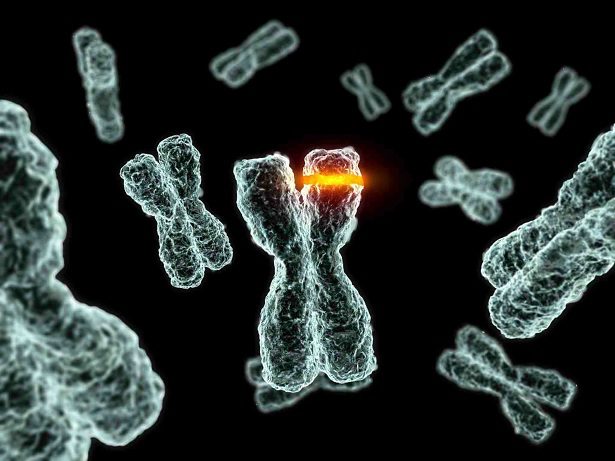
    The database is a collection of interrelated information on a particular subject for a specific purpose. Database is an arrangement of complete operational data records of an organization or company, which is organized and stored in an integrated manner using certain methods on a computer so that it is able to meet the optimal information needed by users.

    Database (database) or as a database is a collection of information stored in a computer system systematically so that it can be checked using a computer program in order to obtain information from the database. The software used to manage and call database queries is called a database management system (database management system, DBMS). In a database system, it can be studied in information science.

    The term database originated from computer science, although later it meant more broadly to include things outside the field of electronics. For similarities in this database actually existed before the industrial revolution, namely in the form of ledgers, receipts and data collections related to business.


    Origin of the term database

    The term “database” has its origins in computer science. Although later the meaning became wider, including things outside the field of electronics, this article is about computer databases. Records similar to databases actually existed before the industrial revolution in the form of ledgers, receipts and collections of business-related data.

    The term database refers to a collection of related data and the software should refer to it as a database management system (DBMS). If the context is clear many administrators and programmers use the term database for both meanings.


    Database System Components 

    The database is a system consisting of a collection of interconnected files or tables and a Database Management System (DBMS) that allows multiple users to access and manipulate these files . The database system has several components, namely:

    1. Hardware

    The hardware that is usually contained in a database system is a secondary hard disk memory.

    2. Operating system

    Operating system is a program that activates or functions a computer system, controls all resources (resources) and performs operations on a computer. Operating systems are widely used such as: MS-DOS, MS-Windows 95 MS Windows NT, and Unix.

    3. Database

    A database  can have several databases. Each database can contain or have any number of database objects such as files or tables. Database Management System (DBMS).

    Physical database processing is not carried out by the user directly, but is handled by a software called a DBMS which determines how data is stored, modified and retrieved.

    4. Users (Users)

    For users to interact with the database and manipulate data in programs written in programming languages.

    Database System Components : hardware, software, data, user

    Basic Concepts of Database

    The basic concept of a database is a collection of records, or chunks of knowledge. A database has a structured description of the types of facts stored in it: these descriptions are called schemas. A schema describes the objects that a database represents, and the relationships between these objects. There are many ways to organize schemas, or model the structure of a database: these are known as database models or data models.

    The model that is commonly used today is the relational model, which according to the term represents all information in the form of interconnected tables where each table consists of rows and columns (the actual definition uses mathematical terminology). In this model, relationships between tables are represented by using the same values ​​between tables. Other models, such as the hierarchical model and the network model, use a more explicit way of representing the relationships between tables.

    The basic concept of a database is a collection of records or a piece of knowledge. A database has a structured explanation of the types of facts stored in it, the explanation is with a schema. Schema describes an object that is represented by a database and has a relationship between these objects. There are many ways to organize schemas or model database structures, these are known as database models or data models. Usually the model that is commonly used today is the relational model whose term layman represents all information in the form of interconnected tables where each table consists of rows and columns (the actual definition uses mathematical terminology). In this model the relationship between tables is represented by using the same values ​​between tables.


    Database Creation Tool

    Databases can be created and processed using a computer program, which is what we usually call software. The software used to manage and call database queries is called a Database Management System (DBMS) or if translated into Indonesian it means “Database Management System”.

    DBMS consists of two components, namely Relational Database Management System (RDBMS) and Overview of Database Management System (ODBMS). RDBMS includes Interface Drivers, SQL Engine, Transaction Engine, Relational Engine, and Storage Engine. While ODBMS includes Language Drivers, Query Engine, Transaction Engine, and Storage Engine.

    As for the level of the software itself, there are two levels of software that allow us to create a database, namely High Level Software and Low Level Software. Included in the High Level Software are Microsoft SQL Server, Oracle, Sybase, Interbase, XBase, Firebird, MySQL, PostgreSQL, Microsoft Access, dBase III, Paradox, FoxPro, Visual FoxPro, Arago, Force, Recital, dbFast, dbXL, Quicksilver, Clipper, FlagShip, Harbor, Visual dBase, and Lotus Smart Suite Approach. Meanwhile, included in the Low Level Software include Btrieve and Tsunami Record Manager.


    12 Database Type

    There is 12 database type, such as Operational database, Analytical database, Data warehouse, Distributed database, End-user database, External database, Hypermedia databases on the web, Navigational database, In-memory databases, Document-oriented databases, Real-time databases, dan Relational Database.


    1. Operational database

    This database stores the detailed data needed to support the operations of the entire organization. They are also called subject-area databases (SADB), transaction databases, and production databases. Example: customer database, personal database, inventory database, accounting database.

    2. Analytical database

    This database stores data and information retrieved from selected operational and external databases. They consist of summarized data and information most needed by an organization’s management and other End-users. Some people refer to multidimensional analytical databases as databases, database management, or database information.

    3. Data warehouse

    A data warehouse stores data from current and previous years – data retrieved from various operational databases of an organization. The data warehouse is the primary source of data that has been vetted, edited, standardized and integrated so that it can be used by managers and other end users across professional organizations. The latest development of the data warehouse is that it is used as a Shared nothing architecture to facilitate extreme scaling.

    4. Distributed database

    These are databases of local workgroups and departments in regional offices, branch offices, factories and other work sites. This database can include both operational and user database segments, as well as data generated and used only on site users themselves.

    5. End-user database

    This database consists of various data files developed by end-users on their workstations. Examples of this are document collections in spreadsheets, word processing and even file downloads.

    6. External database

    This database provides access to external, privately owned data online – available for a fee to end users and organizations of commercial services. Access to a wealth of information from external databases available for a fee from commercial online services and with or without charge from many sources on the Internet.

    7. Hypermedia databases on the web

    This is a collection of interconnected multimedia pages on a website. They consist of the home page and other hyperlinked pages of multimedia or mixed media such as text, graphics, still images, video clips, audio etc.

    8. Navigational database

    In database navigation, queries find objects primarily by following references from other objects.

    9. In-memory databases

    mainly rely on main memory for computer data storage. This is in contrast to database management systems that use disk-based storage mechanisms. Main memory databases are faster than disk optimized databases since Internal optimization algorithms become simpler and fewer CPU instructions execute. Accessing data in memory provides faster and more predictable performance than disk. In applications where response time is critical, such as telecommunications network equipment operating emergency systems, main memory databases are frequently used.

    10. Document-oriented databases

    Document-oriented databases are computer programs designed for document-oriented applications. This system can be implemented as a layer on top of a relational database or object database. As opposed to relational databases, document-based databases do not store data in tables with uniformly sized columns for each record. Instead, they store each record as a document that has certain characteristics. Any number of long fields can be added to the document. A field that can also contain multiple pieces of data.

    11. Real-time databases

    Real-time databases are processing systems designed to handle state workloads that can change constantly. It differs from traditional databases which contain persistent data, largely unaffected by time. For example, the stock market changes rapidly and dynamically. Real-time processing means that transactions are processed fast enough for results to come back and act immediately. Real-time database that is useful for accounting, banking, legal, medical records, multi-media, process control, reservation systems, and scientific data analysis.

    12. Relational Database

    The standard for business computing since 2009, the relational database is the most commonly used database today. Use tables for structure information so it’s easy to find.


    Database Models

    The database has two model variants, namely the Post-relational database model and the Object database model.

    1. Post-relational database models

    A product that offers a data model that is more general than the relational model and is known as post-relational. The data model in the product includes relationships but is not limited by the Information Principle which represents all information with data values ​​in relation to it. Some of these extensions to the relational model actually integrate concepts from technologies that pre-date the relational model.

    For example, they allow the representation of a directed graph with trees on nodes. Some products implementing this model do so by extending the relational database system with non-relational features. Others, on the other hand, have arrived at the same place by adding relational features to pre-relational systems. Surprisingly, this allows products that are historically pre-relational, such as PICK and hyacinth, to make reasonable claims to be post-relational in today’s architecture.

    2. Object database models

    In recent years, object-oriented paradigms have been applied in fields such as engineering and spatial databases, telecommunications and other scientific sciences. The conglomeration of object-oriented programming and database technologies led to a new programming model known as Object databases. These databases seek to bring the database world and the application-programming world closer together, in particular by ensuring that the database uses the same type of system as the application program.

    This is to avoid the overhead (sometimes referred to as an impedance mismatch) for converting information between its representation in the database (for example as rows in a table) and its representation in the application program (usually as objects). At the same time, object databases seek to introduce key ideas from object programming, such as encapsulation and polymorphism, into the database world.

    Various ways have been tried to store objects in the database. Some products run into problems from the application programming side, with objects being manipulated by the program constantly. This also usually requires the addition of some kind of language query, because conventional programming languages ​​do not provide language level functionality for finding objects based on their information content.


    Database Design Stage

    Database design (database) is an effort to build a database in a business environment, to build a database there are stages that need to be passed, namely:

    • Database planning (database)
    • Define system
    • Analyze and collect needs
    • Database design (database)
    • Application design
    • Make a prototype
    • Implementation
    • Data conversion
    • Test
    • Operational maintenance

    Database Software (Database)

    Database software (database) that is widely used in programming

    1. MySQL

    Is a software on a SQL database management system or DBMS (database management system) that is multithreaded, multi-user, with about 6 million installations worldwide. MySQLAB makes MySQL available as free software under the GNU General Public License (GPL) but they also sell under a commercial license for cases where its use is incompatible with the use of the GPL. Unlike projects like Apache where software is developed by the general community, and the copyright for the source code is owned by the respective authors, MySQL is owned and sponsored by a Swedish commercial company MySQL AB, which holds the copyright to almost all of the source code. . The two Swedish and one Finnish who founded MySQL AB is David Axmark.

    2. Microsoft SQL Server

    A relational database management system (RDBMS) Microsoft product. Its primary query language is Transact-SQL which is an implementation of the ANSI/ISO standard SQL used by Microsoft and Sybase. In general, SQL Server is used in the business world that has small to medium-sized databases, but then grew with the use of SQL Server on large databases. Microsoft SQL Server and Sybase/ASE can communicate over the network using the TDS ( Tabular Data Stream ) protocol. Apart from that, Microsoft SQL Server also supports ODBC (Open Database Connectivity) and has a JDBC driver for the Java programming language. Another feature of SQL Server is its ability to create database mirroring and clustering.

    3. Relational Database Management System ( RDBMS )

    MySQL is a Relational database management system (RDBMS) which is distributed free of charge under the GPL (General Public License) where everyone is free to use MySQL but may not be used as a commercial derivative product. MySQL is actually a derivative of one of the main concepts in databases for a long time, especially for the selection or selection and entry of data that allows data operations to be done easily automatically. The reliability of a database (DBMS) can be seen from how the optimizer works in processing SQL commands made by the user and its application programs. As a database server, MySQL can be said to be superior to other database servers in querying data. This is evident for queries made by a single user,

    4. Clipper

    It is a programming language for the XBase family of computers that is used to create computer programs that run primarily on the DOS operating system. More specifically, the clipper is generally used to create programs related to databases/businesses, such as savings/loan management, accounting and others. The history of the clipper was first introduced in 1985 by Nantucket which was then sold to Computer Associates as a compiler for Dbase III which was very popular at that time. Compiling Dbase codes means changing them from interpreting code (human-readable source code) that the computer has to interpret each line run, to P-code (or pseudo-code) that uses a virtual machine to process the p-code that is generated. have compiled it.

    5. DBASE

    A database management system (DBMS) widely used on microcomputers introduced by Ashton-Tate for the CP/M computer and later for the Apple II, Apple Macintosh and IBM PC platforms with DOS being one of the best-selling software for several years. at the time. The inability of dBASE to transition to newer operations, Microsoft Windows eventually made use of dBASE replaced by other newer products such as Paradox, Clipper, Foxpro and Microsoft Access. Ownership of Dbase was eventually sold to Borland in 1991 and in 1999 Borland sold the rights to the dBASE product line to a new company Dbase Inc. Starting from the mid-1980s many vendors created dialects or variations on their products or in their own languages. These included FoxPro (now known as Visual FoxPro), Quicksilver, Clipper, Xbase++, Flagship, and Harbor. They are what information is known or referred to as xBase or Xbase. The basic dBase file format, known as file.dbf, is currently one of the widely used formats by many applications that require a simple format for storing structured data. Dbase is licensed to its users for a period of five years during which it is not possible for the user to operate Dbase during that period. dbf, is currently one of the widely used formats by many applications that require a simple format to store structured data. Dbase is licensed to its users for a period of five years during which it is not possible for the user to operate Dbase during that period. dbf, is currently one of the widely used formats by many applications that require a simple format to store structured data. Dbase is licensed to its users for a period of five years during which it is not possible for the user to operate Dbase during that period.

    6. Firebird

    Firebird or also called FirebirdSQL is a relational database management system that offers the features contained in the ANSI SQL-99 and SQL-2003 standards. This RDBMS runs both on Linux, Windows and on a number of Unix platforms. Firebird is directed and maintained by the FirebirdSQL Foundation. It is a derivative of Borland’s open source version of Interbase. New code modules added to Firebird are licensed under the Initial Developer’s Public License (IDPL) while the original modules released by Inprise are licensed under the InterBase Public License1.0. both licenses are modified versions of the Mozilla Public License 1.1.


    Data Base Management System (DBMS) Function

    A system is needed to integrate data files into a file so that it can serve different users. hardware and software and procedures that manage the database management system.

    1. Provides a quick access system.
    2. Reduce data redundancy and redundancy.
    3. Allows for updating there.
    4. Provide a system that allows for database development.
    5. Provide protection from the wearer is not entitled.

    Database Creation Example

    Database Creation Example
    Database Creation Example

    An example of creating a database using Microsoft Access 2003, the steps are as follows:

    1. Activate Microsoft Access

    If we want to work with Microsoft Access 2003 we must know the following terms:

    • Field: Places data or information in groups of the same type.
    • Record: A collection of fields stored in rows in a table.
    • Table: A collection of data arranged according to certain rules.
    • Database: A collection of interacting data that can be processed.
    • Workspace: Provision of a work area intended for the use of more than one database in an application creation.

    2. Database Architecture

    To be more familiar with Microsoft Access 2003, we must first know the database objects owned by Microsoft Office 2003, namely the components that form a unified system in the database that composes Access 2003. To create a new database, Access databases can be easily stored with the extension .mdb.


    3. Creating a Database

    We must activate the database first starting with the creation of Blank Database, give it a name as desired, for example balance, we put it in our work folder, then name our folder with the same name, then enter, then the database manager will appear. Access database is a combination of tables, queries, forms, reports, pages, macros and modules.

    • Tables: A collection of data arranged according to certain rules and related to certain topics and data storage facilities.
      Create a table:
      « Click the Table Object
      « Click Table In Design View
      « Click Design
      « Specify the required tables and their fields specify the primary key by clicking Edit, clicking Primarykey

    • Query: Means for managing data records contained in a table and grouping specified fields and records from a table.
      Creating a Query:
      « Click Query from Database object
      « Click New
      « Click Design View then OK
      « Click a table from the list
      « Click Add to create Query
      « Close and save the Query
      „« Run by clicking Run from the menu Query


    • Form: Sheet for displaying data, entering data, and modifying data in a way or format that can be designed by yourself.
      Creating a form with the Form Wizard:
      « Click Form from the Database Object
      « Double click Create Form By Using Wizard then OK
      „« Select the fields used in the form by moving the fields then Next
      „« Select the Form Display form then Next
      « Select the form of the form display model then click Next
      « Specify the title of the form then click Finish


    • Report: A tool used to display data in the form of a report.
      Creating a Report with the Wizard:
      « Click Report from the Database Object option
      « Double click Create Report By Using Wizard
      « Move the field to the Select field column then Next
      « Select the output display form then Next
      « Select the model(style) Form then Next
      « Specify the title of the form click Finish


    • Macro: Saves the sequence of operations performed into an operation to simplify the process without having to write program code.
      Creating Macros:
      « Select Macros from Database Objects
      « Click New
      « Select the Action we want then fill in the form
      « Save the macro we created with the name we want
      « Run by clicking Run


    • Switchboard: Microsoft Access 2003 facility used for Navigation Menu
      Creating Switchboard:
      « Activate Form Object then click Tools menu
      « Select Database Utilities
      « Click Switch Manager then click Yes
      « On Switchboard Pages there is ¡¨Main Switchboard(Default)¡ replace with ¡§Main Menu(Default)¡¨
      « Click Edit then click Close
      « Create Switchboard page by clicking New
      « Click on the Switchboard Page Name field with data menu then click OK
      « Click Main Menu (Default)
      « Click Edit then click New
      « From Switchboard Manager select Switchboard Page Menu Data, click Edit then click New
      « Fill in the command then Close
      « Run by first activating Database Object Form
      « Select Switchboard then Open


    4. Visual Basic For Applications

    Creating applications with Microsoft Access, we manipulate objects that can be used Visual Basic For Application (VBA).

    • If statement: Used to select multiple statements from several conditions.
    • Select Case Statement: Used to select multiple existing statements and execute the statements that meet the conditions.
    • For Statement: Used to repeat a statement until a specified value
    • Do…Loop statement: Used to repeat a statement until the specified loop condition is met.
    • While….Wend statement: Used to repeat the statement as long as the condition is still true.
    • GoSub…Return statement: Used to enter into a subroutine and return to a procedure.
    • On Error Statement: Used to enable error handling in program code and specify a location or location in a procedure.
    • With statement: Used to run a series of statements on an object without mentioning the object name repeatedly.

    We can program forms, reports, data access, and manipulate interfaces and databases. VBA also provides an activeX data object (ADO) to interact with various databases, both Access SQL Server and Oracle. VBA is also available in MS Excel, MS Word, and Powerpoint so that we can integrate our application easily.


  • Gene Mutations And Their Levels

    Gene Mutations And Their Levels

    What happens if our bodies suddenly mutate, huh? Did you instantly turn into Spiderman or Wolverine? Unlike that, don’t imagine examples of gene mutations in humans like in superhero fiction films. Because, a number of cases of gene mutations in humans actually cause abnormalities in the body, you know!
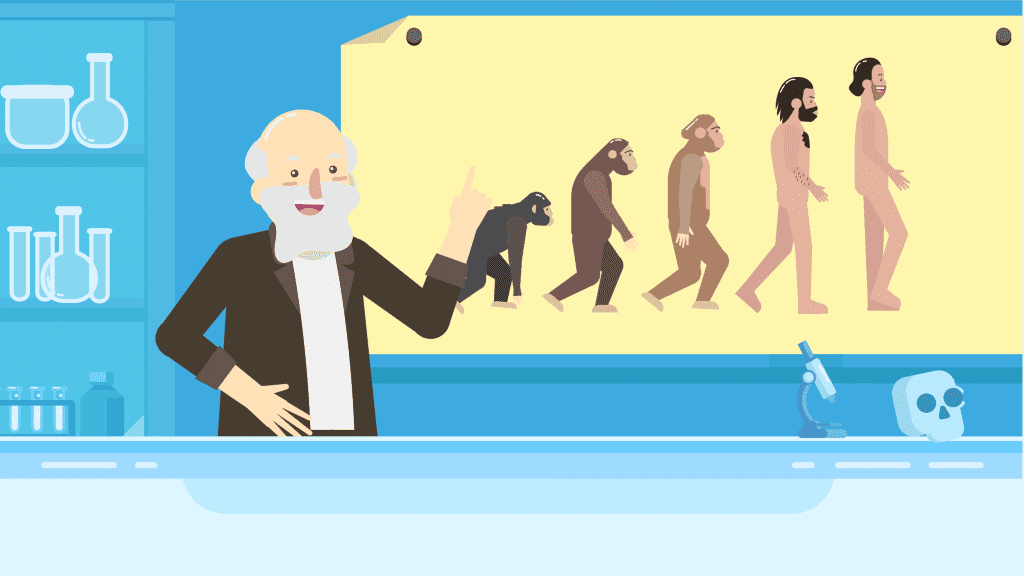
    Well, so that you understand more, in this article, sinaumedia wants to invite you to know about gene mutations, along with examples of gene mutations in humans. Listen to the discussion until it’s finished, yes.

    Definition of Gene Mutation

    Gene mutations are changes that occur in the genetic material in cells. Changes in this material can make changes in properties, both at the cellular level and in living things.

    In people who have gene mutations, the DNA in the cells will undergo changes. These mutations can occur only in DNA or extend to the chromosomes involving several types of genes.

    gene
    gene. source : medlineplus

    Based on changes in the level of occurrence, mutations are divided into gene mutations and chromosomal mutations. The difference between gene mutations and chromosomal mutations lies in the scale of the changes. In gene mutations, only one gene is changed.

    While chromosomal mutations change many genes in it. That is why, chromosomal mutations have a greater effect on the body and can cause more serious abnormalities when compared to mutations at the gene level.

    You need to know, organisms that experience this mutation are usually called mutants. The cause of the mutation is called a mutagen. For example in the fictional Spiderman story, in this film the main character Peter Parker turns into a mutant. While the spider venom that causes mutations is called a mutagen.

    Main Types of Gene Mutations

    There are two main types of gene mutations, namely mutations in the number of bases in the sequence of nitrogenous bases and mutations in the types of nitrogenous bases. These kinds of gene mutations can affect the formation of amino acids that are different from the normal state. So that you understand better, see the following explanation.

    1. Nitrogen Base Mutation

    This mutation occurs due to the addition (addition), reduction (deletion), or doubling (duplication) of nitrogenous bases in the DNA chain of an organism.

    The nitrogenous base mutation can affect the triplet reading of the genetic code in mRNA (messenger RNA). As a result, the amino acids that cells make are different from those that are supposed to be formed.

    For example, there is a DNA chain that has the nitrogenous base sequence CCA–TAA–GCG. This DNA chain will be translated by mRNA, one-third of its nucleotide bases, into the amino acids glycine, isoleucine, and arginine.

    If there is a mutation in the DNA chain, for example there is a T base, thymine, which suddenly increases the front of the chain, the reading of the 3 nucleotide bases will change to TCC-ATA-AGC.

    If you have this, the amino acids that are formed will turn into arginine, tyrosine, and serine. This change in the addition of the thymine nucleotide base in front of the DNA chain is referred to as an addition gene mutation. Not only at the front, the addition of DNA chains can also occur in the middle, yes.

    In addition to mutations in addition genes, changes can also occur if there is a duplication or duplication in the sequence of nucleotide bases in the DNA chain. For example, the beginning of the chain is CCA-TTA-GCG, because the cytosine is duplicated, the chain changes to CCC-ATA-AGC. In this situation, the amino acids formed by the chain will also change.

    Lastly, there is a change in the nucleotide base in the DNA chain which is called a deletion. A deletion is a reduction in the nitrogen sequence in DNA. For example, initially the DNA chain is CCA-TTA-GCG, then the cytosine at the beginning of the chain is deletion and is lost. As a result, the DNA chain will turn into CAT-AAG-CG.

    2. Nitrogen Base Type Mutation

    Types of nitrogenous bases in DNA are divided into two groups, there are purines consisting of adenine and guanine (A and G), and pyrimidines consisting of cytosine and thymine (C and T).

    In nitrogenous base type mutations, the changes can occur in similar groups or are called transition substitution gene mutations. For example, adenine turns into guanine, or thymine turns into cytosine. If the change occurs in a different group, between purines and pyrimidines, the gene mutation is called a transversion substitution.

    Examples of Gene Mutations in Humans

    By now, you must have understood more about gene mutation, right? To be clear, you should also know examples of gene mutations in humans. Until now, gene mutations in humans have more adverse effects on the condition of the body, you know!

    One of the examples of gene mutations in humans can cause errors in the formation of red blood cells. Red blood cells that are initially round in shape turn into a sickle shape or commonly called sickle cell anemia .

    This sickle shape makes blood flow easily blocked so that less oxygen is carried by the blood, blood cells die quickly. The body of patients with sickle cell anemia is usually easily tired, dizzy, painful, has difficulty breathing, and can experience damage to several organs of the body.

    Another example of gene mutations in humans is cancer. Cancer occurs due to errors in the formation of amino acids that affect the cell division cycle.

    Cells in the body of cancer sufferers undergo mutations and divide continuously without stopping, until finally damaging the function of the sufferer’s organs. If that’s the case, gene mutations in humans can cause severe organ damage, or even make the sufferer die,

  • The Theory of Human Evolution and Its Controversy

    The Theory of Human Evolution and Its Controversy

    most of you must have heard stories about human origins, right? There is an evolutionary theory that says that humans came from apes. Do you think that information is correct or not? Well, before discussing this further, it’s a good idea to first know what is meant by the theory of evolution.
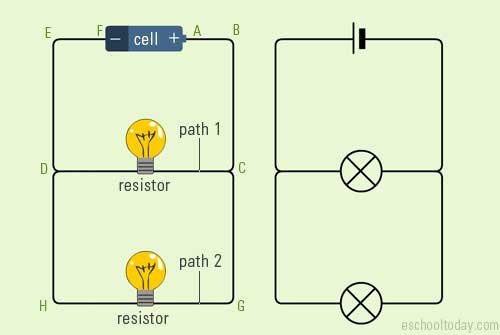
    Actually, until now there is still a debate about the theory of evolution. Instead of being curious, in this article, we wants to invite you to discuss what is meant by the theory of evolution, as well as unique facts and growing controversies. Read this article until it’s finished.

    What is the Theory of Evolution?

    The theory of evolution is a theory that discusses the changes or development of living things, their origins, and their genetic linkages between one living thing and another. In the theory of evolution, change or development of living things occurs due to a combination of three main processes, namely variation, reproduction, and natural selection.

    human evolution
    human evolution – source : britannica.com

    In the process of reproduction and variation, the characteristics or characteristics of a living being that form the basis of evolution are carried by genes and passed on to the next generation. The inheritance of this gene can be a lot of variation in a population.

    In short, when living things reproduce, their offspring will have new traits, it can be more common or rarer than the previous generation. These traits can occur due to gene mutations or gene transfer between populations or between species.

    The theory of evolution also states that evolution occurs due to the process of natural selection. In this natural selection, traits that are detrimental to living things will decrease, while traits that are beneficial will have a great chance of survival and reproduction. So, there will be more living beings in the next generation who will inherit these beneficial traits.

    In addition, adaptation is also an important factor in the evolutionary process of living things, you know. For example, in today’s humans, there are minor differences between people living on the coast and people living in the mountains.

    The number of red blood cells of people in the mountains is more than the red blood cells of people on the beach. This is an evolutionary process that occurs due to natural adaptations that occur in the human body.

    The culmination of the evolutionary process is usually marked by the emergence of new species. Based on history, it is the evolutionary process that has resulted in the emergence of many species of living things in this world.

    All living things have different species and these differences can be evidence that the theory of evolution really occurs in nature. Species differences can occur due to strict adaptation, geographical conditions of the region, gene mutations, and natural selection.

    Theory of Evolution According to Experts

    Some experts define the theory of evolution as follows:

    Anaximander

    It is argued that the origin of life on earth was the ocean. Therefore, all living things on earth, including humans, were originally fish.

    When the heat of the sun caused the appearance of land on earth, living things began to move to the land. According to him, it makes the evolution of living things from fish to various land living creatures, including humans.

    George Louis Leclerc

    Believe that the earth is very old, more than 7,000 years. Therefore, he argues that living things have existed and developed during the age of the earth based on their migratory movements.

    As a result of these migration movements, living things must eventually adapt to their new environment. The pattern of adaptation is what causes living things to evolve due to the interaction of organic particles that trigger changes in the bodies of living things.

    Jean-Baptiste Lamarck

    Has two ideas about evolution. The first idea relates to the parts of the body that are used and not used by living things.

    Through this idea, he assumed that the parts of the body that are constantly used by living things in dealing with certain environments will become bigger and stronger than the parts of the body that are rarely used. Meanwhile, limbs that are rarely used will experience setbacks.

    Lamarck’s second idea relates to the inheritance of traits or traits that living things acquire in adapting to their environment. It is this inheritance of traits or traits that modifies the organism that it acquires during its lifetime.

    For example, the so-called giraffe has a short neck, but because its neck is constantly sticking out to get leaves on a tall tree, the giraffe’s neck begins to get long. This long neck is passed on to all his descendants.

    Charles Robert Darwin

    argues that evolution occurs through the process of natural selection. Only living things that can adapt to nature can survive.

    In contrast to Lamarck who thought that giraffes were originally only short-necked, Darwin argued that the necks of giraffes were initially varied, some with short necks and some with long necks.

    Through the process of natural selection, the short-necked giraffe eventually became extinct and only the long-necked giraffe has managed to survive and reproduce to this day.

    In addition to explaining evolution based on the process of natural selection, Darwin also argued that all species on earth came from a common ancestor ( common ancestor ), which evolved over time.

    Early Human Evolution Theory

    By this point, you have begun to understand what is meant by the theory of evolution, right? To be clear, it’s better if you know the theory of early human evolution.

    After removing body hair, humans were naked for 1 million years. Why did they put on clothes later?

    As discussed earlier, Anaximander, a pre-Socratic philosopher who lived around 610–546 BC has discussed the possibility of how humans evolved from fish. However, there is no scientific evidence that can prove this opinion.

    Over time, this theory of human evolution focuses more on the assumption that humans evolved or evolved on earth from extinct primates, you know. The primates that are often associated with human evolution are ape-like primates. That’s why there is a lot of information circulating that humans came from apes.

    Evidence that primates are related to humans is from their genetics. DNA between humans and primates can reach a similarity of up to 97%. However, that does not mean that humans are considered to have originated from apes. This fact can only trace that humans and primates may have shared a common ancestor.

    Human Theory According to Charles Darwin

    In fact, information about humans evolving from apes emerged because of Charles Darwin’s theory of human evolution. In the book ” The Origin of Species ” which put forward the theory of evolution written by Charles Darwin, concluded that all living things came from a common ancestor ( common ancestor ) and are related to each other.

    According to Darwin in the book, the process of genetic mutation from a common ancestor resulted in the process of evolution and the emergence of various new species. Darwin imagined human evolution like a tree.

    A single tree trunk and roots are the ancestors of living things. While the twigs and leaves of trees become new species that were born due to the process of genetic mutation. The process of genetic mutation can occur due to natural selection in a long time.

    From natural selection, Darwin then divided the evolutionary process into microevolution and macroevolution. Microevolution is changes that occur in species in small ways. For example, changes in color or size in a population over several generations.

    While macroevolution is a change due to natural selection that is able to create new species. For example, the change of dinosaurs into birds, amphibian mammals into whales, and the ancestors of apes into humans.

    Human Evolution Theory Controversy

    Darwin’s statement about what is meant by the theory of human evolution that later caused controversy. Did humans come from apes or not?

    Actually, Darwin’s theory of humans never concluded with certainty that humans evolved directly from apes. He simply argued that all living things came from a common ancestor. Evidently, from the similarity of human DNA with primates by 97%.

    However, the theory of human evolution has already been debated. Essentialists and religious people reject this theory emphatically. They believe that humans have been created according to their shape and nature as they are now by God.

    Some people also think that Darwin’s theory cannot explain the missing link in the process of human evolution. The missing sequence of human evolution is a link between the hairy and tailed generation like apes and intelligent and intelligent living things like humans.

    The undiscovered human fossil in the form of half human and half ape is considered to be the missing link to explain the sequence of human evolution. The fossil is considered necessary to be valid evidence that humans did evolve from an ape.

    source: pahamify.com

    Even though the theory of evolution causes controversy, but you can see strong evidence about the truth of this theory of evolution. For example, you can see that the racial differences that exist in humans are part of the strict adaptation process that occurred in ancient homo sapiens . Or, you can see it from the immunity of bacteria and microbes to certain antibiotics that occurs due to the process of genetic change.

    That is a review of  the theory of human evolution, along with its controversies. Hopefully the above review can help you understand what is meant by the theory of evolution, yes.

  • Difference between Series and Parallel Circuits and Examples

    Difference between Series and Parallel Circuits and Examples

    Parallel circuit is one type of circuit or arrangement of electrical components that are connected in parallel.

    The parallel circuit formula is Voltage V= V1=V2=V3, resistance 1/R =1/R1 +1/R2 + 1/R3 and current flowing I = I1 +I2 + I3.
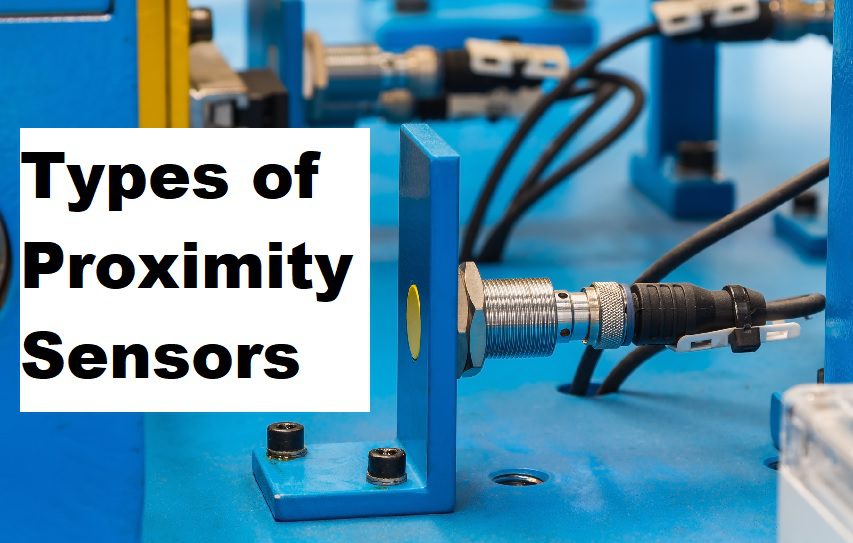

    In this modern era, electricity is a very important requirement for life. In fact, almost all human activities require a power source so that it is as if electricity is a cog in everyday life.

    However, many people still do not understand electricity, especially the basics of electricity such as series and parallel circuits.

    Knowledge of parallel series circuits is something that is commonly used by everyone. An example of its application is when someone wants to install a light installation in his house. Therefore, in this article, we will discuss series and parallel circuits starting from the differences, advantages and disadvantages along with examples of both.

    preliminary

    Before we dive deeper into series and parallel circuits, we need to know the basics first.

    An electrical circuit is a collection of several electrical components that are connected and attached to a voltage. Here are some electrical components along with symbols that are often used in circuits:

    There is also a symbol regarding another parameter called electric current. Usually, electric current is indicated by the direction of the arrow on the circuit and the symbol “I”

    Difference between Series and Parallel Circuits

    As we know, series and parallel circuits have significant differences. Some of these differences include:

    Differences in Circuit Arrangement

    What we can clearly see from the difference between the two circuits is the arrangement of the components installed. The arrangement can be seen from the branching of the cable or the placement of its components. For more details, here is the description in detail:

    Series Circuit

    “The series circuit has a simple arrangement so that the series arrangement does not have cable branches between the load or the installed voltage source.”

    Parallel circuit

    “In parallel circuits, there are complex arrangements and there are branching of cables between loads or installed voltages.”

    Circuit Component Difference

    Apart from the obvious differences in arrangement, we can distinguish series and parallel circuits from the components used. Although the amount of load or resistance can be adjusted, there are differences in the components, including:

    Series Circuit

    In a series circuit, the components are simpler consisting of a voltage source, cable and load. Although sometimes a series circuit uses a switch, a series circuit only requires one switch.

    Parallel circuit

    In parallel circuits, the components used tend to be more. An example is the cable that is used in parallel circuits is longer because parallel circuits have branches. In addition, parallel circuits usually use one switch for one load only.

    Differences in Physics Formulas and Parameters

    In addition to things that are clearly visible, there are other parameters that affect the series and parallel circuits, namely the electric voltage “V” and the electric current “I”. Of course to find these two parameters have different ways for series circuits and parallel circuits. Here’s how to calculate voltage and electric current in series and parallel circuits:

    Strong Electric Current

    Electric current is a quantity that states every electric charge that flows in a component. In series and parallel circuits, the electric current has a different calculation for each component.

    Series Circuit

    “The electric current in a series circuit has the same amount of electric current flowing through each resistance. This makes one point on the series circuit equal to another point.”

    Parallel circuit

    Also read:   Standard Deviation Formula (FULL) + Explanation and Example Questions

    “In a parallel circuit, the sum of the strong currents flowing out of the junctions will be equal to the sum of the strong currents entering the junctions.”

    Electrical voltage

    electrical circuits

    In an electric circuit, voltage is the amount of potential energy in an electric field and has units of volts. Electrical voltage in series and parallel circuits have different calculations.

    Series Circuit

    series circuit

    “In a series circuit, the electric voltage is not as strong as the current, but the voltage that is installed is equal to the voltages on the components.”

    Parallel circuit

    parallel circuit

    “Unlike the case with a series circuit, the voltage applied to all circuits will always be the same value in parallel circuits.”

    Electrical resistance

    In addition to voltage and current sources, there is one more parameter that is commonly owned by each component, namely resistance or load. On the total resistance of each circuit has a different way of addition including:

    Series Circuit

    series circuit

    “Every resistance that is connected in series in the circuit will add up to each other. So, the total resistance installed is the total resistance of each component.”

    Parallel circuit

    parallel circuit

    “While in a parallel circuit all the voltages on the components will be the same value. Therefore the total resistance installed in the parallel circuit as described in the picture above.

    Thus the article about series circuits and parallel circuits, hopefully it can be useful for you.

  • Types of Proximity Sensors

    Types of Proximity Sensors

    Proximity sensor is a detection tool that works based on the distance of the object to the sensor. The characteristic of this sensor is to detect objects at a fairly close distance. This proximity sensor has a working voltage between 10-30 Vdc and some use a voltage of 100-200VAC. Almost every production machine today uses this type of sensor, because in addition to being practical, this sensor includes a sensor that is resistant to impact or shock, besides that it is easy to carry out maintenance or replacement repairs.

    There are types of proximity sensors

    1. Inductive Proximity Sensor

    Inductive Proximity Sensor
    Inductive Proximity Sensor

    Inductive Proximity is used to detect metal objects. The working principle of inductive proximity is that if there is a voltage source, the oscillator in the proximity will generate a magnetic field with a high frequency. If a metal object is brought near the surface of the sensor, the magnetic field will change.

    Inductive Proximity Sensor
    Component of Inductive Proximity Sensor

    Changes in this oscillator will be detected by the sensor as a signal of the presence of an object. This example of Inductive Proximity is usually used in metal detectors at airports. This proximity sensor will detect the presence of metal objects even if they are not visible.

    2. Capacitive Proximity Sensor

    Capacitive Proximity Sensor
    Capacitive Proximity Sensor

    Capacitive Proximity sensor is   able to detect metallic and non-metallic objects. The working principle of capacitive proximity is by measuring the change in the electric field capacitance of a capacitor caused by an object approaching it. Capacitive proximity is usually used on car bumpers or other car parts. The simple benefit is to make it easier for the car to park, because this sensor will work when it detects objects at a certain distance so that the car will not hit the object.

    Componen of Capacitive Proximity Sensor
    Componen of Capacitive Proximity Sensor

    3. Optical Proximity Sensor

    Optical Proximity Sensor
    Optical Proximity Sensor (infrared)

    This sensor detects the presence of objects with light usually infrared. This optical proximity consists of a light and a receptor that detects an object by reflection. If an object is within a sensitive distance or an object hits the light from the sensor, the light will bounce back to the receiver and indicate that an object has been caught by the sensor.

    Optical Proximity Sensor
    Optical Proximity Sensor

    The disadvantages of this optical proximity sensor are that in its use sometimes the lens is dirty, the light is blurry, the reflection surface is poor and the object orientation is wrong. This optical proximity is usually used in touch screen cell phone technology. Because when receiving a call, the ear will become an object that blocks the emission of infrared rays, then the infrared rays will be reflected back and indicate that there is an object in front of them. The result is that the phone screen will be locked so that the screen does not random when it comes into contact with the ear.

  • 7 Types of Safety Hand Gloves

    7 Types of Safety Hand Gloves

    Maybe many of us are already familiar with safety hand gloves. Especially for those who work with a high potential for danger, the use of hand gloves is no longer just an obligation but a necessity so that our healthy and beautiful hands are not scratched and may even be seriously injured due to work.

    But did you know that there are  many types of safety gloves ?

    Safety hand gloves are tools used to protect hands from potential hazards such as scratches from sharp objects, heat, and even chemicals. Hand gloves that are used to protect from heat are certainly different from those used to protect hands from chemicals. What’s the difference? Then how to apply it? Here are some types of hand gloves based on their function and constituent materials:

     1. Impact Hand Gloves

    Impact Hand Gloves
    Impact Hand Gloves via tokopedia

    This type of Impact Hand Gloves is equipped with a shock absorber feature This means that when a heavy object falls and hits your hand, Impact Hand Gloves can protect your hand by absorbing the impact energy so that your hand is not completely affected by the impact energy.

    2. Cut & Puncture Resistant Gloves

    Cut & Puncture Resistant Gloves digitx-gloves.com
    Cut & Puncture Resistant Gloves digitx-gloves.com

    Hand Gloves of this type are hand gloves that are often used when machining, especially abrasives. The nitrile formulation in the material makes these gloves resistant to abrasion caused by friction. Cut & Puncture Resistant Glove is also resistant to sharp objects, so it is suitable for workers who use abrasive machines.

    3. Anti-Slip Hand Gloves

    Anti-Slip Hand Gloves
    Anti-Slip Hand Gloves

    Anti Slip Hand Gloves are used on wet or oily workpieces. These anti-slip gloves are equipped with Grip Technology so that oily or wet work objects can be gripped firmly without slipping. With microchannel technology, these gloves absorb liquid fluids that stick to the workpiece so that the contact of the glove with the workpiece is not blocked by these fluids.

    5. Lifting Hand Gloves

    Lifting Hand Gloves
    Lifting Hand Gloves

    This type of hand gloves is the type of safety gloves that are most often found on the market. Used to protect hands from scratches by sharp objects and minimize the potential for slippage when lifting something. These hand gloves are made of fibrous fabric. There are also several lifting hand gloves that are equipped with a rubber layer on the palm of the hand to increase hand grip strength when lifting.

    Do not use this type of hand gloves when you operate objects or rotating machines. Why? Because these hand gloves are made of fibrous cloth, there is the potential for the fibers to get caught in the rotating machine which actually endangers our hands.

    6. Heat Resistant Gloves 

    Heat Resistant Gloves 
    Heat Resistant Gloves

    These hand gloves are usually made of leather and have a smooth layer of cloth inside. These Heat Resistant Gloves are thicker and heavier than other hand gloves. Why is it made of rubber and thick? Because as the name implies, these hand gloves function as heat insulators that protect our hands from heat or high temperatures. In the market, these hand gloves are often referred to as welding gloves. Usually used when welding work, blander (cutting torch), and various other jobs that are directly related to high temperatures, furnaces, etc.

    also read

    HVAC Services

    Janitorial Services

    7. Chemical Resistant Gloves

    As the name implies, chemical resistant gloves are usually used in the scope of laboratories and work that is directly related to chemical materials or substances, such as wet analysis and painting. These hand gloves are usually made of latex, nitrile, vinyl, and PVC materials. Chemical gloves made of latex, nitrile, and vinyl are gloves that we often see used in the medical field, but the use itself is actually not limited to that, these hand gloves can also be used in chemical laboratories because they are impermeable to liquids. These gloves are disposable or single use.

    medical gloves
    Latex gloves

    In addition, there are also chemical gloves made of PVC. When viewed from the shape, these gloves usually have longer and thicker sleeves than other chemical resistant gloves. Chemical Resistant Gloves of this type are commonly used during painting jobs.

    Chemical Resistant Gloves

    Of course, there are many other types of safety hand gloves. Hopefully this article can provide more knowledge for those of you who are going to buy safety gloves. The more suitable the gloves are, the smaller the potential danger.

  • 12 Types of Screws and Bolts

    12 Types of Screws and Bolts

    The type of fixing screw ( Set Screw ) commonly known as the cap screw has a shape similar to a bolt, but this type of screw is full-grained. The difference between a bolt and a screw is that the bolt has a thread that is not complete, in other words the thread does not reach the head of the bolt.
    While the screw has a thorough thread until it reaches the screw head. Another difference can also be identified from the bolt and screw heads. In its use, the bolt does not use a screwdriver but a key, while the screw uses a driver,  in the form of a screwdriver .

    Here are the types of set screws and their bolts:

    1. Fastener Screw (Set Screw)

    Fastener Screw (Set Screw)
    Fastener Screw (Set Screw) via rs components

    This type of screw is the most widely used type. Usually better known by the name of the screw head (cap screw). This type of screw is widely used to join and fasten the two objects.

    2. Stud Bolt

    Stud Bolt
    Stud Bolt via dumore

    Stud bolts are headless and have threads from each end. Stud bolts are applied in a number of industries for fitting parts, industrial equipment, flanges and machine tools. These types of bolts are available in various sizes and can be configured as double end or tap end.

    3. Round Head Bolt

    Round Head Bolt
    Round Head Bolt via united fasteners

    This type of bolt is very commonly used with a round head. This round head bolt has a portion of the stem that is square in shape to hold the bolt, which can be used to fasten the wooden floor of the truck body or to the metal bumper.

    4. Partially Threaded Bolt

    Partially Threaded Bolt
    Partially Threaded Bolt

    A small diameter full hydrated screw fitted with a square or hexagonal nut. The head can be round or “cheese head” and has a groove for a screwdriver.  This Partially Threaded Bolt is used to place lightweight components or small brackets.

    5. Gutter Bolt

    Gutter Bolt
    Gutter Bolt

    Full grain and often galvanized with a dome-shaped head and a screwdriver groove. Used with a nut to fasten lightweight materials and sheet metal.

    6. Grub Screw

    Grub Screw
    Grub Screw

    A headless screw that may have a groove for a screwdriver or a groove for an Allen Key Wrench . Used when the screw must be attached below the submerged surface.

    7. Self Drilling Screw

    Self Drilling Screw
    Self Drilling Screw

    These screws will thread themselves into the thin metal. Usually it is used directly into the sheet metal or a special sheet metal nut is attached to the component. All screw head shapes can be used with self drilling screws.

     8. “U” Bolt

    “U” Bolt
    “U” Bolt

    U bolt is  usually used for the needs of gas / water pipes. U bolts can also hold leaf springs on the vehicle axle, and also on the exhaust system.

    9. Split Pin/Cotterpin

    Split Pin/Cotterpin
    Split Pin/Cotterpin

    This pointed steel pin has a flat section on one side and a small threaded section on the small end. Its flat pointed section is used to hold components such as truck king pins in place. Nuts and washers need to be attached to these split pins to avoid movement.

    10. Battery Bolt

    Battery Bolt
    Battery Bolt

    A square head bolt, firmly galvanized, which is often used to secure the battery terminals (battery) to the pole (head) of the battery.

    11. Taper Lock Stud

    Taper Lock Stud
    Taper Lock Stud

    Uses a special thread to produce a thread whose last few threads are tapered. The stud has threads that are almost as sharp as to create an interference fit when the stud is installed. These studs are used in heavy load applications on moving equipment.

    12. Plow Bolt

    Plow Bolt
    Plow Bolt

    Has a tapered head that can fit into embedded screw holes. When installed, the head is immersed in the surface of the component. These bolts are used to mount the blade on dozers and graders that require a ground connection, so that the driven soil can rotate/roll smoothly on the bonded parts.

  • Energy Revolution, Transition to Renewable Energy

    Energy Revolution, Transition to Renewable Energy

    Renewable energy is not the only effective approach to reducing carbon emissions. Renewable Energy will continue to play a growing role in power generation capacity, he said, but it is projected that by 2050, 74% of global primary energy demand will still be supplied by coal, oil and gas.

    Instead, industry leaders and energy experts recognize there are many different avenues to explore on the journey towards delivering cleaner energy. Now that the energy sector understands this premise, realistically, achieving a low-carbon future becomes a more complex challenge.

    Mitigating climate change while balancing the growing global demand for energy remains a key focus for the industry, but there are many other considerations. Key challenges for the years ahead include addressing supply intermittency, navigating economic realities and ensuring a safe and consistent energy supply.

    Natural gas remains the main focus of the transition to cleaner and more fuel-efficient fuels, supported by several factors: including falling renewable energy prices; the growing impact of innovations such as carbon capture and provision (CCS); alternative fuels for coal and oil; and expansion of wind and solar technology.

    Costly moving towards cleaner energy, solar power, along with offshore and onshore wind generation, holds the key to the renewable resources of the future. The success of this emission-free technology is driven by cost reductions, coupled with increased generating capacity. As future energy generation leans towards a decentralized power grid, matching supply with demand will prove a challenge. New innovations or alternative fuels will be needed to combat the intermittency of renewable energy supplies to generate power when there is no sunlight or wind.

    The large number of new energy solutions being brought to market creates a large trader risk for the energy industry. The danger of investing in the wrong technology, or in solutions that cannot be measured, acts as a barrier to new innovations being adopted.

    Future Energy Sector

    Natural gas remains the main focus of the transition to renewable energy, but also has an important role in the long-term energy mix, along with other alternative fuels such as hydrogen and biomass. These fuels support renewable energy in an effort to meet the growing demand in the energy sector of the future.

    Biomass is a cleaner source of fuel that does not require large investments in infrastructure, as the process of generating electricity is the same as using fossil fuels.

    Improve Energy Efficiency

    In addition to reducing emissions by using alternative fuels, the energy sector is also developing ways to increase energy efficiency and reduce the environmental impact of traditional fossil fuels.

    Another efficiency-enhancing technology, which can be applied to the manufacture of things like cement, steel, glass and metal, is waste heat recovery. That in heat recovery applications, organic rankine cycle (ORC) units increase the efficiency of the production process by converting low-level heat into useful power.

    model world

    In an increasingly digital world, the Fourth Industrial Revolution is poised to transform the energy sector, just like most other industries.

    Advances in Artificial intelligence (AI), The internet of things ( IoT) and machine learning will automate processes, optimize efficiency and lower costs. In a rapidly changing world, digital energy generation and distribution will enable the energy sector to model real-world behavior and simulate the resource and infrastructure challenges required to scale renewable energy in the future. Using technology to make decisions and create realistic models should make the simulations as realistic as possible.

    Framework for success

    To meet the uncertain challenges of the future energy sector, there is a growing industry confidence in market-based solutions involving government and private sector alliances. By working in unison, policymakers and industry representatives can create a flexible regulatory framework to facilitate the transition to renewable energy.

    Government support and encouragement gives the energy sector scope to absorb and scale up new technologies. The increasing global demand for energy will put pressure on the market in the future as renewable energy becomes fully utilized. In the future, long-term seasonal generation reserves will be very important, including from fossil fuels.

  • Edge Computing Technology

    Edge Computing Technology

    Methods for storing and leveraging data are constantly evolving, which is why it’s critical for tech businesses to follow them to ensure they are implementing best practices. Edge computing will enable businesses to do just that by enabling them to process data near the edge of their IT network, offering accelerated data streaming and instant communication.

    What is Edge Computing?

    Edge Computing basically refers to the process of data being collected, stored and analyzed at the ‘edge’ of the network where the original data is generated. In contrast to cloud-based methods of data being collected, stored and analyzed on servers or centralized data centers. While edge computing is not a commonly used phrase today, it will become a central part of the technology landscape over the next few years. This is the result of a large amount of data being processed, largely through the increased use of Internet of Things (IoT) devices, of which there will be over 50 billion in use by 2020. As a result, there is an increasing need for more computing power and data storage. the more;

    These data centers will bear little physical resemblance to the large, centralized data centers we see in a typical corporate environment. They will have the ability to be managed and automated remotely, as they are likely to be on a site with little, or no IT personnel.

    Align advanced computing with your digital transformation strategy

    First, you need to see Edge Computing as a central part of your digital transformation strategy, as it will have a significant impact on the development of new revenue streams, products and services. Second, there needs to be an appreciation of the speed of development, because the construction of edge data centers needs to be completed quickly to meet business requirements. In terms of delivery, third-party integration is a potential solution, as vendors who have traditionally delivered a converged infrastructure, which brings together servers, networks, storage, and software in a single solution, are now doing the same with the data center edge.

    The skills your business needs

    It is important to strategically recruit for Edge Computing related positions to get the right infrastructure for your organization. In terms of skill sets in the Edge Computing space, you need to find candidates with the following skills:

    • Powerful data center and cloud experience
    • Exposure to security, storage, networking, and virtualization

    Implementation of Edge computing will not be an easy ‘plug-and-play’ solution, and as such, you need to assess the inevitable changes to your existing IT architecture. This means that you need to hire senior specialists who have an understanding of excellence throughout the design, implementation and support stages.

    Take advantage of the benefits

    As with any new trend in the technology space, the recruitment industry will be best positioned to serve its clients by understanding the skill set that needs to be supplied, to meet the inevitable demand brought about by the rise in Edge Computing. Having a detailed understanding of a client’s strategy in Edge Computing as part of their digital transformation roadmap will be key, not only enabling the delivery of the right skill set, but also enabling this skill set to be delivered in the correct time frame.

    Edge Computing vs cloud computing

    Edge computing will not replace cloud computing as cloud computing will continue to be an important part of the IT landscape in the same way as on premise computing. Instead, Edge Computing and the cloud will coexist.

    Businesses that can find the best way for edge and cloud to complement each other will have the greatest success from their computer services. In an ideal setting, cloud computing would continue to take responsibility for larger functions such as big data analytics, large-scale data storage, and business logic, while Edge Computing would allow on-premises devices to run as effectively as possible without constant intervention from the cloud. wider.

    Key benefits of Edge Computing

    1. Speed

    Edge Computing allows devices to respond instantly, sometimes in microseconds, as it cuts out the need for data going back and forth between centralized servers.

    2. User experience

    In addition to speed, the overall experience for end users will be improved through high latency and unreliable connections, such as those in remote locations.

    3. Security and privacy

    Tighter security and privacy around sensitive data would mean that, theoretically, you would be able to avoid sending sensitive data off-site, and instead process this data locally.

    4. Reliability

    With edge data centers located closer to the end user, there are far less chances of network problems in offsite locations impacting on-premises customers. Even in the event of a critical issue, such as a data center outage, IoT devices connected to the localized edge network must continue to operate independently.

    5. Save cost

    Edge Computing must provide a level of cost savings for your business. Given that it will allow a significant reduction in data flow load on a centralized server, thereby saving network and computing resources, leading to reduced congestion on the network, and less energy demand for servers.

    Why edge computing is important

    Edge Computing is not going to be a passing trend. This is because it is a central part of the business technology landscape, as is cloud computing. According to International Data Corporation (IDC) Worldwide IoT 2018 predictions: “By 2020, IT spending on advanced infrastructure will account for up to 18% of total spending on IoT infrastructure.” In the immediate short term, it will be the organizations that have the most effective transformation strategies around Edge Computing and IoT that will be rewarded ahead of their competitors.

  • Edge Computing Concept for Industry

    Edge Computing Concept for Industry

    Following productivity gains in the 1980s and 1990s from techniques such as lean manufacturing, just-in-time manufacturing popularized by Toyota, and Six Sigma, industrial companies have experienced steady declines in efficiency. Today the average annual productivity gain is very poor, 0.5%. With some room left for continued operational improvement, industrial organizations must find new ways to increase production, performance and profits.
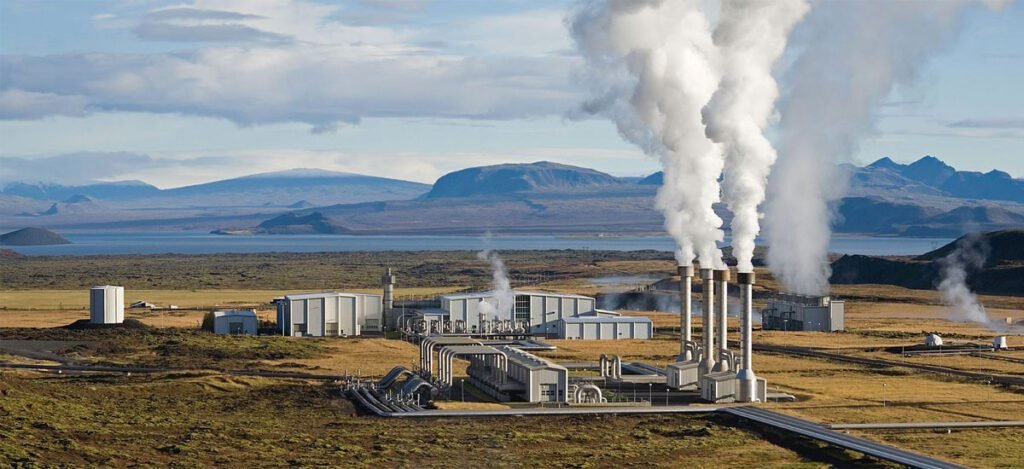
    Enter the digital industry transformation.

    Using technological innovations, industrial companies are beginning to push for new levels of performance and productivity. And while cloud computing is a key driver of industrial transformation, Edge Computing is rapidly becoming an important part of the Industrial of Things (IIoT) equation for accelerating digital transformation.

    Edge computing is not a new concept, but several trends have come together to create opportunities to help industrial organizations turn massive amounts of machine-driven data into actionable intelligence closer to the source of the data.

    This blog covers the many facts of Edge Computing, including defining what Edge Computing is, what the components of Edge Computing are, what drives its current feasibility and implications, and its role in distributed computing in coordination with cloud computing. It also provides some examples of Edge Computing as well as Digital’s approach to Edge Computing for industry.

    The existing computing infrastructure is close to the data source.

    In the context of IIoT, ‘edge’ refers to existing computing infrastructure close to data sources, for example, industrial machines (e.g. wind turbines, magnetic resonance (MR) scanners, underwater explosion suppressants), industrial controllers such as SCADA systems, and time series databases. collects data from various equipment and sensors. These Edge Computing devices are usually located far from the centralized computing available in the cloud.

    Wikipedia defines Edge Computing as “pushing the boundaries of compute, data, and service applications from centralized nodes to the logical extremes of the network. This allows analytics and data collection to occur in the data source. This approach requires leveraging resources that may not be constantly connected to the network such as laptops, smartphones, tablets, and sensors. ”

    The role of Edge Computing to date has mostly been used to ingest, store, filter, and send data to cloud systems. We’re at a point in time, however, where Edge Computing systems pack more compute, storage, and analytics power to consume and act upon on-premises data. This Edge Computing capability will be more than valuable to industrial organizations — it will be indispensable.

    The promise of the Industrial Internet includes significant investments in the years to come.

    Industry experts have calculated that tens of billions of connected things will generate huge volumes of data from disparate sources. The promise of the Industrial Internet includes significant investments in the years to come. Industrial IoT unites minds and machines — connecting people to machine data that accelerates the transformation of the digital industry.

    By applying big data, advanced analytics and machine learning to operations, the industry can reduce unplanned downtime, improve asset performance, lower maintenance costs, and unlock the potential for new business models that capture the untapped value of machine data.

  • How Geothermal Power Plant Work System

    How Geothermal Power Plant Work System

    What exactly is a Geothermal Power Plant?
    Geothermal Power Plant is a power plant that uses geothermal energy as its energy source.
    Geothermal energy is one of the natural resources in the form of hot water or steam which is formed through natural heating.
    The word geothermal  comes from the Greek “geo” which means earth and “therme” which means heat. In other words, geothermal energy refers to the energy produced by heat stored in the earth’s core. As a source of energy that comes directly from nature and is renewable in nature, its use does not have a negative impact on the environment and humans.
    Indonesia is very fortunate to be blessed with abundant geothermal resources because of the many volcanoes in Indonesia.

    Things that need attention in choosing technology for using geothermal energy to be converted into electrical energy are:

    1. Temperature; geothermal fluids with a high temperature of> 225 oC have long been used for electricity generation. Medium temperature 150 – 225 oC
    2. Resource reserves of up to 25-30 years
    3. Steam Quality; It is expected that the pH is almost neutral, because if the pH is very low the corrosion rate of the material will be faster.
    4. Well Depth and Chemical Content Usually not very deep (no more than 3 km). The location is relatively easy to reach.
    5. The likelihood of a hydrothermal eruption is relatively low. The production of hot fluid from the bowels of the earth can increase the risk of hydrothermal eruptions.

    Geological Characteristics of Geothermal Areas

    1. Heat Source: Magma which has a temperature of ~ 700 C
    2. Bed Rock: The bedrock layer which is the hard rock of the lower layer
    3. Aquifer (Permeable Zone Layer): is a layer that can be flowed by water. This layer serves as a reservoir
    4. Cap Rock: A layer of hard rock as a cover rock layer.
    5. Water Replishment: as water enhancer.
    6. Surface Manifestation, namely: Symptoms that appear on the earth’s surface (craters, hot springs, geysers, volcanoes, etc.).

    Benefits of Geothermal Energy

    The benefits of geothermal energy obtained from the center of the earth is one of the environmentally friendly alternative energies.
    The way to take advantage of geothermal energy is to drill the part that is the location of geothermal energy to release steam at a certain depth.
    In modern times, geothermal energy is not only used as electricity generation, it turns out that energy from geothermal can also be used as other means such as to help plant growth or other agricultural products that are in the greenhouse during winter. Even this energy can also be used as a space heater and guard the road or sidewalk so that it is not too slippery.
    In the future geothermal energy will be of great help to us in many ways. However, we also have to know that not all regions have locations that have the potential to be used as a source of geothermal energy. With the increasing need for energy in modern times, there are many benefits that we get by taking advantage of geothermal energy.

    How Geothermal Power Plants Work

    How does Geothermal Power Plant work?
    For more details on how the PLTP works, let’s look at the picture and description below.

    1. Steam is supplied from production wells through a steam transmission system which then enters the Steam Receiving Header as a steam collecting medium. The Steam Receiving Header is equipped with a Rupture Disc which functions as the last safety unit. If there is over pressure in the Steam Receiving, the steam will be discharged through the Vent Structure. The Vent Structure functions for warming-up in the pipe line when starting the unit and as a safety valve that will relieve pressure if a sudden trip occurs.

    2. From the Steam Receiving Header, the steam is then flowed to a Separator (Cyclone Type) which functions to separate steam (pure steam) from foreign objects such as heavy particles (Sodium, Potassium, Calcium, Silica, Boron, Ammonia, Fluor etc.).

    3. Then the steam enters the Demister which functions to separate the moisture contained in the steam, so it is hoped that clean steam will enter the turbine.

    4. The steam enters the turbine so that the energy conversion occurs from the heat energy contained in the steam into kinetic energy which is received by the turbine blades. The turbine which is coupled with the generator will cause the generator to rotate when the turbine rotates so that there is a conversion from kinetic energy to mechanical energy.

    5. The rotating generator produces Electricity

    6. Exhaust Steam from the Turbine is condensed in the Condenser with a Jet Spray system (Direct Contact Condensor).

    7. NCG (Non Condensable Gas) which enters the Condenser is sucked by the First Ejector then enters the Intercondensor as a cooling medium and NCG catcher. After from the Intercondensor, NCG is sucked again by the Second Ejector into the Aftercondensor as a cooling medium and then discharged into the atmosphere through the Cooling Tower.

    8. From the condenser, the water from the condensation is flowed by the Main Cooling Water Pump into the Cooling Tower. Furthermore, the cooling water from the cooling tower, dry steam, is recirculated back into the condenser as a cooling medium.

    9. The Primary Cooling System besides being a cooler the Secondary Cooling System also fills the cooling water to the Intercondensor and Aftercondensor.

    10. The overflow from the Cold Basin Cooling Tower will be accommodated for the benefit of the Reinjection Pump.

    11. River Make-Up Pump operates only when filling the Basin Cooling Tower.

    Advantages And Disadvantages of Geothermal Power Plants

    Advantage

    There are actually many advantages to geothermal power. Here are the advantages of geothermal power:
    1. First and foremost, geothermal energy is renewable energy, which means that as long as we don’t pump too much water the energy will continue to exist.
    2. Geothermal energy does not produce pollution, and at the same time, does not contribute to the greenhouse effect.
    3. The location of the power plant for geothermal energy does not require a large area and therefore tends to have little impact on the surrounding environment.
    4. Since geothermal energy is energy that comes from within and from itself, no sources outside of fuel are required to keep the generator running.


    Deficiency

    Although it has many benefits, there are still some disadvantages of geothermal energy. These deficiencies can affect or all three stages of production – pre-production, production and post-production:
    1. Perhaps the biggest drawback of geothermal power is that you don’t build a geothermal power plant anywhere you want. You will need an exact location containing hot rock. After that, not all of these rocks can be drilled because they are too hard. These rocks must also have a depth that allows them to be drilled.
    2. There are also other risks to consider – sometimes a geothermal site may be drilled but has run out of steam. It could be that this happens when the dry season lasts for a long time.
    3. The final loss concerns the potential hazards of geothermal energy. When it is carried out into the soil and which can be mined, this could also mean that there is a possibility that other substances that are not environmentally friendly could also be involved. Harmful gases and minerals can seep from underground and it is very difficult to find ways to safely dispose of these substances into the surrounding environment.
    However, there are certainly advantages and disadvantages caused by exploration. However, with increasingly sophisticated technology, these losses can be anticipated and minimized.
    Why is PLTP now prioritized in Indonesia? Because the profit aspect is greater and Indonesia has abundant geothermal wealth.
  • Benefits of Radioisotopes in Various Fields of Life

    Benefits of Radioisotopes in Various Fields of Life

    Radioisotopes may sound very foreign to us, right? In fact, most people have never seen and also do not know the use of radioisotopes in various fields. Without realizing it, there are many benefits of radioisotopes that we don’t know about, there are various fields that are already feeling their benefits. If so, there is nothing wrong with trying to find out and study the benefits provided by radioisotopes for various fields in the world. Read it until it’s finished, so you can get complete information.

    Definition of Radioisotopes

    Radioactive elements are elements that spontaneously emit radiation. The atomic number of this radioactive element is usually above 83, for example Uranium which has an atomic number of 92. Radioactive elements have an unstable ratio of neutrons and protons, so to stabilize themselves, these elements emit radiation.

    For radioisotopes, the definition is an isotope (when both atoms have the same number of protons) of a radioactive substance, made by the reaction of the nucleus with neutrons. Isotopes of an element, both stable and radioactive, have the same chemical properties. Can become another element, by giving off radiation. So, isotopes that emit radiation can turn elements into radioisotopes.

    To produce radioisotopes, we can shoot stable isotopes with neutrons into a target. This firing can increase the number of neutrons in the target nucleus which will create an instability in the atomic nucleus and make it radioactive.

    When radioisotope elements change from one element to another, it will not cause the type of element to be different. For example, the element O turns into the H element. Radioisotope elements are still the same, but they differ in atomic mass.

    Benefits of Radioisotopes

    The following are some of the radioisotope names and their uses in a wide variety of fields, from health to industry.

    Types of Radioisotopes and Their Benefits

    No. Element Name Benefits / Uses
    1 Iodine (I-131) Helps to look for abnormalities in the thyroid / thyroid gland.

    In the field of hydrology, it can be used to determine the velocity of river flow.

    2 Iodine (I-123) Helps to find out disorders of the kidneys
    3 Carbon (C-14) Look for abnormalities associated with diabetes and anemia.
    4 Chromium (Cr-51) Play a role in the spleen scanning process.
    5 Selenium (Se-75) Play a role in the scanning process of the pancreas.
    6 Technetium (Tc-99) Play a role in the process of scanning lung bones, and heart damage.
    7 Ti-201 Detects heart damage, is used in conjunction with the Tc-99.
    8 Gallium (Ga-67) Play a role in the lymph scanning process.
    9 Xe-133 Play a role in detecting lung health.
    10 Fe-59 Studying the formation of red blood cells.
    11 Sodium (Na-24) Detect narrowing of blood vessels / thrombosis, and detect circulatory disorders.

    Detect underground drainage leaks and investigate river flow velocity

    12 Silicon radioisotope Radioisotope tracer in port or tunnel mud dredging process.
    13 Phosphorus (P-32) Can be used to estimate the amount of fertilizer a plant will need.

    For the health sector, it can be used to detect eye, tumor and liver diseases.

    14 Carbon (C-14) Measuring the age of animal, plant and human fossils (by measuring beta rays).
    15 Uranium (U-238) Estimate the age of the rock.
    16 Uranium (U-235) Controlled chain reaction in the NPP.
    17 Cobalt (Co-60) Play a role in controlling the growth of several types of cancer through the resulting gamma rays.
    18 Isotope 8 O 15 Analyze the photosynthetic process in plants.
    19 Isotope O-18 Atom tracer / tracer from which water molecules are formed.
    20 K-40 K-40 is used in conjunction with stable and Ar-40 to measure the age of rocks, by comparing the concentrations of K-40 and Ar-40 in the rock.


    So, that’s the information along with the benefits of radioisotopes for various fields.

  • How The Diesel Engine Works

    How The Diesel Engine Works

    Diesel engines are combustion engines that use pressure as a trigger for diesel fuel explosion, while gasoline engines run on gasoline.
    Currently we recognize two types of engines for vehicles, namely diesel engines and gasoline engines.

    Diesel engines are combustion engines that use pressure as a trigger for diesel fuel explosion, while gasoline engines run on gasoline.

    However, the use of diesel engines is still sidelined compared to gasoline engines. Even though the diesel engine also has many advantages.

    How the Diesel Engine Works

    In theory, How the diesel engine works are almost the same as a gasoline engine.

    Both are internal combustion engines designed to convert chemical energy from fuels into mechanical energy or motion.

    In short, this mechanical energy will move the piston up and down in the cylinder. The piston is connected to the crankshaft and causes a rotating motion to turn the wheels of the car.

    Diesel engines use a four-stroke combustion cycle like a gasoline engine, where:

    • Intake stroke – The intake valve opens, allowing air to enter and moving the piston down.
    • Compression stroke – The piston moves back up and compresses the air.
    • Combustion stroke   – When the piston reaches the top, fuel is injected at the right moment and ignited, forcing the piston back down.
    • Exhaust stroke – The piston moves back upward, pushing the exhaust resulting from combustion out of the exhaust valve.

    The Advantages of Diesel Machine

    In Indonesia, diesel engines are widely used in heavy transport vehicles such as trucks, and rarely used in private cars.

    Even though the diesel engine has many advantages compared to gasoline-fueled engines. Here are some of the advantages of a diesel engine.

    1. Diesel engines are more efficient than gasoline engines

    diesel engine is

    The thermal efficiency of a diesel engine can reach more than 40%, which is greater than a gasoline engine which is only 20-30%.

    This is why this machine is very popular for use in large vehicles such as trucks.

    2. At high altitudes, diesel engines have better power than gasoline engines.

    diesel engine is

    This is because diesel engines have turbochargers, which pump air into the combustion chamber.

    3. Diesel fuel has a high energy density

    Diesel has a higher energy density than all the fuels used for transportation engines.

    4. The best performance of a diesel engine when it is below 100 km per hour

    diesel engine is

    Peak power is achieved when RPM is low, generally at speeds below 100 km per hour.

  • Basic Knowledge of Kinetic Energy

    Basic Knowledge of Kinetic Energy

    Energy is something that is very in every activity of our life. Generally, energy is the ability of an object to do work. An object is said to have energy when it is capable of producing a force that can do work. Energy is required in almost all activities, such as pushing tables, playing ball, throwing objects, and other activities. Energy has several types, namely kinetic energy, potential energy, and mechanical energy.
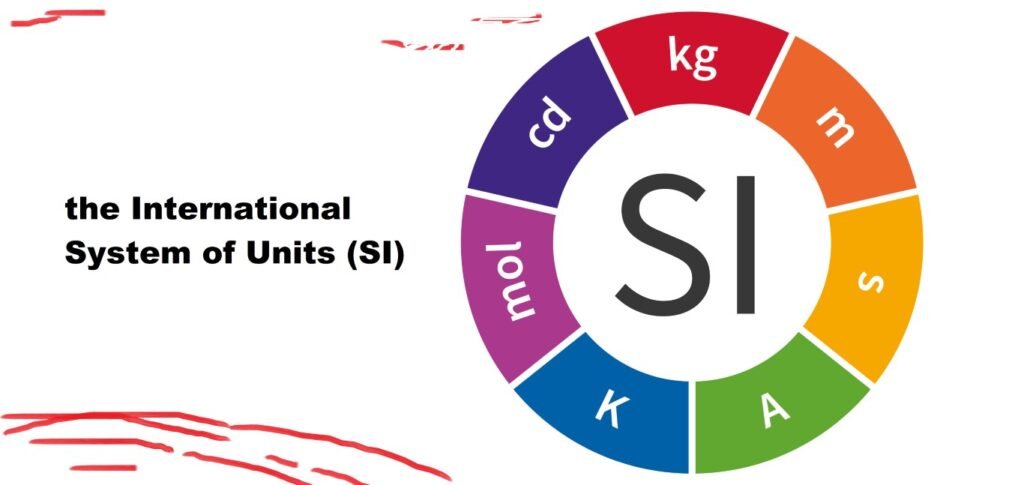
    Kinetic energy is a type of energy due to the movement of an object. The word kinetic comes from the Greek which means to move. Therefore, all energy in motion must have kinetic energy. The kinetic energy is mathematically formulated as follows:

    KE = 1 / 2.mv 2

    Where :

    m = mass

    v = speed

    From this equation, it can be seen that the kinetic energy is influenced by the mass (m) and velocity (v) of an object. The SI unit for energy is the joule (J). The joule is equal to kg.m 2 / s 2 , the other units are calories (cal) which is equivalent to 4.184 J.

    A simple example of kinetic energy is when someone hits a ball with the aim of making the ball fly towards the opponent. Or when you throw stones at a certain speed. Energy can be seen when a rock hits the target it hits.

    Summary 

    • Energy is the capacity of an object to do work or generate heat.
    • Kinetic energy is energy arising from the motion of objects.
    • A joule (J) is the SI unit for energy equal to kg.m 2 / s 2 .
  • Basic Units in the International System of Units (SI)

    Basic Units in the International System of Units (SI)

    The International Unit (SI) is a modern form of the metric system and is currently the most commonly used measurement system. This system consists of a coherent measurement system consisting of 7 base units and defines 22 units and many more derivatives.
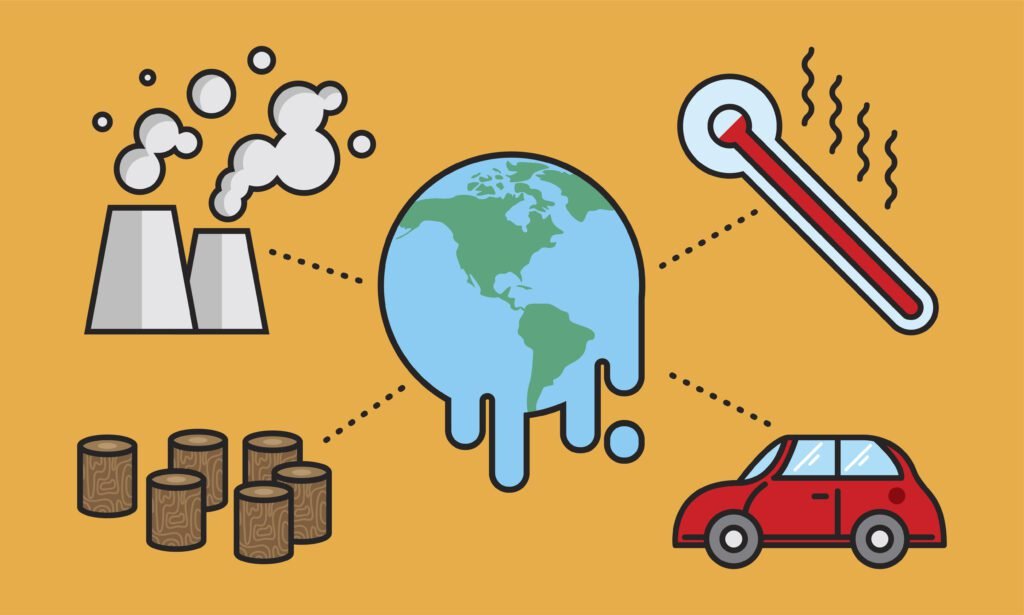
    Meanwhile, the SI base unit is the seven units of measurement defined by the Systeme International d’Unites , as the basic set to derive all other SI units, namely SI derived units. This basic unit is commonly used in various measurements, such as measuring height, weight, time and many others.

    Here are 7 basic units for the international system (SI) :

    • Long. Dimensions of an object which expresses the distance between ends, with the SI base unit meters (m).
    • Mass. A quantity representing weight, with the SI basis of the kilogram (kg).
    • Time. The entire sequence during which a process, action, or state exists or takes place, has the SI base unit second (s).
    • Temperature. Indicator of the degree of heat of an object, has units of kelvin (K).
    • Electric current. The amount of electric charge caused by the movement of electrons flowing through a point in an electric circuit over time, in the SI base unit amperes (A).
    • Light intensity. The basic physical quantity in measuring the power emitted by a light source in a certain direction per unit angle, has units of candela (cd).
    • Amount of substance. A physical base unit that measures the number of elementary samples which can be atoms, electrons, ions, molecules, or certain particles, with the SI base unit mole (Mol).
    No. Basic Quantity Unit Name Unit Insignia Magnitude Symbol
    1 Long Meter m l
    2 Mass Kilogram Kg m
    3 Time Second s t
    4 Temperature Kelvin K T
    5 Electric current Ampere A I
    6 Light intensity Candela CD j
    7 Amount of substance Mole mole n

    The five of the units of the international system of units are commonly used in chemistry, namely length, mass. Temperature, time and amount of substance.

    Summary

    • The International System of Units (SI) is a modern form of the metric system and is currently the most commonly used measurement system.
    • In international units there are seven basic quantities used, namely length, mass, time, temperature, electric current, light intensity, and amount of substance.
    • Five of the basic SI quantities are commonly used in chemistry.
  • 7 These Are the Causes of Global Warming

    7 These Are the Causes of Global Warming

    Global warming is causing the earth to get worse.

    Global warming causes the earth to experience an increase in average temperature which has an extraordinary impact on life in it.

    Extinction of living things, extreme climate change are also the effects of global warming.

    Here are 7 things that cause global warming:

    Deforestation

    Deforestation

    Forests play an important role in the environment, the more forests the lower the pollution. Massive forest loss caused sudden climate change.

    Trees which are the key to climate regulation, play a role as controlling CO₂ and oxygen. Bush and forest areas act as carbon sinks and regulate the temperature to about 1.5 degrees.

    Currently, the industry uses wood as raw material which is obtained by cutting down forests. Deforestation is the main reason for global warming as the amount of oxygen decreases and CO₂ increases in the atmosphere.

    We know that vegetation is very important, but it is continuously being destroyed and eliminated, the concentration of CO2 is increasing and causing global warming, 1/5 of greenhouse gas pollution is generated from forest degradation and tree cutting.

    The causes of global warming can actually be prevented and checked if the right things are done such as planting more and reforestation

    Rapid Industrialization

    Industry uses chemicals in its manufacture and produces waste that pollutes the environment. These chemicals and industrial wastes enter the environment and mix with water and cause various diseases.

    Some industries use gas and fuel to run factories. During the process, one of the end products is harmful fumes and pollutes the air. The smoke contains large amounts of CO₂ which is the main cause of global warming

    Transportation

    Based on research, findings, and observations, it was gathered that transportation also has a hand to play in the causes of global warming. This can also be seen in the gas output of transportation equipment such as cars, airplanes, trains, and others.

    The World Resources Institute in 2012 proved that 15% of climate pollution comes from transportation.

    Fertilizers and Pesticides

    Fertilizers and pesticides are used to increase production from the agricultural sector. Initially it was clear that the use of fertilizers and pesticides increased production. But on the other hand this results in the release of nitrogen gas which mixes into the air and causes global warming.

    Agriculture also produces methane gas products, especially from livestock such as cattle and sheep. Fertilizers made from nitrogen release nitrogen oxides and have recently become a problem in many countries.

    Household Waste

    This Waste releases methane gas which immediately reacts with oxygen and changes its condition. Why did this happen?

    If not managed properly, waste which generally comes from organic waste which is “anthropogenic waste” will degrade and decompose into methane gas (CH 4 ). CH 4 gas is a greenhouse gas that can cause a greenhouse effect which has the potential to cause global warming.

    Refrigerator and air conditioner

    Refrigerators and air conditioners are used in almost every home and office. These tools use Freon gas or CFC (Cloro Fouro Carbon).

    Freon can deplete the ozone layer when it is put into the air and is one of the causes of global warming. This ozone layer is useful for protecting the earth and living things from exposure to Ultra Violet B (UV-B) radiation and also absorbs high ultraviolet radiation from the sun from reaching the earth.

    Fossil Burning

    Fossil fuels include gas, oil and coal. The main producer of CO₂ is Australia which has been widely recognized for many years compared to others. When fossil fuels are burning, carbon dioxide is released into the atmosphere.

    The cause of this pollution in Australia has been linked to electricity where around 73% of electricity comes from burning coal and about 14% from burning gas. The remaining 13% comes from sources such as wind, sun and water or water. In fact, less pollution is achieved when the amount of gas, coal, several sources of energy. The burning of fossil fuels has for years been recognized as the main cause of global warming.