Tag: Macroeconomics

  • Adam Smith’s Thoughts in The Wealth of Nations

    Adam Smith’s Thoughts in The Wealth of Nations

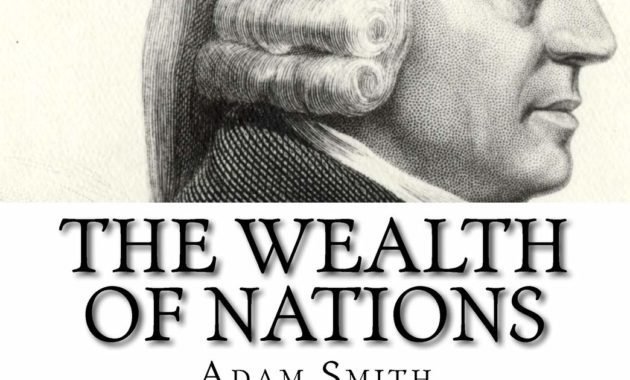
    An Inquiry into the Nature and Causes of the Wealth of Nations , one of Adam Smith’s masterpieces which until now has become the foundation of modern economics, contains the concepts of Smith’s thoughts for many years.

    In this article we will note the important points presented in the book.

    Please note that  The Wealth of Nations  consists of five broad topics, which are further divided into chapters.

    It should also be remembered that this book was published in the 18th century, where the economy, science, and technology were not as advanced as they are today, so some of the explanations are no longer relevant for today.

    Smith stated many things in the book, including those  related to the factors of production , namely labor, land, and capital; with  an emphasis on the labor element .

    He also touched on  regulations in economic activity, taxation, international trade, and public policy .

    Smith also spoke about the importance of  freedom and justice as the foundation for the welfare of the country .

    First, Smith asserts that  economic efficiency can be achieved through the division of labor (tasks) for labor ; In this case, task specialization greatly determines the level of time and cost efficiency, which in turn affects the final product.

    If the workforce is specialized according to expertise, they will do the same task from time to time, so the task will be completed quickly. This also guarantees the quality of the product being worked on.

    In addition, the more efficient the time required, the products with competitive prices will be produced.

    In essence,  the efficiency generated by a specialized workforce is the source of the country’s success in achieving prosperity .

    Furthermore,  trade between individuals  (note: at that time trade was commonly carried out by barter) was basically  carried out freely, according to each other’s interests .

    For example: farmers sell their crops, then buy chicken meat; on the other hand there are traders who sell chicken meat, then buy rice. In this case, all transactions occur because of individual interests.

    However, it must be remembered  that individual interests are not related to greed or egoism  (remember that Smith bases economic activity on aspects of ethics and morality (reread the previous article).

    However, real trading is certainly not as simple as the above example; Therefore , a better method is used, namely using  a transaction medium called money . This money  has an exchange rate that is  agreed by each party.

    Then  how to measure the exchange rate of each traded product?  Namely  by measuring the value (power) used by labor  in the production process.

    So it can be said that  the value of labor is an important factor in the economy , while money is only a tool to measure that value.

    The value of the workforce varies, depending on several factors, such as the level of difficulty of the job, the level of education and skills of the workforce, the risk of the job, and so on. This value is  represented by wages ( wages ) .

    In its development, not only labor is used in the production process, there are other factors involved, namely  capital ( capital )  and  land ( land ) ; so the production value must be calculated from each element used.

    The completion of the production process is marked by the creation of a product that has a selling price. The selling price of the product which is calculated from the accumulation of production factors is called  the natural price .

    Meanwhile, the real price of the product in the market is called  the market price , which is the base price plus the determined profit .

    The more special or special a product, generally requires a larger capital to make it (reflected in the higher product price). This accumulation of capital  is what  drives economic growth .

    The picture is as follows: an increase in capital creates a specialized product, which then creates a surplus. The surplus is used for investment, by creating other specialized products, then resulting in an increase in capital, so continuously continuously.

    In terms of labor, Smith grouped it into  productive and non-productive labor ; the difference lies in the final product ( output ).

    Productive labor produces  marketable output  for some period of time . Examples of productive labor are spinning factory workers and food factory workers.

    Meanwhile  , non-productive labor produces  output  that is only consumed or utilized immediately , for example restaurant waiters, actors, and dancers.

    In terms of national income, the more consumption of non-productive labor, the less income and capital accumulated for investment, so the smaller the added value for national income.

    Smith also revealed, when someone wants to increase production capacity, usually he will borrow capital (debt) to other people. This capital loan is carried out in the hope of obtaining greater profits from the increase in production capacity.

    So it can be said that  debt is one of the important elements in calculating national income .

    When a debt transaction occurs, the lender and the borrower agree on certain clauses, including the sharing of  profits called interest .

    If one day it is found that there are more lenders, then various options are available for borrowers. This prompts lenders to lower loan interest. In other words,  the more loan capital available, the lower the loan interest .

    Higher capital growth , followed by lower costs, will  encourage increased industrial productivity . As a result,  more and more workers are absorbed , so  the more competitive wages are received by workers .

    Furthermore, Smith asserts that  economics is closely related to how to generate wealth for society and provide income for the state .

    He put forward two systems to achieve this, namely  the mercantilist system ( merchantile system )  and  the agricultural system ( agricultural system ) .

    The mercantilist system held that prosperity was obtained through the possession of money, gold, and silver . The more these elements are owned, the more prosperous the society and the state.

    Meanwhile,  the agricultural system states that agricultural products are the main source of income and welfare of the country .

    In the agricultural system there are three social groups that contribute to state income, namely landowners, farmers and workers, as well as traders and manufacturers.

    Smith further stated that  the main task of the state is to protect people from violence and harm . The state must also  protect the economic interests of the  people, including overcoming the problem of economic and social inequality.

    In addition, the state must  facilitate the needs of the community through public policies , for example in the education sector.

    One way is through  the imposition of taxes . In this case, the community must contribute according to the proportion, by setting aside a portion of the income to be given to the state.

    The money collected will be used in the administration of the state, as well as to ensure good governance in society.

    These are some of Adam Smith’s main thoughts as stated in  The Wealth of Nations . Actually there are many more views of Smith that need to be explored and studied; Of course, it is the duty of all learners to find this, for the sake of the development of science. *

    Reference:

    1. Butler, Eamonn. (2012). The Condensed Wealth of Nations and The Incredibly Condensed Theory of Moral Sentiments, CIS Occasional Paper 126.
    2. Smith, Adam. (1776). An Inquiry into the Nature and Causes of the Wealth of Nations, London.
  • Understanding Inflation: Definition, Causes, and Effects

    Understanding Inflation: Definition, Causes, and Effects

    Inflation is one of the main topics in economic studies. The amount of inflation is very influential on the economic growth of a country.
    Inflation is often used as an excuse for not achieving economic growth targets.

    Not infrequently inflation is also used as a campaign tool for prospective leaders to win the votes of the voters, with promises to control it.

    Even in 1974, the then president of the United States, Gerald R. Ford, declared that inflation was the number one enemy of the United States.

    Therefore, in this paper we will learn about the nature of inflation, the factors that cause inflation, and economic policies to control inflation.

    1. BASIC CONCEPTS OF INFLATION.

    As a start, we will study the basic concept of inflation.

    Blanchard states that inflation is  a sustained rise in the general level of prices’ (Blanchard, Olivier,  Macroeconomics , 4th edition, 2006).

    Sementara Samuelson dan Nordhaus menyebut inflasi (inflation or inflation rate) sebagai ‘the percentage of annual increase in a general price level’ (Samuelson, Paul A., and William D. Nordhaus, Economics, 7th edition, 2002).

    In principle,  inflation is a general increase in prices, which occurs within a certain period .

    The price increase can be seen from  two points of view , namely:

    • a broad perspective ( broad perspective ) , for example the increase in prices for goods/services, as well as an increase in the cost of living .
    • a narrow perspective , for example an increase in the price of consumption products such as chili, onions, or rice.

    The inflation rate is measured in percent ( rate ) . One  method of measuring inflation  is  to know the size of the consumer price index (CPI)  or  consumer price index  (CPI).

    The CPI figure is obtained by  calculating the cost of living for household consumers (especially those living in urban areas) , including the cost of consumption of goods and services, housing costs (including rent), and other daily living costs, within a certain period of time.

    Furthermore , the figures obtained are  compared with the index figures in the base year . This base year index becomes the benchmark for every measurement of inflation.

    The comparison produces a number/index called the consumer price indexThe percentage change in CPI  from a certain period of time is  called  consumer price inflation ; In simple language: inflation or the rate of inflation .

    For example: the CPI figure in the base year is 100, while this year the CPI calculation reaches 105, the inflation rate this year is 5% ((105/100) – (100/100))x 100%).

    For information, there is the term  core consumer inflation , which  describes the calculation of the cost of living for consumers, by excluding the prices of certain  products that are seasonal in nature (seasonal products usually experience a price increase that exceeds reasonableness due to increased demand, for example ahead of religious holidays, nearing the end of the year, etc.). etc).

    Public policy makers tend to pay more attention to the calculation of  core consumer inflation , because price changes that occur are relatively stable.

    In addition, economic policy makers will also  try to keep the inflation rate within a certain range , as  a symbol of economic stability from time to time .

    Moreover, a stable inflation rate will facilitate economic policy making. Various economic studies have also stated that if inflation exceeds a certain target, it can trigger further inflation at a more severe level if it is not addressed immediately.

    Actually  there is no certain benchmark related to the inflation rate that is considered reasonable , however, there is a range that can assist economic policy makers in determining the inflation rate targeted in one economic year, namely:

    • inflation rate  is 0% – 2.5% , meaning that  the economy is in a stable condition .
    • inflation rate  2.5% – 5% , indicating  a moderate inflation rate .
    • inflation rate  5% – 8% , including high inflation category  .
    • The inflation rate  is above 8% , meaning that  the economy is entering a dangerous inflation phase , with a further impact in the form of hyperinflation.

    (Hellerstein, Rebecca, The Impact of Inflation, Federal Reserve Bank of Boston, 1997).

    On the other hand,  inflation below 0% is called deflation or  negative inflation .

    A more complete discussion of the Consumer Price Index ( Consumer Price Index ) and the calculation of the inflation rate can be read in the articles on the Consumer Price Index, Producer Price Index, and Determination of the Inflation Rate.

    2. INFLATION TRIGGER FACTORS.

    Inflation can arise as a result of the implementation of fiscal and monetary policies .

    In terms  of monetary policy , for example,  increasing the money supply  or  decreasing the benchmark interest rate .

    The description is as follows:

    • when the money supply increases , then  the value of money will decline .
    • This policy is actually only natural to spur an increase in consumption, but  when the decline in the value of money is greater than the size of the economywhat happens is the increase in product prices  as an adjustment to the decline in the value of money.

    Regarding  fiscal policy , for example, when  the government increases spending  , this triggers an increase in demand .

    However ,  when  demand  exceeds  supply , there will  be a shortage of production resources , resulting  in an increase in product prices . This condition is known as  demand-pull inflation .

    Changes in product supply can also  trigger inflation  ; namely  when  supply shocks occur , for example  when natural disasters occur  which result in  an increase in production costs . This has  an impact on reducing the quantity of product inventory, thus inflating prices .

    In other words,  inflation occurs because of disruptions to product inventories . This phenomenon is known as  cost-push inflation .

    3. INFLATION CONTROL POLICY.

    With so many factors triggering inflation, economic policy makers must be careful in every fiscal, monetary policy decision, as well as in maintaining a balance of  demand  and  supply .

    If there is unexpected inflation, certain policies can be applied, for example  the central bank conducts a  contractionary policy , namely by  raising the benchmark interest rate , so that it can suppress demand (some economic actors will hold their money and not use it for consumption).

    In addition, the central bank can also  tighten the rules for obtaining credit (loans) . In general, policies like this in the short term can have a negative impact on the economy, for example on the housing sector.

    There is one  expression in an effort to overcome inflation , namely  ‘the problem must intentionally be made worse before it gets better!’ , meaning  that economic conditions must be made ‘ worse ‘ in the short term, before improving in the long term .

    It can be concluded that managing the inflation rate so that it remains stable is the best step, because if inflation is out of control, the costs to be incurred will be very expensive.

    Meanwhile,  if the cause of inflation comes from global factors , then  a country’s economic policies will not have a significant effect . The global economic slowdown in 2007-2008 proved that when there was a sharp increase in world crude oil prices, many countries did not have the ability to control it.

    At that time, the policies taken were generally in the form of increasing subsidies and/or reducing the state budget in certain sectors to minimize the impact of inflation.

    This is a description of the basic concept of inflation, the factors that trigger inflation, and economic policies to overcome it. **

  • What Triggers Economic Recession: Definition, Causes, and Impact on Society

    What Triggers Economic Recession: Definition, Causes, and Impact on Society

    In measuring the development and progress of a country, of course the main reference or indicator is how much economic growth is.
    Meanwhile, the level of economic growth can be seen from the value of the Gross Domestic Product (GDP) in the country.

    If the GDP is low and continues to decline for months, it can trigger an economic recession . What is an economic recession?

    Understanding Economic Recession

    A recession or slump is a condition marked by a decline in the wheels of the economy due to the weakening of the value of Gross Domestic Product (GDP) for six consecutive months in the same year.

    A recession is marked by a significant decline in economic activity that lasts for several months. An economic recession can also be defined as a major slowdown or contraction in economic activity.

    Recession is marked by the value of economic growth reaching 0% and can even reach minus in its worst condition. This condition can certainly disrupt the economic system and threaten the survival of the community.

    A recession can be characterized by high unemployment , falling retail sales, and a prolonged contraction in manufacturing earnings.

    Characteristics of an Economic Recession

    This economic disaster certainly has certain characteristics, the following are the characteristics:

    1. Gross Domestic Product (GDP) continues to decline.
    2. The real income of the people is decreasing.
    3. The decline in sales and manufacturing production , many goods are not sold and piled up in factories.
    4. The unemployment rate is getting higher, while there are fewer jobs.
    5. People’s purchasing power or consumption is low.
    6. Economic growth has slumped for two consecutive quarters.

    Causes of the Economic Recession

    This decline in economic conditions and GDP is certainly caused by many factors, including:

    1. Inflation

    Inflation is a condition in which the price of goods increases continuously. This is actually not a bad thing, but if this price increase occurs excessively or significantly, it will certainly have an impact on society and cause a recession.

    If the price of goods for public needs continues to soar to the point where people are unable to carry out consumption activities and cannot fulfill their needs, then this can be a disaster for the country.

    2. Deflation

    The opposite of inflation, deflation is a condition in which the price of goods continues to experience a significant decline. This will have a similar impact, because if production prices fall, wages will also fall and suppress market price stability.

    Deflation has more of an impact on business owners. If this condition continues, many companies will not be able to continue their business and lead to bankruptcy. This will certainly have an impact on the destruction of the economic system.

    3. Asset Bubble

    An asset bubble is a situation where the impact can be enormous. This condition occurs because there are many investors who are competing to buy shares when the value is high, and competing to sell them when the economy is in disarray.

    Another name for this situation is irrational excitement. This joy comes when investors make decisions to buy stocks and real estate when the economy is good. It’s that fun that inflates the stock market and residential assets.

    Until in the end the bubble burst because the economy was in a downturn, then they would destroy the market by selling all the assets they had. This then triggers a recession.

    4. Economic Shock

    This condition can be many things. Starting from a pile of individual debt, to companies. The more debt you have, the higher the repayment fee will be. In fact, this can get to the point where the debtor is unable to pay off the debt.

    Economic shocks can also occur due to natural disasters , political and social instability, terrorism , war , or in times of pandemics such as those that have occurred since 2020 until now.

    5. High Interest Rates

    High interest rates can also cause prolonged economic problems . A high nominal can indeed protect the value of the currency, but it can also burden the debtor and cause credit faltering. If this problem occurs continuously, it is not surprising that many banks close and collapse.

    6. Loss of Investor Confidence

    In economic development, investment is the key. Therefore, it is necessary to have a conducive and safe climate so that investors are interested and believe in pouring their money.

    If many investors lose confidence and withdraw their investment, then the economy will be weak, production will decrease, unemployment will increase and of course the country will experience an economic recession.

    7. Imports are Bigger than Exports

    When countries bring in more of their basic needs from abroad and are not matched by sales of domestic products to foreign countries, this will trigger a recession.

    It is clear that the expenditure for obtaining imported goods is greater than the income from selling local products to foreign countries. This will of course lead to a deficit in the state budget.

    Impact of the Economic Recession

    The economic recession will certainly have a big impact on all. At least this impact will be grouped into 3 groups, namely:

    1. Government

    An economic recession can cause a reduction in the state budget that comes from taxes and non-taxes. This is because people’s income and property prices have decreased.

    Not only that, the recession also causes high unemployment rates. Of course, the government must find ways to open up the widest possible employment opportunities for those in need.

    Not surprisingly, this condition can make countries apply for loans to foreign banks and increase the amount of state debt.

    2. Company

    Recession is one aspect that can lead to business bankruptcy . When the company is not strong enough to face losses and economic problems that hit the market, the solution is to go out of business.

    Of course, that’s not a good way out. Because this causes massive layoffs that lead to low economic activity in the community due to poverty.

    3. Workers

    They are the worst affected in the event of a recession. Workers will be threatened with losing their jobs and having difficulty meeting their daily needs. If their income is nil due to layoffs, then the impact will no longer only be on the economy, but will also spread to social problems and so on.

    Example of an Economic Recession

    The world has changed dramatically in the three months since our last update of the World Economic Outlook in January. A rare disaster, a coronavirus pandemic, has resulted in a tragically large number of human lives being lost. As countries implement necessary quarantines and social distancing practices to contain the pandemic, the world has been put in a Great Lockdown. The magnitude and speed of collapse in activity that has followed is unlike anything experienced in our lifetimes.

    source : imf.org

    Difference Between Recession and Economic Depression

    In addition to the economic recession that threatens the survival of the community, there is also the term economic depression. Here’s the difference:

    • Scale. The occurrence of a recession is usually limited to one country, while an economic depression affects the global economy. An economic depression is a much more severe condition of the economy and its effects are worse than a recession.
    • GDP levels. The level that marks the onset of a recession is that its GDP fell in the range of minus 0.3-5.1%. While depressed, its GDP was at minus 14.7%-38.1%.

    Period of time. A country is considered to be in a recession when its economy has deteriorated for 6 to 18 months in a row. In depression, the effects are much more severe and long lasting. The slump in economic conditions in the economic depression can last for more than 18 months.

  • What Are Economic Bubbles, How To Avoid Them?

    What Are Economic Bubbles, How To Avoid Them?

    The term economic bubble or often also referred to as a speculative bubble or financial bubble. This is one thing to watch out for, especially when you invest.
    Determining investment instruments is not an easy thing. Of course, everyone hopes that the chosen investment instrument can increase in price so that it will provide benefits in the future.

    There are many things that must be considered so that you are not wrong in choosing an investment instrument. One thing that is quite important and needs to be watched out for is the phenomenon of the economic bubble.

    Because this phenomenon can make the value of the investment instrument you choose fall very deeply. So instead of getting a profit, you will actually experience a large amount of loss.

    Understanding the term bubble economy

    The phenomenon of economic bubbles has occurred in many countries and has a long history. The occurrence of this phenomenon makes many people suffer losses in very large numbers.

    The term economic bubble itself refers to the condition of rising asset prices to become unrealistic. Furthermore, the price of these assets experienced a sharp decline in a very fast time.

    So that people who have bought assets at high prices, suffer losses due to the decline in prices. This phenomenon can occur in various assets such as stocks, property and other types of assets.

    The naming of this phenomenon takes from the reality of bubbles that easily rise to the top. But at a certain point, the bubble will burst very quickly.

    This illustrates how the price of an asset can soar to the point of being unrealistic. Until in the end the value of the asset broke and the price fell to a very low level.

    The term economic bubble has been known by economists as something to be wary of. Because the occurrence of this phenomenon will have an influence on macroeconomic conditions.

    There have been many examples of economic crises caused by the economic bubble phenomenon. One of them is the housing bubble that occurred in 2005 – 2008 in the United States.

    In that year, house prices in the United States experienced a very high increase. Until finally in 2008, the bubble burst and caused an economic crisis.

    Until finally the American government had to bail out or provide bailout funds to help some companies keep operating. Without the bailout funds, there will be massive layoffs.

    Understanding Some of the Causes of Economic Bubbles

    In general you have understood the term bubble economy. In fact, this phenomenon refers to the movement of the price of an asset that increases and then at some point will break.

    Economists still do not know the exact cause of this phenomenon. However, there are several things that may be the cause of this phenomenon, namely as follows.

    Excessive Liquidity in the Financial System

    The first thing that may be the cause of an economic bubble is excessive monetary liquidity in the financial system. Simply put, the ease of getting a loan can be the cause of an economic bubble.

    Again remember that the term bubble economy refers to a condition in which asset prices increase to the point where it becomes unrealistic. The ease of getting a loan is one of the causes of this.

    With the ease of getting a loan, the purchase of an asset will increase. According to the law of supply-demand, more demand will make the price of an asset increase.

    At a certain point, the price of the asset becomes unaffordable so it cannot be sold. As a result, the owners of assets will make sales at low prices.

    This is done so that they still get income even though they have to suffer losses. Because on the other hand, they still have debts that have the potential to default.

    Investors’ Speculative Behavior

    One of the possible causes of the economic bubble phenomenon is the speculative behavior of investors. Because it refers to the term economic bubble, that in fact an increase in asset prices is an expected thing.

    The higher the potential increase in the price of an asset, the more attractive it will be. Because these assets are predicted to be able to provide huge profits in the future.

    Therefore, an asset that is considered to have a high price in the future must be in great demand. So that more and more investors invest in these assets and make the price increase.

    However, if the price increase is not accompanied by an increase in the intrinsic value of the asset, it will have a bad impact. Because in the end, people will realize that the asset price is too expensive.

    So the demand for these assets will decrease which will also lower the price. So investors who have bought assets at high prices will experience losses.

    The Greater Fool Theory

    One theory that is considered to be the cause of the economic bubble is the greater fool theory This theory is in line with the term economic bubble which describes a significant increase in asset value.

    In general, this theory states that price increases occur when someone can sell an asset that is overpriced to a “stupid” person. Then the “stupid” person will sell it back to the “stupider”.

    This will continue until the price of an asset becomes very high. Until finally the last person could no longer find a “stupider” one to buy the asset.

    So that the bubble will burst and make asset prices that were very high fall very low. So the last “stupider” person will receive a large amount of loss.

    Extrapolation

    Extrapolation is the behavior of equating historical data in the past with the future. This could be the cause of the economic bubble phenomenon considering that the term economic bubble is closely related to price increases.

    Indeed, one way to predict the value of an asset is to look at historical data. However, historical data is not the only data because there are other aspects that also need to be taken into account.

    Extrapolating behavior does not take this into account. They only see that the value of an asset in the past can rise to a very high which may also happen in the future.

    At some point, investors will realize that these assets cannot provide the returns as in the past. So that the bubble burst was marked by a decrease in asset prices.

    Lack of Community Financial Literacy

    It is undeniable that today many people are starting to realize the importance of investing. Unfortunately, awareness of investment is not accompanied by good financial literacy.

    In fact, one of the possible causes of the economic bubble is the lack of public literacy regarding the financial world . In fact, there are still many people who do not know the term economic bubble.

    This lack of literacy or knowledge will certainly affect people’s decisions to invest. One of them is in determining the right instrument and can provide benefits in the future.

    People who are minimal in financial literacy tend to make decisions on a whim and without careful consideration. As a result, they are more easily trapped in the economic bubble phenomenon so that they will get losses in the future.

    Tips to Avoid This Phenomenon

    After understanding the term economic bubble and its causes, of course you need to avoid this phenomenon. Because the losses that can be received due to the economic bubble phenomenon can be very large.

    There are several ways you can do to avoid this phenomenon. Here are some tips that can be done so as not to get caught in an economic bubble.

    Perform Fundamental Analysis

    One of the techniques in investing is fundamental analysis. This technique is done by choosing investment instruments that have good fundamental values. Of course, the fundamental value must be in line with the asset price.

    Fundamental analysis techniques are usually used in stock selection. This method is done by looking at the company’s performance and assessing whether the stock price is in accordance with that performance.

    But you can apply fundamental analysis techniques not only to stocks. Various other assets also have a fundamental value or intrinsic value on which the price of the asset is based.

    Given the term economic bubble is an increase in the value of prices to be unrealistic, then it doesn’t matter as long as the price increase is reasonable. This means that the price increase occurs because the intrinsic value increases.

    Don’t follow

    One of the problems faced by investors, is the fear of making decisions. So many investors prefer to follow the steps or decisions of other investors.

    This is what makes signaling groups very popular  because it makes investors not have to think. The decision to buy or sell an asset simply follows the signals given in the group.

    Whereas decisions that only follow the words of others are very vulnerable to bad effects. Because the decision could be wrong and was done to increase the price of a particular asset.

    People who are not familiar with the term bubble economy are often used for things like this. When the bubble has burst, then of course the one who feels the loss is yourself.

    Improve Financial Literacy

    Improving financial literacy is a must to avoid the economic bubble phenomenon. Apart from exploring the investment world, you also need to learn other things such as financial management and macroeconomics.

    Because basically, economic activities around the world are interconnected. For example, economic conditions in the United States can have an impact on the economic conditions of other countries.

    In addition, it is very important for you to study the economic history of the world. So you can take lessons from history and use them for consideration in the present.

    Moreover, the term economic bubble itself is not new. There has been a lot of history from various countries in the world that you can use as a lesson to be able to avoid this phenomenon.

    Avoid Excessive Desire (Greedy)

    One of the problems that must be avoided by investors is greed. Because greed will make you want the maximum profit to ignore various aspects that must be considered.

    Especially now that there are many investment instruments that promise too sweet but end up losing. Excessive desire or greed will encourage you to get stuck in such an investment instrument.

    Usually when feelings of greed arise, then someone will forget the term economic bubble. When they see an asset experiencing a rapid increase in price, they buy it without thinking.

    As a result, when the bubble burst, they were trapped because they had bought at a high price. Even worse, they can’t sell the assets, so they lose all their investment capital.

    One of the things that investors should be wary of is the economic bubble. Especially considering the term economic bubble that makes people suffer huge losses.

  • Understanding Economic Growth: Characteristics, Factors and Measurement Methods

    Understanding Economic Growth: Characteristics, Factors and Measurement Methods

    The economic growth of a country is closely related to the welfare of its people which also becomes a benchmark for whether a country is in a good economic condition or not.
    Simon Kuznets himself stated that economic growth is a condition in which a country is able to increase its production based on technological progress which is accompanied by an adjustment of its ideology. The following is a more complete explanation of the Theory of Economic Growth, Starting from the understanding, characteristics, factors to the measurement steps:

    Understanding Economic Growth

    Economic growth is an increase in the value and amount of production of goods and services calculated by a country in a certain period of time based on several indicators, such as the increase in national income, per capita income, the number of workers that is greater than the number of unemployed, and the reduction in poverty levels.

    Economic growth can also be interpreted as a process of continuous change towards better conditions in the economic conditions of a country. The economy of a country itself can be said to be growing if the economic activities of its people have a direct impact on the increase in the production of goods and services.

    By knowing the level of economic growth, the government can then make plans regarding state revenues and future development. Meanwhile, for business sector players, the level of economic growth can be used as a basis for making product development plans and resources.

    Economic Growth Theory

    In its development until now there are various theories of economic growth. This theory itself appears a lot to explain the growth cycle as well as the factors that directly influence an increase in the national economy by experts. Among the many theories that have emerged, here are some of them:

    1. Neoclassical Theory

    Neoclassical theory or also known as the Solow-Swan model of economic growth because it was originally introduced by Adam Smith, then put back by Robert Solow and TW Swan. This theory states that there are three main factors that influence economic growth including capital, labor, and technological developments.

    This theory also believes that an increase in the number of workers can increase per capita income. However, without developing modern technology, this increase will not have a positive impact on national economic growth.

    2. Classical Theory

    Classical theory has developed since the 18th century. Its originator is a prominent figure named Adam Smith who stated that the economy of the population in a country will reach its highest point when using a liberal system consisting of two main elements, namely population growth and output.

    This concept was later refuted by David Ricardo who stated that population growth did not have a positive influence on national economic growth, on the contrary, it would only increase the productive workforce, thus resulting in a decrease in worker wages.

    Classical economic theory was born as the first milestone in economic thought which is used as a scientific discipline. This theory arises because of the weaknesses and shortcomings of previous economic theories.

    3. Historical Theory

    This theory was developed by a number of economists including Karl Bucher, Werner Sombart, and Frederich List with different views, but both are centered on the economic activities of society.

    According to Karl, the relationship between producers and consumers affects national economic growth, this relationship itself occurs in cities, communities, closed household levels, to the world.

    Meanwhile, Werner Sombart classifies the role of society in economic growth, from the closed economic stage, the industrial growth stage, to the capitalist stage.


    Factors Affecting Economic Growth

    Economic growth is a process of changing the economic conditions of a country on an ongoing basis towards a better state within a certain period of time. Find out what factors really play an important role in influencing economic growth:

    1. Natural Resources (SDA)

    Natural Resources or something that comes from nature includes soil fertility, location and composition, natural wealth, minerals, climate, water resources, to marine resources. For economic growth, the availability of abundant natural resources is very good in supporting development.

    Natural resources themselves are further divided into three types including Biological Natural Resources (resources that come from living things both from animals and plants. Examples of biological natural resources include chickens, cows, vegetables, rice, corn, cotton, wood, tea, coffee, to fish, non-biological natural resources (resources that do not come from living things.

    Examples are water, sunlight, air, soil, mining materials, petroleum, and natural gas), natural resources that can be or are recovered (Examples of these resources include animals, plants, trees, and fish, Natural resources that cannot be recovered) renewable resources (resources that are limited because they are formed by natural processes over a long period of time (petroleum, coal, and natural gas), lastly, eternal natural resources that will never run out (examples of these resources include water, air, sunlight, etc.) sun, wind, waves, tides, and geothermal).

    2. Human Resources (HR)

    Human Resources play a very important role in economic growth. Human resources or also abbreviated as HR are productive individuals who act as drivers of an organization, both within companies and institutions.

    It acts as the main element of the organization compared to other elements such as technology and capital, because it is humans who will then control these other factors. Human Resources itself is not solely calculated based on the number but rather on its efficiency. In encouraging Human Resources to work efficiently, there are several things that can be done:

    • Motivation of Human Resources (HR)  – Change and development will not occur without the awareness of each party. Therefore, motivating Human Resources (HR) is one of the things that must be done.
    • Adjust the Work to the Abilities and Interests of Human Resources (HR)  – Human Resources (HR) performance will be less productive if they accept assignments that are not in accordance with their abilities and interests. Therefore, they must be smart in choosing and determining their position according to their abilities and interests in something.
    • Training Programs  – Providing training programs to Human Resources (HR) will also help improve their skills. The training program must be well structured and must be right on target and in accordance with valid data. Guidance on valid data will then produce optimal output.
    • Periodic Evaluation of Human Resources (HR)  Performance – In controlling the performance of Human Resources (HR) within the specified period, it is necessary to have an evaluation so that they are introspective and try to improve and improve their work to maintain their position.

    Human Resource Economics can also be defined as the science of economics which is applied to analyze the formation and utilization of human resources related to economic development.

    3. Capital Accumulation

    The accumulation of capital as a supply of reproducible factors of production. Capital accumulation is the process of adding to the stock of human-made physical capital in the form of equipment, machinery and buildings. If the capital stock increases within a certain time, it is also called capital accumulation or capital formation.

    The relationship between Capital Accumulation and economic growth itself can measure aggregate capital accumulation from the gross capital formation (gross investment) minus depreciation, both of which are within the scope of the Gross Domestic Product (GDP) component.

    In the Harod-Domar model of economic growth, an increase in the saving rate allows more investment, which then leads to a higher rate of economic growth in the medium and short term.

    4. Managerial Personnel and Production Organization

    Production organization as an important part in the process of economic growth which is then closely related to the use of production factors in various economic activities. Production organization is also carried out and regulated by managerial personnel in various daily activities.

    5. Technology

    Technological change is considered as one of the most important factors in the process of economic growth, because technological change and progress is closely related to changes in production methods. It will eliminate the boundaries of time and space which then gives rise to new industries that take advantage of technological developments.

    This is what then results in economic movement, if initially the exchange of goods was done physically, now this exchange is also happening through the media of technology. Economic movements that occur later will indirectly affect economic growth.

    At the macroeconomic level, technological developments play a role in contributing to economic growth and encouraging economic development in a better direction. The development of information technology will also indirectly strengthen the competitiveness of a country in developing its economy.

    The companies in it can then increase national income which can later be used to support the welfare of its residents. Therefore, technological changes will increase the productivity of Human Resources (HR), capital, and other production factors.

    6. Political Factors and Government Administration

    Weak political and administrative structures are a major obstacle to a country’s economic development. Politics that are in an unstable condition and a corrupt government will certainly hamper economic progress.

    In addition, the social aspects of people’s lives such as behavior, attitudes, work motivation, community views, or community institutions, legal order and the composition and incorrect implementation of laws and regulations are also factors that hinder economic progress. So it does not support the implementation of economic growth. Therefore the law should be implemented in a consistent and orderly manner.


    How to Measure Economic Growth

    The economic growth of a country can be measured by comparing the Gross National Product (GNP) and Gross Domestic Product (GDP), in the current year with the previous year. These two benchmarks help in calculating the total output of a country’s economy.

    Meanwhile, according to Todaro and Smith (2004) there are three main factors or components that affect economic growth, namely capital accumulation, population growth (growth in population), and technological progress (technological progress).

    Meanwhile, how to measure the economic growth of a country can be used the following formula:

    Gt = ((PBDt – PBDt-1) / PBDt-1)) x100%.

    Information :

    Gt    = Economic Growth Rate

    PBDt       = PDB value period t

    GDPt-1 = GDP value of the previous period

    In addition, in encouraging economic growth, there are several factors that influence it. Among them, are human resources, natural resources, science and technology, culture and capital resources.


  • The Concept of Deflation and Its Impact on the Economy

    The Concept of Deflation and Its Impact on the Economy

    In the previous material, we have studied the definition of inflation, its triggering factors, and economic policies to overcome it. In this article, we will study the situation opposite to inflation, namely negative inflation or deflation and its impact on the economy.

    1. DEFINITION OF DEFLATION.

    In principle, deflation is a general decline in output prices . This situation is actually a common thing in the economy.

    It should be noted that when the price decline lasts only for a moment, it cannot be said to be deflation.

    Likewise, when price declines only occur in certain sectors even though they last for some time, as long as they do not have an impact on the aggregate economy, it cannot be said to be deflation.

    Therefore,a deflative situation has the potential to harm the economy if a general decline in prices occurs over a period of time (some literature mentions at least 1-2 quarters), and is reflected through a decline in the consumer price index (CPI) or GDP deflator .

    The decline in prices could be caused by several factors , including:

    1. productivity increase .
    2. application of modern technology .
    3. policy changes , for example through regulatory deregulation.
    4. decrease in the price of input goods .
    5. excess capacity ( excess supply ).
    6. weak demand .

    If the deflation that occurs is caused by points 1 to 4, what usually happens is mild deflation ( benign deflation ) which does not pose a threat to the economy , because falling prices tend to be followed by an increase in economic growth.

    The simple explanation:

    • when modern technology is applied to increase productivity, it will result in cost and time efficiency . This efficiency will cut production costs and operating costs , thereby lowering the selling price of output that must be borne by consumers.
    • in turn, this situation will trigger an increase in consumption (an increase in the quantity of output sales), as well as encourage an increase in economic growth . This also applies if there is a deregulation policy that encourages productivity growth.

    It is different if the price decline lasts for a long time and causes the CPI and GDP deflator to become negative , then this situation has the potential to harm the economy (a deflative situation like this is known as a malign deflation ).

    The explanation is simple:

    • when prices have decreased for some period of time, consumers and investors will hold liquidity (choose to hold money), in the hope that prices will continue to decline in the future.
    • on the other hand, when supply exceeds demand for a long time, this results in a decrease in profit, an increase in input costs, and an increase in unemployment .

    One case of deflation was the economic crisis in the United States in the 1930s (the Great Depression ), where output prices fell by about 25%, real GDP fell by 30%, and the unemployment rate rose sharply to 25% (Brooks, Douglas H. ., and Pilipinas F. Quising. Danger of Deflation , Asian Development Bank, ERD Policy Brief No. 12, December 2002).

    2. ECONOMIC VIEWS ON DEFLATION.

    In this section we will summarize some of the economists’ views on deflation.

    2.1. The view of the monetarists.

    The monetarist’s point of view is the money supply – side cause . The occurrence of deflation can be described by the following equation:

    The view of the monetarists.

    description:

    • M is the money supply ( money supply ).
    • V is the velocity of money circulation .
    • P is the price of output, which also indicates the size of the GDP deflator.
    • Y is the quantity of output, which also shows the size of real GDP.
    • (Remember! In the previous lesson we learned that the GDP deflator = Nominal GDP / Real GDP. This means P x Y = Nominal GDP).

    The explanation is as follows:

    • If real GDP is held constant in the short term (recall material Three Model Approaches in the Study of Macroeconomics), a decrease in M ​​or V through tight monetary policy, will result in a decrease in the GDP deflator or inflation rate .
    • when the decline in the inflation rate continues to below zero , then deflation occurs .
    • For the record: tight monetary policy ( contractionary monetary policy ) is the central bank’s policy by reducing the money supply (M), or increasing the benchmark interest rate (i).

    The monetarists suggest the implementation of expansionary monetary policy ( expansionary monetary policy ) , for example by increasing the money supply through the purchase of financial assets (bonds). This policy is also known as quantitative easing .

    2.2. Irving Fisher’s Perspective (Fisher’s Effect).

    The deflative situation can also be explained by the Fisher effect, where:

    Irving Fisher's Perspective

    description:

    • i is the nominal interest rate ( nominal interest rate ).
    • r is the real interest rate ( real interest rate ).
    • nē is the expected inflation ( expected inflation ).

    The explanation is:

    • when consumers and investors still view the continued decline in prices in the future, this will result in a decrease in expected inflation as well as a lower nominal interest rate .
    • at that time, consumers and investors tend to choose to hold liquidity rather than spending on consumption or investment. This is what triggers deflation.

    2.3. The Keynesian View.

    The Keynesians view that deflation occurs because of a decrease in aggregate demand ( demand-side cause ) (note: remember the equation Y C + I + G + NX, this equation will often be found in subsequent materials; and given the large number of materials related to aggregate demand , then the review will be presented in a separate article).

    According to Keynesians, deflation is associated with an increase in unemployment, a decrease in profits and income , and the emergence of debt defaults .

    One of the important focuses of the Keynesian perspective is the theory of the liquidity trap ., where the addition of liquidity by the central bank is not able to raise interest rates and income , and encourage economic growth .

    In modern macroeconomic concepts, the liquidity trap is a situation where the nominal interest rate is zero . So if the interest rate is zero , then consumers and investors prefer to hold cash rather than invest (for example in bonds) with a 0% profit rate .

    This at the same time argues against the view of monetarists, stating that monetary policy is not effective in overcoming deflation .

    To answer this question, Keynesians suggest implementing a fiscal-stimulus policy (Eurobank Research. Is Deflation a Risk for Greece? , Economy & Markets, Vol IX, Issue 3, April 2014).

    This is an understanding of deflation and its impact on the economy. **

  • Concepts of Utilitarianism, Liberalism, Libertarianism, and Socialism in Economic Policy Determination

    Concepts of Utilitarianism, Liberalism, Libertarianism, and Socialism in Economic Policy Determination

    Concepts of Utilitarianism, Liberalism, Libertarianism, and Socialism in Economic Policy Determination.

    Determination of economic policy is a classic problem that has always been a debate. The question of what policies the government should implement regarding equitable distribution of social welfare often raises pros and cons. In this paper, we will study the basic concepts that become the reference in determining policy, namely utilitarianism ( utilitarianism ), liberalism ( libertarianism ), libertarianism ( libertarianism ), and socialism ( socialism ).

    Previously, it should be noted that these concepts are multidisciplinary in nature, from the perspectives of politics, ethics, law, economics, and sociology. However, this article will only review from the point of view of economics.

    UTILITARIANISM TREE OF THOUGHT.

    The concept of utilitarianism developed in the mid-17th century until the 18th century. The main thinkers of this concept include Jeremy Bentham (1748-1832) and John Stuart Mill (1806-1873).

    The view of utilitarianism departs from two factors that influence human behavior, namely pain/suffering ( pain ) and satisfaction/happiness ( pleasure ).  These factors determine individual actions, related to whether or not the actions taken, as well as the causes of the actions themselves. It is also said that  every individual always wants happiness and avoids suffering  (Bentham, Jeremy.  An Introduction to the Principles of Morals and Legislation , Batoche Books, Kitchener, 2000).

    Thus, a  socially just policy is a policy that is able to produce  the greatest pleasure  or  total utility  for the community.  It can simply be shown in Figure 1. below.

    description:

    • The initial utility of each individual in society is represented by the line A – B.
    • The blue curve depicts the possible limit of increasing the total utility of society through government policies.
    • The shaded area (in green) is the government’s effort to increase the total utility of the community.

    Furthermore,  Mill asserts that the main purpose of a policy is to maximize utility (happiness) for the majority of society.

    Why the majority of people? Because each individual has a different goal of happiness, happiness for the many (society) becomes more important than happiness for the few (individuals).

    In determining policy, the basis used is the law of diminishing marginal utility , which states that individual satisfaction will decrease as consumption increases for a good (Mill, John Stuart.  Utilitarianism , Batoche Books, Kitchener, 2001) .

    simple example:

    • Individual A has an  income  of IDR 100,000 which can be spent on 10 servings of meatballs. According to the concept of  diminishing marginal utility , the more he consumes meatballs, the less satisfaction he gets.
    • individuals B, C, and D have an income of IDR 30,000, IDR 20,000, and IDR 15,000. With this income, each of them is only able to consume 3 portions of meatballs (for B), 2 portions (for C), and 1 portion (for D).
    • because the goal of utilitarian thought is to provide total satisfaction, then through an economic policy (eg the application of a proportional tax rate), some of the  marginal utility of  individual A will be reduced; while in individuals B, C, and D, will be added, so as to achieve the maximum total utility.

    However,  the concept of utilitarianism cannot be separated from criticism . Some of them are:

    1. The view of utilitarianism  ignores individual rights , simply because individual happiness differs from one another.
    2. The concept that solely aims to maximize happiness,  negates the ‘human’ side of the individual.
    3. Policies that satisfy the majority of people in the short term  do not necessarily provide maximum benefits in the long term.

    LIBERALISM PERSPECTIVE.

    In contrast to the view of utilitarianism which focuses on achieving the total utility of society,  liberalism sees it from an individual point of view .

    In one of his works,  John Locke (1632-1704) stated  that there are at least  three things that form the basis for achieving a liberal society , namely  tolerance and freedom in embracing beliefs, government policies at a certain level, and the recognition of individual rights as basic human rights  (Locke). , John.  A Letter Concerning Toleration , Liberty Fund, 2010).

    Locke asserts that  policy is made  not to produce the truth of an opinion, but  to ensure the security and safety of society and every individual in it.

    In addition, the view of liberalism also states that  the government must be able to regulate and manage public goods , and  ensure that each individual has the freedom to achieve their own happiness.

    In this case,  public goods  are a means of achieving public welfare, social stability, and economic efficiency. Some of the instruments in it include: national security tools (army), health and education facilities, civil security institutions, and infrastructure.

    The management of  public goods  is also what distinguishes the liberalism system from the  laissez-faire system  (classical view), which sees no need for the government’s role at all in the allocation of production factors and market intervention.

    As for one of  the characteristics of liberalism in the economy is a free competitive market , where the factors of production such as labor and capital are determined entirely by the market. In other words,  the free market mechanism is believed to be able to create effective resource allocation and produce efficient production  (Freeman, Samuel.  Liberalism , Oxford Research Encyclopedia of Politics, Online Publication, April 2017).

    Meanwhile, Rawl (1921-2002) argues that community institutions, legal order, and public policy stand on equality. The problem he raises is how to determine ‘equality’ objectively.

    Furthermore,  Rawls mentions that the formation of a community structure begins with cooperation, discussion, and bargaining between individuals, which ends with a mutual agreement; This is where public policy is created.

    Therefore,  public policy must prioritize increasing the degree of individuals who are most vulnerable or in the lowest position in society , or also called the  maximin criterion  (Rawls, John.  A Theory of Justice , 1971).

    VIEW OF LIBERTARIANISM.

    Libertarians argue that  the government must make policy through the application of the law against crime, as well as enforce the agreement voluntarily.  On the other hand,  the government does not need to intervene in terms of income redistribution.

    In one of his studies,  Friedman (1912-2006) states that people who receive minimum intervention from the government will tend to be more efficient and equal .

    In addition,  the market mechanism must work as freely as possible , because it is the key to economic efficiency; so that when a transaction occurs between two parties voluntarily, it will only be realized when each party benefits (Friedman, Milton.  Capitalism and Freedom , 1962).

    While  Nozick (1938-2002) asserts that the main focus of a policy is on the process of economic activity , not on the  outcome ; so that when there is an injustice in the income distribution phase, that is where government policy is applied to overcome the problem.

    On the other hand, when every process of economic activity has been running fairly, the government does not need to think about fairness in   economic outcomes .

    So it can be concluded that  libertarians view equality in opportunity as a more important factor than income equality.  Therefore, the government must ensure that the policies taken allow each individual to have equal opportunities in economic activity (Nozick, Robert.  Anarchy, State, and Utopia , 1974).

    SOCIALIST VIEW.

    If the perspective of liberalism and libertarianism lies in the position of the individual in economic activity, then  in the perspective of socialism, society is in control.  In socialism  there is no recognition of individual property rights related to economic capital  such as land, buildings, and means of transportation. In other words, true freedom is under the complete control of society.

    Marx (1818-1883) and Engels (1820-1895) argued that the workers ( labor force ) were in a vulnerable position to be exploited by capitalists , mainly related to economic productivity. The capitalists will also try to keep the wages of workers as low as possible.

    Therefore,  government intervention in economic activity is an absolute must  to achieve equality for every economic actor.

    While responding to the criticism that too much government intervention has a negative impact on the economy, socialists assert that in principle each party can make a collective agreement in determining the value of justice for each party (Marx, Karl, and Friedrich Engels.  The Communist Manifesto , NY: SoHo, 2013).

    Thus the perspectives of utilitarianism, liberalism, libertarianism, and socialism are related to the determination of economic policy. **