Tag: Dahrendorf

  • Differences in Conflict Theory of Karl Marx and Ralf Dahrendorf

    Differences in Conflict Theory of Karl Marx and Ralf Dahrendorf

    Social conflict is a form of conflict in society that occurs due to various factors. The complexity of social conflict makes studying this phenomenon give rise to multiple theories. Among the sociological thinkers who formulated specific theories to analyze social conflict were Karl Marx and Ralf Dahrendorf.

    Conflict theory was born to oppose the theory of structural functionalism. This is because the last theory provides an understanding that it is as if the development of society is balanced and static.

    Conflict theory comes with the understanding that society is changing because of the ongoing conflicts in life.

    Conflict also turns out to be derived from class conflicts, for example, the ruling group and the oppressed community group. This was one of the factors that brought about social changes or social systems in social life.

    An unbalanced condition ignores generally accepted norms and values but still affects people’s lives. In other words, social life cannot be separated from the various conflicts that occur in it.

    So, what are the Differences in the Conflict Theory of Karl Marx and Ralf Dahrendorf?

    Karl Marx’s Conflict Theory

    Karl Marx considers that a class conflict occurs due to differences in access to power. In this case, the key meant by Karl Marx is the facility of capital (money) which can create two classes, namely the bourgeoisie and the proletariat.

    Furthermore, Elena G. Bystova and Petter Gottschalk, in their research, add that Karl Marx views conflict as a form of class conflict. Karl Marx also explained the concept of class structure in a society full of inequality.

    Both class differences and social inequality can cause conflicts in everyday life. Some groups can dominate, and some are controlled only because of differences in economic class.

    The following are the main concepts in Karl Marx’s conflict theory:

    • There is a class structure in society
    • There are conflicting economic interests in each of the different classes
    • There is a significant influence of economic class on a person’s lifestyle
    • The influence of class conflict can lead to changes in social structure

    Ralf Dahrendorf’s Conflict Theory

    Ralf Dahrendorf’s opinion about conflict theory. He wrote that Ralf Dahrendorf proposed an idea that concluded: conflict occurs because of the social relations in a system.

    Thus, it can be concluded that conflict only occurs with groups belonging to one system. The relations were also classified by power. The existence of the controller with sanctions makes those who have power can benefit from those they control.

    This conflict finally conveyed a conflict between the owners of power and those who were not in control.

    Not only that, but Ralf Dahrendorf’s conflict theory also explains that society has two sides, namely conflict and cooperation.

    In the end, both the theory of Karl Marx and Ralf Dahrendorf explain that conflicts that occur in society can be a factor in social change. In other words, conflict, discontinuity, inequality, and deviation of norms and values also become an unavoidable part of society.

  • Conflict Theory according to Dahrendorf

    Conflict Theory according to Dahrendorf

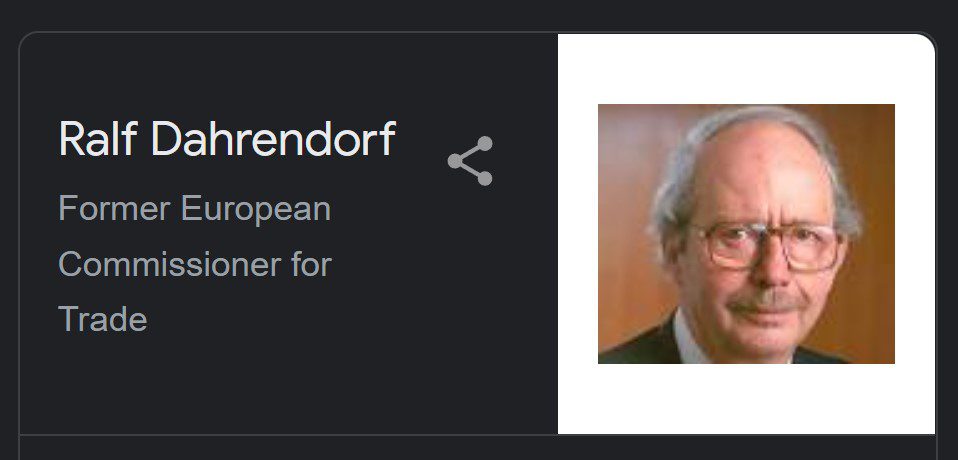
    Another quite popular conflict theory is Dahrendorf. Ralf Dahrendorf is a German intellectual who became famous through his work ” Class and Class Conflict in Industrial Society ” in 1959.

    For Dahrendorf, the functionalist explanations of integration, value and consensus, and stability needed to be revised. He rejected these functionalist assumptions and sought to base his theory on a modern Marxist perspective. For him, social conflicts based on the opposition of interests and the consequences of disputes can be widespread and, at the same time, can give birth to social change. (Johnson: 1986: 183).

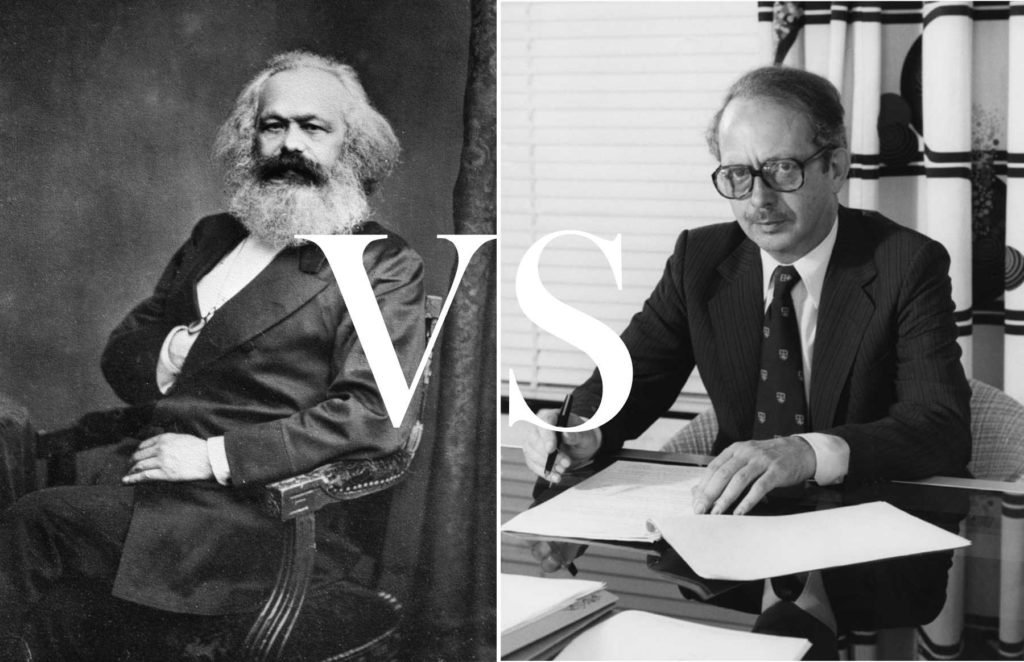
    Although Dahrendorf has the same thoughts in viewing class conflict, Dahrendorf does not agree with the proposition offered by Marx. Dahrendorf considers Marx’s view irrelevant to post-industrial society (modern industry).

    That is why Marx’s theories and concepts are recommended to be modified so that they can be adapted to analyze modern industrial society. Dahrendorf views that Marx only refers to capitalist society. Since Marx wrote his thoughts, there have been significant changes in the social structure. (Dahrendorf 1988).

    That is why, Dahrendorf offers a concept and theory that pays more attention to explaining capitalist and post-capitalist society. Dahrendorf then built his new theory through this framework.

    Dahrendorf had quite a few conflicts with Marx. He even rejected Marx’s concept of a classless society. Dahrendorf considers that the analysis of a classless society is highly speculative, and there is no empirical evidence that it can be realized.

    Furthermore, Dahrendorf views several of Marx’s theses as not supported by empirical facts. In reality, class division cannot be carried out solely based on ownership of the means of production.

    In conflict theory, Ralf Dahrendolf assumes that society is loyal when subject to change and conflict processes. Conflicts and various elements of culture that exist in the social system are considered to contribute to disintegration and change.

    For him, the order that can be created in society is nothing but coercion on its members, carried out by those with power. This means that power in this social system plays a role in efforts to maintain order in society.

    Dahrendorf also put forward the idea of ​​a dialectical conflict theory. This theory states that society is a subject with two faces, namely conflict, and consensus. From this, Dahrendorf proposed the division of sociological theory into two parts, namely conflict theory and consensus theory.

    In conflict theory, we can examine conflicts of interest and the use of violence in society. In consensus theory, we can examine the value of integration in society.

    Dahrendorf assumes that society cannot exist without consensus and conflict because the unification of society occurs because of enforced non-freedom. This also reflects that in certain societal positions, there is authority over other positions that delegate power.

    That’s it; Conflict Theory, according to Dahrendorf, I hope it is useful.