Tag: conflict

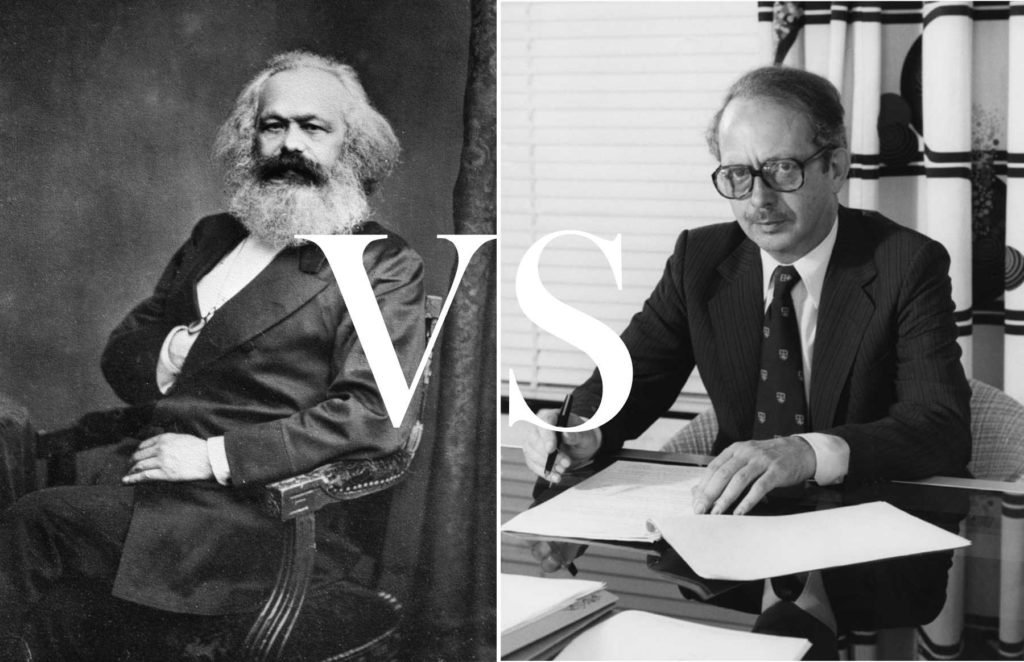
  • Differences in Conflict Theory of Karl Marx and Ralf Dahrendorf

    Differences in Conflict Theory of Karl Marx and Ralf Dahrendorf

    Social conflict is a form of conflict in society that occurs due to various factors. The complexity of social conflict makes studying this phenomenon give rise to multiple theories. Among the sociological thinkers who formulated specific theories to analyze social conflict were Karl Marx and Ralf Dahrendorf.

    Conflict theory was born to oppose the theory of structural functionalism. This is because the last theory provides an understanding that it is as if the development of society is balanced and static.

    Conflict theory comes with the understanding that society is changing because of the ongoing conflicts in life.

    Conflict also turns out to be derived from class conflicts, for example, the ruling group and the oppressed community group. This was one of the factors that brought about social changes or social systems in social life.

    An unbalanced condition ignores generally accepted norms and values but still affects people’s lives. In other words, social life cannot be separated from the various conflicts that occur in it.

    So, what are the Differences in the Conflict Theory of Karl Marx and Ralf Dahrendorf?

    Karl Marx’s Conflict Theory

    Karl Marx considers that a class conflict occurs due to differences in access to power. In this case, the key meant by Karl Marx is the facility of capital (money) which can create two classes, namely the bourgeoisie and the proletariat.

    Furthermore, Elena G. Bystova and Petter Gottschalk, in their research, add that Karl Marx views conflict as a form of class conflict. Karl Marx also explained the concept of class structure in a society full of inequality.

    Both class differences and social inequality can cause conflicts in everyday life. Some groups can dominate, and some are controlled only because of differences in economic class.

    The following are the main concepts in Karl Marx’s conflict theory:

    • There is a class structure in society
    • There are conflicting economic interests in each of the different classes
    • There is a significant influence of economic class on a person’s lifestyle
    • The influence of class conflict can lead to changes in social structure

    Ralf Dahrendorf’s Conflict Theory

    Ralf Dahrendorf’s opinion about conflict theory. He wrote that Ralf Dahrendorf proposed an idea that concluded: conflict occurs because of the social relations in a system.

    Thus, it can be concluded that conflict only occurs with groups belonging to one system. The relations were also classified by power. The existence of the controller with sanctions makes those who have power can benefit from those they control.

    This conflict finally conveyed a conflict between the owners of power and those who were not in control.

    Not only that, but Ralf Dahrendorf’s conflict theory also explains that society has two sides, namely conflict and cooperation.

    In the end, both the theory of Karl Marx and Ralf Dahrendorf explain that conflicts that occur in society can be a factor in social change. In other words, conflict, discontinuity, inequality, and deviation of norms and values also become an unavoidable part of society.

  • Definition of Social Conflict and Its Theory According to the Experts

    Definition of Social Conflict and Its Theory According to the Experts

    From several conflict theories known in sociology, there are two groups, namely first, functional conflict theory and second, class conflict theory.
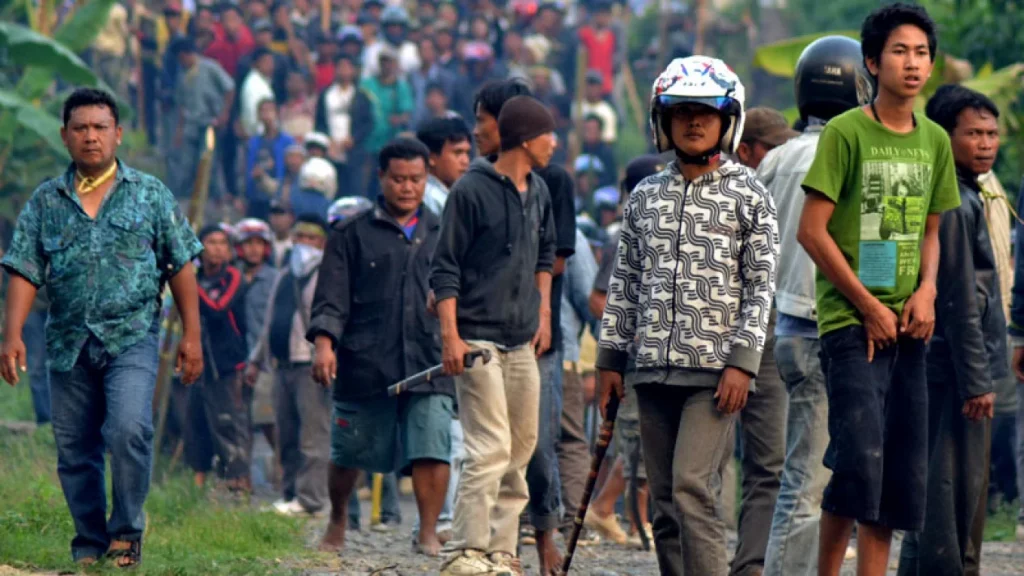
    There are various social groups in society. This diversity can lead to social conflicts that can have an impact on the disruption of the regularity of people’s lives.

    Social conflict can be triggered by several things, such as the presence of community members who do not understand the goals of the group or society.

    Conflicts that take place in society can also occur between individuals, individuals with groups, and groups with groups.

    According to Webster, the term “conflict” in English means a fight, war or struggle, which is a physical conflict between several parties.

    The meaning of the word then develops with the inclusion of “sharp disagreements or oppositions over various interests, ideas, ideas, etc.”. So the term “conflict” also touches on the psychological aspect behind the physical conflict itself.

    Meanwhile, according to Gurr, the criteria that mark a conflict as a conflict are as follows:

    1. A conflict must involve two or more parties in it;
    2. The parties attract each other in mutually opposing actions;
    3. They usually tend to engage in coercive behavior to confront and destroy the “enemy”;
    4. The conflicting interactions between the parties are in a definite state, therefore the existence of conflicting events can be easily described by social observers who are not involved in the conflict.

    Definition of Social Conflict According to Experts

    Several expert opinions regarding the definition of social conflict include:

    a. Soerjono Soekanto: Conflict is a social process of individuals or groups of people trying to fulfill their goals by opposing the opposing party accompanied by threats and/or violence.

    b. Robert MZ Lawang: Conflict is a struggle for value, status, and power in which their goal is not only to gain advantage, but also to subdue their rivals.

    c. Berstein: Conflict is a disagreement or difference that cannot be prevented. This conflict can have a positive or negative influence when interacting with other people.

    Social Conflict Theories According to Experts

    From several conflict theories known in sociology, there are two groups, namely first, functional conflict theory and second, class conflict theory.

    These two groups of theories are rooted in the thoughts of two figures, namely Georg Simmel and Karl Marx. Simmel’s thinking was then followed by Lewis Coser, while Marx was followed by Ralf Dahrendorf.

    More fully, the following are theories of social conflict according to experts in the field of sociology:

    1. Conflict Theory According to Lewis A. Coser

    Lewis A. Coser
    Lewis A. Coser

    According to Coser, conflicts that occur in society are caused by lower-level groups who increasingly question the legitimacy of the existence of the distribution of resources. rare source.

    Coser considers that conflict is not always negative, but conflict can strengthen and establish harmony within a group.

    Three factors that influence the duration of a conflict in society are as follows:

    a. The breadth and narrowness of the goals of social conflict.

    b. There is knowledge and defeat in conflict.

    c. There is a leader’s role in understanding the costs of conflict and persuading followers.

    Conflict can maintain intergroup relations and reinforce group identity. The benefits of conflict according to Coser, are as follows:

    a. Conflict can be a medium for communication.

    b. Conflict can strengthen group solidarity.

    c. Conflicts with other groups can produce solidarity within the group and that

    solidarity can lead to alliances with other groups.

    d. Conflict can cause isolated community members to play an active role.

    Then, Coser classifies social conflicts into two types, namely realistic conflicts and non-realistic conflicts.

    a. Realistic Conflict Realistic

    conflict is a conflict that comes from individual or group disappointment over the demands or estimates of benefits that occur in social relationships.

    b. Non-Realistic

    Conflict Non-realistic conflict is conflict that stems not from conflicting rival goals, but from a need to defuse tension.

    2. Conflict Theory According to Karl Marx

    Karl Marx
    Karl Marx

    Karl Marx has a view of social conflict as a class struggle. Communities in conflict are dominated by dominant groups.

    The existence of a more dominant party appears the party in power with the party being controlled. The two parties have different or conflicting interests that can lead to conflict.

    In Karl Marx’s theory, there are several facts as follows:

    a. The existence of a class structure in society

    b. There are conflicting economic interests among people who are in different classes.

    c. There is a great influence seen from the economic class on a person’s lifestyle.

    d. There are various effects of class conflict in causing changes in social structure.

    3. Conflict Theory According to Ralf Dahrendorf

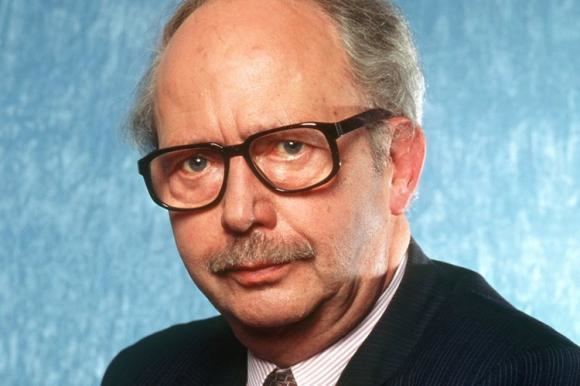
    Ralf Dahrendorf
    Ralf Dahrendorf

    Dahrendorf sees conflict theory as a partial theory used to analyze social phenomena.

    Dahrendorf sees society as having two different sides, namely conflict and cooperation. Dahrendorf uses Marxian theory of class struggle to build a theory of class and class struggle in contemporary industrial society.

    The class struggle in modern society lies in the control of power.

  • Conflict Theory According to Lewis A Coser’s Perspective

    Conflict Theory According to Lewis A Coser’s Perspective

    Conflict can also be positive for the fabric of a society or social group. Well, here is the conflict according to Luwis Coser, which states that conflict has a positive function.

    According to Coser’s perspective, conflict theory is a functional social system. According to Coser, conflicts that occur in society do not merely show a negative function. However, conflict can also positively impact the ongoing social order.

    For Coser, conflict is a form of interaction and does not need to be denied. Coser means that conflict does not have to be destructive or dysfunctional for the system concerned because conflict can also have positive consequences.

    Coser shows us that conflict is a dispute about values ​​or demands regarding power, status, and sources of wealth whose supply is insufficient.

    Furthermore, Coser stated that disputes or conflicts could occur between individuals, collectivities, or individuals within the group. We can see the conflict between individuals and individuals; we still remember that when we attended high school, we unconsciously created positive conflicts, namely at the level of competition, in competition events, competing to become class winners, and experiencing positive conflict. We’ve been through.

    In negative conflicts, we can see the final results of the competition where the results are not in line with expectations, such as fights between football supporters/fans, coachmen debate that do not teach us lessons, and examples of negative conflicts that can harm many communities. Therefore, we should avoid these negative conflicts.

    Conflict is an important element of interaction, and it cannot be said that it is always bad, divisive, or destructive. Conflict can contribute greatly to the group’s sustainability and unite/strengthen relationships between its members. Such as facing a common enemy can integrate people, generate solidarity and engagement, and make people forget their internal strife.

    Positive Function of Conflict According to Lewis Coser. Conflict is a way or tool to maintain, unite and reinforce the existing social system. For example, the positive function of conflict is in matters relating to the dynamics of the relationship between the in-group and the out-group. Here are some propositions made by Lewis Coser:

    First, the strength of internal solidarity and inner group integration will increase if the level of hostility or conflict with outside groups increases.

    Second, the increased integrity of groups involved in conflict can help strengthen boundaries between that group and other groups in the environment, especially hostile or potentially hostile groups.

    Third, within the group, there is the possibility of a reduced tolerance for division or divisions and an increased emphasis on consensus and conformity.

    •  Consensus is a phrase to produce or make an agreement that is mutually agreed upon between groups or individuals after debates and research are carried out in the intelligence collective to obtain consensus decision-making.
    •  Conformity is a type of social influence when someone changes their attitudes and behavior to suit existing social norms. (Source: id.wikipedia.org)

    Fourth, deviants in the group are no longer tolerated; if they cannot be persuaded to enter the right path, they may be expelled or put under close surveillance.

    Fifth, on the other hand, if the group is not threatened by conflict with hostile outsiders, the strong pressure on cohesiveness, conformity, and commitment to the group may decrease.

    Internal disagreements may surface and be discussed, and deviants may be more tolerated. Generally, individuals will get greater space to pursue their personal interests.

    According to Coser, the function of external conflict can also be to strengthen internal cohesiveness and increase group morale so that groups can provoke antagonism with outside groups or create enemies with outsiders in order to maintain or increase internal solidarity.

    Tensions that occur in a group due to friction make conflict occur. To be able to solve the conflict problems that occur, Lewis Coser has a way or mechanism to be able to reduce or resolve a conflict.

    The mechanism that Coser mentioned is called a safety valve or other designation a safety valve. Coser admits that conflict can jeopardize unity. Therefore, it is necessary to have a solution called Coser as a safety valve.

    For Coser, this safety valve is an institution (safety valve institution). In society’s broad order of elements, we will find many social interests that may take time to fulfill. There needs to be an institution or institution that becomes the safety valve of these interests so that there will be no conflict in the community.

    Let us look at the legislative institution or body which consists of representatives of the people, such as the Indonesian Parliament in Indonesia. The existence of this institution is as a savior or as a safety valve for high conflicts. This is because each region already has representatives in the realm of delivering the community’s social needs in each region.

    Regarding the implementation in the field, it depends on how the community responds and the representatives give the right of their constituents. Thus, a large conflict does not need to occur because there is already a place to convey aspirations.

    In addition, according to Coser, safety valves also do not have to be on institutions; they can also be safety valves based on actions or habits that can reduce tension because conflicts cannot be channeled.

    For example, a joke inserted in a tense situation can reduce or eliminate the tension at that time, even though the joke itself may still contain critical values.

    Coser’s opinion regarding conflicts is that conflict is functional (good) and/or dysfunctional (bad) for relationships and structures that are not encapsulated in the social system. Coser focuses more on the functional conflict; Coser does not see it as dysfunctional.

    Coser defines social conflict as a struggle for value and recognition of rare status, then powers and sources of conflict are neutralized or perpetuated, and rivals are eliminated.

    Coser’s view of functional conflict states that conflict can change the form of interaction, whereas the expression of feelings of hostility is not the case. Therefore, conflicts that occur in society, either individually with individuals or groups with groups, as well as individuals and groups, are one way of unifying elements of society.

    This is because the conflict that occurs is not always negative but also positive in terms of uniting various social interests in it.