Tag: animal

  • Why Do Cats Enjoy Playing With Their Prey?

    Why Do Cats Enjoy Playing With Their Prey?

    For loverscat, definitely know the habits of this one cat. Whenpredatory instinctThe cat appears, then the cat will catch a bird, a small mouse or a lizard, the cat will play with it for a few minutes.

    After the cat is satisfied, or until the prey doesn’t move anymore, then the cat puts it in front of the door or even gives it to you.

    For cat owners, this behavior is the behavior of fur kittens – their adorable cat’s affectionate nickname. But for many conservationists, it’s an invasive killing machine action with four legs full of blades.

    This difference in perception has sparked a heated debate between conservationists and cat lover about whether cats can be allowed out of the house.

    But why do domestic cats chase and play with their prey even after they are dead? Are they adorable pets or furry serial killers? The truth lies somewhere in between.

    To answer this question, we need to look at cat domestication. Wild catThe first to be domesticated probably around 8,000 years ago in Egypt and the surrounding region, according to a 2017 study published in the journal Nature Ecology and Evolution.

    These cats are members of the species Felis silvestris lybica, also known as the African wildcat. They are attracted to the city by the rats they hunt for food.

    Humans, in turn, keep these cats because they control populations of disease-spreading and grain-eating rodents. In certain societies, such as ancient Egypt and China, these feline companions were considered lucky or even respected.

    But, even though we’ve lived with our feline friends for thousands of years, “the domestication of ‘true’ cats can be traced back to about 200 years ago,” Martina Cecchetti, a conservation scientist who studies cat behavior at the University of Exeter in the UK, told Live Science.

    In this context, Cecchetti explains, “true” domestication means selectively and deliberately bred by humans, not simply living together with our species.

    Because they were recently tamed, cats retain many of the instincts passed down from their wild ancestors. They hunt small prey throughout the day, according to a 2006 study in The Journal of Nutrition.

    This evolutionary remnant encourages a cat “to catch prey even if it’s not hungry,” Cecchetti said.

    What’s more, cat play instincts, such as hitting, pouncing, and clawing with claws, stem from hunting behavior. Feral cats often play with their prey to tire it out before eating it, which reduces the risk of injury to the cat.

    Thanks to this instinct, even modern domestic cat breeds can survive relatively easily in the wild. Some Polish populations have been so successful, they are now considered invasive pests.

    Studies show that domestic cats allowed to roam outside can cause serious environmental disturbances. A 2013 study in the journal Nature Communications estimated that cats kill more than 1.3 billion birds and 6.3 billion small mammals each year in the United States alone.

    So how can people stop their furry friends from causing so much ecological damage? Cecchetti’s research shows that some pet cats’ urges to hunt can be stymied by giving them sufficient playtime at home.

    Then, feed them a high-quality, meat-rich diet that provides the right balance of micronutrients.

    “Domestic cats are obligate carnivores,” Cecchetti says, so if they don’t get enough meat at home, they may look elsewhere.

    If you choose to provide food for feral cats, the Humane Society recommends using a trap-neuter-return (or TNR) program. These programs temporarily catch stray cats and spay or neuter them, vaccinating them against rabies.

    Then they identify the cats by ear tips and return them to the area where they were found if local shelters cannot accommodate them.

    This process helps control the feral cat population, which in turn can reduce the number of feral creatures they kill.

    But perhaps the best way to ensure that your feline friends don’t run amok in your local ecosystem is to keep them indoors. With lots of toys and at least 20 square feet of space, or 1.8 square meters.

    And if you leave the house, take it with a rope. That way, he can unleash his hunting instincts to his heart’s content, without sacrificing the wildlife around him.

  • The “Sausage”: Its Discovery and Development

    The “Sausage”: Its Discovery and Development

    Hello friends, this time we want to share insights about processed food from livestock called sausage. We will discuss starting from the definition, history of sausages, the process of making sausages, types of sausages, and the technology used to make sausages. keep reading.

    In the past, people faced many problems in the processing and handling of animals. First, the size of animal is large. Animal must be cut into small pieces so that it is easy to use. Cutting tools that are commonly used such as animal bones, horns, and teeth. Second, animals have a short shelf life so that are prone to spoilage. As we know, meat is one of the perishable foodstuffs. Third, the body parts of the animal are not fully utilized. The ancients needed great effort to hunt, but not all parts of the body of the game were used so that they were wasted.

    In fact, people have known that smoking and drying can extend the shelf life of food. They also have known that salt can improve the quality and preserve meat. Many of these references are obtained from an inscription in the form of clay found in the Mesopotamian era of the 16th century BC. In addition, people are starting to realize that the intestines, stomachs, and skins of animals can be used, but they still have nott figured out how to use them.

    1. Definition of Sausage

    The word Sausage comes from the Latin “Salsus” which means salted or preserved. Sausage has been an important food product for the last twenty centuries. The first recognizable mention of this meat diet is found in a Greek play called “The Orya” or “The Sausage” written around 500 BC, after that the word for sausage appeared in many Greek writings. Sausage was originally invented to preserve blood, offal, and small pieces of meat that were inserted into the intestines of animals.

    Sausage
    Sausage

    2. Sausage: Its Discovery

    Sausage was first discovered in an area called Mesopotamia. This area was roughly the territory of modern-day Iraq, Kuwait, and some of Saudi Arabia. The dominant tribe in this region is the Sumerians. These people were instrumental in the invention of the sausage around the 3100 BC century.

    Sausage is then more widely known in other areas, for example in Turkey around 1000 BC and in China around 580 BC based on historical records. The development of sausages occurred due to the introduction of new spices that allowed sausages to be more varied in taste and advances in technology such as drying/preserving.

    Previously, countries with hot climates were very limited with the utilization and processing of their meat. They do not have many choices of what products they can make and where they can market their processed meat products. Furthermore, the development of the taste and type of sausage is greatly influenced by the spices available in each region of the world.

    3. Sausage: How Its Made

    The sausage-making process includes several stages, namely:

    1. Preparation of ingredients and spices. Seasonings and ingredients include: chicken eggs, tapioca flour, salt, garlic, flavourings, (nitrite/nitrate), emulsifier. The best products will be produced if the best ingredients are used too
    2. Grinding Process. This process aims to reduce the size of the meat so that it is easily mixed with other ingredients
    3. Mixing meat and spices. This process aims to mix the spices and minced meat evenly
    4. Emulsification process. In this process a piece of ice is added to reduce the effect of heat so that the meat protein is not damaged. The occurrence of a stable emulsion is largely determined by the functional properties of meat protein as an emulsifier. In addition to meat, other sources of emulsifier are eggs and emulsifiers in the form of protein concentrates
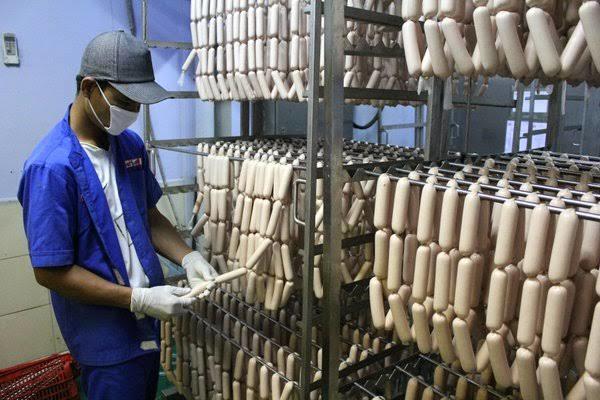
    5. Filling the dough into the casing. Sausage dough is inserted into the casing and then tied according to the desired sausage size. Fastening can be done manually or by machine
    6. Cooking (boiling or smoking). This process aims to cook, preserve, improve taste and aroma
    7. Removal of the casing. Not all sausages are removed from the shell/skin. Peeled sausages need to be repackaged. Some types of sausages use an edible casing, meaning that you can eat the contents as well as the casing
    8. Packaging: Sausage that has been peeled is put in plastic packaging

    Sausage

    4. Types of Sausages

    Sausages are made from minced/ finely ground meat that is seasoned and stuffed into gut casings, then dried, can be fermented, smoked, or produced using a combination of these techniques. Sausages can be made using very finely ground beef or meat cut into small pieces. Some sausages need to be cooked further before consumption, but there are also those that have been preserved or smoked so they are safe for direct consumption.

    Based on the method of manufacture, sausages are categorized into several types as follows:

    1. Fresh sausage : The most popular type in some countries, for example in the UK. This sausage is usually marketed in the form of uncooked (fresh/uncooked) in frozen or unfrozen conditions, the contents of which are coarsely ground meat and fat. Example: British fresh sausage (not widely marketed in Indonesia)
    2. Cooked sausage : The sausage is cooked after the process of filling the sausage dough into the casing. The meat and fat are finely ground, but not to form an emulsion. This type of sausage has a longer shelf life than fresh sausage. Popular example: Sozis
    3. Emulsion sausage: The meat and fat are finely ground to form an emulsion (oil in water emulsion). Meat protein acts as an emulsifier because it can “unite” fat and water (protein has a hydrophobic arm that can bind to fat and a hydrophilic arm that binds to water). Meat proteins that act as emulsifiers are myofibril proteins, namely myosin and actin. Emulsion-type sausages are also usually cooked sausages, some are also smoked. Example: Bologna, frankfurter, bratwurst
    4. Fermented sausage: In its manufacture involves the formation of lactic acid through the fermentation process. Lactic acid is produced by lactic acid bacteria. Has a fairly long shelf life (1-2 years) without freezing; This is the combined effect of low water content and acidic conditions. Grouped into dry (dry) and semi-dry (half-dry). Example: Dry: salami, pepperoni, genoa Semi-dry: summer-sausage, Lebanese bologna

    Based on the type of meat used, sausages can also be divided into beef sausage, chicken sausage, pork sausage and so on.

    type of sausage

    5. Development of Sausage Making Technology

    Long ago, people cooked sausages with the idea of ​​a sausage production site, close to slaughterhouses and markets so that meat raw materials could be obtained easily and the final product could be marketed more quickly.

    However, with the freezing technology, sausages have a longer shelf life and of course can be marketed more widely.

    To reduce production costs as well, the sausage industry is making innovations, for example, replacing meat raw materials with cheaper ones and adding flavour as a substitute. For example, beef-flavoured chicken sausage.

    Sausage casings also did not escape development. In the past, sausage casings came from natural ingredients (made from the digestive tract of animals; cows, goats, sheep, pigs). The advantage of natural casings is that they are edible, but have non-uniform shapes and sizes, often tear easily.

    So the industry is looking for other alternatives such as artificial casings. Artificial casings can be made from cellulose (non-edible), collagen (edible & non-edible), plastic (non-edible). With the development of sausage-making technology, the more variety of sausages on the market.

    References: