
Tag: political system

  • Totalitarian Political System, Definition, Type and Characteristics

    Totalitarian Political System, Definition, Type and Characteristics

    The political system consists of several kinds, one of which is the totalitarian political system. Over the years, many countries have experienced transitions in political systems. Initially using a totalitarian political system then changed to a democratic political system.

    So what exactly is the meaning of this totalitarian political system, what are the types and characteristics and which countries use the system. Let’s take a look at the following review of sinaumedia.com .


    Understanding Totalitarian Political System

    As a totalitarian term, it was first coined by an Italian dictator named Benito Mussolini. Then along with the development of the times, political scientists used this term to describe the phenomenon of the Soviet Union and the Adolf Hitler Regime, the Nazis in Germany.

    The totalitarian political system is a system of governance that controls society as a whole both at the social, cultural, economic and political levels. In this system the state is not present as a referee but the state is present as the main player.

    That is, there is no clear boundary between the state and citizens. In other words, the state is served by citizens, not the other way around, citizens are served by the state.

    By adopting this system, a country will impose consensus on the community even in situations of internal and external conflict. In addition, the totalitarian system uses state ideology as a way of life in the social order.

    Furthermore, totalitarianism views that individual human existence is not important because for this system a human being is only limited to carrying out his role as a supporter of the ideals of the state.

    There is no freedom of citizens, the government will blatantly eliminate an individual or group of different opinions.

    Sadly, this system will also regulate all aspects of life, from the dress code to the hair style of the citizens of the country. On the other hand, the assessment of good and bad behavior of citizens is also determined by the taste of the state.

    The military, police, communication tools to the media are all under the control of the government. This means that a citizen cannot contribute criticism and suggestions to the government.

    This non-democratic form of government prioritizes ideological indoctrination and the implementation of a government that tends to impose its will.


    Types of Totalitarian Political Systems

    Based on the background of its nature, this system is divided into two as follows:


    1.Communism

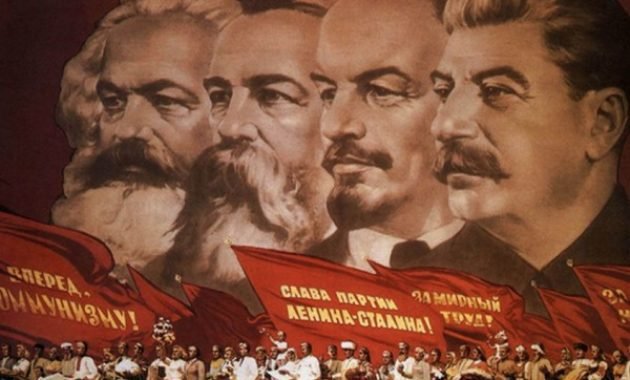
    Communism is an idea pioneered by German philosophers, namely Karl Marx and Friedrich Engels . These two philosophers made a phenomenal work entitled The Manifesto of the Communist Party in 1848.

    Communism itself is a political ideology which believes that society can gain prosperity by eliminating private property. Private ownership in question is ownership of the means of production.

    Thus the means of production are controlled by the state but the state is obliged to ensure the welfare of its citizens by meeting the needs of each of its citizens.

    Based on history, communism is actually a criticism of the capitalist and liberal economic system, which according to him is very exploitative. Despite the fact that communism is trapped in a dictatorial and authoritarian monopoly of power over what they call the proletariat.

    Countries that still adopt this system are China, North Korea, Cuba, Albania, and Vietnam.


    2. Fascism

    Fascism is more or less the same as communism, but fascism does not only see the problem of class struggle. They assume that society has experienced chaos and moral decay so that it needs improvement.

    As a system, fascism is an ideology that rejects the narratives of capitalism, liberalism, communism and conservativeism. Fascism is based more on an authoritarian nationalist system of government.

    Countries that adopt a fascist ideological system tend to sacrifice aspects of social life for the sake of the state. Fascism will put the interests of a single party above the interests of the people in the name of the interests of the state.

    However, in practice, Benito Mussolini, the originator of the term totalitarianism, vehemently denied that the fascism that Adolf Hitler practiced was the same as what he did in Italy. For Mussolini Hitler’s racism was not part of the narrative of fascism in Italy because humans were not testing instruments for the benefit of a handful of other humans.

    Fascism is an idea that binds many people with a spirit of nationalism accompanied by pressure and threats. Countries that embraced fascism were the countries of Eastern Europe, West Germany, and the Soviet Union before it collapsed. Fascism clearly rejects parliamentary and democratic methods because these methods will open up space for public participation.


    Characteristics of Totalitarian Political Systems

    1. The existence of political repression, namely the state has a more role in regulating and limiting its citizens from participating in the political world.

    2. Aspects of individual and community life become a political concern.

    3. There is only one ruling party. This political party has strong legal force and can control politics as a whole so that competition, recruitment and opposition can be regulated in such a way.

    4. Ideological indoctrination of the people in order to regulate the views of the nation and state and how their political activities are carried out. Indoctrination usually covers all aspects of people’s lives.

    5. There is control over the people’s economy because there is no private ownership and the means of production are wholly state-owned.

    6. There is a limit to express voice. No people can protest or criticize the government.

    7. The existence of control over the mass media so that there is a lack of transparency, the cult of a leader to the arbitrariness of the state against its people.

    8. There is mobilization of the people to get mass support. Usually this mobilization is in the name of democracy so that it seems as if the ruling regime has the legitimacy of the people.

  • Liberal Democracy Political System, Definition, Type and Characteristics

    Liberal Democracy Political System, Definition, Type and Characteristics

    Liberal Democracy Political System is one of the popular political systems after the cold war. Geopolitical changes that accelerate the flow of globalization have resulted in many countries adopting a liberal democratic political system. This is because this political system prioritizes individual freedom and people’s sovereignty.

    So what exactly is this liberal democratic political system, what are its types and characteristics and which countries have adopted this political system as their state system. Let’s look at the full review at Sinaumedia.com below.

    Definition of Liberal Democratic Political System

    Liberal Democracy Political System is a political system that gives freedom to the people at large. People are free individually and in groups to form associations. This means that in a liberal democratic system, individual freedom is the main pioneer in social life.

    On the other hand, government decisions must not violate individual freedoms and rights as stated in the constitution.

    This liberal democracy is rooted in the social contract theory that was born during the Enlightenment by thinkers such as Jean-Jacques Rousseau, John Locke and Thomas Hobbes.

    After the cold war there was a significant shift in the political and economic situation. The flow of industrialization has touched various countries so that the economy crosses borders without knowing territory.

    The advantages of economic power and resources are used by developed countries to spread their ideology. Of course, one of them is a liberal democratic political system. It’s no wonder that liberal democracy is the formula for western countries to become the antithesis of the ideology of Chinese communism.

    The narrative of individual freedom is characteristic of a liberal democratic system. As a result, the highest constitution of this system is held by the people. However, there are things that are prerequisites for a liberal democratic system to work well, one of which is the formation of a stable legislative composition, balanced opposition, and information disclosure.

    In practice, this system places the President as the head of state, and the prime minister as the head of government and the head of the cabinet.

    This system can only work well if the parliament has a balanced and steady composition between the supporters of the government and the opposition. The composition of the government’s supporters and opposition that often changes will mean that the cabinet can be dropped at any time.

    Types of Democracy Based on Their Ideology

    1. People’s Democracy

    People’s democracy is a democratic system based on the notion of communism or socialism in which individual interests have no space at the societal level. The interests of the state and the public interest are important factors in social life.

    In practice, the state has full authority over its people.

    2. Liberal Democracy

    Liberal democracy is a democratic system that places individual freedom as the main pioneer. With this, the state has limited power and is tasked with providing protection for the freedom of its citizens.

    In this system, criticism can be done by anyone and at any time as long as it does not harm others. This means that the government and the opposition are very important instruments for the realization of a stable government.

    Features of Liberal Democracy

    1. The President and Vice President serve as Heads of State

    In a liberal democratic system, the President and Vice President are heads of state, while the government process is carried out by the prime minister.

    2. Policy Based on Majority Decision

    In taking a policy, a liberal democratic system must be based on the majority vote of the people based on the vote in the legislature.

    3. Parliament can control Cabinet

    As a system that places individuals above the government, parliament is certainly able to carry out its role and function as an institution that controls government policies.

    4. There is a General Election 

    The succession of leadership in a liberal democratic system must be through free and open elections. The election results are able to legitimize that the winning government is the people’s choice.

    5. Executive powers are limited by the Constitution, Legislation and Law

    Executive power is limited to avoid abuse of power. In addition, this limitation aims to keep the government on the right track in accordance with the agreement of the state.

    6. Minority Groups Can Fight For Their Groups

    Freedom in a liberal democratic system is not only for individuals but also for groups. As a result, any group with a majority and a minority scale has the same right to freedom.

    7. Allocation of Natural and Human Resources can be controlled

    Natural resources as well as human resources are entirely for the benefit of citizens

    8. Open criticism and votes of no confidence are common.

    In this liberal democratic system, criticism and motions of no confidence often occur either from the public or from the parliament to the cabinet.

    9. The Head of Government is headed by the Prime Minister

    The prime minister runs the government process as well as heads the cabinet.

    10. Prime Ministers and Ministers are appointed and dismissed by Parliament

    In this system, the parliament has control over who is entitled to become a minister.

    11. Legislative is stronger than Executive 

    For the sake of government stability, the legislative role is the key to good governance. As a result, the legislative power is stronger.

    Thus a brief explanation of the political system of liberal democracy, Happy Reading!