
Tag: tools

  • 7 Types of Safety Hand Gloves

    7 Types of Safety Hand Gloves

    Maybe many of us are already familiar with safety hand gloves. Especially for those who work with a high potential for danger, the use of hand gloves is no longer just an obligation but a necessity so that our healthy and beautiful hands are not scratched and may even be seriously injured due to work.

    But did you know that there are  many types of safety gloves ?

    Safety hand gloves are tools used to protect hands from potential hazards such as scratches from sharp objects, heat, and even chemicals. Hand gloves that are used to protect from heat are certainly different from those used to protect hands from chemicals. What’s the difference? Then how to apply it? Here are some types of hand gloves based on their function and constituent materials:

     1. Impact Hand Gloves

    Impact Hand Gloves
    Impact Hand Gloves via tokopedia

    This type of Impact Hand Gloves is equipped with a shock absorber feature This means that when a heavy object falls and hits your hand, Impact Hand Gloves can protect your hand by absorbing the impact energy so that your hand is not completely affected by the impact energy.

    2. Cut & Puncture Resistant Gloves

    Cut & Puncture Resistant Gloves digitx-gloves.com
    Cut & Puncture Resistant Gloves digitx-gloves.com

    Hand Gloves of this type are hand gloves that are often used when machining, especially abrasives. The nitrile formulation in the material makes these gloves resistant to abrasion caused by friction. Cut & Puncture Resistant Glove is also resistant to sharp objects, so it is suitable for workers who use abrasive machines.

    3. Anti-Slip Hand Gloves

    Anti-Slip Hand Gloves
    Anti-Slip Hand Gloves

    Anti Slip Hand Gloves are used on wet or oily workpieces. These anti-slip gloves are equipped with Grip Technology so that oily or wet work objects can be gripped firmly without slipping. With microchannel technology, these gloves absorb liquid fluids that stick to the workpiece so that the contact of the glove with the workpiece is not blocked by these fluids.

    5. Lifting Hand Gloves

    Lifting Hand Gloves
    Lifting Hand Gloves

    This type of hand gloves is the type of safety gloves that are most often found on the market. Used to protect hands from scratches by sharp objects and minimize the potential for slippage when lifting something. These hand gloves are made of fibrous fabric. There are also several lifting hand gloves that are equipped with a rubber layer on the palm of the hand to increase hand grip strength when lifting.

    Do not use this type of hand gloves when you operate objects or rotating machines. Why? Because these hand gloves are made of fibrous cloth, there is the potential for the fibers to get caught in the rotating machine which actually endangers our hands.

    6. Heat Resistant Gloves 

    Heat Resistant Gloves 
    Heat Resistant Gloves

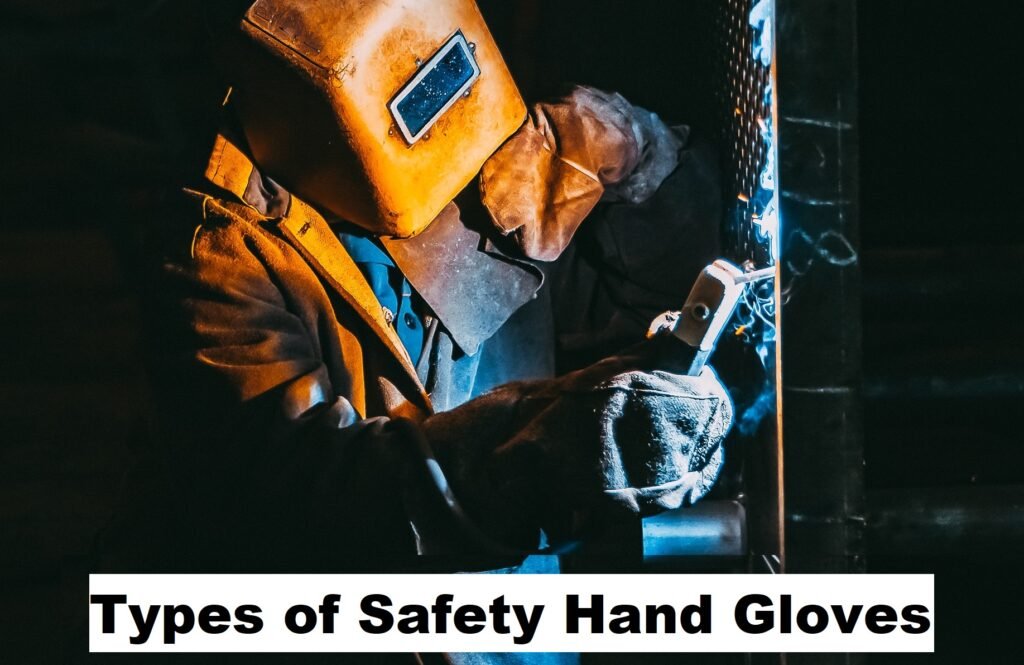
    These hand gloves are usually made of leather and have a smooth layer of cloth inside. These Heat Resistant Gloves are thicker and heavier than other hand gloves. Why is it made of rubber and thick? Because as the name implies, these hand gloves function as heat insulators that protect our hands from heat or high temperatures. In the market, these hand gloves are often referred to as welding gloves. Usually used when welding work, blander (cutting torch), and various other jobs that are directly related to high temperatures, furnaces, etc.

    also read

    HVAC Services

    Janitorial Services

    7. Chemical Resistant Gloves

    As the name implies, chemical resistant gloves are usually used in the scope of laboratories and work that is directly related to chemical materials or substances, such as wet analysis and painting. These hand gloves are usually made of latex, nitrile, vinyl, and PVC materials. Chemical gloves made of latex, nitrile, and vinyl are gloves that we often see used in the medical field, but the use itself is actually not limited to that, these hand gloves can also be used in chemical laboratories because they are impermeable to liquids. These gloves are disposable or single use.

    medical gloves
    Latex gloves

    In addition, there are also chemical gloves made of PVC. When viewed from the shape, these gloves usually have longer and thicker sleeves than other chemical resistant gloves. Chemical Resistant Gloves of this type are commonly used during painting jobs.

    Chemical Resistant Gloves

    Of course, there are many other types of safety hand gloves. Hopefully this article can provide more knowledge for those of you who are going to buy safety gloves. The more suitable the gloves are, the smaller the potential danger.

  • 12 Types of Screws and Bolts

    12 Types of Screws and Bolts

    The type of fixing screw ( Set Screw ) commonly known as the cap screw has a shape similar to a bolt, but this type of screw is full-grained. The difference between a bolt and a screw is that the bolt has a thread that is not complete, in other words the thread does not reach the head of the bolt.

    While the screw has a thorough thread until it reaches the screw head. Another difference can also be identified from the bolt and screw heads. In its use, the bolt does not use a screwdriver but a key, while the screw uses a driver,  in the form of a screwdriver .

    Here are the types of set screws and their bolts:

    1. Fastener Screw (Set Screw)

    Fastener Screw (Set Screw)
    Fastener Screw (Set Screw) via rs components

    This type of screw is the most widely used type. Usually better known by the name of the screw head (cap screw). This type of screw is widely used to join and fasten the two objects.

    2. Stud Bolt

    Stud Bolt
    Stud Bolt via dumore

    Stud bolts are headless and have threads from each end. Stud bolts are applied in a number of industries for fitting parts, industrial equipment, flanges and machine tools. These types of bolts are available in various sizes and can be configured as double end or tap end.

    3. Round Head Bolt

    Round Head Bolt
    Round Head Bolt via united fasteners

    This type of bolt is very commonly used with a round head. This round head bolt has a portion of the stem that is square in shape to hold the bolt, which can be used to fasten the wooden floor of the truck body or to the metal bumper.

    4. Partially Threaded Bolt

    Partially Threaded Bolt
    Partially Threaded Bolt

    A small diameter full hydrated screw fitted with a square or hexagonal nut. The head can be round or “cheese head” and has a groove for a screwdriver.  This Partially Threaded Bolt is used to place lightweight components or small brackets.

    5. Gutter Bolt

    Gutter Bolt
    Gutter Bolt

    Full grain and often galvanized with a dome-shaped head and a screwdriver groove. Used with a nut to fasten lightweight materials and sheet metal.

    6. Grub Screw

    Grub Screw
    Grub Screw

    A headless screw that may have a groove for a screwdriver or a groove for an Allen Key Wrench . Used when the screw must be attached below the submerged surface.

    7. Self Drilling Screw

    Self Drilling Screw
    Self Drilling Screw

    These screws will thread themselves into the thin metal. Usually it is used directly into the sheet metal or a special sheet metal nut is attached to the component. All screw head shapes can be used with self drilling screws.

     8. “U” Bolt

    “U” Bolt
    “U” Bolt

    U bolt is  usually used for the needs of gas / water pipes. U bolts can also hold leaf springs on the vehicle axle, and also on the exhaust system.

    9. Split Pin/Cotterpin

    Split Pin/Cotterpin
    Split Pin/Cotterpin

    This pointed steel pin has a flat section on one side and a small threaded section on the small end. Its flat pointed section is used to hold components such as truck king pins in place. Nuts and washers need to be attached to these split pins to avoid movement.

    10. Battery Bolt

    Battery Bolt
    Battery Bolt

    A square head bolt, firmly galvanized, which is often used to secure the battery terminals (battery) to the pole (head) of the battery.

    11. Taper Lock Stud

    Taper Lock Stud
    Taper Lock Stud

    Uses a special thread to produce a thread whose last few threads are tapered. The stud has threads that are almost as sharp as to create an interference fit when the stud is installed. These studs are used in heavy load applications on moving equipment.

    12. Plow Bolt

    Plow Bolt
    Plow Bolt

    Has a tapered head that can fit into embedded screw holes. When installed, the head is immersed in the surface of the component. These bolts are used to mount the blade on dozers and graders that require a ground connection, so that the driven soil can rotate/roll smoothly on the bonded parts.