
Tag: temple

  • The History of Borobudur Temple and Its Origin Story

    The History of Borobudur Temple and Its Origin Story

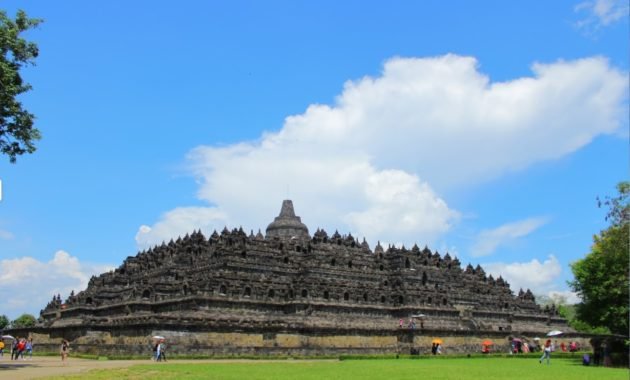
    Borobudur Temple is a Buddhist temple located in the city of Magelang, Central Java province. Borobudur Temple is the largest Buddhist temple or temple in the world, as well as one of the largest Buddhist monuments in the world. Because of its splendor and majesty, the temple which was built in the 8th century has been designated by UNESCO as one of the world’s cultural heritages (world heritage).

    Borobudur temple was built during the reign of the Syailendra dynasty. This stupa -shaped was erected by Mahayana Buddhists during the reign of the Syailendra dynasty. History of the establishment of Borobudur Temple was built in the 8th century.

    The origin of the Borobudur temple is still shrouded in mystery, regarding who the founder of the Borobudur temple was and what was the initial purpose of building this temple. Many stories and stories of the Borobudur temple are circulating which are now known as local folk tales.

    The temple building was built in the 8th century AD. This temple was inaugurated as a tourist spot on July 15, 1980. Then, Borobudur temple was designated as a World Cultural Heritage by UNESCO in 1991.

    History of Borobudur Temple

    There is a long history in the founding of the Borobudur temple. Until now, no written evidence has been found that explains who built Borobudur and what was the purpose of building this temple. It is estimated that Borobudur temple was built in 800 AD.

    The estimated time for the construction of the temple is based on a comparison between the type of script written on the closed foot of Karmawibhangga with the type of script commonly used in 8th and 9th century royal inscriptions. Borobudur temple was built during the kingdom of the Syailendra dynasty in Central Java which coincided between the period 760 to 830 AD.

    The process of building the Borobudur temple is estimated to take more than 75 to 100 years. The new Borobudur Temple was completely completed 100% during the reign of King Samaratungga in 825 AD. Also read : The History of Prambanan Temple.

    Borobudur Temple Construction Process

    From the thesis entitled The Relation of the Meaning of Borobudur Temple Symbols with Buddhist Teachings, the builder of the Borobudur temple named Gunadarma. This temple was built in 5 stages:

    1. The first stage (780 AD)

    Initial construction was carried out on a hill. The hillside was leveled and the courtyard expanded. Not all materials for the temple are made of andesite. The process of building a hill uses compacted soil and covered with stone structures.

    This rock structure resembles a shell and encloses a hill of earth. Meanwhile, the rest of the hill is covered with stone structures layer by layer. The beginning of the construction of the temple was arranged in stages like a stepped pyramid.

    2. Second and third stages (792 AD)

    The second level, there is the addition of two square -shaped steps. Part of the ledge fence and a circular step on it. The stair section has a large single stupa.

    stupa
    stupa

    The third part is a change in the design of the building. The top of the circle with a single main stupa was dismantled. The stupa was replaced by three circular steps, while small stupas were built in a circle on the courtyard of the steps. The large stupa is in the middle.

    Archaeologists suspect, originally Borobudur was designed in the form of a single, very large stupa. So that the stupa is like a crown in the middle. But the large stupa was too heavy, pushing the structure of the building.

    Stupa that is too large can shift the building. The core of Borobudur is just a hill of earth, so that the pressure on the top can spread downwards so that Borobudur is threatened with landslides and collapses.

    Finally, the main stupa was replaced with circular terraces decorated with small stupas. The main stupa is only one which functions to support the temple walls and prevent shifting.

    3. The Fourth Stage (824 AD) and the fifth 833 AD

    The temple building underwent minor changes, such as the addition of the outermost balustrade, improvement of the reliefs, changes to the stairs, widening of the toe, and the arch of the gate.

    Philosophy of Borobudur Temple

    Borobudur Temple symbolizes the universe. The structure of the building consists of 10 levels in the form of terraces which are divided into three levels. Each level contains a philosophical meaning in Buddhism, namely:

    • Kamadhatu , the bottom part which symbolizes the underworld or human behavior bound by worldly desires
    • Rupadhatu , the middle part which symbolizes the intermediate nature or human behavior that begins to leave worldly desires
    • Arupadharu , the top part which symbolizes the upper nature or human behavior that has been completely free from worldly desires

    These three levels are distinguished based on the reliefs of the temple. This relief is stretched for 3 meters. There are 1,460 frames interspersed with dividing fields totaling about 1,212 pieces.

    Borobudur Temple Construction Process

    Above the row of frames there is a kind of longitudinal fold, extending as far as one and a half kilometers. These folds are decorated and form a series of lotus flowers. In the bag there is a triangular simbar decoration amounting to 1,476 pieces.

    Level Kamadhatu and rupadhatu contained 1,472 432 stupas and Buddha statues that surround the entire winds. At the last level, there are 72 stupas that surround the main stupa at the top. It took about two million pieces of stone to build this monument.

    Borobudur Temple as a whole consists of a stupa. The stupa is one of the Buddhist memorial buildings. In Sanskrit, stupa means mound or heap of earth.

    This temple is located in Borobudur in the Kedu plain area which is surrounded by Mount Merapi and Merbabu in the east, Mount Sindoro and Sumbing in the north, and the Menoreh mountains in the south.

    Borobudur Temple Abandoned

    Borobudur Temple was abandoned around 928 and 1006. At that time, King Mpu Sindok moved the royal capital of Medang to East Java. The move of the capital city was due to a volcanic eruption and the Borobudur temple was finally abandoned.

    Around the year 1,365, Mpu Prapanca in the Nagarakretagama manuscript was written during the Majapahit kingdom. In the manuscript he mentions “Wihara di Budur”

    The History of the Rediscovery of the Borobudur Temple

    The history of the next Borobudur temple enters the stage of rediscovery. Please note that the Borobudur temple was hidden and neglected for centuries. Borobudur was buried under a layer of soil and volcanic ash which was then overgrown with trees and shrubs so that Borobudur at that time really resembled a hill.

    It is not known why Borobudur was abandoned and left unkempt. It is estimated that between 928 and 1006 AD when King Mpu Sindok moved the royal capital of Medang to East Java because a volcanic eruption was a factor why Borobudur was abandoned, although this is also uncertain.

    The scattered parts of Borobudur Temple at Karmawibhangga Museum
    The scattered parts of Borobudur Temple at Karmawibhangga Museum

    The entry of the Islamic kingdom in the 15th century also made Borobudur increasingly forgotten. Although there are stories and legends of Borobudur temple circulating about the success of this temple in the past.

    Only in 1814 AD, Borobudur temple was rediscovered again. At that time the island of Java was under British rule, led by Thomas Stamford Raffles as governor general. Raffles has an interest in Javanese history and culture.

    While inspecting Semarang, Raffles heard the news of a large monument hidden in the forest near the village of Bumisegoro. He then sent HC Cornelius, a Dutch engineer, to investigate the existence of this large building.

    Within 2 months, Cornelius and 200 of his subordinates cut down the trees and shrubs that grew on the Borobudur hill and cleaned the layer of soil that buried this temple. He reported this finding and gave Raffles a sketch of the Borobudur temple. Raffles is also credited with rediscovering the Borobudur Temple and starting to attract world attention for the existence of this once lost monument.

    Hartmann, a Dutch East Indies government official at the Kedu Residency, continued Cornelius’ work. In 1835 AD, finally all parts of the temple building have been excavated and can be seen. The Dutch East Indies government commissioned FC Wilsen, a Dutch technical engineer to study this monument.

    After that, the Dutch East Indies government continued to conduct research related to Borobudur temple. Borobudur is also increasingly famous to invite temple collectors to visit. Borobudur was also a target for temple artifact thieves to be then sold at high prices.

    In 1882, the chief inspector of cultural artifacts suggested that Borobudur be completely dismantled and its reliefs moved to a museum due to unstable conditions, uncertainty and rampant theft at the monument. However, a government-appointed archaeologist named Groenveldt conducted a thorough investigation of the site and then suggested that the building be left intact and not dismantled for removal.

    Borobudur Temple Restoration

    The history of the founding of Borobudur Temple continues with the restoration process. In 1900 AD, the Dutch East Indies government took steps to preserve this monument.

    A commission consisting of three officials was formed to examine this monument consisting of an art historian named Brandes, a Dutch engineer and soldier named Theodoor van Erp and a building construction expert engineer of the Department of Public Works named Van de Kamer.

    The restoration of the temple was carried out by paying attention to many things. Among other things, improvements were made to the drainage system, setting the corners of the building, removing dangerous stones, strengthening the first balustrade and restoring several niches, gates, stupas and main stupas.

    Another thing that must be added is the making of the temple yard fence and the cleaning of the area. The process of restoring the Borobudur temple was carried out in the period 1907 to 1911 AD. After Indonesia’s independence, the government also carried out several restorations, although on a small scale.

    In the late 1960s, the Indonesian government had submitted a request to the international community for a major restoration to protect this monument. The Indonesian government in collaboration with UNESCO took steps for the overall repair of the temple in a major project that started from 1975 to 1982.

    After the renovation, in 1991 to be exact, UNESCO then included Borobudur Temple in the list of World Heritage Sites and included in the Cultural criteria.

    So that’s an explanation of the brief history of the Borobudur temple and the origin of the complete Borobudur temple. Currently, Borobudur temple tourism is one of the most visited tourist attractions in Indonesia. Borobudur Temple is able to attract local and foreign tourists as one of the world’s famous cultural heritages.

  • The History of Prambanan Temple and Its Origin & Story

    The History of Prambanan Temple and Its Origin & Story

    History of Prambanan Temple – Prambanan Temple is a Hindu-style temple complex in Sleman, Yogyakarta. This temple is also known as Roro Jonggrang Temple. Prambanan Temple is the largest Hindu temple complex in Indonesia. The history of this temple was first built in the 9th century AD during the Mataram or Medang Kingdom.

    According to the Siwagrha inscription, the original name of this temple is Siwagrha Temple, which in Sanskrit means Shiva’s House. This temple was built as an offering to the Trimurti, the three primary Hindu gods, Brahma, Vishnu, and Shiva. But indeed, Lord Shiva is preferred in this temple.

    Prambanan Temple is located in Prambanan District, Sleman Regency, Yogyakarta and Prambanan District, Klaten Regency, Central Java. This temple is located between 2 sub-districts from 2 different provinces. This means that this temple is situated on the border of Central Java and Yogyakarta provinces. Click here to see the Prambanan temple on the maps.

    Prambanan Temple is a UNESCO World Heritage Site. This temple is claimed to be the largest Hindu temple in Indonesia and one of the most beautiful temples in Southeast Asia. As a cultural heritage, this temple is one of the tourist attractions visited by local and foreign tourists every year.

    History of Prambanan Temple

    The following will explain in detail the history of Prambanan Temple, starting from the origin and background of the temple, the development process, the legend that developed in the community, and the rediscovery and restoration of the damaged temple building.

    The Origin of Prambanan Temple

    The history of this Prambanan temple began when the archipelago was still in the era of the Hindu-Buddhist Kingdom. Rakai Pikatan initiated the construction of this temple. He tried to build a magnificent Hindu-style temple to match the Buddhist-style Borobudur Temple that had been built previously.

    The construction of the Prambanan temple is also thought to be aimed at marking the return of the Sanjaya family to power in Java. Indeed, there was a rivalry between the Sanjaya dynasty, who were Hindus, and the Buddhist Sailenda dynasty regarding their power in Java.

    The temple’s construction became a transition from a Buddhist to a Hindu style in the Mataram or Medang Kingdom. Prambanan Temple was also built to glorify Lord Shiva. The original name of this building in Sanskrit is Siwagrha Temple or Siwalaya Temple.

    prambanan temple grub

    Prambanan Temple Construction Process

    The temple building was first built around 850 AD by Rakai Pikatan. Then successive kings, such as King Lokapala and King Balitung Mah Sambu, continued the development process. The building method is also accompanied by changes in the water system and the areas around the temple so that the temple is more awake.

    The temple complex was built periodically and continued by kings such as King Daksa and King Tulodong. Hundreds of additional temples were also built around the main temple as a companion temple.

    After that, a very magnificent temple building was formed. The splendor of the Prambanan temple also received wide acceptance from the people of that era. This temple is dedicated to Trimurti, the three primary Hindu gods: Brahma as the creator god, Vishnu as the preserver god, and Shiva as the destroyer god.

    Inside the Shiva temple as main temple, there is a Shiva statue in the garbhagriha or main room. Archaeologists believe that the statue is a statue of the embodiment of King Balitung.

    The splendor of this temple makes Prambanan the great temple of the Mataram Kingdom. Prambanan Temple is a meeting place for rituals and important royal ceremonies. Also, read The History of Borobudur Temple and Its Origin Story.

    The Legend of Prambanan Temple 

    Prambanan Temple was abandoned around 930 AD. This is most likely caused by the violent eruption of Mount Merapi in the north of the Prambanan temple. The capital of the Mataram kingdom was moved to East Java by Mpu Sindok, who later founded the Isyana dynasty.

    Another possible cause for the transfer of the capital is a war or power struggle. As a result, the Prambanan temple needed to be addressed. The temple building began to crumble and collapse. The Prambanan temple became increasingly damaged after an earthquake in the 16th century.

    After the split of the Mataram Sultanate in 1755 AD, the ruins of this temple became the boundary between the Yogyakarta Sultanate and the Surakarta Sunanate. At that time, many residents knew about the existence of this temple but needed to learn its history and origin.

    At that time, myths and fairy tales were developed about the origin of the temple’s existence. The fairy tale tells the story of thousands of temples built in one night with the help of spirits at the request of Rara Jonggrang’s daughter, but then the princess was cursed to become a statue for cheating.

    The story became so famous that the temple is known as Roro Jonggrang Temple. Even today, the story of the temple’s construction in 1 night is still widely told as part of the legend of the community.

    Prambanan Temple
    Prambanan Temple

    Discovery and Restoration of Prambanan Temple

    CA later discovered Prambanan Temple. Lons from the Netherlands in 1733. This temple also attracted the attention of many circles during the British occupation of Java. Governor General Sir Thomas Stamford Raffles then ordered further investigation of the ruins of this temple.

    Then around 1855, a massive demolition was carried out to restore the temple building. Even so, residents took many statues and temple stones carelessly. The severe restoration of the Prambanan temple only began in the 1930s.

    Dutch archaeologists carried out the temple’s renovation and then continued with native Indonesians. Restoration efforts continue to be carried out even today. The restoration of the Shiva temple, the main temple of the complex, was completed in 1953 and inaugurated by President Soekarno.

    In 1991, Prambanan Temple was officially included in the World Heritage Site protected by UNESCO. Some parts of the temple continue to be maintained and restored, especially after the Yogyakarta earthquake 2006, which damaged several statues and temple buildings.

    So that’s a brief explanation of the history of the Prambanan temple and the origin of the Prambanan temple in full. Currently, Prambanan temple is also one of the tourist attractions visited by many local and foreign tourists—so many references to the history of the Prambanan temple this time.

    prambanan temple restoration